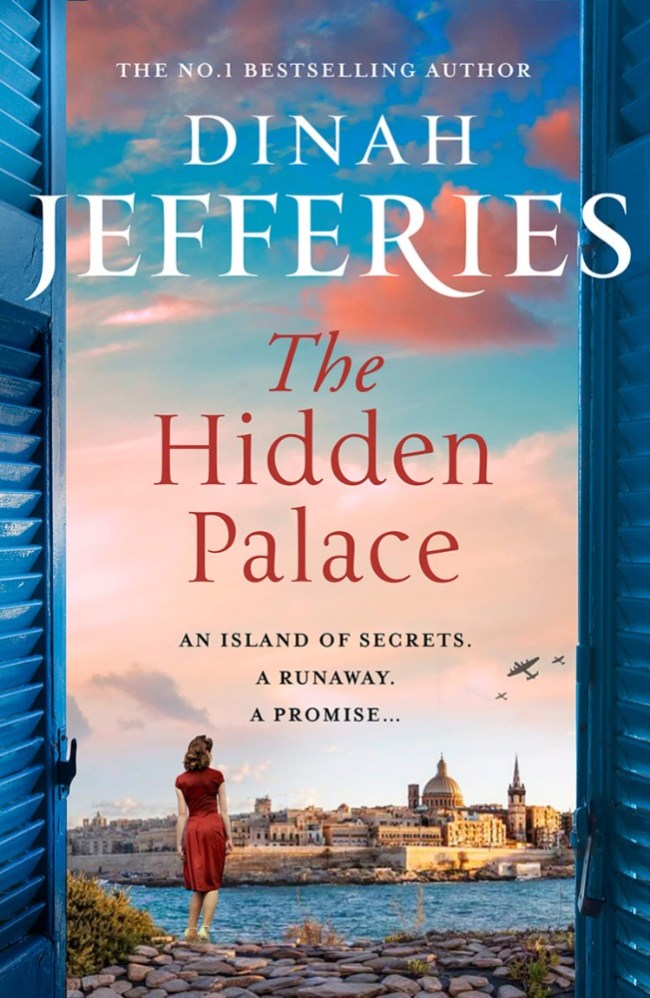
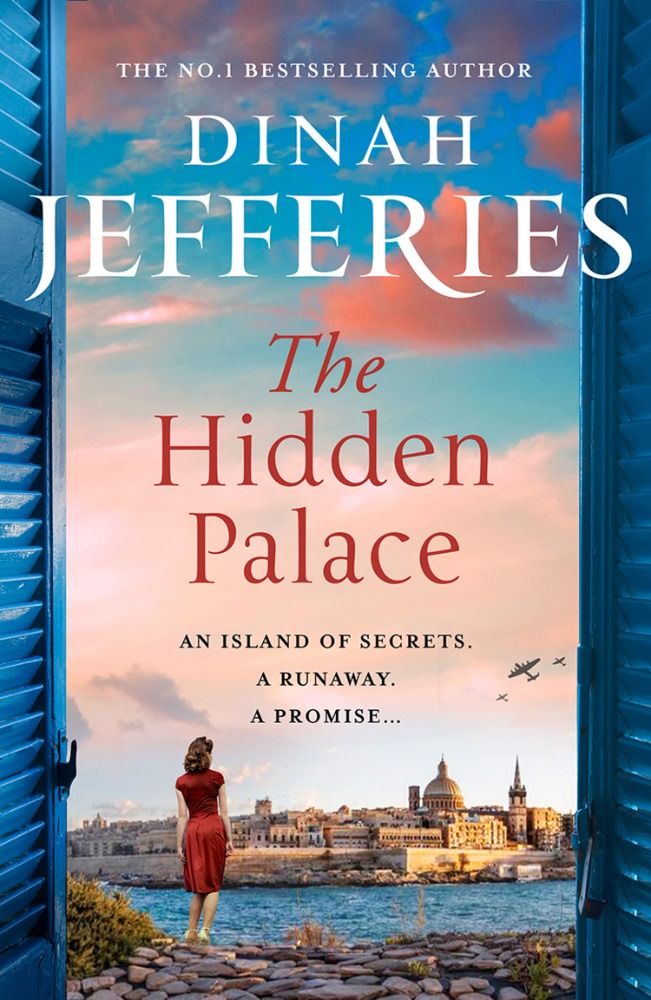
The Hidden Palace by Dinah Jefferies

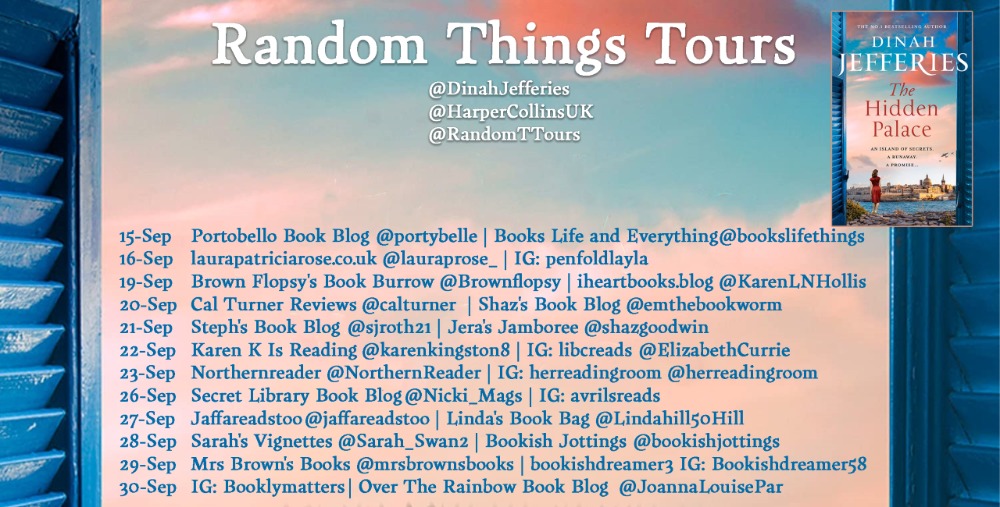
It’s almost a year since I reviewed Dinah Jefferies’ Daughters of War here and I’m such a huge fan of her writing that I’m thrilled to have the opportunity to share my review of The Hidden Palace today. My huge thanks to  Anne Cater of Random Things Tours for inviting me to take part in this blog tour and to Harper Collins for sending me a copy of The Hidden Palace in return for an honest review.

I chose Dinah’s’ The Tea Planter’s Wife as one of my books of the year when I began blogging in 2015, and my review is here.

I interviewed Dinah here about Before The Rains and reviewed The Silk Merchant’s Daughter here with my review of The Sapphire Widow here. I also reviewed Dinah’s The Missing Sisterhere.

The Hidden Palace was published by Harper Collins on 15th September 2022 and is available for purchase through the links here.

The Hidden Palace

A rebellious daughter

  1. Among the ancient honey-coloured walls of the tiny island of Malta, strangers slip into the shadows and anyone can buy a new name. Rosalie Delacroix flees Paris for a dancer’s job in the bohemian clubs deep in its winding streets.

A sister with a secret

  1. Running from the brutality of war in France, Florence Baudin faces a new life. But her estranged mother makes a desperate request: to find her vanished sister, who went missing years before.

A rift over generations

Betrayals and secrets, lies and silence hang between the sisters. A faded last letter from Rosalie is Florence’s only clue, the war an immovable barrier – and time is running out…

My Review of The Hidden Palace

Florence has made it to England.

I didn’t so much read The Hidden Palace as step into the pages and be swept away by it. I thought it was just wonderful. It felt much more like a real life experience than a story.

The Hidden Palace might be set in the 1920’s and 1940’s but my word it has relevance and resonance for today’s world of war and loss. As a result, The Hidden Palace packs a powerful historical and emotional punch as the two stories of Florence and Riva are carefully woven together. The themes here are mature, profound and affecting. Dinah Jefferies looks at how trauma, guilt and loss alter our perceptions of who we are and our behaviours towards others in a compelling story of war, families and relationships. I was so impressed yet again by the quality of her story telling.

In fact, we have met Florence and her sisters before in Dinah Jefferies’ Daughters of War but although that book is wonderful too and I’d urge you to read it, The Hidden Palace stands independently and can be thoroughly enjoyed because just enough back story is included to ensure the reader understands the past of Jack and Florence without ever slowing the interest and pace in this narrative. What I so enjoyed here is that the dynamics between Florence and Jack are foreshadowed by those between Riva and Bobby and yet remain distinct. Equally compelling is the fact The Hidden Palace is true to the difficulties of life and doesn’t find a panacea for every problem facing those between its pages in this brilliantly plotted story.

Dinah Jefferies has an amazing ability to create setting. Her descriptions are so evocative that it is as if the reader is standing alongside her characters. She also weaves in historical with such dexterity that her narrative is utterly convincing, being steeped in historical fact, whilst being the intimate and intense lives of a handful of individuals. This is such immersive and affecting story telling that it is impossible not to be moved and ensnared.

In case it isn’t obvious, I loved The Hidden Palace. It has all Dinah Jefferies’ trademark features of arresting plot, evocatively described place and characters that feel real and vivid and about whom the reader cares deeply. I thought it was a wonderful book and thoroughly recommend it.

About Dinah Jefferies

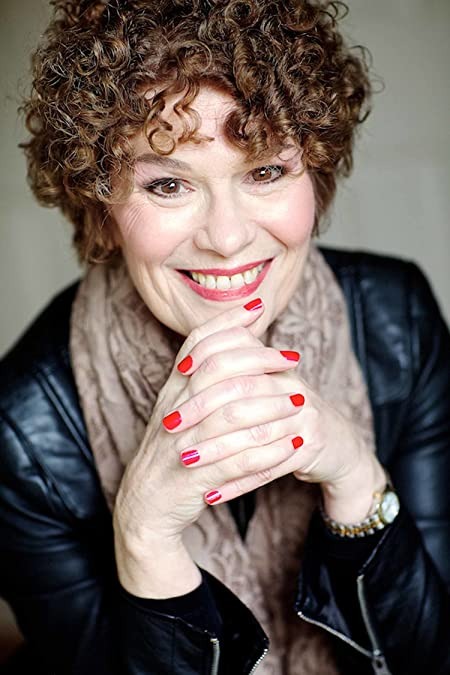
Dinah Jefferies began her career with The Separation, followed by the number 1 Sunday Times and Richard and Judy bestseller The Tea-Planter’s Wife. Born in Malaysia, she moved to England at the age of nine. When she began writing novels, deeply influenced by her Eastern childhood, she was able to return there on annual research trips for each new novel.

With her most recent bestseller, her seventh novel The Tuscan Contessa, she has moved to writing about a European setting for the first time and continues that in this new series.

She is published in 28 languages and over 30 countries and has twice been a Richard and Judy bookclub pick.

You can follow Dinah Jefferies on Twitter @DinahJefferies and visit her web site. You’ll also find Dinah on Facebook.
There’s more with these other bloggers too:

The Big Amazing Poetry Book edited by Gaby Morgan and illustrated by Chris Riddell

I love receiving surprise book post and when The Big Amazing Poetry Book: 52 weeks of poetry from 52 brilliant poets, chosen by Gaby Morgan and illustrated by Chris Riddell dropped into my parcel box I was utterly delighted. I think I probably need to send enormous thanks to Jo Hardacre for sending me a copy.

Published by Pan Macmillan Children’s Books on 29th September 2022, The Big Amazing Poetry Book is available for purchase here.

The Big Amazing Poetry Book

A brilliant introduction to 52 fantastic poets introduced by Roger McGough and illustrated by Chris Riddell. The Big Amazing Poetry Book is a warm, funny collection snd packed with different styles of poetry – ballads, riddles, tongue-twisters, shape poems, haikus, sonnets and raps – about seasons, festivals, animals, birds, love, war, food, fish and football and much more. There are 7 poems and a biography to showcase each poet and stunning line artwork on every page.

Includes poems from: John Agard, Ruth Awolola, Gerard Benson, James Berry, Clare Bevan, Brian Bilston, Valerie Bloom, Liz Brownlee, Steven Camden, Lewis Carroll, James Carter, Charles Causley, Mandy Coe, Joseph Coelho, Dom Conlon, Paul Cookson, Pie Corbett, Shauna Darling Robertson, Jan Dean, Peter Dixon, Julia Donaldson, Carol Ann Duffy, Eleanor Farjeon, John Foster, Nikita Gill, Chrissie Gittins, Martin Glynn, Matt Goodfellow, Sue Hardy-Dawson, David Harmer, A. F. Harrold, Jenny Joseph, Jackie Kay, Ian McMillan, Wes Magee, Roger McGough, Michaela Morgan, Brian Moses, Laura Mucha, Grace Nichols, David Orme, Gareth Owen, Brian Patten, Rachel Piercey, John Rice, Coral Rumble, Roger Stevens, Nick Toczek, Kate Wakeling, Zaro Weil, Colin West and Kit Wright

My Review of The Big Amazing Poetry Book

Seven poems from each of 52 poets.

I don’t really want to review The Big Amazing Poetry Book because the Foreword by Roger McGough says everything I think about this book so eloquently I can match his words. However, here goes:

I always like to comment on the physical quality of children’s books and The Big Amazing Poetry Book is wonderful. The hardbacked version of the book has thick, robust covers that will endure through much handling in home or school settings and under the already attractive cover are the most wonderful illustrations:

Indeed, the illustrations are simply brilliant. The little reading mice become an iterative image throughout, but Chris Riddell’s drawings add a vibrancy and engagement that I thought quite perfect because the pictures draw in children who might not naturally be engaged by poetry or who might find reading more of a challenge. They are are witty, funny, emotional, creative and a real catalyst to inspire children to be creative and artistic. I truly feel that simply turning the pages of The Big Amazing Poetry Book and taking in the drawings and the shapes of the words on the page is inspirational without even reading the biographies of the 52 poets or their poems.

The Big Amazing Poetry Book would be fantastic to use in schools. Partly this is because of the range and variety of poetry and poets from John Agard to Kit Wright, partly because many poetic techniques are exemplified (such as James Carter’s fabulous shape poem Electric Guitars) so brilliantly and partly because the poems cover such a wide collection of topics that the scope for projects, investigation, discussion and independent writing from factual to creative is infinite. As an example, Ian McMillan’s Ten Things Found in a Shipwrecked Sailor’s Pocket would make a fabulous and accessible template for children to create their own poems.

That said, to identify The Big Amazing Poetry Book‘s contents only as an educational tool is to miss the most important aspects of the collection. It is inclusive, entertaining and hugely enjoyable.  Within the pages of the book there is a poem to suit everyone – regardless of age, gender or ethnicity. There are poets here I’d never heard of and poems I hadn’t encountered so that either starting at the beginning of the book, or dipping in and out produces an absolute gem every time. I laughed aloud at Laura Mucha’s Compliments of Shakespeare, for example, and I think any adult might be brought up short by Peter Dixon’s Grown Ups.

The Big Amazing Poetry Book is an utter triumph. Not only do I think every child should have one, I think every home should have a copy too. I thought it was fantastic and recommend it completely. I could not have loved it more. Buy it!

About Gaby Morgan

Gaby Morgan is an associate publisher at Macmillan Children’s Books specialising in poetry, non-fiction and fiction.

Follow Gaby on Twitter @peaplanter and Instagram.

About Chris Riddell

Chris Riddell, the 2015-2017 UK Children’s Laureate, is an accomplished artist and the political cartoonist for the Observer. He has enjoyed great acclaim for his books for children. His books have won a number of major prizes, including the 2001, 2004 and 2016 CILIP Kate Greenaway Medals. Goth Girl and the Ghost of a Mouse won the Costa Children’s Book Award 2013. His work for Macmillan also includes the bestselling Ottoline books, The Emperor of Absurdia, and, with Paul Stewart, the Muddle Earth books, the Scavenger series and the Blobheads series. Chris has been honoured with an OBE in recognition of his illustration and charity work. He lives in Brighton with his family.

For further information, visit Chris’ website, find him on Instagram and Facebook or follow him on Twitter @chrisriddell50

Staying in with Maria Bouroncle

I need to begin this blog post with an apology. I had intended to share my evening in with Maria Bouroncle on Saturday 17th September to tie in with the anniversary of the death of Ingeborg Andersson, the subject of the book I’m hearing about from Maria. Sadly I was hit with a migraine that knocked me out on the Friday and I simply didn’t manage to set it up before a busy weekend. However, we are finally staying in together today, albeit a week late!

Staying in with Maria Bouroncle

Welcome to Linda’s Book Bag Maria and thank you for agreeing to stay in with me. 

Thank you so much for inviting me Linda!

I’m so sorry I’m a week late! 

Tell me, which of your books have you brought along to share this evening and why?

I’ve brought along my debut novel It Came to Me on a Whim – The Story of Ingeborg Andersson, Child Murderess, which is based on real events. I’m very excited to share it with you since it was recently published in English.

Oh congratulations. What can we expect from an evening with It Came to Me on a Whim?

It Came to Me on a Whim tells the story of my great-aunt who killed her three children in a small Swedish village in March 1929.

Crikey. And you say it is based on real events. Tell me more.

The story and what happened that day was a well-kept family secret for seventy years. I stumbled upon it back in 1999, as one of my cousin’s patients asked if we were related to “that old murderess Ingeborg”. We both knew her very well as children, since Ingeborg lived with our grand-mother, but we had no idea she had been married or had any children, let alone three.

Good heavens. What a revelation. 

I was 34 years old at the time and had just given birth to my daughter. I simply couldn’t grasp the news and it wasn’t until my father passed away twelve years later, that my thoughts of Ingeborg resurfaced. I finally decided to ask my relatives what happened, and I began digging through the archives.

That must have been equally fascinating and slightly unnerving. Who was Ingeborg?

Ingeborg was born in 1901. Her parents were farmers, and she was the second to youngest of seven siblings. She went to primary school for six years and when she was 23 years old, she got married to the boy next door, who was a relatively well-to-do farmer. Artur was seven years her senior and seems to have been a modern, kind and helpful man. Pretty soon after their beautiful wedding, they had three children together, two boys, and one girl. But Tor only lived to be five years old. Efraim was three and Lucia was only one year old when their mother killed them.

She must have been a very troubled woman. How on earth did you manage to write about it all?

I’ve tried to capture this troubling story without too many gruesome details. By letting my narrative jump back and forth between different time periods, as Ingeborg’s thoughts probably did, I hope to put the reader inside her mind in order to try and understand her. Despite the rigid structures of the prison, I also wanted to show the kindness of the staff who cared for her.

I’m absolutely mesmerised by the thought of It Came to Me on a Whim Maria. How has the book been received?

As Manil Suri, author of bestseller The Death of Vishnu, puts it:  “Maria Bouroncle takes us deep into a story of real-life murder to show us the humanity – even love – behind the crime. A riveting read – haunting, atmospheric, and ultimately, heart-breaking”.

I have a feeling I’m going to need to read It Came to Me on a Whim very soon! Whilst I contemplate what it must feel like to have a murderer in your family, tell me what else have you brought along and why have you brought it?

It was never my intention to write a book about Ingeborg. However, after years of research to shed light on the tragedy and trying to understand how a woman I’d loved as a child could have committed such a horrific crime, I got truly obsessed with the story. Although, it wasn’t until an old relative passed me the letters she wrote to her husband from prison that I knew I had to put her words on paper. I’ve included these letters in my book and I’ve brought one of them with me today.

What an absolute privilege to see Ingeborg’s handwriting Maria.

After the murders, Ingeborg is taken into custody and the reader follows her journey through court, prison and ultimately, a mental facility. When asked why she killed her children, she simply replies: “It Came to me on a Whim”. Throughout the story, she fights for forgiveness and refuses to lose the love of her life. In one of her first letters to Artur, she writes:

I think about the children all the time and about you but forgive me I didn’t know what I was doing O God if it could be undone.

Will her husband ever answer her prayers and take her back?

Obviously we have to feel sorry for Ingeborg’s children but she must have been a very unwell woman. I’m sure her life would have been very different had she lived in a more supportive and enlightened time.

Ingeborg died on September 17, 1978 at the age of 77. I was 13 years old and had just started high school. I have dedicated my book to her children Tor, Efraim and Lucia, my mother’s cousins. It’s my sincere hope Ingeborg’s story will bring mental health issues into the light.

I’m absolutely mesmerised by what you’ve told me about It Came to Me on a Whim Maria and by Ingeborg’s story. Thank you so much for staying in with me to chat all about it. Let me give Linda’s Book Bag Readers a few more details as I think they are going to be intrigued too:

It Came to Me on a Whim

Set in Western Sweden on a cold Easter morning in 1929, Artur leaves his wife and three children alone for a few hours to go fetch firewood in the forest. When he returns, his world has collapsed.

Suddenly it struck him: the windows had not fogged up as they usually did in the winter when his wife hung up the laundry inside. There was a sour smell and the house was unusually quiet.

“Where are the children?” he asked, receiving no answer.

On opening the door to the bedroom, Artur saw the large, round copper washtub sitting just inside. It was half full of water, and the rest had spilled out onto the floor. The water left in the tub contained traces of vomit.

The story about Ingeborg Andersson was hidden from the world for almost a century. The family drama is now being retold by Ingeborg’s grand-niece, Maria Bouroncle. A compelling and horrifying tale that will grip true-crime fans as Maria’s extensive research and tireless investigation slowly sheds light on her family’s tragedy.

Published by Saga Egmont International in ebook on 19th July 2022, the paperback edition will be available in October. It Came to Me on a Whim is available for purchase on Amazon and from Barnes and Noble.

About Maria Bouroncle

Maria is a Swedish author. An economist by profession, she spent over 25 years in the field of international development before publishing her first novel in 2018. It Came to Me on a Whim has been translated into several languages and is currently used on the Scandinavian Crime Literature course at UCLA University of California in Los Angeles.

The book was inspiration for the short documentary film “The Child Murderess of Vesene” by director Carl Eneroth, which has won numerous prizes, including “Best Documentary Short” in January 2021 at the London Indie Film Festival of 24 Frames.

Maria lives in Washington, DC.

For more information visit Maria’s website, find her on Facebook and Instagram or follow her on Goodreads and LinkedIn.

An Interview with Iain Hood, Author of Every Trick in the Book

It’s a little over a year since I stayed in with Iain Hood to chat with him about his book This Good Book in a post you can read here. Today I’m delighted to host a longer interview with Iain to celebrate his latest book, Every Trick in the Book. My huge thanks to Will Dady at Renard Press for inviting me to participate in this blog tour.

Every Trick in the Book was published by Renard Press on 6th September 2022 and is available for purchase here.

Every Trick in the Book

There’s only control, control of ourselves and others. And you have to decide what part you play in that control.

Cast your eye over the comfortable north London home of a family of high ideals, radical politics and compassionate feelings. Julia, Paul and their two daughters, Olivia and Sophie, look to a better society, one they can effect through ORGAN:EYES, the campaigning group they fundraise for and march with, supporting various good causes.

But is it all too good to be true? When the surface has been scratched and Paul’s identity comes under the scrutiny of the press, a journey into the heart of the family begins. Who are these characters really? Are any of them the ‘real’ them at all? Every Trick in the Book is a genre-deconstructing novel that explodes the police procedural and undercover-cop story with nouveau romanish glee. Hood overturns the stone of our surveillance society to show what really lies beneath.

An Interview with Iain Hood

Welcome back to Linda’s Book Bag Iain. Firstly, please could you tell me a little about yourself?

I was born in Glasgow and grew up in the seaside town of Ayr. I live in Cambridge and have worked in education for more than 30 years. I studied an MA in novel writing at the University of Manchester. My first novel, This Good Book, was published in 2021 by Renard Press, and Renard are now publishing my second novel, Every Trick in the Book.

Without spoiling the plot, please could you tell us a bit about Every Trick in the Book?

Every Trick in the Book is about a family living in north London caught up in the Met Police undercover scandal, and the book’s first plot twist is a freelance journalist taking an interest in the hidden life of the father, Paul. There will be many twists and turns to come.

Sounds brilliant. So tell me, why do you write?

I want to use words to create feelings in readers: feelings of amusement, ease, familiarity, but also feelings of anger, unease and perplexity.

That’s really interesting. When did you realise you were going to be a writer?

Probably at school in the 1980s.

Ouch. That makes me feel old as I was a teacher in the 1980s.

How did you go about researching detail and ensuring that Every Trick in the Book was realistic?

Every Trick in the Book plays games with the reader and, yes, tricks on the reader. Well, you were warned by the title! One of these is to sometimes push suspension of disbelief to breaking point to focus a light on some of the grave and serious absurdities of the undercover surveillance of political groups in the UK. But, it is sometimes said that we live in a world where reality has become immune to satire. There are a few utterly absurd details in the book that I swear I read in my research for the book and are true… as far as I can establish… from, um, the evidence…

I think the truth really is often stranger than fiction!

Which aspects of your writing do you find easiest and most difficult?

I like writing dialogue and it always comes first in the writing. I think I get dialogue to carry a lot of the weight of characterisation in my books. I don’t think I’m quite as good at setting the scene, so I demanded of myself that I do that in intimate detail at key points in Every Trick in the Book.

What are your writing routines and where do you do most of your writing?

Anywhere, and any time I can – I still work full time at another job, so this stems from necessity.

Many authors tell me exactly the same thing! But, when you’re not writing, what do you like to read?

I have two TBR piles: one of books I am reading directly for the way they feed in to my writing, and one for stuff I just fancy reading. At the moment, the first pile is a tottering, dangerously listing three-feet-high tower and the second is a couple of novels and a Bobby Gillespie autobiography.

I think we all know that towering TBR pile…

Every Trick in the Book is your second book after This Good Book. What were the challenges and benefits of following up a successful debut?

Some writers preparing for their second book have told me that their publishers and/or agents have said, “OK, so your first book was like this, now do a similar thing again.” Renard have been supportive of me being a lot more freely creative than that… So I have ended up having recurrent and interlinked characters from the debut, for example, and a similar attitude to a city setting, but I feel very free in all other ways of choosing to tell the story and the themes and ideas I engage with. And even where and when I have linked the two books (and this may continue into a third book), I decided this.

It must feel very supportive to have Renard behind you. 

Every Trick in the Book has a cover that feels quite menacing to me, despite the cheerful red London bus. How did that image come about and what were you hoping to convey (without spoiling the plot please!)?

Renard’s brilliant publisher, Will Dady, also designs the book covers for all Renard publications. I think he’s a genius at this. The cover instantly places you in London.

Oh! I had no idea. I’ll view Will in a completely different light now. You’re right. The setting is instantly recognisable. 

You seem to be exploring Joseph Conrad’s ‘thin veneer of civilization’ in Every Trick in the Book. To what extent would you agree with that statement and why?

Spot on! Conrad’s The Secret Agent was much on my mind during the writing. Not only a novel of spies and a society riddled with deceptions, and people as pawns in their own incomprehensible game of chess, but a great novel of the city – in this case the same city in Every Trick in the Book, London. But there’s a paradox at the centre of all this. The police use surveillance to track protestors, the anti-establishment organisation we follow is called ORGAN:EYES, and they shout “THE WORLD IS WATCHING!” The ultimate paradox is that vigilance is the constant and ineluctable requirement of freedom. Say, for example, you feel there are too many surveillance cameras tracking your every move as you shop. You may decide to be vigilant of this erosion of privacy. But is vigilance itself predicated on equal but opposite surveillance?

That sounds a fascinating premise to explore. It’s made me want to bump up Every Trick in the Book to the top of my TBR Iain.

If you could choose to be a character from Every Trick in the Book, who would you be and why?

This is a brilliant question, and just at the moment, because I have just recently finished the research that goes into the writing and editing, I have a soft spot for a police officer who is high up in Met Special Operations, but because of his demeanour is nicknamed ‘the sarge’. He is the fount of all knowledge and in charge of training officers. He does what a writer does when writing: he tries to keep up with all sorts of reading, no matter how overwhelming this task is.

I’ll look out for him when I read the book. So, if Every Trick in the Book became a film, who would you like to play Paul and why would you choose them?
Dougray Scott can do the right sort of beaten quality I think is needed, and, of course, we already know he’s sort of in the police (from the recent series Crime). But more than this, I would love to see Ashley Jensen as Julia, because everyone loves Ashley Jensen for her warmth and humour, but I also think she could play Julia in the latter part of the plot, with all that she goes through and what we find out about her.

And finally Iain, if you had 15 words to persuade a reader that Every Trick in the Book should be their next read, what would you say?

Someone in the game is playing Every Trick in the Book. Who do you trust?
Brilliant! Thank you so much for your time in answering my questions and all the very best with Every Trick in the Book.
About Iain Hood

(PHOTOGRAPH © JEREMY ANDREWS)

Iain Hood was born in Glasgow and grew up in the seaside town of Ayr. He attended the University of Glasgow and Jordanhill College, and later worked in education in Glasgow and the West Country. During this time he attended the University of Manchester. He now lives in Cambridge with his wife and daughter. This Good Book was his first novel.

You can follow Iain on Twitter @iain_hood.

There’s more with these other bloggers too:

Suspect by Scott Turow

It’s always an honour to open a blog tour and even more so on publication day. Consequently I’m really excited to start off the tour for Scott Turow’s Suspect and would like to thank Rachel Nobilo at Swift Press for inviting me to participate. I’m delighted to share my review today.

Published by Swift Press today, 22nd September 2022, Suspect is available for purchase through the links here:

Suspect

The scandalous new novel from the godfather of the legal thriller.

Lucia Gomez is a female police chief in a man’s world and she’s walked a fine line to succeed at the top. Now a trio of police officers in Kindle County have accused her of soliciting sex for promotions and she’s in deep.

Rik Dudek is an attorney and old friend of Lucia’s. He’s the only one she can trust, but he’s never had a headline criminal case. This ugly smear campaign is already breaking the internet and will be his biggest challenge yet.

Clarice ‘Pinky’ Granum is a fearless PI who plays by her own rules. Her 4-D imagination is her biggest asset when it comes to digging up dirt for Rik but not all locks are best picked.

It’s cops against cops in this hive of lies. And it will take more than honeyed words from the defence to change the punchline and save the Chief from her own cell.

My Review of Suspect

Pinky and Rik have a new client.

When I first began reading Suspect, I really didn’t think I was going to enjoy it because of all the American cultural references, such as police acronyms, that felt quite unfamiliar. However, once I had attuned myself to Pinky’s highly engaging, conversational tone, I thoroughly enjoyed the book and what began as a negative impression actually became one of the strengths of Suspect for me as it transported me completely into a different world that I found both entertaining and educational. In fact, I’d even go so far as to say the American aspects of Suspect became a bewitching setting.

There’s an interesting style here as Suspect feels fresh and modern, with technology playing a significant role in the narrative, and yet the writing feels very much part of the Golden Age of crime fiction, especially as Pinky is a private investigator rather than part of the police. I thought Scott Turow managed this blend very effectively in an increasingly fast paced, exciting and compelling narrative. By the time I reached the end of the story my heart was racing. I loved the way the strands of the plot came together with frequent surprises that made for such an enjoyable read.

Pinky is a complete triumph as a character. She’s multi-layered and complex with a cleverly crafted mix of tenderness and vulnerability that balances her more reckless and determined features. With her dyed, shaved hair, her facial piercing, her bi-sexuality and her tattoos, Pinky defies convention and yet she’s also at the very heart of it with her complex family relationships, her strong sense of what is right and her desire to be loved. Again she illustrates Scott Turow’s incredible skill in providing balance and nuance in his writing. I really hope Pinky will appear again in the future as I’ve rather fallen for her.

I thought it was inspired to give definitions of the word suspect at the start of the book because Suspect truly does explore all the possible versions highly effectively. In addition, Scott Turow considers morality in office, sexual behaviour, corruption, organised crime, revenge, coercion and he uncovers the murky world of crime and those tackling it with complete authority so that Suspect is surprisingly thought-provoking. As well as being hugely entertained by Suspect I was fascinated by it too.

Having begun Suspect wondering if I was going to enjoy the book, I ended up thoroughly enjoying it. Indeed, I’m still thinking about characters like the Chief Lucy and like Pinky because Scott Turow made me believe in them completely. I really recommend Suspect. It’s not my usual genre and Scott Turow has convinced me that I’ve been missing out. Make sure you don’t miss this one.

About Scott Turow

Scott Turow is the author of many bestselling works of fiction, including The Last Trial, Testimony, Identical, Innocent, Presumed Innocent, and The Burden of Proof, and two nonfiction books, including One L, about his experience as a law student. His books have been translated into more than forty languages, sold more than thirty million copies worldwide, and have been adapted into movies and television projects. He has frequently contributed essays and op-ed pieces to publications such as the New York TimesWashington PostVanity Fair, the New Yorker and the Atlantic.

For more information, visit Scott’s website, find him on Instagram and Facebook and follow him on Twitter @scottturow.

There’s more with these other bloggers too:

Ravished by Anna Vaught

My enormous thanks to Dave Borrowdale at Reflex Press for sending me a copy of Ravished by Anna Vaught in return for an honest review. I’m delighted to share that review today.

Published by Reflex Press on 27th September 2022, Ravished is available for purchase here.

Ravished

Ravished, subtitled A Series of Reflections on Age, Sex, Death, and Judgement, is the second collection from Anna Vaught. These are peculiar tales, weird fiction, gothic, unusual, full of literary allusion, threaded through with classical and Welsh reference, occasionally starring the author’s relatives and the Virgin Mary. Sometimes funny, morbid, potentially inspiring, Ravished is both revolting and pretty; both awful and yet optimistic in the stress it places on playful language and the abundance of the imagination. The stories explore revenge, angels, an encounter with faith, death and loss and are full of off-kilter experiences, such as a chat with the holy spirit on a bench, a love story in an embalming parlour, passing the time with the man who’s going to bury you and why you should never underestimate the power of the landscape or the weird outcast you underestimated.

My Review of Ravished

A collection of short stories.

Ravished is astonishingly good. Anna Vaught is an amazing author whose prose vibrates with a mesmerising kind of otherness. I was spellbound by this collection and its exploration of those just outside or on the edges of society – the weirdos of the dedication! I think I could reread Ravished innumerable times and discover something new on each occasion. I learnt new vocabulary, made literary connections from Shakespeare to Dylan Thomas and was simply in awe of the quality of Anna Vaught’s writing. She draws in her reader through a conversational tone, through both rhetorical and direct questions, through allusion and through beautiful, poetic, finely wrought prose that is breath-taking.

Each story is so packed with meaning, so filled with themes of love, sexuality and lust, social hierarchy, identity, menace, death, murder and tenderness in balanced, nuanced and frequently wry or witty observation, that reading each one feels like a very special event. Not for nothing is this collection subtitled A Series of Reflections on Age, Sex, Death, and Judgement. Ravished is not a collection to be rushed or taken lightly, but rather is one to savour and enjoy like a perfect morsel of food or sip of the best champagne. I really did think it was a work of genius. This might be a slim collection of fewer than twenty stories but it took me quite a while to read and appreciate, because of the exquisite tapestry of the writing. The writing cries out to be given the reader’s full attention.

Amongst the other themes, death so permeates these pages, from embalming to burial, murder to suicide that Ravished ought to be dismal and depressing. It if far, far from both. The stories are imbued with a respect for humanity, an honesty and a humour that make it feel as if the author is confiding intimately in the reader. I loved the sense of affinity this creates.

Read Ravished and I promise you’ll be astounded. I thought it was amazing; each narrative is a total treat, and I have placed Ravished straight on my list of books of her year. Oh, and you’ll never view a potato in the same way again – but you need to read Ravished to find out why!

About Anna Vaught

Anna Vaught is an English teacher, mentor and author of several books, including 2020’s Saving Lucia and Famished. Her memoir, These Envoys of Beauty, will be published by Reflex Press in 2023, followed by a novel, The Zebra and Lord Jones.

Anna’s work is published in journals, anthologies and the national press. She is a guest university lecturer, speaks at literary and arts events and is a tutor for Jericho Writers, also working as a volunteer with young people who need literacy support.

Anna is from a large Welsh family and lives in Wiltshire with her American husband and three sons. She works alongside chronic illness and caring responsibilities and is passionate about teh role of creative well being.

For more information, visit Anna’s website, find her on Instagram or follow her on Twitter @BookwormVaught.

Weather: A Guest post by Isaac Thorne, Author of Hell Spring

It’s a true frustration that I haven’t been able to squeeze in a review of Hell Spring by Isaac Thorne as I think it sounds magnificent. However, I am thrilled to share a guest post from Isaac to celebrate the book’s recent publication.

Hell Spring was released on 16th September and is available for purchase through the links here.

Hell Spring

In the twilight of March 21, 1955, eight people take cover in their local general store while a thundering torrent and flash flooding threatens life and livelihood alike. None of the eight are everything they claim to be. But only one of them hungers for human souls, flesh, and blood.

An overflowing waterway destroys their only path of escape. The tiny band of survivors is forced to confront themselves and each other when a peculiar stranger with a famous face tries to pick them off one by one.

Can the neighbors survive the predator in their midst as well as the 100-year flood that drowns the small town of Lost Hollow?

Or will they become victims of the night the townsfolk all remember as Hell Spring?

Weather

A Guest Post by Isaac Thorne

The weather as an antagonist is something that has always fascinated me. Stephen King’s short story The Reach and the miniseries Storm of the Century both explore that a little. As do action thrill rides like the movies Twister and Hard Rain.

When I started writing my new novel Hell Spring during the pandemic lockdowns of 2020, I decided to use severe thunderstorms and flash flooding as a tool of the  primary antagonist. I also chose to use the weather as the secondary antagonist because extreme weather is terrifying. Extreme weather complicit in monsters’ evil deeds is even more so.

Something about the helplessness of being stranded by an event over which you have no control drives me nuts. Although I am not a control freak, I am naturally a problem solver. I go mad if a solution is beyond my means. Or if all I can do is try to be patient until the problem resolves itself.

One problem we seem to have the least amount of control over in this world is the weather. And that can make it scary. Who hasn’t sat in the dark, wind howling and rain pounding outside while the house creaks and groans around them? Who at those times hasn’t felt a twinge of terror? Impending doom? It’s  worse when you can’t see what’s happening. When looking out the window into the storm reveals only a black void full of the wretched screams of insane nature.

On May 1, 2010 ,my Middle Tennessee homeland was devastated by what was at first labeled a100-year flood. Later that day, folks called it a 500-year flood. Still later, it becamea1,000-year flood. An estimated 21 people died from flooding caused by a training storm system that dumped bucket after bucket of heavy rain into swollen waterways. Nashville landmarks like the Grand Ole Opry were put out of business for a time thanks to flood damage. Most famously ,a steel temporary school building was recorded floating down Interstate 24 at Bell Road. Recovery from this disaster took years for many folks.

These days, extreme weather events seem to be daily events. I nearly wrote “normal” in that space, but there’s absolutely nothing “normal” about this weather. In the United States, extreme drought now precedes flooding similar to what Nashville and the rest of Middle Tennessee experienced in 2010. In Pakistan, an August severe flood has cost more than 1,000 lives as of this writing. The evening news and social media are rife with these stories regularly.

But back in 2010, Middle Tennessee residents were forced to launch social media campaigns directed at national news media to get them to pay attention to what was happening. Before that, cable news and other outlets were focused almost exclusively on the BP Deep Horizons oil spill in the Gulf of Mexico. It was like no other information existed.

That lonely helplessness, those feelings of isolation and hopelessness provoked by natural disasters were what I relied upon entrap the citizens of the fictional town of Lost Hollow in their local general store on March 21, 1955. They think the weather is their primary antagonist. Meanwhile, an alluring stranger feeds on human guilt and shame among them. Not only are the neighbors trapped and made helpless by the storm, but they’re also trapped and made helpless against this other entity by their own perceived shortcomings.

The weather event in the novel is fictional. However, some of it was inspired by flooding accounts reported in the pages of The Tennessean newspaper’s March 22,1955 edition as well as a 1961 report on floods and flood control by the Tennessee Valley Authority (TVA). A heavy storm coalesced west of the state on March 20,1955. It ended sometime in the early morning hours of March 22. While over the Midstate, the storm dumped rain from three to eleven inches over a 650-mile length and170-mile width of Tennessee. Flooding records were broken in several areas and nearly broken in others. In southern Middle Tennessee, only 1902 and 1948 rivaled the severity of the flood in the spring of 1955.

My research of the 1955 storm dovetailed with my 2010 experience, and the story from there took on a life of its own. At its heart, I think Hell Spring is a story about people and their hells, the darkness in them that others rarely see. The weather and the external antagonist force them to confront it.

****

What a rich and terrifying source of writing inspiration Isaac. Thank you so much for sharing this with us. Congratulations too on Hell Spring. I think it sounds brilliant.

About Isaac Thorne

Isaac Thorne is a Tennessee man who has, over the course of his life, developed a modest ability to spin a good yarn. Really. He promises. The screenplay adaptation of his short story Diggum from the collection Road Kills is the winner of several horror film festival awards. His previous novel, The Gordon Place, was a finalist in the 2020 Readers’ Favorite Book Awards. The audiobook edition narrated by Sean Duregger won the 2020 Independent Audiobook Awards horror category.

You can find Isaac on Twitter @isaacrthorne, Facebook, and Instagram or find out more on Isaac’s website.

The Last Party by Clare Mackintosh

How can it possibly be more than three years since I read a Clare Mackintosh book? Then I was reviewing After The End in a post you’ll find here. Prior to that I reviewed I Let You Go here.

Today, however, I’m sharing my reviewing of Clare’s latest book, The Last Party and I would like to extend my grateful thanks to Emma Finnigan for sending me a copy in return for an honest review.

Published by Sphere on 4th August 2022, The Last Party is available for purchase through these links.

The Last Party

INTRODUCING DC FFION MORGAN, IN THE UNMISSABLE NEW SERIES FROM #1 BESTSELLER CLARE MACKINTOSH

On New Year’s Eve, Rhys Lloyd has a house full of guests.

His lakeside holiday homes are a success, and he’s generously invited the village to drink champagne with their wealthy new neighbours. This will be the party to end all parties.

But not everyone is there to celebrate. By midnight, Rhys will be floating dead in the freezing waters of the lake.

On New Year’s Day, DC Ffion Morgan has a village full of suspects.

The tiny community is her home, so the suspects are her neighbours, friends and family – and Ffion has her own secrets to protect.

With a lie uncovered at every turn, soon the question isn’t who wanted Rhys dead . . . but who finally killed him.

In a village with this many secrets, a murder is just the beginning.

My Review of The Last Party

Rhys Lloyd is dead.

What an absolute belter of a story. I literally suspected almost every single character in this narrative of having murdered Rhys Lloyd at some point, except for DI Crouch!

The Last Party is superbly constructed and the way in which Clare Macintosh draws the threads of the story together is just brilliant. Of course, her twisty, fast paced technique makes it impossible to say anything about the plot for fear of spoilers for other readers. Let me simply say that I thought The Last Party was a brilliant story and the shifting time frames and perspectives make it a mesmerising narrative that is just fabulous.

I loved the characters too. What Clare Mackintosh does so well is to illustrate in her characters how no-one is perfect, how we all present personas that may not be the truth about who we really are or how we really feel, and how right and wrong can become blurred and inverted. Indeed, The Last Party made my head spin and my concept of morality shift on its axis.

I thought Rhys Lloyd was a triumph. The fact that any one of those around him had reason to want him dead should have made him thoroughly despicable and the more I discovered about him, the more glad I was that he’d been murdered! However, just at the point when Clare Macintosh makes her reader delighted such a man has been murdered, she provides just enough redemption for him to add depth and make the reader question their response. I absolutely loved this aspect of the story. It’s incredibly skilled manipulation of reader expectation.

I could not be happier than to learn that The Last Party is the first in a new series as Ffion Morgan is a rounded, flawed, addictive character about whom I need to know more. I felt her sense of belonging to the local community contrasted so intelligently with her difference from others in it making her thoroughly intriguing and compelling.

The themes underpinning The Last Party are profound. Whilst the story can be read as a highly addictive police investigation into a murder, it also explores identity and fame, family and relationships, various aspects of control and manipulation in a swirling maelstrom of engaging elements. Certainly I was thoroughly entertained by The Last Party, but I was equally moved by some of the relationships and revelations, and left contemplative too. I thought this was brilliant writing.

The Last Party is everything a reader wants in a thriller. It’s twisty, engrossing, and downright cracking entertainment. I thoroughly enjoyed it and think everyone should read it.

About Clare Mackintosh

clare mackintosh

Clare Mackintosh spent twelve years in the police force, including time on CID, and as a public order commander. She left the police in 2011 to work as a freelance journalist and social media consultant and is the founder of the Chipping Norton Literary Festival. She now writes full time and lives in North Wales with her husband and their three children.

Clare’s debut novel, I Let You Go, was a Sunday Times bestseller and the fastest-selling title by a new crime writer in 2015. It was selected for both the Richard and Judy Book Club (and was the winning title of the readers’ vote for the summer 2015 selection) and for ITV’s Loose Women’s Loose Books. It is a New York Times bestseller, with translation rights sold to more than 30 countries.

Her second psychological thriller, I See You, was a number 1 Sunday Times bestseller and Audible’s best selling psychological thriller in 2016. Translation rights have been sold to almost 30 countries.

Clare is the patron of the Silver Star Society, an Oxford-based charity which supports the work carried out in the John Radcliffe Hospital’s Silver Star unit, providing special care for mothers with medical complications during pregnancy.

There’s further information on Clare’s website. You’ll also find her on Facebook and can follow Clare on Instagram and Twitter @claremackint0sh.

Skip to the End by Molly James

My enormous thanks to Team Bookends and Quercus for sending me a copy of Skip to the End by Molly James in return for an honest review. I’m delighted to share that review today.

Skip to the End is published by Quercus and is available for purchase in ebook and hardback here with paperback released on 22nd December 2022.

Skip to the End

Three kisses. Two break ups. One happy ending…

Amy Daniels has a pretty nice life. Her career is on the up, she loves her friends, and she’s about to buy her very own flat. On a good day, Amy could be described as a catch – so why is she perpetually single?

The trouble is, Amy can see something no one else can: the end. As soon as she kisses someone, she knows, in intimate, vivid detail, how their relationship will end. A screaming argument in the middle of the supermarket over milk. An explicit email sent to the wrong address. A hasty escape through a bathroom window on the second date. At the altar – runaway-bride style. There seems to be no end to the unhappy endings.
After years of trying, and failing, to change a pre-written future, Amy has given up. But then she drunkenly kisses three men at her best friend’s wedding and sees three possible endings: two painful, one perfect. The problem is, Amy can’t really remember who she kissed, and worse, what ending belongs to which person – the only thing she knows for certain is that she’s determined to find out…

This novel will have you swirling with first date butterflies, crying with laughter and finally, brimming with joy. The perfect summer read for fans of Lindsey Kelk, Mhairi McFarlane and Sophie Cousens.

My Review of Skip to the End

Amy is looking for The One.

What an absolute treat of a book. Skip to the End is, quite simply, pure unadulterated joy and I loved it.

As an aside, I think Skip to the End would make an ideal study for any aspiring writer of romantic fiction as well as being a wonderful read for lovers of the genre. Molly James achieves the perfect balance of wit and humour, depth and levity, romance and friendship making it absolutely sparkle with pleasurable elements. I finished Skip to the End feeling my life had been made happier by reading it.

The characters are wonderful. Obviously it is Amy, through her first person narrative, who is the most rounded and developed, but I thought every single one from the most minor, to the group of friends at the heart of the story, added something. In fact, whilst Skip to the End is light and entertaining, through the range of characters Molly James adds sufficient depth of theme to enhance reader satisfaction without slowing or marring the sheer pleasure of the narrative. Amy’s Mum, for example, illustrates how, despite her premonitions, the future is never entirely knowable and Jay’s flamboyant nature hides some profound understanding of human nature which is displayed through his perceptive comments to Amy.

The plot is smashing. Of course there will be a happy ending, and of course the reader grasps way before Amy with whom that happy ending will come about, but that just adds to the pleasure of the story because the journey getting to the denouement is charming, pacy, funny and brilliantly entertaining. In fact I finished reading Skip to the End with an enormous, contented sigh and a huge smile on my face. Molly James’ writing lifted my spirits, taught me a couple of things about how I might live my life, and washed away the cares of the world as I was reading. What could be better than that?

Skip to the End is sheer delight in book form. Don’t miss it.

About Molly James

A former magazine journalist, Molly James is the author of 12 escapist novels including multiple bestsellers. Excited to take her writing in a new direction, Molly now brings a twist of magical realism to her heart-based humour, creating worlds the reader will want to return to over and again…

For more information, find Molly on Instagram.

The Other Side of Night by Adam Hamdy

It was a real pleasure to be sent a set of Adam Hamdy’s The Other Side of Night to share with the U3A reading group to which I belong. My enormous thanks to the team at Pan Macmillan for sending them to us. They arrived in time for our July meeting when, in a change from our usual morning meeting, we went out for afternoon tea.

Not everyone has told me their thoughts yet, but there has been a range of comments from those who thought The Other Side of Night was wonderful to others who found it challenging because it doesn’t readily fit an identifiable genre. Sadly I was away on holiday for the last two meetings so it will be October before I hear everyone’s opinions. Today, however, I’m delighted to share my review.

The Other Side of Night is published by Pan Macmillan today 15th September 2022 and is available for pre-order through the links here.

The Other Side of Night

David Asha wants to tell you a story about three people:

Elliott Asha, his son, broken by a loss that will redeem him.

Ben Elmys, a surrogate father and David’s trusted friend, a man who might also be a murderer.

Harriet Kealty, a retired detective searching for answers to three mysterious deaths, while also investigating a man who might turn out to be the love of her life.

Every word David tells you is true, but you will think it fiction . . .

My Review of The Other Side of Night

David has a tale to tell.

I have no idea what I’ve just read. The Other Side of Night does not readily fit any specific genre, being part romance, part literary fiction, part mystery, part police procedural and part sci-fi. I think it’s one of those books that would reward multiple readings so that the full impact of meaning can be explored. The clues for this narrative are threaded throughout but the reader doesn’t know to look for them so that The Other Side of Night feels mysterious and incredibly thought provoking. As soon as I’d finished it, I immediately wanted to read it again because I found it very beguiling.

It’s impossible to say too much about the plot for fear of spoilers, and the reader needs to be immersed in the story fully to appreciate it because it has surprises throughout. At the risk of sounding bonkers, it felt to me as if The Other Side of Night was rather like a sliced loaf of bread. It doesn’t matter which slice you take, it’s still part of the same loaf but each slice is distinct! In my limited knowledge The Other Side of Night put me in mind of string theory, being equally mysterious and tricky to define and it is impossible to guess the outcomes, making for a very intriguing read.

I found the characters intense and almost claustrophobic. The cast is relatively small, creating an edgy atmosphere that I found quite disturbing. I didn’t warm to Harri and yet I was desperate to know how her story ended. I found Ben completely compelling, unsure if he was insane, murderous, innocent, maligned or a complete genius. He captivated me completely.

Interesting characters and compelling narrative aside, however, it is the themes of The Other Side of Night that make it such an affecting read. Adam Hamdy explores grief and identity, truth and right, choice and consequences in an innovative and intelligent manner that leaves the reader educated and wondering just how they may behave in similar circumstances. The Other Side of Night is one of those books that reverberates in the reader’s consciousness long after the final page is read. Indeed, some of Adam Hamdy’s writing is so poetic and beautiful that it entrances as it disturbs.

The Other Side of Night is fascinating, thought-provoking and surprisingly emotional. I think it might divide readers, but it will certainly create a lasting impression and leave them thinking about their own lives with both increased understanding and bewilderment. I think you should read The Other Side of Night for yourself to see if you can articulate thoughts about it more coherently than I can! I thoroughly enjoyed it.

About Adam Hamdy

British author and screenwriter Adam Hamdy works with studios and production companies on both sides of the Atlantic. He is the author of Black 13, a Scott Pearce novel, and the Pendulum trilogy, an epic series of conspiracy thriller novels. James Patterson described Pendulum as ‘one of the best thrillers of the year’, and the novel was a finalist for the Glass Bell Award for contemporary fiction. Pendulum was chosen as book of the month by Goldsboro Books and was selected for BBC Radio 2 Book Club. Prior to embarking on his writing career, Adam was a strategy consultant and advised global businesses in the medical systems, robotics, technology and financial services sectors.

For further information visit Adam’s website, follow him on Twitter @adamhamdy and find him on Instagram and Facebook.