Horatio and the Fear of Dying Audiobook by J.D. Oldenberg

horatio1

I don’t often review audiobooks on Linda’s Book Bag but I am partial to a children’s story so when I was asked if I’d like to listen to Horatio and the Fear of Dying I readily agreed – not least because I seem to have lost so many precious people of late, including my wonderful Dad.

Horatio and the Fear of Dying is a Kickstart project and you can find out more here.

Horatio and the Fear of Dying

horatio1

Once upon a time… a brave boy named Horatio challenged and conquered Death, dawning everlasting life over his Kingdom. But as life and death are in love, one without the other became joyless. Soon, Horatio must mend the cycle he has broken.

Horatio And The Fear Of Dying was inspired by Jim Henson’s 1997 TV adaptation of the famous 1850s Russian Folktale, The Soldier And Death.

My Review of Horatio and The Fear of Dying

Horatio is so worried about dying that he doesn’t enjoy life as much as his sister Rosemary.

Firstly, I want to say how well I felt the music reflected the various events and characters. Happy Rosemary’s pieces are so much lighter than fearful Horatio’s.

Horatio and the Fear of Dying is a really great way to explore and discuss death with children in a non-threatening way. The story has all the characteristics of a traditional fairy story with a mysterious woman, eternal sleep and a magic crystal so that it fits into the conventions children will feel comfortable with.

As an English person, it took me a couple of minutes to attune to the American accent of the narrator but the quality of the story was such that I was soon engaged with the narrative and forgot about the voice telling it to me. I thought the vocabulary was extremely well chosen as there were enough unfamiliar of more challenging words to add a layer of mystery for children without undermining their ability to understand the story.

However, what is most deserving of praise is the tackling of a subject – death – that children can begin to become obsessed by. Through listening to this story in a safe environment with a protective adult a child can ask questions and be reassured so that death is not a taboo and fearful subject. I think that is an admirable approach.

About J.D Oldenburg

JD

J.D. Oldenburg (Jose Diaz-Oldenburg) grew up with an unusually intense fear of death. He didn’t suffer trauma or family member’s death in his early youth, yet as a little kid he often sat with his parents to ask concerned questions about the subject. Conversations about death took place almost every evening. Some nights he understood, some nights he feared.

At the early age of nine, he confronted his anxiety by penning a short tale titled “La Muerte de la Muerte” or, Death of Death. A short story inspired by Jim Henson’s 1997 adaptation of an old Russian Folktale called The Soldier and Death.

In early 2015, La Muerte de la Muerte showed up hidden between old books in the family library and a new idea was born. Horatio and The Fear of Dying would come to life.

Armed with a bachelor’s degree in film, a couple of highly encouraging rejection letters, and seven years of experience in film production and advertising, J.D. felt compelled to bypass traditional publishing and retain full control of the final product. He built his creative team through persistence, trial and error, and craigslist ads. After locking the right artists, they embarked on an almost three-year process to the final creation released now.

J.D. hopes the book will help kids all over the world ease this universal fear and gain a strengthened sense of adventure about life.

J.D. Oldenburg lives in Los Angeles, California.

You can read ,more about J.D. Oldenburg on his website, find him on Facebook and read much more about Horatio and the Fear of Dying here.

Zenka Introducing Zenka by Alison Brodie!

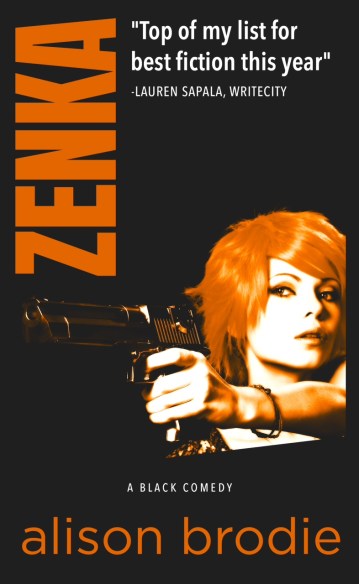
Zenka_Final_Amazon_1535x2500

Here on Linda’s Book Bag I love a wide variety of blog posts but I don’t very often have protagonists introducing themselves so it’s a real treat to meet Zenka today. Zenka features in lovely Alison Brodie’s latest novel, entitled Zenka funnily enough.

I have previously reviewed another of Alison’s books Brake Failure here and Alison herself featured on the blog with a fabulous guest post all about second book syndrome that you might like to read here.

Published on 6th November 2017, Zenka is available for pre-order from your local Amazon site.

Zenka

Zenka_Final_Amazon_1535x2500

Devious, ruthless, and loyal.

Zenka is a capricious Hungarian with a dark past.

When cranky London mob boss, Jack Murray, saves her life she vows to become his guardian angel – whether he likes it or not. Happily, she now has easy access to pistols, knives and shotguns.

Jack discovers he has a son, Nicholas, a male nurse with a heart of gold. Problem is, Nicholas is a wimp.

Zenka takes charges. Using her feminine wiles and gangland contacts, she will make Nicholas into the sort of son any self-respecting crime boss would be proud of. And she succeeds!

Nicholas transforms from pussycat to mad dog, falls in love with Zenka, and finds out where the bodies are buried – because he buries them. He’s learning fast that sometimes you have to kill, or be killed.

As his life becomes more terrifying, questions have to be asked:

How do you tell a mob boss you don’t want to be his son?

And is Zenka really who she says?

Introducing Zenka

A Guest Post by Er, Zenka!

Hello darlinks,

I am Zenka, the fabulous star of Alison Brodie’s book, ZENKA!!!

Linda Book Blagger told Alison to write about me. Vy? Vy should Alison do this? It is ME who must write about ME.

I tell you. From beginning, Alison make big mistakes. She has me as tiny voman in background, but I don’t like that, and I tell her.

She make me a little bigger. But still it is not enough. How can she be so stupid? I am first class character with vit and culture and sexy body. I drill and drill and drill into her head until she sits heavily on chair in front of computer, opens up Flesh and Blood (that vas the title then) and re-writes book. I give her idea that I send letter to my friend in Hungary at the start of each chapter. Clever, huh?

I tell her Flesh and Blood is not good title.  She must call it ZENKA!!!   She doesn’t do exclamation marks but she puts my name on cover. That is good.

Then she must design cover for designer. She vants me walking down London street with my BACK to camera. And the colour is sepia (that means colour of old tea-bag). I am not sepia person. I vant black! I vant orange! I vant a gun in my hand. And I vant the vorld to see Zenka Valentina Varga’s beautiful face!

(Before, the cover had Jack vith his crumpled MacDonald bag face. Who vants to see his ugly mug? (That is my joke, Jack. And hear me talk Cockney?)

Alison thought that vas the end of me. Ha!

She goes on holiday to Barcelona. She is lying on beach bed, vanting to empty brain, thankful to have finished book. Then POW I pop into her head. I tell her to change the end of the story.  She is shocked. But then she sits up and starts thinking about it, and not finding pen in bag, grabs the vaiter by his ankle as he hurries by vith tray of mojitos, and takes his pen. Her husband, Barry, says to forget that bloody book.

Forget that bloody book! He is imbecile. And he vers yellow socks. What sort of REAL man vers yellow socks, huh?

So, Alison gets home and changes the ending. Now I am happy. Alison is not happy. She has to write to 40 blaggers to tell them to delete last book she sent and replace with the new one.

I go now. Alison, I leave you in peace forever. But remember, you think you know me, but you will never know me.

From your loving friend,

Zenka

xxxxxxxxxxxxxxxxxxxxxxxxxxxxxxxxxxxxxxxxxxxxxxxxxxxxxxxxxxxxxxxxxxx

(Well, I don’t know about Linda’s Book Bag readers but I daren’t NOT read Zenka now!)

About Alison Brodie

author-photo

Alison Brodie, an international best-selling author, is a Scot, with French Huguenot ancestors on her mother’s side.

Alison’s book have been published in hardback and paperback by Hodder & Stoughton (UK), Heyne (Germany) and Unieboek (Holland). Alison has now gone “indie” but you can find all her books here.

Find out more by visiting her website or following her on Twitter. You’ll also find her on Facebook. Alison has a Goodreads page too.

A Publication Day Interview with Charles Spencer, Author of To Catch A king

To Catch a King

As a lover of historical fiction, it gives me very great pleasure to be turning my attention to historical non-fiction too today, with a publication day interview with Charles Spencer, author of To Catch A King. I also have my review.

To Catch A King is published today, 5th October 2017, by William Collins, an imprint of Harper Collins and is available for purchase through the links here.

To Catch A King

To Catch a King

Guided by its various twists and turns, To Catch A King tells the story the manhunt for Charles II, following the rebellion that spurred his father’s beheading in 1649. This unputdownable sequel to Killers of the King tells an old story with new eyes, challenging our polarised notions of royalism, nationalism and loyalty.

In January 1649, King Charles I was beheaded in London outside his palace of Whitehall and Britain became a republic. When his eldest son, Charles, returned in 1651 to fight for his throne, he was crushed by the might of Cromwell’s armies at the battle of Worcester.

With 3,000 of his supporters lying dead and 10,000 taken prisoner, it seemed as if his dreams of power had been dashed. Surely it was a foregone conclusion that he would now be caught and follow his father to the block?

At six foot two inches tall, the prince towered over his contemporaries and with dark skin inherited from his French-Italian mother, he stood out in a crowd. How would he fare on the run with Cromwell’s soldiers on his tail and a vast price on his head?

An Interview with Charles Spencer

Welcome to Linda’s Book Bag, Charles Spencer. Thank you so much for agreeing to answer some questions about your writing and To Catch A King in particular.

Firstly, when did you realise you were going to be a writer?

When I was 15 or 16, I wrote an essay on concentration camp poetry that was the turning point for me.  I gained the confidence to believe that I could put words together in a way that others liked.  I edited the school magazine at Eton college (having been arts editor to my precursor, Boris Johnson). I then went straight from Oxford university into TV journalism, and was writing my own scripts from the age of 22.  I had thought about writing books, and the chance to do that was when I wrote to thank a literary agent for a book launch he had hosted for a friend of mine.  The agent wrote back, saying he liked the way I wrote, and he would like to represent me.

Why do you write? 

It is a compulsion.  It’s hard work, it’s solitary, and it’s sometimes exasperating.  But, at the end of the day, holding a new book that you’ve written remains one of life’s more thrilling experiences!

(I think all authors would agree with that!)

To what extent have you used or adapted what you learnt in your early journalistic career in your later books?

I worked for 10 years as a reported for NBC news, of the USA, working for them in 40 countries. Television is impatient and to the point, particularly when your reports are 3-4 minutes long.  There’s no place for wasted words or thoughts.  The story has to be clear and easily digested.  Key points have to be drawn out.  All of that experience was invaluable.  When I write my books, I am keen to tie the words to the images in my mind of what is happening.

Which aspects of your writing do you find easiest and most difficult?

It is a rollercoaster process for me.  There are days when, in research, you want to shout “eureka!” – when you find a nugget that you just know will be in your book.  Then there are times when you realise that the two weeks you’ve spent drilling down into one aspect have been wasted, because the findings are so thin – or perhaps irrelevant. When it comes to writing, I find it quite easy to get words on to the page.  However, I edit at least four times after that, and am always surprised how many rough edges have been left in the previous version.

What are your writing routines and where do you do most of your writing? 

I have no routines, any more.  I used to be much more rigid, but now I do what I can, when I can.  My life is a busy one, and while my writing is extremely important to me, it has to fit in with the rest.

Please could you tell us a little about To Catch A King?

It’s the true story of the future Charles II’s time on the run after his army was defeated by Oliver Cromwell at the Battle of Worcester in September 1651.  If he had been captured, he would have been executed. It seemed impossible to those that were hunting him down that they wouldn’t quickly scoop him up – apart from anything else, he was enormously tall, for the era – six foot three – and so would stand out. He had incredibly close shaves, but ultimately was saved by good luck, brave companions, quick-wittedness, and grit.  I’ve used the eyewitness accounts of those who aided Charles in his escape – a ragbag of peasant farmers, catholic priests and gentry, and royalist army officers, aided by some very strong women.  We see what happened to them, too.  It’s, in the end, the story of one of the greatest escapes in history.

To Catch A King has a cover that partially obscures the portrait of Charles, suggesting an enigmatic and partly unknowable man to me. How did that image come about and what were you hoping to convey? 

I learnt a long time ago that the writer is not the best man to choose his cover: this was taught to me by my publishers!  I loved the cover that the professionals at William Collins (publishing To Catch A King) chose, though.  I think they wanted to convey the “they seek him here, they seek him there” aspect of the book. And you’re right, there is a lot more to Charles II than the womanising pleasure-lover that has come down through history.  He was a very brave man, who inspired love and loyalty in those closest to him.

Your books focus very firmly on history. What draws you to this genre as a writer? 

I’ve always loved history as a subject, and used to read all sorts of history books from when I was a boy.  For me, history is about people watching – we haven’t, as a species, changed very much at all since Stuart times, and so it’s easy to put oneself in the shoes of a character from that era, and guess how it must have been.  I also really enjoy reading history.

How do you choose which era of history to write about?

I’ve written 6 books.  Two of them were on my family home and my family.  The other four were on the Stuarts:  Blenheim: Battle for Europe (a ‘sunday times’ bestseller, which was shortlisted for “history book of the year” at the national book awards in 2005) was written to commemorate the 300th anniversary of the battle of Blenheim – Britain’s first major military victory on European soil in 300 years, since Agincourt.  The more recent three have connected to the English civil wars, which are among the most dramatic moments in this nation’s history.  I kicked off with a biography of Prince Rupert of the Rhine (2007); then had the fortune of my last book, Killers of the King, becoming a Sunday Times bestseller.  It was the tale of what happened to the men who killed Charles 1, once his son unexpectedly returned to claim the throne. Then someone who read that wrote to me out of the blue to ask why nobody had written the story of Charles II’s escape for so long.  I think I enjoy bringing topics that have been semi-forgotten, but shouldn’t be.

You have also written factually about your own history in The Spencer Family as well as Althorp: the Story of an English House. Do you prefer researching facts or the creativity of writing more and why?

I have tried to write fiction, but it didn’t go well.  I am not convinced I have an ear for dialogue!  I do try to give my historical works the pace and energy of fiction, while dealing in facts. Most people who think they don’t like history probably suffered a dull teacher or book when young, and it understandably turned them off.  History not only can be lively – it generally should be!

Your works have clear themes of danger and revenge in a political world. To what extent do you think the lessons of the 1600s are relevant to today’s world? 

One of the things about man is that he rarely seems to learn his lesson.  History can repeat itself.  The 17th century in Britain was a time of great polarisation, particularly over religion and politics – which were, of course, intertwined.  We see the same rigid dogma today,and the same willingness to determine that anyone who doesn’t believe in your world view is beyond the pale.  You only have to look at the sides who are still fighting over Brexit to recognise that.  The same is true in the extraordinarily divided politics of the United States of America.

How do you go about researching detail and ensuring your books are realistic? 

‘time spent in reconnaissance is seldom wasted’, as the army tells its officers.  And I believe solid research is the key.  I am writing history, after all, so the facts must be correct.  The writer part comes with the material being mastered.

When you’re not writing, what do you like to read? 

I only read a few books a year, other than for research.  I enjoy dry humour, and learning something new.  Everything from Evelyn Waugh to Edward St Aubyn, and – in terms of history – there are just so many brilliant historians about right now that I struggle to pick one out.

If you had 15 words to persuade a reader that To Catch A King should be their next read, what would you say?

Charles II’s astonishing time on the run was one of the most dramatic moments in history.

Thank you so much for your time in answering my questions.

My Review of To Catch A King

The future Charles II is on the run.

I rarely read non-fiction and was apprehensive about reading To Catch A King. I needn’t have been, because the vivacity of the writing frequently made me forget that this was a factual book and I became thoroughly absorbed in the narrative elements.

That said, To Catch A King is no sloppy fictionalised romp through the seventeenth century. Each element has been meticulously researched and the quality and extensiveness of the Notes and Bibliography are solid proof of just how much effort has gone in to making To Catch A King an authentic, believable and authoritative account of the events. It’s a period of history about which I thought I knew quite a bit, but I was thoroughly educated and loved the primary source materials included. Also worth mentioning are the excellent quality photographs of the portraits of Charles and those around him.

I was struck by the insight into life in general. I hadn’t previously considered the role of a blacksmith as the greatest source of local information, for example. I found the casual dispensing of life far more disturbing than I had previously considered. Somehow Charles Spencer has brought home to me just how fleeting and perfunctory life then was.

However, for me the greatest enjoyment of reading To Catch A King was the depth of understanding about the man I gained, regardless of his status in life. Charles Spencer explores every element from Charles II’s strategic planning to his need of a clean shirt so that by the time I read of his death at the end of the book I was actually quite moved by his passing.

To Catch A King is a book of elegantly written historical accuracy that brings alive a crucial period of British history. I found it both interesting and engaging.

About Charles Spencer

charles spencer

Charles Spencer was educated at Eton College and obtained his degree in Modern History at Magdalen College, Oxford. He was a reporter on NBC’s Today show from 1986 until 1995, and is the author of four books, including the Sunday Times bestseller Blenheim: Battle for Europe (shortlisted for History Book of the Year, National Book Awards) and Prince Rupert: The Last Cavalier.

You can follow Charles Spencer on Twitter @CharlesSpencerBooks__.

The Perfect Hero: A Guest Post by Victoria Cornwall, Author of The Thief’s Daughter and The Captain’s Daughter

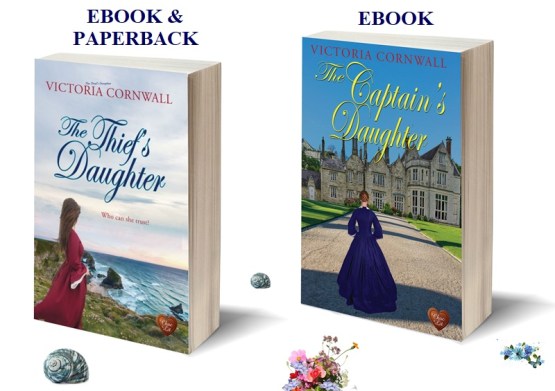
Image of both books

I love the idea of being swept away by a tall, dark handsome hero and so it seems does Victoria Cornwall, author of both The Thief’s Daughter and The Captain’s Daughter! Victoria has written a smashing guest post for Linda’s Book Bag today all about The Perfect Hero and I think I agree with every word she says!

The Captain’s Daughter was published on 3rd October 2017 by Choc Lit and Is available for purchase here. The Thief’s Daughter is available here.
The Captain’s Daughter

The Captain's Daughter

Sometimes you need to discover your own strength in order to survive …

After a family tragedy, Janey Carhart was forced from her comfortable life as a captain’s daughter into domestic service. Determined to make something of herself, Janey eventually finds work as a lady’s maid at the imposing Bosvenna Manor on the edge of Bodmin Moor, but is soon caught between the two worlds of upstairs and downstairs, and accepted by neither, as she cares for her mistress.

Desperately lonely, Janey catches the attention of two men – James Brockenshaw and Daniel Kellow. James is heir to the Bosvenna estate, a man whose eloquent letters to his mother warm Janey’s heart. Daniel Kellow is a neighbouring farmer with a dark past and a brooding nature, yet with a magnetism that disturbs Janey. Two men. Who should she choose? Or will fate decide.

The Thief’s Daughter

The Thiefs daughter cover

Hide from the thief-taker, for if he finds you, he will take you away …
Eighteenth-century Cornwall is crippled by debt and poverty, while the gibbet casts a shadow of fear over the land. Yet, when night falls, free traders swarm onto the beaches and smuggling prospers.

Terrified by a thief-taker’s warning as a child, Jenna has resolved to be good. When her brother, Silas, asks for her help to pay his creditors, Jenna feels unable to refuse and finds herself entering the dangerous world of the smuggling trade.

Jack Penhale hunts down the smuggling gangs in revenge for his father’s death. Drawn to Jenna at a hiring fayre, they discover their lives are entangled. But as Jenna struggles to decide where her allegiances lie, the worlds of justice and crime collide, leading to danger and heartache for all concerned.

The Perfect Hero

A Guest Post by Victoria Cornwall

It’s tough being the perfect hero, just ask any man. The modern man walks an obstacle course made of unspoken rules and expectations which they are continually trying to figure out. These can change daily, depending on the subject, situation, or the woman they are trying to impress. One day taking control is interpreted as a strong male characteristic, on another it’s considered domineering behaviour. Taking a back seat can be viewed as allowing the woman to have control or it could be viewed as disinterest on his part. Is he the strong and silent type or emotionally distant? Has he the confidence to show his vulnerability or is he just plain weak? The only time a man can be assured of being the hero is when they remove a spider … but only if they are asked to do it. Then they can confidently sweep in, capture the hairy monster, show any witnesses present just how monstrous it is, before releasing it into the wild. The man in your life wants to be your hero, he just isn’t always sure what sort of hero you want.

Creating the ideal hero in fiction has the same pitfalls as each reader has their own idea of what he is like. The type of hero may differ depending on what is going on in the reader’s life at the time. Swing too much one way and you lose the reader’s affection, swing too much the other and you lose the reader’s respect.

When I wrote The Thief’s Daughter, I wanted the hero, Jack Penhale, to have all the good qualities of Ross Poldark, the dark brooding looks, the bravery, the tricorn hat that casts a shadow across his handsome face and his capacity to love deeply … so deeply that it dictates his behaviour in a way that may not necessarily be wise. As an antidote to the dangerous situations he finds himself in, I wanted Jack to show a softer side too, without appearing weak. He only shows this side to the woman he falls in love with. I decided to show this side of him through flashes of humour and his occasional, affectionate teasing of Jenna, the heroine. These exchanges mark their relationship as different from the very beginning, for she has already drawn out a side to him he rarely shows to anyone else. Readers may vary in their ideal hero’s looks, characteristics or ability to make sound judgements, but I’m sure that most readers would agree with me that by the end of the book the hero must love the heroine so deeply, it is to the exclusion of all others.

The hero in The Captain’s Daughter is a very special man. I defy anyone not to fall in love with him just a little bit. He is not a man for fancy words and he does not have the skill to charm, but he speaks the truth and his love for the heroine is enduring. He is a man who rarely shows his feelings, yet the love he feels for the heroine is enough to have the power to break his heart if he let it. He is one of the strongest heroes I have ever written and I adore him.

About Victoria Cornwall

Victoria Cornwall. Profile Picture JPG

Victoria Cornwall grew up on a farm in Cornwall. She can trace her Cornish roots as far back as the 18th century and it is this background and heritage which is the inspiration for her Cornish based novels.

Victoria is married and has two grown up children. She likes to read and write historical fiction with a strong background story, but at its heart is the unmistakable emotion, even pain, of loving someone.

Following a fulfilling twenty-five year career as a nurse, a change in profession finally allowed her the time to write. She is a member of the Romantic Novelists’ Association.

You can find out more by following Victoria on Twitter @VickieCornwall, by finding her on Facebook and visiting her website.

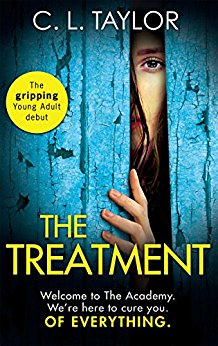
The Treatment by C. L. Taylor

the treatment

Many readers will be thoroughly familiar with C.L. Taylor’s adult fiction and indeed, will remember a fabulous guest post from Cally on Linda’s Book Bag that you can read here from when The Missing was released.  Today, however, thanks to the author herself, I’m delighted to be reviewing the first of C.L. Taylor’s young adult (YA) books, The Treatment.

The Treatment will be published by HQ Young Adult, an imprint of Harper Collins, on 19th October 2017 and is available for pre-order here.

The Treatment

the treatment

“You have to help me. We’re not being reformed. We’re being brainwashed.”

All sixteen year old Drew Finch wants is to be left alone. She’s not interested in spending time with her mum and stepdad and when her disruptive fifteen year old brother Mason is expelled from school for the third time and sent to a residential reform academy she’s almost relieved.

Everything changes when she’s followed home from school by the mysterious Dr Cobey, who claims to have a message from Mason. There is something sinister about the ‘treatment’ he is undergoing. The school is changing people.

Determined to help her brother, Drew must infiltrate the Academy and unearth its deepest, darkest secrets.

Before it’s too late.

My Review of The Treatment

When her brother Mason is incarcerated in the Residential Reform Academy, Drew realises he’s in considerable danger and sets out to try to rescue him.

I thought The Treatment was brilliant. If this is what Young Adult fiction reads like then I need to read more of it. There’s no dumbing down of plot, theme or character in The Treatment; just fabulous writing that engages and enthralls from start to finish.

From opening quite literally with a bang, the plot of The Treatment races along at a breathtaking pace so that I had to put down the book a few times to give my thumping heart a rest. I think it’s because the events are actually extremely plausible and there’s real fear in realising we could easily head towards similar establishments as the Residential Reform Academy. There are surprises along the way so that I was brought up short a couple of times too, adding to the immense enjoyment of this book.

I loved the characters. Each is well defined and so realistic. It felt perfect to see the events through Drew’s eyes, especially when there is the contrast of the more usual events in a teenager’s life, such as her difficult relationships with her peers, against the horror that is the Residential Reform Academy. Even the most minor people add depth and texture to a cast of completely believable people.

However, it was the themes that really hooked me. Our desire to conform, or to make others conform to what we decide is right, bullying, relationships and societal expectations and norms are all thoroughly explored so that not only is The Treatment hugely entertaining as a read, it’s also highly thought provoking.

I’d love to see The Treatment as a film because I have a horrible feeling some adult readers might dismiss it as a YA book not weighty enough for an adult audience, and they would be wrong, but might be hooked by a film and then read an amazing book. The Treatment is a narrative with depth, excitement, brilliantly developed characters and themes that affect all our lives. I really recommend it for all thriller lovers – regardless of age.

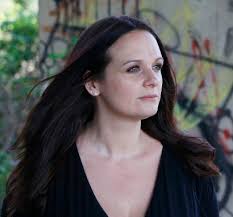
About C. L Taylor

cally

C.L. Taylor studied for a degree in Psychology at the University of Northumbria, Newcastle then moved to London to work as a shipping co-ordinator for a medical publishing company. Made redundant after two years she re-trained and moved to Brighton where she worked as a graphic designer, web developer and instructional designer over the course of 13 years. She currently works 4 days a week as a Distance Learning Design and Development manager for a London university, looks after her toddler son 3 days a week and squeezes in writing her novels when she should be sleeping.

You can follow C.L. Taylor on Twitter and find out more about her on her web site. You’ll also find her on Facebook.

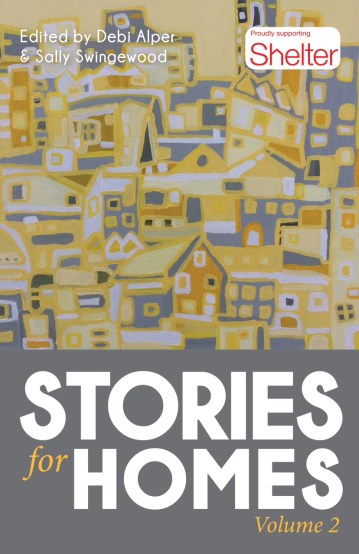
Stories for Homes Edited by Debi Alper and Sally Swingewood

StoriesForHomes2 front cover FINAL RGB

When I was asked by Faye Rogers to be part of the celebrations of Stories For Homes (volume 2) and that the book would support Shelter in response to the Grenfell Tower tragedy I was delighted to help out.

Stories for Homes (volume 2) was published on 28th September 2017 and is available for purchase here.

Stories for Homes

StoriesForHomes2 front cover FINAL RGB

Published and unpublished writers come together to create an anthology of stories about what ‘home’ means.

55 writers are included in a second charity anthology that brings issues around housing, poverty and crisis to life through the power of storytelling. Volume One of the Stories for Homes Project raised over £3K for housing charity Shelter and raised awareness of housing issues.  Volume Two of the anthology includes stories, poems and flash fiction and again all proceeds will be donated to the charity.

My Review of Stories for Homes

Home can mean something different to every single person.

I wasn’t quite sure what to expect in this collection of short stories and I certainly found it an eclectic and varied mix of tales.

What I enjoyed most was the ease with which I could pick up the collection and just read one or two pieces to fit into my busy life. I thought the theme of home was so interestingly portrayed, with home being a place in a person’s memory or imagination as in The Sound of the East Dry River by Matt Barnard just as much as a physical place as in Leigh Forbes Coming Home.

I felt that Stories for Homes opened up to me a completely different world to the one I have inhabited all my (seemingly privileged and sheltered) life with immigration, prison, parenthood and so on all explored between its pages. I did feel quite uncomfortable reading some of the stories because they raised issues that I hadn’t given a second thought to before, and I felt quite guilty.

I was struck by the feeling of desperation and loneliness running through many of the pieces and I have to admit to being completely befuddled by Plastic by Santino Prinzi which I found a very unnerving read! My favourite was I Never Wore A Watch by Jacqueline Ward. I feel there must be home upon home with Annie-like characters who have been wrongly categorised and feel themselves outside society. It made me quite emotional to read it.

Many of the stories are written with great variety so that there is accent, dialect and indigenous language in the direct speech or, in some of them, quite a poetic turn of phrase such as in Motherland by Julie Hayman so that I really feel there is something for every reader to enjoy or to contemplate. I heartily recommend Stories for Homes, not just because by purchasing a copy a really good cause will be supported which is enough incentive in itself, but because there are stories to suit all readers between its pages.

About Stories for Homes

You can find out more about the project on the Stories for Homes website and by following Stories for Homes on Twitter @storiesforhomes. You’ll also find Stories for Homes on Facebook and there’s more with these other bloggers:

Stories for Homes Banner3

An Interview With Obliterati Press

Obliteratilogo

One of the things I try to do on Linda’s Book Bag is support independent authors and publishers as well as feature the bigger publishing houses. Consequently, I’m thrilled to be showcasing Obliterati Press, a brand new independent publisher, today. Run by Wayne and Nathan, I got them both to tell me more about their new venture.

The very first book from Obliterati, Lord of the Dead by Richard Rippon, will be released on 3rd November 2017 and is available for pre-order here.

Lord of the Dead

Lord of the dead

A woman’s body has been found on the moors of Northumberland, brutally murdered and dismembered. Northumbria police enlist the help of unconventional psychologist Jon Atherton, a decision complicated by his personal history with lead investigator Detective Sergeant Kate Prejean.

As Christmas approaches and pressure mounts on the force, Prejean and Atherton’s personal lives begin to unravel as they find themselves the focus of media attention, and that of the killer known only as Son Of Geb…

An Interview with Obliterati Press

Obliteratilogo

Hi Nathan and Wayne and welcome to Linda’s Book Bag. Thanks so much for agreeing to tell me a bit about your fabulous new venture Obliterati Press.

I know you’re both writers so would you mind introducing yourselves first please?

6042e7_9329769cec76466b9d8884703f956af4.jpg_srb_p_960_1284_75_22_0.50_1.20_0.00_jpg_srb

Nathan

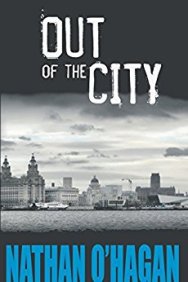
Nathan: I self-published a collection of short/flash fiction in 2013, and my first novel The World Is (Not) A Cold Dead Place was published by Armley Press in 2015, and had far more success than any of us imagined. The lead character, Gary Lennon, really seemed to strike a nerve with people. My second novel Out Of The City came out in February.

out of the city

WLEEMING

Wayne

Wayne: I also self-published some work before Armley Press accepted my novel Justice is Served for publication in June 2016. I like to write in various genres, but writing modern, contemporary fiction and science fiction are definitely where I feel more comfortable. I feel that with science fiction, in particular, comes a freedom to explore philosophical ideas.

justice is served

Why Obliterati as a name?

Nathan: As a music obsessive, I always try and shoehorn musical references into just about  everything. One of my favourite bands, Mission Of Burma, released an album called ‘The Obliterati’ in 2006. As well as the album, I loved the title, and always thought I’d want to use it if I ever started my own press.

How did Obliterati Press come into being?

Wayne: Nathan and I first met during the Leeds Big Bookend literary festival in June 2016 for the launch of my novel within Armley Press’s designated panel appearance. The night before the event, the four Armley Press writers (John Lake – one of the partners of Armley Press – Mark Connors, Nathan and myself) went out for a curry. At some point, Nathan and I got talking about our own ideas concerning publishing and as the subsequent months went by it was something we came back to time and again. We both switched between being really taken with the idea, and being quite intimidated by it. After a while, we decided to conduct some serious research as to how we could go about it on a limited budget. We knew that we each had skills that we could bring together to make a functional partnership, whilst each having a similar taste in writing. We work well together, I think. We make a really good team.

You are a publisher ‘for writers by writers’. How would you define your ethos?

Wayne: We believe that a lot of good writers don’t get the attention they deserve or even the opportunity to get the attention they deserve. As writers ourselves, we know the frustrations and expectations of seeking publication. We want to welcome good writers and create a friendly, collaborative experience. We don’t mind taking a work that isn’t 100% polished as long as we recognise something skilful within it. We’ve got other skills that we can bring to the mix, too, and we want to use these in our ideas for promoting work. We want to spend time creating a finished product that our writers love just as much as we do, whilst also trying to stay aware of what readers want from a book.

If would-be authors wanted to submit a manuscript to you, what would they need to do and what advice would you give?

Nathan: Follow us on Twitter @ObliteratiPress and Facebook for a start. We’re not currently open to full-length submissions, but we’ll announce our submission windows via social media. We’re always open to short story and guest blog post submissions, however, in fact we’d welcome both of those.

Your current authors are all male. Do you believe men write the edgier fiction you’re looking for or is that just coincidence?

Nathan: I think that’s pure coincidence. It’s just how things have worked out for us so far. All we care about is the quality of writing. In fact, when we were setting up, we talked about how we would like to give a voice to minority authors. And that includes LGBTQ, gender non-binary and anyone else. But the most important thing will always be the work.

Wayne: Yeah, it is just coincidence at this stage. I don’t believe that any kind of writing is done best by one sex over another. I’d like a good diverse range of authors, but in terms of submissions, it’s just worked out that we’ve had more from men.

You’re quite outspoken in your views – how do you balance saying what you think and running a business?

Nathan: I try to keep my outspokenness mostly to my personal twitter account rather than the Obliterati one, which I run. Anyone who’s read my work or follows my tweets will know I don’t tend to hold back. But we both have very strong views about politics and current affairs, and I think we’d both like Obliterati to be as much a part of the political conversation as we both are personally. I don’t think it’s necessarily damaging to the business side of things, if anything it helps to give us some kind of identity.

Wayne: Social media, although obviously having negative qualities, definitely has a lot of positive things going for it, and I do believe it has helped galvanise political interest in particular. Despite the fact it gives a forum to abusive trolls, it also provides a forum for people to connect and access information. Obliterati Press is ultimately the product of two people who are outspoken and passionate and it would be impossible, I think, for our opinions and the business to stay utterly disconnected.

You write, blog, you run a website, are active on social media and are setting up in the publishing world. How do you allocate roles and keep all the plates spinning?

Nathan: We had a few long chats about before setting up. We quickly realised that each would have different roles. Wayne has far more technical and design skills than me, so he designed and runs the website. He’s also a very good editor, with a very keen eye, so he also takes the lead on that, with input from myself and the writers, and he takes care of the layout of the books.

My initial job was to find us a couple of writers to get us started, and I drew from the wide circle of writers I’ve got to know online over the years to find Richard Rippon and Dave Olner. I also run the social media accounts, as it’s something I enjoy.

Nathan, I know music has played a very big part in your life. Is there anything in the music world that you can translate into usefulness in publishing?

Nathan: I think both the music and publishing industries have become increasingly risk-averse over the years, particularly since the 2008 financial crash. There’s a sense of playing it safe. That’s something we are in part reacting against, so we’ve perhaps learned how not to conduct ourselves. There are great writers and musicians out there who are talented but are being ignored because they don’t guarantee a financial return. Those writers are who we’re looking for. When it comes to writing, I am almost as influenced by music as literature. I think punk rock is the most important artistic movement of the last hundred years at least, and its principles; not playing by the rules, finding your own identity, having no sacred cows, can be applied to all art forms.

Wayne, I know you give some of your royalties to homeless charities. Why do you choose to do this?

I wrote and self-published my book Generation Rent: The Inequalities in the Private Lettings System after a long string of rubbish experiences with landlords and lettings agents. As an ex-paralegal, I was aware of the fact that so many people out there suffer the injustices associated with tenancies and don’t know their legal rights. The book was designed to openly discuss my own numerous disputes with landlords and letting agents, and to contextualise them with the appropriate legal advice. It seemed right to give something back to campaign and advice groups like Shelter, who I’ve used many times in the past, so I decided to donate all the profits of my book to them.

What are you most excited about for Obliterati Press in the next couple of years?

Nathan: There’s something absolutely thrilling about helping someone to get their book out there, when it may not have happened for them otherwise. In some ways it’s even more exciting than getting published myself. There’s a huge responsibility with that, of course, you’re desperate not to fuck it up. But we’ve got two amazing novels from debut writers which absolutely deserve to be read by as wide an audience as possible, and it’s really exciting to be able to help them achieve that. We’ve got a couple of other things in the pipeline, but we’re really on the lookout for talented writers whose work has so far been overlooked.

Wayne: Opening our first submissions window and seeing what we get. There’s a particular excitement you get from reading a manuscript that stands out. And that’s a feeling I’m looking forward to feeling again.

Good luck to you both with Obliterati Press and thanks for being on the blog to tell us more about it.

About Obliterati Press

Obliteratilogo

Obliterati Press is an independent publishing company set up by writers, for writers. You can follow Obliterati on Twitter and find them on Facebook. For more details and to find out when and how to submit manuscripts please visit the Obliterati website.

Why I Choose to Write for the Self-Help Genre: A Guest Post by Shelley Wilson, Author of How I Motivated Myself to Succeed

How I MMTS

You know when you meet an author and they are even better in real life than you imagined? More beautiful inside and out? Well Shelley Wilson is EXACTLY like that, so I’m utterly delighted to be supporting the release of her latest book How I Motivated Myself to Succeed. If you don’t know Shelley and would like to meet her vicariously, you can read my interview with her here. 

Whilst I still have some of Shelley’s fiction on my TBR, I have reviewed another of her books, Motivate Me! Weekly Guidance for Happiness and Wellbeing here.

Shelley’s latest book, How I Motivated Myself to Succeed was published on 22nd September by Hillfield Publishing and is available for purchase in eBook and paperback on Amazon UK and Amazon US.

 How I Motivated Myself to Succeed

How I MMTS

If you’ve ever felt like life is passing you by at a startling rate, or you just exist day to day rather than living life to the full, this book will share honest, straightforward, and realistic techniques to help motivate you to make powerful changes.

From setting goals and organising your life, to freeing yourself from fear, Shelley shares the unique story of how she planned, prepared, and executed the year of challenges and life-changing events brought about by her motivational, award-winning blog.

How I Motivated Myself to Succeed is full of practical tips, exercises, and real-life stories of success, including advice on how to trust yourself and celebrate achievements, as well as manage your time and balance your life effectively.

Shelley’s first book, How I Changed My Life in a Year, became a bestseller in self-help and memoir as it struck a nerve with the thousands of women looking to make a difference and be the best they could be.

Dubbed as the sequel-that’s-not-a-sequel, this book can be enjoyed before or after reading How I Changed My Life in a Year.

Why I Choose to Write for the Self-Help Genre

A Guest Post by Shelley Wilson

There has been a substantial rise in sales of self-help titles year on year with additional help from the adult colouring book boom of 2015. In the United States, the self-help industry is worth an estimated $11 billion, and the personal development market is expected to continue growing by approximately 5% each year.

I didn’t know any of this when I trained as an alternative therapist and started my holistic health spa for women. I had no idea that self-help books were so popular even though I had read hundreds over the years. I also didn’t appreciate the supportive community involved in self-help until I published my first book.

For me, it was personal. I survived an emotionally and physically abusive marriage by finding the strength to walk away, taking my three young children with me. Life was bleak for a long time but I never gave up hope. Self-help books became my therapist, the authors my mentors, and eventually, I was able to utilise the things I’d learned and turn my life around.

Training in Reiki healing, reflexology, emotional freedom technique, and meditation began as a journey of self-recovery. Only when I began to heal myself could I help others.

Life

Writing my first self-help book happened by accident. It was based on a series of challenges I set myself in a bid to show my clients that they could be the best they could be. How I Changed My Life in a Year was part self-help and part memoir. It was a very personal story, but this resonated with so many of my readers and the messages I received were beyond anything I could imagine.

“I wanted you to know that I have just finished your book and found it inspiring. I have recently been wanting to change my path and my whole outlook on life. As a survivor of childhood sexual abuse it has taken me a very long time to find my own self-worth (I’m 40 now), but through my children, my husband, and counselling I am stronger and better than that. I guess what I’m trying to get at is that your book has inspired me to reach higher and take my next step…so thank you for that.” Name supplied.

“Hi, I just wanted to say a huge thank you for your book ‘How I Changed My Life in a Year.’ I’ve read it in two days flat and have enjoyed every second of it – so much of the book I could personally identify with and although I’ve been through the mill and the upshot now is that I’m in a wheelchair, but I’m doing a degree in English Lit and Creative Writing, and your book has helped me rationalise a lot of my fears. Thank you again.” Name supplied.

I have always believed in walking the walk, and talking the talk. I could never recommend a therapy to my clients if I hadn’t experienced it for myself. How could I convince a lady with anxiety and depression that meditation would be hugely beneficial for her mental health if I didn’t meditate myself? Would a client suffering from M.E ever believe that lying on a couch covered in needles could help balance flagging energy levels unless I could tell them about my own regular acupuncture sessions?

I may have initially stumbled into writing self-help, but now it feels like home to me. Writing books that help inspire and motivate readers by sharing my personal journey is my way of paying it forward. I learned so much from other personal development authors, teachers, and mentors, and keeping this knowledge to myself is just not possible.

I choose to write self-help so that I can continue to support as many people as possible. If I also continue receiving wonderful messages from my readers and knowing that I’m helping women (and men) across the world then I know I picked the right genre.

I’d like to finish with a huge thank you to my lovely friend and host, Linda. Thank you for reading and be sure to check out the other host spots for more inspiration, motivation, and a sprinkle of fun.

Shelley – it’s my absolute privilege and pleasure to host you on Linda’s Book Bag.

Blog Tour Banner for Shelley Wilson HIMMTS

If you would like to read more about Shelley’s self-help work then take a look at her new release, How I Motivated Myself to Succeed, out now in paperback and eBook, and packed full of information on self-care, freeing yourself from fear, organising your life, and much more.

About Shelley Wilson

shelley

Shelley is a multi-genre author of non-fiction self-help and young adult fantasy fiction. Her latest release, How I Motivated Myself to Succeed is being dubbed as the sequel-that’s-not-a-sequel to her bestselling book, How I Changed My Life in a Year. She writes a personal development blog (www.motivatemenow.co.uk) as well as an author blog (www.shelleywilsonauthor.com) where she shares book reviews, author interviews, and random musings about writing. Shelley was thrilled to win the Most Inspirational Blogger Award at the Bloggers Bash in 2016, and to scoop second place in the same category in 2017. She is a single mum to three teenagers and a black cat, loves pizza, vampires, and The Walking Dead, and has a slight obsession with list writing.

You can find out more about Shelley on her author blog or via her personal development blog. You can also follow Shelley on Twitter @ShelleyWilson72 and find her on Facebook and Instagram.

There’s more with these other bloggers too:

Blog Tour Schedule - HIMMTS

Finding The Right Story: A Guest Post by Apple Gidley, Author of Fireburn

Fireburn

It gives me enormous pleasure to welcome Apple Gidley to Linda’s Book Bag today to celebrate the publication of her novel Fireburn. April has written a wonderful post for today’s blog outlining some of her journey to publication that I think will resonate with authors and readers alike. I’m sure, like me, readers will have watched with horror the devastation in the Caribbean recently as a result of the hurricanes. With Fireburn set in the Caribbean and with an historical era explored, there’s no better time to read it.

Fireburn was published yesterday, 1st October 2017, and is available for purchase here.

Fireburn

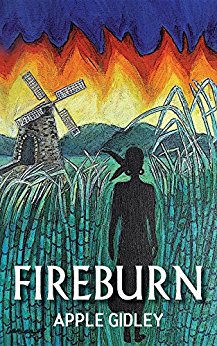
Fireburn

The Danish-owned island of 1870s Saint Croix vibrates with passion and tension as Anna Clausen, a young Anglo-Danish woman, returns to her childhood home after her mother’s death. Her heart sinks at what she finds on arrival. Her father is ailing and desolate and her beloved plantation, Anna’s Fancy, which has been in the Clausen family for three generations, is in shambles.

The unwelcome lust of one man and forbidden love for another makes Anna’s return to Saint Croix even more turbulent. Despite the decline in the sugar industry she is determined to retain Anna’s Fancy but must first win the trust of her field workers, of Sampson the foreman, and the grudging respect of Emiline the cook and local weed woman.

Fireburn tells of the horrors of a little-known, bloody period of Caribbean history. Anna weathers personal heartache as she challenges the conventions of the day, the hostility of the predominantly male landowners and survives the worker rebellion of 1878, 30 years after Emancipation.

Rich in description, Fireburn is a well-researched novel that shines a light on a historic period in Saint Croix that has received little attention in literature until now.

Finding The Right Story

A Guest Post by April Gidley

I have been posing for a number of years as ‘a writer’ – that’s what I put on those inquisitive government forms. And yet, had it not been for a supportive spouse I doubt I would have been able to afford a garret apartment anywhere, let alone in Paris, New York or London. Isn’t that where writers and artists flee to find themselves?

The impetus to take on that presumptive moniker came after I gave a closing key-note speech at the 2010 Families in Global Transition conference, www.figt.org. The topic was my itinerant life – 26 relocations through 12 countries. As I glowed in the after-speech aura of goodwill I took in the refrain, ‘you should write the stories down’. And so, Expat Life Slice By Slice was born. A memoir of countries and cultures from the cradle to not quite the grave.

expat life

I had been advised that no publisher would look at me if I did not have a credible platform and so I started a blog, wrote the occasional travel or expatriate article, and tried to hone my skills. Each professional edit improved my writing. I started to read a number of ‘how-to’ books but finished only one, Stephen King’s On Writing.

Summertime Publishing took the manuscript on and in April 2012, Slice By Slice was launched. It was comforting to know I already had an audience – those about to experience expatriate life, those who were in expat land and old lags like me who knew nothing else. People were eager for true confessions of how not to do things, and a few guidelines on good practices.

Yesterday marked the release of Fireburn, my debut novel set in the 1870s Danish West Indies – now the US Virgin Islands. And whilst OC Publishing, has been equally patient both with the editing and the publishing process, my stomach has not benefited from the relative sangfroid of the first experience.

And I have been wondering why.

Fireburn is not my first actual novel, and whilst the Beta readers of that first manuscript were encouraging, I knew it was not worthy of publication. I still believe the kernel is good and one day I might go back to it. But I learnt a lot writing it – about plot, character, dialogue and voice, and that I had the discipline to write a full length book.

I just had to find the right story.

Then in 2013 I was at a ceremony on the beautiful Caribbean island of St Croix, celebrating the transfer of the Danish West Indies to a US possession in 1917, for the sum of 25 million dollars in gold coin. Much was being made of the centennial four years hence. Sitting under the marquee, the trade winds ruffling programmes and straw hats, my mind started to wander. What, I wondered, had it been like in the lead up to the purchase?

The seed was sown and three of the main characters danced in. Each would give their own perspective of the same event – the transfer of power between two countries. I started the research the next day, and very quickly became aware of ‘Fireburn’, also known as The Great Trashing. My focus changed and Fireburn became the event around which my characters coalesced. And I added a fourth.

That research has been fascinating. People, far more knowledgeable than I, have been generous with their help and suggestions. I like my characters, though one I hold in deep and vitriolic loathing. And yet, and yet, the collywobbles are still here.

My bottle of wine analysis is that Fireburn, the book, is a story based on an actual event around which fictitious lives revolve. They despair, they fear, they hate, they love and they all come from my imagination.

That is what is terrifying me. Will people like my story? My make believe.

Every writer wants their story to be read, to be talked about, to be liked. We all dread the bad reviews, though recognise we will all get one, or two, or more, at some stage. That is why I am a million little fragments waiting to explode in a shower of shattered dreams if the pundits damn me and my book.

I comfort myself with an old Bantu proverb told to me during an attempted coup d’etat by a wise Ghanaian man I knew in Equatorial Guinea. He said, ‘smooth seas do not make skilful sailors’.

And so while the jury is out, I have put my blinkers on and have started the sequel – Transfer of the Crown. I am writing under the assumption that I can only improve with each attempt.  

Isn’t that all we can hope for?

(It is indeed Apple. And I wish you every success with Fireburn.)

 About Apple Gidley

apple gidley

Apple Gidley, an Anglo-Australian author, whose life has been spent absorbing countries and cultures, considers herself a global nomad. She currently divides her time between Houston, Texas and St Croix, in the US Virgin Islands.

She has moved 26 times, and has called twelve countries home (Nigeria, England, Malaysia, Singapore, Australia, Papua New Guinea, The Netherlands, Trinidad and Tobago, Thailand, Scotland, USA, Equatorial Guinea), and her experiences are described in her first book, Expat Life Slice by Slice.

Her roles have been varied – from magazine editor to intercultural trainer, from interior designer to Her Britannic Majesty’s Honorary Consul. Now writing full time, Apple evocatively portrays peoples and places with empathy and humour, whether writing travel articles, blogs, short stories or full-length fiction.

You can find out more about Apple on her website and by finding her on Facebook or following her on Twitter @ExpatApple.

Snow Sisters by Carol Lovekin

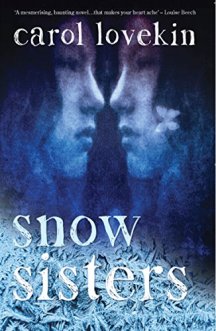
Snow Sisters

I’m delighted to be part of the launch celebrations for Carol Lovekin’s second novel after Ghostbird, Snow Sisters. Carol has always been very supportive of Linda’s Book Bag, despite the fact that Ghostbird, her first novel, is STILL sitting on my TBR pile, and I’m delighted to feature her here today. As I’m married to a Welsh man it makes it even more special that Honno is a Welsh publisher too!

snow sisters blog tour poster2

Snow Sisters was published by Honno on 21st September 2017 and is available for purchase here.

Snow Sisters

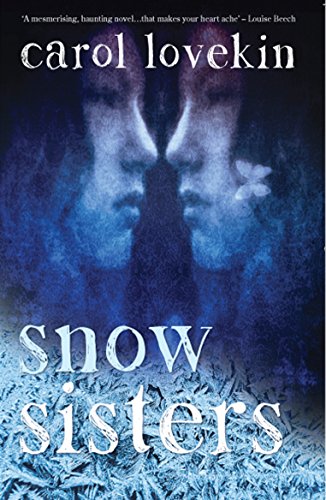
Snow Sisters

Two sisters, their grandmother’s old house and Angharad… the girl who cannot leave.

Meredith discovers a dusty sewing box in a disused attic. Once open the box releases the ghost of Angharad, a Victorian child-woman with a horrific secret she must share. Angharad slowly reveals her story to Meredith who fails to convince her more pragmatic sister of the visitations, until Verity sees Angharad for herself on the eve of an unseasonal April snowstorm.

Forced by her flighty mother to abandon Gull House for London, Meredith struggles to settle, still haunted by Angharad and her little red flannel hearts. This time, Verity is not sure she will be able to save her…

My Review of Snow Sisters

Gull House holds secrets and an attraction that those who live there cannot leave behind.

I really don’t want to review Snow Sisters by Carol Lovekin as I know I have too inadequate a vocabulary to do it justice. I found Snow Sisters absolutely mesmerising. There’s an ethereal quality to the writing that is beautiful, poetic and heartbreaking. The different layers of mystery as past and present mingle are so wonderfully constructed that reading Snow Sisters is like having a magical spell woven about you so that all time and place diminishes and you find yourself completely transported to Gull House.

Carol Lovekin explores the complex relationships between women, between sisters and between families in a way that is intimate, soulful and brutally honest. At times I found reading Snow Sisters almost too much to bear because Carol Lovekin conveys love and hate, loyalty and betrayal with almost visceral emotion and with a passion that invades the soul. At the same time, however, there’s also a fleeting purity to some of the moments so that they reflect the transient nature of the snow in the title.

I thought the characterisation was outstanding. Although Allegra needs empathy I hated the way she behaved. I wanted to shake her. My heart broke for Meredith as she dealt with Anghared. Even Gull House is as much a character as the people with its magical woods and blue garden.

I loved everything about Snow Sisters: its Welshness, its characters, its setting and its themes. I found the writing exquisite and when I’d finished it I felt as if a snowflake crystal will be forever lodged in my heart to remember it by.

I cannot praise Snow Sisters highly enough. My life has been enriched by this wonderful, enchanting book and I urge you to let it into your life too.

About Carol Lovekin

Carol Lovekin

Carol is a writer, feminist and flâneuse. Her home is in beautiful West Wales, a place whose legends and landscape inform her writing. She writes contemporary fiction threaded with elements of magic.

Ghostbird, her first novel, was released on 17th March 2016. The book was chosen as Waterstones Wales and Welsh Independent Bookshops ‘Book Of The Month’ for April 2016. It was longlisted for the Guardian ‘Not the Booker’ prize 2016 and nominated for the Guardian Readers’ Book of the Year 2016. Snow Sisters is her second book.

You can follow Carol on Twitter @carollovekin, visit her website and find her on Facebook.

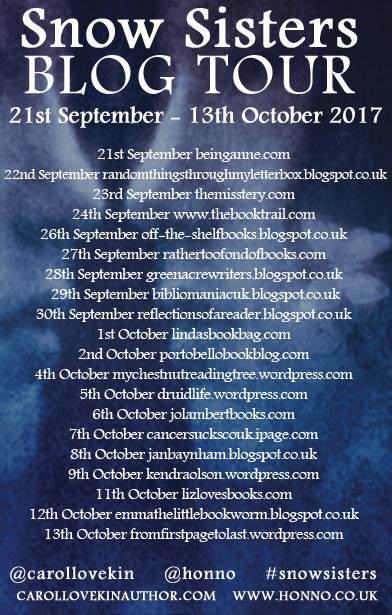
You can follow the blog tour too:

poster