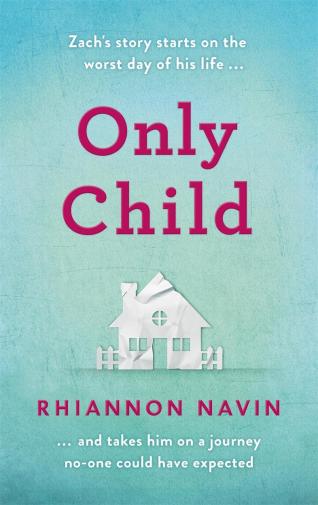
Only Child by Rhiannon Navin

poster

I’m absolutely delighted to be part of the launch celebrations for Only Child by Rhiannon Navin and would like to thank Jess Duffy at Pan Macmillan for inviting me to participate.

Published by Mantle, an imprint of Pan Macmillan, Only Child is available for purchase here.

Only Child

poster

We went to school that Tuesday like normal.
Not all of us came home . . .

Huddled in a cloakroom with his classmates and teacher, six-year-old Zach can hear shots ringing through the corridors of his school. A gunman has entered the building and, in a matter of minutes, will have taken nineteen lives.

In the aftermath of the shooting, the close knit community and its families are devastated. Everyone deals with the tragedy differently. Zach’s father absents himself; his mother pursues a quest for justice — while Zach retreats into his super-secret hideout and loses himself in a world of books and drawing.

Ultimately though, it is Zach who will show the adults in his life the way forward — as, sometimes, only a child can.

My Review of Only Child

A school shooting has repercussions that reverberate throughout the community and especially the life of Zach.

That’s it. I am officially broken. I’ve found it difficult to shake off the total feelings of devastation, grief and, yes, hope, as a result of reading Only Child.

Let me be honest. I don’t much like children. I’m never very keen on children as protagonists and I usually find their appearance contrived or unrealistic. I avoid books where they play too great a role.

And I am utterly wrong.

Zack in Only Child is sheer perfection. He has wrapped his fists round my heart and I am not going to forget him. The manner in which Rhiannon Nevin conveys Zach’s innocence and his wisdom is nothing short of genius. He is completely and utterly real so that it is impossible not to be caught up inescapably in his story.

I found Only Child gut-wrenchingly emotional. I was so glad the chapters were short as I had to keep stopping for a break as I couldn’t tolerate the intensity of the emotions it created in me. I experienced the grief of Zach’s family. I experienced deep love. I experienced white hot rage. I think the fact that I read Only Child just after the latest totally futile shooting of children in America made me feel every moment, every nuance so that I wish all those in favour of guns would read it too. Whilst Rhiannon Nevin illustrates the absolute devastation such events have on those left behind, she does so without sentimentality, but rather lays bare the very souls of those affected. So powerful is her writing that I felt I had lost Andy myself.

The reverberations in the aftermath of a school shooting are poignantly and acutely displayed. The breakdown in relationships, the family dynamics and interactions, the response of the media and society, the desire for revenge and the need for forgiveness are flawlessly explored so that I experienced every moment first hand and not just as a reader one space removed.

I finished Only Child through a blur of unstoppable tears, mirroring those of the characters between its pages. I applaud Rhiannon Nevin for her utterly beautiful, heart rending and impassioned writing. I’ve not encountered anything quite like it. I cannot express what an important, moving and terrifyingly too familiar story this is. We all need to read Only Child and campaign to stop the madness.

About Rhiannon Navin

rhiannon

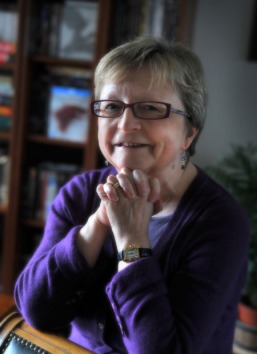
Rhiannon Navin grew up in Bremen, Germany, in a family of book-crazy women. Her career in advertising brought her to New York City, where she worked for several large agencies before becoming a full-time mother and writer. She now lives outside of New York City with her husband, three children, two cats, and one dog.

Only Child is her first novel.

You can follow Rhiannon on Twitter @rhiannonnavin and visit her website. You’ll also find Rhiannon on Facebook and Goodreads.

There’s more with these other bloggers too:

Actual poster as opposed to cover

Staying in with Anne Stormont

Displacement Cover MEDIUM WEB

I’m so thrilled to be staying in with Anne Stormont today because I feel as if I’ve ‘known’ Anne forever. She has been such a wonderful supporter of Linda’s Book Bag that I’m delighted to welcome her here today.

If you’re an author who’d also like to stay in with me to tell me about one of your books, please click here for more details.

Staying in with Anne Stormont

Welcome to Linda’s Book Bag, Anne. Thank you for agreeing to stay in with me as I feel I’ve known you for ever.

Which of your books have you brought along to share with me and why have you chosen it?

I’ve chosen Displacement. I chose it as I still feel very close to it and its characters. This could be because I’m currently writing its sequel, Settlement. And I’d like to introduce readers of this blog to the main characters Rachel and Jack and their story.

(Brilliant – so blog readers can soon get their hands on two books featuring Rachel and Jack.)

What can we expect from an evening in with Displacement?

You’ll be transported to the beautiful and wild landscape of the Isle of Skye and then to the heat and edginess of the contested land of Israel-Palestine.

(Crikey – that’s some journey!)

You’ll spend time with former Edinburgh policeman Jack, and with children’s book writer, illustrator and crofter Rachel. And you’ll follow the growing relationship between this – on the face of it – mismatched pair.

The supporting cast should prove good company too. They include Jack’s six-year-old granddaughter Poppy, and Rachel’s good friend, Morag, who are keen to see Jack and Rachel get together. Then there’s Jack’s friend and sometime lover, Bridget, and Rachel’s Israeli suitor, Eitan, who’d like to keep them apart.

Because the theme of the book is displacement, you’ll be prompted to think about certain political issues such as the plight of refugees and the consequences of war, but you’ll also be confronted by personal issues such as bereavement and divorce. All-in-all you can expect an emotional and hopefully heart-warming time in two relatively unusual settings – from a book that’s probably best described as contemporary fiction in the romance-plus genre.

(I love the sound of Displacement Anne. I think it sounds a perfect book for me.)

What else have you brought along and why?

Two things:

Talisker

I’ve brought a bottle of Talisker malt whisky from the distillery on Skye. This is a favourite drink of Jack’s and I’m rather partial to it myself. I’ll pour us a wee dram each and we’ll say the Scots Gaelic toast – Slainte Mhath (pronounced slanje va) which means Good Health –  before enjoying this smoky, peaty flavoured amber liquid.

(I’m not a big spirits drinker Anne but this does sound delicious.) 

And I’ve also brought along some delicious Middle-Eastern snacks. There are olives, homemade hummus and falafels and some tasty bread. They actually go rather well with the whisky. Enjoy!

Middle Eastern snacks1

(Now you’re talking. I love Middle-Eastern food!)

Thanks so much for staying in with me to tell me all about Displacement Anne. It sounds a wonderful read.

Displacement

Displacement Cover MEDIUM WEB

A story of love, courage and hope

Divorce, the death of her soldier son and estrangement from her daughter, leave Hebridean crofter, Rachel Campbell, grief stricken, lonely and lost.

Forced retirement due to a heart condition leaves former Edinburgh policeman Jack Baxter needing to take stock and find a new direction for his life.

When the two of them meet in dramatic circumstances on a wild winter’s night on the island of Skye, a mutually supportive friendship develops between them, despite their very different personalities.

But with Rachel due to be in the Middle East for several months and Jack already in a relationship, it seems unlikely they’ll get the chance to take their relationship any further – much as they might want to.

Set against the contrasting and dramatic backdrops of the Scottish island of Skye and the contested country of Israel-Palestine, this book tells a story of love, home and heritage and what happens when these are threatened at a political and a personal level.

Displacement is available for purchase on Amazon UK and Amazon US

About Anne Stormont

DSC_3676

Anne Stormont writes contemporary women’s fiction. So far she has published two novels Change of Life and Displacement. She is currently working on a sequel to Displacement which will be out in 2018. She has also written a children’s novel called The Silver Locket published under the name of Anne McAlpine.

Anne is a Scot and she has recently moved from the Isle of Skye to the Scottish Borders. She has travelled the world and has visited every continent except Antarctica –where considering her penchant for penguins she really must go. Anne was a primary school teacher for 36 years and is also a wife, mum and grandma.

She says she is a subversive old bat but maintains a kind heart.

You can find out more about Anne on her author websites: Anne Stormont and Anne McAlpine. She has an excellent Blog. You’ll also find Anne on her Facebook Author pages: Anne Stormont and Anne McAlpine and can follow Anne on Twitter @writeanne.

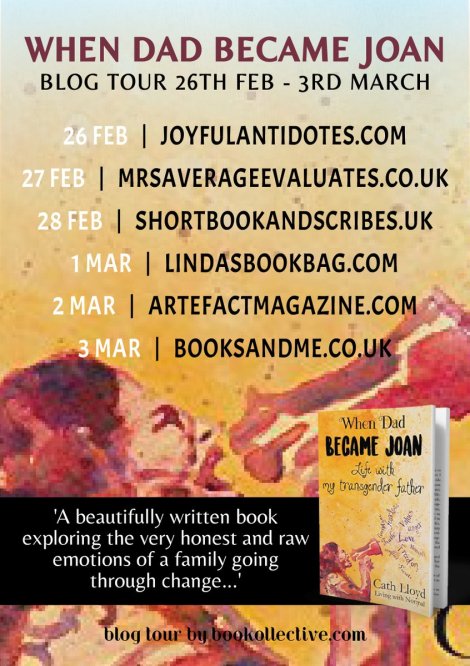
When Dad Became Joan by Cath Lloyd

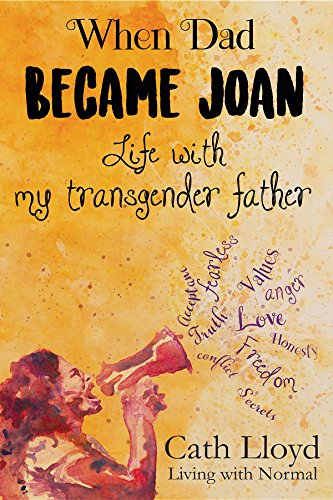
When Dad Became Joan cover

You know, being a blogger is a real privilege and also a responsibility because authors and publishers are trusting you with work that represents some very personal effort and emotion. Today I review one of those books that falls into that category and am delighted to have been asked by the team at Bookollective if I would like a copy of When Dad Became Joan: Life with My Transgender Father in return for an honest review.

Published by Librotas, When Dad Became Joan: Life with My Transgender Father is available for purchase here.

When Dad Became Joan: Life with My Transgender Father

When Dad Became Joan cover

In 1987, Cath Lloyd’s father made the shocking confession that he was a transsexual and wished to become a woman.

Although she wanted to be supportive, Cath didn’t want to lose her dad, and it was hard to accept his decision. In those days, asking for help wasn’t the norm, and gender issues like this were swept under the carpet. Throughout the years of emotional, conflicting and tormenting thought processes, Cath wondered if life was ever going to feel normal again.

We all have a story about coming to terms with change, whether this is transgender reassignment, separation, divorce, loss, grief, illness, disability or living through another trauma. As we live through our story, we do the best we can with the strategies we have at our disposal. Sometimes these are not enough and we have to search long and hard to find alternatives.

That’s where Cath’s book will help you. She shares 7 of the strategies that helped with her family challenges. These can support you too, whatever difficulties you’re facing in your life.

With self-help tools that focus on topics like your values, self-honesty and positivity, you’ll develop a plan of action to support you through the difficult times. This will help you to understand, acknowledge, and accept what needs to happen to move forward and live your new normal. These strategies are those which Cath uses now with her clients as a life style change and stress relief life coach.

My Review of When Dad Became Joan: Life with My Transgender Father

Cath Lloyd’s father is about to become a woman and it impacts on Cath rather more than she would have liked.

Firstly let me say what a bargain When Dad Became Joan is. The reader is getting two books in one as the first part is more of a biography and autobiography as Cath Lloyd describes finding out her father was undergoing gender transitioning and the second is more of a self-help manual as Cath Lloyd outlines her seven strategies for living a happy and fulfilled life. In both sections there are some helpfully motivational quotations that I enjoyed immensely, particularly the final one in the book which I found inspirational.

I have to admit to feeling slightly uncomfortable reading the first section of When Dad Became Joan as it seemed slightly voyeuristic to be enjoying the processes Cath Lloyd describes, because the book is so well written and interesting. I was also slightly ashamed that I have never really considered just how difficult it must be for those undergoing gender transitioning, but have simply blindly and rather unthinkingly accepted those people for who they are. Equally, I hadn’t any previous idea of the real impact on the family and I felt extremely sorry for Cath and for Joan as they tried to adapt to new lives – or, as Cath would put it, a new normal.

I found the style of writing in this first section honest, compelling and engaging. It is also hugely informative, giving scientific and medical detail as well as a personal perspective. I felt quite privileged to have been allowed a glimpse into the lives of Joan and her family, even if I did want to climb into the pages and give Nick a jolly hard shake.

In the second section, 7 Steps to Living Your New Normal, I thought the way Cath Lloyd linked her own experiences with strategies for coping that the reader can use was extremely good. There’s an excellent balance between advice, and the opportunity for the reader to become more self aware and reflective. I loved the way all seven strategies are summarised at the end so that the prompt questions can be used as refreshers really easily. There’s a real confidence that Cath Lloyd practises what she preaches here so that a reader needing such self-help guidance would feel they could trust the advice given.

I honestly wasn’t sure what to expect when I picked up When Dad Became Joan, but what I got was a fascinating story of two people. of Cath and Joan, alongside a smashing self-help volume that would be of benefit to any reader to give them coping strategies and a positive outlook on life.  When Dad Became Joan is a great book and I highly recommend it.

About Cath Lloyd

cath lloyd

Cath is a lifestyle change and stress relief life coach, with a teaching background in adult education spanning over 25 years, with 15 of these working with offenders. This experience thrust her into a very different society which helped her refine her teaching and life coaching skills, whilst keeping her in touch with the real and creative worlds.

She now combines her teaching and life coaching skills with a holistic approach. She loves working with her clients on an individual level to achieve positive and quick results. Cath blends her teaching and coaching skills together in group workshops, courses and events such as ‘Recipe To Success’ and her regular ‘Stress Relief Awareness Days’. These courses are a great way for her clients to gain peer support in a fun, educational and inspiring environment.

You can follow Cath on Twitter @CLmakethechange and find out more on her website. Cath is also on Facebook.

There’s more with these other bloggers too:

When Dad Became Joan

Introducing Uther’s Destiny: A Guest Post by Tim Walker

Uther cover box no line

It’s a welcome return to Linda’s Book Bag for Tim Walker, author of Uther’s Destiny. Tim previously wrote a cracker of a guest post about fiction and fear when the second book in his A Light in the Dark Ages trilogy, Ambrosius: Last of the Romans, was published and you can read that post here.

Uther’s Destiny is available for purchase here.

Uther’s Destiny

Uther cover box no line

Britannia is in shock at the murder of charismatic High King, Ambrosius Aurelianus, and looks to his brother and successor, Uther, to continue his work in leading the resistance to barbarian invaders. Uther’s destiny as a warrior king seems set until his world is turned on its head when his burning desire to possess the beautiful Ygerne leads to conflict. Could the fate of his kingdom hang in the balance as a consequence?

Court healer and schemer, Merlyn, sees an opportunity in Uther’s lustful obsession to fulfil the prophetic visions that guide him. He is encouraged on his mission by druids who align their desire for a return to ancient ways with his urge to protect the one destined to save the Britons from invaders and lead them to a time of peace and prosperity. Merlyn must use his wisdom and guile to thwart the machinations of an enemy intent on foiling his plans.

Meanwhile, Saxon chiefs Octa and Ælla have their own plans for seizing the island of Britannia and forging a new colony of Germanic tribes. Can Uther rise above his family problems and raise an army to oppose them?

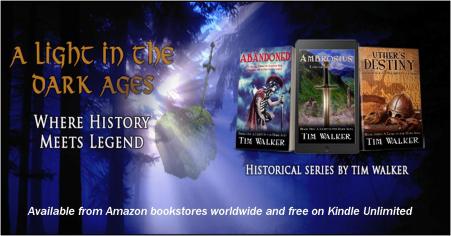
Book three in A Light in the Dark Ages series, Uther’s Destiny is an historical fiction novel set in the Fifth Century – a time of myths and legends that builds to the greatest legend of all – King Arthur and his knights.

Uther’s Destiny – The Background Story

A Guest Post By Tim Walker
A Light Banner2

Uther’s Destiny (published in March 2018) is the third book in the series, A Light in the Dark Ages. I had the idea for this series in the summer of 2015 when I visited the site of what was once the Roman town of Calleva Atrebatum. Located in Hampshire in the English countryside, it is now a grassy meadow without any structures (except the ruin of a Medieval Christian church) on which cattle graze, with the outline of a stone perimeter wall, visible in jagged patches, maintained by English Heritage.

I stood there and soaked up the atmosphere, feeling the call of history. Questions ran around my mind – What was it like being an inhabitant of a Roman town? When did the Romans leave and what happened to the locals afterwards? This set me on a path to research what was known about the final years of Roman Britain and what happened to the Britons after they left. I had already compiled and published a book of short stories – Thames Valley Tales – and felt that I wanted to write my own story of events in Fifth Century Britain – historical fiction woven around historical facts.

I soon discovered that historical facts were thin on the ground, and this period had become known as The Dark Ages for this reason – it was a time of confusion and opportunistic plunder in which the light of learning had all but been extinguished. Although the Christian Church was established, it was in its infancy and this was before the time of monastery building, something that would only happen later under the protection and patronage of Christian Saxon kings. The Romans took their scholars and clerks with them, leaving behind few who could record the events of the time.

I came across a translation of a book written around 1136 AD, the Historia Regum Britanniae (The History of the Kings of Britain) by Geoffrey of Monmouth, that is the earliest written version of the Arthurian Legend. Geoffrey set out to write a complete timeline of British monarchs from ancient times up to the Saxon kings. There is clear evidence he has done his research, drawing on the early accounts of monks Nennius and Gildas, and referencing the Welsh chronicles, but too many gaps remained that he chose to fill with bizarre and unbelievable stories. He also elected to ‘cut and paste’ historical snippets and rearranged them to suit his own purpose, confounding historians. For this reason his work has been largely discounted as a credible historical source. More recently, some have reappraised his work, believing that there may be more credibility than previously thought if his claim to have had access to lost works (written accounts of deeds from the fifth and sixth centuries) is true. Efforts have been made to understand his thought process and re-arrange his maverick chronology into a more believable timeline.

I decided to use Geoffrey’s framework for events after the Romans finally departed (believed to be 410 AD) as a basis for my storytelling. Historians such as John Morris* have boldly claimed that a King Arthur most likely did exist, and have put his death at the Battle of Camlann (based on studies of contemporary sources) at around 515 AD. So, my question is, what actually happened between 410 and 515 AD?

Geoffrey’s account starts with Archbishop Guithelin of London taking ship to Armorica (Brittany) to plead with King Aldrien to claim Britain as his kingdom and provide protection for the people from barbarian raiders. Aldrien declines, but agrees to send his brother, Constantine. He arrives on the south coast with a small army and soon persuades a group of tribal chiefs to make him High King (or Emperor) of Britannia and offer them protection from hostile chiefs and the many invaders who beset the island.

Constantine marries into a Romano-Briton family and rules for about ten years, having three sons – Constans, Aurelius and Uther. He is deceived and murdered by a noble called Vortigern who seizes the crown. Vortigern employs Saxon chiefs Hengist and Horsa to lead his army. Then there is the appearance of sorcerer Merlin, who advises the king to re-site his tower to avoid rock falls caused by two dragons fighting in a cave beneath it. After some time the sons of King Constantine, Aurelius and Uther, defeat Vortigern in battle and Aurelius becomes king, taking the name ‘Ambrosius’ meaning ‘The Diving One’. He is murdered by a Saxon spy and is succeeded by Uther, who takes the name ‘Pendragon’ after seeing a dragon fly across the sky on his coronation day.

Then there is the Arthur story – he is conceived at Tintagel Castle, born from the union of King Uther Pendragon and Ygerna (or Igraine), Duchess of Cornwall, who is deceived into thinking Uther is her husband Gorlois. With Gorlois dead, Uther marries Ygerna and they have a second child, Anna.

Arthur becomes king at the age of fifteen, defeats the Saxons at York wielding a sword called ‘caliburn’, rebuilds London, and marries Ganhumara (‘Guinevere’) who is from a noble Romano-Briton family. Arthur establishes his court at Caerleon in Wales, forms an alliance with his nephew, King Hoel of Brittany, and they inflict further defeats on the Saxons at Lincoln and Bath before crushing a combined force of Picts (Scots) and Hibernian (Irish) tribes near Loch Lomond. They then attacks Ireland, the Orkneys, Iceland, Norway, Sweden and parts of Gaul (France), forcing the people to pay them homage. He lays waste to fields, slaughters the population of these places and burns down their towns – the exact opposite of a chivalric king. Geoffrey’s Arthur is an arrogant, aggressive and brutal warlord who kills and takes what he wants.

But Geoffrey’s story does not end there – Arthur is summoned by the Roman Emperor to face charges of war crimes and responds by raising a large army, sailing to Gaul, and meeting the Roman army in battle, defeating and killing the emperor. Arthur’s mind is set on capturing Rome and becoming Emperor, but he is forced to return home at news that his nephew Mordred has taken his queen, Ganhumara, and seized the kingdom. In a bloody civil war in which thousands die, both Mordred and Arthur fall in battle – Arthur’s body is taken to the Isle of Avalon. Arthur is succeeded by his cousin, Constantine of Cornwall.

This is a summary of Geoffrey’s account in his Historia, and it is an intriguing thought that he MAY have taken it from a lost manuscript. Later generations lightened the blood-soaked narrative and gave Arthur a noble makeover, adding more sorcery, the romance of Camelot, chivalric heroes (the knights of the round table), the quest for the Holy Grail, an evil foe in Morgana, and a doomed love triangle involving Arthur, Guinevere and Lancelot.

Uther’s Destiny continues on from the second story in the series, that of Ambrosius Aurelianius (Ambrosius: Last of the Romans) and follows some of Geoffrey’s narrative, but includes some other historical source material and details I’ve uncovered – such as the connection to Dragon Hill in the Berkshire Downs. Uther is a warrior king who had been his brother’s main military commander for many years, taking the fight to aggressive Angle, Saxon and Jute colonists, the Scots and Irish. His falling in love with the wife of a noble and his elaborate deception to win her presents a great opportunity for character exploration, and there is a climactic battle scene at Badon Hill. This is a battle variously attributed to Ambrosius Aurelianus and King Arthur by speculating historians, but in my story it is Uther who rallies the Britons to defend this hill outside the town of Bath.

Until a missing text is uncovered or archaeologists finally unearth clues that point to real individuals and true events, we are left with a tantalizing glimpse of this lost age through the writing of Geoffrey of Monmouth, and the possibility that there may be some credibility in his account.

*The History of Merlin and Arthur by Geoffrey of Monmouth – translated by A. Thompson and J.A. Giles, published by Omo Press, 2014.

*The Age of Arthur by John Morris, published by Orion Books, 1993

(Thanks so much for this insight Tim. I love this era of history and think your A Light in the Dark Ages sounds fascinating.)

About Tim Walker

tim-profile-picture

Tim has been writing fiction since 2013, following a career encompassing journalism, marketing, general management and business ownership.

After school, he worked as a trainee reporter, progressing to writing a music column and reviewing films.

He obtained an honours degree in Communication Studies, majoring in film studies, and added a Post-Graduate Diploma in Marketing two years later in Bristol.

After graduating, he worked for ten years in London in the newspaper publishing industry in market research and advertising sales support.

He followed this with two years as a voluntary worker with Voluntary Services Overseas (VSO) in Zambia, working in book publishing development.  Soon after, he set up and managed his own publishing, marketing and management consultancy company.

Tim now lives near Windsor in Berkshire where he blogs and writes creative fiction.

You can visit Tim’s website, find him on Facebook and follow him on Twitter @timwalker1666.

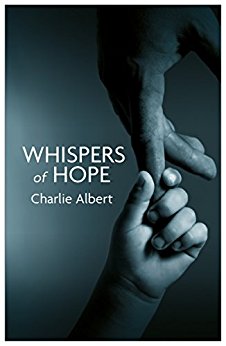
A Publication Day Spotlight on Whispers of Hope by Charlie Albert

Whispers of hope

I am offered so many books for review that I simply can’t accept them all and today I’m featuring one I’m sorry that I had to pass by. Whispers of Hope by Charlie Albert sounds an important book and I am pleased that at least I can spotlight it on Linda’s Book Bag today. Even better, Charlie and I went to the same university so it’s a bit of a trip down memory lane for me too!

I’m also thrilled that not only is Charlie a newly published author today, but the publishing house Whispers Publishing is new too so I’m delighted to support them both.

Published today, Whispers of Hope is available for purchase here.

Whispers of Hope

Whispers of hope

Divorce or separation of a partnership when children are involved can be painful experiences for everyone, not least the children who are the innocent parties.

These six stories based on true events, demonstrate the lengths that some parents will go to, to stop the other parent from having access to their child. Whilst they are shocking, they are written to give hope and to shine a light on this tragic issue.

About Charlie Albert

Charlie Albert, 50 years old. He is currently single and now has a good relationship with his ex-partners, the mothers of his five children. Charlie has four grown up children with his first wife and a young son with his second wife.

Charlie Albert secured residency for his own son Junior in 2013 after a 3-year battle and legal fees in excesses of £100,000. The last year Charlie represented himself employing a barrister in March 2013 for the Final hearing. Charlie is now in a good place with his ex-wife who sees Junior on a regular basis.

Based on all of the above Charlie used this experience to assist other separated parents.

Charlie studied his first year of law at the University of Essex and has not ruled out continuing with his studies.

He was born and raised in London. He has been in the hospitality industry since a teenager. Charlie initially trained as a chef and built his way up to own and co-own Restaurants and Hotels.

Since securing residency of Junior and gaining knowledge of the family courts. Charlie is currently semi-retired. Charlie has just completed his first book, Whispers of Hope and currently writing his second book Shadowed Tears as he feels the time is now right to share these experiences with a wider audience. He is also about to invest in a new Middle East restaurant concept in the city of London. Charlie privately continues to assist single parents in family matters.

You can follow Charlie on Twitter @charliea_author and there’s more on Facebook.

Staying in with Ralph Webster

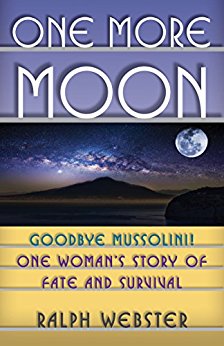
One More Moon

With Jewish History Month approaching, I’m delighted to welcome Ralph Webster to Linda’s Book Bag today to talk to me about his inspiration for one of his books that I think will be perfect for those looking for a suitable book to read this coming month.

If you’re an author who’d also like to stay in with me and tell me about one of your books, please click here for more details.

Staying in with Ralph Webster

Tell me, which of your books have you brought along to share this evening and why have you chosen it?

First, Linda, thank you for allowing me to be here.  I am grateful for the opportunity to tell you about my new book, One More Moon.  The subtitle reads Goodbye Mussolini!  One Woman’s Story of Fate and Survival.  This is the true story of my grandmother’s desperate journey from her comfortable life at the Pensione Alexandra in Naples, Italy to America – after Mussolini and the Fascists joined with Hitler – and as countries across the world closed their doors to Jewish refugees fleeing the spread of Nazi evil.  Amazon releases One More Moon tomorrow.

Sounds fascinating. What can we expect from an evening in with One More Moon?

I am sure that, like most authors, I hope my storytelling will keep you up late, well past your bedtime.  I know I want books I read to take me to special places that I never expected to find.  I want a book to touch me in a way that makes me feel that I am living within the story.  I hope One More Moon strikes that chord with my readers.   That’s what you should expect.  Whether that expectation is fulfilled is something for you to decide.

(This sounds a perfect reason for writing to me Ralph.)

There is a purpose to my writing, a backdrop, a story behind the story.  I hope that will help make your decision.

(Oo – sounds intriguing. Tell me more.)

A little more than two years ago my wife, Ginger, and I spent eight weeks in Europe traveling.  At our stage in life we have the luxury of being able to take off for big chunks of time.  This was a pleasure trip.  We were taking trains, backpacking, hiking, biking, and celebrating the good life.  We started in France and ended in Stockholm for a jazz festival.

Ironically our trip coincided with the rapidly growing refugee crisis in Europe.  Refugees in large numbers were searching for safety, security, and economic opportunity.  They were fleeing Syria and other areas under siege.  At night we watched the news reports on CNN and BBC.  And, by day, we encountered groups on trains, at train stations, in cities, in small towns, and at border crossings.  Right before our eyes we watched mothers, fathers, children as they struggled with their difficult journey.   Indeed, they were strangers in a strange land.  We saw conversations and confrontations with authorities – some civil, some heated.  We saw people being removed from trains and taken away by the military and police.  And, we recognized the difficulty and frustration when trying to communicate across the medium of different languages.  It was easy to see that these were people looking for a hand up, not a hand out.

This sober reflection of humanity touched our hearts.   How can we not all feel compassion for those forced to leave their homes through no fault of their own?  Yet, the reality is that the issues surrounding refugees and immigration are complicated and not easy to resolve.  These are not new.  They are generations old.  And, I suspect as long as we live in a world where some have more and some have less, many of these difficult issues will continue.

I was born into a family of refugees and was raised to believe in an America that embraced the value of opportunity for everyone willing to put in a hard day’s work.  Watching this silent procession of mothers, fathers, and children made me realize that this is what my family must have experienced.  It may have been a different time, a different circumstance, and a different generation.  But, I am certain that the feeling was much the same – the anguish, the loss, the confusion, the uncertainty, the isolation, the fears, the unknown.

That is what inspired me to write my books and to tell my family’s story.  I am afraid that far too often, refugee and immigration issues have become involved in the politics of fear.  Storytelling is my way to try to shine a light on these issues.  I want others to understand the personal depth of this humanitarian crisis.  Mine is not a plea for money.  It is a plea for compassion, respect, and dignity.

(What an incredibly moving background to your book, and indeed your life Ralph. Thank you for explaining it so eloquently.)

What else have you brought along and why?

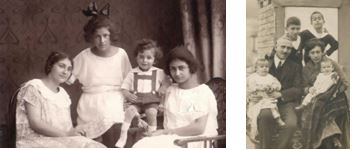
family

I have brought two 1920’s pictures to share with you.  These are my reminders.  The first is a photo of my father and his three sisters in Germany.  The second is a photo from my mother’s side of the family – my grandparents and their children in Naples, Italy.

(What evocative photos Ralph.)

These remind me that all most of us want and hope for is a good life for our families.  What separates refugees from others is a very thin line, a line that can suddenly appear, a line that can be very unfair, a line that can change everything.  I hope my books remind readers how much we are all the same – except for that single difference.  Through no fault of their own, refugees are people like you and me who have no choice but to leave their homelands with literally the clothes on their backs and usually for one terrifying reason – they fear for the lives of their families.  My story within a story?  I want us all to recognize that refugees are the victims.  Please do not allow our world to make them become the enemy.  Thank you.

No, thank YOU Ralph, for being such a wonderful guest to stay in with. I have found hearing about One More Moon a very interesting and humbling experience. Thank you for staying in with me to tell me about it.

One More Moon

Goodbye Mussolini! One Woman’s Story of Fate and Survival

One More Moon

Goodreads Choice Nominee Ralph Webster tells the true story of his grandmother’s desperate journey from her life at the Pensione Alexandra in Naples to America – after Mussolini and the Fascists join with Hitler – and as countries across the world close their doors to Jewish refugees fleeing the spread of Nazi evil.

In 1934, at age fifty-one, Elsa’s comfortable life in Mussolini’s Fascist Italy changes remarkably when she and her husband, Paul, purchase the Pensione Alexandria overlooking the Mediterranean in Naples. Though German Jews, they are embraced by their Italian neighbors, and for the next several years, the pensione flourishes and becomes their perch to observe the world’s events. Travelers from across Europe and America come to the door, each with their own story, mystery, or surprise. Nearly all have been touched in some way by the ominous changes occurring to the north, in Nazi-controlled Germany.

When war breaks out in Europe and Italy sides with Germany, Elsa and her family’s fears are quickly realized. The growing sense that the atrocities in German-occupied lands will soon occur in Italy forces them to give up their pensione and attempt a desperate journey to safety in America. The way seems impossible. Day by day, war makes travel increasingly difficult as countries begin closing their doors to refugees.

Told in Elsa’s words and written by her grandson, One More Moon is the extraordinary story of a woman and her family’s often harrowing experiences in the years before and during World War II.

One More Moon is available for purchase here.

About Ralph Webster

ralph

Award winning author Ralph Webster received worldwide acclaim for his first book, A Smile in One Eye: A Tear in the Other, which tells the story of his father’s flight from the Holocaust. Voted by readers as a Goodreads 2016 Choice Awards Nominee for Best Memoir, A Smile in One Eye: A Tear in the Other and his second book, One More Moon, are proven book club selections for thought-provoking and engaging discussions.

Whether in person or online, Ralph welcomes and values his exchanges with readers and makes every effort to participate in conversations about his books. Now retired, he lives with his wife, Ginger, on the Outer Banks of North Carolina.

You can find out more by visiting Ralph’s website and finding him on Amazon and Goodreads. You can also follow Ralph on twitter @Ralph_Webster.

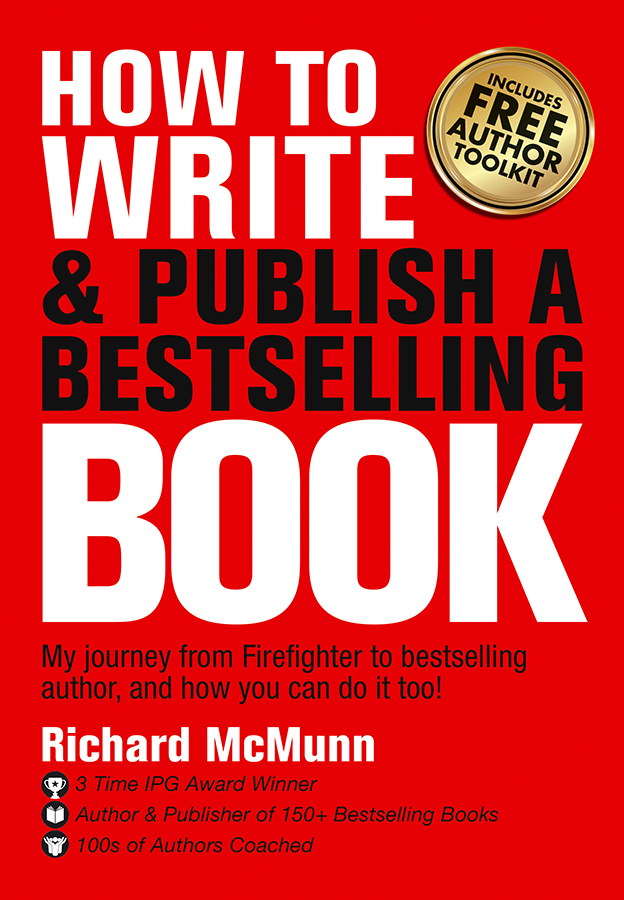
How To Write And Publish A Bestselling Book by Richard McNunn

RichardMcMunn_BookCover

I make no secret of the fact that I have an ambition (albeit fairly vague and theoretical) to finish my novel and so when I was asked if I would like a copy of How to Write & Publish a Bestselling Book: My journey from firefighter to bestselling author, and how you can do it too! by Richard McNunn I jumped at the chance.

How to Write & Publish a Bestselling Book: My journey from firefighter to bestselling author, and how you can do it too! is available for purchase here.

How to Write & Publish a Bestselling Book: My journey from firefighter to bestselling author, and how you can do it too!

RichardMcMunn_BookCover

How to Write & Publish a Bestselling Book: My journey from firefighter to bestselling author, and how you can do it too! is written by bestselling author Richard McMunn, who has written and published over 150 books.

In this book, he covers everything you need to know in order to write and self-publish your own book in print and ebook format, and also how to get your book on Amazon and in high street stores such as Waterstones.

To write and self-publish a book, you need no prior experience of the publishing world. This might seem surprising, but it’s actually really simple! What you do need is a willingness to learn, and a mentor (someone who will help you). This book is divided into 3 sections: sections 1 & 3 cover Richard’s incredible and inspirational story from being a firefighter to discovering the publishing world and how he went on to publish over 150 bestselling books through his publishing company.

Section 2 covers the different steps you need to take to not only get your book written and published, but also to achieve bestseller status.

In Richard’s book you will learn in a simple, step-by-step format:

– How to write a book in any genre;
– How to give yourself the best possible chance of writing a bestseller;
– Understanding how the Amazon bestseller rank works;
– How to get your book ready for publishing, including critical elements such as proof-reading, editing, typesetting, e-Book formatting, book cover design, book descriptions, and more;
– How to create high-quality, professional artwork for your book, both digital and physical, ensuring that it stands out from the crowd;
– How to self-publish your book and start selling it on Amazon;
– How to effectively market your book to increase exposure;
– How to get your book stocked in Waterstones;
– Plus LOTS more!

Richard McMunn is a Number 1 bestselling author, Specialist Consumer Publisher of the Year and Nielsen Digital Marketing Award Winner.

Ideal for any aspiring author, this book is an essential read for anyone looking to get their book written and on sale to millions of readers worldwide.

My Review of How to Write & Publish a Bestselling Book

A handbook of practical advice for all aspiring writers.

Initially I wasn’t entirely sure I was going to get on with How to Write & Publish a Bestselling Book: My journey from firefighter to bestselling author, and how you can do it too! The long title and exclamation mark made me think I was going to get an exaggerated American style self help manual that was all fanfare and froth with little depth. I was wrong.

Certainly, there’s quite a bit about Richard and his route to publication, some 100 pages in the first section,  but as he says at the end of the book, this isn’t to brag about his own achievements, but to inspire others and in this first section he helpfully sums up what he learnt from each aspect of his life so that aspiring writers won’t make the same mistakes but can skip straight to the positive aspects of making the most of their talents. I actually enjoyed reading about his life (and as an ex-English teacher am rather glad he was inspired by his own frizzy haired English teacher) as this section has pace and interest. I liked the poster style encouragements at the end of each chapter and could see these being pinned around a writer’s workspace for motivation when times get hard.

The book provides a wide range of helpful advice so that aspiring writers have much to learn between its pages. I think How to Write & Publish a Bestselling Book is most helpful to those thinking about self-publishing and I found the information about doing so through Amazon especially interesting. I also think it is more suited to those looking at a non-fiction route because the author has more experience there. However, there are useful hints and tips for fiction writers too, especially in the action planning in Chapter 13.

As a blogger who frequently encounters authors who want me to read and review their books in the hope of boosting sales but who don’t use any social media to promote it themselves I thought Chapter 21 was essential reading. It sets out exactly what authors can do to promote their writing and encourage sales, regardless of whether they are writing fiction or non-fiction.

I enjoyed Richard McNunn’s How to Write & Publish a Bestselling Book and I think it can be read on many levels. It is a practical and useful handbook for those considering writing, especially non-fiction. It’s a motivational book whose tenets could be applied to many aspects of life, not just writing. It’s also a highly entertaining biography of a hugely inspirational man.

About Richard McNunn

richard

Based in Tunbridge Wells, Kent, Richard McMunn is the bestselling author of the ‘How2Become’ series of career guides and the founder of his own unique VIP author mentoring programme.

After leaving school in Lancashire with just 3 GCSEs, Richard went on to join the Royal Navy — serving four years onboard HMS Invincible as an aircraft engineer. After leaving the navy, Richard took up a childhood ambition to become a firefighter with Kent Fire and Rescue Service where he served for seventeen years.

Today, Richard works as a full-time author and publisher and to date has authored 150 books and helped over 100 aspiring writers become published authors. He has also been awarded the IPG Specialist Consumer Publisher of the Year and the Nielsen Digital Marketing Award.

You can find out more by visiting Richard’s website.

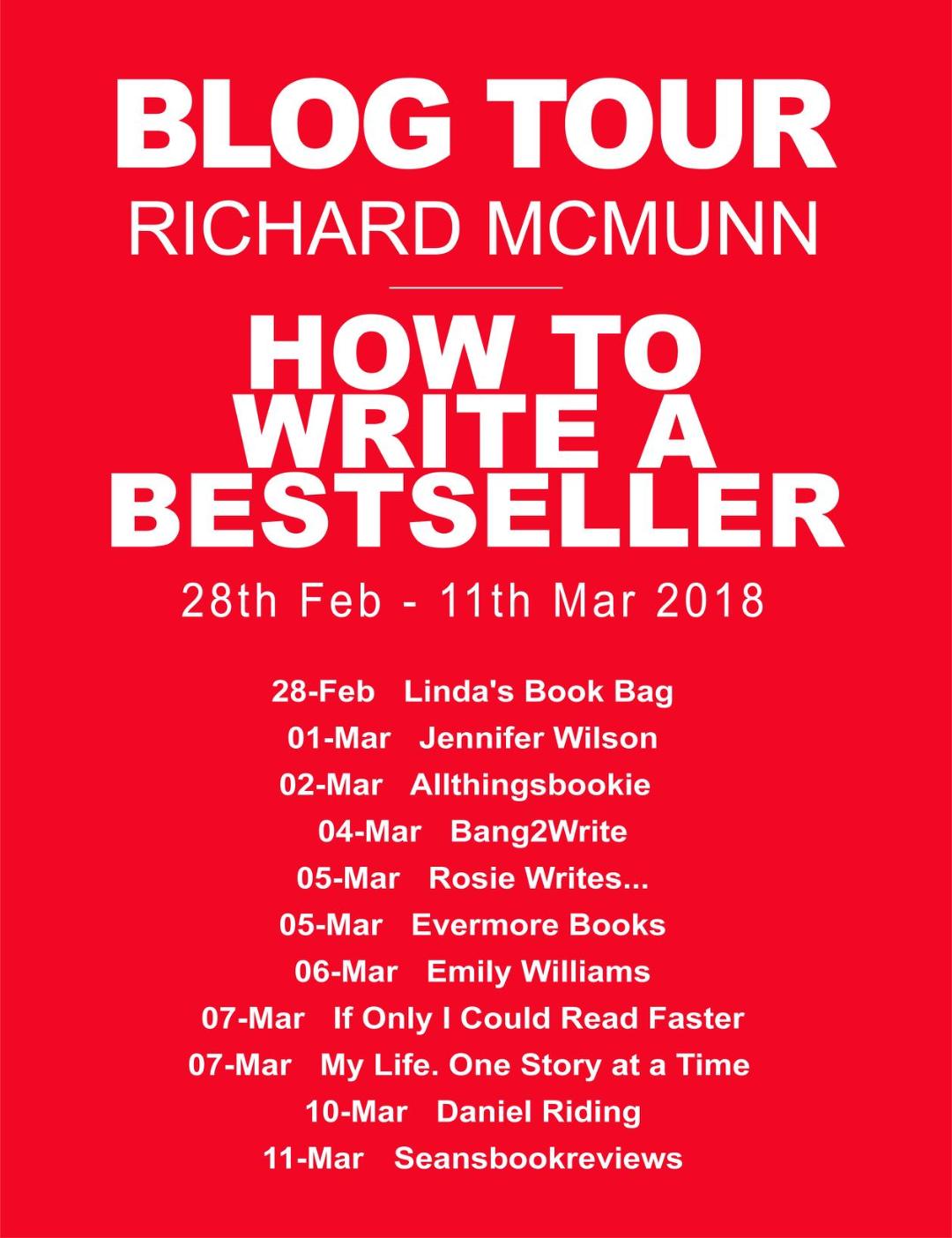
There’s more with these other bloggers too:poster

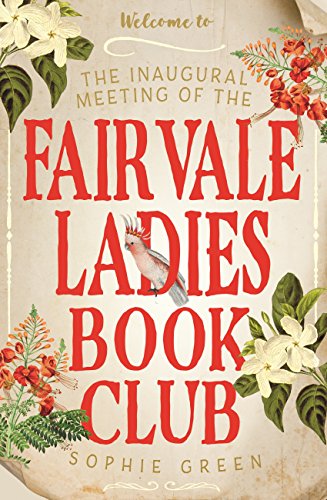
The Inaugural Meeting of the Fairvale Ladies Book Club by Sophie Green

fairvale

My grateful thanks to Clara Diaz for a copy of The Inaugural Meeting of the Fairvale Ladies Book Club in return for an honest review as part of the UK launch celebrations.

The Inaugural Meeting of the Fairvale Ladies Book Club is available for purchase here.

The Inaugural Meeting of the Fairvale Ladies Book Club

fairvale

In 1978 the Northern Territory in Australia has begun to self-govern and telephones are not yet a common fixture. Life is hard and people are isolated, but these five women find a way to connect.

Sybil, the matriarch of Fairvale Station, misses her eldest son and is looking for a distraction.

Kate, Sybil’s daughter-in-law, is thousands of miles away from home and finding it difficult to adjust to life at Fairvale.

Sallyanne, mother of three, dreams of a life far removed from the dusty town where she lives with her difficult husband.

Rita, Sybil’s oldest friend, is living far away in Alice Springs and working for the Royal Flying Doctor Service.

And Della, who left Texas for Australia looking for adventure and work on the land, needs some purpose in her life.

Sybil comes up with a way to give them all companionship: they all love to read, and she forms a book club. As these five women bond over their love of books, they form friendships that will last a lifetime.

My review of The Inaugural Meeting of the Fairvale Ladies Book Club

In the desolate Northern Territory of Australia, five women find friendship and support through books.

I have to be honest and say I think the title The Inaugural Meeting of the Fairvale Ladies Book Club is slightly misleading, because although that meeting does take place and there are references to books dotted throughout the text, this is a book about so much more than a book club of five members in an isolated location.

I did struggle a bit at the beginning to work out who was who and what relation they had to one another, but once I got into the rhythm of the book I grew to understand them all and to see them as real people leading challenging lives. I felt closest to Della and Kate and I think it’s because they experienced the ‘otherness’ of Australia in line with my own experiences. By the end of the novel I felt quite emotional at how the five women’s lives had turned out.

Having visited Australia I really enjoyed the geographical references and details as they illustrated just what it’s like extremely well. The more I read The Inaugural Meeting of the Fairvale Ladies Book Club the more glad I was that I don’t live with such extremes of climate and weather.

However, what I enjoyed most about reading The Inaugural Meeting of the Fairvale Ladies Book Club was the range of themes. The late 1970s era is very clearly presented and I railed rather at the way women were supposed to follow their husbands and thought the exploration of relationships was extremely deftly handled. The themes of relationships, love, ageing and belonging are beautifully presented in this gentle read and I thoroughly appreciated the concept that belonging doesn’t have to have a physical presence in a location for it to be equally valid. I thought the exploration of the relationships between the women was beautifully and realistically handled.

I found The Inaugural Meeting of the Fairvale Ladies Book Club a gentle, entertaining and enjoyable read that left me with a cosy and satisfied feeling. 

About Sophie Green

sophie green

Sophie Green is an author and publisher who lives in Sydney. She has written several fiction and non-fiction books, some under other names. In her spare time she writes about country music on her blog, Jolene. She fell in love with the Northern Territory the first time she visited and subsequent visits inspired the story in The Inaugural Meeting of the Fairvale Ladies Book Club.

You can follow Sophie on twitter @sophiegreenauth and find her on Facebook.

There’s more with these other bloggers too:

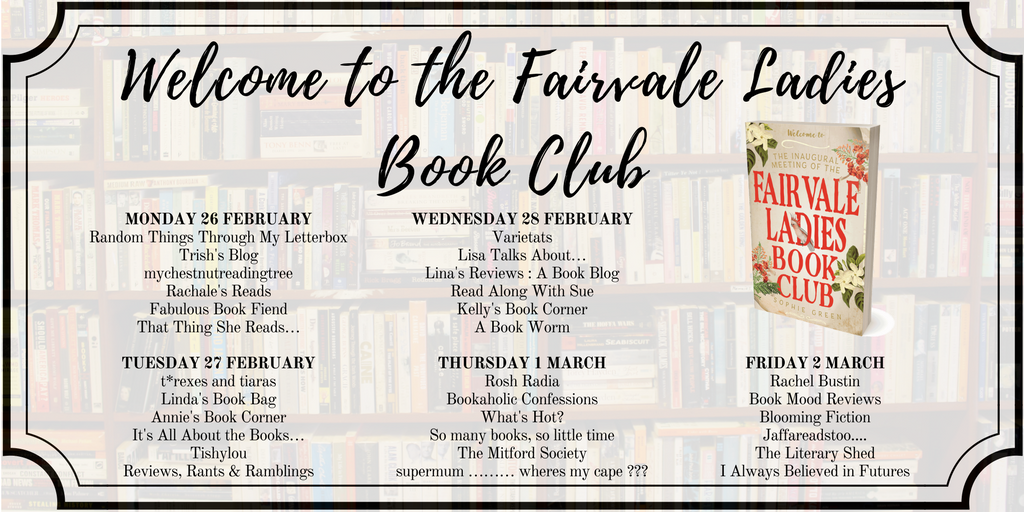
Fairvale blog tour poster

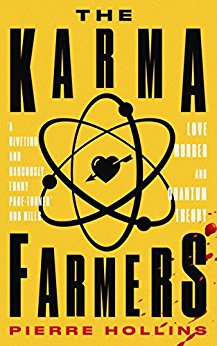
The Karma Farmers by Pierre Hollins

Karma cover

Having studied The Enlightenment and philosophy as part of my first year at university I was intrigued to learn of The Karma Farmers by Pierre Hollins.

My grateful thanks to blogger and organiser Anne Cater of Random Things for inviting me to be part of the celebrations of this novel.

Published by Unbound, The Karma Farmers is available for purchase here.

The Karma Farmers

Karma cover

Bradley Holmeson a thirty-something bookshop manager, is attempting to cure his existential dilemma with quantum physics. A reluctant philosopher embroiled in an occult experiment, he meets the violent, the obsessed and the dangerously misguided, armed only with his defensive sarcasm – all to win back the woman he loves.

My Review of The Karma Farmers

My goodness, The Karma Farmers isn’t an easy book to categorise and it’s none the worse for that quirkiness and originality. Having studied philosophy as part of my degree The Karma Farmers is a book I think will appeal to readers on many, many levels. It’s part allegory, part love story, part mystery, part scientific and philosophical treatise and part religious (or non-religious) guide! I like the way the title reflects the gathering of philosophical ideas and the ‘farming’ of them into something personal by the characters.

Whilst the plot has elements that tricked and occasionally confused me (particularly Brad’s second edition work, despite having studied Kant and the Enlightenment) it has a fascination that ensnares the reader, even if it occasionally bewilders them too. I thought the inclusion of Brad’s online work was a touch of genius. My own thinking was challenged and developed as a result of reading The Karma Farmers. I’m not sure if Brad’s aspirations mirror those of Pierre Collins, but I felt there was an honesty as well as a cleverness behind the writing. I have to admit to liking the shortness of each part of the narrative as I needed time to contemplate the story, look for the implied as well as obvious meanings and process what I’d just read. I’m not sure I thoroughly understood all the references and theories and I felt quite inadequate as a reader at times. However, this isn’t a negative of the book. I think it’s good that we have narratives that promote thinking without mindless acceptance and there’s a good story here to get your teeth into as well.

I found Pierre Collins’ style really visual so that I could see the settings and characters very clearly in my mind. His use of the vernacular and direct speech alongside the continuous present tense give pace and realism too so that at times it was like watching a film as much as reading a book. I enjoyed the humorous touches too. I coud easily see The Karma Farmers as an offbeat BBC 4 television production with a cult following.

The Karma Farmers is clever, witty, entertaining and thought provoking –  a real chimera of a book that will polarise readers. I’ll be interested to see what happens next.

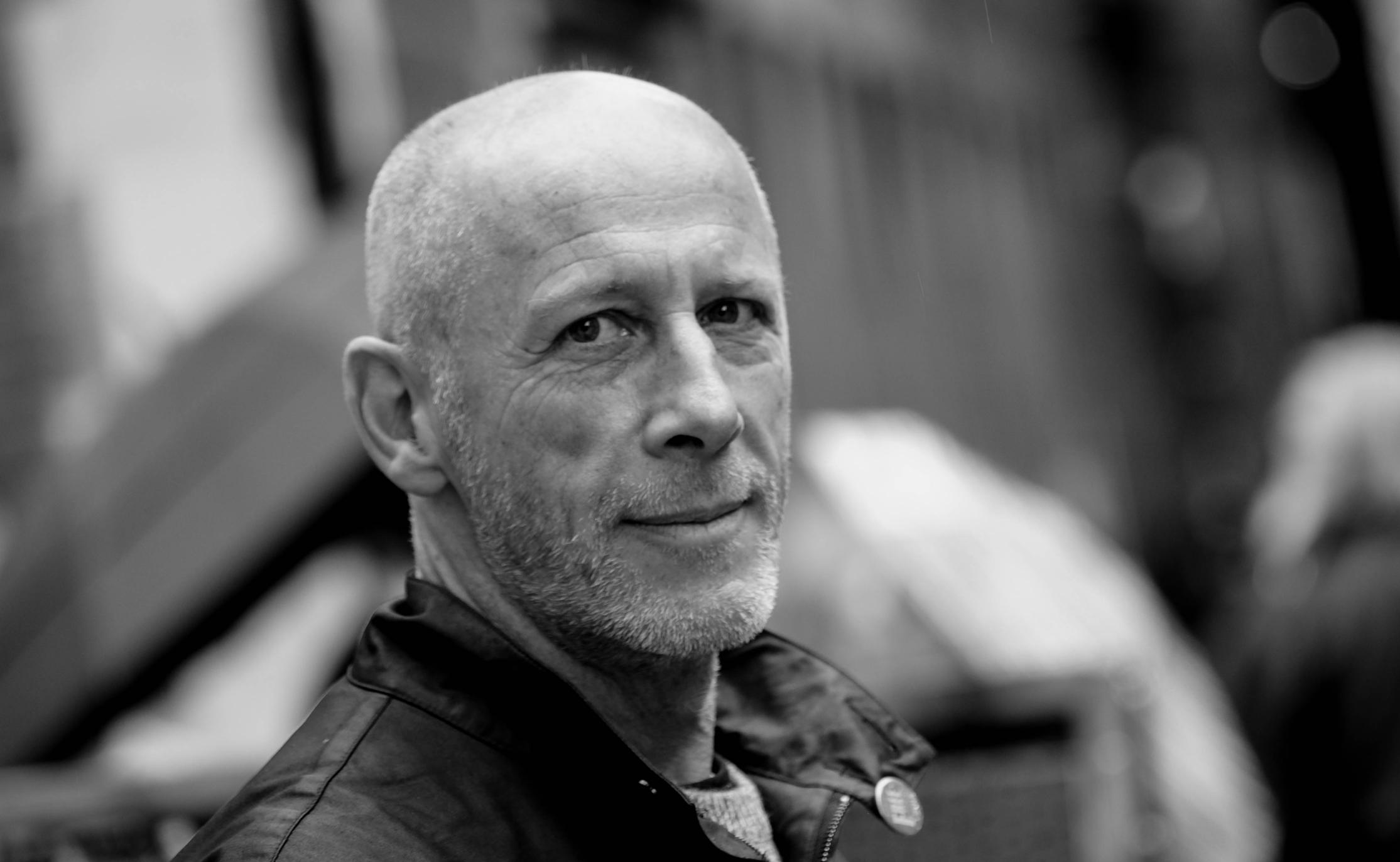
About Pierre Hollins

Author Picture

Pierre Hollins is a stand up comedian; he has written for TV and radio, and his cartoon strip GURU featured in the Fortean Times for many years. This is his first novel, published by Unbound.

You can find out more by following Pierre on Twitter @pierrehollins and visiting his website.

There’s more with these other bloggers too:

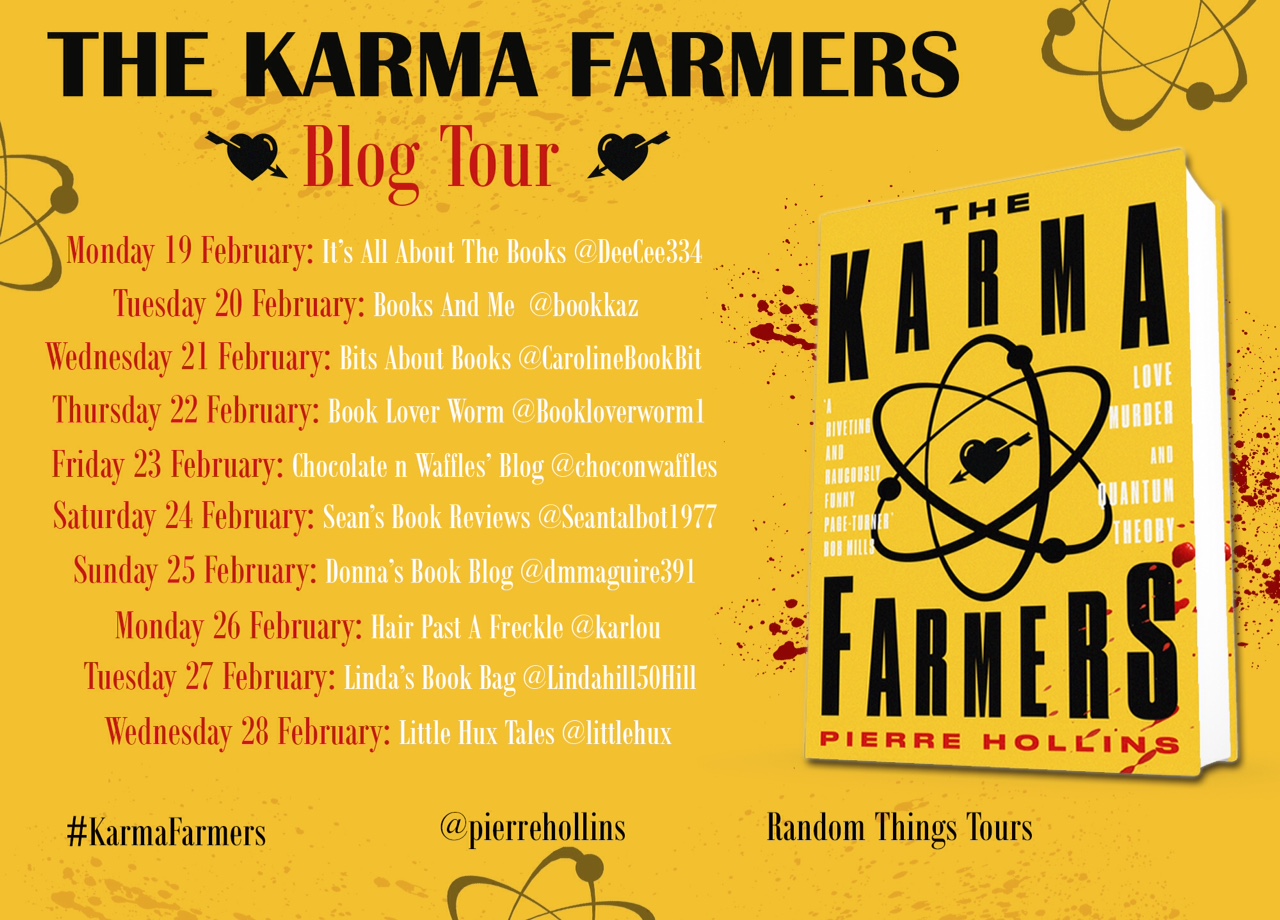
Karma farmers 2

Staying in with Leslie Handler

cover 1

With rotten weather forecast and the need for something to lighten the mood, it gives me enormous pleasure to welcome Leslie Handler to Linda’s Book Bag to stay in with me today.

If you’re an author who’d also like to stay in with me to tell me about one of your books, please click here for more details.

Staying in with Leslie Handler

Welcome to Linda’s Book Bag, Leslie. Thank you for agreeing to stay in with me.

Tell me, which of your books have you brought along to share this evening and why have you chosen it?

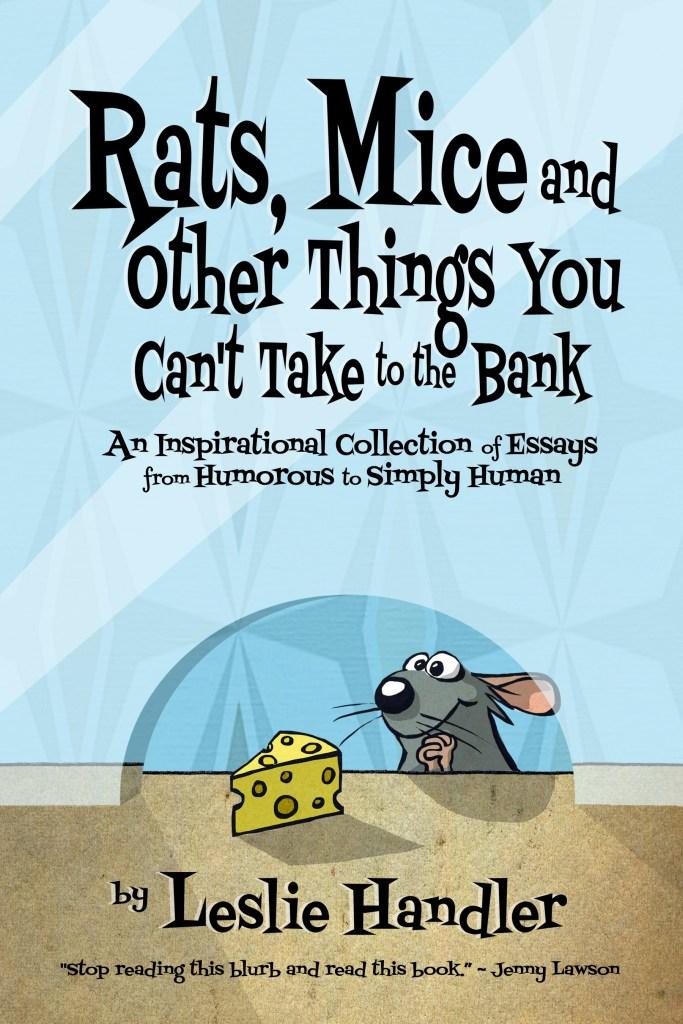
I have with me Rats, Mice, and Other Things You Can’t Take to the Bank: A Collection of Essays from Humorous to Simply Human. I’ve been sharing my stories for a number of years now as a freelance columnist for many publications.  The book started out as a collection of some of those previously published essays, but then it morphed into many more stories that just didn’t fit into on-line and print publications.  People seemed to be touched by my stories and I needed a warm fuzzy place for them to land.  Rat’s become that warm and fuzzy place.

(I love the idea of associating rats with something warm and fuzzy!)

Although my degree is in journalism, my career took me in other directions.  It wasn’t until I was forced our of work due to a disability that I started to write.  I can no longer work, but I still have a brain, and I still need an outlet for the times that I’m able to function.  So writing and I became best friends.  I can get so immersed in my writing that I find it’s the only time that I can actually forget to eat!  Often, it’s either my bladder or my grumbling tummy that tell me to step away from the computer.

(Isn’t it wonderful how writing and reading can transport us and give us a new outlook and purpose in life?)

What can we expect from an evening in with Rats, Mice, and Other Things You Can’t Take to the Bank: A Collection of Essays from Humorous to Simply Human?

I’m honored to now be able to call myself an award winning syndicated columnist.  The book includes some of those award winning pieces.  It’s a collection of essays-sometimes nourishing, sometimes passionate, sometimes humorous, and always relatable.

(Congratulations – how exciting.)

This is the book to read if you are feeling sad.  This is the book to read if you need a good chuckle.  This is the book to read so that you never ever feel like you’re alone.

In one of the essays I summarize my embarrassment for not being supportive of my husband.  I write that “When you’re sad, you get the kind [of tears] that roll down your cheek flowing freely.  They drip down your collar and snot up your nose.  No.  These were different.  These were tears of shame and embarrassment…These were tears that didn’t want to puddle or roll. These were tears that didn’t want to come out at all but couldn’t help themselves as they reluctantly dripped sideways into the hairline instead of following gravity down the face. These were my tears.”

In my essays, I try to shine light into my very own soul and leave it wide open for all to see.  In my storytelling, I try to be a keen observer of my own human nature and I’m not shy about sharing it.

(I think the best writers are those prepared to lay themselves bare to the reader.)

Part memoir, part essay collection, I hope that you find both wit and charm in Rats, Mice, and Other Things You Can’t Take to the Bank.  It will take you on a ride from finding a mouse in the house to the mortgage crisis.  My hope is that you become so engaged while reading it, that you may just find yourself wondering how your own personal stories ended up in it!

(It sounds perfect for me actually as we are battling mice in our loft at the moment, Leslie.)

What else have you brought along and why?

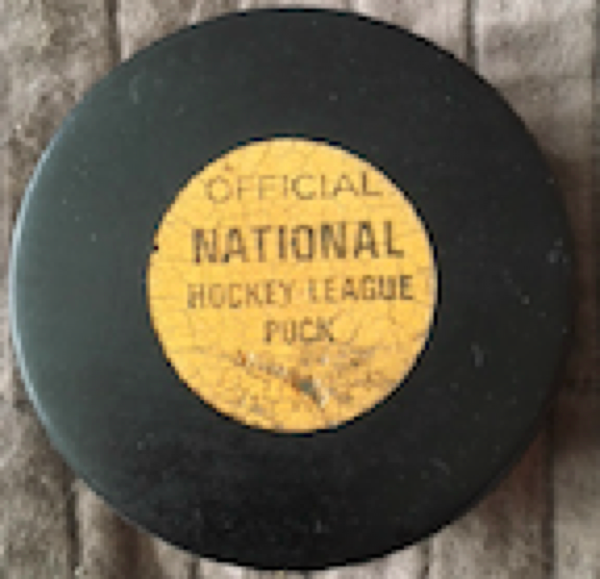
I’ve brought two photos for you all. The first is a photo of a thirty-eight year old hockey puck.

hockey puck

You probably want to know why I’ve brought this item.  It’s very special to me.  I keep it on my night table and take a quick glance at it every night before I turn the lights out and go to bed.  Sorry, but I guess you’ll just have to read chapter two to find out why this odd item is so important to me.

(Argh – that’s so naughty of you. I will HAVE to find out now!)

Here’s the other photo that I’ve brought along:

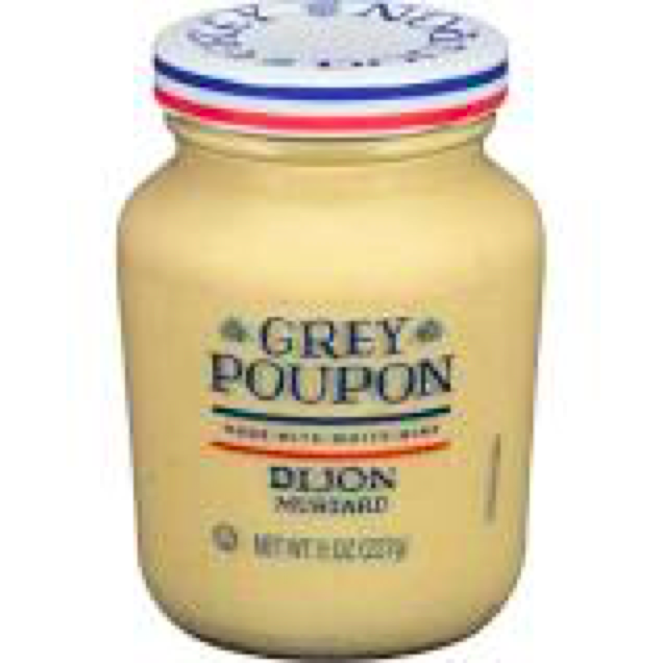
mustard

I can assure you that this is not a personal epicurian delight.  This one has to do with the love between a father and a daughter, but you’ll have to check out chapter five to discover its importance.

(I really will as I’m thoroughly intrigued.)

The bottom line, is that I hold sentiment much more dear than monetary value.  I’ve lived through a whole lot of crap and still firmly believe that I’m one of the healthiest, happiest, sick people I know.  I hope that you’ll find yourself in the pages of my book and share your stories with me as well.

What an inspirational comment Leslie. I think Rats, Mice, and Other Things You Can’t Take to the Bank sounds like a smashing read. Thanks so much for staying in with me to tell me all about it.

Rats, Mice, and Other Things You Can’t Take to the Bank

cover 1

Part memoir, part essay collection, Rats, Mice, and Other Things You Can’t Take to the Bank is written with both wit and charm. It will take you on a ride from finding a mouse in the house to the mortgage crisis, from a smile to a chuckle and from a few tears to the feeling of being wrapped in a blanket sipping a warm cup of cocoa on a cold winter’s day. Handler offers a rich, touching, heartfelt and reflective read that will leave the reader with an indelible uplifting spirit.

Rats, Mice, and Other Things You Can’t Take to the Bank is available for purchase here.

About Leslie Handler

Leslie

Leslie is a 2015 Society of Newspaper Columnists award winner. She’s an international syndicated columnist with Senior Wire News Service and a frequent contributor to WHYY and CityWide Stories.

She freelances for The Philadelphia Inquirer, ZestNow, and Boomercafe, as well as blogs for HuffPost.

Leslie currently lives smack dab between Philadelphia and New York City with husband Marty, dogs Maggie, Hazel, and Ginger, a collection of fish, said husband’s cockatoo who she’s been trying to roast for dinner for the last 33 years, and a few occasional uninvited guests.

You can follow Leslie on Twitter @Leslie_Handler, find her on Facebook and visit her blog.