

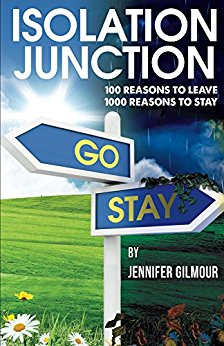
I’m a lucky person. I’m married to a man who goes out of his way to make sure I’m loved and happy, but not everyone is as fortunate and when I realised Jennifer Gilmour was releasing her debut novel Isolation Junction to coincide with October’s Domestic Violence Awareness Month I had to invite her onto the blog to tell us more.
Isolation Junction is available for purchase in e-book here and paperback here.
Isolation Junction
Rose is the mother of two young children, and finds herself living a robotic life with an abusive and controlling husband. While she struggles to maintain a calm front for the sake of her children, inside Rose is dying and trapped in ‘Isolation Junction’.
She runs an online business from home, because Darren won’t let her work outside the house. Through this, she meets other mums and finds courage to attend networking events, while Darren is at work, to promote her business. It’s at one of these events that Rose meets Tim, a sympathetic, dark-haired stranger who unwittingly becomes an important part of her survival.
After years of emotional abuse, of doubting her future and losing all self-confidence, Rose takes a stand. Finding herself distraught, alone and helpless, Rose wonders how she’ll ever escape with her sanity and her children. With 100 reasons to leave and 1,000 reasons she can’t, will she be able to do it? Will Tim help her? Will Rose find peace and the happiness she deserves? Can Rose break free from this spiralling life she so desperately wants to change?
The Importance Of Tackling Difficult Issues
Like
Domestic Abuse Through Fiction
A Guest Post by Jennifer Gilmour
I’m Jennifer Gilmour, a young married mum of 3, an entrepreneur and now a published author. From an early age, I have had a passion for writing and have been gathering ideas and plot lines from my teenage years. A passionate advocate for women in abusive relationships, I have amalgamated and fictionalised other survivors’ experiences alongside my own to write my first novel. It details the journey of a young woman from the despair of an emotionally abusive and unhappy marriage to develop the confidence to challenge and change her life and to love again.
Isolation Junction has been a challenging novel to write and I have written it for a few reasons. I have been the victim of abuse myself. I found myself writing down my feelings in a way to get it out. For many years I have kept a diary; it first hit when I was around 15 and Bridget Jones came out – I wanted her diary. I don’t have those diaries from my teenage years anymore and I never really read through them. I did however, find it very therapeutic to write my emotions, highs and lows down and this got me through my early teens.
This was a bit harder; I had to keep a record to remember my emotions on the abusive relationship. You can find yourself minimising the abuse and looking on it and thinking it wasn’t that bad, but when reading back on my diary snippets I can see that it is important for me to remember. Isolation Junction was by far not an easy write and there were times I couldn’t write because it was damaging emotionally, I really had to be in the right zone. Now my debut novel is released it feels a little strange but now the conversation is about the message of the book and this is the important thing. I feel like I don’t have to be quiet anymore about admitting what I went through.
People have seen a different side to abuse through my fictional novel. It’s something that has been addressed in a text book rather than a novel. The reaction has been that people have learnt about a different type of abuse and what coercive control can look like. It is hard to explain in a text book to fully demonstrate this type of behaviour. I’m pleased that people are being educated through my fictional story.
I’ll quote a few reviews here to give you a bit of an idea:
”This book I was not able to put down”
“A hugely important book!”
“A very gripping and interesting read”
“Thank you Jennifer for highlighting this issue and hopefully inspiring women to break free from emotional abuse”
“A fictional account of an everyday, unacceptable issue”
The novel has opened up a huge discussion of the behaviour and for those who don’t understand, it’s enlightened them to see what it could be and the progression behind it. My aim is to encourage questions, challenge the current law and the behaviour itself. It has gotten people thinking about their friendship circle and I have been contacted by many saying, “I have passed your book on to my friend because I think they are in this situation…”
As well as educating, it is also an entertaining book as you can see from the reviews. It is not filled with doom and gloom but features romance and some comedic moments.
I hope that the book will raise awareness of this often hidden and unseen behaviour and empower women in abusive relationships to seek help for themselves and find the confidence to change their lives. I also mention at the end of the book a message from myself and I include a helpline as I recognise that there needs to be a link to support from reading the book.
Now the book is out there to buy, the message needs to be talked about and to break the taboo. The book is just the beginning of blocking the road to ‘Isolation Junction’, I have put myself forward as an passionate advocate for women in abusive relationships.
Thank you so much Jennifer for raising awareness of such a tricky subject. If readers need help they might like to see some of the following websites:
About Jennifer Gilmour

Born in the North East, Jennifer is a young, married mum with three children. She is an entrepreneur, running a family business from her home-base and she has a large readership of other young mums in business for her blog posts.
Jennifer’s debut novel Isolation Junction is designed to raise awareness of domestic violence whilst providing readers with a great read.
You’ll find more about Jennifer on her website, on Facebook and by following her on Twitter.














 Linda's Book Bag