The Long Road to Overnight Success! A Guest Post by Apple Gidley, Author of Have You Eaten Rice Today?

Can you believe it’s almost five years since lovely Apple Gidley last featured on Linda’s Book Bag? Then Apple was explaining how to find the right story in a guest post celebrating Fireburn here. Today Apple is back with a brilliant post about achieving success as her latest novel Have You Eaten Rice Today? is recently published. I would like to thank Apple too, for sending me a copy of Have You Eaten Rice Today? which I’m very much looking forward to reading.

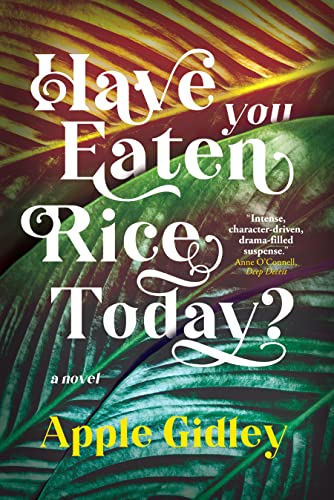
Have You Eaten Rice Today? was published on 6th September by Vine Leaves Press and is available for purchase through the links here.

Have You Eaten Rice Today?

The Emergency rumbles through the jungle, the kampongs, and towns as the communist uprising in 1950’s Malaya adds poignancy to the salutation, ‘have you eaten rice today?’ when hunger drives some terrorists to surrender.

Simon Frampton returns to Malaya as a rubber planter after failing to settle into civilian life in England after the War. His knowledge of the jungle is again put to use when a war-time covert force is reformed and renamed, Ferret Force, made up of Malays, Chinese and Europeans.

Dee Cunningham, an Australian nurse longing to escape the confines of Townsville, Queensland, joins the British Red Cross to help set up and run rural clinics in Malaya.

The violence of guerrilla warfare becomes the backdrop to their love story, but miscommunication leads to sadness. It is not until sixty years later, when Simon’s grandson Max comes to stay at his Dorset farm, when he finds a box filled with envelopes with Australian stamps, and the truth comes to light.

Have You Eaten Rice Today? is a poignant exploration of Malaya’s violent history, merdeka, and how love is found in unexpected places.

The Long Road to Overnight Success!

A Guest Post by Apple Gidley

Do you ever put down a book and sigh? I do. Regularly. The satisfaction of words that have taken you long past bedtime. Although I am fickle. Each book read that I like levitates the author to the number one spot. Until the next book. I should show greater empathy because I am a writer.

Writing is a solitary role that demands self-discipline and a healthy dose of optimism to chase away the doubts. Which is why, for me, Mondays at 10 are sacrosanct. It is when The Writers’ Circle of St Croix meet to critique and cheer on their fellow scribes. We are a diverse group with eclectic works in progress but all with the goal of seeing our books in print.

And therein lies the conundrum. Which route to take?

Self-publishing, hybrid, or traditional. I’ve tried them all.

The first, self-publishing, allows total autonomy and is the fastest and relatively inexpensive route to publication. It does though, in some ways, require the greatest self-discipline. Every book, needs to be edited, but with possible monetary constraints it is tempting to scrimp on cover design and more than one edit. There is little more off-putting for a reader than to find misspelled words or incorrect grammar, even if it’s a cracking story.

Hybrid publishing, wherein, depending on the contract, costs are shared between the author and the publisher can be expensive. It is a gentle way to learn the importance of the aforementioned editing, cover design and marketing. Due diligence is required in finding the right hybrid publisher as there are charlatans lurking behind many glowing promises.

Lag time is the biggest drawback with traditional publishing. Once a book is written authors want to get books to readers.

Finding an agent can take six months or more, and there is no guarantee your manuscript will not fall into a publishing abyss. If the work is picked up by either an agent and / or publisher the lapse between submission and response can seem interminable. The upside is the knowledge pool of not just the industry but the people in it. However, another eighteen months can easily be lost as a manuscript goes through numerous edits, cover design, and my biggest bugbear, marketing. With only four major publishing houses, albeit with numerous imprints, a level of autonomy is lost for the writer.

I am inordinately fortunate to have been signed on by an independent publishing house, Vine Leaves Press, wherein the author’s voice is heard, whilst still being open to advice and accepting they know the business. I feel I now have the best of all worlds in that a small indie press allows personal involvement, not only throughout the publishing process, but also with the stable of writers.

Writers are in many ways an insecure bunch. Not surprising when one considers the number of rejections we go through in our early writing days. On the days when I ask myself, “Who do you think you are to presume you can write?”, I make a cup of tea, or walk the dog, or do some weeding and remember an interview from 1990 in which Terry Wogan asked Rosamunde Pilcher, author of The Shell Seekers, about her overnight success. She replied “I’m an overnight success who only took forty-five years to make it.”

What writers need to remember, on those lonely days, is that someone, somewhere, is reading your words way past lights out. That ‘overnight’ is a relative term that can stretch through both hours and years.

****

I think those are wise words indeed Apple. I’m sure many aspiring and established authors will be able to relate to them completely. Thank you so much for sharing them with us.

About Apple Gidley

A transient life has seen Anglo-Australian Apple Gidley live in countries as diverse as Trinidad and Thailand, Nigeria and the Netherlands, and another eight in between. St. Croix in the US Virgin Islands is home, for now. Her roles have been varied-editor, intercultural trainer for multinational corporations, British Honorary Consul to Equatorial Guinea, amongst others. Gidley started writing in 2010 and is now working on a contemporary novel whilst researching for two more historical fiction books. She has short stories in anthologies, and also writes a regular blog, A Broad View.

You can find out more about Apple on her website and by finding her on Facebook or following her on Instagram and  Twitter @ExpatApple.

An Extract from The Last Girl to Die by Helen Fields

It’s ridiculous that it’s five years sine the fantastic Helen Fields appeared on Linda’s Book Bag with a superb guest post to tie in with Perfect Prey that you can read here. I’m delighted to correct that by sharing an extract from Helen’s latest book, The Last Girl to Die, as part of the blog tour. My enormous thanks to Olivia Collier at Midas PR for inviting me to participate. I’m thrilled that I have The Last Girl to Die on my TBR too.

Published by Avon Books on 1st September 2022, The Last Girl to Die is available for purchase through the links here.

The Last Girl to Die

A stunner! I guarantee you’ll put everything on hold until you arrive at the shocking final scenes. Without a doubt, one of the best crime novels of the year!’ – No.1 international bestseller Jeffery Deaver

In search of a new life, seventeen-year-old Adriana Clark’s family moves to the ancient, ocean-battered Isle of Mull, far off the coast of Scotland. Then she goes missing. Faced with hostile locals and indifferent police, her desperate parents turn to private investigator Sadie Levesque.

Sadie is the best at what she does. But when she finds Adriana’s body in a cliffside cave, a seaweed crown carefully arranged on her head, she knows she’s dealing with something she’s never encountered before.

The deeper she digs into the island’s secrets, the closer danger creeps – and the more urgent her quest to find the killer grows. Because what if Adriana is not the last girl to die?

An Extract from The Last Girl to Die

Humans and animals share a remarkable number of traits. They have the capacity to parent well, but sometimes they just up and leave. They can be kind, not only to their own species, but to others. They know fear, but they can be courageous. They experience both pleasure and pain. Animals grieve just as people grieve. They squabble and play for power. Some can be cruel. Cats play for hours with half-dead mice, tigers kill for sport, humans kill for sexual pleasure and dominance.

Hypocrisy, though, is an exclusively human trait.

The day Adriana Clark arrived in Tobermory, a line of teenage girls sat along a harbour bench and declared her showy and pretentious as they clutched their fake designer bags, their makeup copied from online tutorials, so much applied that it was a challenge to see bare skin. They said she loved herself, as they tossed their hair and watched passersby for any sign of admiring glances. They said she thought she was something really special, as they ignored the square girls, the ugly girls, the not-so-skinny girls who walked on by. They said they bet Adriana was a right bitch.

The Blether was no more of a sanctuary. Young men muttered to girlfriends that the new barmaid was a cold fish after they’d spent time trying to catch her eye while ordering a pint. Older men whispered to their wives that Adriana was sure to be trouble, as they waited for the long darkness of night to imagine themselves next to her warm, youthful body. Women welcomed her to their isle, to her new job, to the community, even as they wished she hadn’t come, knowing their partner’s eye had strayed. Older women muttered and tutted to themselves about Americans, remembering the war, all the while wishing they’d had a chance to travel and explore new shores.

Visitors came and went, leaving a trail of destruction along with much-needed money. They patronised the islanders, consigned them to the murky depths of parochialism. Drove too fast on narrow roads, left too much rubbish, trod down tender plants. But they bought mementos and guidebooks. Paid for meals at the pubs and overnight stays at guest houses. Treated the island like a plaything, then moved on.

Perhaps that was why the foreigners had not been entirely welcomed. They had yet to prove their permanency, to show they’d come with the right attitude to island life.

The priest, Father Christophe – himself a relative newcomer in island terms – had issued requests for the Clarks to be welcomed. If he’d taken the opportunity to tell the odd tale about how he’d found Americans to be morally wanting in the past, so what? If he’d made Adriana feel uncomfortable about the length of her skirt, or the tightness of her top, in the course of a discussion in the confessional, wasn’t he just doing his duty to God and the community?

Harris Eggo, the island’s most senior police officer, longed for more. To have risen through the ranks in one of Scotland’s cities, with crimes to solve that were so much more than joyriding, drunk driving, petty theft and closing-time violence. Yet here he was, wishing Adriana’s death had fallen at the feet of some other policeman. As much as the Major InvestigationTeam was overseeing the case from their comfortable mainland station, he was left with the dirty end of it. The suspicion, the anger and the rising froth of vigilantism. Here it was, his chance to shine, and all he wanted was to turn out the light and go back to bed.

The island watched and wept.

****

Oo. I am SO pleased I have The Last Girl to Die on my TBR!

About Helen Fields

Helen fields

Helen Fields’ first love was drama and music. From a very young age she spent all her free time acting and singing until law captured her attention as a career path. She studied law at the University of East Anglia, then went on to the Inns of Court School of Law in London.

After completing her pupillage, she joined chambers in Middle Temple where she practised criminal and family law for thirteen years. Undertaking cases that ranged from Children Act proceedings and domestic violence injunctions, to large scale drug importation and murder, Helen spent years working with the police, CPS, Social Services, expert witnesses and in Courts Martials.

After her second child was born, Helen left the Bar. Together with her husband David, she went on to run Wailing Banshee Ltd, a film production company, acting as script writer and producer.

Helen self-published two fantasy books as a way of testing herself and her writing abilities. She enjoyed the creative process so much that she began writing in a much more disciplined way, and decided to move into the traditional publishing arena through an agent.

Perfect Remains is set in Scotland, where Helen feels most at one with the world. Edinburgh and San Francisco are her two favourite cities, and she travels whenever she can.

Beyond writing, she has a passion for theatre and cinema, often boring friends and family with lengthy reviews and critiques. Taking her cue from her children, she has recently taken up karate and indoor sky diving. Helen and her husband now live in Hampshire with their three children and two dogs.

You can follow Helen on Twitter @Helen_Fields. Visit Helen’s website for further information and find her on Instagram and Facebook.

There’s more with these other bloggers too:

One Last Gift by Emily Stone

Having been privileged to help reveal the cover to Emily Stone’s second novel One Last Gift back in July I am delighted to share my review of the book too today. Emily’s debut Always, in December which I reviewed here was my outright Book of the Year in 2021, so when Emily got in touch to ask if I’d mind having a character named after me in One Last Gift I was beside myself with excitement. There was also a little trepidation – what if I didn’t like the Linda Hill in One Last Gift or I didn’t like the book? I needn’t have worried!

I think I owe thanks to Sherise Hobbs at Headline for sending me a copy of One Last Gift in return for an honest review.

Already available in ebook, One Last Gift will be published in paperback by Headline Review on 13th October 2022 and is available for purchase through the links here.

One Last Gift

For as long as Cassie can remember, it had been the three of them: Cassie, her big brother Tom, and Tom’s annoying best friend Sam.

Now, Tom is sorted, Sam is flying high, and Cassie thinks she’s figured it all out. Then tragedy happens and three becomes two.

For Cassie picking herself up seems unimaginable. Until she finds an envelope addressed to her, asking her to follow the trail to one last gift…

And suddenly what seems like an ending leads Cassie to something unexpected, beautiful and new…

Take a heartwrenching and uplifting romantic journey, from London to the Hamptons to the south of France and the Welsh mountains, with the author of Always, in December.

My Review of One Last Gift

Cassie is on a treasure hunt.

Oh my poor battered heart. I’m beginning to think Emily Stone may just be the most outstanding writer of this kind of fiction around. Her debut Always, in December was my favourite read of 2021 and so One Last Gift had an awful lot to live up to. It surpassed every expectation I had. I could NOT have adored it more, even if it did reduce me to a blubbering, sobbing wreck.

The quality of Emily Stone’s writing is just lovely. It seems luminescent with emotion and her ability to convey passion, both literal and metaphorical, love and fear in all their forms, and grief, feels almost beyond comprehension. It’s not as if you’re reading about Cassie and the others, but more that you’re experiencing every moment of their feelings with them. Indeed, I’d go so far as to say that whilst One Last Gift is romantic, uplifting and entertaining, it actually feels profoundly cathartic too. There’s real, insightful, human understanding in Emily Stone’s narrative.

The characters are so appealing because they are layered and multi-dimensional. Every one has flaws, strengths and weaknesses. Just as in real life, they can behave generously and selfishly with both rash and considered responses and actions, so that they feel totally authentic and true. I think the most moving aspect of the characterisation is that Emily Stone explores how grief can affect us individually and she illustrates perfectly that there is no correct way to grieve.

I loved the plot of One Last Gift because it held me completely captivated with the ups and downs of Cassie’s life. That said, I had to take short breaks from reading to let my heart recover from what was happening before I could bear to read on. I think it speaks volumes that I lay awake at night worrying about the characters – Cassie and Sam in particular – and wondering what was happening to them whilst I wasn’t reading. I may have finished reading One Last Gift, but I have a feeling the people within the story, including Linda Hill, will remain with me for a considerable time.

One Last Gift is truly wonderful. It’s written with compassion, skill and a true sense of love. I adored it without reservation. I’d defy any reader to finish the story and remain unmoved by it. I totally, absolutely, loved it and I won’t forget it. Make sure you read it too.

About Emily Stone

Emily Stone lives and works in Chepstow and wrote Always, in December in an old Victorian manor house with an impressive literary heritage. Her debut novel was partly inspired by the death of her mother, when Emily was seven, and wanting to write something that reflected the fact that you carry this grief into adulthood, long after you supposedly move on from the event itself.

For more information, follow Emily on Twitter @EmStoneWrites. You’ll also find Emily on Instagram.

The Mortification of Grace Wheeler by Colette Dartford

Today I’m delighted to share details of another of my online reviews with My Weekly and this time it’s of the wonderful The Mortification of Grace Wheeler by Colette Dartford.

Published by White Fox on 18th August 2022, The Mortification of Grace Wheeler is available for purchase here.

The Mortification of Grace Wheeler

Faced with an empty nest when her only child goes to university, the flaws in Grace’s marriage are sharply exposed. Finding excuses to escape the taut atmosphere at home, she is drawn into an affair that ignites a mid-life sexual awakening.

But when her secret is discovered there is a terrible price to pay, and Grace is not the only one who pays it.

A compelling and emotional read, The Mortification of Grace Wheeler shines a spotlight on a marriage in crisis, the challenges of being a middle-aged woman, and the fear that your best years are behind you.

My Review of The Mortification of Grace Wheeler

My full review of The Mortification of Grace Wheeler can be found on the My Weekly website here.

However, what I can say here is that The Mortification of Grace Wheeler is an astonishingly vivid portrait of a middle-aged woman’s life that I won’t find easy to forget. I absolutely loved it.

Do visit My Weekly to read my full review here.

About Colette Dartford

Colette Dartford writes contemporary fiction with compelling emotional themes. Her debut novel, Learning to Speak American, was shortlisted for the Amazon Breakthrough Novel Award and published by Bonnier Zaffre. Her second novel, An Unsuitable Marriage, was a Kindle bestseller for over 18 months. In addition to her novels, Colette has had award-winning Flash fiction, short stories and poetry, published in popular magazines and anthologies. The Mortification of Grace Wheeler is her third novel. Colette lives in Bath with her husband and a very demanding labradoodle.

For further information, visit Colette’s website, follow her on Twitter @ColetteDartford, or find her on Facebook and Instagram.

Staying in with Anya Wylde

I’m disappearing for a few days but before I go I just have time to welcome Anya Wylde to Linda’s Book Bag to stay in with me and tell me about her latest book. Let’s find out what Anya has to say:

Staying in with Anya Wylde

Welcome to Linda’s Book Bag Anya. Thank you for staying in with me. Tell me, which of your books have you brought along to share this evening and why have you chosen it?

Hello, Linda. I have brought along Meara since it’s the latest book I have written, and I would love to share it with your readers.

What can we expect from an evening in with Meara?

Meara is a humorous romantic fantasy. It’s about a sweet, eighteen-year-old girl who loves baking and cooking when she finds herself thrown in the middle of a chaotic war of the realms. The eastern gods are battling the western ones for supremacy, while her only desire is to keep her little sister safe and away from the drama.

Hopefully, the readers will immerse themselves in her world and forget about the daily grind.

That sounds very entertaining! I don’t read much fantasy but I’m fond of romance and humour so I think I’ll have to add Meara to my towering TBR!

What else have you brought along and why have you brought it?

I have brought along a lot of things. A song called the River Flows in You since it is a favourite of Meara’s. Chocolates because why not? Peonies, cushions, cosy blanket, coffee, and a poodle. Everything that brings me joy.

I was with you all the way until you got to coffee! Can’t drink it. And I’m more cats than dogs but as this is your evening I’ll let you off. Thank you for staying in with me to chat about Meara. You put the kettle on and I’ll give readers a few more details:

Meara

Meara lives an ordinary life with her eccentric grandmother and three siblings in a small Georgian house in Dublin. On her eighteenth birthday, her little sister is kidnapped by an incredibly powerful man, and her entire world turns upside down.

A whisper of someone like her being born has been discussed for aeons by the gods. The question is, who is she, and where is she?

Meara lives an ordinary life with her eccentric grandmother and three siblings in a small Georgian house in Dublin. On her eighteenth birthday, her little sister is kidnapped by an incredibly powerful man, and her entire world turns upside down.

Long hidden family secrets tumble out, and supernatural beings suddenly surround her. However, she thinks she is a side character, the hero’s friend and the heroine’s sister. After all, her nature is more girl-next-door than a tortured soul with ninja fighting skills.

Her only desire is to get her sister back and keep her safe but to do so, she must battle dangerous beings and reign in her treacherous heart, which has begun to beat for her family’s sworn enemy, a gorgeous demigod.

Meara is available for purchase here.

About Anya Wylde

Anya Wylde lives in Ireland along with her husband and a fat French poodle (now on a diet). She can cook a mean curry, and her idea of exercise is occasionally stretching her toes. She holds a degree in English literature and adores reading and writing.

For more information, visit Anya’s website, find her on Instagram and Facebook or follow her on Twitter @Anyawylde.

Salmacis: Becoming Not Quite a Woman by Elizabeth Train-Brown

It’s always good to discover new to me authors and my thanks go to Will Dady of Renard Press for sending me a copy of Salmacis: Becoming Not Quite a Woman by Elizabeth Train-Brown in return for an honest review and for inviting me onto the blog tour. I’m delighted to share my review of Salmacis: Becoming Not Quite a Woman today.

Salmacis: Becoming Not Quite a Woman was published by Renard press on 31st August 2022 and is available for purchase here.

Salmacis: Becoming Not Quite a Woman

As recounted by the Roman poet Ovid, a young nymph, Salmacis, one day spied Hermaphroditus bathing; consumed with passion, she entered the water and, begging the gods to allow them to stay together, the two became one – part man, part woman.

An Eclectic Pagan, for Elizabeth Ovid’s fables are more than fiction, and form a framework for exploring identity. Drawing on the rich mythological history associated with the tale of Salmacis and Hermaphroditus, and re-examining the tale through the lens of metaphor, Salmacis: Becoming Not Quite a Woman is a stirringly relatable and powerful exploration of gender, love and identity.

this is my lake salmacis, and i am the wild nymph

with a hollow in her belly and nothing between her legs

My Review of Salmacis: Becoming Not Quite a Woman

A slim volume of 25 poems.

Salmacis: Becoming Not Quite a Woman is an intriguing and often visceral collection that challenges reader perceptions and leaves them thinking long after they’ve read the words.

I found Elizabeth Train-Brown’s language powerful and quite violent with several references to red, blood, screaming and difficult physical experiences so that the raging against patriarchal control as in gods, monsters and complex ptsd, is felt almost physically by the reader. I also discovered on my second reading of the anthology that these works feel even more passionate when they are read aloud.

It was fascinating that there is only one upper case letter in the entire collecting in the very last entry and that it is for ‘Being’, because I thought Salmacis was entirely about being. About being who we are expected or forced to be. About being who or what others expect of us, about being afraid, enraged and lost, and about being ourselves. What Elizabeth Train-Brown does is to make the reader question accepted norms and how the readers perceive themselves, and others around them, with images of blood, moons, seas and the natural world, from mythology from gods to selfies, and cutting, bleeding and knives. Indeed, Salmacis is not an easy read because although there are tender moments, much feels disturbing and and almost displacing.

That displacement is also conveyed by the physical appearance of the poetry, where white space shows hesitation or thought and the lack of full stops in 3 a.m. voice notes in snapchat, for example, illustrates to perfection the very stream of consciousness, the unstoppable flow of poetic ideas, that the author is describing. I loved the gaps in writing is easy as breathing because they show the poet’s own hesitation, they surprise the reader when the line is completed and they engage the reader completely, giving sufficient pause for them to supply their own suggestion mentally before finding what has actually been written. This creates a feeling of connection between poet and reader.

Salmacis is challenging, thought provoking and elusive. I have no idea whether my interpretation matches the writer’s intention and that, for me, makes the collection all the more intriguing. Read Salmacis for yourself to see if you agree. I can guarantee you won’t be left unmoved or unaffected!

About Elizabeth Train-Brown

Elizabeth Train-Brown is a poet and writer whose work has been published internationally in various anthologies and journals. Their journalism on discrimination, asexuality, transgender issues and polyamory has also received widespread recognition. Outside of writing, Elizabeth follows in her parents’ footsteps as a circus performer and fortune teller. Salmacis is their first collection.

For more information follow Elizabeth on Twitter @BethTrainBrown or Instagram.

There’s more with these other bloggers too:

The Lingering by SJI Holliday

I’ve long been a fan of Susi Holliday’s writing so I was delighted when one of her older books under her SJI Holliday persona, The Lingering, became the September book for the reading group to which I belong. Sadly I’m away for the meeting and won’t get to join in the discussions about it, but I’m delighted to share my review today.

Most recently I reviewed Susi’s Substitute here and previously The Last Resort here. You’ll also find my review of Willow Walk here, an interview with Susi to celebrate The Damsel Fly here and my review of her excellent Violet here.

Published by Orenda on 15th November 2018, The Lingering is available for purchase in all the usual places including directly from the publisher here.

The Lingering

Married couple Jack and Ali Gardiner move to a self-sufficient commune in the English Fens, desperate for fresh start. The local village is known for the witches who once resided there and Rosalind House, where the commune has been established, is a former psychiatric home, with a disturbing history.

When Jack and Ali arrive, a chain of unexpected and unexplained events is set off, and it becomes clear that they are not all that they seem. As the residents become twitchy, and the villagers suspicious, events from the past come back to haunt them, and someone is seeking retribution

At once an unnerving mystery, a chilling thriller and a dark and superbly wrought ghost story, The Lingering is an exceptionally plotted, terrifying and tantalisingly twisted novel by one of the most exciting authors in the genre.

My Review of The Lingering

Ali and Jack are looking for a fresh start.

Let me say at the outset that I expected far more horror in The Lingering than I got. This is not a criticism as I’m not a horror fan and I far preferred the power of suggestion to the more overt moments of creepiness in the story! The Lingering is an impactful narrative, particularly when the reader understands that the oldest historical elements are based on real people and, without giving too much away about the plot, knowing that the author works within the pharmaceutical industry, so that where aspects might feel unusual, there’s an unnerving sense of truth and authenticity underpinning the narrative. SJI Holliday’s structure here is so clever as she makes history reverberate through the present day, as well as through the 1950’s journal of Dr Henry Baldock, making the reader wonder if a setting truly can become almost contaminated by its past.

I found the setting of Rosalind House set my nerves on edge even before the plot had begun to unfold. There’s a terrible sense of something wicked in the house, despite Smeaton’s attempts to create a positive atmosphere in the light, so that the reader is anticipating awful events. This makes the plot all the more affecting as the malevolence is uncovered. Given that I live in the Fens not far from where the story is set, I appreciated that sense of isolation the commune creates. Similarly, that claustrophobic nearby village community, where gossip and superstition can always be a good substitute for the truth, adds both atmosphere and realism.

I very much enjoyed The Lingering, even where I guessed some of the outcomes, but it was the underpinning psychological aspect that I found most engaging and disturbing. So many of the themes in The Lingering leave the reader thoughtful and unsettled. The treatment of women and of those with poor mental health, the way superstition can permeate society, the possibility of unworldliness, the themes of coercion, control and loyalty, all contribute to a malicious atmosphere that does indeed linger in the reader’s mind.

Cleverly presented, I though Ali was an abomination. I loathed her from the outset but was never quite certain whether my feelings about her would prove to be correct until the very end of the story. I couldn’t decide if she was far more insane than any of the previous inhabitants of Rosalind House had been, whether she was evil, or whether she was herself a victim of events. Obviously you’ll need to read The Lingering for yourself to find out! In fact, I suspected all the characters of duplicity at some point and because the author doesn’t uncover them all in detail I’m still pondering them and wondering what brought them to Rosalind House.

However, what I found most compelling was SJI Holliday’s exploration of what makes us evil, whether nature or nurture can play a part and how it’s the knowable that can be just as terrifying as the unknowable. We can be haunted by the supernatural, our own upbringing and past and by the actions we have carried out. In The Lingering, ghosts are the least of our worries!

The Lingering is, thankfully, not as frightening as I was expecting, and I thoroughly enjoyed reading it as a result.

About Susi Holliday

susi-holliday

Susi (S.J.I.) Holliday grew up in East Lothian, Scotland. A life-long fan of crime and horror, her short stories have been published in various places, and she was shortlisted for the inaugural CWA Margery Allingham prize. She lives in London (except when she’s in Edinburgh) and she loves to travel the world.

Her serial killer thriller The Deaths of December, featuring Detective Sergeant Eddie Carmine and Detective Constable Becky Greene was a festive hit in 2017.

Writing as SJI Holliday, she also has three crime novels set in the fictional Scottish town of Banktoun, which are a mix of police procedural and psychological thriller. They are: Black WoodWillow Walk and The Damselfly – all featuring the much loved character, Sergeant Davie Gray.

Also as SJI Holliday, her spooky mystery The Lingering was released in September 2018, followed by Violet – a psychological thriller set on the Trans-Siberian Express – in September 2019. Violet has been optioned for film.

You can find out more about Susi Holliday on her website and on Facebook or Instagram and by following her on Twitter @SJIHolliday.

Staying in with Richard Storry

Despite the fact that we’ve only just stopped staying in literally, I’m still enjoying staying in metaphorically with a range of authors. It gives me great pleasure to welcome Richard Storry to an evening in today.

Staying in with Richard Storry

Welcome to Linda’s Book Bag Richard. Thank you for agreeing to stay in with me.

Thanks for having me Linda.

Tell me, which of your books have you brought along to share this evening?

I’ve brought The Cryptic Lines.

What can we expect from an evening in with The Cryptic Lines?

This atmospheric tale is part mystery and part treasure hunt, and it is set in a remote location in the crumbling old mansion, Heston Grange. The idea for this story had been in my mind for some considerable time before I actually sat down and put pen to paper. The interesting thing was that when I did eventually make a start, because it had been simmering away for such a long while the story just poured out of me, and the whole thing came together very quickly.

That must have been quite cathartic then!

The challenge was how to write a story that included so many tried and tested traditional elements, while retaining a freshness and originality. I think I can say I succeeded, since, to my amazement, the book has received dozens of glowing reviews, both in its paperback and audio formats.

You must be delighted with that response. 

Subsequently, in response to demand, I added a sequel, The Enigma of Heston Grange.

They both look very atmospheric Richard.

What else have you brought along and why have you brought it?

I have also brought a photo of the actor, Jake Urry, who recorded the audio versions of both books, and who made a truly wonderful job of bringing the stories to life. I thought it would be interesting to include his photo, since his recording voice makes him sound several decades older than he really is!

I’m glad you said that as I was thinking he looks about 12!

I will never forget the first time I heard him deliver the opening words of The Cryptic Lines – his vocal tone was so atmospheric that it gave me the shivers. Needless to say, I was delighted when he later agreed to record the second instalment too.

I imagine you were! Thanks so much for telling me about The Cryptic Lines Richard. Let me give Linda’s Book Bag readers a few more details:

The Cryptic Lines

Set in a sprawling gothic mansion in a remote coastal location, somewhere in the British Isles, the elderly recluse Lord Alfred Willoughby is deciding what is to become of his vast fortune after his death.

Whilst his head is telling him to leave nothing at all to his wastrel son, Matthew, his heart is speaking differently.

After much deliberation, in a last-ditch attempt to try and show to his son the importance of applying himself to a task and staying with it to the end, he devises a series of enigmatic puzzles cunningly concealed within the lines of a poem – the cryptic lines.

If he completes the task successfully and solves the puzzles he will inherit the entire estate; but if he fails he will receive nothing.

However, from Lord Alfred’s Will it emerges that Matthew is not the only interested party. The mysterious old house holds many secrets, and nothing is as it first appears…

The Cryptic Lines is available for purchase here.

About Richard Storry

The first time Richard ever really thought that he wanted to become an author was while he was still at school. At the age of 14 he attended a Literature Weekend where the guest author was Leon Garfield. Over the course of that weekend Richard was encouraged to write a short story for a competition, which was judged by Leon – and he won! Richard always remembered the story he wrote for that occasion and, in fact, a re-vamped version now appears in his collection of short mystery tales, The Book of Names.

It was some years before “The Cryptic Lines” was born. The kindle version was published in February of 2015, with the paperback following a few months later and the audio not long after that. Since then Richard has continued to write. At this point, there are fourteen books available in total. Number 15 is complete though not yet published, and number 16 is about three quarters complete.

For more information visit Richard’s website, find him on Facebook and Instagram or follow him on Twitter @richardstorry.

The Almanac – A Seasonal Guide to 2023 by Lia Leendertz

I don’t know if it’s the ex-teacher in me, but I always feel September is the beginning of a new start and with The Almanac – A Seasonal Guide to 2023 by Lia Leendertz heading for publication at the beginning of next month, now seems the perfect time to review it. My enormous thanks to Hazel O’Brien at Octopus for sending me a copy in return for an honest review.

Published by Octopus imprint Gaia on 1st September 2022 The Almanac – A Seasonal Guide to 2023 is available for purchase through the links here.

The Almanac – A Seasonal Guide

*THE ORIGINAL & BESTSELLING ALMANAC*

Reconnect with the seasons in Britain and Ireland with this month-by-month guide to the world around us – including key dates, tide tables and garden tasks; constellations and moon phases; sunrises, folk songs, seasonal recipes plus a ‘bun of the month’; and – because 2023 will be a good year for planet spotting – the solar system and the zodiac.

The Almanac: A Seasonal Guide to 2023 gives you the tools and inspiration you need to celebrate, mark and appreciate each month of the year in your own particular way. Divided into the 12 months, a set of tables each month gives it the feel and weight of a traditional almanac, providing practical information that gives access to the outdoors and the seasons, perfect for expeditions, meteor-spotting nights and beach holidays. There are also features on each month’s unique nature, with this instalment following the swirling micro world of the garden pond through the year.

You will find yourself referring to The Almanac all year long, revisiting it again and again, and looking forward to the next edition as the year draws to a close.

This year’s edition is illustrated by artist Whooli Chen.

My Review of The Almanac – A Seasonal Guide

A guide to 2023.

What an absolute gem of a book. This is a nature lover’s dream. The Almanac might be pocket sized but it packs an almighty punch. The hard backed version is robust and durable so that it will last a whole year of reading, re-reading and dipping in to. I loved the red silk bookmark that adds a sumptuous feel too. The illustrations by Whooli Chen are beautiful and I couldn’t decide if they would have been even better in colour or whether that would detract from their exquisite subtlety. Either way, they add a lightness of touch that balances the stark and effective tide tables or phases of the moon.

It’s no exaggeration to say I feel somewhat in awe of the research and detail in The Almanac. It’s astonishing. There is something here for every reader and not just those who are nature lovers. Certainly there is information about the natural world and I loved the concept of following the life of an ordinary garden pond throughout the year, but there’s so much more besides. Written in an accessible style with some super smattering of humour in a conversational tone, readers will find recipes and songs, notable dates and traditions, the zodiac and gardens so that there’s everything from the seas to the skies contained here. It’s evident from the acknowledgements that The Almanac has been a collaborative effort and I really think that collaboration makes it more than the sum of its parts.

I found The Almanac engaging, interesting, entertaining and informative. It would make a brilliant gift for anyone interested in the world around them – or for anyone who is impossible to buy for. It’s fascinating and it’s living in our motorhome for the whole of 2023.

About Lia Leendertz

Lia Leendertz is an award-winning garden and food writer based in Bristol. She writes regularly for the Daily Telegraph, The Garden, Simple Things, the Guardian and Gardens Illustrated. Her reinvention of the traditional rural almanac has become an annual must-have for readers eager to connect with the seasons, appreciate the outdoors and discover ways to mark and celebrate each month.

For further information, follow Lia on Twitter @lialeendertz, visit her website, or find her on Instagram.

The Manhattan Girls by Gill Paul

I adore Gill Paul’s writing so I couldn’t be happier than to participate in the blog tour for Gill’s latest book, The Manhattan Girls by sharing my review today. My huge thanks to Anne Cater of Random Things Tours for inviting me to take part.

Recently I reviewed Gill’s The Collector’s Daughter My Weekly’s online magazine in a post you’ll find here.

Previously Gill featured on Linda’s Book Bag when I reviewed The Lost Daughter here, and Gill wrote a superb guest post here. I reviewed The Second Marriage here too.

The Manhattan Girls was published by Harper Collins’ imprint Avon on 18th August 2022 and is available for purchase through the links here.

The Manhattan Girls

NEW YORK CITY, 1921

An impossible dream.

The war is over, the twenties are roaring, but in the depths of the city that never sleeps, Dorothy Parker is struggling to make her mark in a man’s world.A broken woman.

She’s penniless, she’s unemployed and her marriage is on the rocks when she starts a bridge group with three extraordinary women – but will they be able to save her from herself?

A fight for survival.

When tragedy strikes, and everything Dorothy holds dear is threatened, it’s up to Peggy, Winifred and Jane to help her confront the truth before it’s too late. Because the stakes may be life or death…

A new novel from the internationally bestselling author, Sex and the City meets the 1920s in this sweeping tale of love, loss and the everlasting bonds of friendship. Perfect for fans of Fiona Davis, Dinah Jefferies and Chanel Cleeton.

My Review of The Manhattan Girls

Four women become unlikely friends.

Every time I read a Gill Paul book I think, ‘Oh. Gill Paul’s writing is getting better and better. This is her best book to date.’

Guess what? I think The Manhattan Girls is her best book to date! I adored it.

Gill Paul writes with a cinematic accuracy so that reading The Manhattan Girls is more like being in the settings with the characters rather than reading about them. From food to clothing, and from real people and places, to imagined situations and conversations, the writing is a feast for the senses that makes for such an immersive and satisfying read. Through her assiduous research, Gill Paul takes what you think you know about real women in history, turns it on its head and makes it a truly gripping and engaging her-story. In The Manhattan Girls she excels at bringing legendary people into sharp modern focus so that they are utterly fascinating.

I loved the plot and was torn between reading and enjoying the fabulous story-telling as an imaginative and compelling narrative and looking up what happens to see if it was a true event. I didn’t want to give myself any spoilers because I was thoroughly enjoying the read regardless of the fact these are real people involved in it. What works so brilliantly is the silky-smooth blend of fact and fiction that makes The Manhattan Girls an absolute delight to read. There’s such a vivid sense of the era with prohibition and drunkenness, post war austerity and excess, patriarchy and feminism, for example, so that every exquisite moment feels relevant and authentic.

There are weighty themes wrapped up in the narrative too with some sensitive issues explored, but never in a prurient or excessive manner. I won’t reveal too much for fear of spoiling the story. What Gill Paul does so brilliantly is to show humanity in all its facets, so that The Manhattan Girls is a sensitive, mature and intelligent consideration of what it meant to be a woman in the society of the time.

And what women they are. Other than Dorothy Parker, I was unaware of the other women presented here, but as a result of reading The Manhattan Girls I feel I have come to know them intimately. I have been horrified by some of their actions and reactions, I’ve cheered for some of their successes and feel almost as if I have lived vicariously through them. I could not have enjoyed meeting Jane, Dottie, Winifred and Peggy more. In particular, I thought the way Gill Paul presented Dorothy Parker was every bit as witty and scalpel sharp as the woman herself was thought to be, but at the same time she is made human and frail too so that she’s all the more real.

In case you hadn’t guessed, I adored The Manhattan Girls. It’s simply glorious. It’s beautifully written, wonderfully researched and hugely entertaining. The Manhattan Girls is one of my books of the year and you’d be a fool to miss it.

About Gill Paul

Gill Paul is an author of historical fiction, specialising in the twentieth century and often writing about the lives of real women. Her novels have topped bestseller lists in the US and Canada as well as the UK and have been translated into twenty languages. The Secret Wife has sold over half a million copies and is a bookclub favourite worldwide. This is her twelfth novel. She is also the author of several non-fiction books on historical subjects. She lives in London and swims year-round in a wild pond.

Gill’s novels include The Second MarriageAnother Woman’s HusbandThe Secret Wife, about the romance between cavalry officer Dmitri Malama and Grand Duchess Tatiana, the second daughter of Russia’s last tsar, who first met in 1914,  Women and Children First about a young steward who works on the Titanic and The Affair set in Rome in 1961–62 as Elizabeth Taylor and Richard Burton fell in love while making Cleopatra. No Place for a Lady is about two Victorian sisters who travel out to the Crimean War of 1854–56 and face challenges beyond anything they could have imagined.

You can follow Gill on Twitter @GillPaulAUTHOR, visit her website and find her on Facebook for more information.

There’s more with these other bloggers too: