An Interview with Jessikah Hope Stenson, author of Trace This Scar

trace-this-scar

I’m delighted to welcome Jessikah Hope Stenson, author of Trace This Scar, to Linda’s Book Bag today. Trace This Scar was published by Excalibur on the 24th November 2016 and is available for purchase here.

Trace This Scar
trace-this-scar

A lie. A betrayal. A Murder.

Daphne has everything she’s been dreaming of since the day her parents died when she was a teenager. A husband, a home and a job. The only problem is her beloved Rich’s ex girlfriend Gina who won’t leave then alone. Filled with jealousy, Gina’s interference soon escalates into harassment.

But one day Gina disappears. When Rich is sentenced to sixteen years in prison for murdering Gina, Daphne refuses to believe he is guilty.

But what else could explain his mysterious disappearances?

And if he didn’t kill Gina…

…then who did?

An Interview with Jessikah Hope Stenson

Hi Jessikah. Thank you so much for agreeing to answer some questions on my blog about your writing  and Trace This Scar in particular.

Firstly, please could you tell me a little about yourself?

I absolutely love reading (of course) and I run a book blog called Read By Jess. Second to that is my love of music – I love listening to it, going to gigs, interviewing bands, the whole scene. I’m basically just one of those people who prefers the books and music to watching TV.

You seem completely immersed in the world of writing. When did you first realise you were going to be a writer?

When I was in Year 9 our homework task for English was to write a prologue for a story. I wrote about someone looking out of their bedroom window at night to see another person looking up at them – a person who went on to stalk them, although the protagonist didn’t know why. I read it out to my mum to check it over and she asked me what was going to happen next? How did the mystery unravel? So instead of telling her, I wrote it. I’ve never stopped writing since.

You’re a very young author. What do you say to those who feel authors need experience in life to write well?

There’s a brilliant quote from American short story writer Eudora Welty. She says: “I am a writer from a sheltered life. A sheltered life can be a daring life as well. For all serious daring starts from within.” While I agree experience definitely helps, I find my best writing comes completely from my imagination and sometimes if you are writing from experience you can get too fixated on how you personally felt about something, rather than how your character would feel.

You blog and are studying at university, as well as writing fiction. How difficult is it to balance all the elements in your life?

I’m also the Editor-In-Chief of the university’s music magazine and work as a freelance journalist so it’s pretty difficult to keep everything in balance. I think the most important thing is to keep on top of everything. I set myself goals every day and make sure I get everything done. Good planning and a diary is essential!

How do you go about researching detail and ensuring your writing is realistic?

This is my weakness. With Trace This Scar there are scenes involving prisons and courtrooms which were a real challenge. I did very little research and made loads of errors to begin with, I just sort of felt my way around each chapter, hoping for the best. I sent each chapter to my boyfriend as I wrote it – he studies criminology so he managed to help me a bit. Then my mum and I spent hours on the phone, each of us on Google, trying to figure it all out. After that, my editor Jane ironed out any inaccuracies – she’s just great at that.

Which aspects of your writing do you find easiest and most difficult?

I think the easiest thing is starting a novel. Coming up with a first line or paragraph can be really fun. Sticking with it right to the end is the challenging bit, as well as editing your own work.

What are your writing routines and where do you do most of your writing?

With Trace This Scar I used to get up every morning and write 1,000 words first thing as that’s usually when I am most inspired. I dedicated every Wednesday afternoon to sitting in a local coffee shop and writing a bit more. Now, I’m back to writing short stories for a while and I usually dedicate Mondays and Tuesdays to just gazing out my bedroom window and writing at my own pace.

When you’re not writing, what do you like to read?

I love thrillers and YA. They tend to be quite different as YA is often issue-focussed whereas thrillers have the creepy, action factor. YA can have a sense of thrill too and that combination is great.

Do you have other interests that give you ideas for writing?

As a journalist I hear people’s stories all the time and I’ve come across some really interesting life stories which could manifest so well into characters. Of course, all of my characters come from my own imagination, but I feel like taking time out to interview people helps you understand what makes a person an individual and that can give you a great sense of character.

Both Trace This Scar and your first book of short stories A Single Drop of Perfect contain plots built around truth and lies. Why do you choose to explore this theme in your writing?

I hadn’t even noticed that! I guess we subconsciously write about what plays on our minds. I’ve been through some really nasty betrayals in the last couple of years and I suppose I’ve just been channelling them into my writing as a way of processing it.

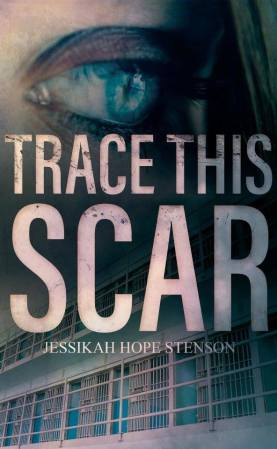
Trace This Scar has quite a bleak cover that matches the blurb for the book so well. How did that image come about and what were you hoping to convey (without spoiling the plot please!)?

I did a lot of research into the book covers of psychological thrillers then I saw the eye and just loved it, it demands attention. The fabulous Ollie Cave designed the dust-jacket and found the images of the prison and barbed-wire to complete it. The idea was to convey a sense of the looming threat of the criminal justice system and to imply that perhaps there’ll be a crime aspect to the novel.

If you could choose to be a character from Trace This Scar, who would you be and why?

If I could say none of them – I would! But if I have to pick, I’d be Jamie’s mum. She’s hilarious!

If Trace This Scar became a film, who would you like to play Daphne and Rich?

That is so difficult! Perhaps Emily Blunt for Daphne because she is so good in Girl On The Train. Leonardo Dicaprio for Rich – that could be quite conflicting for viewers. We have to include Jamie in this and I’d get Paul Wesley or Sam Heughan to play him – Sam’s already had practice of playing another Jamie in Outlander.

If you had 15 words to persuade a reader that Trace This Scar should be their next read, what would you say?

One woman’s dead. One man’s in prison. Perhaps both are innocent.

Thank you so much, Jessikah, for your time in answering my questions.

About Jessikah Hope Stenson

jessikah

Jessikah Hope Stenson is an author, book blogger and journalist. She currently studies English at the University of Exeter where she is also the Editor-In-Chief of PearShaped Music Magazine. In her spare time, she enjoys slam poetry, listening to Paramore and curling up with a good book.

You can follow Jessikah on Twitter, visit her blog and find her on Facebook.

There’s more with these other bloggers too:
postertracethisscar_blogtour

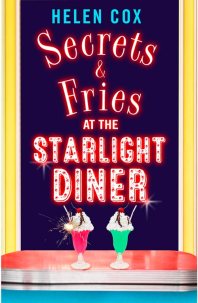
Cover Reveal: Secrets and Fries at the Starlight Diner by Helen Cox

starlight-diner-2

Having previously featured Helen Cox, author of Secrets and Fries at the Starlight Diner, with a smashing guest post all about where to eat in New York that you can read here, I’m delighted to be participating in the cover reveal for this latest book.

Secrets and Fries at the Starlight Diner will be published on 16th December 2016 is available for pre-order here.

 Secrets and Fries at the Starlight Diner

starlight-diner-2

What brings Bonnie Brooks to The Starlight Diner? And why is she on the run?

As the front-woman in a band, Bonnie is used to being in the spotlight, but now she must hide in the shadows.

Bonnie only has one person who she can turn to: her friend Esther Knight, who waitresses at the Fifties-themed diner. There, retro songs play on the jukebox as fries and sundaes are served to satisfied customers. But where has Esther gone?

Alone in New York City, Bonnie breaks down in front of arrogant news reporter, and diner regular, Jimmy Boyle. Jimmy offers to help her. Can she trust him?

When the kindly owner of the Starlight Diner offers Bonnie work, and she meets charming security officer Nick Moloney, she dares to hope that her luck has changed. Is there a blossoming romance on the cards? And can Bonnie rebuild her life with the help of her Starlight Diner friends?

About Helen Cox

helen

Helen Cox is a book-devouring, photo-taking, film-obsessed novelist. If forced to choose one, Helen’s Mastermind specialism would be Grease 2. To this day, she still adheres to the Pink Lady pledge and when somebody asks her if she is a god she says ‘yes.’

After completing her MA in creative writing at the University of York St. John Helen found work writing for a range of magazines, websites and blogs as well as writing news and features for TV and radio. She has written three non-fiction books and founded independent film publication: New Empress Magazine. She currently lives in York and writes novels.

You can find Helen on Facebook, follow her on Twitter and visit her website.

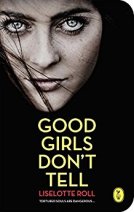
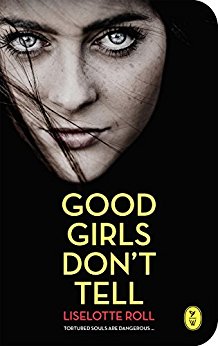
Argentina and Me, a Guest Post by Liselotte Roll, author of Good Girls Don’t Tell

good-girls-dont-tell

Having visited Argentina en route to Antarctica, I was fascinated by the country. Consequently I’m delighted to be featuring a guest post about Argentina by Liselotte Roll, author of Good Girls Don’t Tell as part of the launch celebrations for the book. Good Girls Don’t Tell was published by World Editions on 17th November and was translated by Ian Giles. It is available for purchase here.

Good Girls Don’t Tell

good-girls-dont-tell

When Erik Berggren, a man with  learning disabilities is found mutilated and brutally murdered Inspector Magnus Kalo and his team are mystified.  Other than being an alcoholic, the victim seems to have led a completely normal, if rather lonely, life.

Then Erik’s mother is viciously attacked in a similar way.  Investigating family secrets that stretch back decades and a trail that leads to to the Argentinian military Junta’s reign of terror Magnus realises that someone is stalking him and his own family.  His wife, Linn, a therapist, offers her own insights into the case until she too is attacked.

As the Swedish winter draws in clues seem to disappear under the falling snow. It’s clear that Magnus is on the trail of a master manipulator with a brutal mission…

Argentina and Me

A Guest Post by Liselotte Roll

The earth is dry and red, with harsh mountains and here and there and clusters of huge cactus plants. Once in a while you’ll see rattlesnakes sunbathing on top of the sun heated rocks.

Prior to my work as a news reporter and scriptwriter for a kids show in public radio I worked as an archaeologist. It was during that time, in the late 90’s that I visited Argentina and La Rioja, a medium size city embedded in the Pre-Andees. I was part of a pre-Incan excavation, looking for the remains of the locally called ‘Leopard people’. The country and its generous people made quite an impression on me. I was young and travelled by myself so I had to reflect on everything on my own, since there was no travel companion to bounce off my thoughts with, maybe that’s why I remember everything so well.

Initially I stayed at a self-proclaimed Shaman woman who had an altar of Marilyn Monroe in her hallway and a dog kennel in her house. I thought it was quite interesting and exotic, but my colleagues at the Patrimonial Cultural were concerned. They argued that her house wasn´t clean enough (the dogs had some accidents) and that the woman was obviously mad. Eventually a colleague of mine invited me to stay at her house instead, and we became good friends and indeed still are.

My friend told me stories about the military junta and took me to a cemetery where young men who had died during the military regime were exposed in glass coffins, to always be remembered. It was emotional and I think that’s why ten years later I came to write Good Girls Don´t Tell. And small pieces of my life melted together in this story.

Argentina has a sad history, but the people are still able to enjoy life in a way that Swedish people usually don’t. Maybe it’s the hot weather, maybe it’s because they have learnt to appreciate what they have, knowing that all can be lost? In Sweden we close our doors in the late fall and don’t come out until the light and warmth comes back, usually six months later, so we are not a very social people.

Argentina and Sweden are different in many ways, but my characters seemed to move themselves easily over the borders, both geographically and emotionally. It really didn’t matter if they were in a snowy Sweden or struck by a heat wave in La Rioja, they did what they were destined to do. My main characters, Linn, who is a smart therapist and her husband Magnus, who is a kind but somewhat slow minded cop, have to protect themselves and their two little daughters from a very conniving and savage murderer, who likes to scald his victims, and the tracks went back to the military regime in Argentina.

When I get a story in my mind it usually rolls along by itself. It´s more or less like watching a movie, with the exception that I can go back and change parts I don´t like afterwards. I really loved writing this scary story, hopefully you will like it too … and hopefully I will frighten you.

About Liselotte Roll

liselotte

Liselotte Roll lives with her family near Stockholm. While studying Archaeology, she lived and worked in Argentina, where she witnessed at first hand how the military junta’s reign of terror was still affecting the lives of Argentinians. This experience led to her debut novel Good Girls Don’t Tell.

Liselotte Roll has been compared to crime writers such as Camilla Läckberg, Liza Marklund, Sara Blaedel and Karin Slaughter.  Her work has been translated into eight languages.

About Ian Giles

Ian Giles currently divides his time (often unequally) between translation and his doctoral research at the University of Edinburgh in Scotland. He also sits on the managing committee of the Swedish-English Literary Translators’ Association. He has translated a wide range of Scandinavian works for publication or performance, including August Strindberg’s Dance of Death. In 2015, Ian was shortlisted for the Crime Writers’ Association International Dagger for his translation of Andreas Norman’s Into A Raging Blaze.

You can find Ian on Twitter.

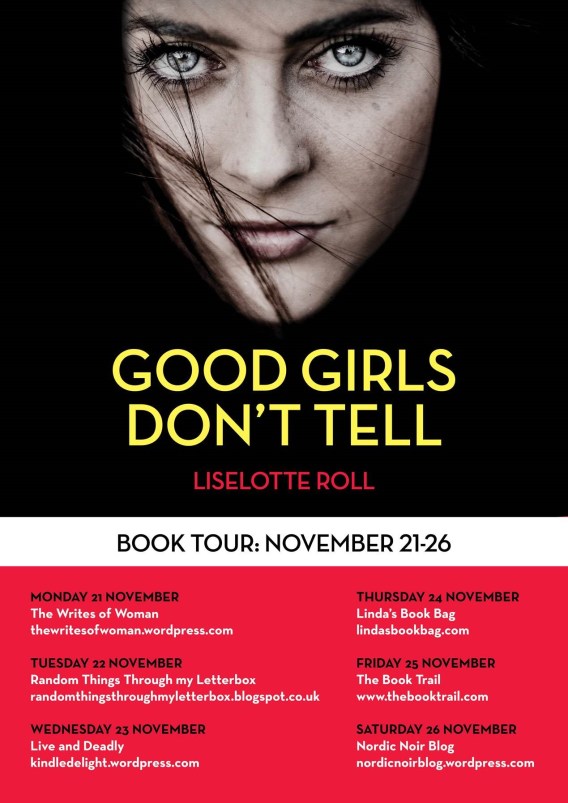
There’s more with these other bloggers too:

good-girls-tour-banner-use-this-final

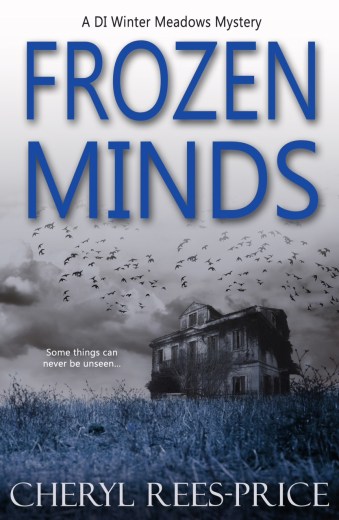
Setting the Scene, a Guest Post by Cheryl Rees-Price, author of Frozen Minds

frozen-minds

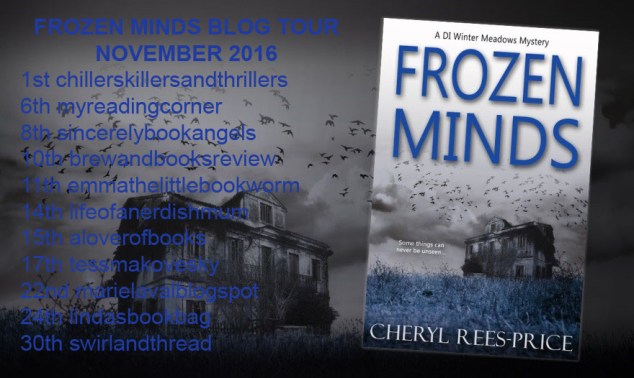
I love featuring authors I’ve actually met so it gives me great pleasure to be part of Cheryl Rees-Price’s blog hop for Frozen Minds as I met lovely Cheryl at a recent book event. Cheryl’s second book in her The Winter Meadows series, Frozen Minds, was published by Accent Press on 14th October 2016 and is available for purchase in e-book here.

To celebrate Frozen Minds, Cheryl has provided a smashing guest post all about the challenges of settings.

Frozen Minds

frozen-minds

When a man is found murdered at Bethesda House, a home for adults with learning difficulties, local people start to accuse the home’s residents of being behind the killing. The victim was a manager at the home, and seemingly a respectable and well-liked family man.

DI Winter Meadows knows there’s more to the case than meets the eye. As he and his team investigate, Meadows discovers a culture of fear at the home – and some unscrupulous dealings going on between the staff.

Does the answer to the case lie in the relationships between the staff and the residents – or is there something even more sinister afoot?

Setting The Scene

A Guest Post by Cheryl Rees-Price

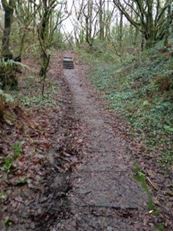
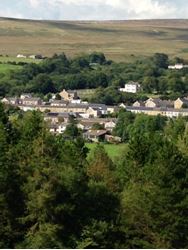
When I started writing The Winter Meadows series my first choice of setting was the village and surrounding area where I grew up and still live. It seemed to be a perfect location, I knew the area well, there are plenty of nooks and crannies to hide a body, and no C.C.T.V. Added to that there is also the abundance of secrets and gossip.

As I started to write it occurred to me how easily I could offend. I couldn’t just place a body on someone’s farmland, this could well cause suspicion especially if the farmer’s wife was off to visit her daughter in Australia. Then what of the antagonist? Imagine if the character was the local vicar, school teacher or shop keeper, I could be responsible for all manner of rumours!

To solve the problem I created a fictitious setting, based on the Valley. This gave me the scope to place buildings where I pleased and squeeze in an extra farm, or church. Anyone who lives locally can still identify the area and some readers have told me they enjoy working out where I am in the valley as they read.

The Setting for The Silent Quarry

silent-quarry

So what makes remote locations a good setting for a murder mystery? For me the close knit communities found in small remote villages was appealing. People have a sense of belonging, many have grown up in the area and are from large families. There is also a sense of safety, if you are out late at night it’s likely you will run into someone you know out walking the dog. They will stop for a chat, comment on the weather and ask after your mother. This makes a murder in these locations so much more shocking. One of your own has been taken and one of your own could be responsible. It is a fact that murder is less common in small communities. If you look at the citizens report UK site, locations where there has been a violent crime are highlighted with a balloon. You can see the balloons clustered around the larger cities, very few in remote areas. When these crime do occur there is a huge impact on the community involved with many affected, someone is a relative, close friends, or neighbour of yours.

Home

home

Most who live in these villages will confess to enjoying a good gossip. This exchange of information renders the local newspaper redundant. You can find out who is sick, who’s been having an affair and who’s dead all when going out to post a letter. The gossip goes around like Chinese whispers and there have been occasions when someone has been pronounced dead only to be seen walking the dog up the park two days later.

From a writer’s point of view gossip can either hinder or help the investigation. It is a great way of getting information across to the reader and can aid in setting a smoke screen.

I have tried to capture the spirit of the community in my books and encompass the shock, speculation, and fear that follows a violent crime. Fortunately for me the only crime to occur in my home village is that in my imagination.

About Cheryl Rees-Price

cheryl-by-rasa-mombeini-6

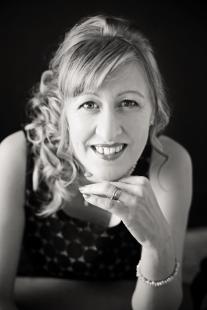
Cheryl Rees-Price was born in Cardiff and moved as a Young child to a small ex-mining village on the edge of the Black Mountains, South Wales, where she still lives with her husband, daughters and two cats.  After leaving school she worked as a legal clerk for several years before leaving to raise her two daughters.

Cheryl returned to education, studying philosophy, sociology and accountancy whilst working as a part time book keeper. She now works as a finance director for a company that delivers project management and accounting services.

In her spare time Cheryl indulges in her passion for writing, the success of writing plays for local performances gave her the confidence to write her first novel. Her other hobbies include walking, and gardening which free her mind to develop plots and create colourful characters.

You can find out more about Cheryl by visiting her website, following her on Twitter and finding her on Facebook. There’s more with these other bloggers too:
blog-tour-banner

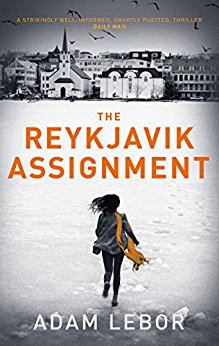
Iceland, a Guest Post by Adam LeBor, author of The Reykjavik Assignment

cover

I loved Reykjavik when I visited so even the title of Adam LeBor’s The Reykjavik Assignment appeals and I’m delighted to be part of the launch celebrations. The Reykjavik Assignment was published by Head of Zeus on 3rd November 2016 and is available for purchase here.

Today, Adam LeBor tells us why Iceland is perfect as a setting for thriller writers.

The Reykjavik Assignment

cover

A lone agent. A terrifying enemy. UN negotiator Yael Azoulay uncovers a people-trafficking ring with links to Iran… and Washington.

UN covert negotiator, Yael Azoulay, has been sent to Reykjavik to broker a secret meeting between US President Freshwater and the Iranian president. Both parties want the violence to stop, but Yael soon realises that powerful enemies are pulling the strings. Enemies for whom peace means an end to their lucrative profit streams.

In this gripping, intelligent thriller, Adam LeBor uses insights gained from twenty-five years of frontline reporting to show us who really has the upper hand in the international game of politics.

Iceland

A Guest Post by Adam LeBor

Iceland is a gift for thriller writers.

The ground is alive: giant cracks rend the earth asunder, geysers erupt, sending giant spurts of boiling water high into the air. Underneath our feet tectonic plates shift, magma bubbles. Great plains of black lava stretch towards the horizon. A freezing wind howls, pauses for a moment as if to take a breath, then whips at us with even greater force while rainbursts explode overhead.

And then, as suddenly as the downpour erupted, it stops. The sun appears, the wind stops, and the sky turns blue. The local saying has it best: “Welcome to Iceland. If you don’t like the weather then wait five minutes.”

Yet the bleak landscape has proved a catalyst for extraordinary creativity. The Sagas, the epic tales of life in Iceland in the 10th and 11th centuries, rank with Homer and Shakespeare. Iceland has more writers and publishes more books per capita than any country in the world.

Iceland certainly worked it creative magic on me. I travelled there as a guest of the Iceland Writers Retreat. The second half of The Reykjavik Assignment, my new thriller, takes place in Iceland. Yael Azoulay, the heroine, is a former Mossad agent who now works as the secret negotiator for the United Nations secretary-general. Yael is in Iceland on her most difficult and dangerous mission yet: to broker a secret deal between the presidents of the United States and Iran.

My trip to Reykjavik and its surrounds provided plenty of scene-setting. I took long walks around the city to find useful and suitable locations. There are no rules for the kind of place that can be useful and I don’t take notes. I do take photographs and video clips, dozens of them for each city. There’s definitely something about water that appeals to me: seafronts, lakes and oceans; ferries and ships seem to feature in most of my thrillers.

I spent quite a while at Lake Tjörnin in the heart of downtown Reykjavik. This is how Yael sees the lake and the shore, while she waits for Eli, her former lover and enemy, to kidnap her.

The shore was lined with large, detached houses painted in bright colors, their reflections shimmering on water the color of gunmetal. The sky was a patchwork of clouds, daubs of white on a vast gray canvas. The wind gusted back and forth, sending gentle waves lap- ping at the shore.

And there is always something new to learn on location-finding trips, which can also be included in the narrative:

Who knew bird-watching could be so engrossing? A whooper swan glided across the water, its long white neck regally straight. A short and stubby greylag goose bobbed past, its beady black eyes looking from side to side. A mallard watched her warily from the stone bank, its green head tucked into its curved body. The sun suddenly emerged and the lake shimmered.

I was lucky enough to interview Olafur Ragnar Grimsson, the then-president of Iceland, on my trip, for Monocle magazine. We met at Bessastadir, the presidential residence, which stands on an isolated strip of land a short drive from the city. I knew immediately that Bessastadir would be the setting for the climax of the book. This is how I used the setting in The Reykjavik Assignment:

Bessastadir was only twenty minutes’ drive from downtown Reykjavik, but the sense of isolation was palpable. It was a tiny settlement, a handful of buildings and a church, built on a long, thin promontory of land that poked into the Atlantic like a crooked finger. Such isolation was not rare in Iceland, but more surprising was the lack of security at the residence. The flat terrain around it was wide open, the gray-green grass, liberally spattered with seabird droppings, turning into a swampy black mud where it met the water.

A low white gate controlled vehicular access to the black stone road, but it would barely slow a family sedan, let alone a determined attacker. There were no fences or gates or flip-up barriers to stop a vehicle crashing into the building. The windows seemed to be normal glass. Overhead a helicopter swooped low, banked steeply, and then headed out to sea. With the Americans and the Iranians coordinating with the Viking Squad, the residence was ringed with well-trained, armed agents from all three countries. But the basic topography could not be changed. Bessastadir was an assassin’s dream.

Until Yael Azoulay arrives.

About Adam LeBor

Adam LeBor lives in Budapest and writes for the Economist, Newsweek, New York Times, The Times and other publications. He is the author of a number of nonfiction books, including the Orwell Prize shortlisted Hitler’s Secret Bankers.

You can find out more about Adam by visiting his website, by following him on Twitter or on Facebook.

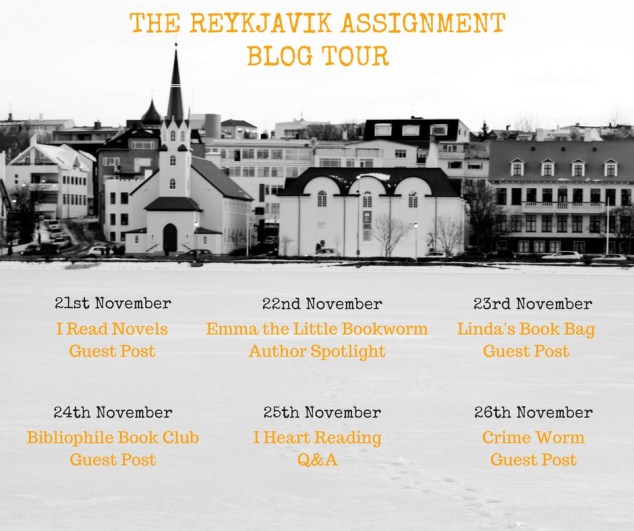
There’s more too with these other bloggers:

reykjavic-assn


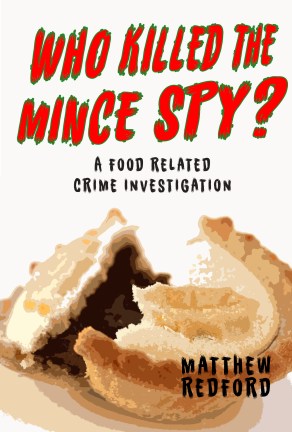
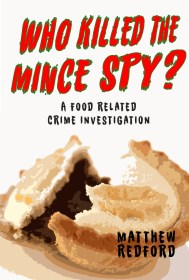
Who Killed The Mince Spy by Matthew Redford

who-killed-the-mince-spy

I’m delighted to be taking part in the launch celebrations of Who Killed The Mince Spy by Matthew Redford. Who Killed The Mince Spy will be published by Clink Street on 6th December 2016 and is available for purchase in e-book and paperback here.

In celebration, as well as my review, Matthew Redford has kindly provided a guest post all about Christmas cracker jokes.

Who Killed The Mince Spy

who-killed-the-mince-spy

Who Killed The Mince Spy?

Tenacious carrot, Detective Inspector Willie Wortell is back to reveal the deviously delicious mind behind the crime of the festive season in this hugely entertaining, and utterly unconventional, short story.

When Mitchell the Mince Spy is horrifically murdered by being over baked in a fan oven, it falls to the Food Related Crime team to investigate this heinous act. Why was Mitchell killed? Who is the mysterious man with a long white beard and why does he carry a syringe? Why is it that the death of a mince spy smells so good?

Detective Inspector Willie Wortel, the best food sapiens police officer, once again leads his team into a series of crazy escapades. Supported by his able homo sapiens sergeant Dorothy Knox and his less able fruit officers Oranges and Lemons, they encounter Snow White and the seven dwarf cabbages as well as having a run in with the food sapiens secret service, MI GasMark5.

With a thigh slap here, and a thigh slap there, the team know Christmas is coming as the upper classes are acting strangely – why else would there be lords a leaping, ladies dancing and maids a milking?

And if that wasn’t enough, the Government Minister for the Department of Fisheries, Agriculture and Rural Trade (DAFaRT) has only gone and given the turkeys a vote on whether they are for or against Christmas.

Let the madness begin!

This short story by Matthew Redford follows his deliciously irreverent debut Addicted To Death (Clink Street Publishing, 2015).

addicted

Three Favourite Christmas Cracker Jokes

A Guest Post by Matthew Redford

So who doesn’t like a good Christmas cracker joke? They are silly, corny, and groan-inducing but every bit a part of Christmas lunch as the turkey or the roast potatoes.  Who can resist sitting around the kitchen table wearing a paper hat, pigs in blankets wrapped up cosily on your plate, reading aloud some of the worst jokes ever to have been written?

And let’s be honest, if you are forcing Brussels sprouts down your throat at least you can try and have a chuckle while doing so.

Personally, I look forward to the Christmas cracker jokes. And before you ask, I honestly haven’t been on the mulled wine before I started to write this piece. I have a daft sense of humour. I like puns. I enjoy wordplay, and so they appeal to me. I share this sense of humour with my Mum and, when he was alive, my grandfather too. For my Dad and my Nan, they look at me and Mum as we fall about laughing as though we’ve lost the plot completely, which to be fair, we probably have.

So while much derided, I am going to stick-up for the Christmas cracker joke. It is not easy to write a Christmas cracker joke. It has to be easy to understand, short, sharp and funny. They are underrated, slightly surreal and the perfect antidote for when you realise that despite having eaten those darn Brussels sprouts for the last twenty minutes, you’ve still got another five left on your plate. Seriously, do they multiple when you are not looking?

So here are my three top Christmas cracker jokes and the reasons why I think they are funny.

How does Good King Wenceslas like his pizzas? Deep pan, crisp and even.

It’s daft, it’s funny and its food related which I like. There is also a nice musical element to the joke. So not only do you get to tell a joke, but you can sing the punch line too if you feel so inclined! Just a word of warning, which is that while you can sing a punch line, those at the kitchen table don’t appreciate it when you stand on your chair giving it the big jazz hands. Apparently that is considered ‘unnecessary and over the top’.

What happened to the man who stole an advent calendar? He got 25 days…

And so he should, theft is no laughing matter, In fact, he should have got a lot longer than just 25 days…oh, hang on, I’ve just got it. Silly me, apologies everyone.

Who hides in the bakery at Christmas? A Mince Spy.

Now I had to have this one in the mix didn’t I? How could I overlook a mince spy given that I have written a food related crime story about one who gets murderously over-baked. So the mince spy is the James Bond of the Christmas food items, mysterious, spicy, rarely seen all year around and then before you know where you are, its Christmas and the mince spy is about once more!

My Review of Who Killed The Mince Spy

Mitchell the Mince Spy has been horrifically murdered by fan oven and it’s up to food sapiens police officer Detective Inspector Willie Wortel so solve the case.

Recently my dear father passed away. One thing he was always known for was his awful jokes, so I feel I’m honouring his memory by featuring a book that has equally groan worthy jokes on Linda’s Book Bag.

I’m going to be completely honest; had I not agreed to be part of the blog tour I wouldn’t have read Who Killed The Mince Spy. I rarely enjoy so-called comic writing as my sense of humour seems at odds with that of many authors. However, I did enjoy Matthew Redford’s book. It lifted my spirits at a very sad time. The puns were akin to those in my childhood from the Beano and I liked the ones based on word play especially.

Aside from the ridiculous humour though, Who Killed The Mince Spy is actually cleverly written. There are many political, social and historical references and I liked playing spot the allusion and the conceit of referring to the first story in the series too, Addicted to Death. There is also a fast paced, completely madcap, plot for readers to enjoy.

Who Killed The Mince Spy is seriously bonkers. If you have the kind of sense of humour that loved the Leslie Nielson films, for example, this book is a must.

Oh – and in the spirit of this blog post, a typical joke from my Dad in advance of his funeral on Thursday;

Q.’Why is there a cockerel on so many church spire weather-vanes?

A. ‘Because if there was a hen, it’d be too far to collect the eggs!’

About Matthew Redford

Born in 1980, Matthew Redford grew up with his parents and elder brother on a council estate in Bermondsey, south-east London. He now lives in Longfield, Kent, takes masochistic pleasure in watching his favourite football team snatch defeat from the jaws of victory, is a keen chess player and is planning future food related crime novels. To counterbalance the quirkiness of his crime fiction Redford is an accountant. His unconventional debut crime thriller, Addicted to Death: A Food Related Crime Investigation was published by Clink Street Publishing last summer.

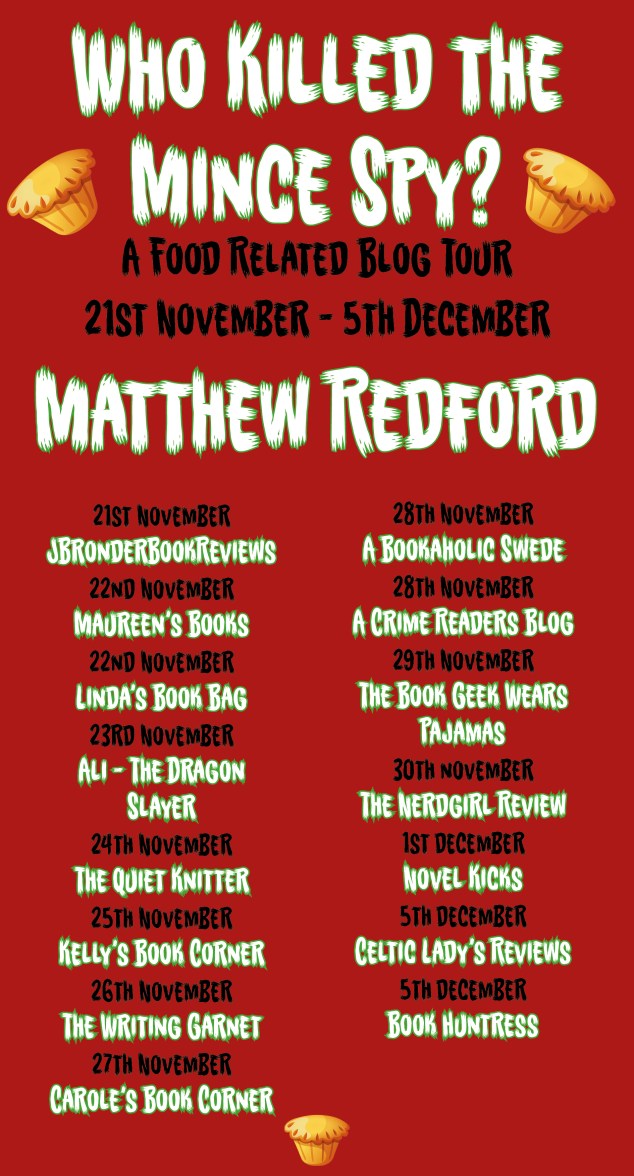
You can find more about Matthew by following him on Twitter and visiting his website. There’s more with these other bloggers too:

matthew-redford_banner

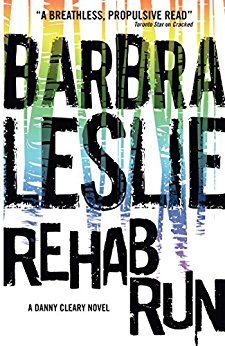
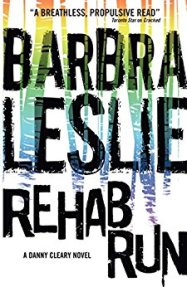
Rehab Run by Barbra Leslie

rehab-run

I’m so excited to welcome back Barbra Leslie to Linda’s Book Bag to celebrate Rehab Run, the second in Barbara’s Cracked trilogy. Rehab Run is published today in North America and on 25th November 2016 in the UK, by Titan and is available in e-book and paperback from Amazon and through the publisher.

Last year I read the first in the series, Cracked, my crime book of the year 2015, reviewing it here and was delighted when Barbra agreed to an interview which you can read here. Today, to celebrate Rehab Run, Barbra has written a guest blog all about her central character Danny, who doesn’t always behave as Barbra wants! I’m also sharing my review.

Rehab Run

rehab-run

Danny Cleary is getting clean. When her twin sister was murdered and her nephews kidnapped, drug-addicted Danny crossed North America with her brother Darren pursuing those responsible and being pursued. Now she’s in rehab in the peace and tranquility of rural Nova Scotia; the hardest thing she’s smoking is nicotine, and she s taken up running. This was exactly what she needed. Then she finds a human hand in a mailbox and her rural idyll is shattered. Once again Danny is drawn into a complex underworld of insanity, revenge and murder. She will have to fight to protect her family and uncover the truth.

Controlling Character

A Guest Post by Barbra Leslie

The lovely Linda Hill mentioned something to me recently about writing about the “less salubrious” side of life – her words, not mine.  Once I was able to wipe the smile off my face (‘salubrious’ is one of my favourite words, and I’m always tickled when someone uses it), it got me thinking.  How much of my own life makes it into my fiction?  And holy cow, does everyone assume my own life is as dark as what I write about?

The first novel in my crime trilogy, Cracked, involves a woman – who happens to be a crack addict – on a quest to avenge her twin sister’s murder.  As readers of Linda’s blog may know, I took my own trip down the rabbit hole of addiction, years back.  (In fact, I started writing an early draft of the book when I was recovering.)  Cracked covers a lot of ground – literally.  From the streets of Toronto to a wealthy California beach town and east to the wilds of Maine, Danny is an unstoppable force.  It has an almost frenetic pace.

In the new book, Rehab Run – and I don’t think I’m giving much away here, future readers – Danny is in rehab.  This time, she’s in a cloistered private facility on the east coast of Canada, in Nova Scotia.  And in this chapter of the Danny saga, we are entirely in one part of the world; no private planes for our heroine in this book.  That being said, the action – and as I wrote it, you can be pretty sure there is a lot of action – takes place in the idyllic Annapolis Valley.

I was born and raised in the area I wrote about in Rehab Run.  I have family and friends there.  Those streets and lakes and woods are as familiar to me as the concrete jungle I live in now.  In fact, the Annapolis Valley is where I retreated to, when I left the mess of my own life of addiction behind.  While I never went to rehab myself – I white-knuckled detox and recovery on my own – and the facility Danny stays in is a figment of my imagination, I used a lot of my own experience, my own pain, and made it Danny’s.  Writing about Danny’s struggles with addiction is an exorcism, of sorts, for me.

That being said, I most definitely have not walked in Danny’s shoes in most respects, I am happy to report.  I have three amazing sisters, all of whom are alive and kicking.  And like most of us in the real world, I don’t think I have an archenemy, and as far as I can recall no one has every shot at me with a crossbow.  Really, she and I don’t have much in common, other than that pesky addiction, and the tendency to be a smart-aleck at unfortunate moments.  It may sound crazy to some, but Danny really has got a life of her own, outside of my plans for her.  I found that while writing Rehab Run, Danny was getting up to things that I hadn’t planned for her.  As a writer, that’s both invigorating and sometimes slightly annoying, throwing my careful plot outlines out the window.

Speaking of which, one of my favourite scenes in Rehab Run involves Danny crawling out an upstairs window clad in not much more than an old pair of her late husband’s boxers.  I hadn’t planned for her to do that, but Danny does what Danny does.

Myself, I’m closing my window right now against a cold, grey November morning in Toronto.  I’m keeping myself firmly planted in my office chair, throwing an old cardigan over my t-shirt, and working on my plans for Danny in the next book.  Which she will, undoubtedly, ignore.

(And which I can’t wait to read about Barbra!)

My Review of Rehab Run

Crack addict Danny is trying to get clean in Rose’s rehabilitation unit after a pretty tough time, but her life simply won’t settle down.

Barbra Leslie’s writing should come with a warning; if you don’t want to put your life on hold, don’t pick up one of her books because once you have, that’s it – you’re hooked. Having loved Cracked I wondered whether Rehab Run would appeal as much. It did. I couldn’t tear myself away.

It’s so difficult to review books like Rehab Run without giving away some of the plot, which in this case is twisty and compelling so that one shock for the reader follows another until you’re almost as punch-drunk as some of the characters! Rehab Run is a thrilling, heart thumping read. I kept having to put the book down to get my breath back and take in the furious pace of events, but I couldn’t leave it alone either and had to read on, almost without my own say so, so brilliant is Barbra Leslie’s storytelling. I don’t usually quote from fiction books I review for fear of spoiling the read, but if I share the first line of Rehab Run I think you’ll get an idea of Barbra Leslie’s style far more eloquently than I can express: ‘It was just my luck that I was the one who happened to to find the severed hand in the mailbox.‘

As the narrative raced along, with the frequently gruesome body count increasing, I was well out of my comfort zone, but I loved every word, even the frequent expletives as they are never out of place or gratuitous. What Barbra Leslie does so skilfully is to vary the length of her sentences so that they have maximum impact, especially at the end of chapters. She also writes with a wry, dark humour and the first person approach made it feel as if someone I knew really well, Danny, was addressing me directly as I read.

And it is Danny who really makes this series so magnetic. She is an incredible creation. She’s violent, unpredictable, feisty and volatile but equally vulnerable and sensitive when it comes to those she loves. If the chips were down you’d want her on your side and to be honest, I’d be completely terrified if she were my enemy.

Whilst Rehab Run is the second in the Cracked trilogy, you don’t have to have read Cracked to appreciate and enjoy it. There are references that will help new readers and remind previous ones, but Rehab Run is a brilliant thriller as a stand alone too. I honestly, truly, can’t recommend Barbra Leslie’s writing highly enough. If you love crime thrillers and you haven’t read Cracked or Rehab Run you’re really missing out.

About Barbra Leslie

img_1059-1-1

Barbra Leslie studied film and theatre at York University, then English at University of Toronto. She has published numerous stories in literary magazines, novels, and a screenplay. She’s been a marketing manager for a major law firm, a court reporter, and a criminal law issues officer for a government ministry.

You can follow Barbra on Twitter and visit her website.

Jungle Rock by Caroline James

jungle-rock

I was delighted to be offered a copy of the novella Jungle Rock by Caroline James in return for an honest review as I’ve featured Caroline in interview on Linda’s Book Bag in the past. You can read that interview here. Today Caroline explains how Jungle Rock came about – and how, with writer’s block, it nearly didn’t!

Jungle Rock is published today, 21st November 2016, by Ramjam and is available for purchase here.

Jungle Rock

jungle-rock

Handsome young chef, Zach Docherty is feeling the heat. Following an exposé in a national newspaper, his fiancée Poppy Dunlop has broken their engagement. Heartbroken at the thought of life without Poppy, Zach drowns his sorrows and when his agent suggests that Zach becomes a contestant in a reality TV show, Jungle Survival, he reluctantly agrees. Plunged deep in the jungle, into a bizarre mix of talent and trials, Zach meets glamour model, Cleo Petra, and the cameras go crazy.

Will Zach survive and be crowned Jungle King?

Or will his latest exploits push Poppy further away…

Jungle Rock and Writer’s Block

A Guest Post by Caroline James

AUTHOR CAROLINE JAMES (PROFESSIONAL PROMO SHOTS 14.08.2015)

Huge thanks to Linda for hosting me on her lovely blog today. Jungle Rock is my new novella and has been described as ‘a feel-good read’. I wrote this shorter story at a time when I was having a writer’s block and as soon as I started, the words began to flow again. Jungle Rock finds Zach Docherty, a handsome young celebrity chef, plunged deep into the Australian jungle when his agent puts him forward to be a contestant on a popular TV reality show. Zach is feeling the heat after a recent expose in a national newspaper and his fiancée has broken their engagement. The novella includes characters from previous novels but like all my novels, is a stand-alone read. Perhaps the familiarity of the characters helped to get me writing again.

To have a block in any work of creativity is tough, especially when it is your job and it is a discussion I often have with a lovely group of writers that I belong to (The Cheshirati). My own thoughts on how to overcome this problem is to stop procrastinating and turn up at the page and write. Get your rear on a seat and get typing. It doesn’t matter what you get down, at some stage something will start to develop. Don’t attempt to proof or edit till the end and most of all, believe in yourself; don’t die wondering about what might have been.

The urge to write is back, thank goodness, and my next novel, Boomerville, is scheduled for 2017. Jungle Rock is a happy piece and it made me smile and I hope readers enjoy the novella as much as I enjoyed writing it.

Happy reading and writing xx

My Review of Jungle Rock

Having blown his engagement with Poppy, Zach finds himself in a reality TV programme in Australia.

I haven’t read the other books featuring Zach, but it made no difference at all to my enjoyment of this topical and entertaining story. I have a confession. My guilty pleasure is ‘I’m A Celebrity, Get Me Out Of Here‘ which I watch every year leading up to Christmas. Now, whilst I don’t think you need to be a fan of the programme to appreciate Jungle Rock, the fact that I am really enhanced my pleasure in the story as there are many echoes. I could imagine the scenarios and recognise the references which brought the story to life very vividly. Christmas is an underlying theme too, but it is not overdone as in some Christmas stories. It successfully underpins the time of year in which the story is set.

Whilst Zach is the central character, he is presented in a slightly oblique way so that Poppy, Bob, Jo and Harriett have greater focus and uncover Zach to the reader. I really liked this different approach and felt I got to know all the characters intimately, despite Jungle Rock being a novella. There’s a brilliant range of individuals with a cast of different ethnicities, sexualities, professions and ages so that Jungle Rock has a character that every reader can relate to.  I especially liked the fact that Harriett and Jo are living life to the full, giving a positive image of those of us of a certain age!

I thoroughly enjoyed the underlying messages to the story too. Characters are quick to judge one another and have to reassess their position which gives a clear message about not jumping to conclusions even when presented with ‘evidence’. Caroline James celebrates family, relationships, honesty and trust in her quick and lively writing and through her fast paced plot.

If you’re looking for a highly entertaining story for a winter’s afternoon in the run up to Christmas, look no further. Jungle Rock is for you.

About Caroline James

AUTHOR CAROLINE JAMES (PROFESSIONAL PROMO SHOTS 14.08.2015)

Caroline’s debut novel, Coffee Tea The Gypsy & Me shot to number 3 on Amazon and was E-book of the Week in The Sun newspaper. Her second novel, So, You Think You’re A Celebrity… Chef? has been described as wickedly funny: ‘AbFab meets MasterChef in a Soap…’ Coffee Tea The Caribbean & Me, an Amazon best-seller, was a Top Ten Finalist at The Write Stuff, London Book Fair 2015 and the judge’s comments included: Caroline is a natural story-teller with a gift for humour in her writing.” Her next novel, Boomerville will be published spring 2017.

Gypsy

Caroline has owned and run many catering related businesses and cookery is a passion alongside her writing, combining the two with her love of the hospitality industry and romantic fiction. As a media agent, Caroline represented many well-known celebrity chefs and her TV script, So, You Think You’re A Celebrity Chef? was runner up at the Winchester Writers Festival 2016.

She has published short stories and is a member of the Romantic Novelist’s Association. Caroline writes articles on food and celebrity based interviews and is Feature Editor for an online lifestyle magazine. She is a founder member of The Cheshirati and is available for inspiring and entertaining talks on anything related to the hospitality and publishing industry.

You can find all of Caroline’s books on Amazon UK and Amazon US.

You can find out more about Caroline on her website and follow her on Twitter. You’ll also find her on Facebook.

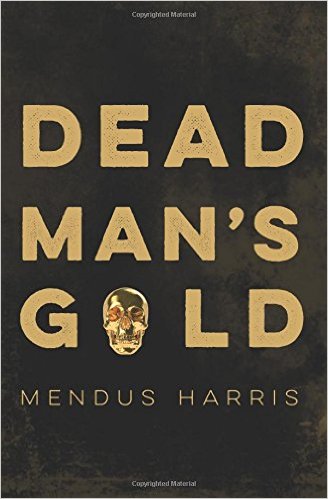
An Interview with Mendus Harris, author of Dead Man’s Gold

dead-mans-gold

I’m delighted to welcome Mendus Harris to Linda’s Book Bag today to tell us all about his writing and Dead Man’s Gold in particular. Dead Man’s Gold is the first in the Lomax Gold Mine Series and is available for purchase in paperback here.

Dead Man’s Gold

dead-mans-gold

There is a small town in Ghana, W Africa which exists for no other reason than to mine gold. It was founded in the early twentieth century when a lucky strike sent people flocking to the site to find wealth and employment.

Edryd (Ed) Evans arrives from his hilltop on the Welsh Borders. He is an experienced gold exploration geologist who has spent large amounts of time in West Africa. But he is wary of returning after being kidnapped and held hostage on his previous visit. He has come because an old friend, Greg Boston, has disappeared in mysterious circumstances…

An Interview with Mendus Harris

Firstly Mendus, please could you tell me a little about yourself?

I’m a Welsh Liverpudlian, born in Scotland whose spiritual home is in Ireland. After many years working as a geologist in mining I now earn a living as a teacher. I’m married with three children and live in North Wales.

When did you first realise you were going to be a writer?

I always felt that  I’d like to be a fiction writer, the urge grew progressively as I got older, when I realised that I had a story to tell. I began to write seriously seven years ago

If you hadn’t become an author, what would you have done instead as a creative outlet?

As a gold exploration consultant I was required to write the equivalent of a Master’s thesis every six weeks. Although based in cities in New Zealand, then Australia and then Canada, much of my time was spent in isolated mine or exploration camps in the Outback, Labrador Coast, Scandinavia and, of course, Africa. So in some ways being an author is a way of utilising the creativity that developed during these formative years.

How do you go about researching detail and ensuring your books are realistic?

I write using my own experiences. Dead Man’s Gold is a memoir that morphed into a work of fiction when I stitched my own recollections of working in a real African gold mine along a plot line. The more outlandish incidents have been left out, either because nobody would believe them, or because they would be misunderstood.

Which aspects of your writing do you find easiest and most difficult?

The beginning is hardest. You need to start somewhere, and I always begin writing at the beginning with the knowledge that much of it will be ditched. After the meat of the book is written, it’s time to return to the beginning and rewrite. This can be challenging, particularly when it’s a sequel and the events of the previous book have to be summarised for events in the new book to make sense.

What are your writing routines and where do you do most of your writing?

Writing gets done when time and tiredness allow. The best times are in the morning at the weekend or a couple of hours at night once the kids are in bed.

You’re now based in North Wales. How far has location impacted on you as a writer?

It probably influenced the setting of Ed’s farmhouse. As a writer (and teacher) having a place like North Wales on my doorstep is very important. I can be in Snowdonia and climbing a hill within an hour of leaving the house. Unfortunately my own family ditched the Welsh language a generation or so ago in the mistaken belief that it was a mill stone. Once a language is lost, its not so easy to regain, like trying to put toothpaste back into the tube.

When you’re not writing, what do you like to read?

Thrillers are best. Le Carre is king, but only his Cold War novels. Stieg Larsson has been a revelation. Quirky autobiographies; Boycott’s made me laugh like a drain recently. JRR Tolkien. Science fiction up to a point, if it’s internally consistent. Dean Foster’s rendering of the Alien movies are engaging. I like to dip into social history books, recently I read a book about the North Wales slate industry. The last heavy-weight book I read was Crime and Punishment.

Do you have other interests that give you ideas for writing?

One of my greatest joys is fly fishing for trout, particularly somewhere high and remote, several hours strenuous walk from road end. My mind empties and for several hours focuses on only one thing. Afterwards, ideas appear in my head.

Dead Man’s Gold has a very stark contrasting black and gold cover. How did that image come about and what were you hoping to convey (without spoiling the plot please!)?

The book is dark. It’s about conflict, whether between geologists and engineers, Europeans and Africans, new and old religions, capitalism and organised labour…… But the lustre of gold obliterates bonds of kinships and at the same time sharpens rivalries between intractable foes. It’s impossible to represent that fabric within the simple patina of a book cover

(I’d say you’ve done so pretty well!)

Dead Man’s Gold is the first of your books featuring Edryd (Ed) Evans. How did you create his character? (I’m wondering if he’s based on you, someone you know, if you used a template or post-its, or produced an entire character profile for him etc)

Ed has a lot of me in him, but not entirely, he’s what I might have become had I not stepped aside and become a teacher. I needed somebody from a similar background so I could anticipate reactions to certain people and situations. He’s a bit of a lost boyo or a faithful old dog who has difficulty interpreting people, particularly women. Health and happiness are always just out of his reach.

If Dead Man’s Gold became a film, who would you like to play Edryd (Ed) Evans?  

Ed is riven by internal conflicts, prey to the whim of powerful interests, fighting internal demons. Rhys Ifans would be good.

What can we expect from Ed in the future? (Blog readers please note there are slight spoilers in this answer from Mendus!)

In The Wolf Man Approaches Ed returns to the mine after a plea for assistance from Allen. The loose ends from Dead Man’s Gold are tied up and Ed realises that there’s more, much more, going on behind the scenes than he previously suspected. We find out a lot more about Allen and his murky past thanks to the arrival of two new characters at the mine.

In Ice Bound Ed is persuaded by Lucky Lomax, owner of the Lomax Mine, to visit the Labrador Coast in Canada. When the exploration camp is hit by a storm and all lines of communication are cut, Ed begins to realise that he’s been set up. Even in this remote place, echoes of the events at Lomax Mine continue to reverberate.

With so many countries in Africa relying on gold why did you choose Ghana in particular for your setting?

I know Ghana. I did dabble with a fictional country, mainly because people who know Ghana might think they recognise the mine in the book. But on long reflection I decided that didn’t matter, so long as I changed the name and did not use any easily recognisable characters.

As a geologist in a previous life, how easy or difficult is it to get the right balance of geological reference in your fiction?

Very difficult. In the end I’ve plumped for as little as possible, just enough to give a ring of authenticity. On the other hand, I think the use of trilobites will intrigue readers.

(Oh – I have a trilobite myself bought as a present by my husband!)

I know gold mining in Africa is fraught with danger and corruption. How much was this a motivator for your writing?

Quite a bit. Huge wealth flows out of the Lomax Mine into the hands of rich City investors and only a fraction of a percent finds its way into the pockets of ordinary people in the town.  They live in conditions of squalor, in shacks next to open sewers.  It’s the dichotomy between extreme wealth and extreme poverty which fuels the greed that causes corruption and dangerous working practices.

Dead Man’s Gold doesn’t shy away from the realities of life in African mining communities and I think some readers will be surprised by what they read. How far do you think it is the role of an author to educate as well as entertain?

People who like to read want to be transported from their own lives into another place, even if that place is less pleasant that their own. Life in a town surrounding an African gold mine is as detached from our own as its possible to get and still be on Earth. I think most people would see Lomax Mine and its town as a fantasy place.

If you could choose to be a character from Dead Man’s Gold, who would you be and why?

James Allen… Allen has led a charmed life. He is a man of experience who can read people. Rumours abound about his past and the Old Hands at the mine avoid him. He’s attractive because he’s an outsider, he isn’t swayed one way or the other by mere words and has enough internal resources to decide for himself.

As Dead Man’s Gold is the first in a series, how have you managed continuity and progression in your writing?

By keeping the number of characters and places to a minimum.  Although the third book, “Ice Bound”, takes place outside the Lomax Mine, its setting is an island where there is only four other people. Keeping the primary POV to Ed also helps to maintain the continuity, it forces discipline.

And finally, if you had 15 words to persuade a reader that Dead Man’s Gold should be their next read, what would you say?

Life and death at an African Gold Mine written by someone who knows.

About Mendus Harris

mendus

Mendus Harris has been writing conspiracy thrillers for the last ten years. His latest books are based in a fictional gold mine named Lomax and draw on his extensive experience as an exploration geologist.Very few people appreciate how a large gold mine in Africa functions and those that do may not be keen for the truth to be told.

His writing conjures images which are redolent with the sights and sounds of West African gold mines, the characters who inhabit them and the political conflicts which can threaten to rip them apart. Here is an author who has been there and seen that and has a view on what he has experienced.

You can find out more by visiting Mendus’ website and finding him on Facebook. You can also follow him on Twitter.

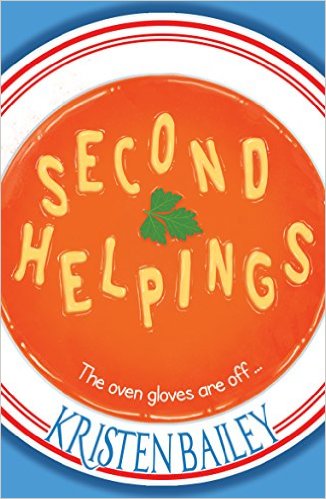
Seven Secrets for Being a Souper Mum, a Guest Post by Kristen Bailey, author of Second Helpings

second-helpings

I’ve never been a Mum and think I’d be pretty useless at it too. Therefore, I’m rather in awe of Kristen Bailey’s guest post on Linda’s Book Bag today all about being a ‘souper’ mum! Kristen is celebrating her latest novel Second Helpings which was published by Accent Press on 17th November 2016. Second Helpings is available for purchase in e-book and paperback here. Kirsten’s first novel in this series Souper Mum is available for purchase here.

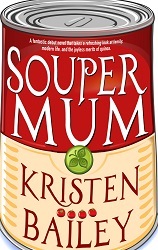
Souper Mum

souper-mum-cover

Souper Mum is the story of Jools Campbell, a stay-at-home mother of four, who becomes an unlikely foodie hero when she stands up to a pompous celebrity chef, Tommy McCoy on a reality show.  Armed with fish fingers and a severely limited cooking repertoire, we watch as she becomes a reluctant celebrity and learns some important life lessons about love, family and the joyless merits of quinoa.

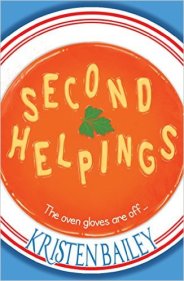
Second Helpings

second-helpings

Exactly eighteen months after squaring up to a pompous TV chef, Jools Campbell finds herself back in the fame game as she becomes a judge on a family cooking show.  How will she cope being back in the limelight, juggling being a working mum?  What happens when she finds out her old nemesis, Tommy McCoy is her fellow judge?  The knives are sure to fly as ‘Souper Mum’ makes her triumphant return.

Seven Secrets For Being A Souper Mum

A Guest Post by Kristen Bailey

  • Souper Mums operate on sleep. Where possible, sleep.  Of course, this is easier said than done so catch sleep when you can.  This may be in the day while you’re watching Judge Rinder in mismatched pyjamas with a chocolate Bourbon stuck to your forehead, or when you’re in the car waiting for the school gate to open.  If the blighters are up at 6am on a weekend, you have full permission to throw them all a brioche and put on Netflix, then crawl back into bed.  It’s why the world created Netflix.
  • Souper Mums’ Guide to Laundry
  1. No one ever died wearing an unironed school shirt.
  2. It’s mismatched socks or no socks.
  3. Also, totally fine to wear said socks two days in a row.
  4. Ribena/grass/paint stains come as standard. Wear them like nouveau fashion statements.
  • Souper Mum’s Guide to the School Run
  1. Lots of caffeine.
  2. Contrary to popular belief, it’s totally fine to do the school run in your pyjamas, just put your trackies and hoodie over the top.
  3. No one is looking at your hair bundled atop your head like a small mammal’s nest. Or the fact you don’t have any make up on.  Or a bra.
  4. Get the kids in and leave, making sure to avoid the mums with the clipboards, the ones gloating about spelling tests, the ones who look like they’ve come from the gym…
  • Cake Sales are the benchmark by which you can measure a Souper Mum. There will be some who send in perfectly risen cupcakes, iced within an inch of their lives and covered in glittery sparkles and shards of caramel.  There will be those who send in cupcakes that have been shop-bought but put in their own Tupperware to make it look like they baked them.  Others will send in a pack of Jaffa Cakes, others will forget…*whispers* none of it matters really because we all know kids just lick the icing off and never eat the cake anyway.
  • Souper Mums sometimes make a spag bol from scratch. Other days they will serve fish finger sandwiches with a packet of crisps that have to be eaten in the car or else everyone will be late for swimming.  There is nothing wrong with fish fingers.  They are endorsed by Captain Birdseye – a man with genuine naval expertise.  Level everything out with boxes of raisins, apples and a token bit of cucumber; all of which you’ll find in between the car seats three months later.
  • Souper Mums drink. Not in the day if possible but when you know you don’t have to get back in the car again that day, it is totally fine to open up a bottle and have a cheeky glass of something.  If your day has involved vomit, public tantrums, temporary traffic lights, toilet training, a lost remote control then up the stakes and hit the hard liquor.  Drink with other Souper Mums to console each other.
  • *whispers again* The seventh secret is that…there is no secret to motherhood.  Everyone’s winging it, and you’re doing just fine.  If any of the above sounds familiar though, I’d like to introduce you to my Souper Mum; Jools Campbell.  Her adventures in motherhood and modern life were published in June 2016 and the next instalment of her story, Second Helpings is out this month.  Both novels take a refreshing look at family, celebrity culture and the joyless merits of quinoa.  Both are gluten-free and suitable for vegetarians.

About Kristen Bailey

author-pic

Mother-of-four, gin-drinker, binge-watcher, receipt hoarder, hapless dog owner, enthusiastic but terrible cook.  Kristen lives in Fleet, Hampshire in a house overrun by Lego and odd socks.  Her debut novel, Souper Mum was released by Accent Press in June and its sequel, Second Helpings was released on 17th November.

You can find out more about Kristen on her blog about being a modern mother.  You can follow her on Twitter and find her on Facebook and Instagram.

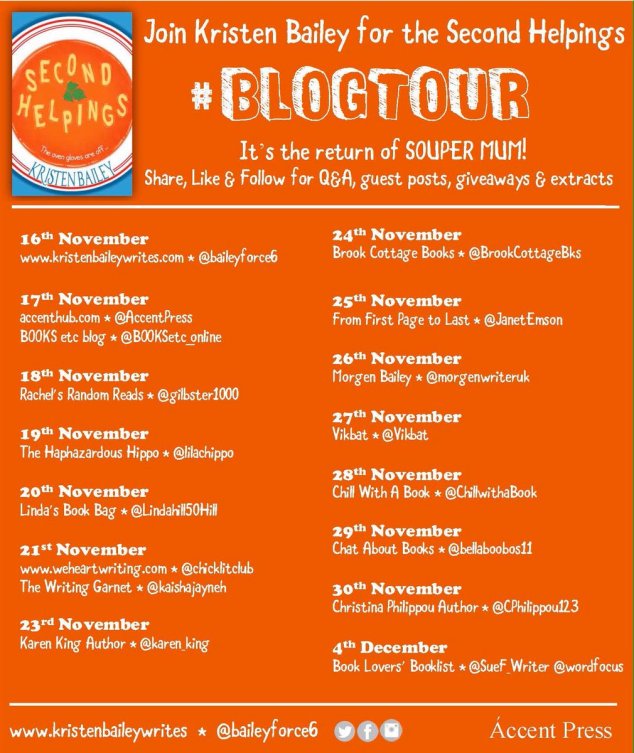
There’s more with these other bloggers too:
tour-poster