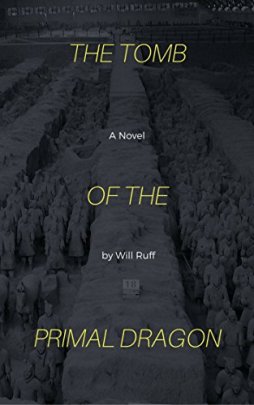
Why We Need Fiction In A Rapidly Moving Technological World: A Guest Post by Will Ruff, Author of The Tomb of the Primal Dragon

Primal Dragon

I’m desperate to visit China to see the tomb of the ancient warriors so when Will Ruff got in touch about his novel The Tomb of the Primal Dragon, I had to invite him on the blog.

The Tomb of the Primal Dragon was published on 27th November 2017 and is available for purchase here.

The Tomb of the Primal Dragon

Arthur Biers is an aspiring historian looking for his path to graduate school when he gets invited to help tell the story of one of history’s deadliest tombs.

In 1974 two farmers digging a well outside of Xi’an, China, discovered a clay statue and a pot that belonged to China’s first Emperor. The site they discovered was the second pit of his mausoleum, and is one of the most interesting historical finds of the 20th century.

But the Emperor’s Tomb has yet to be excavated as claims have arisen from conspiracy theorists that the site is a fraud. The Tomb of the Primal Dragon tells the story of a group of researchers vying for the inside scoop on the tomb’s excavation as each source they investigate suggests there’s much more going on at the Museum than the excavation of historical relics.

Led by worldwide bestselling pseudo-historian, Bruce Philips, and technologist, Wyatt Waller, Art embarks on a journey across mainland China as they hunt down every lead to show the world what deadly secrets are buried inside the tomb.

Why We Need Fiction In A Rapidly Moving Technological World

A Guest Post by Will Ruff

When you look at how fast technology is moving in the world today, and you look at how few people read, it’s become evident that the art of storytelling is more important than ever.

And in a world that’s grown politically divided over every single topic, skepticism of the source is a concern that’s causing the general population to refuse to read news stories altogether. Everyone seems to do it.

This is why fiction is more relevant now than ever, because fiction at its best, can explore the world as it is, as we’d like it to be, and as we fear it will become, and when it’s done well, whether that’s in the form of a romance novel, a thriller, or a work of contemporary fiction, when it resonates, it creates unity within humanity instead of division. It celebrates the curious detours, and the inevitable challenges of life, and reminds us that we’re all a part of the same journey, that it’s the persistence through these struggles that makes us human.

Fiction challenges us to think about our core emotions, and successful fiction does so in a way that the reader is left looking inward at something else that gave them a similar feeling, and when they have none, and the writing is exceptional, the reader can’t help but feel empathy. When it’s done well, fiction is a unifying medium for all mankind.

Technology by contrast should be a similar force, but the trend in technology has been more brevity, more shallow appeal, and more “what can I get right now?” There is very little deferred gratification, and there is very little thought in the words you consume on these mediums. Let me be clear: they have value, and I don’t reject these tools, but the goal of these platforms is making as much money as quickly as possible with no regard for how it affects society.

To take a more optimistic approach, fiction has the power of influencing business and technology. It can draw attention to this technology, and start a conversation among crowds to better educate them about its abilities, and it can inspire people to celebrate their line of work. This is more evident in film and television, but I can think of a handful of doctors who celebrate every drama, and comedy out there that highlights their lifestyle. I can think of security people who praise the authenticity of shows like Mr. Robot, and I know that a combination of reading Jurassic Park, and watching Indiana Jones, inspired me to pursue a degree in history. Finally I can think of someone who went into the world of information systems when she was a young girl watching the original Tron in theaters.

What is the power of fiction? What is the allure of watching a story we know isn’t real? It’s exactly that. We have plenty of fields of study that try to explain the way things are, and they’re all incredibly important to follow, but fiction is the format that challenges us to ask, what if?

The next time you find yourself endlessly scrolling through some social media feed, I hope you’ll consider moving over to your bookshelf and picking up a novel you haven’t read. You might just find what you were looking for.

About Will Ruff

will-ruff-hero-240x300.jpg

Will Ruff is the author of the newly released The Tomb of the Primal Dragon, which is available on Amazon Kindle. The novel follows a young historian who gets invited to help research one of history’s deadliest tombs. You can learn more about Will here and follow him on Twitter @WilliamLRuff.

An Interview with Harriet Cabelly, Author of Living Well Despite Adversity

cover1

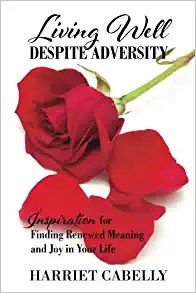
Having had a tricky few recent years, it gives me very great pleasure to welcome Harriet Cabelly to Linda’s Book Bag to tell us a little bit more about her book Living Well Despite Adversity as I know I need some advice and I dare say many blog readers do too!

Living Well Despite Adversity is available for purchase in e-book and paperback here.

Living Well Despite Adversity

3D-Cover-DespiteAdversity-Rev1-300px (1)

Join Cheryl Strayed, Temple Grandin, Meredith Vieira and others as they share their honest accounts of heartbreak, and the secrets they discovered that led them to triumph ‘despite it all’.

In this collection of interviews, Harriet Cabelly has dug deep to reveal the critical wisdom found in the midst of huge challenge or loss. She highlights themes such as purpose and gratitude that all of us can incorporate into our lives as we go through our own difficult times. In particular, she reflects on the importance of developing resilience and a positive attitude, even in the face of insufferable odds.

The people in this book don’t flinch from telling it how it really is. Their stories are raw, at times, as they openly describe their struggles and how they have learned to cope with loss, disability and addiction.

Their stories will strengthen and inspire you.

They will show that you, too, can come out the other side of heartbreak intact and go on to rebuild a life filled with renewed meaning and joy. That, despite it all, you can thrive.

An Interview with Harriet Cabelly

Welcome to Linda’s Book Bag, Harriet. Thank you so much for agreeing to answer some questions on my blog about your writing and Living Well Despite Adversity in particular. Firstly, please could you tell me a little about yourself?

I am a social worker, positive psychology coach, speaker and workshop facilitator.  And I now can add in author!  I am a guest coaching expert on WOR radio’s, Change Your Attitude, Change Your Life show.  I journey with my clients as they cope with and grow beyond their painful circumstances,  supporting and guiding them towards their best life.  I am a life-long learner and I love taking on new and challenging experiences – saying Yes to new opportunities.  I believe we can all rebuild our lives with renewed meaning, purpose and joy despite and through our personal challenges and adversities.  Hence my website – rebuildlifenow.com

Please could you tell us a bit about Living Well Despite Adversity?

This book is a compilation of interviews of people who have been able to transcend their personal challenges and losses and gone on to live with renewed meaning and joy.  The wisdom, teachings and inspiration are from the interviewees who share with open hearts their pain and the journey they’ve been on to come through whole and richly engaged in  a thriving life.

As well as being a writer, you’re also a social worker and positive psychology coach. How did these other roles lead you to writing Living Well Despite Adversity?

First and foremost I’m a parent of a daughter with special needs who miraculously survived a year-long medical crisis, which I write about in the book.  This book is really the outgrowth of her miracle, as I was searching for a way to honor it.   I have always been interested in this theme of people overcoming adversity; the idea that it’s not how we can avoid bad things happening since it’s inherent in the human condition, but rather when they do happen, how can we cope and still manage to have a good life, despite.  Since we’re only given this one life, it behoves us to make it as good as possible.

Combining my professional expertise and interest in people and their stories, together with my personal experiences, I decided to take my life theme on the road, so to speak, and when I started my blog years ago, I began my project of monthly interviews with people who exemplified this theme.

How did you decide whom to interview for Living Well Despite Adversity?

I wanted a variety of challenges and adversities, to show that it wasn’t the circumstance per se but rather how the people responded to their situation.   Since I’m a book lover and specifically of memoirs, I found many of my interviewees through their books.  I took the liberty to request a blog interview by email or phone and most surprisingly said yes.  As an unknown interviewer,  I was thrilled, especially when some more well-known people agreed.

Many of the stories in Living Well Despite Adversity show people with extremes of problems or emotion. How would you say their messages can be incorporated into anyone’s ordinary life?

These are stories of grief and resilience.  Research is now pointing to the fact that we can build our resilience, that it’s a learned set of skills we can develop and enhance within ourselves.   Although each person/interviewee’s circumstance is different, the themes that are gleaned out are universal: faith, support, purpose, gratitude, attitude, choice….  A main theme in the book that I hope comes across loud and clear is that it’s not our circumstance that defines us but rather our response to it; and we are responsible for our response.  We can intentionally and purposefully choose how we respond.   Another predominant theme is that feelings are to be felt – in other words, permission to feel.   We must allow ourselves to feel – the bad and the good.  In fact we need to grieve, that’s how we go through the pain.  As someone once said, “We can’t heal what we don’t feel.”

These vital messages of choice, response, allowing for our feelings, gratitude …are all ingredients for a life of well-being.

As a result of producing Living Well Despite Adversity what have you learnt?

I’ve learned that living well beyond loss and extreme challenges/adversity is very intentional.  It’s a choice.  It’s all too easy to fall prey to our circumstances and remain stuck in our pain.  All these interviewees made the decision to continue on living and learning how to do it well; not just to survive but to grow, create meaning out of their suffering and to thrive.

If you had 15 words to persuade a reader that Living Well Despite Adversity should be their next read, what would you say?

A book to guide and inspire us to cope and live well beyond our struggles.

Thank you so much for your time in answering my questions, Harriet.

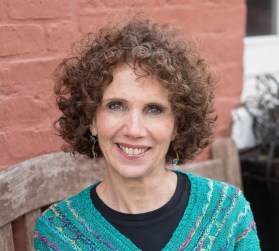
About Harriet Cabelly

2016_34_HarrietCabelly_Portrait_187 (7)

Harriet Cabelly is a social worker, speaker and workshop facilitator who has appeared on ABC News as a parenting coach and is a guest coaching expert on WOR Radio’s, Change Your Attitude, Change Your Life Show. As a positive psychology coach, Harriet journeys with her clients as they cope with and grow beyond their painful situations.

You can follow Harriet on Twitter @rebuildlife and visit her website. You’ll also find her on Facebook.

Romantic Novelists’ Association Thank You Giveaway

RNA

A few weeks ago I received a top secret email telling me I had been short-listed for The Romantic Novelists’ Association Industry Awards Media Star Award. I was, quite literally, astounded.

I knew that last year it had been won by the most amazing lady, Kim Nash who is not only a fellow blogger at Kim the Bookworm and someone I consider a friend, but the publicity and social media manager at publishers Bookouture.

I had no idea who had nominated me (and still don’t know – but if it was you, then thank you!). I was in Mauritius on holiday when the news was released and was beside myself with excitement but really didn’t expect to win.

The awards ceremony was held on 15th November 2017 and I was all set to go, although I needed to rearrange a few things in order to get there. Unfortunately things didn’t quite go according to plan!

As my father had died last November and the 15th was bang slap in between his death and his funeral, I had arranged to take my mother on a coach trip to Milton Keynes to see Vincent and Flavia in Tango Moderno as a distraction. My sister was willing to go in my place and I was all set. Unfortunately, my sister then developed a problem in the foot she had totally reconstructed a few years ago and we thought it was broken or some of the screws had come adrift. Either way, she was unable to walk and certainly couldn’t support my unsteady mother. It meant that I couldn’t attend the ceremony as I had to look after Mum.

Some of you know that day was a bit of a challenge. We had lunch in a restaurant and just as I was ordering my meal a large, heavy Christmas Bauble somewhere between a football and basketball in size dropped from the high ceiling on top of my head leaving a large lump and a thumping headache for the rest of the day! When the waiter said, ‘That’s the second one to drop down today’ I did feel maybe a lesson could be learnt.

bauble

However, we headed off to the theatre only to find Vincent wasn’t in it as he had injured his back…

On arrival home, Mum was very unsteady on her feet and couldn’t make it across the road. My husband duly collected us in the car and we took her home. About 30 minutes after he had said to me that he wouldn’t be surprised if she had a fall, the phone rang and it was Mum. She had fallen and broken her hip. She’d crawled to the phone and rung us. We called the ambulance and some six and a half hours later it finally arrived at 3.45 in the morning. It’s been a bit of a nightmare ever since!

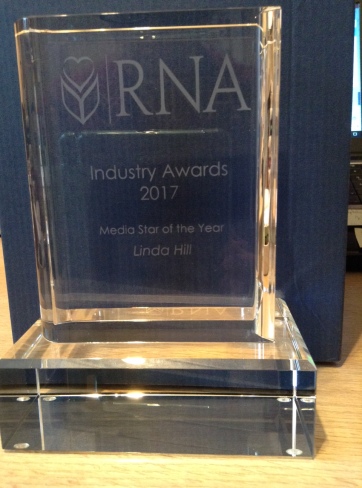
It was amongst all of this chaos that I learnt I had actually won The RNA Media Star Award. I can’t begin to tell you how much it meant to me after a such a day of frustrations. I’m thrilled and delighted. Runner up was the wonderful Kaisha Holloway who blogs at The Writing Garnet. You can read all about the awards ceremony and the category winners here. but I confess to shedding a tear of joy when I read:

Media Star of the Year

Blogger Linda Hill was awarded Media Star of the Year for her continued support for romance novels through retweeting, reviewing and blogging. Friendly and professional, even when her TBR pile is overflowing, she’ll take more books on, going above and beyond the call of duty, and all with a smile. This award recognises those who have helped raise the profile of romance writing and/or the RNA in a positive way.

What wonderful words. Thank you, thank you, thank you RNA. Today postie has reignited all my excitement having delivered my certificate, closely follwed by my gorgeous award.

Award

IMG_0880

Now, I may have won the award, but if it were not for fabulous authors whose books I have the privilege to read, the generous publishers who send me copies for review and my fellow bloggers and others who share my posts this couldn’t have happened. As a result I would like to say an enormous thank you to all of you. I have found the bookish world to be supportive, friendly and talented and it is a joy to be part of it. By way of a thank you I’d like to run a small giveaway and you can enter below.

Giveaway

IMG_0877

To say thank you for all the bookish love and support I’ve received, not just through this Romantic Novelists’ Industry Award, I would like to offer an Amazon e-gift card of £20 or $20 to one of Linda’s Book Bag readers. To enter click here. Giveaway closes at UK midnight on Christmas Eve.

Good luck everyone and thank you all once again. Merry Christmas x


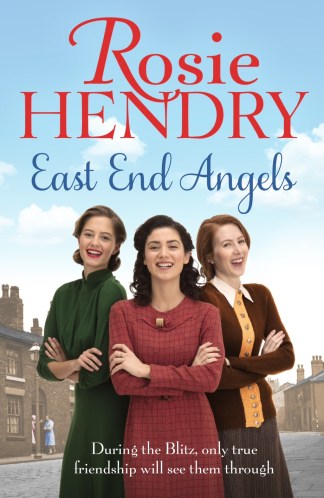
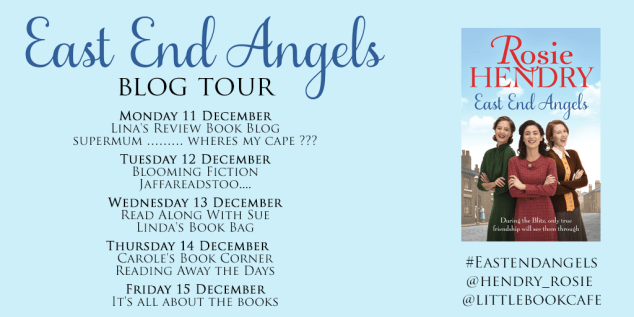
East End Angels by Rosie Hendry

9780751566819

I’m delighted to be part of the paperback launch celebrations for East End Angels by Rosie Hendry as I love historical fiction.

available in e-book and hardback, East End Angels is released by Sphere, an imprint of Little Brown, in paperback tomorrow, 14th December 2017 and is available for purchase here.

East End Angels

9780751566819

Strong-willed Winnie loves being part of the crew at Station Seventy-Five but her parents are less than happy. She has managed to avoid their pleas to join the WRENS so far but when a tragedy hits too close to home she finds herself wondering if she’s cut out for this life after all.

Former housemaid Bella was forced to leave the place she loved when she lost it all and it’s taken her a while to find somewhere else to call home. She’s finally starting to build a new life but when the air raids begin, it seems she may have to start over once again.

East-Ender Frankies sense of loyalty keeps her tied to home so it’s not easy for her to stay focused at work. With her head and heart pulling in different directions, will she find the strength to come through for her friends when they need her the most?

Brought together at LAAS Station Seventy-Five in London’s East End during 1940, these three very different women soon realise that they’ll need each other if they’re to get through the days ahead. But can the ties of friendship, love and family all remain unbroken?

My Review of East End Angels

Three women from very different backgrounds find common interests when they become ambulance drivers during the Blitz.

What a lovely story East End Angels is. Rosie Hendry’s style is effortless to read making for a heartwarming and feel good reading experience, perfect for lovers of what is traditionally termed women’s fiction.

The settings make East End Angels so authentic. I thoroughly enjoyed the insight into the way women supported the London Auxiliary Ambulance Service in the desperate days of bombing and through perfectly chosen language found myself transported to that era with the sound of the bombs, the smells and the dust. I thought the details had been meticulously researched, beautifully handled and woven into the narrative with enormous skill.

There’s a great plot too, with a few surprises along the way that draw in the reader completely. I know there is to be a sequel to East End Angels and will be first in the queue to read it as I both want, and need, to find out what happens next. As I read about the events I found myself questioning my own personality and wondering how I would have coped and behaved in similar circumstances. The themes of the book such as friendship, values and family mean there is something for every reader to identify or empathise with. I found the dynamics of the class structure of the era and the way it was altered by the war extremely interesting too.

However, it is the characters that make East End Angels such a compelling story. I completely forgot that these are fictional people. Partly, this effect comes through the direct speech. Frankie, in particular has a voice I could hear in my head as if I were listening to a friend speaking. I most identified with Winnie and despised Ivy with every fibre of my being. Is it awful of me to hope throughout that she would get a direct hit from a bomb? All three of the main characters, Bella, Frankie and Winnie, felt real and vivid, but so too did the more minor individuals, even Trixie. I believed in them all completely.

I finished East End Angels feeling I had been thoroughly entertained and drawn in to the worlds of Bella, Winnie and Frankie. I’d love to see this book taken up for Sunday night television as I think it would be classic material for such viewing. I’m highly impressed by Rosie Hendry’s historical writing and look forward to more in the future. I really recommend East End Angels.

About Rosie Hendry

Rosie Hendry

Rosie Hendry lives by the sea in Norfolk with her husband and two children. East End Angels is the first book in her uplifting and heart-warming saga series that follows the lives and loves of Winnie, Frankie and Bella, who all work for the London Auxiliary Ambulance Service (LAAS) during the Blitz. Listening to her father’s tales of life during the Second World War sparked Rosie’s interest in this period and she loves researching further, searching out gems of real life events which inspire her writing.

You can find out more about Rosie by following her on Twitter @hendry_rosie, finding her friend on Facebook or visiting her website.

There’s more with these other bloggers too:

poster

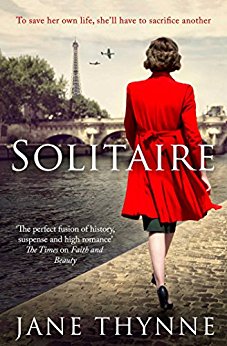
Clare Vine and Solitaire Concept: A Guest Post by Jane Thynne, Author of Solitaire

Solitaire cover

I know we shouldn’t judge a book by its cover, but Solitaire by Jane Thynne is so gorgeous that I’m thrilled to be part of this blog tour to support it. My thanks to Sian Divine for inviting me to take part and for my review copy of Solitaire which I’m saving up to read over Christmas.

It gives me great pleasure to find out a little more about the concept of Solitaire and its protagonist Clare Vine today. I’m doubly lucky as I have an extract to share as well as Jane’s super guest post.

Published by Simon and Schuster, Solitaire is available for purchase here.

Solitaire
Solitaire cover

To save her own life, will she sacrifice another?

June 1940: the first summer of the war. Berlin is being bombed and nightly blackouts suffocate the city. Then France falls and a shadow descends.

A shadow has fallen over Clara Vine’s own life, too. She is an Anglo-German woman in a country that hates England. Then she is summoned to meet the Propaganda minister, Joseph Goebbels, who has decided that Clara should adopt a new role – as his spy.

Much as she dislikes the idea, Clara realises this might be the chance to find an escape route to England. But Goebbels has other ideas and soon Clara is drawn into a web that threatens to destroy her. As everything she holds dear is taken as ransom, she must fight to protect her family – and to survive…

The Clare Vine and Solitaire Concept

A Guest Post by Jane Thynne

Welcome to Linda’s Book Bag, Jane. Would you talk to us a little about the inspiration for the Clare Vine Series? Where did the concept for the Clare Vine Series come from?

I knew I wanted to write a spy thriller, and I was fascinated by WW2, but I always found Nazi Germany a very male story. I wanted to know about the women – mothers, wives, brides and schoolgirls – whose lives were tightly controlled under the regime. The Third Reich was extremely gender segregated – there was even a female Führer, called Gertrude Scholtz-Klink – yet these women get very little attention from historians and their lives are largely hidden, so I decided to use a spy to penetrate their world. My heroine, Clara Vine, is Anglo-German and an actress, because actresses are accustomed to playing a role, and trained to observe detail. Clara’s entire life in Berlin is an act, but her glamour blinds the Nazi VIPs to her real purpose. Her adventures start in Black Roses, which is set in 1933, just after Hitler has come to power in Germany. She arrives in Berlin at the age of 26, hoping to make a career at the famous Babelsberg studios, and by chance comes into contact with Magda Goebbels, wife of the Propaganda Minister, and becomes privy to the gossip of the VIP Nazi wives. Later, she agrees to relay information to British Intelligence, and thus becomes actress by day, spy by night. Although Clara herself is not modelled on any specific historical character, I read a lot of letters and diaries by young British women who had visited Germany before the war, and observed the build-up of Nazism. They came back and warned people about the rise of the Nazis, but their warnings fell on deaf ears.

Without spoiling the plot for readers, would you tell us about the storyline for Solitaire?

It’s 1940, and Germany is now at war with Britain, so Clara’s life is more perilous than ever. Unaware that she is a British agent, Joseph Goebbels, the Propaganda Minister, summons her to carry out a mission for him. The job takes her to neutral Lisbon, where a flood of refugees, aristocrats and spies has congregated, waiting to escape Nazi Europe. Among them are the Duke and Duchess of Windsor – and Ian Fleming.

What’s next for Clare Vine? How many books do you see her series carrying?

The next Clara Vine story is set in 1941, with locations in Vienna, Hamburg, Berlin and London. Clara is filming the most expensive Nazi movie ever made, called The Sinking of the Titanic, when she is presented with a daunting task, to track down a rogue British agent. The only problem is, this man was once her lover. I enjoy so much writing the Clara stories and being in her world, that I have no desire to stop. But I do have another protagonist who is longing to be written about, and she’s a rather different character, so I may start another series soon.

And what’s next for Jane Thynne?

My next novel is a standalone, provisionally titled The Typewriter. It’s a split time narrative set in the 1940s and the present day featuring two English sisters, Cordelia and Irene Capel, who are divided by ideology and war. Part of it is set during the fall of Berlin, when Russian soldiers rampaged through the city, raping every woman in sight. After the war Cordelia Capel becomes a Pulitzer prize-winning journalist, yet she is never able to confront the secret that has created a lifetime rift with her sister. At the time I was writing it, the Brexit debate was raging and the potential for ideology to divide families was all around. The family rift in this novel features spies, love and lies, and its repercussions stretch right into the present day.

Thanks so much for telling us a bit more about your writing Jane.

An Extract From Solitaire

In this extract from the prologue of Solitaire, a glamorous German nightclub singer is in Lisbon, waiting restlessly outside the casino at Estoril  for someone to emerge.

The night was rich and dark, dense as a wedding cake, and the sky powdered with stars. The young woman stood to one side of the casino’s pillared door, trying to remain inconspicuous as knots of people drifted through the glass doors and across the thick red carpet to the gaming room. Inside, chandeliers hung on gold painted ropes, bored croupiers raked the tables and a layer of cigar smoke was intercut by musky drifts of Chanel, Lanvin and Worth. The atmosphere was the same as in any casino the world over: joyless, thick with alcohol and moneyed voices. Occasionally the woman would venture out of the shadow and peer past the porters and bellboys, trying to catch a glimpse inside, but each time she hesitated and withdrew again, drawing her silk jacket closer around her. A black, strapless evening gown, decorated with silver faux-Chinese motifs, hung on her like a negligee and a single strand of pearls circled her neck. She had a gleaming drape of charcoal-coloured hair, eggshell skin, a soft pillow of lips, and a face that had broken a hundred hearts.

The night air raised goose bumps on her flesh and she braced herself, as though she could shrug off the shadows like a sable stole. On the opposite side of the square the red neon sign of the casino expanded and contracted like an artery and a short way away the shivering glitter of the sea was advancing and receding, tugging the shingle outwards to America and back to Europe again. Raucous laughter and the crash of bottles rattled from a nearby bar. The splayed branches of pine trees fractured the dark sky and as she stood there shivering, a momentary waft of resin transported her hundreds of miles, back to the pine-scented Grunewald of Berlin.

Berlin. Nothing about her life in that city could have predicted her presence here, all alone, in an unfamiliar town on the far westerly edge of Europe. Not the ranks of teachers at school or the marching and massed parades and gymnastics in the Tiergarten. Not the dancing and singing, nor the nightclubs, nor the stint at the Haus Vaterland, draped across a grand piano, trying to be Marlene Dietrich. At the thought of it she instinctively flexed a leg with the toe pointed and circled it slowly, as though she was warming up for a performance.

It was love that had brought her here. Damned, inconvenient love. She had always imagined herself immune, as though she’d had an injection against it, like you had for a disease. She prided herself on her indifference. Her heart was as hard as a Wehrmacht helmet. Melting eyes and tender protestations glanced off her like raindrops from the windshield of a pale blue Mercedes convertible, the kind she had always dreamed of owning. But somehow, love had undermined her defences and left her stranded here, three countries away from home, frozen, uncomfortable and very afraid.

She shivered again, shuffling toes that were growing slowly numb in her high heels, and tried to calculate the time. She was, in fact, perfectly used to high heels and late nights; back in Berlin, midnight was nothing. Usually, two o’clock in the morning was her favourite time, when everything slowed down and the harsh edges of the city relaxed. Often she would still be out at dawn, when the housewives first appeared at their doors, clutching their dressing gowns to their necks, looking for the milk cart. But on this particular night, the waiting was a strain.  A numbing exhaustion was seeping through her body, up from her legs, coaxing her into a waking doze, forcing her to shake herself awake. She wished yet again that she could find a cigarette, but smoking might draw unwelcome attention. Coffee would help, and the bar across the square was still open, its light fizzing over a few plastic tables, yet she dared not desert her post. Instead, she took out a chunk of chocolate and let it dissolve slowly on her tongue, staring restlessly at the casino from her vantage place in the shadows. It helped that her performer’s training had instilled a certain vigilance in her, a hypersensitivity to her surroundings, and she told herself that standing here was no different from waiting in the wings, poised to enter the stage for her moment of action.

About Jane Thynne

Jane Thynne

Jane Thynne was born in Venezuela and educated in London. She graduated from Oxford University with a degree in English and joined the BBC as a journalist. She has also worked at The Sunday Times, The Daily Telegraph and The Independent, as well as for numerous British magazines.

She appears as a broadcaster on Radio 4. Jane is married to the writer Philip Kerr. They have three children and live in London.

You can find out more by visiting Jane’s website, finding her on Facebook or following her on Twitter @janethynne.

There’s more with these other bloggers too:
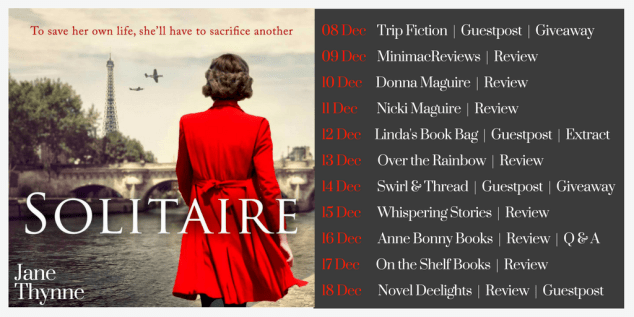
Tour poster

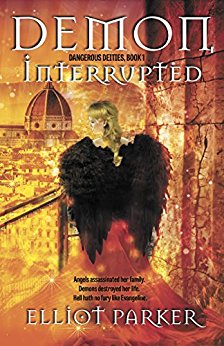
Introducing Urban Fantasy: A Guest Post by Elliot Parker, Author of Demon, Interrupted

Demon cover

Once again I’m featuring an author and book I really wish I had had time to read as I know just how important reviews are for writers. This time I’m welcoming Elliot Parker, author of Demon, Interrupted to Linda’s Book Bag. Elliot has kindly agreed to explain a little bit more about urban fantasy as I feel a total ignoramus when it comes to the fantasy genre.

Demon, Interrupted is  published by Dragon Moon Press and is available for purchase here.

Demon, Interrupted

Demon cover

Hide or die.

Evangeline Lawson can find anything, except freedom. A descendant of St. Anthony of Padua, the Patron Saint of lost articles, she has the supernatural ability to locate any missing object, car keys, missing dogs, children, as well as nuclear missiles, secret underground bunkers, and divine objects of power. The only thing she can’t find is freedom from every power hungry treasure hunter.

Breadcrumbs left by her ancestors lead Evangeline to the doorstep of the world’s most morally ambiguous angel, Adrien. Sure he can protect her, but he can also use her to find his way back into heaven. The angel will use any means possible to force Evangeline to stop running and strengthen her abilities.

Abilities that Evangeline will need to fight the oldest and most powerful of demons. Lilith has been hunting the St. Anthony lineage for hundreds of years, and will stop at nothing to turn Evangeline into her own personal divining rod. She needs Evangeline’s super charged GPS to find artifacts that can unleash hell on earth.

Evangeline swings like a pendulum. Run and hide or fight? Where she stops could determine the fate of mankind.

Introducing Urban Fantasy

A Guest Post by Elliot Parker

Good day everyone!  My name is Elliot and I write Urban Fantasy. That sounds like I am recovering from addiction to it, which I might be.  What is Urban Fantasy you ask?  Urban fantasy is a subgenre of Fantasy.  It gets its name from the common use of urban or city settings.  So much so, that one could argue that the setting itself becomes a character in many novels.  Ilona Andrews, Kate Daniels series centers on Atlanta, Georgia.  Karen Monings’ Fever series centers on Dublin, Ireland.  My novel Demon, Interrupted focuses on Florence, Italy.

The characters often find themselves wrapped up in a blend of everyday and supernatural phenomena.  Many elements will be familiar to the reader, but presented with a “twist”. Vampires, werewolves, wizards and humans living knowingly or unknowingly side by side.  Ancient supernatural feuds raging beneath the noses of mere mortals.

While the majority of Urban Fantasy is narrated from the first-person point of view of a gritty female protagonist, there are very notable male exceptions including Jim Butcher’s Harry Dresden and Kevin Hearne’s Iron Druid Chronicles among others.  The benchmark is definitely a tough-as-nails female protagonist who plays be her own rules and is vulnerable to a very select few.  She is the lynchpin of her story, often containing abilities or powers that no other character in the supernatural world possesses.  These powers usually present as the largest hurdle for her to overcome, but are integral to her becoming the hero of the story.

The closest cousin to Urban Fantasy is not High Fantasy but Paranormal Romance, driven by the main character being female and typically some romantic lines being present. A constant conversation occurring among authors and readers is the difference between the two.  In any romance or subgenre of romance, the main story line must be the romance itself.  The relationship between the two protagonists.  We watch them meet, fall in love, almost mess it up (sometimes several times) to finally have a happily ever after. I stress the happily ever after because it is a requirement in romance.  While romance often occurs in Urban Fantasy, it is not a requirement and frequently evolves at a much slower pace than paranormal romance. The main story line of an Urban Fantasy novel is whatever the main character must find, accomplish or overcome.

One of my favorite hallmarks of Urban Fantasy is the dreaded cliffhanger. I know, I know, as a reader I have a deep love/hate relationship with cliffhangers, but as an author they are awesome sauce! Many Urban Fantasy novels end on a cliffhanger because of the episodic nature of the genre. There are very few single, stand-alone stories.  Most authors have extensive collections of five to ten or more books where the main character finds him/herself mixed up in problems with ever-increasing stakes.  If the series does end, for me, it is sad but fulfilling.  Most monogamous romance storylines end with a happily ever after for the characters.

I hope you have enjoyed this nutshell explanation of Urban Fantasy. I have been drawn to this genre for over two decades. I love the tough, gritty, loner females who start their journey alone but slowly and surely form their own piecemeal family, more loyal than any blood relatives.  There are no doubt many more hallmarks and genre-norms but these are some of my favorites, and you can bet I included them all in my novel.

(Thanks so much Elliot – I’ve definitely learnt something today!)

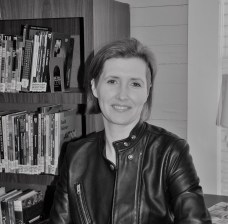
About Elliot Parker

DSC_0122

Elliot Parker is a 38-year-old author transplanted from the North into the Deep Deep South. Originally from a scientific research background, she incorporates her love for research and science into every story. She is always looking for the perfect blend of creative and analytical. When not writing she consumes inhuman amounts of chai tea and searches for another animal to add to her menagerie. Demon, Interrupted her debut novel published by Dragon Moon Press, is out on December 12th.

You can find out more about Elliot and urban fantasy by following her on Twitter @AuthorEParker and finding Elliot on Facebook.

An Extract From Music Notes by Manning Wolfe

Music Notes

Having previously had the chance to interview Manning Wolfe, here on Linda’s book Bag, I’m delighted to be sharing an extract from her latest Merit Bridges series and the new release Music Notes: Texas Lady Lawyer vs L.A. Baron

Music Notes: Texas Lady Lawyer vs L.A. Baron was published by Starpath on 18th November 2017 and is available for purchase from your local Amazon site.

Music Notes: Texas Lady Lawyer vs L.A. Baron

Music Notes

Attorney Merit Bridges is looking over her shoulder! Who’s back there?

When client Liam Nolan is slain with his own guitar, Davey Ray Bell shows up claiming to be Liam’s illegitimate son. L.A. Baron, Nolan’s former manager, makes a back-door music deal and vies for the estate.

When the probate court pushes Baron out of the power position, he pursues Merit with a vengeance. Using the dark web, he ruins her reputation, destroys her career, and finally attempts to take her life.

Who will come out on top of the scales of music and the scales of justice?

An Extract from Music Notes

Liam got up, picked up his Strat, and walked along the lake on the hike and bike trail toward home. As he dropped down under the First Street Bridge, he looked up from his dreamy state to see a Pursuer coming toward him. The Pursuer was slight in stature, but backlit by the bridge and Liam could only see an outline.
“Hey, Liam,” the Pursuer said.
“Hey. Who’s there?” Liam asked.
“Don’t you know who I am?” the Pursuer asked.
The voice sounded familiar. The Pursuer continued toward Liam until they were close enough for Liam to recognize the face.
“What are you doing here at this hour?” Liam asked.
“Looking for you. I followed you from the Saxon Pub.”
“Well you found me. What do you want? I told you I have nothing for you,” Liam said.
“Don’t be that way. Let me buy you a cup of coffee. I want to talk to you,” the Pursuer said.
“I don’t want coffee and I don’t want to talk to you. Leave me alone,” Liam said and turned to go.
“Don’t turn your back on me again!”
The Pursuer looked around and picked up a large rock from beside the path. Liam felt movement behind him. As he turned back, he felt a strong blow between his neck and skull. He fell, dropped his guitar case, then struggled to get up.
“You, asshole,” Liam said.
As Liam pushed himself up from the ground, the Pursuer grabbed the guitar case and slammed it into Liam’s head. Liam fell to the ground again and the Pursuer hit him with the case over and over until the latches broke and the case flew open, sending the Strat spiraling into the water.
Liam looked up to see the Pursuer freeze, blink, and begin to shake. A hand reached down by the dying face and gathered up the case handle and rock, and put them inside the broken case. The Pursuer ran along the trees and out of the park with the case. Liam’s blood spread out over the trail, pooled at the grassy edge, and finally spilled over into the dark water.
No one came to help poor Liam or see the face of his killer. Dozens of purple guitar picks lay strewn along the water’s edge.

About the Author – Manning Wolfe

Manning Wolfe Headshot 2

Manning   an author and attorney residing in Austin, Texas, who writes cinematic-style, smart, fast-paced thrillers with a salting of Texas bullshit. The first in her series, featuring Austin Lawyer Merit Bridges, is Dollar Signs: Texas Lady Lawyer vs Boots King.

A graduate of Rice University and the University of Texas School of Law, Manning’s experience has given her a voyeur’s peek into some shady characters’ lives and a front row seat to watch the good people who stand against them.

You can find more about Manning Wolfe through these links: FacebookwebsiteTwitterGoodreadsInstagramGoogle+ and LinkedIn.

An Extract from That They Might Lovely Be by David Matthews

That they might lovely be cover

Sometimes I get frustrated as a blogger as a book turns up that I know I’d love but I simply don’t have time to read and review. This is exactly what has happened with David Matthews’ That They Might Lovely Be. However, I do have an extract to share today as part of the launch celebrations for the book.

Published by Top Hat Books on 8th December 2017, That They Might Lovely Be is available for purchase here.

That They Might Lovely Be

That they might lovely be cover

No-one thought Bertie Simmonds could speak. So, when he is heard singing an Easter hymn, this is not so much the miracle some think as a bolt drawn back, releasing long-repressed emotions with potentially devastating consequences…

A decade later, Bertie marries Anstace, a woman old enough to be his mother, and another layer of mystery starts to peel away.

Beginning in a village in Kent and set between the two World Wars, That They Might Lovely Be stretches from the hell of Flanders, to the liberating beauty of the Breton coast, recounting a love affair which embraces the living and the dead.

An Extract from That They Might Lovely Be

Chapter One

Monday, 12 August 1940

All day there had been dogfights high overhead. It was mid- afternoon  when  the rector’s wife  stepped  through  the  French windows  into the garden.  Bullets  spattered  down through  the trees, ripping the turf around her feet yet leaving her unscathed. This, the second miracle of her life, turned her wits.

In the same hour, Delia Simmonds  was about to wring the neck of a young cockerel ready for the pot while her father, the retired schoolmaster, was sitting on the old oak bench, resolutely ignoring the combat above the clouds. The squawking of the doomed bird was drowned out as a stricken aeroplane came screaming down from the sky toward them. They watched as it roared above the roof of their cottage, skimming the tops of the trees before ploughing straight into the South Lodge on the other side of the wood.

They  heard  the  crash,  but  neither  felt  compelled  to  hurry along the lanes to see where it had hit the ground. News would reach  them  soon  enough.  They  had  inhabited  the  fringes  of village life for some years now. As an accumulation of barnacles and weed gradually renders a vessel unseaworthy, so the steady accretion of gossip and suspicion, which had attached itself to the schoolmaster  and  his  family  since  the  tragic  events  ten  years before, had made his position untenable. He had bought a small parcel of land in the woodlands and had a cottage built there for himself and his daughter.

As it happened, it could not have been ten minutes before a child came running up the path to the gate.

‘You’d  best  come,  miss,  sir.  Plane’s  crashed  into  the  South Lodge. They’re saying your Bertie and Mrs. Cordingley’s inside but it’s all ablaze.’

For  a  moment,  Delia  froze,  the  limp  bird  in  her  hand,  the basket for its feathers between her feet. Then she threw back her head and laughed and laughed.

The child fled.

About David Matthews

author

David Matthews was born in the middle of the last century to a Quaker father and a mother who left the Church of England to become a Jehovah’s Witness. After a number of years “in the wilderness”, he found himself back in the Anglican Church, active in the local community.

David had a fulfilling career as a teacher, including eleven years heading a comprehensive school in Croydon, where he still lives with his wife and sons. His play Under the Shadow of Your Wings was professionally directed and performed in the summer of 2015, as part of Croydon’s heritage festival. He now feels he may devote a significant amount of time to transforming ideas, hatched over countless summer vacations, into novels, poems and plays. He enjoys spending time in south-west France where he is renovating a stone cottage with an idyllic view, and making a garden for it.

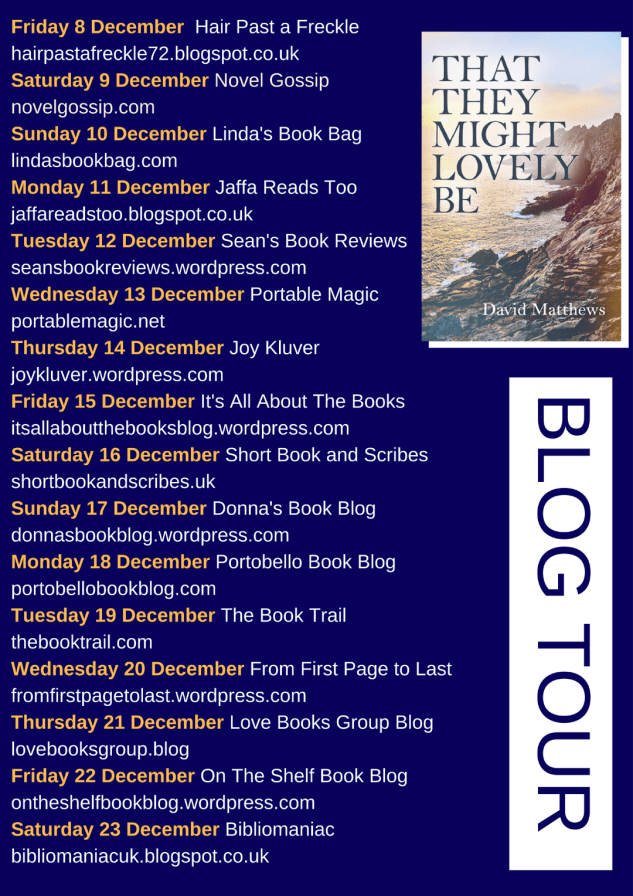
There’s more with these other bloggers:

tour poster

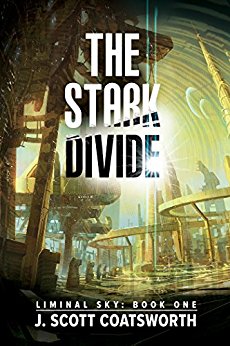
Introducing Queer Sci-Fi: A Guest Post by J. Scott Coatsworth, Author of The Stark Divide

The Stark Divide

When J. Scott Coatsworth got in touch about his ‘queer sci-fi novel’, The Stark Divide, I was intrigued. Given that the UK and the US are often ‘two countries divided by a common language’, I wasn’t sure if ‘queer’ referred to homosexual or unusual or both! As my TBR stands at over 900 books I couldn’t take on the review but I had to know more and luckily, Scott was willing to tell me!

The first book in the Liminal Sky series, The Stark Divide was published on 10th October 2017 and is available for purchase in e-book and paperback from your local Amazon site.

The Stark Divide

The Stark Divide

Some stories are epic.

The Earth is in a state of collapse, with wars breaking out over resources and an environment pushed to the edge by human greed.

Three living generation ships have been built with a combination of genetic mastery, artificial intelligence, technology, and raw materials harvested from the asteroid belt. This is the story of one of them—43 Ariadne, or Forever, as her inhabitants call her—a living world that carries the remaining hopes of humanity, and the three generations of scientists, engineers, and explorers working to colonize her.

From her humble beginnings as a seedling saved from disaster to the start of her journey across the void of space toward a new home for the human race, The Stark Divide tells the tales of the world, the people who made her, and the few who will become something altogether beyond human.

Humankind has just taken its first step toward the stars.

Introducing Queer Sci-Fi

A Guest Post by J. Scott Coatsworth

I’ve been writing sci fi and fantasy, on and off, for more than thirty years. But until I came back to writing seriously in 2014, I hadn’t embraced my queer roots in my writing. I’m a gay man, married to my husband since 2008 (and together since 1992). When I starting writing queer characters in my sci fi and fantasy, it really took off.

When I was growing up, I read both sci fi and fantasy voraciously. My mother was a member f the science fiction book club, and I read every book in her library, from Pern to the Foundation. I loved them, but outside of the green dragon riders in Pern, none of them reflected who I was.

I wanted to read about characters like me, guys who fell in love with other guys, and about characters like my friends across the LGBTIQA spectrum.

Sometimes queer speculative fiction is heavy on the romance. I write a bit of that. And sometimes it’s a lot more heavy on the sci fi or fantasy plot. Both have their place, but the important thing is that it is inclusive – and that people in both my community and the mainstream one can read it and see all kinds of different folks represented.

One of the first things I did when I started writing again was to create a new group and website – QueerSciFi.com. We serve as a safe space for all kinds of people to come together to talk about queer speculative fiction, and we’re dedicated to encouraging queer writers to try to push our way out of our safe spaces and into the mainstream, so that more of our voices are heard.

My own Liminal Sky series offers a glimpse at a world that mirrors our own in its diversity, and a look at where we might be going as a society if things continue the way they are.

In the process, it holds up a mirror to our society, and isn’t that what good sci fi does?

That’s what Queer Sci Fi is all about.

About J. Scott Coatsworth

J Scott

Scott inhabits the space between the “here and now” and the “what could be”. He was shepherded into his love affair with fantasy and sci fi by his mother at the tender age of nine, and soon read her entire library. But as he grew up and read more, he wondered where all the gays were.

He came out as gay at 23, and decided to create the stories he couldn’t find at his local bookstore. He reimagined his favorite genres, subverting them and remaking them to his own ends. And every now and then he hopes someone finds and enjoys them.

His friends say Scott’s mind works a little differently – he sees connections between things that many people miss, and accomplishes more in a day than many people do in three.

Scott’s fiction subverts expectations and transforms traditional science fiction, fantasy, and contemporary life into something fresh and unexpected. He manages both Queer Sci Fi and QueeRomance Ink with his husband Mark to promote and celebrate fiction that reflects their worldview.

He infuses his work with love, beauty and power, making them soar, and maybe that changes the world, just a little.

Scott lives with his husband of 25 years in Sacramento, California, in a small yellow house with two pink flamingoes in front.

You can follow J. Scott Coatsworth on Twitter @jscoatsworth and find him on Facebook. You can also visit his website.

Building Up A Momentum: A Guest Post by Jim Ody, Author of The Place That Never Existed

The Place That Cover

With two books out recently, from Zombie Cupcake Press, Lost Connections and The Place That Never Existed, I was fascinated to find out from author Jim Ody just how he managed to have two publications on the go at once. Huh! It wasn’t just two, as he explains in a guest post that made me tired just thinking about it.

The Place That Never Existed is available for purchase here and Lost Connections is available for purchase here.

The Place That Never Existed

The Place That Cover

For Paul and Debbie it was meant to be the happiest time of their lives. A small village wedding in front of their family and friends, followed by a quiet honeymoon in Devon.

Not everyone had been happy to see them together. A woman from their past refused to accept it. Her actions over the previous year had ended in tragedy, and had almost broken the happy couple apart.

Now, away from it all in a picturesque log cabin, Paul and Debbie look forward to time spent alone together… But she has found out where they are, and she will stop at nothing to make sure that the marriage is over… forever.

But Huntswood Cove isn’t just a beautiful Devonshire fishing town, it has its own secret. Recently, people have begun to disappear, only to turn up dead in suspicious circumstances. The locals begin to question what is going on.

Soon everything strange points to the abandoned house in the woods. The house that nobody wants to talk about. To them, it is the place that never existed.

Lost Connections

Lost Connections

What would you do if the most important person to you had been kidnapped?

One minute your daughter is there, and the next she has been bundled into a van right under your nose. They want something of your father’s. You don’t know what that is, and your father mysteriously disappeared over 7 years ago. Going to the police is not an option. And the answers will slowly appear in the most unlikely of places.

As single-parent Eddie’s world falls apart, an unlikely alliance forms between friends and neighbours who put their differences aside to help get his daughter, Daisy, back.

As the mystery unfolds a huge secret is uncovered that not only will affect Eddie and his family, but the whole of mankind. Only the truth will set his daughter free…

Building Up A Momentum

A Guest Post by Jim Ody

I have always had a burning ambition to adorn a shelf or two of a bookcase with my own books. Having now re-released Lost Connections, and The Place That Never Existed, I know that it is important to keep the momentum going in order help build on a fan base and keep up the interest in my books. Only then can I not only fill up the aforementioned bookcase, but hopefully fill other people’s bookcases too!

A year ago I had just self-published both of these two books and whilst to the outside world it looks like I’ve not written anything new since, that couldn’t be further from the truth! This year I have written my next book A Cold Retreat, and this will be released for the first time in January 2018, and will be the third release by Zombie Cupcake Press. Aside from this I have also written six short stories and am putting the finishing touches to a novella. I am not one for writing short stories as I love the complexities that a novel allows me. However since submitting and having my short-story A Moth In The Jar published by Bloodhound Books in their Dark Minds anthology, I realised that this was something that I could write quickly and potentially reach a whole new audience.

My books are psychological/thrillers with twists that hopefully you won’t see coming, however my publisher is more romance/sci-fi/horror focused. This has suddenly opened my books to a whole new audience who have happily embraced my writing. This is why I jumped at the chance to write more short stories as you offer out bite-size chunks of literature to other people’s fans gaining more readership as you go. Next month my short story The Reveal will be release in an anthology called Madame Scarlet’s Carnival, a collection of six stories that include the same characters that all intertwine. And I have a sci-fi/comedy called Virgin Women in Outer Space which uses the same format of using one storyline to weave the individual stories around. The anthology is called Off Course and is released in February. The other four stories are all horror and will be released in two other anthologies sometime in 2018.

You have to understand that as an author I am surrounded by fantastic books and huge competition (although I feel us authors work together rather than against each other). Just like the music industry if you remain quiet and low key you can lose your followers in a flash. For me I find it best to put together a two year plan and work towards that. The goals are more of a guide, but they keep me focused on what I am trying to achieve. So my aim is to release one psychological/thriller a year that will now be slightly more serious, commercial and mainstream. To counter balance this I am about to start a series which will be more comedic. The first book is called Just South of Heaven and was written about eighteen years ago. I will be re-writing it for a number of reasons including the improvement of my writing, and updating things like technological advancements and my humor. I then hope to release novella each year too which will allow me to explore different genres and push me out of my comfort zone. My current novella is called Beneath The Whispers and is a cross-genre tale of love in the dark corners of the mind.

Sitting in front of a laptop and spilling out words onto a screen is what most people consider to be the main, and often, the only work for an author. If only. Thankfully we have social media and I have embraced it as much as I can. As I have grown and gained a following I have felt the need to interact more with them. I have written two books for myself, and whilst A Cold Retreat was also written in the same vein, there were a few changes in what happened after the book was written. For a start I put together a launch team of about fifteen to twenty people who I could share the ideas of my book with. I had half a dozen BETA read for me, and the feedback received was invaluable. When I signed for my publisher the group grew and turned into my street team called Jim Ody’s Spooky Circus and currently there are about seventy selected members who get insights into my writing, giveaways, ARC’s and answer questions in polls to name my books, choose covers, pick story ideas etc.

Being an author can be a lonely occupation, but it doesn’t, and certainly shouldn’t need to be. Whilst I am by no means successful, I have learnt a lot throughout my journey and already I am trying to give that knowledge back through a Facebook group that I helped to put together. The point of it is to help out self-publishing authors by bringing together all of the services an author could need for free. The services and advice are offered free of charge by people either looking to gain experience, build a portfolio, or just give something back. These range from editors and proofreaders, to cover and web designers and bloggers.

I love writing and releasing books, so I want to continue improving my writing and eventually have a larger publisher release my work. And then, of course, there are the film rights for the adaptation…

(Crikey Jim! It sounds like you’re going to be busy!)

About Jim Ody

Author Photo

Jim was first published in an English School Textbook in 1987. He won a competition to draw a dog-walking machine. Having won an art competition the year before, he felt that at the age of eleven he had peaked and consequently retired from art.

For 10 years Jim wrote for a number of websites reviewing and interviewing bands in his own unique way, as well as contributing dark poems and comedic features.

Jim likes to write psychological/thrillers that have endings that you won’t see coming. He also favours stories packed with wit.

He has a very strange sense of humour and is often considered a little odd.  When not writing he will be found playing the drums, watching football and eating chocolate. He lives with his long-suffering wife and three beautiful children in Swindon, Wiltshire.

You can follow Jim on Twitter @Jim_Ody_Author and find him on Facebook.