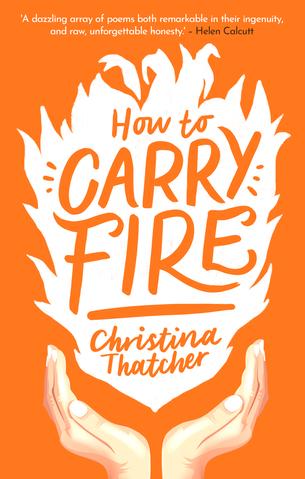
Writing Loss, Love and Fire: A Guest Post by Christina Thatcher, Author of How to Carry Fire

How_to_Carry_Fire_-_FINAL_HIGH_RES_large

It’s a real honour to be closing the blog tour for Christina Thatcher’s How to Carry Fire with a fabulous guest post from Christina all about writing love, loss and fire. I’m only sorry I couldn’t fit in a review today too because I think How to Carry Fire sounds amazing. My enormous thanks to Christina for her guest post and to Isabelle Kenyon for inviting me to take part in the blog tour.

Published by Parthian Books on 2nd April 2020, How to Carry Fire is available for purchase here.

How to Carry Fire

How_to_Carry_Fire_-_FINAL_HIGH_RES_large

How to Carry Fire was born from the ashes of family addiction.

Beginning with the burning down of her childhood home, Thatcher explores how fire can both destroy and cleanse.

Her work recognises embers everywhere: in farmhouses, heroin needles, poisonous salamanders. Thatcher reveals how fire is internalised and disclosed through anxiety, addiction, passion and love.

Underneath and among the flames runs the American and Welsh landscapes – locations which, like fire itself, offer up experiences which mesmerise, burn and purify.

This poignant second collection reminds us of how the most dangerous and volatile fires can forge us – even long after the flames have died down.

Writing Loss, Love and Fire

A Guest Post by Christina Thatcher, Author of How to Carry Fire

When I was 21 my father burnt down our family home. It was an accident but he never recovered from the guilt. This loss of our house – as well as our cherished objects, photographs and land – acted, in a way, like a culmination of all our losses. My father and brother had been losing their war with addiction for years. Many deaths and heartaches had led to this. The fire felt like the height of our hardship but also like an omen of more destructive things to come.

My second poetry collection, How to Carry Fire, explores these many losses. The writing process was sparked by a workshop I attended in 2017 called ‘The Poem as Witness: War and its Aftermath’. Just one month before, a fire had consumed the Grenfell Tower block in London killing over 70 people. The workshop facilitator asked us to read a transcript from one of the survivors and then played a recording of them, in shock, talking about the trapped residents in the tower. The whole room was silent. Then, we were asked to dig deep and consider what we had survived, what our families had survived, what our communities had survived. Immediately, I felt compelled to write about the fire which had followed me and my family for years. In that workshop, I wrote and read out the first shaky draft of ‘Insurance Report’, the poem which now opens my collection.

In the months and years after, I could not stop thinking and writing about fire. At first, it was physical: the literal flames and wreckage of the house. But, soon, the fire I was writing became emotional: the vein of addiction which runs through my parents and brother, my uncle and cousins. It became the anxiety that I carry about all my loved ones dying. Still, even as I wrote into the darkness, I could not shake the idea that the fire which devastated my family had also released us – how losing everything gave my mother permission to flee her abusive relationship, how it led me to search for a new life abroad.

Soon it became clear that fire was symbolic of both loss and love and that the burning of one home could lead to the building of another. Fire came to represent heartening things too, burning bright in pieces about passion and love. I didn’t expect to write so many poems on this theme but the flames just kept growing. And now this collection has emerged full of a kind of hope that I may never have discovered without the language of fire.

Thank you so much for this wonderful piece Christina. I think How to Carry Fire sounds utterly wonderful and I wish you every success with it.

About Christina Thatcher

Black_and_white_head_shot_medium

Christina Thatcher won the Black Lion Poetry Competition in 2019, was a winner in the Terry Hetherington Award for Young Writers in 2016 and was shortlisted for the Bare Fiction Debut Poetry Collection Competition in 2015. Her first collection, More than you were, was published by Parthian Books in 2017 and was named a Poetry School Book of the Year. Her poetry and short stories have featured in over fifty publications including The London Magazine, Planet Magazine, And Other Poems, Acumen and The Interpreter’s House. She lives in Cardiff and works as a Creative Writing Lecturer at Cardiff Metropolitan University.

For more information, follow Christina on Twitter @writetoempower and Instagram or visit her website.

There’s more with these other bloggers too:
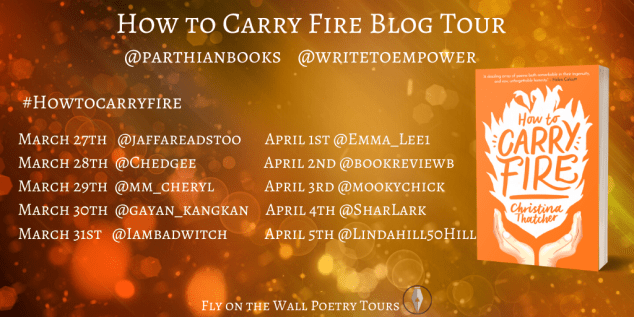
How To Carry Fire Blog Tour

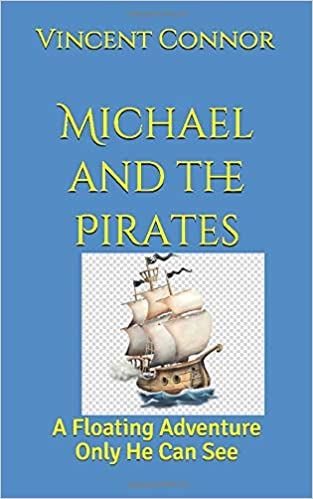
Michael and the Pirates by Vincent Connor

Michael and the Piratesbook

With lockdown, home schooling and difficult times, I’m trying to feature some books here on Linda’s Book Bag that I think might appeal to families and children as well as support independently published authors and the big publishing houses. With that in mind, I’d like to thank Vincent Connor for sending me a copy of Michael and the Pirates in return for an honest review.

Michael and the Pirates is available for purchase here and in audible read by Ian Billings.

Michael and the Pirates

A story in forty-one verses that will appeal to small children, as well as pre-teens. Michael and the Pirates can be read in a leisurely way in about 15-20 minutes. It could also be read as a bedtime treat over a number of nights; roughly, a page per day during the course of a week. With a solid storyline behind it, as well as verse it is written to make it interesting and appealing to adults, as well as children, who will laugh together at the humorous parts.

My Review of Michael and the Pirates

Michael is about to go on an adventure.

I was so lucky both to read a copy of Michael and the Pirates as well as listen to the Audible version. The audio book is brilliantly brought alive by Ian Billings whose different character voices, intonation and pace make for a wonderful listening experience.

I really liked the written version of the story too and can see it bringing considerable enjoyment to children aged around 4 – 10. The rhyming couplets give a regular rhythm and pace and exact rhymes, near rhymes, homonyms and homophones all contribute to the engagement of the story as well as affording great literacy opportunities for children to discuss spellings and notice language patterns. There’s a good range of new and familiar vocabulary included. Unfamiliar words are woven into the story so that meaning is clear.

However, learning opportunities aside, Michael and the Pirates is a super story for sheer enjoyment too. As Mike finds himself lost in the mist, dealing with irascible pirates and battling a giant squid there’s such an engaging narrative. I particularly liked the ending of the story because of the potential for future adventures.

Michael and the Pirates is a smashing children’s story because there’s humour, peril, danger and adventure with lots of mystery woven in. I’m looking forward to Michael’s future adventures.

About Vincent Connor

vincent connor

Vincent Connor doesn’t consider himself AN author, as such, as Michael and the Pirates is his first ever book. However, he found it immensely enjoyable writing this book, and hopes that readers will find as much pleasure in reading it. Vincent is planning more adventures for Michael, as he seems to come into his own when he’s faced with a challenge. He leads me, and I just follow with my pen and pad in hand, capturing the moments for you to enjoy…

You can follow Michael’s adventures on Twitter @michaelandthep1 and Facebook.

Tim Walker Introduces PERVERSE – a collection of short prose and verse

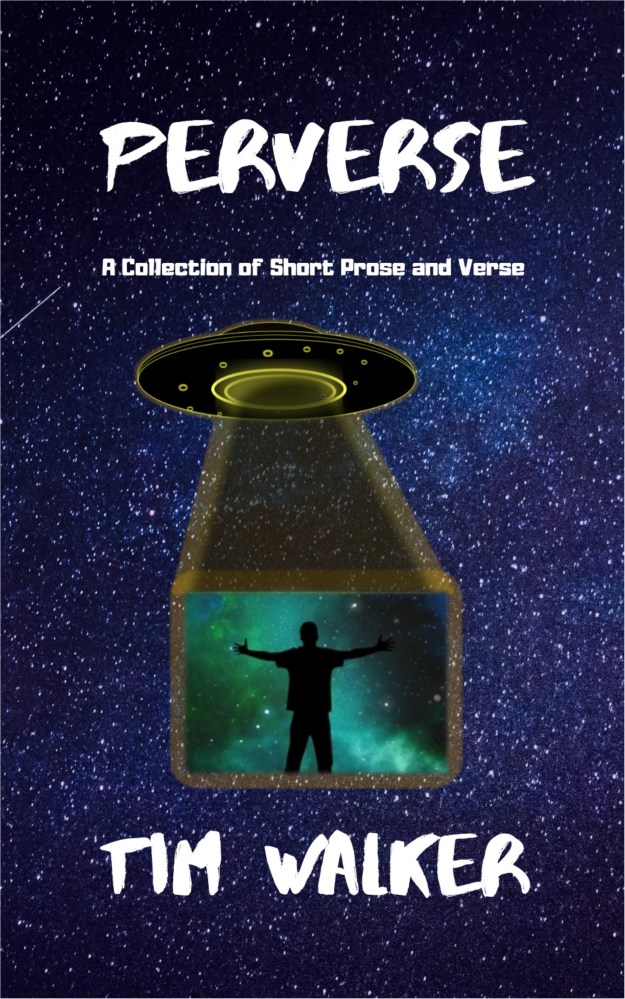
Perverse cover2

Approximately once a year Tim Walker hops onto Linda’s Book Bag and I’m delighted to welcome him back today with a slightly different post, introducing PERVERSE – a collection of short prose and verse, his brand new collection of short stories and poems, and sharing a poem with us.

Last time Tim was here we were sharing an extract from Arthur Dux Bellorum. Tim has introduced his book Uther’s Destiny in a post you can see here, as well as  previously writing a fabulous guest post about fiction and fear when the second book in his A Light in the Dark Ages series, Ambrosius: Last of the Romans, was published, and you can read that post here.

Tim will be back in June so don’t forget to pop back then.

PERVERSE – a collection of short prose and verse is available in ebook and paperback. It’s also free today in Kindle unlimited!

So, over to Tim:

Perverse – a collection of short prose and verse

Perverse cover2

PERVERSE is an eclectic collection of short, snatched memories and random ideas that tumbled out of a monthly spoken word event called The Innerverse. After two years, I had amassed plenty of odd poems and short stories, and began to pull this collection together during corona virus quarantine in March 2020.

‘Perversity’, is an obstinate urge or contrary behaviour; a wilful desire to not conform.

That made me think – life can sometimes be perverse – full of contradictions, disappointments, grief and sheer bloody-mindedness. But despite this, our sense of what is right and our collective willingness to submit to the rule of law, provides a counter balance that somehow gets us through.

I hope you enjoy this collection of verse and prose – a pastiche of my life, a nod to history and current affairs, a wistful look back, a hope for better days, and a celebration of life and all its riches.

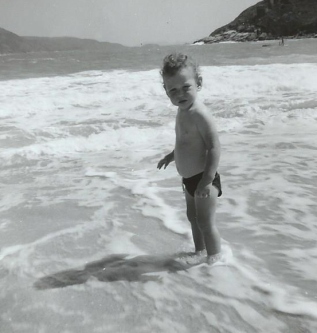
Thanks so much Tim. I think we could all do with a celebration of life right now. Thank you for introducing PERVERSE and for sharing the following poem Down to the Sea with us (as well as the impossibly cute photo of you as a toddler in the sea).

Tim toddler pic

Down to the Sea

Tiny feet dancing on the hot sand

Happily holding Mummy’s hand,

Giggling and squinting in the bright white light

White granules reflecting with all their might

Rhythmic lapping of white prancing mares

Whisper a summons to Neptune’s wet lair.


I break away from her protection

And run towards the beckoning big blue

Her shriek drives me on, wanted to be chased

Into the unknown; a brand-new experience

The consequences only big people know

Onwards into the cool splashing sea

You see it’s all just a game to me

She catches me when I’m up to my chest

Lacking a plan except she knows what’s best

Before my mischief leads to whatever I’ll find

In my infant’s inexperienced and untested mind.


She lifts me with a cry of relief mixed with rage

Her tight grip tells me this is not a game.

It’s the end of my adventure now I’ve been waylaid

Confined to the towel digging holes with my spade.

But I remember the thrill of running into the sea

A defining experience of risk-taker me.

By Tim Walker

About Tim Walker

profile pic3

Tim Walker is an independent author living near Windsor in the UK. He grew up in Liverpool where he began his working life as a trainee reporter on a local newspaper, The Woolton Mercury. A media career ensued, including a stint overseas in Zambia.

His creative writing journey began in earnest in 2013, as a therapeutic activity whilst recovering from cancer treatment. He started an historical fiction series, A Light in the Dark Ages, in 2015, following a visit to the near-by site of a former Roman town.The aim of the series is to connect the end of Roman Britain to elements of the Arthurian legend, presenting an imagined history of Britain in the early Dark Ages.

His latest book is Arthur, Dux Bellorum, a re-imagining of the story of King Arthur, published in March 2019. Book four in the A Light in the Dark Ages series, it won two book awards in April 2019 – One Stop Fiction Book of the Month and the Coffee Pot Book Club Book Award. The final book in the series, Arthur Rex Brittonum, is due out in June 2020.

The series starts with Abandoned (second edition 2018); followed by Ambrosius: Last of the Romans (2017); and book three, Uther’s Destiny (2018). Series book covers are designed by Canadian graphic artist, Cathy Walker. Tim is self-published under his brand name, timwalkerwrites.

Tim has also written two books of short stories, Thames Valley Tales (2015), and Postcards from London (2017); a dystopian thriller, Devil Gate Dawn (2016); and two children’s books, co-authored with his daughter, Cathy – The Adventures of Charly Holmes (2017) and Charly & The Superheroes (2018) with a third in the pipeline – Charly in Space.

To find out more you can visit Tim’s website. You’ll find him on Amazon and Facebook and you can also follow Tim on Twitter @timwalker1666.

Hamnet by Maggie O’Farrell

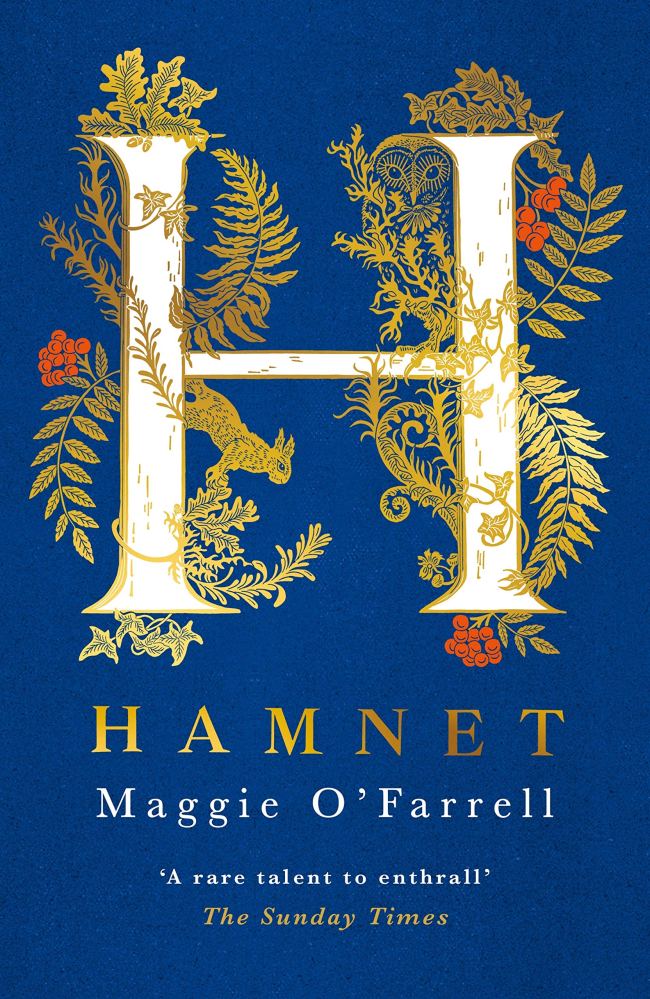
Hamnet Cover

Some weeks ago I was utterly thrilled to receive a wonderful surprise copy of Maggie O’Farrell’s Hamnet from Midas’s Director of Books and Publishing, Georgina Moore. No sooner had I dived in to Hamnet than the coronavirus crisis began and all Maggie’s promotional events had to be cancelled. With lovely Anne Cater of Random Things Tours stepping in to help out I was delighted to join in the blog tour to help celebrate the launch of Hamnet.

Published by Tinder Press yesterday, 31st March 2020, Hamnet is available for purchase through the links here.

Hamnet

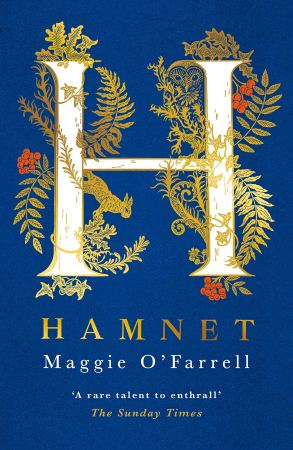
Hamnet Cover

TWO EXTRAORDINARY PEOPLE. A LOVE THAT DRAWS THEM TOGETHER. A LOSS THAT THREATENS TO TEAR THEM APART.

On a summer’s day in 1596, a young girl in Stratford-upon-Avon takes to her bed with a fever. Her twin brother, Hamnet, searches everywhere for help. Why is nobody at home?

Their mother, Agnes, is over a mile away, in the garden where she grows medicinal herbs. Their father is working in London. Neither parent knows that one of the children will not survive the week.

Hamnet is a novel inspired by the son of a famous playwright. It is a story of the bond between twins, and of a marriage pushed to the brink by grief. It is also the story of a kestrel and its mistress; flea that boards a ship in Alexandria; and a glovemaker’s son who flouts convention in pursuit of the woman he loves. Above all, it is a tender and unforgettable reimagining of a boy whose life has been all but forgotten, but whose name was given to one of the most celebrated plays ever written.

My Review of Hamnet

An imagined story of Shakespeare’s son Hamnet.

Where on earth do I begin to review Hamnet? This is one of those books that defy the reader because it is so brilliant, so moving and so wonderful that all the usual adjectives and superlatives feel jaded, hackneyed and inadequate in response.

Maggie O’Farrell’s mesmerising prose has a luminous beauty that feels almost ethereal, whilst at the same time being grounded in very human senses. Her descriptions are exquisite, transporting the reader to the late 1500s with vivid clarity, complete depth and authenticity alongside a lightness of touch that is breathtaking. Some of the seamless similes and metaphors literally made me gasp aloud. As I read I could feel a tangible tenderness in the writing that touched me completely. I adored too, the occasional oblique references to Shakespeare’s writing that are slipped in, making Hamnet feel connected through time and space to Hamlet and Shakespeare himself. Indeed, that is one of the huge successes of Hamnet as we see how humanity is linked in minute ways that have profound impact, so that it doesn’t matter whether a reader knows anything about the playwright or his plays to enjoy this story completely.

Whilst Hamnet is the protagonist and catalyst for the narrative, this is very much Agnes’s story. I loved the fact that Shakespeare himself is referred to as ‘the son’, ‘the father’, ‘the husband’ so that Maggie O’Farrell has inverted the concept of history, making Hamnet very much her-story, with Agnes at the heart. And what a character Agnes is. She is the very embodiment of universal womanhood, of her era and of human emotion. Agnes can hate as well as love, control as well as comply, create as well as destroy so that she feels pulsatingly real. Both mystical and earthly, I don’t think I’ve ever encountered a character quite like her. I lived alongside Agnes rather than read about her because she felt so alive.

The other people in the pages of Hamnet are equally vivid and realistic. I often found I had quite strong emotional responses to them so that I experienced pure, unselfish love, strong dislike and all consuming grief particularly powerfully. I wept on more than one occasion as I read. As the captivating plot unfolds, each person is revealed with increasing clarity so that they mattered to me as much as any real people.

Character, setting and sublime writing aside, Hamnet is a cracking story. The narrative ebbs and flows with history, peril, love and events that sweep the reader along. I was utterly mesmerised.

Hamnet is a book that feels absorbed by the reader’s soul rather than read. I am in awe of Maggie O’Farrell’s writing talent and feel privileged to have read Hamnet. Don’t miss it.

About Maggie O’Farrell

Maggie Author Pic

Maggie O’Farrell is the author of the Sunday Times no. 1 bestselling memoir I Am, I Am, I Am, and eight novels: After You’d Gone, My Lover’s Lover, The Distance Between Us, which won a Somerset Maugham Award, The Vanishing Act Of Esme Lennox, The Hand That First Held Mine, which won the 2010 Costa Novel Award, Instructions For A Heatwave, which was shortlisted for the 2013 Costa Novel Award, This Must Be The Place, which was shortlisted for the 2016 Costa Novel Award, and Hamnet. She lives in Edinburgh.

You’ll find Maggie on Facebook and can discover more on her publisher author page.

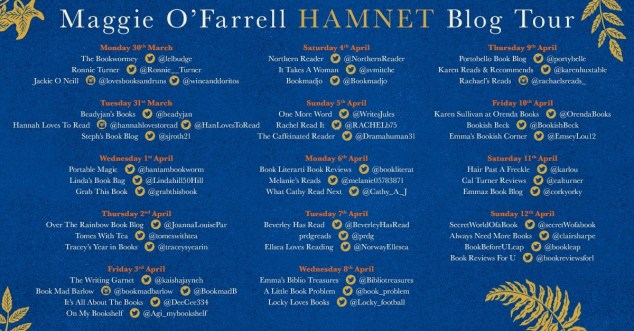
There’s more with these other bloggers too:
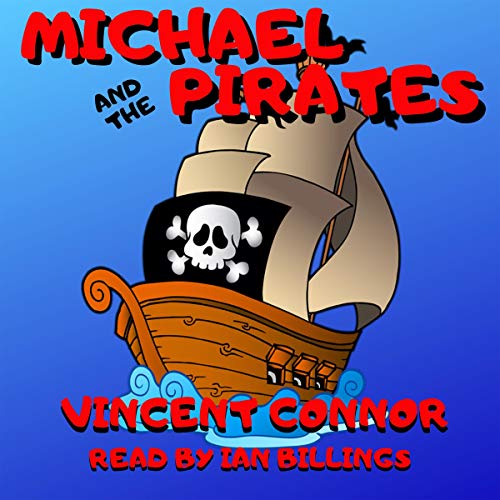
Hamnet BT Poster (1)