The Fine Line Between Right and Wrong: A Guest Post by David Videcette, Author of The Detriment

the detriment

Earlier this month I reviewed The Detriment by David Videcette. You can see what I thought about this cracking thriller here. This got me thinking about where we draw the lines between what is morally right and wrong so I asked David if he’d write a guest post for me on that very topic and luckily he agreed. David has written a guest post every bit as interesting and thought provoking as his fiction.

The Detriment is the second book by David to feature Jake Flannagan after The Theseus Paradox and is available for purchase here.

The Detriment

Linda book bag The Detriment quote

“The truth costs nothing, but a lie can cost you everything…”

June 2007: a barbaric nail bomb is planted outside a London nightclub, a spy is found dead in his garden, and a blazing Jeep is driven into Glasgow airport. Three events bound by an earth-shattering connection that should have remained buried forever.

From the author of The Theseus Paradox, the smash-hit 7/7 thriller based on true events, comes the sequel about a real-life mystery that threatens to destroy a nation. Detective Inspector Jake Flannagan must uncover how a series of astonishing events are inextricably linked, before the past closes in on him.

We all have secrets we say we’ll never tell…

The Fine Line Between Right and Wrong

there are no heroes without villains

As a crime fighter turned crime writer, Linda asked me to write about right and wrong for her blog, which sounded nice and simple. Having spent a career in the police, you would think it would be a straightforward matter. Yet, the fine line between right and wrong is as indecipherably complex to me now as the day I started as a bobby on the beat twenty years ago.

As children, we are taught that we shouldn’t lie and shouldn’t be unkind, but the simple act of being told isn’t enough. We learn far more from our interactions with others. You don’t hit other kids, as they cry or hit back, creating a negative experience for us as individuals. You locate a lost ball and return it to someone, this results in a positive experience. We learn how to coexist. A form of social justice develops about what is acceptable and what isn’t. And this is where our early notions of right and wrong come from.

Animal instincts

In this respect, humans are like most other animals. Experiments with lots of different species have shown that all animals can differentiate between making good and bad choices.

Over time, an animal can learn that choosing A, gives them X amount of food, and choosing B, gives them no food at all. The reward is then their big driver in future decision making.

Animals can also learn that to do something wrong, results in a negative experience. For example, an electric fence encircling a field of cows says to the animals, “Don’t try to leave the field, as it’s going to hurt. Leaving the field is bad, it’s wrong.”

Choose your words carefully

Most of us can tell the difference between right and wrong, good and evil, or even between legal and illegal. But in doing so, we tend to rely on very simple, animalistic binary choices based on our learned experiences.

Even the language we use often only gives us binary choices. There is no third or even fourth option. We must choose one or the other. Right or wrong. For some people these simple choices are enough. They build their lives and environments based on one or the other. But there are certain people and situations where the simple rules of live or die; eat or starve; hunt or be hunted are much more complex and difficult to decipher.

A murderer is an evil wrongdoer

The police officer that catches him or her is good and righteous… easy.

But what happens when the murder is committed in revenge, or in a fit of rage? What happens when a drug dealer is tied to a chair, and watches a corrupt police officer torture his family, and rape his wife, in an effort to get the drug dealer to reveal where his drugs and money are hidden? What happens when that father and husband breaks free, hunts down the corrupt police officer, who he knows will never stand trial or face justice for what he did – and kills the police officer? Where are the boundaries of right and wrong, good and evil, legal and illegal now? Where are the simple binary choices that we learned as children? Where is the reward for doing the right thing?

firearm-409252_1920

How far would you go?

Imagine that you are a counter-terror officer. You’ve got a terrorist suspect in your custody. You are convinced he’s planted some bombs somewhere, convinced they are going to kill and maim hundreds of people, but he won’t tell you where they are hidden. Could you be tempted to intimidate or even hurt him, for the greater good, to save lives? Would you be happy to torture him, to get the answers you wanted?

The complexities of these decisions, of how to act, on what to do – have always fascinated me. They are issues which Detective Jake Flannagan, the lead character in my thrillers, has to face on a daily basis. They are what define us from the rest of the animal kingdom. No other animal would have these dilemmas; their decision making is completely binary. But as humans, we can be forced into a place where grey exists, where black and white is either side of us. Where lying becomes rewarding, where inflicting pain becomes acceptable, where the very basics of what we learned as children, is turned on its head.

Let’s go back to the scenario of you as the counter-terror officer, holding a terrorist prisoner whom you are convinced has planted bombs which will soon explode, killing and maiming innocent members of the public. How many of you thought that torture was acceptable here, for the greater good?

handcuffs-2102488_1280

Let’s imagine you start with a little bit of punching in the face while he is handcuffed to the chair, stamping on his head, then you progress to some cigarette burning, then even to pulling his fingernails out, then perhaps some waterboarding. Now he begins talking, singing like a canary. You feel good. You did the right thing, even though it was wrong?

But when you go to the places where he said he’s planted the bombs, they aren’t there.

He lied to you. Not because he wanted to, but because it’s the wrong man. You picked up an innocent person. He lied because he learned that saying nothing resulted in more pain. You taught him that lying was good and the right thing to do.

I often wonder if this is why human language evolved, so that we could communicate further than simple likes and dislikes, beyond rights and wrongs. I wonder whether we are short changing ourselves by trying to see the world in black and white, like animals do, instead of shades of grey.

This is where I think natural justice comes into play, where humans can justify their decision making over and above the simple binary choices of animals. The thing we hold deep inside ourselves – is the knowledge that we can say, ‘I am happy with myself’ or ‘I can sleep at night.’

It’s the human state of being able to recognise the grey in the world, which no other animal appears to have. It is language and explanation that allow us to do this.

But as you will discover in my books, these choices for a detective are never simple.

Wrong can sometimes be right – and right wrong.

About David Videcette

both books just one story I can't tell you the truth, but I can tell you a story...

David Videcette is the author of The Theseus Paradox and The Detriment – compelling detective thrillers based on true events.

With twenty years’ policing experience, including counter-terror operations and organised crime, David was a lead detective on the intelligence cell during the 7/7 London bombings investigation. As a Scotland Yard investigator, David has chased numerous dangerous criminals, searched hundreds of properties and interviewed thousands of witnesses. Now a security consultant for high-net-worth individuals, he’s also a regular commentator for the media on crime, policing and terrorism. David currently lives in London and is addicted to going to the cinema.

You can find out more about David on his website, by following him on Twitter and on Facebook or by checking out all his books on Amazon.
Blog Post 1000 Giveaway

1000

Who would have thought that when I began Linda’s Book Bag just over two years ago I would be posting my thousandth blog post today. I can’t believe it.

It has been such an honour to read fabulous books and meet wonderful authors, publishers and fellow bloggers both in real life and via the Internet. Blogging has brought me so much joy (and not a little stress at times when I STILL haven’t managed to get to a book I’ve promised to read and review) and introduced me to wonderful people I would never otherwise have met.

To celebrate this 1000th blog post I’m running a little thank you giveaway for all those who’ve supported my blog by visiting Linda’s Book Bag and sharing my posts, liking Linda’s Book Bag on Facebook, or following me on Twitter @Lindahill50Hill. Please take part and good luck!

Giveaway

£20

For your chance to win a £20 or $20 Amazon e-voucher click here. Open internationally, the giveaway closes UK midnight on Friday 21st July 2017.

Writing YA Fiction: A Guest Post by James Morris, Author of Feel Me Fall

Pageflex Persona [document: PRS0000032_00050]

I’m delighted to welcome James Morris, author of Feel Me Fall, to Linda’s Book Bag today. James has kindly agreed to tell me a little about the challenges of writing a novel for the so-called young adult market and, like me, he doesn’t always find categories of books helpful.

Feel Me Fall was published by Inkspot Imaginarium on 2nd May 2017 and is available for purchase here.

Feel Me Fall

Pageflex Persona [document: PRS0000032_00050]

Secrets and survival in the Amazon

Emily Duran is the sole survivor of a plane crash that left her and her teenage friends stranded and alone in the jungles of the Amazon. Lost and losing hope, they struggle against the elements, and each other. With their familiar pecking order no longer in place, a new order emerges, filled with power struggles, betrayals, secrets and lies. Emily must explain why she’s the last left alive.

But can she carry the burden of the past?

Discover the gripping new adventure novel that explores who we are when no one is watching, and how far we’ll go in order to survive.

Writing Young Adult Fiction – Or Am I?

A Guest Post by James Morris

Feel Me Fall tells the story of Emily Duran, the sole survivor of a plane crash that left her and her teenage friends stranded and alone in the jungles of the Amazon. Lost and losing hope, they struggle against the elements, and each other. With their familiar pecking order no longer in place, a new order emerges, filled with power struggles, betrayals, secrets and lies. Emily must explain why she’s the last left alive.

Feel Me Fall is classified as young adult, but as a reader wrote, “It reads like an adult psychological thriller,” and that’s exactly what I wanted to hear. For me, writing young adult is no different than other genres. While the characters might be younger, the drama and stakes still have to be high. The plot must still be engaging. The dialogue has got to sound real. A relative of mine once asked me: “How can you write YA if you’re not a teenager?” The undercurrent was: What do you know about being a teenager today? (Let’s just set aside that thing called imagination.) To me, teenagers are the same, in every era. True, the technology might be different, but the worries about fitting in, identity, sex, and wanting to be independent while still being dependent, are universal. People will be writing teen stories hundreds of years from now. That’s what I tap into. Even if I came of age in the 80s, my struggles and worries were probably very much the same as a teenager today.

I do avoid slang, because like technology, that will date itself. And I’m careful not to be patronizing. I try my best to make my characters—no matter the age—as real and complex as possible.

I find it interesting that when I was growing up, there wasn’t a “young adult” category. It was just stories with younger characters. A lot now is about marketing. I had a person in publishing tell me that “it’s all about where your book sits on the shelf,” meaning: What category can they clearly market it to? I think the marketing side of things has taken away some of the surprises of a book. If it’s easily categorized, a reader knows a lot about a story before they even read it.

I don’t even like to say my books are “young adult.” I like my earlier definition; they are stories that just happen to have a teenager at the center. If anything, the phrase “young adult” can seem patronizing—as if the story has to be watered down because the reader isn’t adult enough to handle it. Maybe that’s my own opinion. That’s the danger of YA—riding that line between what’s acceptable in an “adult” book, and one that a younger reader might read. But I like seeing a recent trend where everything is not just safe characters, but more complex, more morally ambiguous, maybe even slightly uncomfortable. I guess it all depends on whether you read for pleasure, or to be challenged. And there are times for both.

I’d like to think Feel Me Fall does both: provide a nice rollercoaster ride for those who want one, while asking questions of us that might be hard to answer.

About James Morris

James Morris

James Morris is a television writer who now works in digital media. He is the author of the young adult thriller What Lies Within, the dystopian love story Melophobia, the young adult suspense Feel Me Fall, and the upcoming young adult horror Screams You Hear. When not writing, you can find him scoping out the latest sushi spot, watching ‘House Hunters Renovation’, or trying new recipes in the kitchen. He lives with his wife and dog in Los Angeles.

You can find out more about James on his website, Goodreads and on Facebook and by following him on Twitter @JMorrisWriter. All of James’ books are available here.

What Writers Learn from Teaching Others, A Guest Post by Sonja Price, Author of The Giants Look Down

The Giants look down

As an ex-English teacher I have the utmost respect for those who are still in the profession and am delighted to welcome teacher Sonja Price, author of The Giants Look Down to Linda’s Book Bag today. I asked Sonja how teaching affected her writing and luckily she agreed to tell me more.

Published by Robert Hale, The Giants Look Down is available for purchase in ebook and paperback here.

The Giants Look Down

The Giants look down

At the age of ten, Jaya Vaidya decides she wants to follow in the footsteps of her beloved father and become a doctor, much to the chagrin of her mother and her local community. It is the late 1960s and the family enjoy an idyllic life in the Vale of Kashmir, despite the area being riddled with conflict and poverty.

But after a devastating earthquake wipes out her entire family, Jaya is taken into the care of relatives in Delhi, who attempt to marry her off and keep secret from her the possibility that Tahir, her younger brother, has survived the earthquake.

After escaping from the arranged marriage Jaya is put through medical training in Scotland, as she had always dreamed, and where she develops feelings for her foster family’s eldest son, Alastair, who is engaged to someone else.

In the meantime, Tahir has been abducted by a band of Kashmiri freedom fighters, who have made him one of their own.

Jaya finally returns to her troubled homeland to find him and come to terms with the loss of her family. Alastair, who arrives in Kashmir to announce his love for Jaya, is kidnapped by the freedom fighters, forcing her to risk everything to get him back.

What Writers Learn from Teaching Others by Sonja Price

A Guest Post by Sonja Price

Teaching creative writing is a bit like reading. Reading is input into writing and writers usually consider reading both a pleasure and an investment. What you read accumulates and morphs in your subconscious, and can be as inspiring as any real life experience. On the downside it can influence your writing to such an extent that a crime writer I know avoids anything too similar when she has a deadline for fear of it influencing her style. Deadlines aside, I read all kinds of books, good and bad (but always entertaining), because I think they can stimulate and improve your style. Knowing what doesn’t work is as important as knowing what does.

And so it is with teaching writing. I get inspired, influenced and amazed by my students’ work. I love the interaction, the exploration of a theme that is central to writing. For technique I cover such areas as character, setting, dialogue, plot, telling not showing, voice, point of view etc. and by doing so hone my own craft. I often think: yes of course I must try that in my next story and reflect on what I did in my last story. I return to my work in progress with a fresh eye, my mind full of impressions of what my students have shown me.

Although you can teach technique, I believe you cannot teach creativity. This must come from within, but you can, of course, encourage and support what is already there. Writing lessons endeavour to unearth that gem buried deep inside a person. Courses can help mine that gem and facilitate a short cut to the final version. You don’t have to reinvent the wheel yourself to get to your destination. If you’ve got the talent, why not avail yourself of anything that might give you a little push? I try to give my students the space to be creative, and get them to go where they have never gone before. I am often bowled over by the result, the revelation of what has been slumbering inside these aspiring writers all the time. How did they come up with that? Where did they get that from? And of course I get some students who bravely open up about a personal experience which you never would have suspected they had gone through.

I rarely learn anything new regarding technique in the classroom, but I am lucky enough to witness flights of imagination which astound and thrill me. It’s not all roses though: I once gave a student a bad grade upon which he handed in a piece about killing his teacher. I had to think long and hard about that one, but came to the conclusion that he was entitled to write whatever he wanted. I made sure I wasn’t left alone with him in the classroom and told him in front of the others that he should be aware of the effect his words could have on the reader- in my case anxiety! This led to a discussion about whether there are any subject taboos and whether you should write about people you know such as family members.

The main thing a writer should do is write. Teaching can be as exhausting as it is rewarding. You cannot just walk out when you’ve had enough, but if you get the writing/teaching balance right, it can be a great enrichment. I know that if I didn’t teach, I would really miss both my students and their creativity.

About Sonja Price

IMG_2390

Sonja is a lecturer for English and Creative Writing at Jena University in Germany and also offers courses in Somerset where she lives. Her debut novel The Giants Look Down was shortlisted for the Joan Hessayon Award.

You can follow Sonja on Twitter @PriceSonja, find her on Facebook and visit her website.

Jungle Jam and Jungle Jam in Brazil by Louise and Noam Lederman

jungle jam

I’ve featured a few children’s books on Linda’s Book Bag because I’m so interested in literacy and promoting a love of reading in children. Today, therefore, I would like to thank Louise Lederman for review copies of Jungle Jam and Jungle Jam in Brazil in return for an honest review.

jungle jam in brazil

Jungle Jam is available for purchase in paperback here and Jungle Jam in Brazil is available here. They are the first two books in the Jungle Jam series and Jungle Jam in Spain will be released in August 2017. All the Jungle Jam books are also available for purchase here (and you can even get a Mikey monkey!)

Jungle Jam

jungle jam

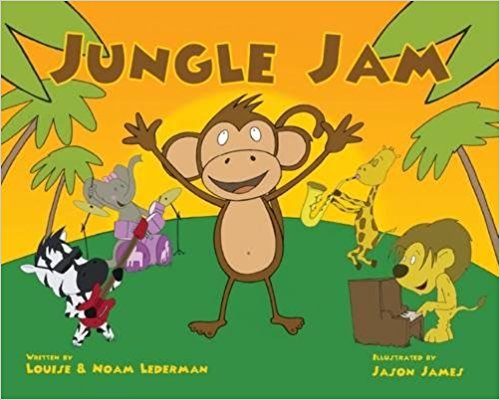
Mikey is a singing monkey who embarks on a musical adventure to find global fame but discovers along the way that he must work with others to make his dream come true.

On his journey, Mikey the Monkey meets Larry the Lion, Ella the Elephant, Ziggy the Zebra and Gina the Giraffe, each of whom play a musical instrument they teach him about, and then invite him to sing with them. Each time he declines and continues on his journey to find fame. Finally he hears an incredible sound and sees all of the animals playing their instruments together and realises that when people work together, dreams can come true.

This sweet, captivating rhyming book is designed for young children from 0-5 as an introduction to musical instruments and sounds. It even has an activity page to show you how to make your own instruments at the end and also shows children how working together as part a team is always best!

Jungle Jam in Brazil

jungle jam in brazil

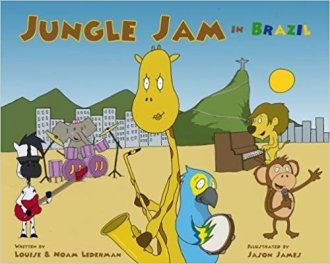
“The band is getting ready for their biggest show yet. They are going to Brazil in a jumbo jet.”

Gina the Giraffe loves being part of the Jungle Jam band but she is nervous about leaving her home and trying new things. Follow Gina on her courageous journey and learn about the fabulous music and culture of Brazil. Following Jungle Jam, Jungle Jam in Brazil is designed for young children as an introduction to new sounds, cultures and musical instruments. Jungle Jam in Brazil shows children that they can do anything they want if they simply try their best and be ‘brave and strong’.

My Review of Jungle Jam and Jungle Jam in Brazil

Mikey the Monkey is looking for something special in his life – to be a singer in a band and have adventures.

These two Jungle Jam books are utterly wonderful and whilst they are designed for pre-school children, older children will love them too as there is so much to explore and entertain them.

Apart from the excellent overall quality of production with wonderful illustrations, Jungle Jam and Jungle Jam in Brazil have outstanding educational value. Firstly, there is a wonderful rhythm alongside the really well structured rhyme scheme so that the musical cadence of speech is underpinned by the narrative. The musical references are accessible through onomatopoeic words so that music becomes a natural part of the experience of reading these two books, affording both unconfident adults and children alike to enjoy the musical element. The use of alliteration and unusual words for children will expand their vocabulary as well as their understanding of how language works, as will the couple of easy Spanish words; especially when the rhythm of breaking them into syllables is used. Syllabification is such a useful tool when learning to read. The advice to adults at the end of Jungle Jam about reading with children is very useful too.

However, the really perfect aspect for me in Jungle Jam in Brazil in particular is the underlying message of friendship. Gina the Giraffe lacks confidence but she is well supported by her friends to try new experiences, new places, new foods and new people – all parts of life that can overwhelm some young children so that they receive the message that it is safe and exciting to try new things.

I really liked the activities included at the end of the books. In Jungle Jam there are musical instruments to make and in Jungle Jam in Brazil there is an observational activity as well as some facts about Brazil so that as well a captivating story, children have other activities as a result of reading these books.

I am astounded by the educational value of Jungle Jam and Jungle Jam in Brazil and think they are must buy books for any parent.

About Louise and Noam Lederman

noam and louise

With a strong belief in the importance of music in a child’s development, husband and wife team Louise and Noam Lederman decided that, if there weren’t books available to share a passion for music with children, then they had better write their own and so the Jungle Jam books were born.

Noam is an educator, musician and author and Louise has spent many years working in marketing, PR and events, mostly for charity organisations.

To find out more you can visit the Jungle Jam website, and follow Jungle Jam on Facebook and Twitter.

Half a Sixpence by Evie Grace

half a sixpence

I’m delighted to be part of the launch celebrations for Half A Sixpence by Evie Grace with my review. Half a Sixpence is Evie’s first novel in her Maids of Kent trilogy. Half a Heart and Half a Chance will follow.

Half a Sixpence was published on 13th July by Arrow Publishing, an imprint of Penguin Random House, and is available for purchase in e-book and paperback here. As well as my review of Half a Sixpence, I’m thrilled to have a character profile of Pa and Ma Rook from Evie too.

Half a Sixpence

half a sixpence

East Kent, 1830

Catherine Rook takes her peaceful life for granted. Her days are spent at the village school and lending a hand on her family’s farm. Life is run by the seasons, and there’s little time for worry.

But rural unrest begins sweeping through Kent, and when Pa Rook buys a threshing machine it brings turbulence and tragedy to Wanstall Farm. With the Rooks’ fortunes forever changed, Catherine must struggle to hold her family together.

She turns to her childhood companion, Matty Carter, for comfort, and finds more than friendship in his loving arms. But Matty has his own family to protect, and almost as quickly as their love blossomed their future begins to unravel.

With the threat of destitution nipping at her heels, Catherine must forge a way out of ruin . . .

Joint Character Profile of Ma and Pa Rook

A Guest Post by Evie Grace

I’m very grateful to you for hosting today’s stop on my tour with Half a Sixpence, the first book in a new series, a Victorian family saga that follows the fortunes of three generations of women from the hop gardens and orchards of East Kent to the squalid slums of Canterbury and brickfields of Faversham.

Half a Sixpence is the story of Catherine Rook, a country girl born in 1817, who lives at Wanstall Farm in the village of Overshill with Pa and Ma Rook, and her older brother, John. Catherine’s other siblings have moved out. Her sister Ivy is married to Overshill’s blacksmith, and her brother, Young Thomas Rook, farms some land that Pa acquired in payment of a debt.

Pa grows barley, hops and apples at the farm, and also decides to introduce a small flock of sheep. He is so dedicated to improving the farm and keeping the tenancy in the Rook family that he even makes notes when he is at church on Sunday mornings. He is one of the pioneers in the mechanisation of agriculture, and invests in new machinery in the hope that it will impress the squire, and improve the lives of his family and labourers. Sometimes it seems – to his wife anyway – that he is too generous with his favours towards the Carters whom he employs to work on the farm.

Pa is short and quick-witted with a wiry-body, tanned complexion and hooked nose. In contrast, his wife is well-spoken but sometimes slow of thought. She was born and bred to be a farmer’s wife, although she does aspire to better things, one of her aims being to arrange for Catherine to marry up. She churns the best butter in the parish, runs her household with the help of a maid, and carries out visits to the poor and the sick with the vicar’s wife.

While Pa Rook prefers to plough any money they receive back into the farm, his wife complains that she would like new clothes so as not to let the side down while she is out doing her ‘good works’ around the parish. Although they have their differences, the couple are fond of each other and fiercely protective of their family’s reputation.

It was while I was thinking about Pa Rook’s character and what his life would have been like as a conscientious tenant farmer who cared about his labourers – people who lived on the breadline and then lost their jobs with the arrival of the threshing machine – that I came across the colourful Sir William Courtenay, and the Battle of Bossenden in 1838, the last armed uprising on British soil. I decided I could use this quite shocking historical event in Half a Sixpence, and show what effect it would have on the Rooks and Wanstall Farm.

I hope you enjoy getting to know the Rooks in Half a Sixpence!

x Evie

My Review of Half a Sixpence

The events of the 1830s will impact on Catherine’s life more than she could ever think

I have a confession to make about Half a Sixpence. I didn’t really like the protagonist Catherine. I thought she was too proud, often too rash in her attitude to others, and at times she really annoyed me. However, I think it proves the quality of Evie Grace’s writing that I still cared about what happened and by the end of the book I was desperate for Catherine to have some good luck in her life!

Indeed, there’s a smashing cast of characters and Evie Grace writes with such visual dexterity that I could picture them all and they came alive as I read. I have a feeling I may have met a few Mattys in my life! I really hope someone picks up this book for television as I think it would make a fabulous series.

The settings are so vividly depicted so that there is a real sense of rural Kent in the 1830s. I loved the way in which the society of the time was so cleverly woven into the story so that there is a real feeling of credibility and era when reading Half a Sixpence. It is a book that manages to inform and educate without the reader realising at the same time as being hugely entertaining.

Half a Sixpence has a plot that romps along at breakneck speed. There are so many twists and turns in Catherine’s life that I didn’t like to put down the book in case something happened when I wasn’t looking.

Half a Sixpence is the perfect embodiment of an historical novel. Readers who are looking for a tale of peril, love and history will adore it.

About Evie Grace

evie grace

Evie Grace was born in Kent, and one of her earliest memories is of picking cherries with her grandfather who managed a fruit farm near Selling. Holidays spent in the Kent countryside and the stories passed down through her family inspired her to write Half a Sixpence.

Evie now lives in Devon with her partner and dog. She has a grown-up daughter and son.

She loves researching the history of the nineteenth century and is very grateful for the invention of the washing machine, having discovered how the Victorians struggled to do their laundry.

You can follow Evie on Twitter @eviegrace2017 and find her on Facebook.

There’s more with these other bloggers too:

half a sixpence poster

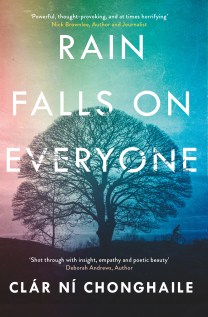
Publication Day Giveaway: Rain Falls on Everyone by Clár Ní Chonghaile

9781785079016

I’m very pleased to be featuring another fabulous Legend Press book today; Rain Falls on Everyone by Clár Ní Chonghaile.

Rain Falls on Everyone is published tody, 15th July 2017, and is available for purchase here.  However, if you’re a UK reader there’s a chance for you to win a paperback copy of Rain Falls on Everyone at the bottom of this blog post too.

Rain Falls on Everyone

9781785079016

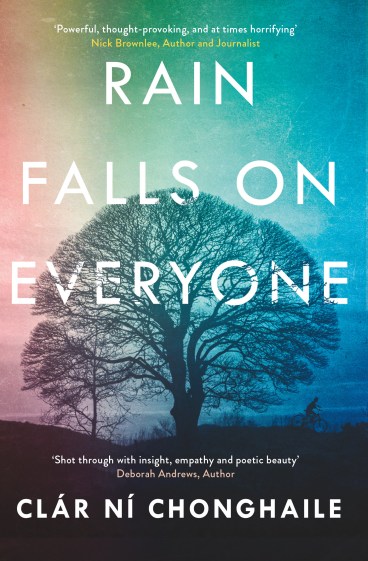
Theo, a young Rwandan boy fleeing his country’s genocide, arrives in Dublin, penniless, alone and afraid. Still haunted by a traumatic memory in which his father committed a murderous act of violence, he struggles to find his place in the foreign city.

Plagued by his past, Theo is gradually drawn deeper into the world of Dublin’s feared criminal gangs. But a chance encounter in a restaurant with Deirdre offers him a lifeline.

Theo and Deirdre’s tender friendship is however soon threatened by tragedy. Can they confront their addictions to carve a future out of the catastrophe that engulfs both their lives?

About Clár Ní Chonghaile

Fractured Author - Clar Ni Chonghaile

Clár Ní Chonghaile was born in London but grew up in An Spidéal, County Galway. She left Ireland aged 19 to join Reuters in London as a graduate trainee journalist. Clár has been a reporter and editor for over 20 years, living and working in Spain, France, the Ivory Coast, Senegal and Kenya.

She now lives in St Albans, England, with her husband and two daughters. Her debut novel, Fractured, was published by Legend Press in 2016.

You can follow her on Twitter @clarnic and visit her blog.

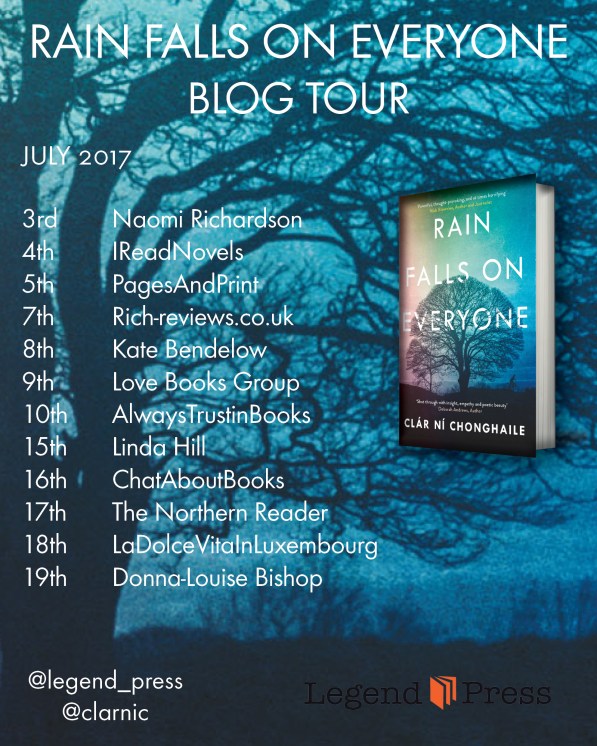
There’s more about Clár Ní Chonghaile with these other bloggers too:

Rain Falls Blog Tour Banner jpeg

Rain Falls on Everyone Giveaway

9781785079016

UK only I’m afraid, but for your chance to win a paperback copy of Rain Falls on everyone by Clár Ní Chonghaile click here. Giveaway ends at UK midnight on Friday 21st July. Good luck!

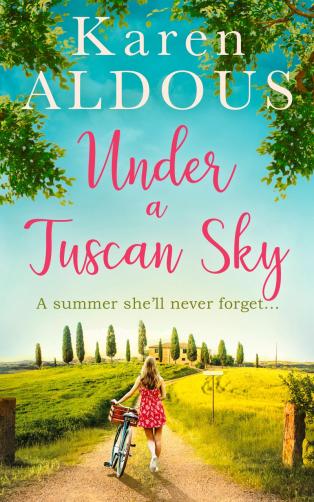
Authors Supporting Authors: A Guest Post by Karen Aldous, Author of Under a Tuscan Sky

Under a Tuscan Sky 01-02

Although I’ve only been blogging for a couple of years, I have been privileged to meet so many wonderful bloggers and writers either vicariously through social media or, as in the case of lovely author Karen Aldous, in real life. Having previously interviewed Karen here, I was thrilled to know she has a new book, Under a Tuscan Sky out now and so I invited her onto Linda’s Book Bag to tell me how important mutual support for authors by other authors really is.

Under a Tuscan Sky is published by HQ, an imprint of Harper Collins, and is available for purchase here.

Under A Tuscan Sky

Under a Tuscan Sky 01-02

A summer she’ll never forget…

When Olivia Montague’s grandmother passes away, she decides it’s finally time to make some changes in her own life. So she breaks up with her ‘going nowhere’ boyfriend and embarks on a journey to her Nonna’s home in Tuscany.

Until now, Olivia has always believed that she’s incapable of love, after being abandoned by her parents as a baby. But with each day spent at the gorgeous villa nestled in the rolling Italian hills, she feels her heart begin to flutter…

And when handsome antiques dealer Hugh St. James arrives on the scene, she realises things might be about to change forever!

Authors Supporting Authors

A Guest Post by Karen Aldous

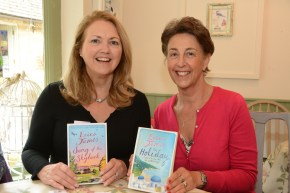
Although we had met on social media, and last year she had very kindly invited me on to her amazing blog, I had the pleasure of actually meeting the lovely book blogger Linda Hill recently at the Deepings Literary Festival, near Stamford, Lincolnshire – attending afternoon tea with one of our favourite authors, Erica James – and along with fellow author, Julie Stock and a room full of readers, we had a very pleasant and interesting afternoon listening to Erica and asking her questions about her writing and her beautiful novels. And naturally as soon as Linda learned I was launching a new novel in June, she immediately invited me on to her blog in support, and suggested I discuss a topic very close to my heart – why authors need to support one another.

DSC_4304

As a novelist who began a career with the publication of my first e-book three years ago, I joined Twitter and Facebook and instantly found myself among a wide circle of authors, book bloggers and readers who began reading and sharing news about my debut novel The Vineyard.  I was overwhelmed, people were reading my novel and discussing the characters like they were their friends, and very quickly my novel was racing up the Amazon charts and gathering bestseller tags. Realizing the power of this media, I immediately reciprocated realising we all have one thing in common – books. We read, review or write them, often all three, and social media was a perfect vehicle to rave and share our passion. My maxim has always been to treat others as I would expect to be treated myself and therefore, since then we have reciprocated promotion on social media and blogs so that my followers hear about their books and their readers get to hear of mine. It makes perfect sense.

What I do:

  1. Buy Other Authors’ Books – Writers are readers first, so naturally we’re fans of authors and the stories they tell. We all appreciate the work it takes to become published, so I buy, read and review what I read when time allows.
  2. Talk About Books – I will always tell my friends about a story I’ve enjoyed and vice-versa. Authors want readers to love their novels, and recommendation spreads faster than fire.
  3. Blog About Books – We are fortunate we have an incredible community of reviewers and book bloggers who generously give their time to share their thoughts with other readers via their reviews and book blogs. Unsurprisingly, the scope has stretched so widely and increasingly, authors have their own blogs where reviewing a book they’ve read on their own blog or inviting a reviewer to talk about their passion, or author to talk about their new book expands ways of reaching new readers.
  4. Promote Other Authors – As well as our friends and family, there are groups on Facebook, Twitter, Google+ etc, who love to hear about new releases, or books on special offer. Sharing our covers and offering excerpts is an ideal way to whet reader’s appetites, so by paying forward, we also reap the rewards with the pay back.
  5. Go To Book Events – By nature, authors write in isolation and so it goes without saying that we all need to touch base with the real world now and again. Book events are a great excuse to get out and meet like-minded people, particularly going to book launches or literary festivals and supporting fellow authors by meeting the author and getting your copy of their book signed, meeting and chatting to readers, reviewers, book bloggers publishers and agents etc., is great for networking too.
  6. Offer Help And Advice – Authors at any stage in their career need help whether starting out, and seeking a publisher, an agent or are going through a block in their writing and are needing a confidence boost or help promoting work, it’s always great to feel you can make a difference and be able to assist. Many successful and experienced writers offer talks, workshops, critiques and mentoring, we yearn to learn from those successes and how to use the tools we need to become better writers – we all dream of becoming like them one day, and nothing beats learning from first-hand experience.
  7. Join A Writing Organisation – The Romantic Novelists association was my very first step in my writing career and their support has been amazing. Not only did I benefit from their New Writer’s Scheme and graduated with a publishing contract with HQDigital/HarperCollins, I’ve attended many events such as conferences, award nights, workshops where I’ve gained knowledge and friendships as well as networking opportunities. The RNA also create marketing opportunities with their Twitter hashtag #TuesNews which enables members to share weekly updates about book launches and promotion. There are still numerous aspects I would love to be more involved with in the future so that I can offer facets of my experience to new writers.
  8. Share Successes – All authors are on a journey and with each step we like to tell the world, so when we reach a new milestone, we want to celebrate, whether we have a new book release, a new contract with a publisher or have found an agent, there is nothing more thrilling than sharing each others news.

Like most authors, work and personal commitments mean that any writing time is precious, so wider author support is very welcome and marketing has to be built into our daily schedule, therefore helping one another does mean we are infringing on writing time, but like building any business, time spent on marketing and publicity is essential to growing it. That is why, apart from the friendships we build, we authors embrace supporting one another.

(And I think you’ve summed up a wonderful philosophy for life Karen, not just for books!)

About Karen Aldous

karen-aldous-author

Karen Aldous enjoys village life on the edge of the north-downs in Kent with easy access to the buzz of London. Not only does she love the passive pleasures of reading and writing, she also craves the more active pursuits with her family and friends such as walking, cycling and skiing especially when they involve food and wine!

You can follow Karen on Twitter, find her on Facebook and Pinterest and visit her website.

You can find all Karen’s wonderful books here.

image001


The Sorry Sticks by Bryony Supper

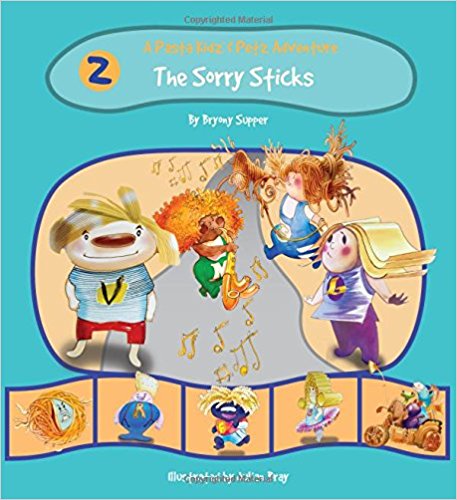
sorry sticks

Having previously reviewed the first in The Pasta Kidz books by Bryony Supper, The Inventing Tubes, here, I was delighted to be offered the chance by the author, Bryony Supper, to read the second in the series, The Sorry Sticks.

Published by Matador, The Sorry Sticks is available for purchase here.

The Sorry Sticks

sorry sticks

Victor Vermicelli and Val the Vermicelli Snake have been speeding in a No Snake Lane . When The Big Ticket arrives to tell them off, they call on the Pasta Petz and the Sorry Sticks to help them. After they have shown that they re really very sorry, The Pasta Kidz and Petz celebrate with a Pasta Parade, full of wonderful music from their pasta instruments.

My Review of The Sorry Sticks

Saying sorry can be more fun than you think!

I’m very tempted simply to refer blog readers to my review of The Inventing Tubes, here, as everything I said about that book is equally relevant to The Sorry Sticks.

I have a couple of negative comments as a couple of typos interrupted the flow for me, but I doubt the children the book is aimed at will mind! I would prefer a more consistent use of case so that the writing models good practice for children’s own emergent writing, but I think these elements could be used as teaching points too.

Again there is an imaginative story, fabulously illustrated by Julian Bray, with a strong moral underpinning that will enable adults to discuss with children how we make amends for thoughtless actions. I really enjoyed the humour with the Sorry Sticks all bumping into one another and apologising (though I’d have like lower case apologies!). The fact that Victor wears his safety helmet when riding his pastaboard models just the right behaviour for children too.

Children will thoroughly enjoy the onomatopoeic language and will be able to experiment with sound and rhyme as a result so that The Sorry Sticks will enable an investigation into language use.

I think that the wonderful illustrations in The Sorry Sticks, the opportunity to colour in a couple of characters, the Pasta Beasites, at the end of the story and the cliff-hanger ending will provide considerable fun and enjoyment for children.

About Bryony Supper

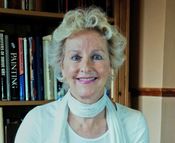
bryony

Bryony Supper trained as a professional actress at the Drama Studio, Ealing. From there she went into Repertoire, always playing comedy roles and has a wide range of experience from The Rocky Horror Picture Show to being a regular on ITV’s Gimmee Five with Ant and Dec.

You can follow Bryony Supper and the Pasta Kidz on Twitter and find them on Facebook.

Cover Reveal: Lost in the Lake by A.J. Waines

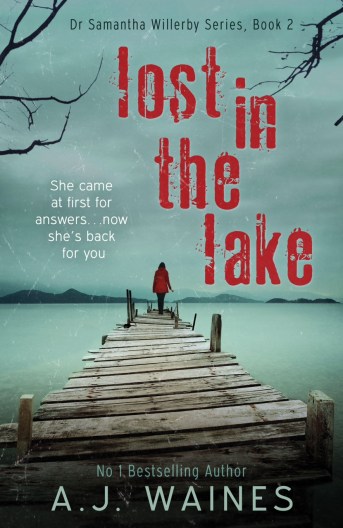
LitLFinalLarge

I’m just thrilled to have been asked to help introduce the latest book, Lost in the Lake, from A.J. Waines here on Linda’s Book Bag today. I have met lovely A.J. Waines and have reviewed the first in her Dr Samantha Willerby series, Inside the Whispers, here and another of her books, No Longer Safe here.

You can pre-order Lost in the Lake in the UK here and the US here.

Lost in the Lake

LitLFinalLarge

 She came at first for answers…now she’s back for you

Amateur viola player Rosie Chandler is the sole survivor of a crash which sends members of a string quartet plunging into a lake. Convinced the ‘accident’ was deliberate, but unable to recall what happened, she is determined to recover her lost memories and seeks out clinical psychologist, Dr Samantha Willerby.

But Rosie is hiding something…

Sam is immediately drawn to the tragic Rosie and as she helps her piece the fragments together, the police find disturbing new evidence which raises further questions. Why is Rosie so desperate to recover her worthless viola? And what happened to the violin lost in the crash, worth over £2m?

When Rosie insists they return to the lake to relive the fatal incident, the truth about Rosie finally creeps up on Sam – but by now, she’s seriously out of her depth…

The second book in the Dr Samantha Willerby series, Lost in the Lake is a nail-biting, edge-of-your-seat Psychological Thriller that will leave you glancing over your shoulder.

banner for Bloggers July

About A.J. Waines

WainesAJ6

AJ Waines has sold over 400,000 books worldwide and topped the UK and Australian Kindle Charts in 2015 & 2016 with her number one bestseller, Girl on a Train. Following fifteen years as a psychotherapist, she is now a full-time novelist with publishing deals in France, Germany, Norway, Hungary and USA (audiobooks).

Her fourth psychological thriller, No Longer Safe, sold over 30,000 copies in the first month, in thirteen countries. AJ Waines has been featured in The Wall Street Journal and The Times and was ranked a Top 10 UK author on Amazon KDP (Kindle Direct Publishing) in 2016. She lives in Hampshire, UK, with her husband. Visit her website and blog, or join her on Twitter, Facebook or on her Newsletter.