

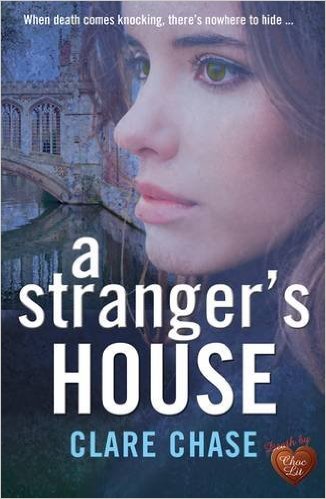
I’m delighted to be supporting Choc Lit in celebrating the paperback release of A Stranger’s House by Clare Chase. A Stranger’s House is available for purchase in e-book and paperback by following the publisher links here.
A Stranger’s House

What if you were powerless to protect the person you cared about most?
When Ruby finds out that her partner has done the unforgivable, she has no option but to move out of their home. With nowhere else to go, a job house-sitting in Cambridge seems like the perfect solution.
But it’s soon clear the absent owner hurts everyone he gets close to, and Ruby’s faced with the fallout. As violent repercussions unfold, her instinct is to investigate: it’s a matter of self-preservation. And besides, she’s curious…
But Ruby’s new boss, Nate Bastable, has his eye on her and seems determined to put a stop to her sleuthing. Is he simply worried for the welfare of a member of staff, or is there something altogether more complicated and potentially dangerous at play?
Absorbing the Atmosphere
Creating A Sense Of Place In Mystery Fiction
A Guest Post by Clare Chase
Thanks so much for having me on your blog today, Linda. I was delighted when you asked me to write a post on this topic. Soaking up the atmosphere of the setting I’ve chosen is one of my favourite parts of preparing to write a new novel.
My latest paperback, A Stranger’s House, is set in Cambridge. Although it’s my home city it still surprises me and I never tire of its beauty. Here’s what I do to absorb its atmosphere.
Look afresh, even though I know the area well
I’ve lived in Cambridge for over twenty years, but I still find it’s important to revisit the areas I want to write about. There are various practical reasons for doing this. There’s a lot of development in Cambridge, meaning streets change, and I can’t take the layout for granted, even if I saw a particular road six months earlier! And the city varies a lot with the seasons too; seeing a specific place at the right time of year certainly makes a difference. There are the normal changes you’d expect of course, but the population alters too. In term time, students from the city’s two universities amount to a fifth of Cambridge’s residents. The ancient streets in the centre are packed with young people hurtling from one lecture to another on their bikes. But from June to October the undergraduates go off for the vacation, to be replaced by increased numbers of tourists, as well as language students from the continent.
But most importantly of all, I find my descriptions from memory get stale and clichéd. If I go and stand in the setting I want to use, and experience it again afresh, I feel confident that I can convey it vividly.
Video and stills
A Stranger’s House is set in a Victorian villa overlooking Cambridge’s Midsummer Common. The story takes place in late May and June, and I took lots of photographs of the Common around this time: cattle grazing up close to the smart townhouses, cow parsley in the tall grass, students cycling across the paths and college boat crews taking part in the May Bumps. (These are races where rowing boats start in a staggered formation and each has to try to ‘bump’ the craft in front. They actually take place in June! You can always spot a winning team as each member of the crew puts willow leaves in their hair.)
Midsummer Common hosts Strawberry Fair, a free festival, which also features in A Stranger’s House. It’s a very colourful occasion full of everything from alternative bands and stalls, to people on stilts dressed as fairies. Again, I went along and took photos and videos so I could conjure up the atmosphere even if I ended up writing about it in November!
Sound recordings
If I’m in a place full of people – a café, for instance, or a pub – it might seem a bit intrusive to wave my camera in people’s faces. I’m not sure they’d understand if explained they were contributing to my novel’s background colour! So I have been known to use the voice recorder on my phone, not to preserve actual conversations of course, but to get an impression of the background hubbub so I can describe it later – from shouts and laughter to drunken singing or someone dropping a teacup. I’ve also recorded the sounds on the river, such as coaches shouting to the college boat crews, and street performers in town singing opera.
Notebooks
Videos and photos are all very well, but they don’t capture the smell of the river, or the chill morning air on your face. If I’m struck by a particular atmosphere and what’s caused it, I’ll note it on my phone. Things like this occasionally cause delays on my journey into work. My cycle route takes me up the river and it’s hard not to stop if there’s something interesting going on!
Capturing the moment
I can’t always tell when a useful scene will land in my lap. It’s easy to go along to events like the Fair I’ve mentioned, or to see what one of the colleges looks like in the snow, but sometimes something much more mundane can be useful: car headlights in the driving rain and plumes of exhaust as traffic queues on the ring road, for example. I try to tune in to these moments so that they don’t slip by and keep my phone handy, ready to take pictures.
Back at home, I keep my photos, videos and notes together, so that I can refer back to them as I write. There’s nothing like fortifying myself with images of long, hot summer days in Cambridge when the winter weather’s at its height! And later the photos are useful all over again, when I start to promote a new novel. The only thing I have to watch out for is overdoing the research. Sometimes taking a stroll on the commons – just to check once again exactly what they’re really like – can seem more appealing than, say, proofreading!
About Clare Chase
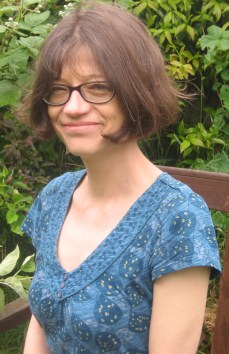
Clare Chase writes women sleuth mysteries set in London and Cambridge. She fell in love with the capital as a student, living in the rather cushy surroundings of Hampstead in what was then a campus college of London University. (It’s currently being turned into posh flats …)
After graduating in English Literature, she moved to Cambridge and has lived there ever since. She’s fascinated by the city’s contrasts and contradictions, which feed into her writing. She’s worked in diverse settings – from the 800-year-old University to one of the local prisons – and lived everywhere from the house of a Lord to a slug-infested flat. The terrace she now occupies presents a good happy medium.
As well as writing, Clare loves family time, art and architecture, cooking, and of course, reading other people’s books.
She lives with her husband and teenage children, and currently works at the Royal Society of Chemistry.
You can follow Clare on Twitter, visit her website and find her on Facebook.
There’s more with these other bloggers too:




























 Linda's Book Bag