An Interview with Michael Fowler, Author of You’re Next

You're Next - Michael Fowler - Book Cover

I’m delighted to welcome Michael Fowler, author of You’re Next to Linda’s Book Bag in interview today, not least because I didn’t ask the questions this time so I’m interested in reading more too!

Published by Caffeine Nights on 7th November 2017, You’re Next is available for purchase from your local Amazon site.

You’re Next

You're Next - Michael Fowler - Book Cover

It is the opening day of Detective Sergeant Scarlett Macey’s biggest case of her life – ‘The Lycra Rapist’ is standing trial for a series of brutal rapes.

But things don’t go according to plan – the trial collapses – and James Green is freed.

Scarlett is determined his freedom will not last long and immediately begins planning his downfall.

Meanwhile James Green has his own plans for revenge, and driven by feelings of hatred begins to pick out those who brought about his downfall – priming them for the kill.

Scarlett has faced many villains in the past, but never one quite as terrifying as James Green…

An Interview with Michael Fowler

Why did you write a book? 

I’ve been writing since the age of eleven, and had several attempts at writing a full novel, but either the plot was weak, or I ran out of steam because of my lack of knowledge and experience of writing. When I finished work in 2006 I promised myself that I would finish a book, even if it was just for fun.

Do you write every day? 

This year has been has been a car crash in terms of writing – so many distractions, which has been frustrating. However, until this year, for the last five years my writing has been pretty intense and I have spent most days writing, or something to do with the development of my novels.

Do you work to a plot or do you prefer to see where the idea takes you? 

I draft an initial plot, with characters, and create a storyboard on a large whiteboard on my study wall, and when I set out with my crime I run my storyboard as if I was running a major incident (back to my detective days). It invariably takes a change of direction as the story develops, but I love that when it happens.

How long does it take you to write a book?

Until this year, I’ve been writing 2 a year.

What’s the worst thing about writing a book? 

Not being able to get the words down fast enough.

What’s the best thing about writing a book? 

Seeing your name on the cover in a store, and getting invited to do talks.

Why did you choose your particular genre? 

I’ve been a lover of crime books since a teenager, and as a former detective ‘write what you know.’

If you had to write in a different genre, which would you choose? 

Horror.

Which book character do you wish you had written? 

Hercule Poirot.

What do you think are the best and the worst things about social media?

It’s great for publicity, but it’s also so instant and needs sustaining. It gets in the way of writing.

A few questions, just for fun:

If you could be invisible for a day, what would you do?

Visit MI5 and GCHQ

If I joined you on your perfect day, what would we be doing? 

We would start with a full English breakfast, go for a stroll around some dramatic headland with a sea view, where I would stop to put in a few hours of painting. During this session I would more than likely write about what I was experiencing/seeing to put into a future novel. Mid-afternoon I would spend an hour in the gym or go for a swim and then in the evening it would be off to a restaurant, for a couple of beers, followed by a meal with wine. Except for the time painting, and in the gym, we would be in conversation – I love talking to people – finding out what makes them tick.

What’s your signature dish? 

My granddaughter says I make the best Spag Bol ever!

If you could be anyone for the day, who would you be? 

I enjoy being me – I have a great life. I’m living the dream.

(I might have to pinch some of those questions for future interviews!)

About Michael Fowler

Michael Fowler Author Image

Following retirement, after thirty-two years as a police officer, working mainly as a detective, Michael returned to the deadly business of murder, as a writer. His past work brought him very close to some nasty characters, including psychopaths, and gruesome cases, and he draws on that experience to craft his novels: There is nothing gentle about Michael’s stories.

His landmark novel Heart of the Demon, published in 2012, introduced Detective Sergeant Hunter Kerr. Michael has since written five novels and a novella featuring Kerr.  He also released the first DS Scarlett Macey book in 2016. Michael is also the author of a stand-alone crime novella and a true crime thriller.

Michael has another side to his life – a passion for art, and has found considerable success as an artist, receiving numerous artistic accolades. Currently, his oil paintings can be found in the galleries of Spencer Coleman Fine Arts.

He is a member of the Crime Writers Association and International Thriller Writers.

You can follow Michael on Twitter @MichaelFowler1, and visit his website.

There’s more with these other bloggers too:

You're Next - Michael Fowler - Blog Tour Poster

A Gay Policeman’s Lot: A Guest Post by David Stuart Davies, Author of Blood Rites

Blood Rites Cover

I’m delighted to welcome David Stuart Davies, author of Blood Rites to Linda’s Book Bag today. David has written a wonderful guest post about why he has made his protagonist homosexual in Blood Rites.

Published by Urbane on 9th November 2017, Blood Rites is available for purchase directly from the publisher and here.

Blood Rites

Blood Rites Cover

1980s Yorkshire. DI Paul Snow has a personal demon. He is a homosexual but is desperate to keep it secret, knowing it would finish his career in the intolerant police force. As this personal drama unfolds, he is involved in investigating a series of violent murders in the town. All the victims appear to be chosen at random and appear to have no connection with each other. After the fourth murder, he is removed from the case for not finding the killer but continues investigating the matter privately.

Gradually, Paul manages to determine a link between the murder victims, but this places his own life in great danger. Can Paul unmask the killer as he wrestles with his own demons?

A Gay Policeman’s Lot

A Guest Post by David Stuart Davies

Homosexuals in drama and literature have usually been presented as either freaks of nature or fools.  The gay man has often been portrayed as a fop or a comic camp character, all limp wrists, sarcasm and soppy voices – think John Inman in Are You Being Served?, Melvyn Hayes in It Ain’t Half Hot Mum, and Jules and Sandy in Round the Horne. One sensitive shining light in these risible scenarios in the mainstream culture was the film Victim (1961) starring Dirk Bogarde, which presented the real dilemma of a sensitive, married gay man who had achieved success as a lawyer. The movie revealed the cruel way that such individuals can easily fall prey to unscrupulous blackmailers. I had Victim in mind while writing my latest novel, Blood Rites, which features a gay policeman.

It wasn’t until 1967  – ten years after the Wolfenden Report – that MP Leo Abse introduced the Sexual Offences Bill, supported by Labour MP Roy Jenkins, then the Labour Home Secretary. When passed, the Act decriminalised homosexual acts between two men over 21 years of age in private in England and Wales. The 1967 Act did not extend to Scotland, Northern Ireland, the Channel Islands or the Isle of Man, where all homosexual behaviour remained illegal.  Remarkably it was not until 1980 that the Criminal Justice (Scotland) Act 1980 decriminalised homosexual acts between two men over 21 years of age in Scotland.

In 1984 Chris Smith, newly elected to the UK parliament declared: ‘My name is Chris Smith. I’m the Labour MP for Islington South and Finsbury, and I’m gay’, making him the first openly homosexual politician in the UK parliament. This brave gesture, which could have encouraged others to follow suit was counteracted to a large extent by the spread of AIDS, which helped to fuel a backlash against homosexuals. AIDS prompted the introduction of Section 28 of the Local Government Act 1988 enacted as an amendment to the United Kingdom’s Local Government Act. This stated that a local authority, ‘shall not intentionally promote homosexuality or publish material with the intention of promoting homosexuality’ or ‘promote the teaching in any maintained school of the acceptability of homosexuality as a pretended family relationship’. It is therefore not surprising that nearly twenty three years after the act of decriminalisation, homosexuals were still reluctant to go public.

So in the mid-1980s it’s no wonder that Detective Inspector Paul Snow, the central character Blood Rites was determined to keep his head below the parapet. He is well aware of how he would be treated by his colleagues and his superior officers if it became known that he was ‘queer.’ This is one stressful dilemma that is a permanent feature of his life, despite the fact that he strives to be celibate, thus providing no evidence of his sexuality. As Peter Tatchell observed: ‘In the past, LGBT+ police officers were closeted and repressed. They were agents of a homophobic institution and lived in fear of being outed and sacked’.

I am hetrosexual  but I have profound sympathy for Paul and those in a similar position. At the beginning of my book, I quote a statement made by the actor John Fraser in his autobiography which has strong resonances with Paul Snow in Blood Rites.  Fraser wrote:

‘Homosexuals then had three choices:

One. To conform to society’s expectations. To marry and have children.

Two. To be celibate.

Three. To live a double life, fraught with danger – of violence or blackmail – and to live it alone.’

As a teenager I had a strong friendship with a lad my own age – let’s call him Cliff. We had a tremendous rapport, shared the same tastes in books, films and had similar senses of humour. We went everywhere together and were seen as a couple: Dave – and – Cliff. Although we were heterosexual with an eye for the girls, because of our closeness a few rumours began circulating that we might be gay. Once these reached the ears of Cliff’s parents, they did all in their power to break us up, preventing him from meeting me. In the end they succeeded and eventually I lost touch with him completely. Despite the gay rumours being unfounded, their prejudice still remains an unpleasant memory. What if we had been gay? Splitting us up would not have altered a thing.

In the 21st century, views on homosexuality are more liberal, but there is still a lot of hatred and persecution in the world. While more and more individuals feel free to declare that they are gay, for some, sadly the closet still beckons.

While the purpose of Blood Rites is to thrill and entertain – it is a crime novel after all – I also hope it also gives the reader pause to consider the issues it raises.

(How brilliantly put David. Thanks so much for such a thought provoking piece.)

About David Stuart Davies

DSD

David Stuart Davies is an author, playwright and editor. His fiction includes six novels featuring his wartime detective Johnny Hawke, Victorian puzzle solver artist Luther Darke, and seven Sherlock Holmes novels – the latest being Sherlock Holmes and the Ripper Legacy (2016). His non-fiction work includes Starring Sherlock Holmes, detailing the film career of the Baker Street sleuth.

David is regarded as an authority on Sherlock Holmes and is the author of two Holmes plays, Sherlock Holmes: The Last Act and Sherlock Holmes: The Death and Life, which are available on audio CD. He has written the Afterwords for all the Collector’s Library Holmes volumes, as well as those for many of their other titles.

David has also penned three dark, gritty crime novels set in Yorkshire in the 1980s: Brothers in Blood, Innocent Blood and Blood Rites.  He is a committee member of the Crime Writers’ Association and edits their monthly publication Red Herrings. His collection of ghost and horror stories appeared in 2015, championed by Mark Gatiss who said they were ‘pleasingly nasty.’

David is General Editor of Wordsworth’s Mystery & Supernatural series and a past Fellow of the Royal Literary Fund. He has appeared at many literary festivals and the Edinburgh Fringe performing his one man presentation The Game’s Afoot – an evening with Sherlock Holmes & Arthur Conan Doyle. He was recently made a member of The Detection Club.

You can follow David on Twitter @DStuartDavies, find him on Facebook and visit his website.

There’s more with these other bloggers too:

BANNER blogtourBLOODRITES


An Extract from Gilding the Lily by Justine John

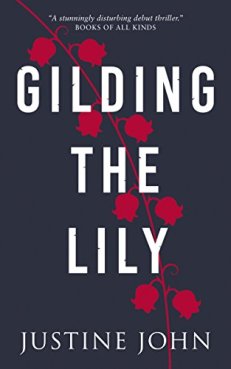
Gilding the Lily cover.jpg

It gives me very great pleasure to be part of the tour for Gilding the Lily by Justine John today because if I hadn’t been a blogger I think I might not have found about this thriller and I hate missing out.

Gilding the Lily is available for purchase here.

Gilding the Lily

Gilding the Lily cover.jpg

A gripping mystery of jealousy, murder and lies.

An invitation to her estranged, wealthy father’s surprise 75th birthday party in New York sees Amelia and her husband, Jack, set off across the pond to meet a whole new world of family politics. Amelia, now a successful businesswoman, feels guilty about never liking her father’s women, so does her upmost to give his new socialite partner, Evelyn, the benefit of the doubt. Wouldn’t it be nice if they could just all get along? But there’s something very dark, determined and dangerous about her…

When Amelia’s father, Roger, becomes ill, Jack grows suspicious that there is more to it. Amelia understands why, but no one else will believe them. They travel back to America to piece together the puzzle, but when Roger goes missing, the couple are driven to their wits’ end. It takes a DEA officer and a secret assassin to bring them answers, but the ruthless truth is something no one expected…

An Extract from Gilding the Lily

PROLOGUE

She stood solemnly at the graveside.  A single tear ran down her cheek.  A man and a woman stood either side of her, and a younger man opposite.  They all looked down at the expensive coffin being lowered in to their family plot.  A few other mourners were scattered around; they formed a small, sad crowd, as the priest said the familiar burial prayer.  But she barely heard the words as the coffin settled with an audible thump.

“… commit her body to the earth, for we are dust and unto dust we shall return..”

She looked around her.  It was a warm, bright day in September, but there was an unusual wind – a hurricane was forecast.  There were many head-stones here, and a few statues.  Of angels mainly.  Different colours but somehow the same hue.  A few trees lined the perimeter fence, some bare, some evergreen. Beyond them the city buzzed – it went on with its day and didn’t notice anyone missing.

The woman next to her was wearing a hat that didn’t suit her.  It kept catching the breeze and the woman’s gloved hand caught it each time.  It was annoying. She should have pinned it or something.  She shivered as a gust blew by them and then smiled inwardly.  How was it she came to be here?  How was it that it all went so well?  Was it her own cleverness, or was it luck?

“…the Lord lift up his countenance upon her and give her peace. We ask this through Christ our Lord. Amen.”

“Amen”, she joined in.

Amen indeed, she thought to herself.  The relief was immense.  The day after it happened, it flooded through her.  How was it she had become capable of such a thing?  And now, it was a huge secret.   But she had always been good at keeping secrets.  It was over now.  She could get on with her life.

“The Lord be with you.”

“And with your spirit.” everyone replied together.

Another gust.  She felt it curl around her stockings.  The woman next to her snatched at her hat.

“God of the living and the dead, accept our prayers for those who have died in Christ.”

She wiped away the tear.  The young man opposite caught her eye and sympathetically smiled.  She smiled back in a way that said ‘yes, I’m ok, thanks’.

And she was ok.

“Let us pray.”

They bowed their heads, some held hands and some sniffed as they all solemnly recited the Lord’s Prayer.

Her mouth moved as she mumbled the words but her thoughts were still elsewhere.

It was thrilling what had happened.  And justifiable.  She wondered if she could do it again.  But the need would never arise, of course.  She now understood how others could do it.  This criminal act.  How other people could get away with it.  If she could do it, anyone could.  How many people could be getting away with it right now? Thousands, millions?  Was the city beleaguered with people crawling around getting away with their sins?

“Gracious Lord, forgive the sins of those who have died in Christ.”

It was easier than she thought. That’s what surprised her the most.  It was just a matter of thinking it through carefully.  Planning well.   Did this make her a bad person?  She was still the same inside.  She was still capable of love, big love, and still wanted to be loved in return.  Isn’t that what life is all about – what everyone wants?  And she felt more…  worthy… or worldly, perhaps that was a more appropriate word.  She felt more ‘something’ anyway, and that could only be a good thing. To feel more.  To be more understanding of other people, and why they do things.  Yes, she was still a good person – in fact a better person.  It’s not as if she didn’t know the difference between right and wrong.  What she did was wrong, but also right.  She had righted the wrong.  It felt good.

“Kindle in our hearts a longing for heaven.”

There was a sudden movement from the woman next to her as her hat actually blew off.  The woman made a quiet apology as she ran gracefully to the point where it had landed.  The wind allowed it to stay there, and she picked it up, before returning to her place in time for the next Amen.

“Amen”.

“Lord, have mercy.”

Would anyone else forgive her if they found out?  Or just God?

She looked for the words in her booklet and joined in again: “…raise us from the death of sin unto the life of righteousness…”

Righteousness?  What is righteousness, really?  A state of mind?  A quality?  A knowledge that one is morally correct?  What she’d done was morally correct, even though it could be termed bad.  So it was righteous.  She stood a little straighter.  A small movement. Yes, it was righteous.  She was righteous.

“May the love of God and the peace of the Lord Jesus Christ console you and gently wipe every tear from your eyes. Amen.”

“Amen” she repeated.  Amen indeed.

About Justine John

Justine

Justine John became a full-time writer in her late forties, after a successfully running various businesses in London. Her first novel, Gilding The Lily, is a domestic-noir suspense story. Animal lover Justine lives in the beautiful Surrey Hills with her husband, horses and hounds.

You can follow Justine on Twitter @JustineCJohn, visit her website and find her on Facebook.

There’s more with these other bloggers too:

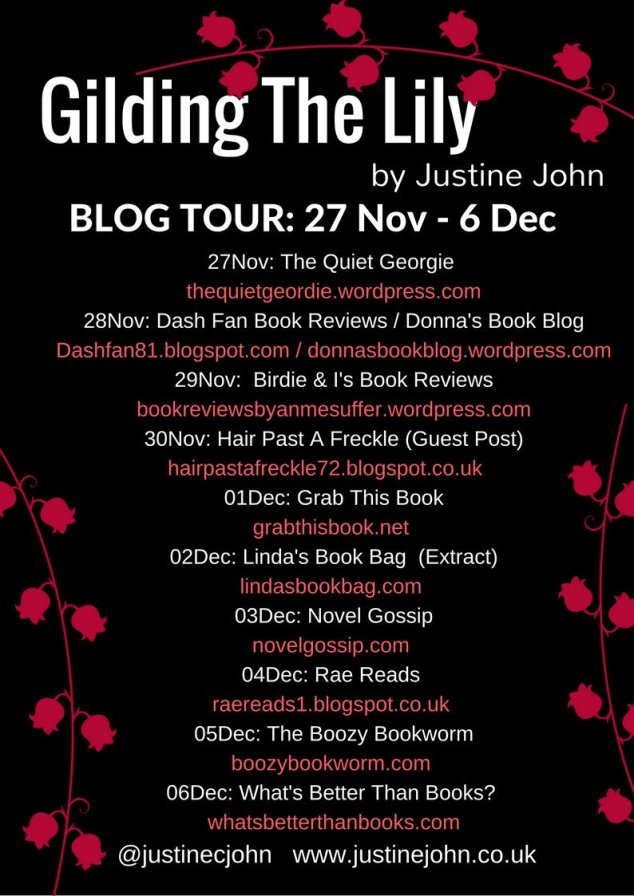
Gilding the Lily tour poster

The Personal in Writing: A Publication Day Guest Post by Kate Murdoch, Author of Stone Circle

stone circle

I’m always fascinated by how authors write and I’m delighted to welcome Kate Murdoch, author of Stone Circle, to Linda’s Book Bag today to explain a little bit about her take on the adage of ‘write what you know’.

Published today, 1st December 2017 by Fireship Press, Stone Circle is available for purchase here.

Stone Circle

stone circle

Is the ability to read minds a blessing or a curse?

When Antonius’s father dies, he must work to support his family. He finds employment as a servant in the Palazzo Ducal, home of Conte Valperga. Sixteenth-century Pesaro is a society governed by status and Antonius has limited opportunities.

When a competition is announced, Antonius seizes his chance. The winner will be apprenticed to the town seer. Antonius shares first place with his employer’s son.

The two men compete for their mentor’s approval. As their knowledge of magic and alchemy grows, so does the rivalry and animosity between them. When the love of a beautiful woman is at stake, Antonius must find a way to follow his heart and navigate his future.

The Personal in Writing

 A Guest Post by Kate Murdoch

I’ve always found it interesting how writers use varying degrees of the personal in their writing. It’s particularly intriguing when I’m reading the manuscript of someone I know, or am getting to know, because their values, experiences and preoccupations are evident.

At one end of the spectrum is memoir, with its laying bare of the life of the author, yet curated and chosen with care. I admire memoirists a lot, because they push the boundaries using their own stories to illustrate what is important to them.

More commonly, people draw from feelings, experiences and people they’ve known, creating fiction. Parsing the information, putting it through a metaphorical filter until the right combination of insight and feeling is conveyed. This is how I work.

In my novel Stone Circle I drew on a number of elements of my life. Family is very important to me and I explored the love of family, the safe space and emotional security it can provide. But all forms of love give us a sense of self and confidence, including friendship and romantic love. My protagonist, the fisherman’s son Antonius, by virtue of his talent for telepathy and ‘seeing’, finds himself part of a middle and upper class society in which he feels ill-equipped. The fact that he comes from a loving family is a crucial factor in his ability to embrace his new circumstances.

The story was also informed by my experiences with spiritual practices, such as reiki healing. Antonius learns so much in a short space of time, all the while confronted with Nichola’s jealous hostility. I can’t say I’ve had any issues with hostile competitors, but the spiritual search was real and consuming.

There are writers I’ve met whose personal lives are so intertwined with the story it’s hard to know where one ends and the other begins. In my opinion, these are the stories which resonate the most. They are mined from such a deep place of emotion and memory, readers sense it and are moved.

A good example is The Book Thief by Markus Zusak. The author’s parents were children in Germany and Austria during the second world war, and many of the scenes are inspired by stories they told him. This is what gives the novel so much heart and realism.

Research is important, as is plot, dialogue and character. But if there is an absence of the personal, I think the work suffers. The emotional heart is drawn from reality. It is, in my view, the most important factor in a good story.

About Kate Murdoch

Kate Murdoch

Kate Murdoch is the author of Stone Circle. She exhibited widely as a painter both in Australia and internationally and was a finalist in a number of prize shows before turning her hand to writing. In between writing historical fiction, she enjoys writing short stories and flash fiction.

Her short-form fiction is regularly published in Australia, UK, US and Canada in places such as Verity La, Spelk Fiction and Feminine Collection.

Stone Circle is a historical fantasy novel set in Renaissance Italy. It will be released by Fireship Press December 1st 2017. She has also completed another novel The Orange Grove about the passions and intrigues of court mistresses in 18th century France.

You can follow Kate on Twitter @KateMurdoch3, find her on Facebook and visit her blog. You can also find Kate on Goodreads. Kate also has a website.

A Publication Day Extract from Gun Kiss by Khaled Talib

Pageflex Persona [document: PRS0000040_00069]

It’s a welcome return to Linda’s Book Bag today for Khaled Talib, author of Gun Kiss. Previously Khaled wrote a smashing guest post entitled My Pen is My Gun that you can read here.

To celebrate today’s publication of Gun Kiss, Khaled has kindly provided an extract for me to share with you. Gun Kiss is available for purchase here. There is to be an online launch party for Gun Kiss on Facebook on 3rd December and you might like to participate to be in with a chance of winning prizes. The details are here.

Gun Kiss

Pageflex Persona [document: PRS0000040_00069]

A stolen piece of history, an abducted actress and international intrigue…

When the Deringer pistol that shot Abraham Lincoln is stolen and ends up in the hands of a Russian military general, covert agent Blake Deco is tasked by the FBI to head to the Balkans to recover the historical weapon. Meanwhile, the United States media is abuzz with news of the mysterious disappearance of Hollywood movie star, Goldie St. Helen.

After Blake’s return from overseas, he receives a tip from a Mexican friend that a drug lord, obsessed with the beautiful actress, is holding her captive in Tijuana. With the help of a reluctant army friend, Blake mounts a daring rescue. What he doesn’t expect is to have feelings for Goldie—or that a killer is hunting them.

An Extract from Gun Kiss

The tall buildings around Washington, D.C.’s 10th Street overshadowed the historic Ford’s Theatre. Though the building had undergone refurbishment both inside and out, it still seemed slightly out of place in modern America. However, that didn’t stop the throngs of tourists visiting the building that June morning as wispy clouds threaded through the cerulean sky.

It was a crowded weekend day when Abraham Lincoln, in his overcoat, and two Union soldiers, their faces covered with bandanas, stepped out of the van. They meandered past the theater’s five historic doorways toward the modern glass entrance. Everyone assumed they were part of a promotion taking place at the museum. It was not uncommon to see park rangers and tour guides dressed in period costumes.

The man behind the Lincoln mask was Rick Walker—at least, that was the name he was currently going by. Highly educated, the thirty-six-year-old professional thief had a penchant for the fast life. If the assignment was a success today, he’d promised his girlfriend a nice holiday.

Two female park rangers stepped forward when Rick and his companions reached the front of the line.

“You have to get in line, sir. Also, you need to get tickets. Kindly remove the mask and bandanas before entering,” one of the park rangers said.

“I do apologize, madam, but I’m in a bit of a hurry,” Rick said. “I don’t think I need a ticket, nor do I have to get in line given who I am.”

“That’s the only way you’re going to get in,” the park ranger said.

“Well, if you insist, madam, and once again, please accept my apologies.” Rick bowed and tipped his hat, then extended a hand to the park ranger, who instinctively took it.

Rick grabbed her wrist tightly and locked it to his own with a steel cuff.

“What are you doing?” the park ranger yelled, trying to jerk her hand away.

“Getting acquainted,” Rick said.

The park ranger reached for the walkie-talkie strapped to her belt, but Rick snatched it away from her. Frantically, she turned to the other park ranger. “Get security!”

One of the two Union soldiers dropped his prop rifle and grabbed the other park ranger’s hand, then cuffed her wrist to his own. He pulled out a real gun tucked under his waistband and aimed it at her.

Rick unbuttoned the jacket of his three-piece suit and brandished the bomb strapped to his chest.

“Bomb! Bomb!” a young teenager in the line shrieked.

Pandemonium broke out as the screams of panic amplified. People ran in every direction. Those who moved slowly were slammed aside, or knocked over.

Rick pulled the ranger cuffed to him aside. “We’re going downstairs, and we’re going to take the Deringer. Obey your president,” he said in a hollow voice.

“Yes, sir,” the park ranger said as beads of sweat formed on her forehead.

They descended by elevator and emptied into an interactive museum. The wealth of history in the dimly lit space featured original artifacts in glass showcases, furniture, statues, murals, and narrative devices. The visitors already in the museum scattered wildly at the sight of a man in a Lincoln mask displaying a bomb strapped to his chest, a park ranger cuffed to his wrist.

“Show’s over, folks,” Rick yelled. “Go!”

The park ranger guided her captors to a section in the museum where the Deringer floated in an oblong glass case capped at both ends with wood. A mural behind it depicted John Wilkes Booth firing a single shot at Abraham Lincoln as he sat in the theater box.

The Union soldier not cuffed to a park ranger took out a glasscutter from his coat pocket and began to cut a circle in the glass. When it popped free, he inserted his hand inside and yanked out the Deringer.

“We’re going to take you with us. Don’t give me trouble. If you behave, you’ll be back home in time for dinner with the family,” Rick said, dragging the park ranger closer to him. “Understand?”

The park ranger nodded once, nervously.

“Excellent,” Rick said.

They exited through the theater’s main door and stepped out into the empty street. The crowd had dispersed. Some had regrouped tensely a few hundred meters away at both ends. “Cheer up—it’s going to be a fun day,” Rick said, walking toward the van.

The park ranger with Rick raised her voice. “Please, please, let us go. I don’t want to die.”

“Well, behave and everything will be fine.”  He opened the side, forced her in and jumped in after her. He shut the door after the accomplice had climbed in with the second park ranger.

The van began to move off.

“Hallelujah!” Rick yelled in excitement behind the mask as he sat at the back of the van.  He removed the cuff from his wrist and secured the park ranger onto a railing.

“We’ll be arriving in five,” the driver said after a few blocks. “You know what to do.”

“I sure do,” Rick said as he removed the bomb strapped to his chest. Still wearing the mask, he looked at the hostages. “Don’t worry about the bomb, it’s fake.”

He unhooked a tote bag from the wall and began removing the contents. Facing away from the hostages, he removed the Lincoln mask and slipped into casual attire. He hid his face by putting on a red baseball cap and a pair of dark shades then stuffed the costume into the bag and swung it over his shoulder.

Rick looked again at the park rangers. “Look on the bright side—now you get to tell visitors a different story at the museum.”

The Union soldier in the back with him handed over the Deringer, which Rick slipped into the bag.

The driver slowed down and stopped behind a parked car.

“All good outside?” Rick asked.

“Yeah…all good. I parked a few cars behind us,” the driver replied, looking at the side mirror.

“Okay. Nice doing business with you guys.” Rick pulled open a trapdoor in the center of the floorboard, slid out, and slithered under the parked car in front of the van.

The van pulled away from the curb and sped down the street. After a minute, Rick rolled onto the road, got up, and walked toward the park at Judiciary Square on the Red Line and descended into the Metro.

A day later, Rick sat at a café with his eyes glued to the screen of a laptop, drinking a hot latte with his back against the wall. He scanned the faces of everyone who entered. Though he wasn’t expecting trouble, he remained vigilant.

“Is it in yet?” the tall blonde sitting across from him asked.

He scratched the roughness of his stubble as he continued to stare at the screen. “Not yet.”

Moments later, the figures on his account changed. A new deposit had been registered: ten million dollars.

Rick lifted his eyes. “Darling.”

“Yeah?”

“Remember, we’re in a public place, so don’t scream.”

She leaned forward. “It’s in?”

Rick wriggled his eyebrows. “Pack your bags. We’re going on a holiday, as I promised.”

About Khaled Talib

khaled

Khaled Talib is the author of the political thriller, Smokescreen, and the recently published Vatican thriller, Incognito. His third thriller, Gun Kiss, will be published this year by Imajin Books. Khaled is a former magazine journalist with local and international exposure. He is a member of the UK Crime Writers Association and the International Thriller Writers. He resides in Singapore.

You can find out more about Khaled on his website, on Facebook and by following him on Twitter @KhaledTalib.

Giveaway and Spotlight on The Big Event by Anne John-Ligali

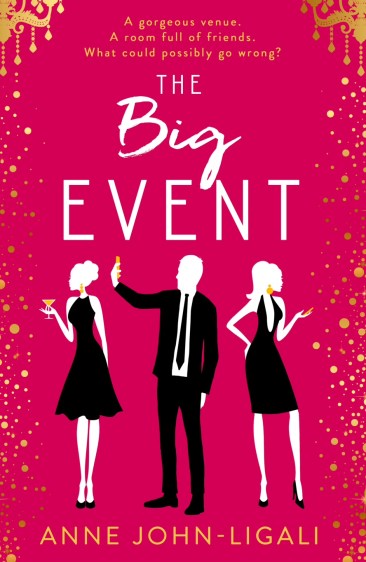
Ligali_TheBigEvent_Ebook

I don’t know about you, but what with missing the Romantic Novelists’ Association winter party (where I actually won an award as their Media Star), having heavy Christmas decorations drop on my head from a great height, spending six hours waiting for an ambulance to arrive for my mother when she broke her hip, having our shared drains with the neighbours collapse, and returning to the weird passing out unexpectedly that I suffered earlier this year, to name just a few events from the last two weeks I think I could do with a party!

Consequently I’m delighted to be part of the release day celebrations for The Big Event by Anne John-Ligali, especially as she originally hails from my home city of Peterborough. I have my review of The Big Event but even better is a wonderful giveaway from Anne John-Ligali that you can enter at the bottom of this blog post to win Sparkly Afternoon Tea for Two at Vertigo 42 in central London and one e-copy of The Big Event.

The Big Event Publication Day Push Banner

The Big Event is available for purchase from Amazon UK

You might like to watch a trailer for The Big Event here too.

The Big Event

Ligali_TheBigEvent_Ebook

You are cordially invited to the party of the season where you’ll meet Constance and friends in action.

Constance Jeffries is excited when she gets the chance to meet up with virtual friends at a get-together in a London hotel. She’s been tweeting and messaging her lovely friends for years and feels they must be just as excited to finally meet her in person too. Or so she hopes.

The Big Event is first part in a short story series about the importance of ‘real’ friendships and how it’s the little things that matter the most.

A Gorgeous Venue, A Room Full of Friends, What Could Possibly Go Wrong?

My Review of The Big Event

Writer Constance finds attending a real-life get-together of virtual friends from social media doesn’t quite work out as planned.

I thoroughly enjoyed meeting Constance. Although The Big Event is a short story, Anne John-Ligali creates vivid characters instantly so that there’s a visceral reader response as protagonist Constance introduces them. I felt I knew them straight away.

I loved this short story. It might only take ten minutes or so to read (perfect for a tea or lunch break) but it really packs a punch. There’s considerable humour, especially in the almost asides Constance makes, so that I smiled my way through the story and kept sniggering too, especially at Jagger’s wallet!

That said, there’s a super moral here that tugs at the emotions. As Anne John-Ligali explores our modern reliance on social media for ‘friendships’, she teaches the reader where to find true value in life and relationships so that I felt a lump in my throat and a prickling behind my eyes as I read the ending.

I’m looking forward to see what happens to Constance in the future as more of this short story series is released. Smashing stuff!

About Anne John-Ligali

Meet Anne

Anne John-Ligali is a writer and the founder of Books and Authors UK, a popular website featuring author interviews and book reviews.  She loves all things books: reading, writing, going to book events, and meeting other book lovers. She has written a series of short stories and is currently writing her first novel.

When Anne is not writing, she is likely to be at soft play with her kids, taking long evening walks in Hyde Park, making green smoothies, window shopping, or having a pampering session at her local beauty salon (whenever she gets the chance). She can also be found watching box sets (albeit with a bit of shame at still having to catch up on Scandal, Grey’s, and Downton).

Originally from Peterborough, Anne now lives in London. After moving to London, she studied graphic design at the University of Arts and has held a number IT administration jobs in the city. Anne continues writing and aspires to write more women’s fiction books, a non-fiction book and several children’s books.

You can find out more about Anne on her blog, on Facebook, Instagram and by following her on Twitter @AnneJohnLigali.

Giveaway

Giveaway Prize - Verigo-Tea

Win Sparkly Afternoon Tea for Two at Vertigo 42 in central London and one e-copy of The Big Event.

To enter and for full terms and conditions, please follow this link for everything you need to know.

(PLEASE NOTE: This giveaway is run separately from Linda’s Book Bag.)

Getting the Balance Right: A Guest Post by K.S. Hunter, Author of Just One Time

JOT-Front-Cover

When I was approached by K.S.Hunter, an international bestselling author whose identity will remain a secret, to see if I’d like to read Just One Time I was intrigued. Then when fellow blogger and friend Rachel from Rachel’s Random Resources set up the blog tour I knew I had to be involved. Although I haven’t had chance to read Just One Time yet, it’s very firmly on my TBR and I have a brilliant guest post to share with you today.

Published on 7th December 2017 Just One Time is available for pre-order from Amazon UK.

Just One Time

JOT-Front-Cover

Desire can have dire consequences

Two years ago, David Madden made a mistake that almost cost him his marriage. His wife, Alison, gave him another chance, but she has not forgotten, nor has she forgiven.

She is irresistible

Then David meets the alluring Nina at a theatre in London. When he loses his phone in the dark, she helps him find it, and by giving her his number he unwittingly invites her into his life.

What David initially views as an innocent flirt turns into a dangerous game of deception. His increasingly suspicious wife thinks something is up, and each lie he tells pushes them further apart.

She is insatiable

Nina pursues David relentlessly, following him to New York where she gives him an ultimatum: sleep with her, just one time, and then she’ll get out of his life forever; or she’ll ruin everything he holds dear.

She is unstoppable

Of course, once won’t be enough for Nina, and what David hoped would be the end is merely the beginning.

A modern-day Fatal Attraction, Just One Time is a steamy psychological thriller that will have you hooked from the first page and holding your breath until its shocking conclusion.

Getting the Balance Right

A Guest Post by K.S.Hunter

I was sitting in a theatre in London. The play I was about to see was called Let the Right One In. I stood up to let a couple pass me. I sat down again. The lights were dim. I remembered I hadn’t switched off my phone, which I’d placed on my lap, but when I reached for it, it wasn’t there any more.

After a slight panic, I realised it must have fallen on the floor when I stood up. A moment later, I was on my hands and knees, trying to find it in a pitch-black space. The woman who was sitting next to me asked what was wrong. “I’ve dropped my phone,” I said, looking up at her, not realising she would become the femme fatale in my next novel two years later.

“What’s your number?” she asked. “I’ll call it for you.” And I gave her my number without any hesitation.

It was at that moment, on my hands and knees, that I saw the beginnings of a story. A series of what-ifs entered my mind. What if she contacted me that evening? What if she found a way into my life and then wouldn’t get out of it again?

I knew erotic fiction was popular and I knew I had a story that could be steamy. I immediately thought of Fatal Attraction and everything that made it work as a story of obsession. One thing it has is a fairly graphic sex scene. I skimmed a few pages of some erotic fiction to find out how far explicit descriptions went nowadays and I was surprised to discover just how graphic they were.

I had the majority of my plot and began writing, but then I realised I was essentially a crime fiction author. How graphic do I make this? I asked myself. Very, was the answer I came up with. After all, E.L. James wasn’t exactly shy. I wrote, edited, rewrote, edited. I laughed at some of the things I wrote. I can’t include that, I said. Ultimately, some things made it, some things didn’t. I decided to rock the boat, but I didn’t want to sink it.

There are a handful of sex scenes in Just One Time, but I knew from the outset that there had to be one major scene – the film Basic Instinct came to mind: all the build-up and then a full meal of a scene (I believe it was called The Fuck of the Century by reviewers). I got to that point in the novel, the point when Nina tells David that she will get out of his life forever, if he sleeps with her just one time. And I knew it had to be my Basic Instinct moment.

It had to be graphic and I couldn’t shy away from the kind of language that would make it even more shocking. Shock comes in two ways: the actions and the language that’s used to describe them, and I utilised both.

The final act of Just One Time contains what I hope is something that readers have never experienced before. I had to find a balance between how to describe it and which words to use that would intensify its impact. I wanted readers to cringe, to go Wow, to feel a gut punch. I wanted them to feel what my characters felt.

As a crime fiction author, I am used to writing thrillers. I try to make my books exciting, but that excitement comes from pace that hopefully rattles along at speed. Excitement in Just One Time, which I’m calling a steamy psychological thriller, in part comes from the pace, because I am the same writer even though I’m using a different name, but it also comes from the erotic elements. The book should, at times, titillate, but there’s a delicate balance between the thrills of the erotic and the thrills of the thriller.

Have I got the balance right? Is there even such a thing as a ‘right’ balance? I think the vast majority of readers today are ready to embrace anything, so long as the characters and story are worth investing their time in.

About K.S. Hunter

Just One Time Tour Banner Horizantal

K.S. Hunter is the pseudonym of an international bestselling author. The identity of the author, who lives in the United Kingdom, will remain a mystery.

You can follow K.S. Hunter on Twitter @Author_KSHunter and visit their Facebook page.

There’s more with these other bloggers too:

Just One Time Full Banner

The Pain of Loss: A Guest Post by Pankaj Giri, Author of The Fragile Thread of Hope

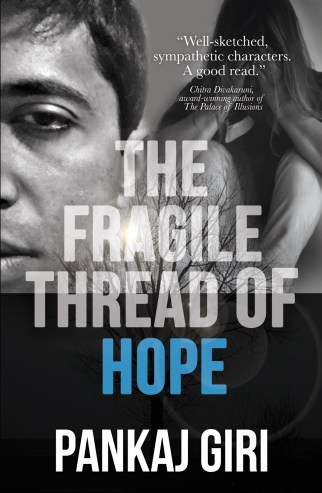
The Fragile Thread of Hope Cover

A little while ago I received a message offering a book I thought would be an incredible read in return for an honest review – The Fragile Thread of Hope by Pankaj Giri. And I turned it down (although I have bought it to read later). Why? Well, partly because with over 900 others in the queue I knew it would be months before I could deal with it and partly because this November sees the first anniversary of my father’s death and I didn’t think I had the emotional stamina to read what looks like such a moving book. Instead, I asked Pankaj if he would like to write a piece for Linda’s Book Bag and I’m thrilled that he agreed. In sharing it with you today I’m sure I would have been moved beyond words by The Fragile Thread of Hope if this guest post is anything to go by.

The Fragile Thread of Hope is available for purchase from your local Amazon site.

The Fragile Thread of Hope
The Fragile Thread of Hope Cover

In the autumn of 2012, destiny wreaks havoc on two unsuspecting people—Soham and Fiona.

Although his devastating past involving his brother still haunted him, Soham had established a promising career for himself in Bangalore.

After a difficult childhood, Fiona’s fortunes had finally taken a turn for the better. She had married her beloved, and her life was as perfect as she had ever imagined it to be.

But when tragedy strikes them yet again, their fundamentally fragile lives threaten to fall apart.

Can Fiona and Soham overcome their grief?

Will the overwhelming pain destroy their lives?

Seasoned with the flavours of exotic Nepalese traditions and set in the picturesque Indian hill station, Gangtok, The Fragile Thread of Hope explores the themes of spirituality, faith, alcoholism, love, and guilt while navigating the complex maze of familial relationships.

Inspirational and heart-wrenchingly intimate, it urges you to wonder—does hope stand a chance in this travesty called life?

The Pain of Loss

A Guest Post by Pankaj Giri

Have you ever in life encountered an event, an event that pulls the rug from under your feet, threatens to destroy the very foundation of your existence?

I have.

The date was 2nd January 2013. It was a calm, sunny day in Bangalore. After having breakfast, I was relaxing on my bed when I received a call. It was from Vikas Daju (Daju means elder brother in Nepali, my mother tongue), my father’s office staff. He accompanied Baba, my father, at home in Gangtok during every winter vacation while Aama, my mother, visited me in Bangalore.

In a trembling voice, he informed me that Baba had turned seriously ill and was admitted to Manipal hospital. I felt as if I had fallen off a cliff of astonishment. According to Daju, Baba had taken longer than usual to come out of the Puja room, and when he went to check, he found Baba lying on the floor, unconscious. They had tried to revive him, but when he failed to respond, they had rushed him to the hospital. The call got disconnected. I tried to call back, but I couldn’t reach Daju. Minutes later as I was writhing in a swamp of anxiety, he called. Sobbing he told me what I had dreaded. Baba had passed away after suffering a massive heart attack.

Imagine that you are travelling in a car, enjoying the scenery when suddenly the wheels of the car fall off. I got a similar feeling then. I still couldn’t believe it, for Baba never had any history of heart problems. Why did it happen? How could it happen…? He was just fifty-six years old… How could life be so unfair? Had he really gone, or was this some kind of a nightmare from which I would escape soon? But the painful reality kept nudging me, urging me to accept it. Slowly, relatives and friends started calling, confirming the devastating news, offering support and courage, which seemed as futile as the definition of colours to a blind man. I tried to imagine the pain Baba must have felt in his last few moments, how he would have craved to catch a glimpse of Aama, my sister, and me, how he would have begged for his life before God snatched it away. My heart bled with sorrow, and the tears came like rain as I succumbed to the assault of pain.

However, I had to force myself back to reality. I was told to tell Aama only a partial truth—that Baba was seriously ill and admitted to the hospital—as she would not be able to handle the vicious truth. Then, I had to arrange to return to Gangtok as soon as possible.

Somehow, I managed to lie to Aama (escaping to the confines of my room or the bathroom whenever grief overpowered me), and on the very evening, we headed to Gangtok. Throughout the journey, she kept muttering the Mahamrityunjaya Mantra, the death-defeating chant, praying for my father’s survival. I wanted to tell her that there was no hope, that Baba had already gone, but I stayed quiet, stifling the violent pain in my heart, summoning the last ounce of my receding strength.

When we crossed Manipal Hospital on the way home, Aama lashed out at me, demanding why we weren’t going to the hospital. As discussed with other relatives, I lied by saying that Baba had been taken home as he had recovered slightly.

When we reached home and Aama saw Baba’s body for the first time, she fainted. For moments after her fall, I couldn’t breathe. Surely, God wouldn’t be so cruel! Surely, He wouldn’t snatch both of them from me. I hadn’t hurt anyone in life. Surely, He wouldn’t give me this unjust punishment.

However, by God’s grace and instant help from relatives, Aama soon regained consciousness. Caressing my father’s lifeless body, she made one-sided conversations with him, asking him to wake up, tell everyone that this was a joke just like the practical jokes he used to crack often. But Baba didn’t respond, didn’t throw his head back in laughter like he used to, didn’t smile his trademark, lopsided grin.

Soon, inevitably, Aama broke down, surrendering to her emotions, her wails wrenching my already fragile heart, rivulets of tears streaming down her face. However, I refrained from crying, battling my emotions, as my relatives and friends had told me not to display my emotions in public, me being the eldest male member of the family now. Later, however, when one of my aunts saw my emotionless, shell-shocked face, she asked me to sit next to her. She reminded me of the humongous loss that I had just experienced, that from the next day, Baba wouldn’t be there with me, that he was gone forever. She told me to let out my pain, break free from the shackles of blankness I had built around myself. Her brutal yet well-meaning words worked. My resistance tore like a flimsy cloth, and I cried as I had never before.

My sister also arrived after a few hours from Pune—she was undergoing training in a software company there—and drowning in an ocean of pain, we, along with other relatives and other acquaintances, proceeded to perform the final rites of my father.

When a pillar of a family falls, the incident not only leaves behind the painful memories of the deceased but also disrupts the balance of the living family’s lives. My sister and I could not leave our mother alone in our relatively big house. We had to relocate to Gangtok. However, for that, we needed to sacrifice our lucrative jobs in Bangalore and Pune. Days passed as we found ourselves lost in the hazy lanes of indecision.

Meanwhile, the three of us lived like zombies, Baba’s memories reflecting off everything in our home, pushing us repeatedly into a marsh of pain. Aama used to sob almost throughout the day, and we had to accompany her and try to divert her mind away from the all-consuming loss. But who were we, as children, to judge her? Only a wife knows how it feels when her husband is snatched away without warning, leaving her alone in this world for the rest of her life. We had mostly stayed away from home, but she had lived every moment with Baba. Whenever I tried to imagine her pain, I felt like falling into a bottomless pool.

I remembered his oval face, his bushy moustache spilling over his upper lip, his thin yet sturdy frame. His melodious voice, especially his rendition of old Bollywood classics, rang in my ears. A particular image used to haunt me often—Baba waving at me as he boarded the airport cab a week before the tragedy, when he was returning to Gangtok. Little did I know that it would be his last farewell, the last time I would ever see his face. Now there was no one to call Baba any longer. Now on every Dasain—Durga Puja, a popular Indian festival—I wouldn’t be able to touch his feet. Now every morning he would not nag me when I woke up late. Now there was no one who would beam in uninhibited pride when I announced any achievement in my career.

On top of that, a painful regret took birth in me. Baba having left us so suddenly, I never got a chance to bid him a final goodbye, to say how much I loved him. Throughout my life, I kept revolving in my own selfish world. I never remembered his birthdays, never did anything special for him, never expressed my affection to him. How I wished I could turn back the hands of time and sprinkle all my moments with Baba with the love that he truly deserved and which I never offered.

My younger sister being much smarter than I am, she took over the major responsibilities of the house. My mother was still unstable, stuck in the marsh of Baba’s memories. I concentrated on getting a job in Gangtok, while I worked online for my software company in Bangalore. The project was extremely hectic, and I had to work fifteen to eighteen hours a day. The poor internet connectivity in Gangtok didn’t help at all. It was one of the worst phases of my life—unable to decide what to do next, the sudden death of Baba tormenting my soul, and encountering work pressure of the highest order. The problem was that I couldn’t leave my Bangalore job until I got a job in Gangtok. My sister, however, stayed in Gangtok, requesting her company for some time until things settled down.

Finally, after a tough few months, we both found decent jobs and thus decided to return to Gangtok permanently. We also sold our flat in Bangalore, as there was no use keeping it unoccupied.

One day, I was sitting with Aama, browsing her mobile to delete unwanted files. I accidentally clicked on a video as the preview was blurred. It turned out to be a video that I had recorded during our recent visit to the South Indian city, Cochin. On the deck of the ship, Baba sat smiling as I recorded the video. It seemed as if Baba was alive, as if the mobile screen were merely a physical barrier and that we could dive into the scene and touch him. Every second of the video was like sweet torture—although every instant was killing me, I didn’t want the torment to cease. Every expression on his face, every word that he spoke, wrenched my heart by turns. Teary-eyed, I looked at Aama. She had already started crying. I followed suit, dissolving into an ocean of tears.

Months passed as we grappled with the pain enveloping our lives. The huge void left by Baba’s absence kept haunting us, but life kept moving on. I went out with friends, travelled, immersed myself in different hobbies and pastimes, meditated, but they were just like layers of thin cloth over the eternal wound of Baba’s absence, and a mere memory of him would seep through the layers and hit the wound, causing unbearable agony.

However, after about a year, slowly but surely, the wound began healing. The memories faded, and gradually, I started to move on. Even Aama came back to normalcy and began taking over some of the responsibilities of the house as she used to before. However, I still couldn’t focus on my job as I used to get reminded of my flourishing career in the software industry that I had to leave. Frustration would wash over me, and despite the receding pain of Baba’s loss, I would find myself teetering on the brink of depression.

To divert my mind towards positivity, some of my friends—including my good friend, Apoorv—urged me to read. I followed their advice, and it worked like magic. Soon, I developed a fondness for books and even began writing. I started with book reviews, wrote a couple of short stories, and then I managed to co-author a short novel with my friend, Apoorv. However, due to lack of experience, some glaring blunders, and my underdeveloped writing skills, it ended up getting a lukewarm response. Nevertheless, this new hobby of reading and writing diluted my pain and helped me move on. I even began liking my current job as it used to give me sufficient time to read and write. Strangely, my passion was changing from technology to literature. I began reading better books, and slowly my writing style improved. Learning from the criticism that I got for my first book and the knowledge I was gaining from the high-quality books I was reading, I got enough confidence to start my first solo novel.

And here I am now, my solo novel published, and writing a guest post for this wonderful blog. Even now, four years after the tragedy, I still can’t look at my father’s pictures without my heart twisting and a lump forming in my throat. Certain events and memories still bring tears to my mother’s, my sister’s, and my eyes. But we have moved on.

This entire episode has taught me something really important.

Sometimes destiny invades our lives like an enemy, snatching the light of happiness from it. It is easy to lose our way in the dark maze of despair and give up, but we must hang on. Life always suspends an elusive thread of hope for us in the darkest of times. We must try to find it and hold on to it until the clouds of darkness disappear and give way to light.

Keep fighting. Keep living.

Cheers,

Pankaj

(I don’t know how I’ll manage reading The Fragile Thread of Hope Pankaj, as your guest post has moved me to tears. Thank you so much for being on my blog.)

About Pankaj Giri
Pankaj Giri

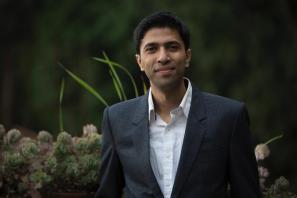
Pankaj Giri was born and brought up in Gangtok, Sikkim—a picturesque hill station in India. He began his writing career with a book review blog, and now, after several years of honing his writing skills, he has written a novel—The Fragile Thread of Hope, a literary inspirational fiction dealing with love, loss, and family relationships. He is currently working in the government sector in Sikkim. He likes to kill time by listening to progressive metal music and watching cricket.

You’ll find Pankaj on Twitter @_PankajGiri.

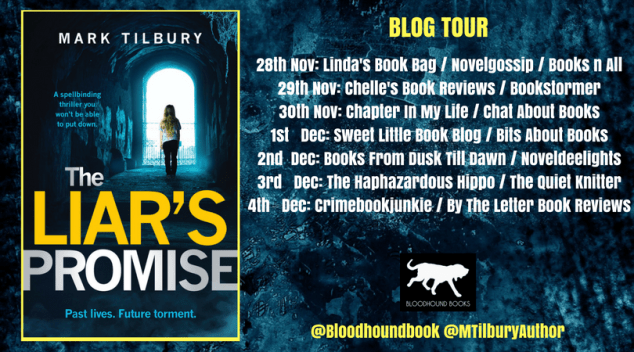
A Publication Day Interview with Mark Tilbury, Author of The Liar’s Promise

Mark Tilbury - The Liar’s Promise_cover

Although I’m thrilled to be part of these launch celebrations, I’m devastated that life simply hasn’t allowed me to read The Liar’s Promise by Mark Tilbury yet as I found his previous novel, The Abattoir of Dreams, an incredibly disturbing and engrossing book. You can read my review of The Abattoir of Dreams here.

However, I do have a fascinating interview with Mark to share with you all today.

The Liar’s Promise is published today, 28th November 2017, by Bloodhound and is available for purchase here.

The Liar’s Promise

Mark Tilbury - The Liar’s Promise_cover

How does a mother protect her child from the unknown?

During a visit to a local theatre, four-year-old Chloe Hollis becomes hysterical. But her mother, Kim, doesn’t realise that this is just the beginning of the nightmare. In the coming weeks, Chloe talks of The Tall Man – Of death.

At her wits end, Kim confides in Charles Honeywell, the headmaster at the school where she works. But what Kim doesn’t know is that Charles is linked to what is happening to her daughter.

Will Kim learn the terrible truth? And can she overcome her own tragic past and save her daughter before it’s too late?

The Liar’s Promise is a story of past lives and future torment.

An Interview with Mark Tilbury

Welcome to Linda’s Book Bag, Mark. Thank you so much for agreeing to answer some questions on my blog about your writing and The Liar’s Promise in particular. Firstly, please could you tell me a little about yourself?

Thanks very much for inviting me. I’ve just finished working on my fourth book, The Liar’s Promise, which is to be published by Bloodhound Books on 28th November. It’s been a busy year so far with four books published by Bloodhound (two of them republished) and the birth of my first Grandson, George. I live in the lovely county of Cumbria, five miles from the sea, twelve miles from a lake and with a river thrown in somewhere in the middle! Perfect. I love being near water, having spent five years in the Royal Navy after I left school. I live with my wonderful girlfriend and have two grown-up daughters.

(Sounds like an amazing year for you Mark.)

Why do you write?

Because it fulfils a need in me. When I don’t write, I feel restless and unsure what to do with myself. Plus my head gets filled up with all kinds of stuff demanding to be written. Some of it good, most of it rubbish!

Which aspects of your writing do you find easiest and most difficult?

I find writing dialogue very natural, but description I have to work hard at. I’m constantly trying to improve and learn from the great writers how to do things well.

What are your writing routines and where do you do most of your writing?

I write in the afternoons in a back bedroom with the curtains closed and loud music playing. I try to keep the same routine throughout the first draft of a novel, and write seven days a week purely for continuity. Even a day off seems to make me lose the thread.

You know I found your last novel The Abattoir of Dreams very disturbing. How far is it your intention to create such a response in the reader and how far a natural part of how you write?

As far as The Abattoir of Dreams was concerned, I was compelled to write about the abuse of children in state run homes. How adults supposed to be overseeing the care of some kids systematically abuse them. I was horrified how this sickening depravity went mostly unreported.

As far as creating a response in the reader, my only intention whilst writing is to create a response in myself, and then hope the reader feels the same way as I do. I was extremely moved and drained during and after writing The Abattoir of Dreams. For me, the realism is important, but I do try to have light-hearted moments, add a bit of humour to balance the darkness.

(I was emotionally drained reading it too.)

You live in beautiful Cumbria. How important is it for you to get out into the countryside as an antidote for the kind of intense fiction you write?

I do enjoy going to the coast, lakes and river. I find being near water relaxing and a nice way to wind down after some of the stuff I write about, especially in such a beautiful setting..

Without spoiling the plot, please could you tell us a bit about The Liar’s Promise?

I know you’ve included the blurb above Linda, but essentially, The Liar’s Promise is about past lives and future torment.

(It sounds brilliant – I’m bumping it up my TBR right now!)

In The Liar’s Promise, Mel confides in her child’s headmaster. You frequently appear to invert reader expectations of those in authority. Why is this?

I haven’t experienced anything personally, but I am constantly looking at all aspects of life. My conclusion is that corruption is rife in every walk of life, and the people getting away with it need to be exposed as much as possible. It’s easy to just look away, never challenge your belief system, pretend that the world if a cosy place where only the good and great are in charge. The more I look, the more I see corruption and depravity at every level. The police. The government. Everywhere really.

Originally you self-published and now have a conventional publisher in Bloodhound. What have you learnt from the publishing process that might be of use to new authors?

I’ve learnt that promotion is key. Getting yourself known and interacting with readers and other writers on social media. There are a lot of really good people out there willing to help, so don’t be afraid to ask.

Although your books are frequently grim and shocking, there’s also an appreciation of love and humanity in your stories. How far does your writing reflect your view of life?

I believe love and friendship can overcome hardships and difficulty. I try to show that decency and honesty can prevail and overcome the most terrible odds. My main aim is to show that ordinary people can do extraordinary things. David really can slay Goliath. Heroes come in all forms, and they don’t have to be like Rambo!

When you’re not writing, what do you like to read?

I enjoy anything with a psychological edge to it, or something supernatural. I’ve been re-reading a few Stephen King and Dean Koontz books, most notably From the Corner of his Eye by Dean Koontz. I think this is possibly the best book I’ve ever read. It’s dark, meaningful, and has a bad guy who is both deranged and funny. My perfect kind of antagonist. I have also just read Sarah England’s latest supernatural thriller, The Soprano, which I highly recommend!

If you had 15 words to persuade a reader that The Liar’s Promise should be their next read, what would you say?

It’s a unique take on reincarnation and a chilling psychological thriller to boot!

Thank you so much, Mark, for your time in answering my questions.

About Mark Tilbury

22782320_512657569088843_1672611666_n

Mark lives in a small village in the lovely county of Cumbria, although his books are set in Oxfordshire where he was born and raised.

After serving in the Royal Navy and raising his two daughters after being widowed, Mark finally took the plunge and self-published two books on Amazon, The Revelation Room and The Eyes of the Accused.

He’s always had a keen interest in writing, and is extremely proud to have his fourth novel, The Liar’s Promise, along with The Abattoir of Dreams, published, and The Revelation Room and The Eyes of the Accused re-launched, by Bloodhound Books.

When he’s not writing, Mark can be found trying and failing to master blues guitar,
and taking walks around the beautiful county of Cumbria.

You can follow Mark on Twitter, visit his website and find him on Facebook.

There’s more with these other bloggers too:

BLOG TOUR (1)

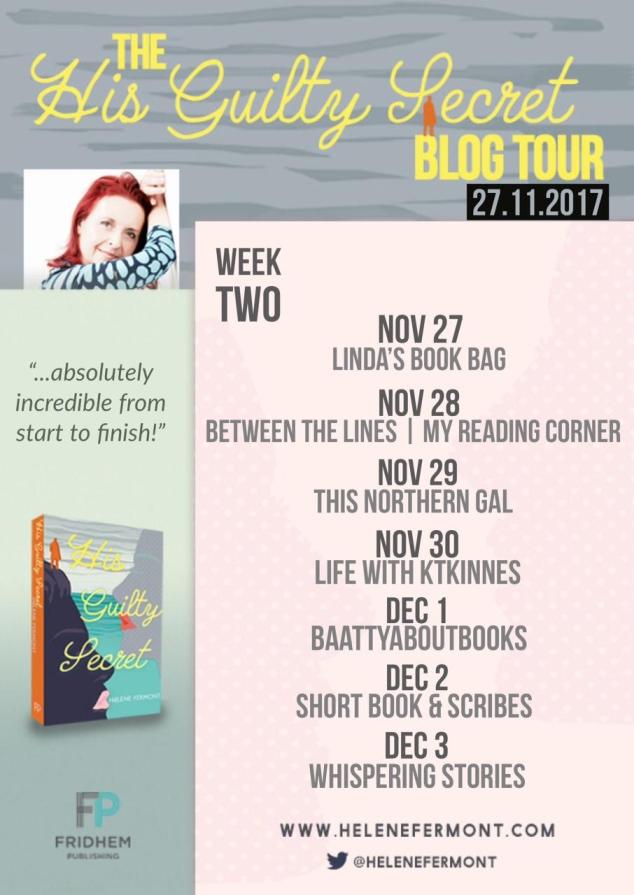
His Guilty Secret by Helene Fermont

His Guilty Secret Cover

I’m delighted to be part of the launch celebrations for His Guilty Secret by Hélene Fermont, especially as I love a book with intrigue. I have my review to share, but more importantly I have an extract from His Guilty Secret for you too today.

His Guilty Secret is published by Fridhem Publishing today, 27th November 2017, and is available for purchase here.

His Guilty Secret 

His Guilty Secret Cover

When Jacques’s body is discovered in a hotel room his wife, Patricia, suspects he has been hiding something from her.

Why was he found naked and who is the woman that visited his grave on the day of the funeral? Significantly, who is the unnamed beneficiary Jacques left a large sum of money to in his will and what is the reason her best friend, also Jacques’s sister, Coco, refuses to tell her what he confided to her?

Struggling to find out the truth, Patricia visits Malmö where her twin sister Jasmine lives and is married to her ex boyfriend. But the sisters relationship is toxic and when a family member dies shortly after, an old secret is revealed that shines a light on an event that took place on their tenth birthday.

As one revelation after another is revealed, Patricia is yet to discover her husband’s biggest secret and what ultimately cost him his life.

His Guilty Secret is an unafraid examination of the tangled bonds between siblings, the lengths we go to in protecting our wrongdoings, and the enduring psychological effects this has on the innocent…and the not so innocent.

An Extract from His Guilty Secret

“I’d love a glass of red wine. Maybe the one Coco used to recommend? Or perhaps a glass of water?” she added.

“I’m sorry, but we’ve run out of it. Coco’s been drinking every bottle on her own. I guess water will have to suffice.”

“That’s fine. Is there something I should know, Rudy? I wasn’t aware Coco had a drinking problem.”

Rudy had been standing with his back to her, and now he turned to look at her. “There’s a lot you don’t know where Coco’s concerned. I think it’s only fair I enlighten you before you hear it from someone else. Coco’s an alcoholic and addicted to tablets. She refuses to admit it but that’s usually the case with people suffering with addictions. I’ve told her we’re over. The reason I’m still here is because she needs me, especially now, with Jacques gone. I’ll get you a glass of water and fetch her for you.” His voice was thick with emotion.

Patricia shook her head in disbelief. “No…don’t bother with the water, just let Coco know I’m here for her if she needs me. I’m here for you both. Why didn’t you tell me? I knew something was wrong. Coco’s not been her usual self lately and each time I’ve called or texted, she didn’t respond. Oh, Rudy, I wish I’d known about what you’re dealing with. I never knew Coco’s on medication, what kind of tablets are we talking about here?” She hoped it wasn’t tranquillisers. She’d read an article about the nasty side effects in a daily paper not so long ago, warning people of the dangers of being on them for longer than a few weeks.

My Review of His Guilty Secret

When pilot Jacques dies from a heart attack whilst with his mistress in a hotel room, this will be the catalyst for a catalogue of events. 

Initially I was confused by His Guilty Secret as I was expecting a fast paced, fairly straightforward psychological thriller. However, His Guilty Secret is more subtle than that. Instead Hélene Fermont explores the nature of the self, the way we live our lives, love, grief and relationships. More importantly for Coco, she delves into the effects of dependency on alcohol and medication so that His Guilty Secret is an interesting presentation of lives the reader might not otherwise have encountered, or, might be experiencing themselves. There is so much for the reader to contemplate in His Guilty Secret, making for a fascinating reading experience.

I must be honest and say I found the style of His Guilty Secret quite abrasive and I couldn’t decide if I didn’t like it, or actually if I thought it was perfect for the nature of the plot and characters.

The concept of a secret is multi-layered. I had thought the guilty secret was simply Jacques’ affair with Isabelle, outlined within the first few pages, but as I read His Guilty Secret it became clear Hélene Fermont understands we all have some kind of secret, even if we don’t actually recognise it within ourselves, and certainly the characters here do. Secrets abound and barely any character isn’t hiding a deep secret that impacts on their feelings and actions throughout. There are many surprising elements as the plot unfolds.

His Guilty Secret is a book that explores the complexities of relationships in a way that will make many readers ask questions of their own lives and pasts. Although it wasn’t quite what I was expecting, I enjoyed its layered and explorative narrative and finished the read feeling I had had the opportunity to exercise my brain and had learnt something whilst I was being entertained. I didn’t always feel comfortable reading His Guilty Secret and I think being taken out of our comfort zone is a very good thing.

About Helene Fermont

helene fermont

Born into an Anglo-Swedish family, Hélene Fermont grew up in Malmö in Sweden. Surrounded by an idlyllic landscape, she started writing at eight years old. Spending a brief time in the music industry performing on Swedish TV and radio, she decided to pursue a career as a therapist, focussing on children with learning diculties. In the mid-90s Hélene moved away from Sweden to move to London, the city has been her home now for over 20 years. Despite her love of London, she frequently travels back to her native city of Malmö to get back to the landscape of her childhood which fi­rst inspired her writing.

Hélene’s other books include: Because of You and We Never Said Goodbye.

You can find out more about Hélene by visiting her website and finding her on Facebook. You can also follow her on Twitter @helenefermont.

There’s more with these other bloggers too:

His Guilty Secret poster