

My enormous thanks to Emily Keogh and Ash Duggirala of Mindbuck Media for sending me a copy of The Geography of Saying Goodbye by Trevor J Houser in return for an honest review. It’s my pleasure to share my review today.
The Geography of Saying Goodbye is published by Unsolicited Press on 15th December and is available for purchase here in the US or here in the UK.
The Geography of Saying Goodbye
On her deathbed, Paul Canton’s mother declares she’s bound for the Alboran Sea. The nurses dismiss it as nonsense-but the next morning she vanishes, along with her son’s credit card. Paul, who finds leaving his comfort zone “more terrifying than the Third Battle of Nanking,” embarks on a quixotic pursuit of a globe-hopping resurrection, desperate for one last chance to say goodbye. Only the farther he travels, the less he understands the woman who raised him, and the more he realizes how little he’s actually lived.
What begins as a son’s attempt to catch up with a runaway parent becomes something stranger: a detective story without answers, a comedy of errors shot through with longing, and a meditation on what it means to live a life shaped by fear rather than risk. Each stop reveals pieces of his mother’s hidden history and forces Paul to reckon with the choices he has long avoided in his own.
Wry and tender in equal measure, The Geography of Saying Goodbye blends humor with lyrical observation in a story about family and mortality, yes, but also about learning how to live.
My Review of The Geography of Saying Goodbye
Paul Canton’s mother is missing.
What a remarkable book.
Having fairly recently lost my own mother I wasn’t sure if I would cope with The Geography of Saying Goodbye, because Pau’s mother is on her deathbed before she decides to take matters into her own hands and escape, but it was a brilliant read and I thoroughly enjoyed it, because it gives reassurance as well as entertainment and can be enjoyed on many levels from a cat and mouse chase to a profound insight into humanity.
Trevor J Houser’s prose is expertly balanced. The Geography of Saying Goodbye has considerable white space sounding the writing which suits the structure of the book perfectly. As Paul is taken literally and metaphorically farther and farther away from his normal life and discovers more and more about his mother, so this space affords both Paul and the reader time to reflect. As a result, the impact of the writing is deepened and more profound.
And I loved the style of writing. Direct speech is natural and engaging with Paul’s first person account presented with diffidence, wit and humanity. There were moments when I laughed aloud both at Paul’s moments of self-deception and his occasional clarity. Some of the writing is truly quirky, but never becomes absurd. Equally, I was moved by events too. I thought the inclusion of cultural references was inspired because it added texture to the story whilst affording moments when the reader feels truly included because they understand the reference or head off to find out more. The Geography of Saying Goodbye seems to exist outside the confines of its pages.
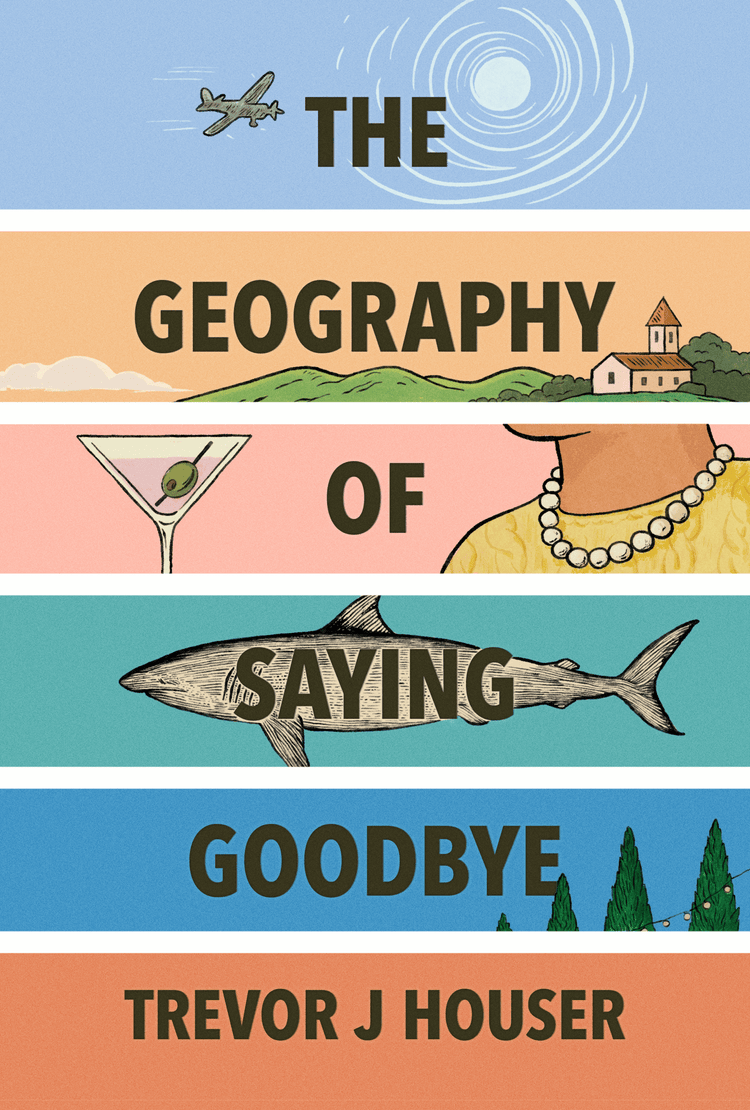
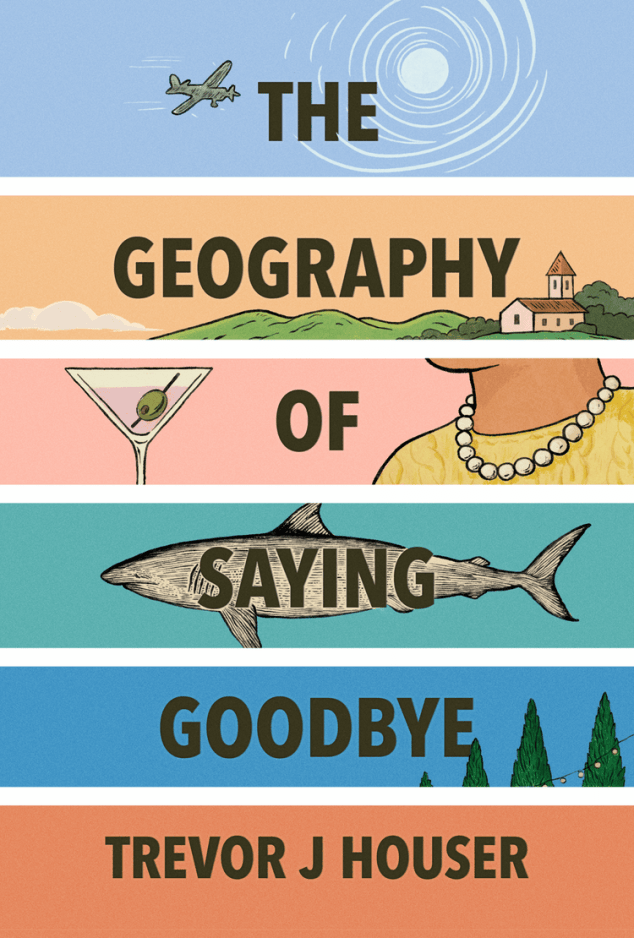
Paul’s mother is a triumph. I won’t spoil the narrative by revealing what happens, but she epitomises the way in which we can make assumptions about, and take for granted, those around us. Our perception of who a person is might well not be who they really are. Certainly The Geography of Saying Goodbye is the story of her activities, which do take place over a physical geography, but equally it is the story of how we navigate the geography of life – how we deal with grief, loss, chances, relationships, children, marriage, family and work. Just as the book’s cover is layered and interesting (and highly pertinent to the story) so too are the themes and concepts in the bookmaking for a captivating read.
Through Paul, his panic attacks and his trepidation, Trevor J Houser illustrates how we can lose ourselves and accept the prosaic and mundane too readily. Paul might be chasing his mother as she embarks on adventures, but through the experience he begins to understand himself. This concept is handled with a real lightness of touch that is all the more affecting as a result.
I’m aware I’ve been deliberately vague in this review because the fast moving narrative has such an unusual quality I don’t want to reveal too much. However, I thought The Geography of Saying Goodbye was a triumph. It’s funny and entertaining, but, more importantly, it is a sensitive insight into who we are and who we could become. Carpe diem in book form, The Geography of Saying Goodbye is a wonderful read and I loved it.
About Trevor J Houser

Trevor J. Houser is the author of Pacific (2021) and The Prumont Method (2023). A finalist for the Next Generation Indie Book Awards and the Eric Hoffer Grand Prize, he lives in Seattle with his wife and two children, where he works in advertising. The Geography of Saying Goodbye is his third novel.
For further information, visit Trevor’s website.

