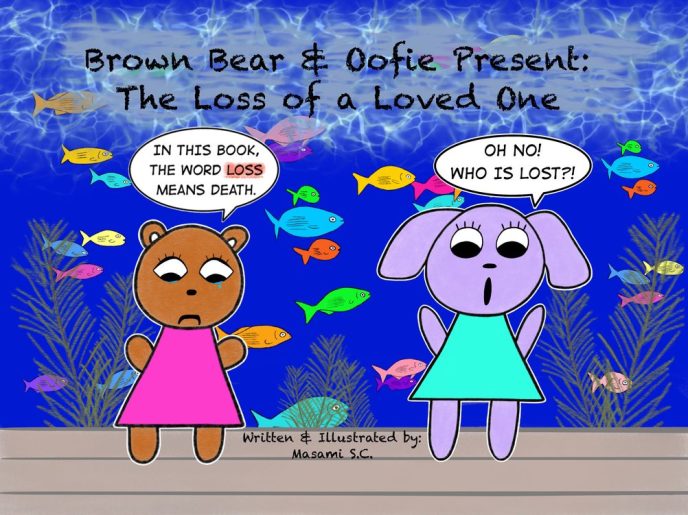
Brown Bear and Oofie Present: The Loss of a Loved One written and illustrated by Masami S.C.

After the past couple of years when life has been so challenging, Masami S.C decided to write and illustrate Brown Bear and Oofie Present: The Loss of a Loved One to help young children come to terms with loss. When Serena got in touch about her project, I knew I had to feature it here on Linda’s Book Bag and I’m delighted to share my review today.

My enormous thanks to Serena for sending me a copy of Brown Bear and Oofie Present: The Loss of a Loved One as well as Brown Bear and Oofie Present: The Loss of Identity and  Brown Bear and Oofie Present: The Verbal Bully.

Brown Bear and Oofie Present: The Loss of a Loved One is available for purchase through the links here and worldwide on Amazon.

Brown Bear and Oofie Present: The Loss of a Loved One

Death is inevitable. No one likes to talk about it because it is such a depressing and emotional topic. Brown Bear & Oofie are best friends and have life learning experiences together. In The Loss of a Loved One, Brown Bear’s Grandma (Mimi), has died. Oofie helps Brown Bear with emotional support and they discuss the topic of death together. This book will help parents and kids ease into this very difficult fact of life. The detailed facial expressions of the two characters will help children connect with their own emotions and grief that they are experiencing from their personal loss of a loved one.
This book is not geared towards any one particular religion. Instead, it provides comfort and inspires the reader to keep an open mind about the possibilities of what happens to us once we depart.

My Review of Brown Bear and Oofie Present: The Loss of a Loved One

A children’s book about the grieving process.

Those of you who know my reviews of children’s books will know I have a pet niggle and so I’m going to get it out of the way before I review The Loss of a Loved One properly. I really prefer words not to be written entirely in upper case letters, even in direct speech, as I don’t feel it models how we want children to learn to write. Right. That’s that done!

Although The Loss of a Loved One is a children’s book, I found the author’s introduction both moving and helpful as it is relevant to any child – whatever their age.

The story is simple as Brown Bear and Ooofie discuss Brown Bear’s Grandma Mimi who has just died. I liked the way Oofie introduced the death of a pet too as this is often the first encounter with death that children have, making The Loss of a Loved One relevant and relatable.

The more difficult vocabulary is highlighted and explained with a glossary of featured words at the end so that The Loss of a Loved One gently introduces language to help children articulate their emotions in a valuable and helpful manner. Indeed, the physical presentation of the book also helps here as there is a charmingly illustrated version of events in Brown Bear and Oofie’s conversation mostly on the right hand pages, with a second more detailed exposition on the left page which has plenty of white space and clear font for emergent and young readers to access so that grief is explained and explored with some practical advice given. This makes The Loss of a Loved One useful in a variety of situations from home and school to community venues. The robust cover ensures a durability in community setting too.

I particularly liked the illustrations in The Loss of a Loved One because they have a simple charm and as they don’t depict a particular race or ethnicity, being toys, there is no danger of exclusion.

Brown Bear and Oofie Present: The Loss of a Loved One is an important and helpful children’s book to help them and the adults in their lives, come to terms with grief and how to accept and overcome it. There’s the raising of what happens after death without any particular belief being advocated so that the story leads to further discussion. It is especially sensitive in explaining that we all react differently to grief and that no particular reaction is the correct one. I really recommend it.

About Masami S.C.

Masami S.C. is a pseudonym created by Serena Masami Caspary, a NYU graduate with a BFA in dance from Tisch School of the Arts.

For more information, visit The Brown Bear and Oofie website, or find them on Facebook and on Instagram.

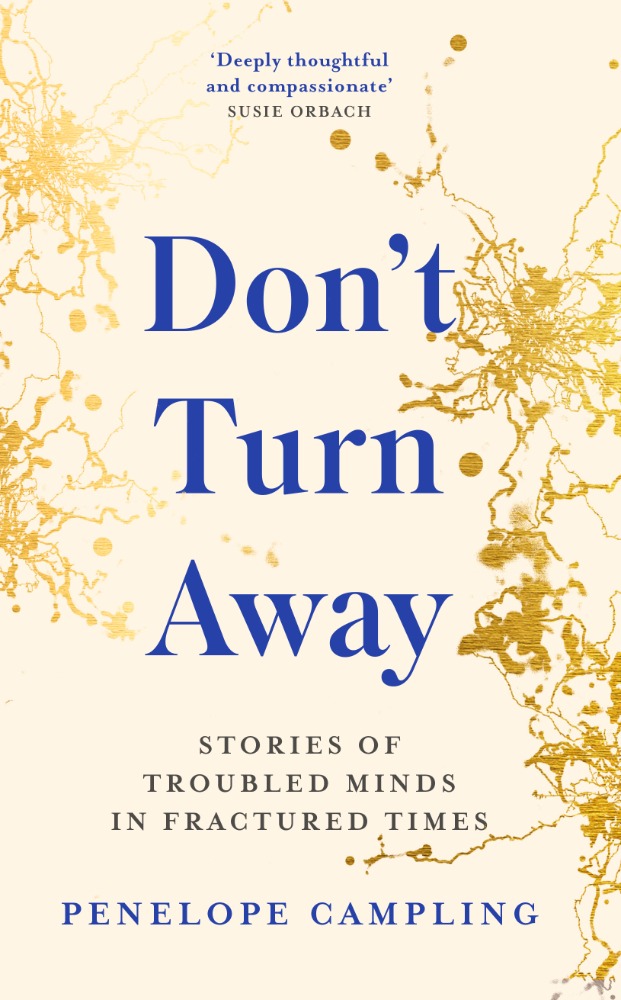
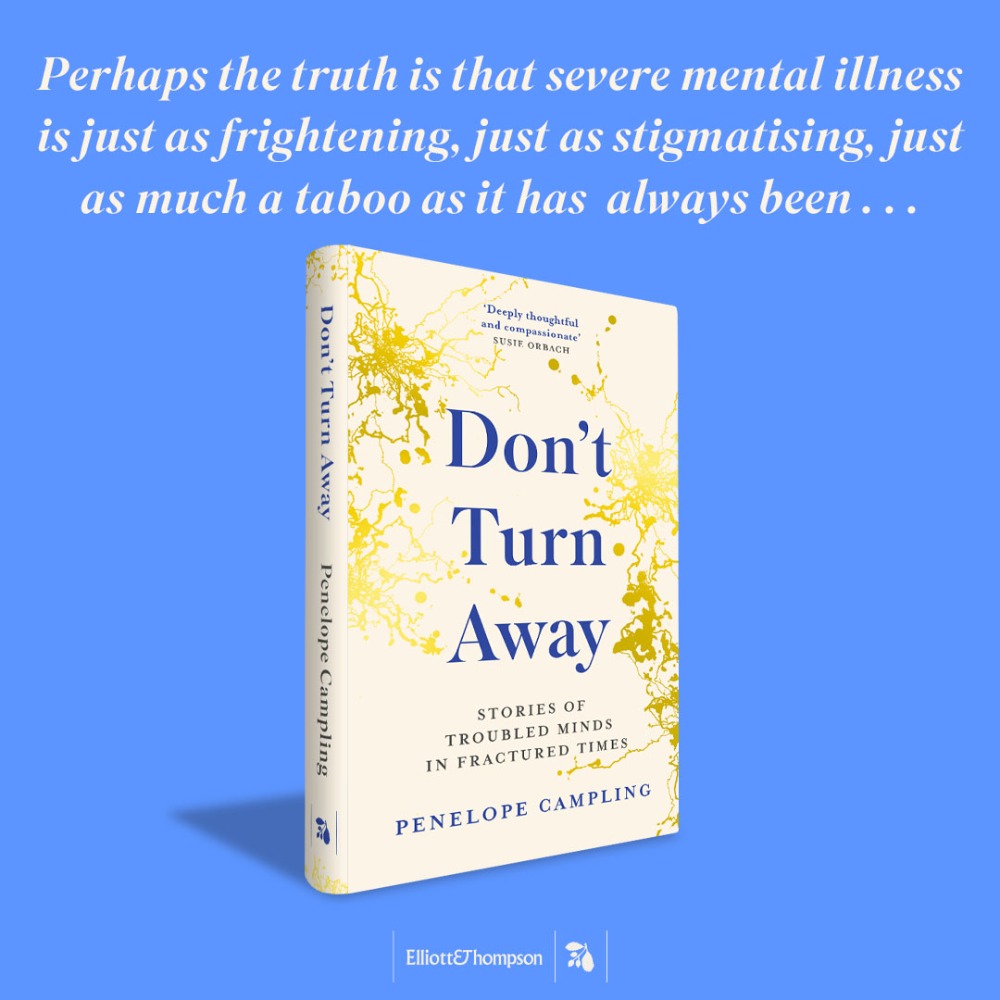
Spotlighting Don’t Turn Away by Penelope Campling

When Alison Menzies got in touch about Don’t Turn Away: Stories of Troubled Minds in Fractured Times by Penelope Campling I was so sorry I simply couldn’t fit in reading it. In these difficult times of international, national and for many, personal, crisis I thought Don’t Turn Away sounded such an important book that I decided to feature it here on Linda’s Book Bag today.

Let’s find out more:

Don’t Turn Away: Stories of Troubled Minds in Fractured Times has been featured on BBC Radio 4’s Woman’s Hour and is published by Elliott & Thompson. Don’t Turn Away is available for purchase in all the usual places including here.

Don’t Turn Away

Stories of Troubled Minds in Fractured Times

Over the course of her 40-year career, psychiatrist and psychotherapist Penelope Campling has worked with patients from all walks of life, from survivors of abuse to ICU doctors struggling under the strain of Covid-19. She has seen many positive changes in how we approach mental health – and yet she is increasingly troubled by the state of our health services. Too often those suffering from serious mental illness are being neglected, locked away, even abused.

In Don’t Turn Away Campling takes us into the therapy room, offering unique insight into how we treat those in distress. She shows us how the progress made in a more optimistic era of psychiatry is fast being eroded; how our struggling healthcare system often fails those who need our support; and how crucial it is in today’s uncertain world that we do not turn away.

****

I don’t know about you, but I think Don’t Turn Away sounds as if we all need to read it as soon as we can.

About Penelope Campling

Penelope Campling is a psychiatrist and psychotherapist, and a fellow of the Royal College of Psychiatrists. For twenty years, she ran the Leicester NHS service for people diagnosed with personality disorder.  She is  the co-author of the highly influential Intelligent Kindness: Rehabilitating the Welfare State (CUP, revised 2020) which led to her being awarded an honorary fellowship of the Royal College of General Practice. She  has worked with patients from all walks of life, from survivors of abuse to ICU doctors struggling under the strain of the Pandemic. She has seen many positive changes in how we approach mental health – and yet she is increasingly troubled that the progress made in a more hopeful era of psychiatry is fast being eroded and that our struggling healthcare system often fails those in greatest need.

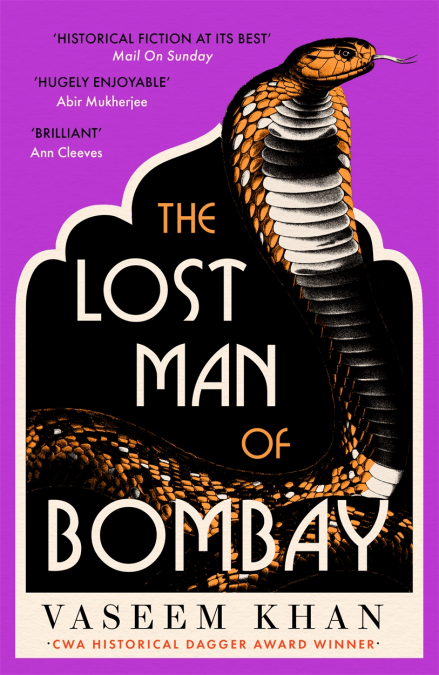
The Lost Man of Bombay by Vaseem Khan

It’s several years since I first met the brilliant Vaseem Khan and discovered what an erudite, charming and downright lovely man he is, but although I have had that privilege several times, even introducing him at the Deepings Literary Festival, and have carried copies of his books to on holiday to India, Sri Lanka and Croatia, I’ve never before managed to read him! It’s more than time to correct that and I’m delighted to share my review of Vaseem’s latest book, The Lost Man of Bombay today. My huge thanks to Vaseem for ensuring I received a copy and to the folk at Hodder for sending me the book in return for an honest review.

The Lost Man of Bombay is published today, 18th August 2022 by Hodder and Stoughton and is available for purchase through the links here.

The Lost Man of Bombay

Bombay, 1950

When the body of a white man is found frozen in the Himalayan foothills near Dehra Dun, he is christened the Ice Man by the national media. Who is he? How long has he been there? Why was he killed?

As Inspector Persis Wadia and Metropolitan Police criminalist Archie Blackfinch investigate the case in Bombay, they uncover a trail left behind by the enigmatic Ice Man – a trail leading directly into the dark heart of conspiracy.

Meanwhile, two new murders grip the city. Is there a serial killer on the loose, targeting Europeans?

Rich in atmosphere, the thrilling third chapter in the CWA Historical Dagger-winning Malabar House series pits Persis against a mystery from beyond the grave, unfolding against the backdrop of a turbulent post-colonial India, a nation struggling to redefine itself in the shadow of the Raj.

My Review of The Lost Man of Bombay

Persis has several new cases to solve.

I must say at the outset that although The Lost Man of Bombay is the third book in the Malabar House series, it doesn’t matter at all if, like me, you haven’t read the first two; but be warned, after reading this one you’re going to want to read the others immediately. I just loved it!

In The Lost Man of Bombay there’s such a fluid and engaging style that the pages turn themselves. There’s a lightness of touch and a wry humour beneath Vaseem Khan’s writing that means he paints a vivid educational picture of India’s history, politics and geography without the reader actually realising how much they are learning at the same time as being brilliantly entertained. The Lost Man of Bombay truly transports the reader to post war India through the use of the senses, painterly descriptions and authoritative, assiduously researched, writing.

The plot is outrageously good, writhing along with dramatic pace so that it is impossible to guess the various reveals as they come, making for an exciting, ensnaring story. I loved the way Persis uncovered the truth with chapters ending on mini cliff hangers, or by her mind slipping to other events so that at the same time the plot is being revealed, Persis’ character is developed too.

And what a character Persis is. She’s fabulous. The first female Indian policewoman, she is multi-faceted and layered and by no means perfect, being spikey and quick-tempered as well as occasionally immature and selfish so that she feels all the more vivid and real. Her tortured feelings about her father, her position in society and about Archie make her absolutely of the era of The Lost Man of Bombay, yet simultaneously modern and fresh, ensuring she is relatable and appealing. Vaseem Khan has so engaged me with Persis’ character that I simply have to read the first two books in the Malabar House series to discover more about her back story and cannot wait for another adventure featuring her.

Adventure is just one aspect of Vaseem Khan’s wonderful narrative. There’s police procedural crime, historical fiction, intrigue and a smattering of romance that makes The Lost Man of Bombay such delicious storytelling of the very best kind. With humour and emotional connection added too, I absolutely adored The Lost Man of Bombay. It’s gone straight on the list of my favourite reads this year. Don’t miss it!

About Vaseem Khan

Vaseem Khan is the author of two crime series set in India, the Baby Ganesh Agency series set in modern Mumbai, and the Malabar House historical crime novels set in 1950s Bombay. His first book, The Unexpected Inheritance of Inspector Choprawas a Times bestseller, now translated into 15 languages. The second in the series won the Shamus Award in the US. In 2018, he was awarded the Eastern Eye Arts, Culture and Theatre Award for Literature. Vaseem was born in England, but spent a decade working in India.

Midnight at Malabar House, the first in his historical crime series, won the CWA Historical Dagger 2021, the pre-eminent prize for historical crime fiction in the worldHis book The Dying Day about the theft of one of the world’s great treasures, a 600 year old copy of Dante’s The Divine Comedy, stored at Bombay’s Asiatic Society.

For further information, visit Vaseem’s website, follow him on Twitter @VaseemKhanUK, or find him on Facebook and Instagram.

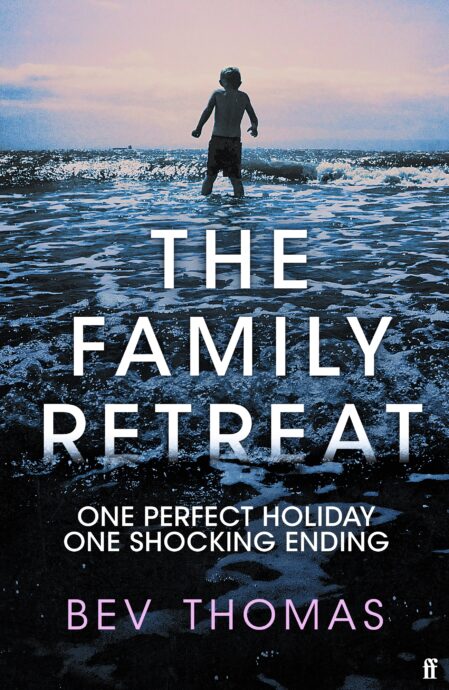
The Family Retreat by Bev Thomas

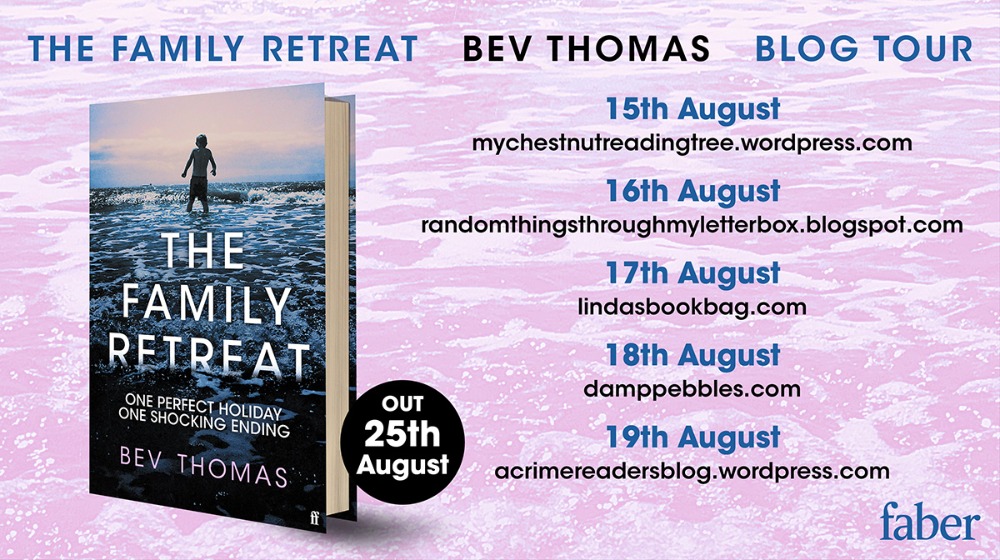
My enormous thanks to Sophie Portas for inviting me to participate in the blog tour for The Family Retreat by Bev Thomas and for sending me a copy of the book in return for an honest review. I’m delighted to share that review today.

The Family Retreat is published by Faber on 25th August 2022 and is available for purchase here.

The Family Retreat

When Rob decides the family needs to get away for the summer Jess is not convinced – won’t all the things they’re escaping be waiting for them on their return? But the kids are thrilled, and before long their idyllic little cottage, the sea air, and the feel of skin sticky from sun-cream, lollies and sand, begins to work its magic. Jess allows herself to sink into the holiday vibes – the family even make holiday friends.

The summer heat intensifies Jess – ever vigilant – unearths a secret, a problem she’s sure she can help solve. But things are not always as they seem. The water may look inviting but even the gentlest looking waves can hide the deadliest undercurrents.

As autumn approaches, Jess – and the reader – will come to realise this is going to end in a way no-one could have imagined…

My Review of The Family Retreat

It took me quite a while to read The Family Retreat because it felt so intense, so raw and so accurate that I needed to step back from time to time and process the depth of emotion and tension. I thought Bev Thomas’s ability to draw in the reader and make them experience what Jess experiences was exceptional.

I can’t say much about the plot for fear of spoiling the read for others, but what Bev Thomas does so completely brilliantly is a kind of sleight of hand that has the reader believing one thing before she hits them with a different reality that is breath taking. As the narrative drew to a close I felt literally rooted to my seat as I read, unable to tear myself away form what was happening.

The Family Retreat is fabulously written, and I loved the setting descriptions particularly. It comes as no surprise that the author was a psychologist as the authenticity, the sensitivity and the authority of the psychological elements is mesmerising, making the book a brilliant read. There are some difficult themes explored through the narrative that give The Family Retreat incredible depth and maturity.

I loved the characterisation because, through the lynchpin of Jess, we get to know the people in The Family Retreat so completely. Jess felt totally real to me and so many aspects of her personality resonated with me personally, particularly that of trying to be all things to all people, so that the narrative was all the more affecting. However, the one person who astounded me most was Polly who is a universal everywoman so familiar in today’s society. Helen’s response to Polly’s experiences has a seismic impact on the reader and I wish every politician and patriarchal figure could read The Family Retreat so that they understand the lives of so many in our society. Through these characters Bev Thomas gave me far greater clarity and understanding than any factual account has managed. A retreat suggests a place of reflection and learning and my word do these characters learn about themselves and others!

I’m aware this review is somewhat vague and indistinct but it’s hard to articulate thoughts without giving away too much. I can say, however, that I thought The Family Retreat was, quite simply, excellent – in style, subject matter, plot and character. I found it compelling, affecting and educational as well as totally entertaining. Don’t miss this one.

About Bev Thomas

Bev Thomas was a clinical psychologist in the NHS for many years. She currently works as an organisational consultant in mental health and other services. She lives in London with her family. Her debut novel, A Good Enough Mother, was published in 2019.

You can find Bev on Twitter @BevThomas20.

There’s more with these other bloggers too:

The Lighthouse Bookshop by Sharon Gosling

Given that Sharon Gosling’s The House Beneath the Cliffs (reviewed here) was one of my books of the year in 2021, I was delighted to be offered the opportunity to review Sharon’s latest book, The Lighthouse Bookshop for the My Weekly website.

Published by Simon and Schuster on 18th August 2022, The Lighthouse Bookshop is available for purchase through the links here.

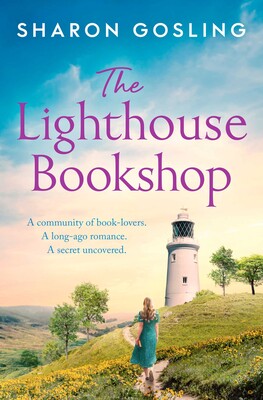
The Lighthouse Bookshop

At the heart of a tiny community in a remote village just inland from the Aberdeenshire coast stands an unexpected lighthouse. Built two centuries ago by an eccentric landowner, it has become home to the only bookshop for miles around.

Rachel is an incomer to the village. She arrived five years ago and found a place she could call home. So when the owner of the Lighthouse Bookshop dies suddenly, she steps in to take care of the place, trying to help it survive the next stage of its life.

But when she discovers a secret in the lighthouse, long kept hidden, she realises there is more to the history of the place than she could ever imagine. Can she uncover the truth about the lighthouse’s first owner? And can she protect the secret history of the place?

My Review of The Lighthouse Bookshop

My full review of The Lighthouse Bookshop can be found on the My Weekly website here.

However, what I can say here is that The Lighthouse Bookshop is just wonderful and I adored it. It’s gone straight on my list of books of the year.

Do visit My Weekly to read my full review here.

About Sharon Gosling

Sharon Gosling lives with her husband in a very remote village in northern Cumbia, where they moved to run a second-hand bookshop, Withnail Books in Penrith. She began her career in entertainment journalism, writing for magazines in the science fiction and fantasy genre, before moving on to write tie-in books for TV shows such as Stargate and the ‘re-imagined’ Battlestar Galactica. She has also written, produced and directed audio dramas based in the same genre.

When she’s not writing, she creates beautiful linocut artwork and is the author of multiple children’s books. The House Beneath the Cliffs is her first adult novel.

You can follow Sharon on Twitter @sharongosling and Instagram or visit her blog.

An Extract from The Couple at Causeway Cottage by Diane Jeffrey

I was fortunate to meet lovely Diane Jeffrey at Harrogate Crime Festival recently and I have a copy of The Couple at Causeway Cottage, Diane’s latest book, on my TBR. Today, just ahead of publication, I’m delighted to share an extract from The Couple at Causeway Cottage with you.

Published by Harper Collins’ imprint HQ Digital on 18th August 2022 The Couple at Causeway Cottage is available for pre-order through the links here.

The Couple at Causeway Cottage

NEW STARTS. OLD SECRETS.

Kat and Mark move to an island off the Northern Irish coast for a new beginning. Far away from their frantic life in London, it’s the perfect place to bring up the family they’re longing to start.

But as soon as they arrive, cracks begin to appear in their marriage. Mark is still texting his ex-wife. Kat is lying about a new friendship. And one of them is keeping an explosive secret about the past.

The couple in Causeway Cottage are hiding something – and the truth can be deadly…

A gripping page-turner with a shocking twist, perfect for fans of Lucy Clarke, Alice Feeney and Shari Lapena.

An extract from The Couple at Causeway Cottage

Chapter 1

It’s only when I’m on the ferry, minutes before arriving, that it hits me how isolated I will be. Standing on the deck, using my hand to shield my eyes from the sun, I glimpse the island for the first time. The cliffs, imposing and impressive, even from a distance, then the port, a speck bobbing in and out of view, becoming bigger and more distinct as we approach. Until now, I’ve only seen images of Rathlin from googling it: a map of a small island shaped like a boomerang or an upside-down sock, pictures of its two churches and its white seafront cottages as well as – and this was the clincher when Mark tried to talk me into moving here – numerous photos of seals and birds.

When I announced I was going to live on a tiny island I’d never been to before, everyone was astonished. I still can’t believe it myself. But new home, new start. The decision wasn’t as rash as it sounds. As I explained to my friends, my dad was from Northern Ireland, so it feels a bit like going back to my roots. And it’s familiar territory for Mark. He grew up eight miles away in Ballycastle, where he recently secured a place for his mother in a nursing home. It was the best thing to do – the only thing to do, but he’s riddled with guilt. An only child who has lost his father, Mark is very close to his mum. I can certainly relate to that. It’s only natural he should also want to be closer to her geographically, especially as she’s so ill.

At the time, it felt like the right decision for me, too. The right move. For several reasons. I mentally tick them off on my fingers as I try to curb the uneasiness swelling inside me. Thumb: I grew up in Devon and I miss the ocean. Index: I was desperate to escape the frantic rhythm of London. Middle finger: I’ve always wanted to be an outdoor photographer – wildlife or landscapes. Rathlin will provide the perfect playground for me to pursue this goal. Ring finger: with its tight-knit community and tiny primary school, Rathlin Island strikes me as an ideal place to bring up our children when they come along. Little finger: the smallest digit on my hand, but an important consideration nonetheless – both Mark and I needed to get away from his ex-wife.

But enumerating all the advantages of this move does nothing to allay my agitation. I’m out of sync with the calm sea.

‘Mark, show me the photos of our house again,’ I say.

‘You’ll see it with your own eyes in a few minutes.’ He hands me his mobile, an amused look on his face, clearly mistaking my jitteriness for excitement.

The estate agent showed Mark around the house while he was over three months ago visiting his mother, who has dementia. He took lots of photos and I’ve swiped through them on his phone so many times I can visualise in detail the place I’ll call home from now on. But I had to make do with a virtual visit of the three-bedroom detached cottage we’ve bought. It doesn’t have a garden, but neither of us is green-fingered, and with it being so close to the beach, that didn’t bother us.

We’d initially been looking for a house on the mainland, but when Causeway Cottage went up for sale, our plans changed. Mark has always had this romantic notion about living on an island and this was the chance of a lifetime. It was the only suitable place for sale on Rathlin – the others were new builds, social housing – so we had to snap it up quickly. I was terrified we’d be gazumped – a word I didn’t even know before Mark made a verbal offer on the house – and delighted when all the paperwork was finally signed and Causeway Cottage was officially ours.

But it feels disconcerting now, moving into a house I’ve only ever seen in photos. Is it because I don’t like the idea of living in a house where someone died? I shudder, then berate myself for being morbid. I’m on my way to a beautiful island, where I’ll be living the dream. It’s not like I’m being ferried across the River Styx.

I give Mark back his mobile. He smiles at me, his turquoise eyes blazing in the sun. A rictus stretches across my face as I force myself to smile back.

‘The finish line’s in sight,’ Mark says, as we make our way to the car, which is laden to the hilt with our mattress strapped to the roof rack. His Northern Irish accent is already more pronounced, even though he hasn’t talked to anyone except me since we left London.

As Mark starts up the car and drives slowly off The Spirit of Rathlin and onto the island itself, I sigh with relief. We travelled for nearly fourteen hours yesterday – getting up at six a.m. and driving from London to Liverpool to take the ferry to Belfast, driving north from there as far as the coastal town of Ballycastle, where we stayed overnight at the house my mother-in-law lived in until very recently. Our crossing this morning – from Ballycastle Harbour to Rathlin – was mercifully short. The first boat of the day and the last leg of the journey.

Causeway Cottage is barely a minute’s drive from the harbour, halfway up a steep hill. I throw off my seatbelt and leap out of the car before Mark can even turn off the engine. Standing at the front gate, I take it in. Now I’m here, I can finally get a feel for the place. The house is quaint and perfectly symmetrical. Red roses climb up the pure white walls on both sides of the front door and, for a second, I picture the cottage as a child might draw it, like a face, the flowers depicting red lips curling upwards as if the house is smiling at me. Or maybe it’s laughing at me. The upstairs windows are eyes, their sills thick lines, pencilled with black kohl. I wonder what they see when they look down at me.

‘It needs a bit of work on the façade and on the roof,’ Mark says, materialising beside me, ‘but other than that, the property’s in pretty good shape.’ I wonder if he’s repeating the estate agent’s words. ‘So, what do you think?’

‘It’s beautiful. Like a cottage in a fairy tale.’ I turn to look at him, but instead my gaze is drawn to the old, stone building behind him. ‘I hadn’t realised the cottage was so close to the church.’

‘We don’t have to go,’ he says jokingly. ‘Apparently there’s no bell-ringing, so we can still have a lie-in on Sundays.’

‘I was thinking more of the graveyard.’ My imagination fills in what I can’t make out, even with my neck craned: tombstones, scattered across the hillside, overlooking the sea and exposed to the elements. Frosty fingers walk down my spine as I wonder if the previous owner of our cottage is buried there.

‘The estate agent assured me our new neighbours are only noisy one night a year.’

Mark’s jovial mood is infectious. ‘Let me guess,’ I say, playing along. ‘Hallowe’en.’

Mark chuckles. ‘You got it.’

I laugh, too.

‘That church doesn’t actually have a graveyard,’ Mark adds. ‘The island’s only burial ground is at the other one.’ As he says that, I remember reading it online.

Mark whisks me up into his arms and carries me up the path to the front door. ‘I didn’t think this through,’ he says, setting me down to fish the key out of his jeans pocket. Then he opens the front door, picks me up again and carries me over the threshold, the two of us giggling like newly-weds.

The first thing I notice is the smell. A stale odour only partially masked by disinfectant and bleach. It’s because it has been shut up for a few weeks, I tell myself. I walk through to the living room, past what I know from Mark is a working fireplace, and fling open the windows to let in the sea air.

‘Wow,’ I breathe. The village sprawls below us and, beyond that, the sea stretches to the horizon.

‘The views are even better from upstairs.’ Mark grabs my hand and leads me upstairs to the front bedroom – the master bedroom.

A cool breeze wafts in through the window when Mark opens it and I shiver.

‘Cold?’ Mark asks.

‘Not really. I was wondering which room the last owner died in. It wasn’t in here, was it?’

‘I don’t know, Kat. I didn’t think to ask.’ He combs his fingers through his wavy, salt and pepper hair. ‘He was an old man. He died peacefully in his sleep.’

‘It probably was in our bedroom, then.’

‘Does it matter? I don’t think the house is haunted.’

I’m being ridiculous. The house doesn’t feel creepy. It’s smaller than it looked in the photos, but it’s massive compared to the flat we were renting in Hammersmith.

We spend the next half an hour or so walking around the house, upstairs and downstairs, opening cupboards and doors and planning where our furniture will go when it arrives. The removals van won’t make it as far as the island – we’ll unload everything at my mother-in-law’s house, then we’ll decide what to keep and bring over on the ferry and what to get rid of or replace.

Mark’s mother had a lot of stuff in her house – she’s a bit of a hoarder – but Mark cleared out most of it when he was offered a place for her in the care home. She insisted Mark should sell her house, and anything in it that would fetch some money, to cover the fees. The house wouldn’t have suited us, not permanently. It’s a very small bungalow with no sea views. On top of that, it’s on a busy road. So we didn’t see ourselves living there. We’d intended to stay there temporarily and take our time finding our dream home. But when Causeway Cottage came onto the market, everything happened more quickly than we’d anticipated and now we’re about to become islanders.

Secretly, I was relieved we wouldn’t be living in Ballycastle itself. As my mind wanders to the fortnight I spent there the summer I turned fifteen, Mark provides a welcome interruption to a painful memory and snaps me back to the present.

‘Shall we do some unpacking?’ he says. ‘Then we can go for a pub lunch.’

*

McCuaig’s Bar is on the seafront. Sitting outside at the wooden picnic table, I tuck into my scampi ravenously, enjoying the squawking of the seagulls. I take a sip of Mark’s beer. I’d love a glass of wine, but I’ve resolved to cut back on drinking. When I stopped taking the pill a few months ago, we hadn’t discussed moving to Northern Ireland. I suppose, with the stress and upheaval of the move, it’s just as well I didn’t get pregnant before now, and there was little chance of it happening with Mark away so often for work. But now would be the perfect time for me to get pregnant and I know too much alcohol could affect my fertility.

I finish my meal and put down my knife and fork. Feeling the sun warm my face, I close my eyes and tip back my head. Then I open them and look around me. At the table next to ours, two tourists are chatting animatedly, their backpacks on the ground by their feet. At another table, a man is sitting by himself, but there’s an empty plate and pint glass opposite him. He’s wearing a checked shirt with his sleeves rolled up and he’s holding a hamburger with paint-stained hands.

Mark drains his beer. ‘I think I’ll have another one,’ he says. ‘Sure you don’t want a drink?’

‘I shouldn’t.’

‘I don’t suppose one will hurt,’ Mark says. ‘We should be celebrating!’

‘Go on, then,’ I say, cursing myself for being so weak-willed. ‘I’ll have a glass of white wine.’

Mark gets up to fetch our drinks from the bar. He clambers over the wooden bench and walks straight into a man carrying a pint of lager in each hand.

‘I’m so sorry,’ Mark says. ‘That was terribly clumsy of me.’

‘Don’t worry, mate. No harm done.’ His voice is deep and sonorous. He’s at least six foot two and towers over Mark, even though my husband isn’t short.

‘I’ve spilt beer all down your T-shirt.’ Mark is clearly mortified.

‘It’s no big deal. It was dirty anyway. These are work clothes.’

As Mark continues to apologise profusely and insists on replacing the pints, the stranger glances my way briefly, although I don’t think he takes me in. When he turns back to Mark, his expression has changed, as if he’s struggling not to lose his temper. Perhaps because of Mark’s fussing, he’s more annoyed now than when Mark collided with him. I watch, mesmerised, as a red flush spreads from his neck to his cheeks and a vein in his forehead bulges. I would find the transformation amusing if it wasn’t so dramatic. But he looks as though he might punch Mark if his hands were free. Instead, he clenches his jaw and glares at him.

As Mark scuttles inside, the man makes his way over to his table. Taking his seat opposite the guy in the checked shirt, he looks so calm and collected I wonder if I imagined his change in demeanour. I sneak a glance at him over my shoulder. He has a large, slightly hooked nose. Huge biceps. His fair hair is unkempt and a little too long, framing his suntanned face. If not exactly handsome, he’s certainly attractive.

Mark comes back, carrying a tray with four glasses on it. He puts the tray down on our table and takes the pints over to the two men, apologising again.

‘His face is familiar,’ Mark says when he has sat down. ‘I’m sure I know him from somewhere.’

I turn to look at the man again, but he’s staring our way and, catching his eye, I whip my head back to face Mark.

‘I’ve never seen him before in my life,’ I say. ‘Maybe you went to school together.’

‘Maybe.’ Mark sounds dubitative. ‘I think I knew him when I was younger, but I don’t think it was at school.’

‘It’s hard to place people out of context sometimes. Hey, maybe he’s a celebrity and you’ve seen him on TV.’

Mark isn’t listening to me. His eyebrows pinch together into a frown. ‘I’m pretty sure I didn’t like him.’

‘What makes you say that?’

Mark shrugs.

‘Oh well,’ I say brightly, ‘with a bit of luck, you won’t bump into him again.’

I hadn’t intended it as a pun, but Mark laughs wryly. ‘If I do, next time I’ll make sure not to knock beer down his front.’ But then his face clouds over. He leans towards me and lowers his voice. ‘I’ve got this strange feeling about him. Sort of gut instinct. Like he’s bad news. I can’t quite put my finger on it.’

I remember the thunderous look that came over the man earlier, when I thought he wanted to hit Mark. Perhaps I didn’t misread his expression after all.

****

Ooh. I really need to bump up The Couple at Causeway Cottage immediately. I’m not sure I trust Mark and I want to find out more!

Don’t forget you can pre-order The Couple at Causeway Cottage here.

About Diane Jeffrey

Diane Jeffrey is a USA Today bestselling author. She grew up in North Devon and Northern Ireland. She now lives in Lyon, France, with her husband and their three children, Labrador and cat.

Diane has written five psychological thrillers, all published by HQ / HarperCollins.

The Guilty Mother, Diane’s third book, was a USA Today bestseller and her fourth novel, The Silent Friend, was a Karin Slaughter pick for ASDA.

The Couple at Causeway Cottage is her latest thriller and is set on the remote island of Rathlin, off the Northern Irish coast.

She is currently working on her sixth psychological thriller, which will be released in 2023.

Diane is an English teacher. When she’s not working or writing, she likes swimming, running and reading. She loves chocolate, beer and holidays. Above all, she enjoys spending time with her family and friends.

For further information follow Diane on Instagram and Twitter @dianefjeffrey, visit her website or on Facebook.

On Being Scottish: A Guest Post by Kenny Boyle, Author of The Tick and the Tock of the Crocodile Clock

I’ll let you into a secret. I’m desperate to read The Tick and the Tock of the Crocodile Clock by Kenny Boyle as I have heard such wonderful things about it. Sadly my TBR is so tall I simply haven’t had chance yet. However, that doesn’t stop me inviting Kenny onto Linda’s Book Bag and I’m delighted to share a cracking guest post from Kenny today. First though, let’s find out more about The Tick and the Tock of the Crocodile Clock.

Published by Lightning on 3rd May 2022, The Tick and the Tock of the Crocodile Clock is available for purchase in all good bookshops including here.

The Tick and the Tock of the Crocodile Clock

An aspiring writer from the Southside of Glasgow, Wendy is in a rut. She tries to brighten her call-centre job by shoehorning as many long words as possible into conversations with customers. But her manager isn’t amused by that and, after a public dressing-down, Wendy walks out.

Jobless and depressed, she finds consolation in a surprise friendship with another disgruntled ex-colleague, wild-child painter Cat, who encourages her to live more dangerously. It’s just what Wendy needs and it’s also brilliant for her creative juices. But a black cloud is about to overshadow this new-found liberation, as well as to put Wendy on the wrong side of the law.

Fresh, insightful and funny, as well as unflinchingly honest about the tougher side of life, Kenny Boyle’s debut novel takes us deep into the psyche of a likeable misfit who treads a fine line between reality and fantasy – and just wants the world to see her true self.‍

On Being Scottish

A Guest Post by Kenny Boyle

I’m Scottish.

And that has already probably conjured some images in your head. Scotland is portrayed so stereotypically around the world that even the mention of our country makes people outside of it jump to certain assumptions. So, be honest, when you read “Scottish” did you think any of these:

A big drinker?
Brusque, straight talking, and no nonsense?
Bad at showing emotions unless it’s anger, aggression, or over the top hospitality?
Maybe living in poor socio-economic conditions?
Maybe a drug user?
Or… perhaps… ginger?

Don’t judge yourself too harshly if you thought any of those things. Scotland has a bit of an identity issue when it comes to how we’re perceived around the world. It seems if you’ve got a Scottish character in literature, film, or tv they’re probably going to fit into one of two general brackets. Either you’ll have a gangster, drug dealer, drug user, hard man from Glasgow who comes from a terrible, gritty, kill or be killed background and is always drunk; or you’ll have a charming, kilt wearing, tartan clad, warrior who comes from an undefined place in the highlands… and is always drunk.

A lot of this worldwide reputation springs from our seminal works of fiction. Scottish writers write really good crime books, really good social realism books, and earth shatteringly good books about how hard it can be for the working classes in our country. Douglas Stuart’s Shuggie Bain rightly won the booker prize. Ian Rankin, Val McDermid, and their contemporaries write crime novels that define the genre. Irvine Welsh’s Trainspotting took the world by storm. These books are incredible, and their influence and importance can’t be overstated. But perhaps their very success has led other authors to tend towards these kinds of stories rather than delve into the bottomless well of other stories our country has to tell.

Respectfully, I’d like to disagree with Renton from Trainspotting. It’s not “s**** being Scottish.”

Or at the very least it’s not always.

We Scots seldom get to be loving, accepting, or vulnerable on screen or in print, and if we are we have to do it in a different accent. You can only be presented with those stereotypes for so long before you start to internalise it. We begin to feel as though nothing good, pure, or transcendental can happen here. That life is grey and we will be forever underdogs.

I’m here to tell you: Scotland is beautiful.

I don’t just mean our scenery, which undoubtedly is breathtaking. I don’t just mean our wildlife, which is stunning, vibrant, and free. I mean the people. We’ve been at the forefront of positive social change for decades. We’re the birthplace of world leading scientific innovation. More than that, the most loving, empathetic, and bravely vulnerable people I have ever known were Scottish.

It’s incredible being Scottish. That’s the Scotland I know. That’s the Scotland I write about.

My debut novel, The Tick and The Tock of The Crocodile Clock was released this year. It’s a modern retelling of Peter Pan set in Glasgow and the Trossachs and, though it focuses on the story of two young Glaswegian girls in their early twenties and deals with some very serious mental health themes, I was aware at all times that I wanted to tell a story that revelled in the cultural beauty of Glasgow rather than painting it as a foreboding or sinister place. The protagonists, Wendy and Cat, are a poet and artist respectively. Their antagonist doesn’t come in the form of a gangster, drug dealer, or murderer but instead in the form of our capitalist system that insists they grow up too quickly and leave whimsy and art behind. The girls rebel and go on a spree of mischief, which ultimately results in Wendy going too far, stealing a priceless work of art, and being forced to go on the run from the law. It’s a quintessentially Scottish story… after all, J.M Barrie was Scottish, and Glasgow is home to Glasgow School of Art and The Royal Conservatoire of Scotland among other things, both of which are world renowned centres of creative training… but perhaps it’s not the kind of Scottish story you’ll have heard often.

In my upcoming radio play Knock Of The Ban-Sìthe, which will be broadcast on BBC radio 4 on the 18th of August, I explore a different side of Scotland entirely. I‘m from the tiny village of Cromore in the Outer Hebrides, which has a population of fewer than fifty people. The culture and way of life on my island are so different from the mainland that even fellow Scots find it hard to understand them until they visit themselves. At midwinter we barely see the sun. The darkness and isolation are a prime breeding ground for ghost stories. Knock of the Ban-Sìthe is a story steeped with our often forgotten mythological Scottish creatures, and interspersed with our often maligned Gàidhlig language.

Crocodile Clock and Ban-Sìthe aren’t what you might expect when you pick up a book or tune into a radio play that is Scottish. But Scottish they are, and they represent stories from Scotland that get overlooked amidst all the tartan, boozing, and grit.

If you’re going to read one book from Scotland this year then… make it Young Mungo, who am I kidding, it’s incredible.

But if you’re going to read two, perhaps consider picking up one of the stories lesser told. There’s more to us than you might realise. There are new stories just waiting to be discovered. Waiting for you to discover them.

****

Thanks so much Kenny. Of course, Your post has made me even more determined to read The Tick and The Tock of The Crocodile Clock as it sounds EXACTLY my kind of book.

About Kenny Boyle

Kenny Boyle is an author, actor and playwright from the Isle of Lewis in Scotland. Kenny trained at the Royal Conservatoire of Scotland and is a recipient of Playwrights’ Studio, Scotland’s New Playwrights’ award 2021. He plays the lead role of Rob in feature film Lost at Christmas.

His debut novel The Tick and The Tock of The Crocodile Clock is available now in all good bookshops and his debut radio play The Knock of The Ban-Sìthe will broadcast on BBC Radio 4 on the 18th of August at 2:15pm.

For further information, visit Kenny’s website, follow him on Twitter @KennylBoyle or find him on Instagram and Facebook.

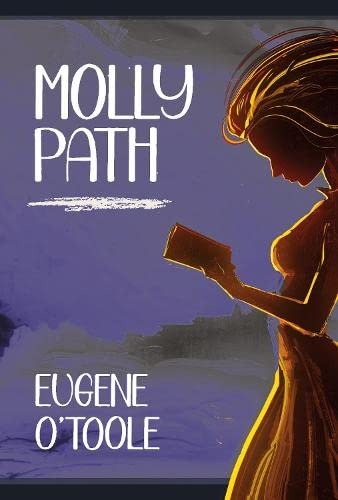
Staying in with Eugene O’Toole on Molly Path Publication Day

One of the ways I got in to blogging was because I used to read young adult fiction, review it and write the classroom resources for a large UK publisher. As a result, when I heard about Eugene O’Toole’s new book, I simply had to invite him on to the blog to chat about it. Let’s see what he told me:

Staying in with Eugene O’Toole

Welcome to Linda’s Book Bag Eugene. Thank you for agreeing to stay in with me.

Thank you for having me — there’s nothing better than staying in with a book! I’m very grateful: I can talk about a subject that’s important to me.

It’s my pleasure. Tell me, which of your books have you brought along to share this evening and why have you chosen it?

I have brought my debut novel for young adults, Molly Path, which is published by Hawkwood Books, one of those brilliant independent presses that sometimes throw untested writers like me a lifeline. I’ve chosen it because it can be hard attracting interest in uncomfortable ‘social’ themes that are not, on the surface, glamorous.

That sounds very positive. I understand Molly Path is out today, so happy publication day Eugene. What can we expect from an evening in with Molly Path?

I hope we can expect an uplifting story that leaves the reader inspired. It’s a contemporary tale about the challenges faced by one teenage girl from a very broken home who flatly refuses to go to school. The reasons for that become clear as the story unfolds, and originate in problems she has inherited from her parents. The story is variously raw, humorous and sad—yet ultimately redemptive. The use of the first person and vernacular, hopefully, enable the reader to get into Molly’s head.

I think Molly Path sounds much needed Eugene. I’ve taught youngsters like Molly in the past.

Moreover, Molly Path is based on true events: specialist teachers I talked to about their work told me that in many such cases the root causes of truancy, exclusion, and emotional problems etc. are the parents, not the child. Here’s an extract about Molly’s mum, Stella:

“Stella is in the kitchen sucking juice from an orange, although in this case it is a cigarette. Nonetheless, she draws on it with a slurp, then gulps the breath down into her lungs forcibly like a reluctant hostage. On a good day she can finish almost an entire fag with one, long, unbroken inhalation. A crooked digit of ash dangles precariously, ready to fall with the slightest judder. It is as if the cigarette has become her accusing finger.

“Her bleached hair flops across her face and half covers it, but she does not make an effort to push it away from her sunken eyes. These languish deep in their sockets with a weariness that is hard to fathom. Around them are bagged cushions of skin smeared with yesterday’s eyeliner. Those eyes are as tired of her as she is of herself, and when she mocks the people around her which is often they roll with an autonomy that could be mistaken easily for madness. Perhaps it is.”

That’s such an accurate portrait of some of the parents I’ve encountered!

Luckily, Molly is drawn back into education by the peripatetic tutor sent by the local authority to teach her at home. It’s not well known, but behind the scenes a small, dedicated legion of teachers carry out the most heroic work imaginable helping young people like Molly. Special education centres and pupil referral units help at least 16,000 students across the country. Their work mostly goes under the radar—yet literally transforms lives. Molly forms a bond with her teacher, Eileen, who also learns a lesson about life from her pupil.

I hope Molly Path will strike a chord with young adults and their teachers, because it explores a neglected theme: the influence of the home environment on a child’s education. It’s critically important and can be a distinguishing factor in terms of educational outcomes. Without preaching, I would judge Molly Path a success it if were to make some young people reflect on just how lucky they are to attend school in the first place, but also to have parents who take an interest in their education.  I have a lot of faith in young people and know from my own daughters that they care deeply about social problems and want to help.

It sounds to me as if Molly Path is a vital addition to the young adult literary world Eugene. Having worked in so many schools who cater for underprivileged youngsters I think Molly’s story would give so many an identifiable character and sense of belonging. I’m thrilled to have a copy on my TBR.

What else have you brought along and why have you brought it?

I have brought an airline ticket to Ireland, to which I will soon be travelling in order to take a copy of the novel to a retired friend who was the inspiration for this story. My friend is called Margaret and I have dedicated the book to her—because she dedicated her life to helping young people like Molly. If there were more people like Margaret, the world would be a better place.

Oh it would indeed. Thank you so much for staying in with me to chat about Molly Path. Let me give readers a few more details:

Molly Path

Special needs teacher Eileen must tutor one last pupil before retiring to her native Ireland, Molly, a teenager who refuses to attend school.

As a bond forms between them, both unravel a common thread stitched throughout their lives: a loveless mother. The books that Eileen gives Molly enable her to reflect upon the condition of her dysfunctional parents, whose demons explain her broken home.

Understanding empowers Molly to overcome her limitations, and Eileen to learn something from her student—forgiveness.

Molly Path is available for purchase in the usual places including from Waterstones, Wordery, Bookshop.org and W.H. Smith.

About Eugene O’Toole

Gavin Eugene O’Toole is a freelance journalist, editor and writer. He is a winner of the Listowel Writers’ Week short story and humorous essay competitions, and the Ovacome competition, and has been second, a runner-up, shortlisted or commended in several other competitions. He is married with three daughters and lives in London.

For more information, follow Eugene on Twitter @GOTwrites or visit his website.

The Girl in the Photo by Heidi Amsinck

I so enjoyed My Name is Jensen by Heidi Amsinck (reviewed here) that I simply couldn’t resist participating in the blog tour for Heidi’s second book in the Jensen thriller series, The Girl in the Photo. My huge thanks to Anne Cater for inviting me to take part and to Muswell Press for sending me a copy of the book in return for an honest review.

The Girl in the Photo was published by Muswell Press on 28th July 2022 and is available for purchase here.

The Girl in the Photo

When ninety-year-old Irene Valborg is found brutally murdered in an affluent suburb of Copenhagen, her diamond necklace missing, it looks like a burglary gone wrong. When two more victims are attacked, the police lament a rise in violence against the elderly, but who is the young girl in the photo found by DI Henrik Jungersen on the scenes of crime? Impatient to claim her inheritance, Irene’s daughter hires former Dagbladet reporter Jensen and her teenage apprentice Gustav to find the necklace. Henrik finds himself once more pitched in a quest for the truth against Jensen – the one woman in Copenhagen he is desperate to avoid.

My Review of The Girl in the Photo

A series of murders needs investigating.

What a pleasure to be back in the company of Jensen and Henrik. As The Girl in the Photo is the second Jensen book, despite it working really well as a stand alone, I’d really recommend reading My Name is Jensen first as this adds understanding of the characters; Jensen, Henrik and Gustav in particular. This time I felt Copenhagen was less of a presence (though I’m not sure my desire to visit is a safe one!) and this allowed Henrik especially to be more satisfyingly developed. Indeed, it was wonderful to find out more about all the major characters. I adore the troubled relationship between Jensen and Henrik because Heidi Amsinck illustrates the pull of desire versus a sense of responsibility and self preservation to perfection. This means that there is humanity and understanding underpinning the murky world of police and journalistic investigation making for a more emotionally affecting read. These are real people I’ve come to care about.

Although The Girl in the Photo revolves around violent murders, somehow Heidi Amsinck manages a lightness of touch – sometimes almost a playfulness in her writing style so that it is incredibly captivating and entertaining. I loved, for example, the sound of Henrik’s wife’s comments in his head, the interplay between Jensen and Gustav and the brilliant hooks at the end of the short chapters that keep the story fast paced and riveting. Add in an ending that has made me desperate for the next book in the series and The Girl in the Photo is a corker of a read.

The plot is layered and interesting. It is filled with surprises so that the readers is fed information just a beat behind Jensen and Henrik, adding to the feeling of mystery. There’s a real sense of urgency in the story that sweeps the reader along.

I almost never read a whole series of books because I have so many to read, but with The Girl in The Photo building on My Name is Jensen so effectively, I know I cannot resist Heidi Amsinck’s writing. She is fast becoming a new favourite author and if you’ve yet to discover Heidi Amsinck’s brilliant books you’re really missing out. I thoroughly enjoyed The Girl in the Photo.

About Heidi Amsinck

Heidi Amsinck, a writer and journalist born in Copenhagen, spent many years covering Britain for the Danish press, including a spell as London Correspondent for the broadsheet daily Jyllands-Posten. She has written numerous short stories for radio, including the three-story sets Danish Noir, Copenhagen Confidential and Copenhagen Curios, all produced by Sweet Talk for BBC Radio 4.

A graduate of the MA in Creative Writing at Birkbeck, University of London, Heidi lives in London.

She was previously shortlisted for the VS Pritchett Memorial Prize. Last Train to Helsingør is her first published collection of stories. Her crime novel My Name is Jensen, set in Copenhagen, will be published in August 2021.

For more information, follow Heidi on Twitter @HeidiAmsinck1. You can also find Heidi on Instagram and Facebook.
There’s more with these other bloggers too:

No Secrets by David Jackson

With The Rule and The Resident still awaiting my attention on my TBR I was determined to read David Jackson’s latest book No Secrets. My enormous thanks to the team at Viper for sending me a surprise copy. I’m delighted to share my review of No Secrets today.

No Secrets was published by Serpent’s Tail imprint Viper on 7th July 2022 and is available for purchase through the links here.

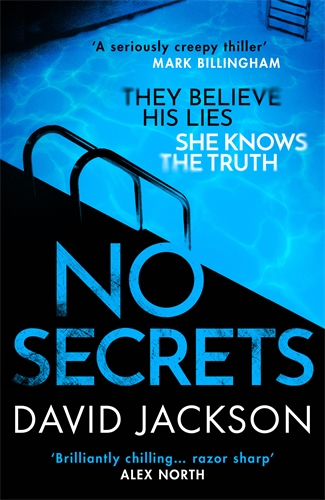
No Secrets

THEY BELIEVE HIS LIES. SHE KNOWS THE TRUTH.

You can’t lie to Izzy Lambert. Her highly developed empathic abilities allow her to read people’s emotions with terrifying accuracy – and consequences. As a child her insights sparked her parents’ divorce. As an adult she avoids getting too close to people for fear of what she might learn.

But now young girls are going missing in her town. The police have no suspects but, seeing her old school caretaker interviewed on the news about the story, Izzy comes to a chilling realisation: he knows where the missing girls are. When the police won’t take her seriously despite the lives at stake, she will risk everything to uncover the truth.

My Review of No Secrets

Izzy can tell when people are lying.

Good grief. Can anyone explain to me why I have been stupid enough not to have read David Jackson before? What a talent! I thought No Secrets was absolutely brilliant because it held me spellbound from start to finish to the extent that I put life on hold to gulp it down over a weekend. I loved David Jackson’s writing style. Through variety of sentence and paragraph length, and with natural dialogue, he seems to have a natural ability to convey life incredibly effectively.

No Secrets is so well plotted that I simply didn’t anticipate some of the actions and that element of surprise enhanced my enjoyment immensely. The pace is fast and captivating, with short chapters that create an almost breathless pace. I definitely had willingly to suspend my disbelief at some of Izzy’s actions, but not because David Jackson didn’t make them plausible in the context of the narrative and her ability to know when someone is lying, but because I couldn’t conceive of having her level of doggedness and conviction. This made her fascinating and frustrating – just like a real person.

Indeed, Izzy is a superb character because she illustrates how those who do the right thing for the right reason don’t always achieve the right outcomes. This means that, as well as being a snappy, enthralling thriller, No Secrets is a mature and contemplative insight into morality, our past and how we are affected by the events life throws at us. Whilst I had expected an exciting story, I wasn’t prepared for the level of emotion I felt too, especially with regard to Izzy and Josh. I was thoroughly entertained, but I was emotionally touched too.

On the surface No Secrets is another thriller revolving around missing young women, but it is so much more than that. I’m not able to say too much about plot or theme as both would reveal too much of the story for others, but I loved this book. Simultaneously unsettling, emotional, exciting and witty, No Secrets is a fantastic read that I thoroughly, thoroughly recommend. I’m so glad I’ve finally got round to reading David Jackson’s excellent writing.


About David Jackson

David Jackson is the acclaimed author of the crime thriller series featuring New York detective Callum Doyle. Pariah, his debut novel, was Highly Commended in the Crime Writers Association Debut Dagger Awards. It is published in the UK by Pan Macmillan, and various audio and foreign rights have been sold. Follow-up novels in the series are: The Helper, Marked, and Cry Baby. The Guardian newspaper said of David’s writing: ‘Recalls Harlan Coben – though for my money Jackson is the better writer.’

For further information visit David’s website and follow him on Twitter @Author_Dave. You’ll also find David on Facebook.