

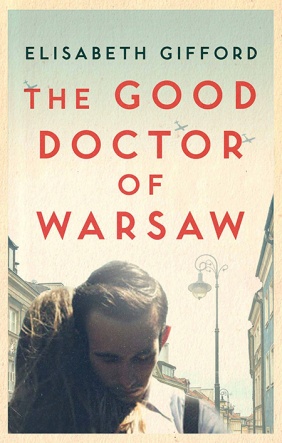
It’s a quarter of a century since I visited Anne Frank’s house in Amsterdam when I first really began to understand the plight of Jewish people during the Second World War. When I was offered The Good Doctor of Warsaw, a book based on the lives of those in Warsaw, by Elisabeth Gifford, in exchange for an honest review I readily accepted. I had previously featured Elisabeth with a fabulous guest post alongside my review of another of her books, Secrets of the Sea House, that you can read here.
The Good Doctor of Warsaw is published by Corvus, an imprint of Atlantic Books and is available for purchase through these links.
The Good Doctor of Warsaw
‘You do not leave a sick child alone to face the dark and you do not leave a child at a time like this.’
Deeply in love and about to marry, students Misha and Sophia flee a Warsaw under Nazi occupation for a chance at freedom. Forced to return to the Warsaw ghetto, they help Misha’s mentor, Dr Korczak, care for the two hundred children in his orphanage. As Korczak struggles to uphold the rights of even the smallest child in the face of unimaginable conditions, he becomes a beacon of hope for the thousands who live behind the walls.
As the noose tightens around the ghetto Misha and Sophia are torn from one another, forcing them to face their worst fears alone. They can only hope to find each other again one day…
Meanwhile, refusing to leave the children unprotected, Korczak must confront a terrible darkness.
Half a million people lived in the Warsaw ghetto. Less than one percent survived to tell their story. This novel is based on the true accounts of Misha and Sophia, and on the life of one of Poland’s greatest men, Dr Janusz Korczak.
My Review of The Good Doctor of Warsaw
Life for the Jewish population of Warsaw is about to be completely extirpated.
The Good Doctor of Warsaw is an exceptional book that should be lauded from the rooftops. It is terrifying. It is emotional. It is beautifully written. However, what is so profoundly affecting is that it is based on real events and real people and this makes it all the more powerful. I found the photographs in the end papers of my copy so captivating. Half the time I was reading I could hardly bear to go on and yet I was compelled to. I could not tear myself away from Dr Korczak, Misha and Sophia because Elisabeth Gifford brought them to life so effectively it was as if they were my own friends, my own family.
Actually, I’m feeling rather stunned by reading The Good Doctor of Warsaw. Yes, I knew about the Nazi atrocities in Poland and elsewhere on an intellectual level, but reading this book has made me experience them in a visceral way. I feel an overwhelming sense of grief and horror at man’s inhumanity to man because Elisabeth Gifford takes the reader right into the heart of Warsaw’s ghetto. That’s not to say she sensationalises events, but rather presents what happens through the lives of those affected so clearly that it is impossible not to be affected by her words. Often the most awful of occurences are presented with a pared down prose that makes them all the more shocking. Even more terrifying is the fact the story is written in the continuous present tense, underlying the abhorrent possibility, and even probability, that events like those in The Good Doctor of Warsaw are still happening today.
However, The Good Doctor of Warsaw is not a self-consciously ‘worthy’ book as I might seem to be suggesting. It is a fabulous narrative that weaves real history and imagined scenes so that reading it is an immersive and life-changing experience. This is wonderful story-telling as well as fabulous history. So much of the book is almost cinematic in style and I’d love it to be made into a film because the intrinsic quality of the writing is so good and its story so important I believe it would bring it to a wider audience.
Underneath all the horrors, the deprivations and the brutality of the era, Elisabeth Gifford manages to weave humanity, truth and love so that whilst I am heart-broken by reading The Good Doctor of Warsaw, I am also inspired and stirred by positivity. There is profound love in so many of the actions, and particularly from Dr Janusz Korczak, that we can all take courage and warmth from reading this story. Reading it has made me glad to be who I am, living where I am, when I am.
I defy anyone reading The Good Doctor of Warsaw not to be moved, shattered and, ultimately, thankful. It is a remarkable book.
About Elisabeth Gifford
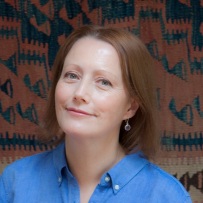
Elisabeth Gifford grew up in a vicarage in the industrial Midlands. She studied French literature and world religions at Leeds University. She has written articles for The Times and the Independent and has a Diploma in Creative Writing from Oxford OUDCE and an MA in Creative Writing from Royal Holloway College. She is married with three children. They live in Kingston on Thames but spend as much time as possible in the Hebrides.
You can find Elisabeth on Facebook, visit her website and follow her on Twitter @elisabeth04Liz.

















 Linda's Book Bag