When Dad Became Joan by Cath Lloyd

When Dad Became Joan cover

You know, being a blogger is a real privilege and also a responsibility because authors and publishers are trusting you with work that represents some very personal effort and emotion. Today I review one of those books that falls into that category and am delighted to have been asked by the team at Bookollective if I would like a copy of When Dad Became Joan: Life with My Transgender Father in return for an honest review.

Published by Librotas, When Dad Became Joan: Life with My Transgender Father is available for purchase here.

When Dad Became Joan: Life with My Transgender Father
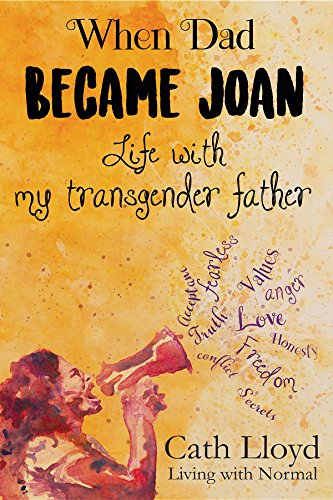
When Dad Became Joan cover

In 1987, Cath Lloyd’s father made the shocking confession that he was a transsexual and wished to become a woman.

Although she wanted to be supportive, Cath didn’t want to lose her dad, and it was hard to accept his decision. In those days, asking for help wasn’t the norm, and gender issues like this were swept under the carpet. Throughout the years of emotional, conflicting and tormenting thought processes, Cath wondered if life was ever going to feel normal again.

We all have a story about coming to terms with change, whether this is transgender reassignment, separation, divorce, loss, grief, illness, disability or living through another trauma. As we live through our story, we do the best we can with the strategies we have at our disposal. Sometimes these are not enough and we have to search long and hard to find alternatives.

That’s where Cath’s book will help you. She shares 7 of the strategies that helped with her family challenges. These can support you too, whatever difficulties you’re facing in your life.

With self-help tools that focus on topics like your values, self-honesty and positivity, you’ll develop a plan of action to support you through the difficult times. This will help you to understand, acknowledge, and accept what needs to happen to move forward and live your new normal. These strategies are those which Cath uses now with her clients as a life style change and stress relief life coach.

My Review of When Dad Became Joan: Life with My Transgender Father

Cath Lloyd’s father is about to become a woman and it impacts on Cath rather more than she would have liked.

Firstly let me say what a bargain When Dad Became Joan is. The reader is getting two books in one as the first part is more of a biography and autobiography as Cath Lloyd describes finding out her father was undergoing gender transitioning and the second is more of a self-help manual as Cath Lloyd outlines her seven strategies for living a happy and fulfilled life. In both sections there are some helpfully motivational quotations that I enjoyed immensely, particularly the final one in the book which I found inspirational.

I have to admit to feeling slightly uncomfortable reading the first section of When Dad Became Joan as it seemed slightly voyeuristic to be enjoying the processes Cath Lloyd describes, because the book is so well written and interesting. I was also slightly ashamed that I have never really considered just how difficult it must be for those undergoing gender transitioning, but have simply blindly and rather unthinkingly accepted those people for who they are. Equally, I hadn’t any previous idea of the real impact on the family and I felt extremely sorry for Cath and for Joan as they tried to adapt to new lives – or, as Cath would put it, a new normal.

I found the style of writing in this first section honest, compelling and engaging. It is also hugely informative, giving scientific and medical detail as well as a personal perspective. I felt quite privileged to have been allowed a glimpse into the lives of Joan and her family, even if I did want to climb into the pages and give Nick a jolly hard shake.

In the second section, 7 Steps to Living Your New Normal, I thought the way Cath Lloyd linked her own experiences with strategies for coping that the reader can use was extremely good. There’s an excellent balance between advice, and the opportunity for the reader to become more self aware and reflective. I loved the way all seven strategies are summarised at the end so that the prompt questions can be used as refreshers really easily. There’s a real confidence that Cath Lloyd practises what she preaches here so that a reader needing such self-help guidance would feel they could trust the advice given.

I honestly wasn’t sure what to expect when I picked up When Dad Became Joan, but what I got was a fascinating story of two people. of Cath and Joan, alongside a smashing self-help volume that would be of benefit to any reader to give them coping strategies and a positive outlook on life.  When Dad Became Joan is a great book and I highly recommend it.

About Cath Lloyd

cath lloyd

Cath is a lifestyle change and stress relief life coach, with a teaching background in adult education spanning over 25 years, with 15 of these working with offenders. This experience thrust her into a very different society which helped her refine her teaching and life coaching skills, whilst keeping her in touch with the real and creative worlds.

She now combines her teaching and life coaching skills with a holistic approach. She loves working with her clients on an individual level to achieve positive and quick results. Cath blends her teaching and coaching skills together in group workshops, courses and events such as ‘Recipe To Success’ and her regular ‘Stress Relief Awareness Days’. These courses are a great way for her clients to gain peer support in a fun, educational and inspiring environment.

You can follow Cath on Twitter @CLmakethechange and find out more on her website. Cath is also on Facebook.

There’s more with these other bloggers too:
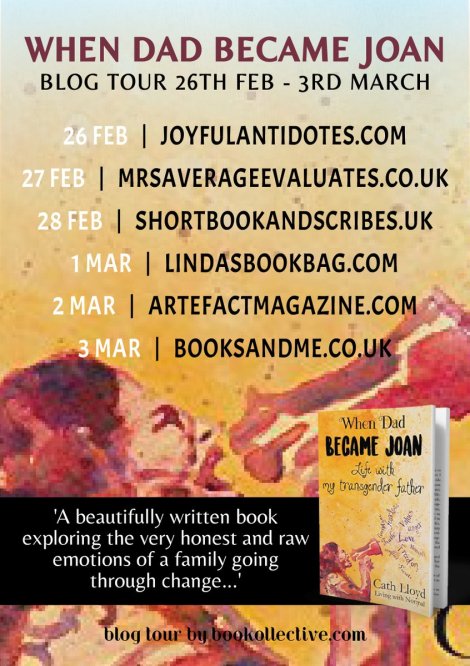
When Dad Became Joan

Introducing Uther’s Destiny: A Guest Post by Tim Walker

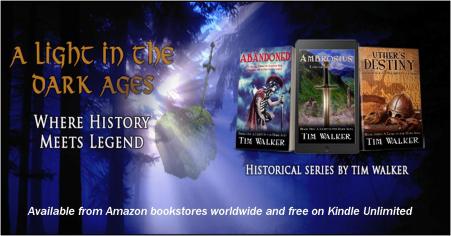
Uther cover box no line

It’s a welcome return to Linda’s Book Bag for Tim Walker, author of Uther’s Destiny. Tim previously wrote a cracker of a guest post about fiction and fear when the second book in his A Light in the Dark Ages trilogy, Ambrosius: Last of the Romans, was published and you can read that post here.

Uther’s Destiny is available for purchase here.

Uther’s Destiny

Uther cover box no line

Britannia is in shock at the murder of charismatic High King, Ambrosius Aurelianus, and looks to his brother and successor, Uther, to continue his work in leading the resistance to barbarian invaders. Uther’s destiny as a warrior king seems set until his world is turned on its head when his burning desire to possess the beautiful Ygerne leads to conflict. Could the fate of his kingdom hang in the balance as a consequence?

Court healer and schemer, Merlyn, sees an opportunity in Uther’s lustful obsession to fulfil the prophetic visions that guide him. He is encouraged on his mission by druids who align their desire for a return to ancient ways with his urge to protect the one destined to save the Britons from invaders and lead them to a time of peace and prosperity. Merlyn must use his wisdom and guile to thwart the machinations of an enemy intent on foiling his plans.

Meanwhile, Saxon chiefs Octa and Ælla have their own plans for seizing the island of Britannia and forging a new colony of Germanic tribes. Can Uther rise above his family problems and raise an army to oppose them?

Book three in A Light in the Dark Ages series, Uther’s Destiny is an historical fiction novel set in the Fifth Century – a time of myths and legends that builds to the greatest legend of all – King Arthur and his knights.

Uther’s Destiny – The Background Story

A Guest Post By Tim Walker

A Light Banner2

Uther’s Destiny (published in March 2018) is the third book in the series, A Light in the Dark Ages. I had the idea for this series in the summer of 2015 when I visited the site of what was once the Roman town of Calleva Atrebatum. Located in Hampshire in the English countryside, it is now a grassy meadow without any structures (except the ruin of a Medieval Christian church) on which cattle graze, with the outline of a stone perimeter wall, visible in jagged patches, maintained by English Heritage.

I stood there and soaked up the atmosphere, feeling the call of history. Questions ran around my mind – What was it like being an inhabitant of a Roman town? When did the Romans leave and what happened to the locals afterwards? This set me on a path to research what was known about the final years of Roman Britain and what happened to the Britons after they left. I had already compiled and published a book of short stories – Thames Valley Tales – and felt that I wanted to write my own story of events in Fifth Century Britain – historical fiction woven around historical facts.

I soon discovered that historical facts were thin on the ground, and this period had become known as The Dark Ages for this reason – it was a time of confusion and opportunistic plunder in which the light of learning had all but been extinguished. Although the Christian Church was established, it was in its infancy and this was before the time of monastery building, something that would only happen later under the protection and patronage of Christian Saxon kings. The Romans took their scholars and clerks with them, leaving behind few who could record the events of the time.

I came across a translation of a book written around 1136 AD, the Historia Regum Britanniae (The History of the Kings of Britain) by Geoffrey of Monmouth, that is the earliest written version of the Arthurian Legend. Geoffrey set out to write a complete timeline of British monarchs from ancient times up to the Saxon kings. There is clear evidence he has done his research, drawing on the early accounts of monks Nennius and Gildas, and referencing the Welsh chronicles, but too many gaps remained that he chose to fill with bizarre and unbelievable stories. He also elected to ‘cut and paste’ historical snippets and rearranged them to suit his own purpose, confounding historians. For this reason his work has been largely discounted as a credible historical source. More recently, some have reappraised his work, believing that there may be more credibility than previously thought if his claim to have had access to lost works (written accounts of deeds from the fifth and sixth centuries) is true. Efforts have been made to understand his thought process and re-arrange his maverick chronology into a more believable timeline.

I decided to use Geoffrey’s framework for events after the Romans finally departed (believed to be 410 AD) as a basis for my storytelling. Historians such as John Morris* have boldly claimed that a King Arthur most likely did exist, and have put his death at the Battle of Camlann (based on studies of contemporary sources) at around 515 AD. So, my question is, what actually happened between 410 and 515 AD?

Geoffrey’s account starts with Archbishop Guithelin of London taking ship to Armorica (Brittany) to plead with King Aldrien to claim Britain as his kingdom and provide protection for the people from barbarian raiders. Aldrien declines, but agrees to send his brother, Constantine. He arrives on the south coast with a small army and soon persuades a group of tribal chiefs to make him High King (or Emperor) of Britannia and offer them protection from hostile chiefs and the many invaders who beset the island.

Constantine marries into a Romano-Briton family and rules for about ten years, having three sons – Constans, Aurelius and Uther. He is deceived and murdered by a noble called Vortigern who seizes the crown. Vortigern employs Saxon chiefs Hengist and Horsa to lead his army. Then there is the appearance of sorcerer Merlin, who advises the king to re-site his tower to avoid rock falls caused by two dragons fighting in a cave beneath it. After some time the sons of King Constantine, Aurelius and Uther, defeat Vortigern in battle and Aurelius becomes king, taking the name ‘Ambrosius’ meaning ‘The Diving One’. He is murdered by a Saxon spy and is succeeded by Uther, who takes the name ‘Pendragon’ after seeing a dragon fly across the sky on his coronation day.

Then there is the Arthur story – he is conceived at Tintagel Castle, born from the union of King Uther Pendragon and Ygerna (or Igraine), Duchess of Cornwall, who is deceived into thinking Uther is her husband Gorlois. With Gorlois dead, Uther marries Ygerna and they have a second child, Anna.

Arthur becomes king at the age of fifteen, defeats the Saxons at York wielding a sword called ‘caliburn’, rebuilds London, and marries Ganhumara (‘Guinevere’) who is from a noble Romano-Briton family. Arthur establishes his court at Caerleon in Wales, forms an alliance with his nephew, King Hoel of Brittany, and they inflict further defeats on the Saxons at Lincoln and Bath before crushing a combined force of Picts (Scots) and Hibernian (Irish) tribes near Loch Lomond. They then attacks Ireland, the Orkneys, Iceland, Norway, Sweden and parts of Gaul (France), forcing the people to pay them homage. He lays waste to fields, slaughters the population of these places and burns down their towns – the exact opposite of a chivalric king. Geoffrey’s Arthur is an arrogant, aggressive and brutal warlord who kills and takes what he wants.

But Geoffrey’s story does not end there – Arthur is summoned by the Roman Emperor to face charges of war crimes and responds by raising a large army, sailing to Gaul, and meeting the Roman army in battle, defeating and killing the emperor. Arthur’s mind is set on capturing Rome and becoming Emperor, but he is forced to return home at news that his nephew Mordred has taken his queen, Ganhumara, and seized the kingdom. In a bloody civil war in which thousands die, both Mordred and Arthur fall in battle – Arthur’s body is taken to the Isle of Avalon. Arthur is succeeded by his cousin, Constantine of Cornwall.

This is a summary of Geoffrey’s account in his Historia, and it is an intriguing thought that he MAY have taken it from a lost manuscript. Later generations lightened the blood-soaked narrative and gave Arthur a noble makeover, adding more sorcery, the romance of Camelot, chivalric heroes (the knights of the round table), the quest for the Holy Grail, an evil foe in Morgana, and a doomed love triangle involving Arthur, Guinevere and Lancelot.

Uther’s Destiny continues on from the second story in the series, that of Ambrosius Aurelianius (Ambrosius: Last of the Romans) and follows some of Geoffrey’s narrative, but includes some other historical source material and details I’ve uncovered – such as the connection to Dragon Hill in the Berkshire Downs. Uther is a warrior king who had been his brother’s main military commander for many years, taking the fight to aggressive Angle, Saxon and Jute colonists, the Scots and Irish. His falling in love with the wife of a noble and his elaborate deception to win her presents a great opportunity for character exploration, and there is a climactic battle scene at Badon Hill. This is a battle variously attributed to Ambrosius Aurelianus and King Arthur by speculating historians, but in my story it is Uther who rallies the Britons to defend this hill outside the town of Bath.

Until a missing text is uncovered or archaeologists finally unearth clues that point to real individuals and true events, we are left with a tantalizing glimpse of this lost age through the writing of Geoffrey of Monmouth, and the possibility that there may be some credibility in his account.

*The History of Merlin and Arthur by Geoffrey of Monmouth – translated by A. Thompson and J.A. Giles, published by Omo Press, 2014.

*The Age of Arthur by John Morris, published by Orion Books, 1993

(Thanks so much for this insight Tim. I love this era of history and think your A Light in the Dark Ages sounds fascinating.)

About Tim Walker

tim-profile-picture

Tim has been writing fiction since 2013, following a career encompassing journalism, marketing, general management and business ownership.

After school, he worked as a trainee reporter, progressing to writing a music column and reviewing films.

He obtained an honours degree in Communication Studies, majoring in film studies, and added a Post-Graduate Diploma in Marketing two years later in Bristol.

After graduating, he worked for ten years in London in the newspaper publishing industry in market research and advertising sales support.

He followed this with two years as a voluntary worker with Voluntary Services Overseas (VSO) in Zambia, working in book publishing development.  Soon after, he set up and managed his own publishing, marketing and management consultancy company.

Tim now lives near Windsor in Berkshire where he blogs and writes creative fiction.

You can visit Tim’s website, find him on Facebook and follow him on Twitter @timwalker1666.

A Publication Day Spotlight on Whispers of Hope by Charlie Albert

Whispers of hope

I am offered so many books for review that I simply can’t accept them all and today I’m featuring one I’m sorry that I had to pass by. Whispers of Hope by Charlie Albert sounds an important book and I am pleased that at least I can spotlight it on Linda’s Book Bag today. Even better, Charlie and I went to the same university so it’s a bit of a trip down memory lane for me too!

I’m also thrilled that not only is Charlie a newly published author today, but the publishing house Whispers Publishing is new too so I’m delighted to support them both.

Published today, Whispers of Hope is available for purchase here.

Whispers of Hope

Whispers of hope

Divorce or separation of a partnership when children are involved can be painful experiences for everyone, not least the children who are the innocent parties.

These six stories based on true events, demonstrate the lengths that some parents will go to, to stop the other parent from having access to their child. Whilst they are shocking, they are written to give hope and to shine a light on this tragic issue.

About Charlie Albert

Charlie Albert, 50 years old. He is currently single and now has a good relationship with his ex-partners, the mothers of his five children. Charlie has four grown up children with his first wife and a young son with his second wife.

Charlie Albert secured residency for his own son Junior in 2013 after a 3-year battle and legal fees in excesses of £100,000. The last year Charlie represented himself employing a barrister in March 2013 for the Final hearing. Charlie is now in a good place with his ex-wife who sees Junior on a regular basis.

Based on all of the above Charlie used this experience to assist other separated parents.

Charlie studied his first year of law at the University of Essex and has not ruled out continuing with his studies.

He was born and raised in London. He has been in the hospitality industry since a teenager. Charlie initially trained as a chef and built his way up to own and co-own Restaurants and Hotels.

Since securing residency of Junior and gaining knowledge of the family courts. Charlie is currently semi-retired. Charlie has just completed his first book, Whispers of Hope and currently writing his second book Shadowed Tears as he feels the time is now right to share these experiences with a wider audience. He is also about to invest in a new Middle East restaurant concept in the city of London. Charlie privately continues to assist single parents in family matters.

You can follow Charlie on Twitter @charliea_author and there’s more on Facebook.