An Interview With Olive Collins, Author Of The Tide Between Us

The Tide Between Us

I don’t know what it is about Irish authors, but I find myself drawn to their writing like a moth to the flame. Consequently it gives me enormous pleasure to welcome Olive Collins, author of The Tide Between Us, to Linda’s Book Bag today to tell me more about her work.

The Tide Between Us is available for purchase in e-book and paperback here.

The Tide Between Us

The Tide Between Us

1821: After the landlord of Lugdale Estate in Kerry is assassinated, young Art O’Neill’s innocent father is hanged and Art is deported to the cane fields of Jamaica as an indentured servant. On Mangrove Plantation he gradually acclimatises to the exotic country and unfamiliar customs of the African slaves, and achieves a kind of contentment.

Then the new heirs to the plantation arrive. His new owner is Colonel Stratford-Rice from Lugdale Estate, the man who hanged his father. Art must overcome his hatred to survive the harsh life of a slave and live to see the eventual emancipation which liberates his coloured children. Eventually he is promised seven gold coins when he finishes his service, but he doubts his master will part with the coins.

One hundred years later in Ireland, a skeleton is discovered beneath a fallen tree on the grounds of Lugdale Estate. By its side is a gold coin minted in 1870. Yseult, the owner of the estate, watches as events unfold, fearful of the long-buried truths that may emerge about her family’s past and its links to the slave trade. As the body gives up its secrets, Yseult realises she too can no longer hide.

An Interview with Olive Collins

Welcome to Linda’s Book Bag, Olive. Thank you so much for agreeing to answer some questions on my blog about your writing and The Tide Between Us in particular. Firstly, please could you tell me a little about yourself?

I’m an Irish writer with a passion for books especially historical fiction. I also love to travel and dip into other cultures, sometimes vastly different from my own. My favourite country is Cuba, I spent a month travelling around it and loved the old crumbling buildings and the people, the hospitality and the climate. I’m not a domestic goddess of any description, I cannot cook and once almost poisoned a few friends to death. My ideal night-out is a nice restaurant with good company and conversations that rolls into the early morning.

Why do you write?

I write to release the many characters and storylines that form in my imagination, if I didn’t they’d make living impossible.

(I think that sounds quite scary actually!)

When did you realise you were going to be a writer?

From a young age. I always had stories to release. When I meet new people who interest me or strangers on a bus or at the theatre, I try to establish their stories or where they’re going.

Which aspects of your writing do you find easiest and most difficult?

At the moment, my difficulty is where to set Book 3. Once I decide on the time and year, it becomes easier. I find it difficult establishing the character for the first few thousand words but once I find the voice and know the character as if they are life-long friends, it becomes a great release and a pleasure, it’s as if they are writing the book and not I.

What are your writing routines and where do you do most of your writing?

My writing routine is normally rigid, 1000 words a day. Each day I set aside a few hours to read, when I find something that tickles my imagination I write about that the following day. Most of my writing is done on an armchair by a window at night. I like to write at night, the layer of darkness brings me closer my characters.

You’ve had quite an eclectic range of jobs in the past. How have your experiences affected your writing style now?

I’ve had various jobs and always welcome new experiences. I worked in the bank in England, was a plasterer in Israel, washed dishes in Tel Aviv. Each job was a new avenue to explore and gave me a clear glimpse into other people lives at an honest raw level which I loved.

For seventeen years I’ve worked in advertising. I spent my days meeting a variety of business owners who wanted to run advertising campaigns. Most people were willing, not only to discuss their businesses but also their personal lives. I’m naturally curious (or nosy) and liked to delve into their backgrounds, why they chose their careers or were they happy to take over their business from a parent? Most were more than happy to discuss everything with me however none knew that the notes I often scribbled in the car afterwards had nothing to do with their business and everything to do with their personal lives – names are always changed!!

(That’s probably just as well…)

How do you find that kernel of a story that takes over until you have to write about it?

Finding the kernel varies for each book. The Tide Between Us began with a chance encounter at a St Patrick’s Day Party in Israel. A Jamaican man who attended the party identified his heritage as Irish. He told me that vast numbers of Jamaican’s were of Irish descent. When Google became available, I researched his story and found so many accounts of exiled Irish to Jamaica, I was enthralled. One particular story about 2,000 exiled children tugged at me. I tried to comprehend their story after their arrival in Jamaica. How did they survive to find their own sense of freedom? When writing about a specific period, I read everything possible, diaries, novels, history books, academic papers and I listen to the music. Music always gives me a greater insight into the social history. The lyrics, melody and instruments convey the atmosphere of the time.

Without spoiling the plot, please could you tell us a bit about The Tide Between Us?

My novel is based between Jamaica and Ireland (1821 – 1991). It follows the story of Art O’Neill, an Irish boy deported to Jamaica at 10 years of age. When he acclimatises to the exotic country and bizarre customs of the African slaves, he takes us through the decades of his life, the coarseness of Jamaica, a county that eventually allowed him progresses from servant to overseer and eventual landowner. We see him become a father and watch as slave emancipation unfolds liberating his coloured children. His greatest battle was fought quietly as he struggled with his abhorrence at his Anglo-Jamaica oppressors, a mutual loathing that passed from father to son. Eventually Art is promised seven gold coins when he finishes his service. Art doubts the plantation owner will part with the coins. Part 1 ends in 1891 with Art going to the Big House to claim his gratuity.

Part 2 is based in Ireland (1921 – 1991) It opens with the discovery of a skeleton beneath a tree on the grounds of Lugdale Estate with a gold coin minted in 1870. Yseult, the owner of Ludgale Estate watches the events unfold and recaps on the rumours that abounded about her father’s beginnings in Jamaica, a county with 25% of the population claiming Irish descent. As the body gives up its secrets, Yseult realises she too can no longer hide.

How did you go about researching detail and ensuring The Tide Between Us  was realistic?

The research was pain-staking and vital. I have a loyalty to the reader, it must be accurate and covey the sentiment of the time. Apart from a month-long holiday in the Caribbean, I knew very little about Jamaica. I began at the beginning, researching the types of boats used for the deportees, the atmosphere of the country both socially and politically when they arrived in 1821. I used diaries, academic papers, letters from the period, documentaries and music. With each passing decade of the novel it reflected the politics of the time. I must admit, it was a wonderful experience writing about slave emancipation and the great strides the ex-slaves made after freedom. I was so involved in the characters, it was as if I too had been liberated and celebrated with them.

To what extent was it your overt intention to explore the political aspects of the way the Irish were treated in the past and to what extent was that element a side issue of your story?

Ireland was a poor country with large families, poor education and occasionally some didn’t speak English, like every third world country we were susceptible to abuse and prejudice. It’s part of our history and was a large vein in my novel as was the survival of the Irish. For centuries large numbers of Irish had great success abroad when Ireland could never offer anything apart from hard work with little to show for it. During the writing of my novel, I realised that the Irish abroad had more of a chance than other nationalities. In my novel, the Irish are indentured servants, they could travel freely (unlike the Africa slaves) in Jamaica. Once the indentureship term expired, the Irish were free. I was surprised to find some Irish had slaves and had no issues with slave-trading. It was necessary to include the political element of the time because that was the backbone of society. It dictated our lives, oppression and rebellion went hand-in-hand both in Ireland and in Jamaica.

What is it that draws you to writing about the past?

I was always interested in history and the past, and the link between the past and how it impacts our present. Not only as a nation, but how it affects smaller communities and in turn family units and finally how conflicts were passed down the generations, eventually impacting us as individuals. Every disagreement, small and large has a backstory. To understand the present, we need to go back.

In 2016 you won the Annie McHale debut novel of the year for The Memory of Music. How did that make you feel?

I was almost finished The Tide Between Us and very close to burn-out when I won the Annie McHale Award. It came at just the right time, I’d locked myself away for ten months to write the novel, in late January I was exhausted. The night I won it I drove back to my apartment and put the award onto my bookshelf in my line of vision. It was the best tonic to motivate me and finally get me over the line with the novel.

Your writing seems to have the underdog or the oppressed at the centre of your plots. How far do you think writers have a moral responsibility to provide a voice for those people?

I don’t consciously search for the oppressed voice, the voice seems to form and when I begin to write and explore the character, it takes flight. Personally I don’t and couldn’t write for any moral obligation. Writing for me is like an involuntary muscle reaction to a story or a picture or something so far in my subconscious, I’m not aware where it comes from, only when the same voice surfaces and niggles me over a long period of time, I must follow it.

When you’re not writing, what do you like to read?

My reading varies across all genres, contemporary, historical, classics and short stories.

If you could choose to be a character from The Tide Between Us, who would you be and why?

It would be Arry, she has no fear.

If The Tide Between Us became a film, who would you like to play Art and why would you choose them?

Maybe the Irish actor Gabriel Byrne as Art O’Neill.

If you had 15 words to persuade a reader that The Tide Between Us should be their next read, what would you say?

A saga with adversity, survival, humour. A novel conveyed with sincerity.

Thank you so much for your time in answering my questions.

About Olive Collins

Olive Collins

Olive Collins grew up in Thurles, Tipperary, and now lives in Kildare. For the last fifteen years, she has worked in advertising in print media and radio. She has always loved the diversity of books and people. She has travelled extensively and still enjoys exploring other cultures and countries. Her inspiration is the ordinary everyday people who feed her little snippets of their lives. It’s the unsaid and gaps in conversation that she finds most valuable.

You can follow Olive on Twitter @olivecollins and find her on Facebook.

There’s more with these other bloggers:
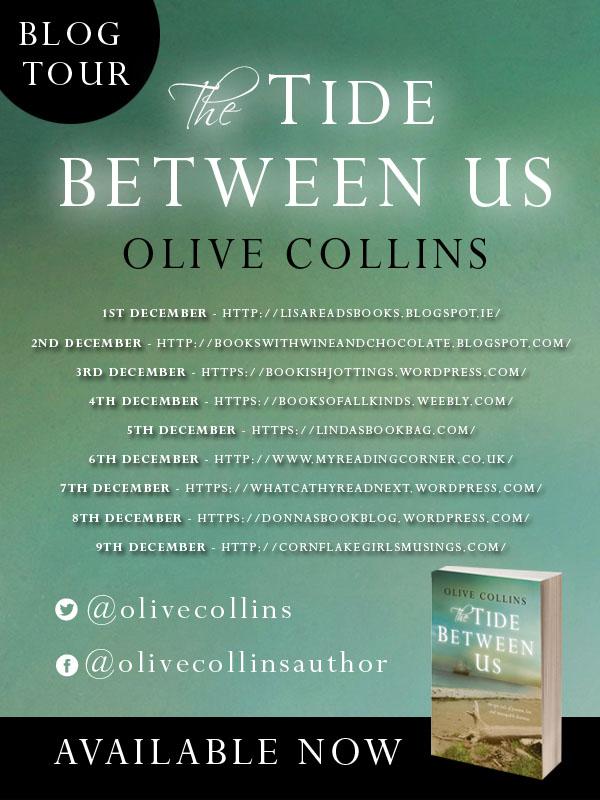
tour poster

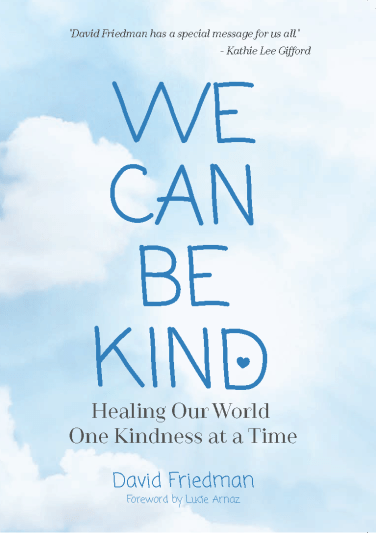
An Extract from We Can Be Kind by David Friedman

We can be kind

A few days ago when I was visiting my mother in hospital she accused me of making life difficult for her because the ambulance took six hours to attend her after she fell and broke her hip and it was my fault. If I’d lied and said she was bleeding or not breathing then it would have arrived sooner and she wouldn’t have had to suffer for so long. I was livid. Was I supposed to lie and put another person’s life at risk who may not actually have been breathing? I opened my mouth to retort and then thought the better of it. I’d recently been sent David Friedman’s We Can Be Kind for review with an extract that I’m sharing with you today. Having read the extract (though I haven’t read the whole book yet) I realised Mum didn’t mean it.  She was about to be released from hospital and was scared of the future. So, following the advice in We Can Be Kind, I didn’t say what I was thinking!

Published by Mango on 27th October 2017 We Can Be Kind is available for purchase here.

We Can Be Kind

We can be kind

One Kindness at a Time

Be kind: The world is changing at lightening speed, and meaningful connections are increasingly elusive. David Friedman, creator of the hit song “We Can Be Kind” offers a powerful reminder of how we need to treat each other, from children to family to coworkers as well as strangers, neighbors and those across the political aisle. Through story, meditation and suggestions of kindness, Friedman encourages us to create new ways of building community. Through the practice of kindness, we become most fully connected, alive, and integrated.

Practicing The Golden Rule: The past few years have shown us what it is like to live in a less caring world. David Friedman’s advocacy for treating each other better and applying the Golden Rule is an idea whose time has come. His deeply thoughtful handbook for the heart brings it all home with simple suggestions of how to be kinder and why it is more important than ever now.

Compassion and empathy: We Can Be Kind is a course in compassion from a beloved composer for Disney Films and Broadway, Daily Show regular, and Unity Church spiritual leader. The book provides:

  • Lessons on the value of kindness
  • Inspiring meditations
  • Daily affirmations
  • Essential truths

An Extract from We Can Be Kind

Chapter Two

A Small Incident Inspires a Universal Song

There was an annual benefit event in New York City called In Celebration of Life, where composers were paired up with singers. The composers were each asked to write a new song that in some way pertained to healing, and the singers performed these songs in a concert that was given at St. Paul’s Cathedral. The AIDS crisis was in full swing, so many of the songs that were written and performed had to do with AIDS. Now if anything qualified as something devastating that could not be controlled, it was AIDS. People across the world were getting sick and dying, and nobody seemed to know anything about how the disease could be cured. In their helplessness, people expressed themselves in whatever ways they could. They talked about it. They sang about it. They raised money for research. What that evening did, alongside so many other performances, research projects, books, speeches, etc., was raise consciousness and open people’s minds to the idea that there had to be a cure. By becoming vocal about it, more and more people became open to this idea. The disease was no less terrifying, but these community expressions gave people hope and the sense that they were not alone.

Each year, the concert closed with Nancy LaMott singing a new song I had written for her. This particular year, I asked Nancy what she wanted me to write about, and she said, “I was getting on the bus this morning, and this woman in front of me was so nasty! Could you write a song about how people should be nicer to each other?” And so, out of that little incident, out of one of those “little” hurts that happen every day, I wrote this song which has ended up being sung around the world for all sorts of causes, big and small.

We Can Be Kind to Ourselves

When you notice that something hurtful has happened, see if you can simply register that it has happened and allow yourself to feel however you feel about it. Don’t fight it off. Don’t try to change it. Often, when hurtful things happen, if we don’t try to fight them off or change them, we get to get in touch with painful feelings we’ve had for a long time which we haven’t allowed ourselves to feel and process. This can be, in its own way, very healing. So before you go into action, try being kind to your “Inner Child” by being with it, giving it a chance to feel whatever it feels, and acknowledging that that feeling exists. Kindness is what our Inner Child didn’t get in the areas in which it’s still in pain. It is you and you alone who can offer this “Inner Child” the kindness it needs to heal.

We Can Be Kind in the World

  1. When someone in a store, in a bank, or on the street is nasty to you, see what  happens if you are not nasty in return. Try to get past their behavior to see why they might be behaving that way. Are they scared? Are they angry? And then, try to offer them what you think they might need to feel better.
  1. You may not be able to prevent people from doing things that hurt you, but you certainly can prevent yourself from doing things that hurt others. The next time you find yourself about to do something that might hurt someone, don’t! Be kind instead and watch what happens, to them as well as inside yourself.
  1. Before you speak or act in any given situation, stop for a moment and think: “Am I hurting anyone by doing this?” And if you find that the action you’re about to take or the words you’re about to use would be hurtful to someone, see if you can substitute kind actions or words instead.

About David Friedman

David Friedman

David Friedman is a conductor and vocals arranger for Disney Classics such as Beauty and the Beast, Aladdin, and Pocahontas. Also, David has written songs for icons such as Diana Ross (“Your Love” Quadruple Platinum), and Barry Manilow (“We Live on Borrowed Time”). The inspiration for his book was inspired by the song with the same title, “We Can Be Kind,” written for the late Nancy Lamott.

You can listen to the song behind the book We Can Be Kind here.

You can also visit David’s inspiring website and follow him on Twitter.


The Fascination of Death: A Guest Post by Lulu Allison, Author of Twice the Speed of Dark

Twice teh speed of dark cover

I’m delighted to be part of the launch celebrations for Twice the Speed of Dark by Lulu Allison, not least because I think it’s a fabulous title!

Published by Unbound on 24th November 2017, Twice the Speed of Dark is available for purchase in e-book and paperback here.

Twice the Speed of Dark

Twice teh speed of dark cover

A mother and daughter circle each other, bound by love, separated by fatal violence.

Dismayed by the indifference she sees in the news to people who die in distant war and terror, Anna writes portraits of the victims, trying to understand the real impact of their deaths.

Meanwhile Anna’s daughter, killed by a violent boyfriend, tells her own story from the perplexing realms of death, reclaiming herself from the brutality.

Anna’s life is stifled by heartache; it is only through these acts of love for strangers that she allows herself an emotional connection to the world.

Can Anna free herself from the bondage of grief and find a connection to her daughter once more?

The Fascination of Death

A Guest Post by Lulu Allison

Sometimes it has felt like Twice the Speed of Dark is a bit of a hard sell. The inevitable first question when I tell someone I am writing/funding/editing/promoting a book is ‘What is it about?’ If I were to answer with one word, that word would be death. Of the two main characters, Caitlin is dead, Anna, her mother, is grieving. The plot of the book relates entirely to those two circumstances. Furthermore, Anna scours the newspaper to find mention of fatalities from bomb blasts and terror attacks and writes portraits of unnamed dead people in the news stories in order to understand what their deaths might really mean.

Here is my work-around that gloomy pitch: The book is about death but it is, as a consequence, very much about life. And love.

Like many people when I was younger I was terrified of death – the death of loved ones, my own, the mere fact of it. My first method for overcoming fear was to define it as a long way off. To keep in contact with people. To reassure myself with statistics about the unlikeliness of X or Y demise. I was lucky not to lose anyone close to me; my grandparents died at a reasonable to good age. My sister suffered a life-threatening accident but recovered completely. My parents always came home after their nights out.

As I got older, I rationalised that there was no reason to worry about death because there were so many terrifying things that could happen, chances are I’d be worrying about the wrong one any way. I found ways not to look at the fear rather than over-come it.

As I got older, banishment became inadequate. In part because people do die; people I love very dearly have died far too young. There is no fairness or logic in their deaths, no system that can be seen to have been applied. Accident, fate, the betrayal of the body, a foolish action. All have caused deaths of people I love, long before their three score and ten. And even when deeply loved people die in their eighties, the enormous sense of loss is life-changing.

As a writer, I have to think about death because I think about it as a human. How could I not? It is one of the most stunning, mind-boggling aspects of life. And through these thoughts, eventually, a kind of peace can be found. Through a process that has been erratic, varied, sometimes dominated by emotion, sometimes by wonder, a process that does not have the measured calm, but has the regular application of a meditation, I have learnt that it is all right. Not, I must add swiftly, the loss of a loved one – this is difficult and can be utterly overwhelming. It seems to me that each bereavement must be met and dealt with anew, each time it is experienced, even when we might look to our shared experiences to find a way through. What I mean is the fact of death. It is all right because the life we have is so wonderful and that wonder is because it is switched on briefly. It is all right because to live forever would be appalling.

Even in the time I have had, I have grown weary of the mistakes, the political foolishness, the cruelty and stupidity of which our species is capable. I am fed up with how little we learn from history, how often our spite, fed by the frailty of our egos has led us to harm others. When will grown humans finally realise that if you hate someone for what they are, that hate is your own, however much incidental pain it causes? Never, sadly, is my answer. We will keep on being too clever by far, not smart enough by half; a mixture that can dream and aspire, that can love, cherish and care with such beautiful courage, and damage and destroy with such ease. I couldn’t stand an eternity of that.

I am not religious, but have developed a soothing sense of wonder in this acceptance. Life is such a blessing. Human life is, perhaps, a not entirely successful experiment and we may never learn to tame our destructive ways. But we thread the air around us with such wonders, such joys, and such hopes. I don’t imagine that rabbits sit on the slope of a grassy field, paralysed with terror or rapt with awe at that sure but uncertain knowledge of the void of space, the unfathomable lurch of eternity, the terrible finality of death. And maybe, because of that, being a rabbit would be easier. We humans do face that and somehow, we get on with our dreams, with our ambitions, with our caring and nurturing, with our loving.

We falter and fail, and take beautiful, defiant stands against that failure. It is why in Twice the Speed of Dark, Caitlin, the girl telling her story from death says “I long for the chance to face the eternal dark of death once more” because it is in facing it that we learn how blessedly alive we are.

(Thank you so much Lulu for such a wonderful guest post.)

About Lulu Allison

Author photo smaller

Lulu Allison has spent most of her life as a visual artist. She attended Central St Martin’s School of Art then spent a number of years travelling and living abroad. Amongst the bar-tending and cleaning jobs, highlights of these years include: in New Zealand, playing drums for King Loser and bass for Dimmer. In Germany, making spectacle hinges in a small factory and nearly designing the new Smurfs. In Amsterdam painting a landmark mural on a four storey squat. In Fiji and California, teaching scuba diving.

After a decade of wandering, she returned to the UK, where she had two children and focused on art. She completed a fine art MA and exhibited her lens-based work and site-specific installations in group and solo shows.

In 2013 what began as an art project took her into writing and she unexpectedly discovered what she should have been doing all along.

Twice the Speed of Dark is her first book. She is currently writing a second, called Wetlands.

You can follow Lulu on Twitter @LRAllison77 and find her on Facebook.

There’s more with these other bloggers too:

blog tour poster

Made in Japan by S. J. Parks

made in japan

Having recently visited Japan I was delighted to be invited by the Bookollective team to be part of the celebrations for Made in Japan by S. J. Parks and I am extremely grateful to them for providing a copy in return for an honest review.

Made in Japan was published by Harper Collins earlier this year and is available for purchase through the links here.

Made in Japan

made in japan

A young girl traces her mother’s steps all the way from London to Japan to search for the father she never knew.

Hana arrives in Tokyo with only two words in her mind: The Teahouse. She’s a long way from home in East London and still fresh from the loss of her mother. But her grief has sent her across to the other side of the world to find out who she is, and for Hana that means finding the Japanese man she has never met, her father with only these two words as clues.

Made in Japan is a beautifully woven story of a mother and daughter who, decades apart, tread the same streets of glittering Tokyo looking for that something that might complete them.

My Review of Made in Japan

Naive and emotionally incomplete following her mother’s death, grieving Hana travels to Japan to find the tea house of her mother’s memories and her real identity.

Made in Japan is a gorgeously written book. It may sound negative, and it is certainly not intended to be so, but reading Made in Japan was almost painful at times. There’s such a strong sense of oppression for Naomi and Hana with a desperate longing to be loved and to belong that I could feel their needs physically. I found the style quite complex and I needed to concentrate as the syntax was sometimes alien to me. I thought this fitted Hana’s sense of displacement especially well. The text is intense, poetic and so potent that I was glad many of the chapters were short as I needed to come up for air.  This is powerful writing.

Essentially, the plot is quite simple. Two women, Hana and her mother Naomi before her, search for their place in life in Tokyo. However, there are twists and turns to their stories that reveal a disturbing world of class, business, forced hedonism and greed that made me feel quite uncomfortable at times as I witnessed Josh’s behaviour in particular. I thought S. J. Parks showed the dichotomies of the country so effectively in Made in Japan and I loved the sense of place. The reader is treated to the customs and places as well as some of the history of Japan with vivid texture through the writing. I felt transported back to some of the places I have visited.

However, it was the themes of Made in Japan that held me captivated the most. There are betrayals on many levels and so many of the characters felt so desperately sad or damaged that I was willing them to find their truths. Friendship, honour, love and passion all underpin the narrative alongside a surprisingly pragmatic approach to life in many ways that I felt this book would reward many re-readings in order to appreciate the subtleties and layers.

I honestly don’t know if I enjoyed Made in Japan. It felt uncomfortable and almost suffocating to read at times because of the depth of feeling conveyed and yet I’m glad I have read it. It deserves to become a modern classic.

About S. J. Parks

SJ

S. J. Parks is a literature graduate with a writing MA from the University of London, Two weeks after she got married S.J Parks went to live in Tokyo and ended up staying for 5 good years. She found the Japanese are an amazing people, living on a cultural and tectonic fault line where East meets West and where once every other month or so an earthquake hits and as in 2011 a huge tidal wave struck the coast.  From her time in Japan she knows what it is like to live among strangers and wanted to begin her writing with a love story like Madam Butterfly. So Made in Japan was born.

S. J. Parks now lives in England with her family.

You can follow S. J. Parks on Twitter and there’s more with these other bloggers:
Made in japan tour poster

An Interview with Michael Fowler, Author of You’re Next

You're Next - Michael Fowler - Book Cover

I’m delighted to welcome Michael Fowler, author of You’re Next to Linda’s Book Bag in interview today, not least because I didn’t ask the questions this time so I’m interested in reading more too!

Published by Caffeine Nights on 7th November 2017, You’re Next is available for purchase from your local Amazon site.

You’re Next

You're Next - Michael Fowler - Book Cover

It is the opening day of Detective Sergeant Scarlett Macey’s biggest case of her life – ‘The Lycra Rapist’ is standing trial for a series of brutal rapes.

But things don’t go according to plan – the trial collapses – and James Green is freed.

Scarlett is determined his freedom will not last long and immediately begins planning his downfall.

Meanwhile James Green has his own plans for revenge, and driven by feelings of hatred begins to pick out those who brought about his downfall – priming them for the kill.

Scarlett has faced many villains in the past, but never one quite as terrifying as James Green…

An Interview with Michael Fowler

Why did you write a book? 

I’ve been writing since the age of eleven, and had several attempts at writing a full novel, but either the plot was weak, or I ran out of steam because of my lack of knowledge and experience of writing. When I finished work in 2006 I promised myself that I would finish a book, even if it was just for fun.

Do you write every day? 

This year has been has been a car crash in terms of writing – so many distractions, which has been frustrating. However, until this year, for the last five years my writing has been pretty intense and I have spent most days writing, or something to do with the development of my novels.

Do you work to a plot or do you prefer to see where the idea takes you? 

I draft an initial plot, with characters, and create a storyboard on a large whiteboard on my study wall, and when I set out with my crime I run my storyboard as if I was running a major incident (back to my detective days). It invariably takes a change of direction as the story develops, but I love that when it happens.

How long does it take you to write a book?

Until this year, I’ve been writing 2 a year.

What’s the worst thing about writing a book? 

Not being able to get the words down fast enough.

What’s the best thing about writing a book? 

Seeing your name on the cover in a store, and getting invited to do talks.

Why did you choose your particular genre? 

I’ve been a lover of crime books since a teenager, and as a former detective ‘write what you know.’

If you had to write in a different genre, which would you choose? 

Horror.

Which book character do you wish you had written? 

Hercule Poirot.

What do you think are the best and the worst things about social media?

It’s great for publicity, but it’s also so instant and needs sustaining. It gets in the way of writing.

A few questions, just for fun:

If you could be invisible for a day, what would you do?

Visit MI5 and GCHQ

If I joined you on your perfect day, what would we be doing? 

We would start with a full English breakfast, go for a stroll around some dramatic headland with a sea view, where I would stop to put in a few hours of painting. During this session I would more than likely write about what I was experiencing/seeing to put into a future novel. Mid-afternoon I would spend an hour in the gym or go for a swim and then in the evening it would be off to a restaurant, for a couple of beers, followed by a meal with wine. Except for the time painting, and in the gym, we would be in conversation – I love talking to people – finding out what makes them tick.

What’s your signature dish? 

My granddaughter says I make the best Spag Bol ever!

If you could be anyone for the day, who would you be? 

I enjoy being me – I have a great life. I’m living the dream.

(I might have to pinch some of those questions for future interviews!)

About Michael Fowler

Michael Fowler Author Image

Following retirement, after thirty-two years as a police officer, working mainly as a detective, Michael returned to the deadly business of murder, as a writer. His past work brought him very close to some nasty characters, including psychopaths, and gruesome cases, and he draws on that experience to craft his novels: There is nothing gentle about Michael’s stories.

His landmark novel Heart of the Demon, published in 2012, introduced Detective Sergeant Hunter Kerr. Michael has since written five novels and a novella featuring Kerr.  He also released the first DS Scarlett Macey book in 2016. Michael is also the author of a stand-alone crime novella and a true crime thriller.

Michael has another side to his life – a passion for art, and has found considerable success as an artist, receiving numerous artistic accolades. Currently, his oil paintings can be found in the galleries of Spencer Coleman Fine Arts.

He is a member of the Crime Writers Association and International Thriller Writers.

You can follow Michael on Twitter @MichaelFowler1, and visit his website.

There’s more with these other bloggers too:

You're Next - Michael Fowler - Blog Tour Poster

A Gay Policeman’s Lot: A Guest Post by David Stuart Davies, Author of Blood Rites

Blood Rites Cover

I’m delighted to welcome David Stuart Davies, author of Blood Rites to Linda’s Book Bag today. David has written a wonderful guest post about why he has made his protagonist homosexual in Blood Rites.

Published by Urbane on 9th November 2017, Blood Rites is available for purchase directly from the publisher and here.

Blood Rites

Blood Rites Cover

1980s Yorkshire. DI Paul Snow has a personal demon. He is a homosexual but is desperate to keep it secret, knowing it would finish his career in the intolerant police force. As this personal drama unfolds, he is involved in investigating a series of violent murders in the town. All the victims appear to be chosen at random and appear to have no connection with each other. After the fourth murder, he is removed from the case for not finding the killer but continues investigating the matter privately.

Gradually, Paul manages to determine a link between the murder victims, but this places his own life in great danger. Can Paul unmask the killer as he wrestles with his own demons?

A Gay Policeman’s Lot

A Guest Post by David Stuart Davies

Homosexuals in drama and literature have usually been presented as either freaks of nature or fools.  The gay man has often been portrayed as a fop or a comic camp character, all limp wrists, sarcasm and soppy voices – think John Inman in Are You Being Served?, Melvyn Hayes in It Ain’t Half Hot Mum, and Jules and Sandy in Round the Horne. One sensitive shining light in these risible scenarios in the mainstream culture was the film Victim (1961) starring Dirk Bogarde, which presented the real dilemma of a sensitive, married gay man who had achieved success as a lawyer. The movie revealed the cruel way that such individuals can easily fall prey to unscrupulous blackmailers. I had Victim in mind while writing my latest novel, Blood Rites, which features a gay policeman.

It wasn’t until 1967  – ten years after the Wolfenden Report – that MP Leo Abse introduced the Sexual Offences Bill, supported by Labour MP Roy Jenkins, then the Labour Home Secretary. When passed, the Act decriminalised homosexual acts between two men over 21 years of age in private in England and Wales. The 1967 Act did not extend to Scotland, Northern Ireland, the Channel Islands or the Isle of Man, where all homosexual behaviour remained illegal.  Remarkably it was not until 1980 that the Criminal Justice (Scotland) Act 1980 decriminalised homosexual acts between two men over 21 years of age in Scotland.

In 1984 Chris Smith, newly elected to the UK parliament declared: ‘My name is Chris Smith. I’m the Labour MP for Islington South and Finsbury, and I’m gay’, making him the first openly homosexual politician in the UK parliament. This brave gesture, which could have encouraged others to follow suit was counteracted to a large extent by the spread of AIDS, which helped to fuel a backlash against homosexuals. AIDS prompted the introduction of Section 28 of the Local Government Act 1988 enacted as an amendment to the United Kingdom’s Local Government Act. This stated that a local authority, ‘shall not intentionally promote homosexuality or publish material with the intention of promoting homosexuality’ or ‘promote the teaching in any maintained school of the acceptability of homosexuality as a pretended family relationship’. It is therefore not surprising that nearly twenty three years after the act of decriminalisation, homosexuals were still reluctant to go public.

So in the mid-1980s it’s no wonder that Detective Inspector Paul Snow, the central character Blood Rites was determined to keep his head below the parapet. He is well aware of how he would be treated by his colleagues and his superior officers if it became known that he was ‘queer.’ This is one stressful dilemma that is a permanent feature of his life, despite the fact that he strives to be celibate, thus providing no evidence of his sexuality. As Peter Tatchell observed: ‘In the past, LGBT+ police officers were closeted and repressed. They were agents of a homophobic institution and lived in fear of being outed and sacked’.

I am hetrosexual  but I have profound sympathy for Paul and those in a similar position. At the beginning of my book, I quote a statement made by the actor John Fraser in his autobiography which has strong resonances with Paul Snow in Blood Rites.  Fraser wrote:

‘Homosexuals then had three choices:

One. To conform to society’s expectations. To marry and have children.

Two. To be celibate.

Three. To live a double life, fraught with danger – of violence or blackmail – and to live it alone.’

As a teenager I had a strong friendship with a lad my own age – let’s call him Cliff. We had a tremendous rapport, shared the same tastes in books, films and had similar senses of humour. We went everywhere together and were seen as a couple: Dave – and – Cliff. Although we were heterosexual with an eye for the girls, because of our closeness a few rumours began circulating that we might be gay. Once these reached the ears of Cliff’s parents, they did all in their power to break us up, preventing him from meeting me. In the end they succeeded and eventually I lost touch with him completely. Despite the gay rumours being unfounded, their prejudice still remains an unpleasant memory. What if we had been gay? Splitting us up would not have altered a thing.

In the 21st century, views on homosexuality are more liberal, but there is still a lot of hatred and persecution in the world. While more and more individuals feel free to declare that they are gay, for some, sadly the closet still beckons.

While the purpose of Blood Rites is to thrill and entertain – it is a crime novel after all – I also hope it also gives the reader pause to consider the issues it raises.

(How brilliantly put David. Thanks so much for such a thought provoking piece.)

About David Stuart Davies

DSD

David Stuart Davies is an author, playwright and editor. His fiction includes six novels featuring his wartime detective Johnny Hawke, Victorian puzzle solver artist Luther Darke, and seven Sherlock Holmes novels – the latest being Sherlock Holmes and the Ripper Legacy (2016). His non-fiction work includes Starring Sherlock Holmes, detailing the film career of the Baker Street sleuth.

David is regarded as an authority on Sherlock Holmes and is the author of two Holmes plays, Sherlock Holmes: The Last Act and Sherlock Holmes: The Death and Life, which are available on audio CD. He has written the Afterwords for all the Collector’s Library Holmes volumes, as well as those for many of their other titles.

David has also penned three dark, gritty crime novels set in Yorkshire in the 1980s: Brothers in Blood, Innocent Blood and Blood Rites.  He is a committee member of the Crime Writers’ Association and edits their monthly publication Red Herrings. His collection of ghost and horror stories appeared in 2015, championed by Mark Gatiss who said they were ‘pleasingly nasty.’

David is General Editor of Wordsworth’s Mystery & Supernatural series and a past Fellow of the Royal Literary Fund. He has appeared at many literary festivals and the Edinburgh Fringe performing his one man presentation The Game’s Afoot – an evening with Sherlock Holmes & Arthur Conan Doyle. He was recently made a member of The Detection Club.

You can follow David on Twitter @DStuartDavies, find him on Facebook and visit his website.

There’s more with these other bloggers too:

BANNER blogtourBLOODRITES


An Extract from Gilding the Lily by Justine John

Gilding the Lily cover.jpg

It gives me very great pleasure to be part of the tour for Gilding the Lily by Justine John today because if I hadn’t been a blogger I think I might not have found about this thriller and I hate missing out.

Gilding the Lily is available for purchase here.

Gilding the Lily

Gilding the Lily cover.jpg

A gripping mystery of jealousy, murder and lies.

An invitation to her estranged, wealthy father’s surprise 75th birthday party in New York sees Amelia and her husband, Jack, set off across the pond to meet a whole new world of family politics. Amelia, now a successful businesswoman, feels guilty about never liking her father’s women, so does her upmost to give his new socialite partner, Evelyn, the benefit of the doubt. Wouldn’t it be nice if they could just all get along? But there’s something very dark, determined and dangerous about her…

When Amelia’s father, Roger, becomes ill, Jack grows suspicious that there is more to it. Amelia understands why, but no one else will believe them. They travel back to America to piece together the puzzle, but when Roger goes missing, the couple are driven to their wits’ end. It takes a DEA officer and a secret assassin to bring them answers, but the ruthless truth is something no one expected…

An Extract from Gilding the Lily

PROLOGUE

She stood solemnly at the graveside.  A single tear ran down her cheek.  A man and a woman stood either side of her, and a younger man opposite.  They all looked down at the expensive coffin being lowered in to their family plot.  A few other mourners were scattered around; they formed a small, sad crowd, as the priest said the familiar burial prayer.  But she barely heard the words as the coffin settled with an audible thump.

“… commit her body to the earth, for we are dust and unto dust we shall return..”

She looked around her.  It was a warm, bright day in September, but there was an unusual wind – a hurricane was forecast.  There were many head-stones here, and a few statues.  Of angels mainly.  Different colours but somehow the same hue.  A few trees lined the perimeter fence, some bare, some evergreen. Beyond them the city buzzed – it went on with its day and didn’t notice anyone missing.

The woman next to her was wearing a hat that didn’t suit her.  It kept catching the breeze and the woman’s gloved hand caught it each time.  It was annoying. She should have pinned it or something.  She shivered as a gust blew by them and then smiled inwardly.  How was it she came to be here?  How was it that it all went so well?  Was it her own cleverness, or was it luck?

“…the Lord lift up his countenance upon her and give her peace. We ask this through Christ our Lord. Amen.”

“Amen”, she joined in.

Amen indeed, she thought to herself.  The relief was immense.  The day after it happened, it flooded through her.  How was it she had become capable of such a thing?  And now, it was a huge secret.   But she had always been good at keeping secrets.  It was over now.  She could get on with her life.

“The Lord be with you.”

“And with your spirit.” everyone replied together.

Another gust.  She felt it curl around her stockings.  The woman next to her snatched at her hat.

“God of the living and the dead, accept our prayers for those who have died in Christ.”

She wiped away the tear.  The young man opposite caught her eye and sympathetically smiled.  She smiled back in a way that said ‘yes, I’m ok, thanks’.

And she was ok.

“Let us pray.”

They bowed their heads, some held hands and some sniffed as they all solemnly recited the Lord’s Prayer.

Her mouth moved as she mumbled the words but her thoughts were still elsewhere.

It was thrilling what had happened.  And justifiable.  She wondered if she could do it again.  But the need would never arise, of course.  She now understood how others could do it.  This criminal act.  How other people could get away with it.  If she could do it, anyone could.  How many people could be getting away with it right now? Thousands, millions?  Was the city beleaguered with people crawling around getting away with their sins?

“Gracious Lord, forgive the sins of those who have died in Christ.”

It was easier than she thought. That’s what surprised her the most.  It was just a matter of thinking it through carefully.  Planning well.   Did this make her a bad person?  She was still the same inside.  She was still capable of love, big love, and still wanted to be loved in return.  Isn’t that what life is all about – what everyone wants?  And she felt more…  worthy… or worldly, perhaps that was a more appropriate word.  She felt more ‘something’ anyway, and that could only be a good thing. To feel more.  To be more understanding of other people, and why they do things.  Yes, she was still a good person – in fact a better person.  It’s not as if she didn’t know the difference between right and wrong.  What she did was wrong, but also right.  She had righted the wrong.  It felt good.

“Kindle in our hearts a longing for heaven.”

There was a sudden movement from the woman next to her as her hat actually blew off.  The woman made a quiet apology as she ran gracefully to the point where it had landed.  The wind allowed it to stay there, and she picked it up, before returning to her place in time for the next Amen.

“Amen”.

“Lord, have mercy.”

Would anyone else forgive her if they found out?  Or just God?

She looked for the words in her booklet and joined in again: “…raise us from the death of sin unto the life of righteousness…”

Righteousness?  What is righteousness, really?  A state of mind?  A quality?  A knowledge that one is morally correct?  What she’d done was morally correct, even though it could be termed bad.  So it was righteous.  She stood a little straighter.  A small movement. Yes, it was righteous.  She was righteous.

“May the love of God and the peace of the Lord Jesus Christ console you and gently wipe every tear from your eyes. Amen.”

“Amen” she repeated.  Amen indeed.

About Justine John

Justine

Justine John became a full-time writer in her late forties, after a successfully running various businesses in London. Her first novel, Gilding The Lily, is a domestic-noir suspense story. Animal lover Justine lives in the beautiful Surrey Hills with her husband, horses and hounds.

You can follow Justine on Twitter @JustineCJohn, visit her website and find her on Facebook.

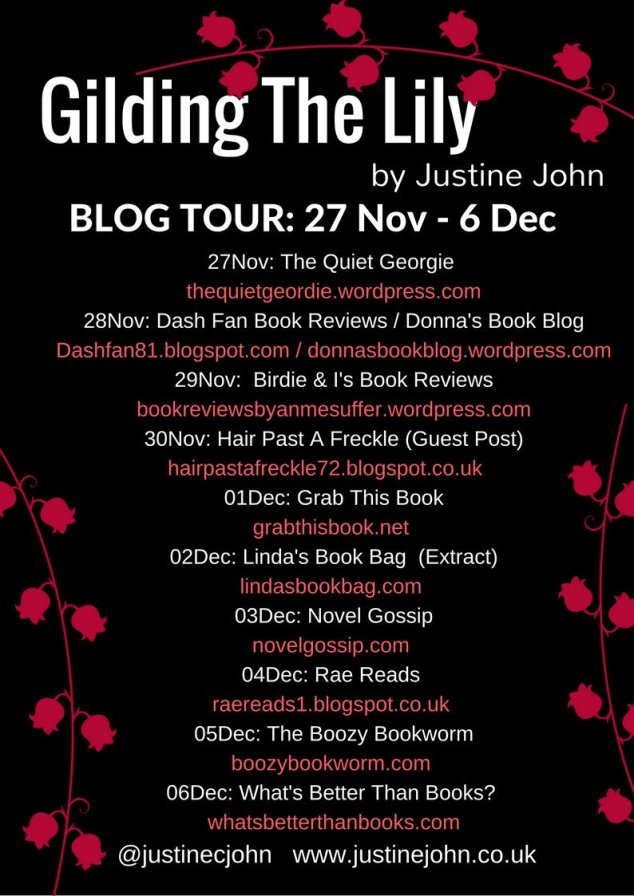
There’s more with these other bloggers too:

Gilding the Lily tour poster

The Personal in Writing: A Publication Day Guest Post by Kate Murdoch, Author of Stone Circle

stone circle

I’m always fascinated by how authors write and I’m delighted to welcome Kate Murdoch, author of Stone Circle, to Linda’s Book Bag today to explain a little bit about her take on the adage of ‘write what you know’.

Published today, 1st December 2017 by Fireship Press, Stone Circle is available for purchase here.

Stone Circle

stone circle

Is the ability to read minds a blessing or a curse?

When Antonius’s father dies, he must work to support his family. He finds employment as a servant in the Palazzo Ducal, home of Conte Valperga. Sixteenth-century Pesaro is a society governed by status and Antonius has limited opportunities.

When a competition is announced, Antonius seizes his chance. The winner will be apprenticed to the town seer. Antonius shares first place with his employer’s son.

The two men compete for their mentor’s approval. As their knowledge of magic and alchemy grows, so does the rivalry and animosity between them. When the love of a beautiful woman is at stake, Antonius must find a way to follow his heart and navigate his future.

The Personal in Writing

 A Guest Post by Kate Murdoch

I’ve always found it interesting how writers use varying degrees of the personal in their writing. It’s particularly intriguing when I’m reading the manuscript of someone I know, or am getting to know, because their values, experiences and preoccupations are evident.

At one end of the spectrum is memoir, with its laying bare of the life of the author, yet curated and chosen with care. I admire memoirists a lot, because they push the boundaries using their own stories to illustrate what is important to them.

More commonly, people draw from feelings, experiences and people they’ve known, creating fiction. Parsing the information, putting it through a metaphorical filter until the right combination of insight and feeling is conveyed. This is how I work.

In my novel Stone Circle I drew on a number of elements of my life. Family is very important to me and I explored the love of family, the safe space and emotional security it can provide. But all forms of love give us a sense of self and confidence, including friendship and romantic love. My protagonist, the fisherman’s son Antonius, by virtue of his talent for telepathy and ‘seeing’, finds himself part of a middle and upper class society in which he feels ill-equipped. The fact that he comes from a loving family is a crucial factor in his ability to embrace his new circumstances.

The story was also informed by my experiences with spiritual practices, such as reiki healing. Antonius learns so much in a short space of time, all the while confronted with Nichola’s jealous hostility. I can’t say I’ve had any issues with hostile competitors, but the spiritual search was real and consuming.

There are writers I’ve met whose personal lives are so intertwined with the story it’s hard to know where one ends and the other begins. In my opinion, these are the stories which resonate the most. They are mined from such a deep place of emotion and memory, readers sense it and are moved.

A good example is The Book Thief by Markus Zusak. The author’s parents were children in Germany and Austria during the second world war, and many of the scenes are inspired by stories they told him. This is what gives the novel so much heart and realism.

Research is important, as is plot, dialogue and character. But if there is an absence of the personal, I think the work suffers. The emotional heart is drawn from reality. It is, in my view, the most important factor in a good story.

About Kate Murdoch

Kate Murdoch

Kate Murdoch is the author of Stone Circle. She exhibited widely as a painter both in Australia and internationally and was a finalist in a number of prize shows before turning her hand to writing. In between writing historical fiction, she enjoys writing short stories and flash fiction.

Her short-form fiction is regularly published in Australia, UK, US and Canada in places such as Verity La, Spelk Fiction and Feminine Collection.

Stone Circle is a historical fantasy novel set in Renaissance Italy. It will be released by Fireship Press December 1st 2017. She has also completed another novel The Orange Grove about the passions and intrigues of court mistresses in 18th century France.

You can follow Kate on Twitter @KateMurdoch3, find her on Facebook and visit her blog. You can also find Kate on Goodreads. Kate also has a website.

A Publication Day Extract from Gun Kiss by Khaled Talib

Pageflex Persona [document: PRS0000040_00069]

It’s a welcome return to Linda’s Book Bag today for Khaled Talib, author of Gun Kiss. Previously Khaled wrote a smashing guest post entitled My Pen is My Gun that you can read here.

To celebrate today’s publication of Gun Kiss, Khaled has kindly provided an extract for me to share with you. Gun Kiss is available for purchase here. There is to be an online launch party for Gun Kiss on Facebook on 3rd December and you might like to participate to be in with a chance of winning prizes. The details are here.

Gun Kiss

Pageflex Persona [document: PRS0000040_00069]

A stolen piece of history, an abducted actress and international intrigue…

When the Deringer pistol that shot Abraham Lincoln is stolen and ends up in the hands of a Russian military general, covert agent Blake Deco is tasked by the FBI to head to the Balkans to recover the historical weapon. Meanwhile, the United States media is abuzz with news of the mysterious disappearance of Hollywood movie star, Goldie St. Helen.

After Blake’s return from overseas, he receives a tip from a Mexican friend that a drug lord, obsessed with the beautiful actress, is holding her captive in Tijuana. With the help of a reluctant army friend, Blake mounts a daring rescue. What he doesn’t expect is to have feelings for Goldie—or that a killer is hunting them.

An Extract from Gun Kiss

The tall buildings around Washington, D.C.’s 10th Street overshadowed the historic Ford’s Theatre. Though the building had undergone refurbishment both inside and out, it still seemed slightly out of place in modern America. However, that didn’t stop the throngs of tourists visiting the building that June morning as wispy clouds threaded through the cerulean sky.

It was a crowded weekend day when Abraham Lincoln, in his overcoat, and two Union soldiers, their faces covered with bandanas, stepped out of the van. They meandered past the theater’s five historic doorways toward the modern glass entrance. Everyone assumed they were part of a promotion taking place at the museum. It was not uncommon to see park rangers and tour guides dressed in period costumes.

The man behind the Lincoln mask was Rick Walker—at least, that was the name he was currently going by. Highly educated, the thirty-six-year-old professional thief had a penchant for the fast life. If the assignment was a success today, he’d promised his girlfriend a nice holiday.

Two female park rangers stepped forward when Rick and his companions reached the front of the line.

“You have to get in line, sir. Also, you need to get tickets. Kindly remove the mask and bandanas before entering,” one of the park rangers said.

“I do apologize, madam, but I’m in a bit of a hurry,” Rick said. “I don’t think I need a ticket, nor do I have to get in line given who I am.”

“That’s the only way you’re going to get in,” the park ranger said.

“Well, if you insist, madam, and once again, please accept my apologies.” Rick bowed and tipped his hat, then extended a hand to the park ranger, who instinctively took it.

Rick grabbed her wrist tightly and locked it to his own with a steel cuff.

“What are you doing?” the park ranger yelled, trying to jerk her hand away.

“Getting acquainted,” Rick said.

The park ranger reached for the walkie-talkie strapped to her belt, but Rick snatched it away from her. Frantically, she turned to the other park ranger. “Get security!”

One of the two Union soldiers dropped his prop rifle and grabbed the other park ranger’s hand, then cuffed her wrist to his own. He pulled out a real gun tucked under his waistband and aimed it at her.

Rick unbuttoned the jacket of his three-piece suit and brandished the bomb strapped to his chest.

“Bomb! Bomb!” a young teenager in the line shrieked.

Pandemonium broke out as the screams of panic amplified. People ran in every direction. Those who moved slowly were slammed aside, or knocked over.

Rick pulled the ranger cuffed to him aside. “We’re going downstairs, and we’re going to take the Deringer. Obey your president,” he said in a hollow voice.

“Yes, sir,” the park ranger said as beads of sweat formed on her forehead.

They descended by elevator and emptied into an interactive museum. The wealth of history in the dimly lit space featured original artifacts in glass showcases, furniture, statues, murals, and narrative devices. The visitors already in the museum scattered wildly at the sight of a man in a Lincoln mask displaying a bomb strapped to his chest, a park ranger cuffed to his wrist.

“Show’s over, folks,” Rick yelled. “Go!”

The park ranger guided her captors to a section in the museum where the Deringer floated in an oblong glass case capped at both ends with wood. A mural behind it depicted John Wilkes Booth firing a single shot at Abraham Lincoln as he sat in the theater box.

The Union soldier not cuffed to a park ranger took out a glasscutter from his coat pocket and began to cut a circle in the glass. When it popped free, he inserted his hand inside and yanked out the Deringer.

“We’re going to take you with us. Don’t give me trouble. If you behave, you’ll be back home in time for dinner with the family,” Rick said, dragging the park ranger closer to him. “Understand?”

The park ranger nodded once, nervously.

“Excellent,” Rick said.

They exited through the theater’s main door and stepped out into the empty street. The crowd had dispersed. Some had regrouped tensely a few hundred meters away at both ends. “Cheer up—it’s going to be a fun day,” Rick said, walking toward the van.

The park ranger with Rick raised her voice. “Please, please, let us go. I don’t want to die.”

“Well, behave and everything will be fine.”  He opened the side, forced her in and jumped in after her. He shut the door after the accomplice had climbed in with the second park ranger.

The van began to move off.

“Hallelujah!” Rick yelled in excitement behind the mask as he sat at the back of the van.  He removed the cuff from his wrist and secured the park ranger onto a railing.

“We’ll be arriving in five,” the driver said after a few blocks. “You know what to do.”

“I sure do,” Rick said as he removed the bomb strapped to his chest. Still wearing the mask, he looked at the hostages. “Don’t worry about the bomb, it’s fake.”

He unhooked a tote bag from the wall and began removing the contents. Facing away from the hostages, he removed the Lincoln mask and slipped into casual attire. He hid his face by putting on a red baseball cap and a pair of dark shades then stuffed the costume into the bag and swung it over his shoulder.

Rick looked again at the park rangers. “Look on the bright side—now you get to tell visitors a different story at the museum.”

The Union soldier in the back with him handed over the Deringer, which Rick slipped into the bag.

The driver slowed down and stopped behind a parked car.

“All good outside?” Rick asked.

“Yeah…all good. I parked a few cars behind us,” the driver replied, looking at the side mirror.

“Okay. Nice doing business with you guys.” Rick pulled open a trapdoor in the center of the floorboard, slid out, and slithered under the parked car in front of the van.

The van pulled away from the curb and sped down the street. After a minute, Rick rolled onto the road, got up, and walked toward the park at Judiciary Square on the Red Line and descended into the Metro.

A day later, Rick sat at a café with his eyes glued to the screen of a laptop, drinking a hot latte with his back against the wall. He scanned the faces of everyone who entered. Though he wasn’t expecting trouble, he remained vigilant.

“Is it in yet?” the tall blonde sitting across from him asked.

He scratched the roughness of his stubble as he continued to stare at the screen. “Not yet.”

Moments later, the figures on his account changed. A new deposit had been registered: ten million dollars.

Rick lifted his eyes. “Darling.”

“Yeah?”

“Remember, we’re in a public place, so don’t scream.”

She leaned forward. “It’s in?”

Rick wriggled his eyebrows. “Pack your bags. We’re going on a holiday, as I promised.”

About Khaled Talib

khaled

Khaled Talib is the author of the political thriller, Smokescreen, and the recently published Vatican thriller, Incognito. His third thriller, Gun Kiss, will be published this year by Imajin Books. Khaled is a former magazine journalist with local and international exposure. He is a member of the UK Crime Writers Association and the International Thriller Writers. He resides in Singapore.

You can find out more about Khaled on his website, on Facebook and by following him on Twitter @KhaledTalib.