Why I Choose to Write for the Self-Help Genre: A Guest Post by Shelley Wilson, Author of How I Motivated Myself to Succeed

How I MMTS

You know when you meet an author and they are even better in real life than you imagined? More beautiful inside and out? Well Shelley Wilson is EXACTLY like that, so I’m utterly delighted to be supporting the release of her latest book How I Motivated Myself to Succeed. If you don’t know Shelley and would like to meet her vicariously, you can read my interview with her here. 

Whilst I still have some of Shelley’s fiction on my TBR, I have reviewed another of her books, Motivate Me! Weekly Guidance for Happiness and Wellbeing here.

Shelley’s latest book, How I Motivated Myself to Succeed was published on 22nd September by Hillfield Publishing and is available for purchase in eBook and paperback on Amazon UK and Amazon US.

 How I Motivated Myself to Succeed

How I MMTS

If you’ve ever felt like life is passing you by at a startling rate, or you just exist day to day rather than living life to the full, this book will share honest, straightforward, and realistic techniques to help motivate you to make powerful changes.

From setting goals and organising your life, to freeing yourself from fear, Shelley shares the unique story of how she planned, prepared, and executed the year of challenges and life-changing events brought about by her motivational, award-winning blog.

How I Motivated Myself to Succeed is full of practical tips, exercises, and real-life stories of success, including advice on how to trust yourself and celebrate achievements, as well as manage your time and balance your life effectively.

Shelley’s first book, How I Changed My Life in a Year, became a bestseller in self-help and memoir as it struck a nerve with the thousands of women looking to make a difference and be the best they could be.

Dubbed as the sequel-that’s-not-a-sequel, this book can be enjoyed before or after reading How I Changed My Life in a Year.

Why I Choose to Write for the Self-Help Genre

A Guest Post by Shelley Wilson

There has been a substantial rise in sales of self-help titles year on year with additional help from the adult colouring book boom of 2015. In the United States, the self-help industry is worth an estimated $11 billion, and the personal development market is expected to continue growing by approximately 5% each year.

I didn’t know any of this when I trained as an alternative therapist and started my holistic health spa for women. I had no idea that self-help books were so popular even though I had read hundreds over the years. I also didn’t appreciate the supportive community involved in self-help until I published my first book.

For me, it was personal. I survived an emotionally and physically abusive marriage by finding the strength to walk away, taking my three young children with me. Life was bleak for a long time but I never gave up hope. Self-help books became my therapist, the authors my mentors, and eventually, I was able to utilise the things I’d learned and turn my life around.

Training in Reiki healing, reflexology, emotional freedom technique, and meditation began as a journey of self-recovery. Only when I began to heal myself could I help others.

Life

Writing my first self-help book happened by accident. It was based on a series of challenges I set myself in a bid to show my clients that they could be the best they could be. How I Changed My Life in a Year was part self-help and part memoir. It was a very personal story, but this resonated with so many of my readers and the messages I received were beyond anything I could imagine.

“I wanted you to know that I have just finished your book and found it inspiring. I have recently been wanting to change my path and my whole outlook on life. As a survivor of childhood sexual abuse it has taken me a very long time to find my own self-worth (I’m 40 now), but through my children, my husband, and counselling I am stronger and better than that. I guess what I’m trying to get at is that your book has inspired me to reach higher and take my next step…so thank you for that.” Name supplied.

“Hi, I just wanted to say a huge thank you for your book ‘How I Changed My Life in a Year.’ I’ve read it in two days flat and have enjoyed every second of it – so much of the book I could personally identify with and although I’ve been through the mill and the upshot now is that I’m in a wheelchair, but I’m doing a degree in English Lit and Creative Writing, and your book has helped me rationalise a lot of my fears. Thank you again.” Name supplied.

I have always believed in walking the walk, and talking the talk. I could never recommend a therapy to my clients if I hadn’t experienced it for myself. How could I convince a lady with anxiety and depression that meditation would be hugely beneficial for her mental health if I didn’t meditate myself? Would a client suffering from M.E ever believe that lying on a couch covered in needles could help balance flagging energy levels unless I could tell them about my own regular acupuncture sessions?

I may have initially stumbled into writing self-help, but now it feels like home to me. Writing books that help inspire and motivate readers by sharing my personal journey is my way of paying it forward. I learned so much from other personal development authors, teachers, and mentors, and keeping this knowledge to myself is just not possible.

I choose to write self-help so that I can continue to support as many people as possible. If I also continue receiving wonderful messages from my readers and knowing that I’m helping women (and men) across the world then I know I picked the right genre.

I’d like to finish with a huge thank you to my lovely friend and host, Linda. Thank you for reading and be sure to check out the other host spots for more inspiration, motivation, and a sprinkle of fun.

Shelley – it’s my absolute privilege and pleasure to host you on Linda’s Book Bag.

Blog Tour Banner for Shelley Wilson HIMMTS

If you would like to read more about Shelley’s self-help work then take a look at her new release, How I Motivated Myself to Succeed, out now in paperback and eBook, and packed full of information on self-care, freeing yourself from fear, organising your life, and much more.

About Shelley Wilson

shelley

Shelley is a multi-genre author of non-fiction self-help and young adult fantasy fiction. Her latest release, How I Motivated Myself to Succeed is being dubbed as the sequel-that’s-not-a-sequel to her bestselling book, How I Changed My Life in a Year. She writes a personal development blog (www.motivatemenow.co.uk) as well as an author blog (www.shelleywilsonauthor.com) where she shares book reviews, author interviews, and random musings about writing. Shelley was thrilled to win the Most Inspirational Blogger Award at the Bloggers Bash in 2016, and to scoop second place in the same category in 2017. She is a single mum to three teenagers and a black cat, loves pizza, vampires, and The Walking Dead, and has a slight obsession with list writing.

You can find out more about Shelley on her author blog or via her personal development blog. You can also follow Shelley on Twitter @ShelleyWilson72 and find her on Facebook and Instagram.

There’s more with these other bloggers too:

Blog Tour Schedule - HIMMTS

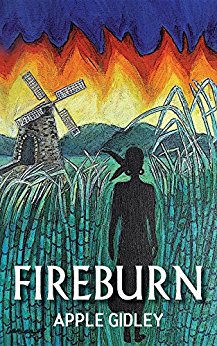
Finding The Right Story: A Guest Post by Apple Gidley, Author of Fireburn

Fireburn

It gives me enormous pleasure to welcome Apple Gidley to Linda’s Book Bag today to celebrate the publication of her novel Fireburn. April has written a wonderful post for today’s blog outlining some of her journey to publication that I think will resonate with authors and readers alike. I’m sure, like me, readers will have watched with horror the devastation in the Caribbean recently as a result of the hurricanes. With Fireburn set in the Caribbean and with an historical era explored, there’s no better time to read it.

Fireburn was published yesterday, 1st October 2017, and is available for purchase here.

Fireburn

Fireburn

The Danish-owned island of 1870s Saint Croix vibrates with passion and tension as Anna Clausen, a young Anglo-Danish woman, returns to her childhood home after her mother’s death. Her heart sinks at what she finds on arrival. Her father is ailing and desolate and her beloved plantation, Anna’s Fancy, which has been in the Clausen family for three generations, is in shambles.

The unwelcome lust of one man and forbidden love for another makes Anna’s return to Saint Croix even more turbulent. Despite the decline in the sugar industry she is determined to retain Anna’s Fancy but must first win the trust of her field workers, of Sampson the foreman, and the grudging respect of Emiline the cook and local weed woman.

Fireburn tells of the horrors of a little-known, bloody period of Caribbean history. Anna weathers personal heartache as she challenges the conventions of the day, the hostility of the predominantly male landowners and survives the worker rebellion of 1878, 30 years after Emancipation.

Rich in description, Fireburn is a well-researched novel that shines a light on a historic period in Saint Croix that has received little attention in literature until now.

Finding The Right Story

A Guest Post by April Gidley

I have been posing for a number of years as ‘a writer’ – that’s what I put on those inquisitive government forms. And yet, had it not been for a supportive spouse I doubt I would have been able to afford a garret apartment anywhere, let alone in Paris, New York or London. Isn’t that where writers and artists flee to find themselves?

The impetus to take on that presumptive moniker came after I gave a closing key-note speech at the 2010 Families in Global Transition conference, www.figt.org. The topic was my itinerant life – 26 relocations through 12 countries. As I glowed in the after-speech aura of goodwill I took in the refrain, ‘you should write the stories down’. And so, Expat Life Slice By Slice was born. A memoir of countries and cultures from the cradle to not quite the grave.

expat life

I had been advised that no publisher would look at me if I did not have a credible platform and so I started a blog, wrote the occasional travel or expatriate article, and tried to hone my skills. Each professional edit improved my writing. I started to read a number of ‘how-to’ books but finished only one, Stephen King’s On Writing.

Summertime Publishing took the manuscript on and in April 2012, Slice By Slice was launched. It was comforting to know I already had an audience – those about to experience expatriate life, those who were in expat land and old lags like me who knew nothing else. People were eager for true confessions of how not to do things, and a few guidelines on good practices.

Yesterday marked the release of Fireburn, my debut novel set in the 1870s Danish West Indies – now the US Virgin Islands. And whilst OC Publishing, has been equally patient both with the editing and the publishing process, my stomach has not benefited from the relative sangfroid of the first experience.

And I have been wondering why.

Fireburn is not my first actual novel, and whilst the Beta readers of that first manuscript were encouraging, I knew it was not worthy of publication. I still believe the kernel is good and one day I might go back to it. But I learnt a lot writing it – about plot, character, dialogue and voice, and that I had the discipline to write a full length book.

I just had to find the right story.

Then in 2013 I was at a ceremony on the beautiful Caribbean island of St Croix, celebrating the transfer of the Danish West Indies to a US possession in 1917, for the sum of 25 million dollars in gold coin. Much was being made of the centennial four years hence. Sitting under the marquee, the trade winds ruffling programmes and straw hats, my mind started to wander. What, I wondered, had it been like in the lead up to the purchase?

The seed was sown and three of the main characters danced in. Each would give their own perspective of the same event – the transfer of power between two countries. I started the research the next day, and very quickly became aware of ‘Fireburn’, also known as The Great Trashing. My focus changed and Fireburn became the event around which my characters coalesced. And I added a fourth.

That research has been fascinating. People, far more knowledgeable than I, have been generous with their help and suggestions. I like my characters, though one I hold in deep and vitriolic loathing. And yet, and yet, the collywobbles are still here.

My bottle of wine analysis is that Fireburn, the book, is a story based on an actual event around which fictitious lives revolve. They despair, they fear, they hate, they love and they all come from my imagination.

That is what is terrifying me. Will people like my story? My make believe.

Every writer wants their story to be read, to be talked about, to be liked. We all dread the bad reviews, though recognise we will all get one, or two, or more, at some stage. That is why I am a million little fragments waiting to explode in a shower of shattered dreams if the pundits damn me and my book.

I comfort myself with an old Bantu proverb told to me during an attempted coup d’etat by a wise Ghanaian man I knew in Equatorial Guinea. He said, ‘smooth seas do not make skilful sailors’.

And so while the jury is out, I have put my blinkers on and have started the sequel – Transfer of the Crown. I am writing under the assumption that I can only improve with each attempt.  

Isn’t that all we can hope for?

(It is indeed Apple. And I wish you every success with Fireburn.)

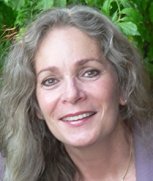
 About Apple Gidley

apple gidley

Apple Gidley, an Anglo-Australian author, whose life has been spent absorbing countries and cultures, considers herself a global nomad. She currently divides her time between Houston, Texas and St Croix, in the US Virgin Islands.

She has moved 26 times, and has called twelve countries home (Nigeria, England, Malaysia, Singapore, Australia, Papua New Guinea, The Netherlands, Trinidad and Tobago, Thailand, Scotland, USA, Equatorial Guinea), and her experiences are described in her first book, Expat Life Slice by Slice.

Her roles have been varied – from magazine editor to intercultural trainer, from interior designer to Her Britannic Majesty’s Honorary Consul. Now writing full time, Apple evocatively portrays peoples and places with empathy and humour, whether writing travel articles, blogs, short stories or full-length fiction.

You can find out more about Apple on her website and by finding her on Facebook or following her on Twitter @ExpatApple.

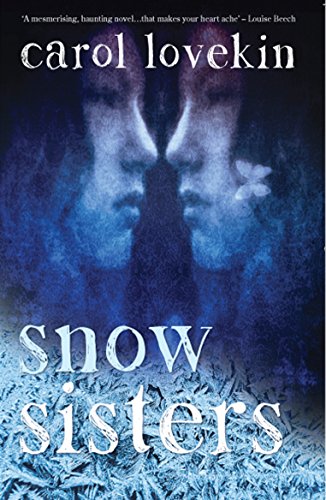
Snow Sisters by Carol Lovekin

Snow Sisters

I’m delighted to be part of the launch celebrations for Carol Lovekin’s second novel after Ghostbird, Snow Sisters. Carol has always been very supportive of Linda’s Book Bag, despite the fact that Ghostbird, her first novel, is STILL sitting on my TBR pile, and I’m delighted to feature her here today. As I’m married to a Welsh man it makes it even more special that Honno is a Welsh publisher too!

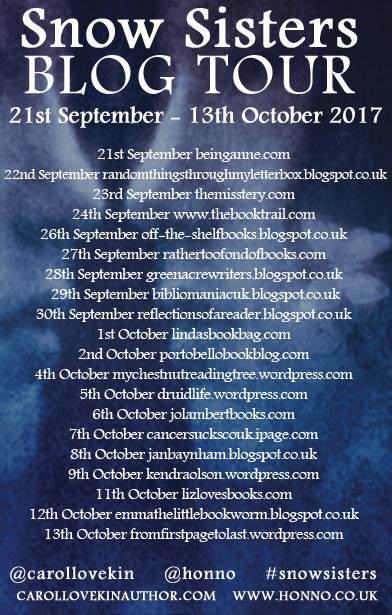
snow sisters blog tour poster2

Snow Sisters was published by Honno on 21st September 2017 and is available for purchase here.

Snow Sisters

Snow Sisters

Two sisters, their grandmother’s old house and Angharad… the girl who cannot leave.

Meredith discovers a dusty sewing box in a disused attic. Once open the box releases the ghost of Angharad, a Victorian child-woman with a horrific secret she must share. Angharad slowly reveals her story to Meredith who fails to convince her more pragmatic sister of the visitations, until Verity sees Angharad for herself on the eve of an unseasonal April snowstorm.

Forced by her flighty mother to abandon Gull House for London, Meredith struggles to settle, still haunted by Angharad and her little red flannel hearts. This time, Verity is not sure she will be able to save her…

My Review of Snow Sisters

Gull House holds secrets and an attraction that those who live there cannot leave behind.

I really don’t want to review Snow Sisters by Carol Lovekin as I know I have too inadequate a vocabulary to do it justice. I found Snow Sisters absolutely mesmerising. There’s an ethereal quality to the writing that is beautiful, poetic and heartbreaking. The different layers of mystery as past and present mingle are so wonderfully constructed that reading Snow Sisters is like having a magical spell woven about you so that all time and place diminishes and you find yourself completely transported to Gull House.

Carol Lovekin explores the complex relationships between women, between sisters and between families in a way that is intimate, soulful and brutally honest. At times I found reading Snow Sisters almost too much to bear because Carol Lovekin conveys love and hate, loyalty and betrayal with almost visceral emotion and with a passion that invades the soul. At the same time, however, there’s also a fleeting purity to some of the moments so that they reflect the transient nature of the snow in the title.

I thought the characterisation was outstanding. Although Allegra needs empathy I hated the way she behaved. I wanted to shake her. My heart broke for Meredith as she dealt with Anghared. Even Gull House is as much a character as the people with its magical woods and blue garden.

I loved everything about Snow Sisters: its Welshness, its characters, its setting and its themes. I found the writing exquisite and when I’d finished it I felt as if a snowflake crystal will be forever lodged in my heart to remember it by.

I cannot praise Snow Sisters highly enough. My life has been enriched by this wonderful, enchanting book and I urge you to let it into your life too.

About Carol Lovekin

Carol Lovekin

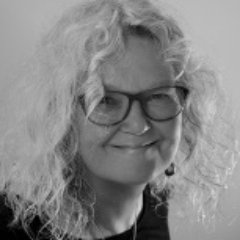
Carol is a writer, feminist and flâneuse. Her home is in beautiful West Wales, a place whose legends and landscape inform her writing. She writes contemporary fiction threaded with elements of magic.

Ghostbird, her first novel, was released on 17th March 2016. The book was chosen as Waterstones Wales and Welsh Independent Bookshops ‘Book Of The Month’ for April 2016. It was longlisted for the Guardian ‘Not the Booker’ prize 2016 and nominated for the Guardian Readers’ Book of the Year 2016. Snow Sisters is her second book.

You can follow Carol on Twitter @carollovekin, visit her website and find her on Facebook.

You can follow the blog tour too:

poster

A Novel of Three Sides: A Guest Post by Ewa Dodd, Author of The Walls Came Down

the walls came down

Many regular readers of Linda’s Book Bag know I have delusions about becoming a writer of fiction. And I am writing! But I only have one protagonist to deal with. When I heard that Ewa Dodd had three in her novel The Walls Came Down, I had to ask her onto the blog to tell me more.

The Walls Came Down is published by Aurora Metro today, 1 October 2017, and is available for purchase here.

The Walls Came Down

the walls came down

The Walls Came Down tells the story of a young boy who goes missing during a workers’ strike in 1980s Communist Poland, unravelling a chain of events which will touch people across decades and continents.

Joanna, a young journalist in Warsaw, is still looking for her brother, who’s been missing for over twenty years.

Matty, a high-flying London city financier is struggling with relationship problems and unexplained panic attacks.

And in Chicago, an old man is slowly dying in a nursing home, losing his battle with liver cancer.

What connects them? As the mystery begins to unravel, the world of the three protagonists is turned upside down…

A novel of three sides

A Guest Post by Ewa Dodd

Joanna

We meet Joanna for the first time in 1988 in Warsaw, when she is four years old. She discovers that her twin brother Adam has gone missing in the crowds during a protest that they have both attended with their mother. At first, she firmly believes that he will come home, but days, weeks and months pass and there is no news of him.

Whilst her mother slowly falls apart, Joanna is doubly-determined to continue searching for Adam, no matter what.  She works closely with the police, helping them to identify new leads, and when the case is closed, she finds her own solution to ensuring that her brother’s story continues to be publicised in the media.

Joanna shares many of the traits of determined and successful young women that I know, but she has additional, almost super-human resolve to continue pursuing what she believes, whilst everything implies that she should give up.

Matty

Matty is a young city slicker, set on a route to becoming a successful investment banker with a six figure salary and a mansion in one of the posher suburbs of London. On the surface he has everything, and is envied by most of his friends. But there’s something that gnaws away at his subconscious, never allowing him to fully relax into his success.

An unusual news story about a plane crash in Russia spirals off a chain of events, which leads Matty to question who he is and where he has come from. He questions his adoptive mother about his real family, but gets very little information, so he decides to conduct some research of his own.

Matty was a complex character to create, as he is so multi-dimensional. Superficially, he is cocky, confident and not always likeable. But on another level, he is burdened with a deep anxiety about having lost his true identity. When writing his sections, I based his narrative on the experiences of people who have lost their memory and the heart-wrenching emotions associated with slowly regaining these.

Tom

We first meet Tom when he gets a diagnosis of liver cancer by his doctor, having noticed some worrying symptoms, including huge weight loss. Tom has recently retired from forty years of hard labour, and the unfairness of the situation hits him with full force. Lacking any immediate family to look after him, he goes to nursing home, to live out the last months of his life amongst other people suffering from terminal illnesses.

Whilst at the home, Tom befriends a fellow patient, Dustin, and one of the nurses, Clara, in whom he eventually confides. He tells them that he had a family whom he abandoned when he was a young father, and slowly the pieces of the puzzle that binds the three protagonists, fall into place.

I found Tom’s character very difficult to bring to life, as I’d never previously written from the point of view of somebody both male and of a very different age to my own. What was most challenging was convincingly conveying the pain, fear and devastation that come with the diagnosis of a terminal illness, and here, I am deeply indebted to a number of brilliant and talented people who were brave enough to write about their experiences of exactly this, including the wonderful Kate Gross.

About Ewa Dodd

Ewa Dodd

The daughter of a bookseller, Ewa Dodd has been writing since she was young – starting small with short self-illustrated books for children. More recently, she has delved into novel-writing, and is particularly interested in literature based in Poland, where her family is from. The Walls Came Down is her first published novel, for which she was shortlisted for the Virginia Prize for Fiction.

You can follow Ewa on Twitter @EwaDodd.