Young Lovers, A Guest Post by Katarina West, Author of The Thousand Tiny Miracles of Living Twice

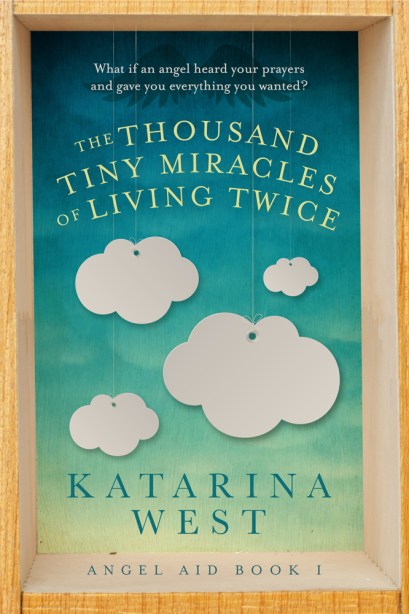
1000 cover

I’m delighted to welcome Katarina West, author of The Thousand Tiny Miracles of Living Twice to Linda’s Book Bag today. Being of a certain age, I found Katerina’s guest post today highly relevant!

The Thousand Tiny Miracles of Living Twice is available for purchase here. As part of the celebrations, Katerina is also running a giveaway which you can enter at the bottom of this blog post.

The Thousand Tiny Miracles of Living Twice

1000 cover

Meet Irene Nylander, a frumpy housewife from Finland … and a yo-yo dieter. She feels trapped in an unhappy marriage, looking after her domineering mother-in-law and living vicariously through romantic movies.

Meanwhile, in Florence, Mimi Kavanough’s star is rising. She has the body of a Barbie princess, the iron will of an army sergeant – and Hollywood in her sights.

On her fiftieth birthday, Irene discovers her husband is having an affair. Devastated, she prays for a way out: she wants to die.

In heaven, a mischievous angel called Aaron hears her prayers. He decides to make Irene and Mimi swap bodies.

How will the two women cope with their unexpected, and very different, second lives? And will Aaron’s meddling get him evicted from heaven? What will happen if he has to transform into a human being and live on Earth?

Four Weddings and a Funeral and Young Lovers:

can middle-aged women have boyfriends half their age?

A Guest Post by Katarina West

Last summer was a hectic wedding season in Florence, where I live with my husband and ten-year-old son: four couples got married under the relentless glare of the Tuscan sun.

And mind you, weddings in Italy are a serious affair… Oh yes, they are. Foreigners think that all Mediterranean weddings are carefree, cheerful affairs, the equivalents of a lively country-dance or a tarantella, but this couldn’t be further from the truth in the elegant and stiff Florence, where centuries of socializing have transformed weddings and other gatherings into elaborate minuets with eight-course lunches or dinners. So not exactly your big, fat Greek wedding – except that the calorie consumption is the same, which means that after four weddings in one summer you’ve got a serious bikini crisis going on for the rest of the season.

Anyhow. What made last summer’s weddings even more delicate was the fact that I was still writing my latest novel, The Thousand Tiny Miracles of Living Twice.

A mixture of chick lit and fantasy, it tells the story of a frumpy, middle-aged housewife from Finland who changes bodies with an oh-ah gorgeous Hollywood celebrity… And obviously, the latter is aged twenty-five. And obviously, the fifty-something housewife, now possessing the body of the likes of – say – Kim Kardashian, falls in love with a Justin Timberlake lookalike, who (obviously) is not many years older than thirty.

So, let’s recap: a frumpy housewife, going on fifty-one. Dating a Justin Timberlake clone, and looking like Kim Kardashian. Except no one knows that it’s not her body.

How’s that for a relationship crisis?

But the curious thing was that all of my girlfriends (who, just like me, are closer to the Finnish housewife’s age, rather than Kim Kardashian’s) were passionate about my heroine’s fate in a way that they’d never been with my previous fictional protagonists.

Yes, you heard me. With The Thousand Tiny Miracles of Living Twice, things were different. This wasn’t just a chick lit novel. No, this was personal. This was a fifty-something woman with cellulite and varicose veins. Snatching a thirty-something hunk.

This was… oh my God… political.

Yes, that’s it. Talking with my girlfriends I sometimes felt that I’d got a promotion. I was no longer a mere novelist penning down their next beach read. No, I was nothing more and nothing less than the Instagram age’s Karl Marx and Joseph Engels, breathing life into a new political manifesto. Everywoman’s manifesto.

A manifesto about middle-aged woman and thirty-something men.

And obviously, the men look exactly like Justin Timberlake.

Can you now understand my delicate position last summer, especially as we all met regularly at those long and calorie-rich weddings? We all sat at the same table. We rarely talked about kids, work, hobbies or summer plans.

No, for all they wanted to know was how my novel was coming along. And whether that frumpy housewife was still dating the Justin Timberlake doppelganger.

And if that could truly happen in real life.

‘Girls,’ said a forty-something stay-at-home mum during the first wedding. ‘Listen to me. It’s a question of a car. I mean, it’s a statistical fact that when men have a midlife crisis, they get rid of their first wives and buy a Porsche. That’s how they get that gorgeous twenty-something girlfriend.’

I looked at her, understanding. Her husband, a lawyer, drove a shiny Audi SUV so big that whenever she borrowed her husband’s car to do the school run the access road to the school was blocked for a good twenty minutes.

Her car, on the other hand, was a run-down Nissan the license plates of which had been registered in the last millennium. Not to mention that the inside had a wonderful patina of ice cream stains and candy wrappers. And dog and child vomit.

Though maybe she had a point. Because would Justin Timberlake ever sit in a car like that?

Our conversation evolved a few weeks later, when we met at the second wedding. It was the height of the presidential primaries in the United States, and all my girlfriends talked about was Donald Trump and Hillary Clinton.

Or, no. Correct that. Because there was someone still more interesting than Donald and Hillary.

It was my middle-aged Finnish housewife. And the question if she could keep on dating that thirty-something hunk.

‘Politics,’ one of my best friends said. She was a university researcher – she should know. ‘Girls – study men in politics. Look what happens to them when they gain even a modicum of power. Look at Trump. Or Hollande. Or Clinton… I mean, Bill Clinton. Or even the goddam JFK. What unites all these men?’

A subdued silence settled into our table. ‘I know,’ someone sighed. ‘It is just so unfair.’

Someone laughed humourlessly. ‘Of course, we Italians are leading in this field,’ she said. ‘After all, Berlusconi outwitted everyone with his harem of showgirls.’

‘Bunga bunga,’ a fifty-two-year-old brunette added, in a rather bleak tone.

Another silence. ‘Even so,’ my researcher friend continued, ‘could you imagine women doing anything similar? Imagine Angela Merkel boasting in a video clip that she can grab any private parts of her male assistants… and then later on dismissing it all as aerobics lesson locker-room talk? Or Theresa May having her very own Lewinsky affair in Downing Street?’

Everyone turned to look at me. ‘Don’t you dare let that Justin Timberlake dump the Finnish housewife,’ the stay-at-home mum said to me. ‘This is a question of rights. Human rights.’

Ouch. Suddenly I felt that if I made the wrong plot move, half of my girlfriends would never speak to me again.

The discussion was more pragmatic – even cynical – at the third wedding, and this was simply because we had a new woman sitting at our table. A boutique owner in the chic parts of Florence, she was a bona fide fashionista. And was dating a man eight years her junior.

‘Oh, come on, girls,’ she said. ‘You really think a frumpy housewife could date a Justin Timberlake lookalike? Give me a break!’

‘Men do it,’ someone said stubbornly.

‘And Madonna did it,’ the fashionista replied. ‘And Demi Moore. But you know what Madonna and Demi possess, apart from money and fame?’

No one said anything.

‘They both have bodies most twenty-somethings would die to have,’ she continued. ‘And it takes an entire war of attrition to get a body like that. You must suffer. You must sweat. You must starve.’

Suddenly none of us was hungry any more.

‘Anyone care to have my dessert?’ my researcher friend asked in a tiny voice. ‘I’m… er… on a diet.’

The Madonna-cum-Demi talk was a game changer, and during the fourth and the final wedding our attitude was hardened to say the least.

‘Money talks,’ the fashionista said. ‘If you’ve got money, you can have all the Justin Timberlakes you want. Even if you look like a walking, Botox-ed zombie. With liver stains on your hands.’

‘Who was that superbly rich woman who died some ten years ago?’ the stay-at-home mum asked apropos of nothing. ‘That New York based hotel billionaire?  The one who was notorious for her meanness?’

‘Ah, yes. The Queen of Mean. Leona Helmsley.’

‘So, did she look like Demi Moore?’

Silence. ‘No,’ someone finally says. Slowly. ‘She actually looked rather nasty.’

Another silence. Everyone’s thinking.

‘And did she, you know… date younger men?’

There is unmistakable hopefulness in the stay-at-mum’s voice as she utters these words. We all turn to look at an American expat married to an Italian.

She looks at us. She smiles apologetically. Then, eventually, she shrugs.

‘Sorry, girls,’ she says. ‘But Leona Helmsley was into… lapdogs. And when she died, her Maltese became the richest dog in the world.’

None of us know what to say.

‘And the most hated, too,’ the American woman continues. ‘Trouble was the dog’s name.’

When we are back home from the fourth and the last wedding, I look at my Bergamasco shepherd dog with new, fresh eyes. For, let’s face it, that dog has never asked for much.

All he wants is a little bit of kibbles and affection.

Plus, after a handful of dog obedience lessons, he comes to me when he must come to me, and he stops barking when he must stop barking.

And… He is four years old.

Which converted to human years means that he is exactly the same age as my Justin Timberlake lookalike in The Thousand Tiny Miracles of Living Twice.

It is then that the truth hits me.

I’m middle-aged. I’m no Demi Moore.

I drive a car that is a far cry from your average shiny Porsche.

But still, there is a thirty-something male who follows my each and every step.

Who would give his dear life for me.

Now who said it again, that women can’t have it all?

(Who indeed? – Thanks Katarina from all we middle aged women!)

About Katarina West

Katarina

Katarina West was born in Helsinki, Finland, into a bilingual family.

She spent time travelling in Africa, Asia and Latin America, and went on to study at Queen Mary and Westfield College in London and the European University Institute in Florence, where she completed a PhD in political science and published a book based on it, Agents of Altruism. During those student years she started work as a journalist, and continued writing for various Finnish magazines and newspapers for over ten years, writing on various topics from current events and humanitarian issues to celebrity interviews and short stories. She also briefly worked as a university lecturer on humanitarian issues in Northern Italy.

Katarina lives in an old farmhouse in Chianti with her husband and son and when not writing, she is fully immersed in Tuscan country life, from jam-making and olive-picking to tractor maintenance.

You can follow Katarina on Twitter, visit her website and find her on Facebook.

Giveaway

1000 cover

For your chance to enter Katerina’s giveaway to win one of 10 e-copies of The Thousand Tiny Miracles of Living Twice, click here.

Spotlight and Extract: Being Simon Haines by Tom Vaughan MacAulay

Being Simon Haines

I’m delighted to be part of the launch celebrations for Being Simon Haines by Tom Vaughan MacAulay and have an extract from the very beginning of the book to share with you today.

Being Simon Haines will be published by Red Door in e-book and paperback on 22nd June 2017 and is available for purchase pre-order here.

Being Simon Haines

Being Simon Haines

Meet Simon Haines.

For a decade he’s been chasing his dream: partnership at the legendary, family-run law firm of Fiennes & Plunkett. The gruelling hours and manic intensity of his job have come close to breaking him, but he has made it through the years and is now within a whisker of his millions: in less than two weeks, he will know the outcome of the partnership vote. He decides to spend the wait in Cuba in an attempt to rediscover his youthful enthusiasm and curiosity, and to clear his mind before the arrival of the news that might change his life forever. But alone in Havana he becomes lost in nostalgia and begins to relive his past…

Set against the backdrop of an uncertain world, and charged with emotion, Being Simon Haines is a searching story about contemporary London and aspiration, values and love. Painting a picture of a generation of young professionals, it asks the most universal of questions: are we strong enough to know who we are?

An Extract from Being Simon Haines

I flew to Havana in memory of earnestness. I was thirty- two years old, professionally accomplished but lacking in wisdom, financially secure but privately adrift, at the point in life when a lawyer recalls Purpose, becomes indignant at the stability afforded by general malaise. It was April 2012 and I had a moment: my eight-month ‘Campaign’ at the law firm of Fiennes & Plunkett, that family-run, exclusive financing and insolvency boutique of the City of London, was over, and I had to wait for two weeks to see if I would be voted in as a new junior partner; if this blue-eyed boy from Lincoln would become a millionaire. During Campaign, the firm, led by the long legs and mighty silver quiff of Rupert Plunkett, had worked me to a level of nervous exhaustion that required not only a period of recuperation, but also an illusion of escape. Sophie Williams, my now ex-girlfriend, had left me only recently. In London spring had been withheld and even the April showers’ vitality curbed, so that instead a fine rain, incessant in its listlessness, drifted through cold, hurried streets below a sky of gloom.

‘Just disappear for a while, Simon – it’ll do you good. God, that sounds banal.’

Dan Serfontein and I had been friends since university – all the way through law school, the training contract and the associate years at Fiennes & Plunkett. Son of a fund manager from Cape Town and his beautiful wife, Dan’s towering alpha- male physique held up a boyish, infuriatingly handsome face and a head of thick blond hair. Dan had poise, that special assurance of all of Belgravia’s children, but unlike them he had an admirable, manic determination too – despite, or rather because of, the family money. All this Dan Serfontein had – but he did not quite have the mind, the obsessive attention to detail, the neurotic speed of thought, to go all the way at Fiennes & Plunkett. He had left just a couple of weeks before the horror of Campaign had begun, burnt out and unable to go on, and now swam the calmer waters of in-house law.

‘No idea how you got through it, mate. You should be proud of yourself, whatever happens – you’re far stronger than I am.’

After much pondering, one morning the apotheosis of strength that was Mr Simon Haines decided where to go. Selecting the age category of 28–35s, I booked myself on a group tour of Cuba, through an agency specialising in bona fide trips for bona fide travellers. Cuba was, I supposed, a place that I had always wanted to see; and those friends of mine who had made me wince when speaking of ‘re-connection with your spirit’ did perhaps have a point, albeit atrociously expressed. For the idea of a faraway land, of new air, brought about a flicker of an old emotion that lay deeper than consciousness …

About Tom Vaughan MacAulay

tom

Tom Vaughan MacAulay was born in Chester and now lives in North London. Tom is a solicitor and has worked in both London and Milan. He is in the process of completing his second novel.

You can follow Tom on Twitter and visit his website.

There’s more about Tom and Being Simon Haines with these other bloggers too:

 bsh

The Thousand Lights Hotel by Emylia Hall

thousand lights hotel

I have loved other of Emylia Hall’s books so I was utterly delighted to receive her latest, The Thousand Lights Hotel thanks to Millie Seaward at Headline. You can see my review of Emylia’s The Book of Summers here and of The Sea Between Us here.

The Thousand Lights Hotel will be published in e-book on 1st July 2017 and in paperback on 13th July 2017 and is available for purchase through the links here.

Please return to Linda’s Book Bag on 10th July when I’m so excited that I’ll be interviewing Emylia about her writing and The Thousand Lights Hotel in particular.

The Thousand Lights Hotel

thousand lights hotel

When Kit loses her mother in tragic circumstances, she feels drawn to finally connect with the father she has never met. That search brings her to the Thousand Lights Hotel, the perfect holiday escape perched upon a cliff on the island of Elba. Within this idyllic setting a devastating truth is brought to light: shaking the foundations upon which the hotel is built, and shattering the lives of the people within it.

A heartbreaking story of loss, betrayal, and redemption, told with all the warmth and beauty of an Italian summer.

My Review of The Thousand Lights Hotel

When Kit’s mother dies, she decides to search for the father she has never known.

I cannot begin to say how amazing I found this book. Emylia Hall has the ability to transport me to another place, both physically, in Elba, and emotionally, so that whilst reading The Thousand Lights Hotel I frequently had to pause to allow myself to process the depth of feeling created. I think it is her elegant style in using such a range of sentence structure that has the ability to stop the reader in their tracks, heart breaking and tears streaming, as emotion after emotion washes over them. Who would have thought a semi-colon could reduce a middle aged woman like me to an emotional wreck! The way direct speech is fractured and fragmented makes it naturalistic and affecting and Emylia Hall knows exactly when less is more. She can convey more emotion in one monosyllabic word than many writers can convey in pages.

The Thousand Lights Hotel is a gorgeously crafted book. The plot is urbane, graceful and believable, but also surprising with tantalising hints of mystery. Elba as the main setting is inspired. A place of exile, all the characters seem to be looking for, or hiding, a part of themselves and as these aspects are gradually revealed the reader is completely entranced. The use of the senses transported me completely to every setting so realistically and the smattering of literary and cultural references, including Italian, enhanced the total credibility of every single word.

The characters themselves are outstanding creations. Although physically present for only a few pages, Rosa is at the very heart of the narrative. Of all the ‘thousand lights’ she burns most brightly in a sense. I found I didn’t much like her, but that I understood her completely and desperately needed to know how the lives of those touched by her were affected. This is such clever story telling. I saw Valentino as a kind of King Lear with Kit almost Cordelia and I don’t think it is an exaggeration to say the strength of emotion in Emylia Hall’s The Thousand Lights Hotel equals Shakespeare’s writing.

It’s hard to articulate how much I adored The Thousand Lights Hotel. I thought it was exceptional.

About Emylia Hall

emylia-hall-detail

Emylia Hall was born in 1978 and grew up in the Devon countryside. She is the author of The Book of Summers, which was a Richard & Judy Summer Book Club pick in 2012, A Heart Bent Out of Shape, The Sea Between Us and The Thousand Lights Hotel. She lives in Bristol with her husband, the writer Robin Etherington, and their young son.

You can follow Emylia on Twitter and visit her website. You’ll also find her on Facebook.

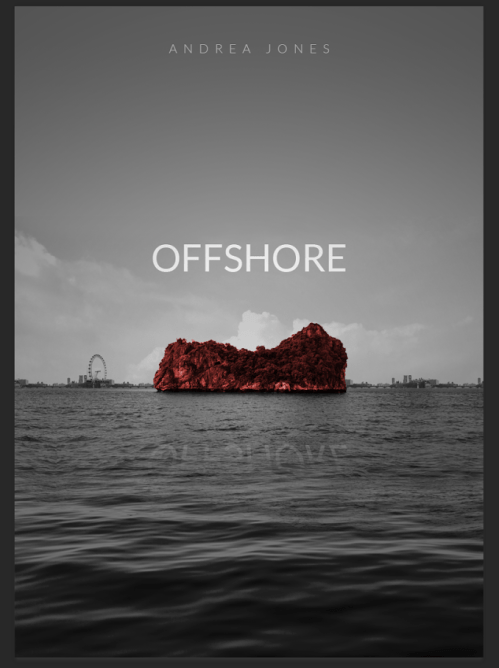
Own Voices: A Guest Post by Andrea Jones, Author of Offshore

Off cover.png

As an aspiring writer I’m always interested in what authors have to say about writing what you know, as that seems to be a constant piece of advice. Today, Andrea Jones, author of Offshore, tells me what she thinks about who gets to write what in fiction.

Offshore is available for purchase in e-book and paperback here.

Offshore

Off cover.png

Girl Meets boy. East meets West. Worlds collide.

Two damaged souls from very different worlds meet in a secretive offshore detention centre where nothing – and no one – is what they seem.

Own voices: who gets to write what in fiction?

A Guest Post by Andrea Jones

The shadowy, shape-shifting possibilities of Brexit and the Trump administration have had some positive effects – in publishing at least.

Diversity is in demand. Agent and Editor calls for ‘own voice’ narratives are at an all-time high.

Some observers call it a trend, and that’s the wrong word. The movement is more well-intentioned than ‘trend’ suggests.

More likely it’s a way to resist. To prove that we don’t live in a monochrome, monosyllabic world. We have vibrancy, colour and nuance. And we want to hear, see and read these things in people’s own words.

It’s right and important.

But … as a fiction writer (whose job it is to put themselves and their readers into worlds they can never experience) ‘own voices’ presents some heavy existential questions:

        Can/should you write what you don’t know?

        And if you do, is it cultural appropriation?

I struggled with these questions for years.

Because I had two stories that I equally needed to tell.

One narrative was familiar: about a bitterly frazzled career woman, leaning out of the relentless and toxic 9-5 culture that we´re told defines us here in the West.

The other narrative was about a Syrian refugee. A Middle Eastern male. Someone with the kind of psychological fault lines I hope to never, ever know.

Ostensibly, he couldn’t be further away from my culture and experience, and so I told myself: you can’t do this. You shouldn’t do this. Why the hell are you doing this?

The answer was simple. I wanted (needed) to humanize beyond news spin and statistics; to create empathy in an increasingly dark world. But as much as I wanted to document, I was aware of the political tension on my page. I was scared to misstep, or screw up, or cross that fine, fine line between exposition and exploitation.

My character only came good when I pushed through doubt and learned this lesson: as writers, we need to focus on our common humanity, rather than the identity markers that separate us.

Research and verification are the foundations of documenting what we don’t know. But it’s digging deeper, hunting for the common threads, that gives us the confidence to write outside our own worldview.

And what you don’t know, you can almost surely extrapolate.

I’ve never been forced out of my home, for example. But I have voluntarily immigrated, and I know what it feels like to have to start again.

I don’t know what it feels like to be in detention. But I do know what it feels like be trapped in a cubicle for forty precious hours a week; my bones itching with the knowledge that I should be being and doing something else.

There are realities common to us all. Whoever we are, and wherever we come from.

So if you’re doubting your project, but can’t let it lie, just write it out.

Balance research with your humanity, and you might just have fiction for our times.

About Andrea Jones

aj logo

Andrea Jones is a British journalist, author and outlier. She looks at the status quo and instead of just saying sure, asks: why?

The question that usually follows is what if … ? What if everything dark and destructive in our society could be challenged by the power of subversion and storytelling…?

You can follow Andrea on Twitter and visit her website to find out more.

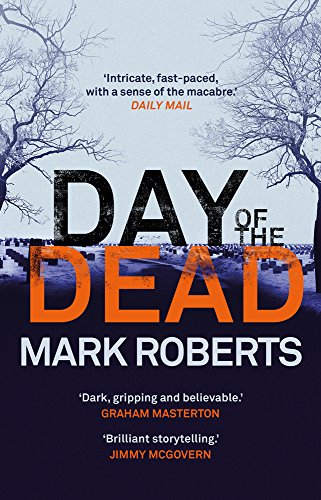
Giveaway: Day of the Dead by Mark Roberts

day of the dead

I’m delighted to be part of the launch celebrations for Day of the Dead by Mark Roberts. Day of the Dead is the third in Mark’s Eve Clay series.

Published by Head of Zeus in e-book and hardback on 4th May 2017 Day of the Dead is available for e-book and hardback purchase and paperback pre-order here.

To celebrate Day of the Dead I have two hardback copies to give away in the UK thanks to Head of Zeus. Links to enter the giveaway are at the bottom of this blog post.

Day of the Dead

day of the dead

Vindici is a hero to many. He is also the nation’s most dangerous criminal…

The man who calls himself Vindici broke out of prison last year. Now he’s filmed himself torturing and killing paedophiles in Liverpool’s affluent suburbs. Half the city are celebrating: the streets are safer for their children. But for DCI Eve Clay and her team at the Merseyside Police, it’s a nightmare. Their job is to solve the crimes and lock up the killer – hard enough without being despised by the public they are trying to protect.

And now, just when they think they’ve cracked the case, they receive a photo of Vindici, at a Day of The Dead parade in Mexico. So if Vindici is 5,000 miles away, who are they hunting in Liverpool? DCI Eve Clay must draw on all her cunning to unmask a killer who is somehow always one step ahead…

About Mark Roberts

mark roberts

Mark Roberts was born and raised in Liverpool. He was a teacher for twenty years and now works with children with severe learning difficulties. He is author of What She Saw which was longlisted for a CWA Gold dagger award.

You can follow Mark on Twitter and find him on Facebook.

Day of the Dead Giveaway

day of the dead

UK only I’m afraid. For your chance to win one of two hardbacked copies of Day of the Dead by Mark Roberts, click here. Giveaway closes at UK midnight on Saturday 17th June 2017.

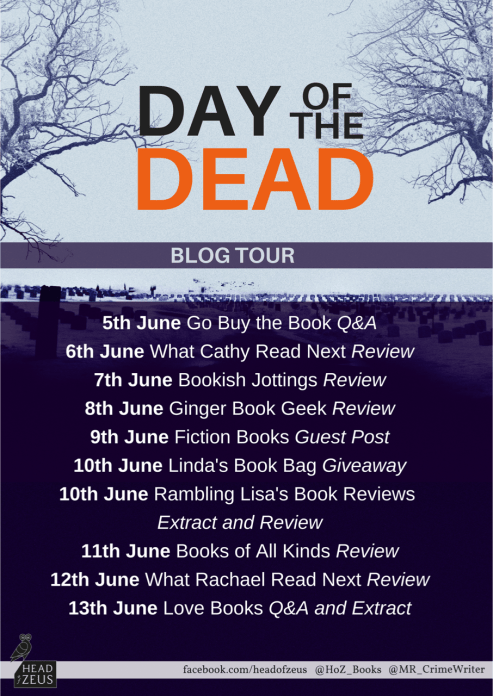
There’s more about Mark Roberts and Day of the Dead with these other bloggers:

Day of the Dead banner.png

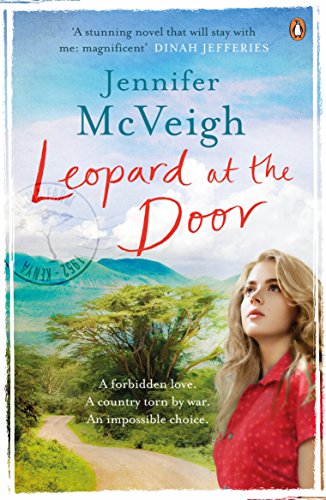
Leopard at the Door by Jennifer McVeigh

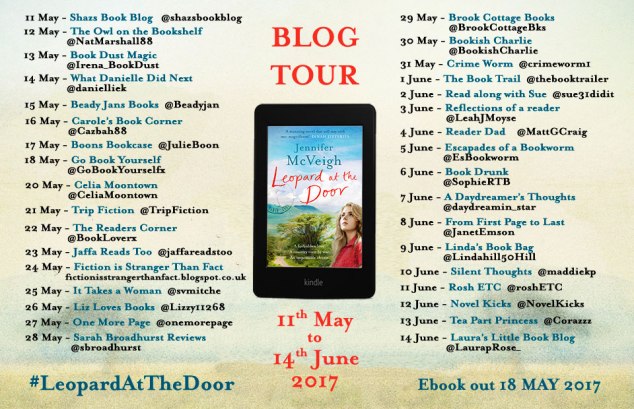
LATDblogtour_TWbanner_Jun9 me

I adore Africa and am thrilled to be part of the launch celebrations for Leopard at the Door by Jennifer McVeigh, especially as it is set in Kenya.

Leopard at the Door is published by Penguin and is available in e-book, hardback and paperback here.

Leopard at the Door

Leopard at the door

Stepping off the boat in Mombasa, eighteen-year-old Rachel Fullsmith stands on Kenyan soil for the first time in six years. She has come home.

But when Rachel reaches the family farm at the end of the dusty Rift Valley Road, she finds so much has changed. Her beloved father has moved his new partner and her son into the family home. She hears menacing rumours of Mau Mau violence, and witnesses cruel reprisals by British soldiers. Even Michael, the handsome Kikuyu boy from her childhood, has started to look at her differently.

Isolated and conflicted, Rachel fears for her future. But when home is no longer a place of safety and belonging, where do you go, and who do you turn to?

My Review of Leopard at the Door

In 1952, after six years in England Rachel arrives home to Kenya. But it isn’t the Kenya she left.

Leopard at the Door is, quite simply, outstanding.

Within two paragraphs of reading Leopard at the Door I was totally ensnared by Jennifer Mc Veigh’s spellbinding prose. She instantly transported me to the Africa I know and love through fantastic use of the senses to convey the sights and smells that make this such a unique place. The heat, the dirt, the brutality all come through with vivid accuracy.

Leopard at the Door has a mesmerising intensity that made me horrified and enthralled in equal measure. I think I felt every one of Rachel’s emotions as I read. The writing is so intelligent. I can’t believe it’s coincidence that the title refers to a supreme hunter and can be applied to Mau Mau, Steven Lockhart and the creature itself, as well as the way in which the white population has treated the Kenyans in the past. Similarly, the fact that Rachel means ewe or lamb, and innocent purity, had me anxious for her welfare from the very first page.

The characterisation is wonderful. It felt absolutely right that both Sara and Steven’s names begin with an evil sibilance as they impact so negatively on Rachel’s life. My heart contracted with pity for Harold but it was Rachel herself who completely enchanted me. Her grief for her mother, her lost childhood and the events that happen as the magnificent plot unfolds absolutely overtook my life as I read.

Meticulously researched, the political events of the novel taught me so much so that I feel I have a far better understanding of Kenya both then and now. However, Jennifer Mc Veigh manages to present those events inextricably wound into realistic, everyday lives of ordinary people through her beautiful prose.

Leopard at the Door is simultaneously disturbing and enthralling and my life has been enriched by reading it. I adored it.

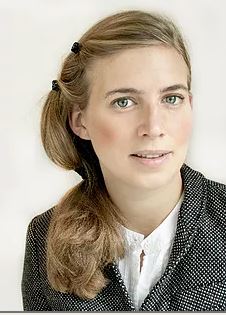
About Jennifer McVeigh

jennifer

Jennifer graduated from Oxford University in 2002 with a degree in English Literature. She went on to work in film, television, radio and publishing, before leaving her day job to do an MA in Creative Writing at Bath Spa University. She graduated in 2011.

She has travelled in wilderness areas of East Africa and Southern Africa, often in off-road vehicles, driving and camping along the way. The Fever Tree and Leopard at the Door were inspired by those experiences.

In 2014 The Fever Tree won the Epic Novel Category at the Romantic Novel of the Year Awards.

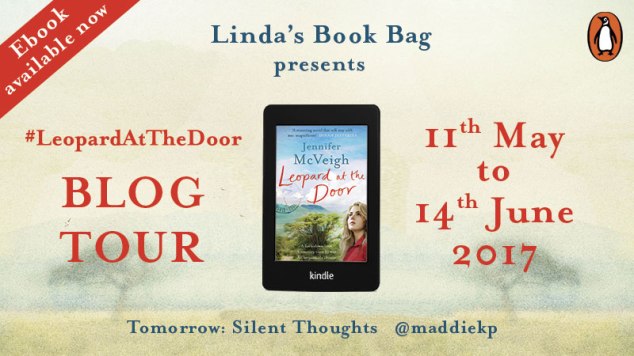
You can follow Jennifer on Twitter, find her on Facebook and visit her website. There’s more with these other bloggers too:

LATDblogtour_poster

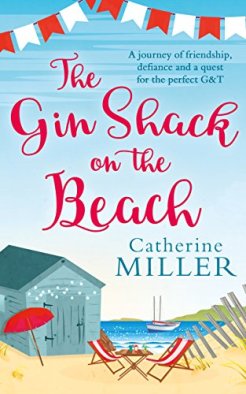
The Gin Shack on the Beach by Catherine Miller

gin shack

I’m delighted to be featuring lovely Catherine Miller today to celebrate her latest book, The Gin Shack on the Beach.

Catherine was kind enough to write a piece for Linda’s Book Bag previously, about striving for what we want that you can read here.

Published by HQ Digital on 5th June 2017, The Gin Shack on the Beach is available for purchase here.

The Gin Shack on the Beach

gin shack

You’re never too old to try something new!

When octogenarian Olive Turner is persuaded by her son to move into a retirement home, she congratulates herself on finding the secret to an easy life: no washing up, cooking or cleaning. But Olive isn’t one for mindless bingo with her fellow residents, and before the first day is over she’s already hatching a plan to escape back to her beloved beach hut and indulge in her secret passion for a very good gin & tonic.

Before long Olive’s secret is out and turning into something wonderful and new. Only a select few are invited, but word spreads quickly about the weekly meetings of The Gin Shack Club. Soon everybody on the beach wants to become a gin connoisseur and join Olive on her journey to never being forced to grow older than you feel.

A journey of friendship, defiance and a quest for the perfect G&T.

My Review of The Gin Shack on the Beach

Olive Turner agrees to move into a retirement apartment but she isn’t going to let her son Richard take her beach hut away without a fight!

What a lovely summery story this is. There’s a real sense of place and community on the beach and The Gin Shack on the Beach made me wish I had a beach hut of my own.

Firstly, I really enjoyed the way in which Catherine Miller has created a cast of lively and often feisty characters whatever their ages. I found Richard so frustrating but there is a history to be uncovered in the relationship between him and Olive that explains why they act as they do towards one another. Matron is despicable and again, there’s more to her than meets the eye so that as well as a light summer read, The Gin Shack on the Beach has mystery too.

I thought the plot was hugely entertaining. Olive and her gang encounter brushes with police, adventure and romance as Catherine Miller explores friendship, loyalty and the search for the perfect G+T. Indeed, it did make me wonder just what kind of research went in to this aspect as I never knew there were so many gins to taste! As I read I thought what a marvellous Sunday night series on television this would make.

The element that took me by surprise was the range of emotions conveyed in what I thought would be a simple beach book. I certainly laughed aloud at lighter moments, but I felt sadness and compassion too so that there were more layers than I had anticipated.

The underlying principal of The Gin Shack on the Beach is that we shouldn’t judge others by age or appearance and if Olive can go skinny dipping in her 80s I’m sure we all can! There’s such positivity and entertainment here that The Gin Shack on the Beach is a feel good read I highly recommend.

About Catherine Miller

catherine miller

When Catherine Miller became a mum to twins, she decided her hands weren’t full enough so wrote a novel with every spare moment she managed to find. By the time the twins were two, Catherine had a two-book deal with Carina UK. There is a possibility she has aged remarkably in that time. Her debut novel, Waiting For You, came out in March 2016, followed by All That is Left of Us.

Catherine was a NHS physiotherapist, but for health reasons (Uveitis and Sarcoidosis) she retired early from this career. As she loved her physiotherapy job, she decided if she couldn’t do that she would pursue her writing dream. It took a few years and a couple of babies, but in 2015 she won the Katie Fforde bursary, was a finalist in the London Book Fair Write Stuff Competition and highly commended in Woman magazine’s writing competition.

You can also find out more about Catherine Miller on Facebook , via her web site and by following her on Twitter.

There’s more with these other bloggers too:

Gin shack poster

Fractured Families: A Guest Post by Dianne Noble, Author of Oppression

104 KB

I love books and I love travel and what better than to combine the two! Today, I am delighted to welcome back Dianne Noble to Linda’s Book Bag. Previously, Dianne took me to India in a super guest post that you can read here when her book A Hundred Hands was published and I’ve now booked a trip there for next year!

Today, we’re featuring Dianne’s new book Oppression, which will be released by Tirgearr on 14th June 2017, when I’ll be able to go back to Egypt, a country I’ve visited and loved.

Oppression is available for pre-order in e-book here.

Oppression

104 KB

When she tries preventing the abduction and forced marriage of 16-year-old Layla, Beth defies her controlling husband, Duncan, and travels to Cairo where she finds the girl now lives in the vast necropolis known as The City of the Dead. She’s hiding from her abusive husband, and incites fellow Muslim women to rebel against the oppression under which they live. Beth identifies with this and begins helping her.

Cairo is in a state of political unrest, and Beth gets caught up in one of the many protests. She’s rescued by Harry, who splits his working life between Egypt and England, and they eventually fall in love. When Harry returns home and Layla vanishes, Beth begins being stalked and threatened with violence. And then Duncan turns up…

Can Beth ever find peace, or will her hopes of happiness remain shattered?

Will Layla’s ideals of freedom ever be fulfilled?

Fractured Families

A Guest Post by Dianne Noble

I have three novels with a fourth on the way, and all of them seem to deal with fractured families.

In my current one, Oppression, which is to be published June 14th.and is available on pre-order at 99p., Beth’s mother has found religion and considers herself on a fast track to salvation. In actual fact she is hard and judgmental and when Beth’s father dies while she’s in Egypt helping Layla, the victim of a forced marriage, she feels truly orphaned.

a-hundred-hands

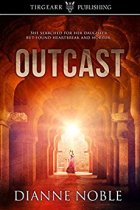
In my two previous novels, both based in India, Polly’s mother abandoned her (A Hundred Hands) and Rose’s mother (Outcast) is distant both geographically and emotionally.

outcast

The background of dysfunctional families in each book wasn’t deliberate but in fact is, in my opinion, topical. Children are raised in single families as a regular thing nowadays, parents have to travel and work unsocial hours to put bread on the table so are often absent, and many of the UK’s immigrants have tragically had to leave their families behind them as they strive to earn enough to live.

In many ways my own childhood was fractured. Many people feel a nostalgia for schooldays, for friends known since kindergarten. There are reunions, old school ties, framed photographs of children in uniform on doting grandmothers’ walls. The oldest pictures, Lucozade-coloured with age, show school hats: berets, Panamas, a topper if you’d been to Eton.

Spare a thought for those who were brought up in service families! Many attended a school for such a brief time there was no time – or money – for a new uniform. You were an outcast in your navy blue while everyone else sported bottle green. I went to fifteen different schools between the age of five and sixteen and it added a great deal to my life experiences but very little to my social skills. It was just not possible to build friendships.

The first interesting school I went to was on a troopship, the Dunera. which was transporting the Scottish regiment, the Black Watch from Glasgow to Korea as part of the peace-keeping force, and we were being dropped off at Singapore. The first day at sea, before we reached the Bay of Biscay and the horrors of non-stop vomiting, I was sitting on deck in the sunshine, nose buried in Enid Blyton’s Ring ‘o’ Bells Mystery. I loved Enid Blyton with a passion, devoured all I could find and was totally engrossed in this one which my father had bought me for the journey. He was more than a little disgruntled to discover I’d finished it in a day and a half and told me I’d have to keep reading it as there was nothing else available. My reading was cruelly interrupted by an officious woman herding children before her for lessons. Lessons? It appeared we had to go to school for six hours a day for the next four weeks. The ship might founder, there might be flying fish off the starboard side, but nothing could interrupt classes.

School in Singapore was wonderful. We started at 7.30 and finished at 1.30 to avoid the heat of the afternoon. Our transport there was referred to as a gharry, but it was a lorry painted air force blue into which we had to clamber before sitting on bench seats and holding on to a rope to avoid being thrown out when we crashed through the craters in the roads. In the playground we caught snails and centipedes, while in the classrooms geckoes scampered across the ceilings, dodging the overhead fans, before dropping on the unwary. On the down side there was no chance of making, or nurturing, new friends. Service life produces children who are self-reliant, somewhat solitary – the unkind would say anti-social, and this background can produce further fractured families.

After a number of years in England we flew out to Cyprus, a beautiful island on which to be educated. Very early morning starts again owing to the high temperatures but now I was older there were trips to Kykko Monastery, Famagusta, the ruins at Salamis. When the threat of Turkish invasion grew, wherever we travelled we had to be in an armed convoy, escorted by UN troops from Canada and Finland in their sky-blue berets. As a teenager I was hugely susceptible to the attraction of a man in uniform, something which has stayed with me to the present day!

But the best school of them all was when, in my fifties I taught English in the slums of Kolkata where I squatted on the ground, in the dirt, with the children who lived on the streets. Their eager little faces, happy smiles, desperation to learn were heart-breaking at times but it remains the most worthwhile thing I’ve ever done. These children came from truly fractured families.

About Dianne Noble

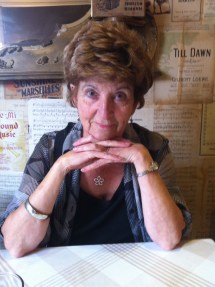
dianne-aug-2015

Born into a service family Dianne was brought up in Singapore, Cyprus and Yorkshire then went on to marry a Civil Engineer and moved to the Arabian Gulf. Since then, with sons grown and flown, she has continued to wander all over the world, keeping extensive journals of her personal experiences which she uses for her novels. Fifteen different schools and an employment history which includes The British Embassy Bahrain, radio presenter, café proprietor on Penzance seafront, and goods picker in an Argos warehouse, have resulted in rich seams to mine for inspiration.

You can find out more about Dianne by following her on Twitter, visiting her website and finding her on Facebook.

An Interview with Mark L. Fowler, Author of Coffin Maker

Coffin Maker - Mark L. Fowler - Book Cover

I’m delighted to have been asked by Caroline who blogs here to be part of the celebrations for Mark L. Fowler’s Coffin Maker. Mark is a new to me author and I love finding out about different writers so I’m thrilled that Mark has agreed to be interviewed for Linda’s Book Bag.

Coffin Maker is available for purchase in e-book and paperback here.

Coffin Maker

Coffin Maker - Mark L. Fowler - Book Cover

The Coffin Maker lives and works alone in the Kingdom of Death. When he completes a coffin a life on Earth ends. That’s how it’s always been.

One day as Coffin sits writing in his journal, The History of Death, trying to sum it all up in one perfect sentence, a note sails past his window.

Is he about to gain a glimpse of the elusive Divine Plan that has eluded him for centuries? Is life in the Kingdom of Death about to change forever?

There are rumours that the devil is finally arriving in the guise of Colonel Gouge. Rumours started by a priest who has upset the Church by writing a book: Coffin Maker. A book written to comfort a bereaved nephew. A book that appears to prophesy not only the arrival of Gouge, but also the cataclysmic events about to unfold in the Kingdom of Death.

An Interview with Mark Fowler

Welcome to Linda’s Book Bag. Thank you so much for agreeing to answer some questions on my blog about your writing . Firstly Mark, please could you tell me a little about yourself?

Hi Linda, and thank you for inviting me to your Book Bag. I’m based in Staffordshire and I have been a writer almost as long as I can remember. I’ve tried my hands at many forms of writing, including poetry, songs, sitcoms, short stories and novels. But I’m primarily a story teller, and more than anything I love writing fiction. I have three novels published so far: Coffin Maker, The Man Upstairs, and Silver. I have a fourth novel, Red Is The Colour, due out in July this year.

When did you first realise you were going to be a writer?

When I was a youngster, I was very much a dreamer, drawn to the world of the imagination. I loved making things up. But I was always very shy about showing anything that I’d written to anybody. I always imagined that they would laugh and say, “Who does he think he is, imagining he can write?” My writing also tended to be very personal, in the early days, quite autobiographical, and of course I was concerned that I might be giving too much of myself away. I think that it was writing my first novel, Coffin Maker, that really changed things for me. I was writing about things that interested me, but I was no longer writing about myself. Things that mattered to me, things that concerned me, that frightened me, perhaps; things that I found amusing, or that made me angry – but I had burnt off the autobiographical tendencies, realising that writing, storytelling, could be an adventure, a voyage of discovery, and the most tremendous fun. I knew then what I wanted to do.

If you hadn’t become an author what would you have done instead as a creative outlet and do you have other interests that give you ideas for writing?

I have musical interests. I play piano and guitar and occasionally I write songs, though nobody listens to them – ha ha, sob sob. A few of my books have a musical theme. I wish I was a better singer, though. I think if I wasn’t writing novels I would go back to screen writing. I had a lot of fun writing sitcoms, and there might still be some unfinished business there one day.

How do you go about researching detail and ensuring your books are realistic?

It depends on the book I’m writing, really. My latest book, Red Is The Colour, has two police officers as main characters. I had to ensure that I had certain facts correct, and I even got a police officer to read over an earlier draft checking for any errors regarding procedures. Beyond that, though, I felt that getting the psychology of the characters right was even more important. The same with Coffin Maker. Coffin is obviously an entirely fictional creation, but I had to know what makes him tick, his desires, motivations, fears. I had to make him real. I wasn’t trying to write an academic treatise; I wanted to be thought provoking. I was free to make of the Kingdom of Death whatever I wanted, but I still had to create the right landscape for the Coffin Maker to inhabit. I had to be consistent and credible even though it was very much a work of the imagination.

Which aspects of your writing do you find easiest and most difficult?

I love writing dialogue. Perhaps that’s the screen writer in me. On the other hand, I don’t tend towards long character descriptions, as I generally don’t enjoy reading them. I like to reveal character more through what they do and what they say. Their interactions. I like to leave some room for the readers’ own imaginations, rather than spelling everything out.

(That sounds like perfect ‘show, don’t tell’ to me Mark!)

What are your writing routines and where do you do most of your writing?

I write at home mainly, and I try to write most days. I find that writing works best for me when I keep a momentum going. If I come to a complete stop, the fear of the blank page can take over, and a week of writing nothing can easily lead to a month, and so on. I think writing feeds ideas, and questions emerge in the writing process.

Without spoiling the plot, please could you tell us a bit about Coffin Maker?

Coffin Maker is a gothic tale set between our world and the Kingdom of Death. In the Kingdom the Coffin Maker lives a solitary existence, and every coffin he completes signals the end of a life in our world. One day he discovers that he is to be sent two apprentices, amid rumours that the devil is arriving on Earth.

How far do you believe in fate or a Divine Plan?

Ha, that depends on how philosophical you want to get. And maybe how religious and psychological. It can be very difficult to reconcile a predestined, Divine Plan, with individual freewill.  Just as it can be difficult to reconcile the idea of a loving God with the existence of pain and suffering, and indeed death. I believe that as human beings we are naturally curious about these things, and it is partly the fascination with such deep mysteries that draws me to philosophy. We get glimpses sometimes, flashes of insight, but I don’t think we can ever nail these questions entirely. In the end it has to come down to faith, I believe. Philosophy can only take you so far.

You studied Philosophy at university. How far has that study impacted on what and how you write?

I think that the study of philosophy has to some extent fed my natural curiosity, and that curiosity has often manifested itself in storytelling. I have never had any interest in writing academically, but in a number of my books, and perhaps in Coffin Maker particularly, I have been drawn into asking philosophical questions. Primarily, though, I want to tell a good story, to explore an interesting character, or characters. Philosophy can fuel a sense of wonder, and so can good storytelling.

There are very real and concrete consequences for Coffin when he completes a coffin.  How far were you trying to convey an allegorical message through your narrative?

I wanted to convey the dark reality of death; the grim, heart-breaking, savagery of what occurs every day in this world. Yet at the same time I wanted to show the possibility of hope and the saving grace of love and compassion.

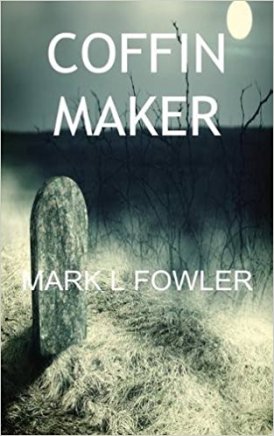
Coffin Maker has a cover that suggests decay and gothic horror to me. How did that image come about and what were you hoping to convey (without spoiling the plot please!)?

I was trying to convey desolation, I think. A clear evocation of death and loss, but without being too corny. I wanted an atmospheric image that had a gothic feel, possibly suggestive of horror, but without tying the book to that genre in an obvious way.

If you could choose to be a character from Coffin Maker, who would you be and why?

Hieronymus. He is a revolutionary, a flawed hero, fighting against something monstrous. I wish I had his courage.

If Coffin Maker became a film, who would you like to play Coffin and why would you choose them?  

It would have to be either an unknown actor, or at least an unrecognisable one. I don’t think that it could possibly work if you were familiar with the actor. Having said that, I have been surprised many times on the screen. I would love to see Coffin Maker on the big screen.

When you’re not writing, what do you like to read?

I read quite a bit of fiction, mainly crime, psychological thrillers, some contemporary fantasy and gothic/horror fiction. I love coming across stories that don’t quite fit into a clear genre, that exist on the borderlines. I think that Coffin Maker fits into that category.

If you had 15 words to persuade a reader that Coffin Maker should be their next read, what would you say?

You will not read another book quite like Coffin Maker. It is utterly unique.

Thank you so much for your time, Mark, in answering my questions.

About Mark Fowler

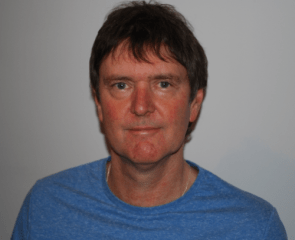
Mark L. Fowler Author Image

Mark L. Fowler is the author of the novels Coffin Maker, The Man Upstairs, Silver, and Red Is The Colour, and more than a hundred short stories. His particular interests are in crime and mystery, psychological thrillers and gothic/horror fiction.

His first published novel, Coffin Maker, is a gothic tale set between our world and the Kingdom of Death. In the Kingdom the Coffin Maker lives a solitary existence, and every coffin he completes signals the end of a life in our world. One day he discovers that he is to be sent two apprentices, amid rumours that the devil is arriving on Earth.

Mark’s second novel, The Man Upstairs, features the hard-boiled detective, Frank Miller, who works the weird streets of Chapeltown. Having discovered that he is in fact the hero of twenty successful mystery novels, authored by The Man Upstairs, Frank has reasons to fear that this latest case might be his last.

In 2016, Silver, a dark and disturbing psychological thriller was published by Bloodhound Books. When a famous romance novelist dies in mysterious circumstances, she leaves behind an unfinished manuscript, Silver. This dark and uncharacteristic work has become the Holy Grail of the publishing world, but the dead writer’s family have their reasons for refusing to allow publication.

Red Is The Colour is Mark’s latest book, a crime mystery featuring two police detectives based in Staffordshire. The case involves the grim discovery of the corpse of a schoolboy who went missing thirty years earlier. Red Is The Colour is the first in a series featuring DCI Tyler and DS Mills, and will be published in July 2017 by Bloodhound Books.

The author contributed a short story, Out of Retirement, to the best-selling crime and horror collection, Dark Minds. Featuring many well known writers, all proceeds from the sales of Dark Minds will go to charity.

A graduate in philosophy from Leicester University, Mark lives in Staffordshire, and is currently writing a follow up to Red Is The Colour. When he isn’t writing he enjoys time with family and friends, watching TV and films, playing guitar/piano and going for long walks.

You can follow Mark on Twitter and find him on Facebook.

There’s more with these other bloggers too:

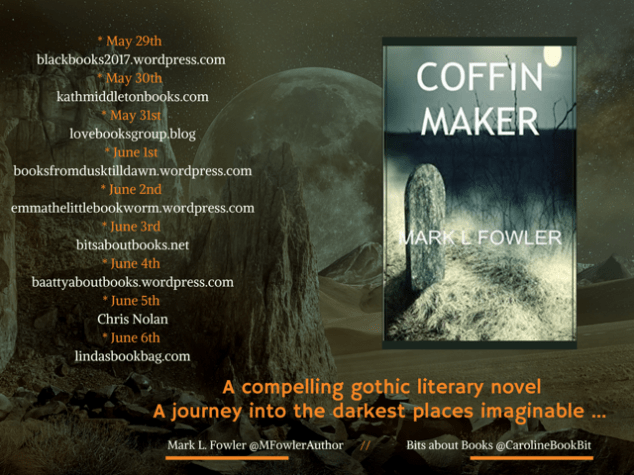
BlogTourPoster Coffin Maker - Mark Fowler - May 29th to June 6th- perfect

A History of Running Away by Paula McGrath

A history of running away

I am indebted to Ruby Mitchell at Hodder for an advanced reader copy of A History of Running Away by Paula McGrath in return for an honest review.

A History of Running Away will be published in e-book and hardback by John Murray on 15th June 2017 and is available for purchase here.

A History of Running Away

A history of running away

In 1982 Jasmine wants to box, but in 1980s Ireland boxing is illegal for girls.

In 2012 a gynaecologist agonises about a job offer which would mean escape from the increasingly fraught atmosphere of her Dublin hospital. But what about her mother, stuck in a nursing home?

And in Maryland Ali, whose mother has recently died, hooks up with a biker gang to escape from grandparents she didn’t know she had.

Gradually revealing the unexpected connections between the three women, A History of Running Away is a brilliantly written novel about running away, growing up and finding out who you are.

My review of A History of Running Away

Running away isn’t always the answer to life’s difficulties – but it can help.

I don’t know what it is about female Irish writers, but they somehow seem to be able to convey extreme emotion completely effortlessly and Paula McGrath is no exception. I loved A History of Running Away because it transported me into the lives of the women between its pages so fully I simply could not stop reading until I had consumed the entire novel in one sitting.

There is a cleverly planned plot that weaves initially seemingly disparate strands together in such a satisfying manner, but A History of Running Away is so much more than just a good story. Through its pages Paula McGrath explores social history and attitudes. She gives the reader a sometimes brutal and disturbing picture of what it is to be female in the early 1980s as well as more recently, so that there is a strong feminist undercurrent that works brilliantly without being aggressively overstated. I could quite easily see myself in the position of any of the women in this story. I also found the violence portrayed very disturbing. It is by no means graphic, but based in cruelty, sexism and racism it felt all too familiar and real. Paula McGrath skilfully makes the reader consider society’s attitudes whilst she entertains.

I loved the structure of the novel. The different voices are distinct and authentic and I found the lack of speech punctuation added to this feeling. A History of Running Away has a natural flow to the style so that it feels more like eavesdropping on real lives than reading about characters.

I thoroughly enjoyed reading A History of Running Away. From the metaphorical to the literal meaning in the title as characters run away from their debts, their families and their own mistakes, to the exploration of how we find our own identity in a world that seeks to define and control us I thought Paula McGrath had produced a pitch perfect novel that ultimately left me feeling uplifted and positive. A History of Running Away is a superb book.

About Paula McGrath

paula mcgrath

Paula McGrath lives in Dublin. Her first novel, Generation, was published in 2015, and described as ‘remarkable’ by the Sunday Times. She has a background in English Literature and is currently a doctoral student at the University of Limerick. In another life she was a yoga teacher.

You can follow Paula on Twitter and visit her website