Interview with Black to White author Sam Hayward

Black to white

Having had a difficult few months whilst my husband got clear of cancer at the end of 2015 and the beginning of 2016, it is a subject close to my heart. When I discovered that Sam Hayward had written a book, Black to White, in which Susie Chester has just lost her husband to cancer, I felt I had to ask Sam about it.

Black to White

Black to white

Sam Hayward’s debut novel Black to White is a fictional portrayal of loss, hope, love and renewal. It can be ordered from all good bookshops and from Sam’s website.

Through darkness comes light, through fear comes love and through pain comes triumph.

Grieving widow Susie Chester is trying to turn her life around with a little help from Peter, her gardener, who just might be her Guardian Angel – or a product of her imagination.

When fifty-five year old Susie Chester’s husband dies, her world falls apart, and although she lives in beautiful surroundings, she doesn’t know how she’ll cope alone. Then, after a chance meeting with Peter, her life slowly starts to change. He works for her as her gardener and, although she finds him mysterious, she feels inexplicably drawn to him. Has she met him somewhere before? Why does he feel so familiar?

Soon afterwards, white feathers begin to appear around the house. At first she finds them intriguing, but then they start to bring her comfort…

An Interview with Sam Hayward

Hello Sam. Thank you so much for agreeing to answer some questions on my blog about your debut novel Black to White.

Firstly, please could you tell readers a little about yourself?

I grew up in a town called Waterlooville on the outskirts of Portsmouth.  I was a very imaginative child, often making up stories about invisible animals that only I could see.  At primary school, my friends would frequently ask if they could see them too, so I said only if they were very nice to me.  Needless to say, I instantly became very popular.  My love of storytelling stayed with me and I knew that one day I would become a writer.  When I left school, I went to secretarial college.  It wasn’t what I wanted to do, but it was a career that most women followed in the ‘70s.  I returned to full-time education in the early ‘90s to study for a degree in journalism.  A few years before this, I had met my husband.  We knew instantly that we were meant for each other so decided to live together before getting married six years later.  We moved to Somerset in 2000 where we lived in an idyllic country cottage.  Then, after seventeen wonderful years together, at the age of 55, I was widowed.  It was the most devastating experience of my life.  In 2012 I enrolled on a postgraduate course in creative writing at Bath Spa University and finally fulfilled my aim of writing a novel.

Black to White is based on your own experiences after losing your husband to cancer. How difficult or cathartic was it to write?

It was extremely cathartic.  I knew that if I could express my feelings in words, it would help me.  I obviously struggled at the beginning because that was the most painful part of the story, but from there on it got easier.  I injected a lot of myself into the protagonist, Susie Chester, who I decided would be strong and positive.  I was determined that she would find happiness again.

You’ve written in the first person. Did doing so help your own grieving process or was that just an approach that felt natural to you?

I think writing in the first person was a more powerful way to convey Susie’s emotions.  It just felt right.  It also enables the reader to get closer to her.  Yes, it helped me enormously, but I wasn’t actually conscious of this until I finished the novel.

Having had my own husband diagnosed with cancer (and now thankfully free from it) when I was 54, Black to White is a book I haven’t been able to bring myself to read yet. What would you say to encourage me to do so?

The essence of the book is summed up in the sentence on the cover: ‘Through darkness comes light, through fear comes love and through pain comes triumph.’  It’s a story about overcoming adversity.  I think you would find it uplifting.  All of my friends who’ve read it said they enjoyed it.  Some of them have experienced loss but the majority haven’t.

There’s a level of spirituality in Black to White. How much has your own attitude to spirituality changed since writing the book?

After my husband died, I gave serious thought to the possibility of an afterlife.  I wanted to know where my husband was.  Sometimes I could sense him around me.  It was as if he still existed but I couldn’t see him.  I then started finding the feathers which I felt were a gift, either from him or my guardian angel.  I now believe that there is an ultimate force for good which we are all a part of.  I think about this a lot and feel certain that there is a sublimely beautiful and peaceful place that we go to when we die.  This was my view before writing my book and I can only say that since writing it, I am more convinced.

How did you feel when you sent Black to White off for editing given that it has such personal resonances?

I didn’t give it much thought at all.  It’s a work of fiction so how it’s interpreted is up to the reader.

What advice would you give to those suffering grief and considering writing about it?

Do it!  It really is the best form of healing.  I found writing and then reading about my feelings far more beneficial than just talking about them.

It’s no secret that white feathers are integral to the story and to your own life. Are you still finding them and how do they make you feel.

I’ve moved twice since I started finding the feathers so have only found a few in recent years.  One appeared on the kitchen floor of my previous house just after I’d moved in and then on a chest of drawers in my bedroom.  I moved to my current house last August and found one about two weeks ago.  It appeared on the sofa right next to where I was sitting.  They still surprise me and bring me joy.  I take them as a sign that I’m doing the right thing.

I’m sure you are Sam. Thank you so much for being on Linda’s Book Bag and sharing what is a very personal experience with me.

You can find Sam on Twitter and on her web site.

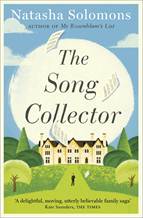
The Song Collector by Natasha Solomons

image003

I’m thrilled to be part of the paperback launch celebrations for Natasha Solomons’ The Song Collector which was published by Sceptre, an imprint of Hodder Books, on 24 March 2016, in paperback and ebook. It is also available in hardback. The Song Collector is available directly from the publisher, WaterstonesAmazon USAmazon UK and from all good bookshops.

I’ve only just had time to begin reading The Song Collector, but I already love it. I’m also honoured to have a guest post below from Natasha all about the cinematic means of setting scenes in which you can get a glimpse of the beauty of her writing.

About The Song Collector

Fox, as the celebrated composer Harry Fox-Talbot is known, wants to be left in peace. His beloved wife has died, he’s unable to write a note of music, and no, he does not want to take up some blasted hobby.

Then one day he discovers that his troublesome four-year-old grandson is a piano prodigy. The music returns and Fox is compelled to re-engage with life – and, ultimately, to confront an old family rift. Decades earlier, Fox and his brothers return to Hartgrove Hall after the war, determined to save their once grand home from ruin. But on the last night of 1946, the arrival of beautiful wartime singer Edie Rose tangles the threads of love and duty, which leads to a shattering betrayal.

With poignancy, lyricism and humour, Natasha Solomons tells a captivating tale of passion and music, of roots, ancient songs and nostalgia for the old ways, of the ties that bind us to family and home and the ones we are prepared to sever. Here is the story of a man who discovers joy and creative renewal in the aftermath of grief and learns that it is never too late to seek forgiveness.

image003

Praise for The Song Collector

‘A delightful, moving, utterly believable family saga.’ The Times

‘Takes you quietly by the hand and introduces you to such brilliantly portrayed characters, nuanced conversations and feelings, a true sense of place. Time and again I marvelled at the way Natasha Solomons unveils a quite complex plot with unerring confidence that makes it all click into place so logically.’ New Books & nudge

‘Packed with beautiful writing and marvellously conceived characters, The Song Collector moves effortlessly between the threadbare riches of England’s postwar country house society and the discordant ambitions of modern life, all bound together by a timeless love story that will break you and heal you.’

Beatriz Williams, New York Times bestselling author of A Hundred Summers

‘A tender, lyrical novel of family and fame.’ The Express

‘This novel is a profound story of love, loss and reconciliation. A captivating read that examines the power of music.’ Lady

Setting the Scene

A Guest post by Natasha Solomons

I don’t think I have a photographer’s eye – I have the dubious skill of missing out people’s heads whenever I take a snap – I think I’m probably more influenced by cinema. My first editor once commented on how I carefully light every scene. I do think in terms of scenes – I hear the characters speaking in my mind, and I see how they move – those tiny gestures that reveal emotion, the glance away, the irritable stirring of a teacup. Objects too can become infused with emotion. I’ve always loved the Philip Larkin poem ‘Home is so Sad’: ‘Home is so sad./ It stays as it was left,/Shaped to the comfort of the last to go/As if to win them back… You can see how it was: /Look at the pictures and the cutlery./ The music in the piano stool. That vase.’

I love the final line: ‘That vase’. It’s so simple, an unremarkable phrase and yet its specificity within the poem makes it oddly moving and also cinematic. I always picture ‘that vase’ left on the table in the empty house gathering dust – but as the camera in my mind lingers on it, I know that once ‘that vase’ meant something to someone. An entire narrative is implied in those two ordinary words. What was it? I imagine a different story each time I read the poem.

When I write a scene I know how much can be suggested by the inclusion of an object familiar to the reader. In ‘The Song Collector’ entire landscapes are suffused with significance for Fox: his creativity is bound up with his sense of home and the hills around Hartgrove. The description of landscape in the novel is never simple – it usually evokes Fox’s conflicting desire to write music and to care for the estate. It’s also a landscape that he lived in with Edie so that after her death the places themselves are imprinted with longing and loss: he sees his earlier shadow on the hills.

I’m fascinated by the connection between music and place. Will Hodgkinson writes that music has a regional accent and I love that idea. A folk song found in Dorset has a different feel to one sourced in Isla. Sibelius or Delius write music deliberately to evoke a specific place but in my novel the Wessex Ridgeway and the dark trees leach into Fox’s music unconsciously. Anteus like his strength comes from the earth of home. He struggles to write away from Hartgrove. He borrows the folk tunes he collects in a style similar to that of John Rutter or Vaughn Williams but the creative source of his internal music landscape is already a reflection of the Dorset landscape and hills that he’s loved through his life. This novel is about love: for a woman, for the songs of home and for the hills and copses of which they sing.

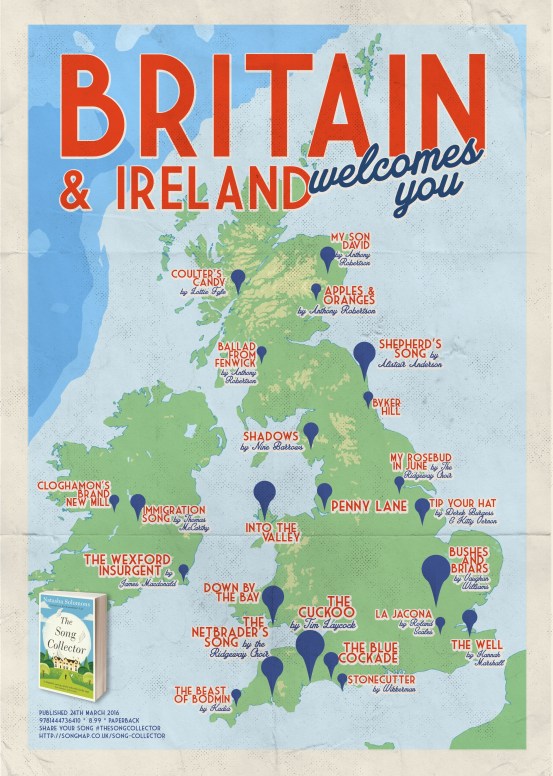
The Map of Songs from The Song Collector

Song Map

The history of Britain isn’t just written in books or notched upon the landscape in Holloways or long barrows, it’s also contained in song.

Since writing this novel, Natasha Solomons has been enchanted by the idea of song collecting. Inspired by the tradition, she has set out to create a portrait of contemporary Britain in song. Every hillside, village and city street has a song, some ancient and others new. Natasha is beginning a communal project to map as many songs as possible, put them up online freely available so that people can both listen to the music of their town, and if they like, learn their own local songs.

Natasha said:
‘It was a song about a blackbird that led me to write my new novel The Song Collector. I discovered that a song collector, alehouse keeper and mischief-maker lived in our cottage in the 1800s. The more I read about and listened to old songs from where I live in Dorset, I realised that I had to write a about a musician and song collector and his connection to the landscape – and woman — he loves.

As I wrote, I started to appreciate that songs are much like stories – one has to follow their rhythms and cadence. But, when I finished the book, I knew I wasn’t finished with song collecting. I’d been utterly caught. After all, there’s always one more song to find.
We now want to create a portrait of contemporary Britain in song. Every hillside, village and city street has a song, some ancient and others new. We want to start a communal project to map as many songs as possible, put them up online freely available so that people can both listen to the music of their town, and if they like, learn their own local songs. We’d love for you to get involved’

For more information on the Great British Song Map please contact Helene Frisby
helenefrisby@gmail.com

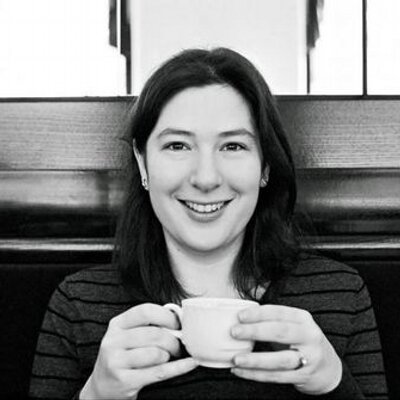
About Natasha Solomons

natcafe_400x400

Natasha Solomons is the author of the internationally bestselling Mr Rosenblum’s List, The Novel in the Viola, which was chosen for the Richard & Judy Book Club, and The Gallery of Vanished Husbands. Natasha lives in Dorset with her son and her husband with whom she also writes screenplays. Her novels have been translated into 17 languages.

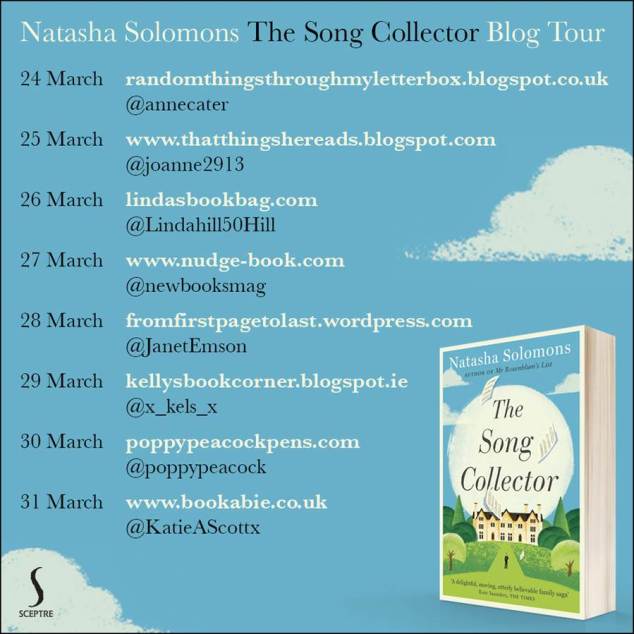
You can follow Natasha on Twitter and find out more about her on her web site and with these other bloggers:

The Song Collector Blog Tour Poster

Author Interview with Martin Spice

Lynx

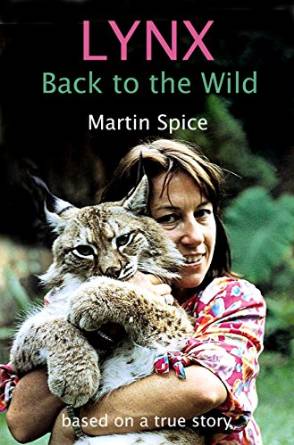
When I found that Martin Spice is an ex-teacher, like me, loves travel, like me, and is a passionate gardener, also like me, I had to invite him on to Linda’s Book Bag to talk about his family novel Lynx:Back to the Wild which is available for purchase on Amazon UK and Amazon US.

About Lynx: Back to the Wild

A tiny lynx cub with no mother. A wise monk in an ancient monastery. A destiny to be fulfilled. A perilous journey across the Himalayas. A battle against time to save the cub’s life. A firm friendship between two boys, worlds apart, united by their love of animals.

Based on a true story and set in Tibet and Nepal, LYNX: Back to the Wild is an exciting adventure story for all the family, full of the life and colour of its exotic settings and deeply moving in its account of a desperate struggle for survival against all the odds.

Rooted in the author’s extensive travels and love for the people and cultures of the Himalayas, this short novel is a celebration of human and animal survival set against one of the world’s most beautiful but harshest environments.

Lynx

An Interview with Martin Spice

Hello, Martin. Thank you so much for agreeing to answer some questions on my blog about your writing and in particular about LYNX: Back to the Wild, your new book.

Firstly, please could you tell readers a little about yourself?

I was born in Northampton, now famous for the film and musical Kinky Boots! I spent my professional life as an English teacher in England and overseas and latterly as the principal of an international school in northern Borneo. In all we spent twenty years working abroad, over nine of which were in Kathmandu. The opportunities for travel were wonderful and Tibet was, of course, an outstanding destination. We came back to England to settle in 2009 and have lived happily near Nailsworth ever since, tending two veg patches, writing and enjoying the company of our children and grandchildren.

(My goodness – more things in common. I went to school in Northamptonshire and my Grandmother belonged to a Northampton shoe making family at the turn of the 20th Century!)

When did you first realise you were going to be a writer?

It is probably a truism that all English teachers want to be writers but I never really got going until I was in my late thirties. And even then I only wrote sporadically. When we worked in Malaysia my writing suddenly took off with a lot of journalism, travel writing and reviews. When we returned to England, I did a lot of work for the Times Educational Supplement and then we decided to write a tongue-in-cheek book about our vegetable growing experiences. That became Spade, Seed & Supper: an allotment year.

Spade,+Seed+&+Supper+FCP

(Looks like I’d better get a copy, Martin, as I have an allotment!)

If you hadn’t become an author, what would you have done instead as a creative outlet?

I would love to say “played saxophone” but as I am completely unmusical it was just as well writing was always my first choice.

(Are you sure we’re not related? I’m tone deaf!)

How do you carry out the research for your novels?

We lived in Nepal for a total of nine years and I travelled to Tibet twice. I suppose that would have constituted research had I actually realised that I was going to write LYNX: Back to the Wild. As it was, I was able to draw on the experiences I had already had.

Tell me about how LYNX: Back to the Wild came to be written.

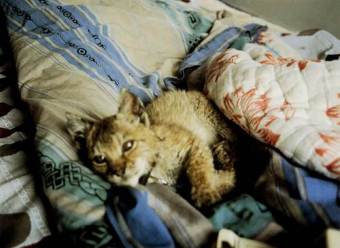
The book is based on a true story. We had friends in Kathmandu who reared a lynx cub that had been brought to them by some travellers in Tibet. It had been very sick at first but when I knew Tashi, which was the cub’s name, he was a healthy survivor. We saw him frequently and were fascinated. One evening they told me the whole story of his rescue and rearing and I knew then that it was a story that had to be told.

How much did you need to add to that basic storyline?

A great deal. There are two strands to the book, the survival of the lynx cub and the story of the Tibetan boy that finds and protects it. He is called Sonam and the book hints that there is something very special about him. He is not like the other nomad children. He is quieter, more reflective, more thoughtful. When he has parted with the cub he feels destitute. He accompanies his mother to a monastery where he gets lost. There he meets a monk to whom he spills out all his woes. The monk tells him that he has a destiny to fulfil and that it is somehow connected with the cub. So Sonam sets off on a perilous journey overland to Kathmandu… From then on his story is intertwined with that of the lynx cub.

Is LYNX: Back to the Wild an adult book or a children’s book?

Emphatically both. It has been used very successfully in the classroom but it has also been read by a lot of adults who have become engrossed in the story. My wife has tales of her classroom assistant in tears! I feel above all that this is a family book. So much can be gained from books being shared. LYNX: Back to the Wild raises lots of issues to do with endangered species and survival, as well as being an out-and-out adventure story set in a fascinating culture.

Which aspects of your writing do you find easiest and most difficult?

Getting down to it is the hardest part! I am capable of working very hard but I also think of myself as a natural prevaricator. I enjoy most of the writing process once I get down to it.

When you’re not writing, what do you like to read?

I read a lot of modern fiction, much of which I review for The Star in Malaysia. It’s the biggest English language paper in the country and they have a Books section that is taken very seriously.

Do you have other interests that give you ideas for writing?

Growing vegetables. That obsession led to the writing of Spade, Seed and Supper, a very tongue-in-cheek account of our attempts to grow our own food. Many of our experiences were very funny and the book reflects that with some lovely cartoon illustrations. Travelling, running a school and the family also provide ideas. They are everywhere once you start looking!

Which of your characters would you most like to be and why?

I rather envy the monk who advises and teaches Sonam; there is a certainty and wisdom there that I find very attractive.

If one of your books became a film, which would you choose and why?  

LYNX: Back to the Wild, unhesitatingly. It would make a wonderful film because the scenery is breath-taking and the lynx is such a beautiful animal. It is also, I think, a very moving story.

How important do you think social media is to authors in today’s society?

Clearly very, and even more so if you self-publish because it is the only shop window we have. I wish I felt more comfortable about it because Twitter seems almost obligatory and I haven’t yet summoned the courage to open an account. I do have a website though which readers can reach by clicking here.

If you had 15 words to persuade a reader that LYNX: Back to the Wild should be their next read, what would you say?

You will be captivated by the cub, fascinated by the cultures and thrilled by the adventure. I hope!

Martin, thank you so much for your time in answering my questions. I think LYNX: Back to the Wild sounds great.

It’s me who should be thanking you for this opportunity. I am very grateful.

You’re most welcome.

Readers can find out more about Martin and his writing on his website where there is more about the story behind LYNX: Back to the Wild, including some wonderful photos.

a+very+sick+cub

In the Shadows by Tara Lyons

IntheShadows

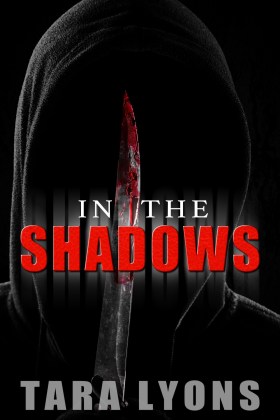
I’m delighted to be part of the launch celebrations for Tara Lyon’s debut novel In the Shadows which was published on 17th March 2016. Not only do I have a guest post from Tara, all about the power of the mind, but you also have the opportunity to enter to win a copy of In the Shadows at the bottom of this post.

Tara has her own blog and you’ll find her on Facebook and Twitter.

In the Shadows

IntheShadows_fbcover

In the Shadows is the debut crime/psychological thriller novel from Tara Lyons.

Detective Inspector Denis Hamilton is tasked with apprehending a brutal murderer stalking the streets of London – and leaving not a shred of DNA evidence. As the suspect list mounts, his frustration and pressure from his superiors intensify.

Grace Murphy, who is dealing with the recent loss of her beloved grandfather, falls deeper into despair when her friends’ bodies are discovered. Fearing she might be the killer’s next target, she begins to question if her horrifying nightmares are the key to unravelling the murderer’s identity.

How far would you go to uncover the truth? Would you venture into the shadows to unmask a killer?

An Intricate Mind

A Guest Post from Tara Lyons

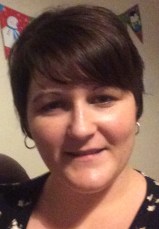
Tara Lyons

The mind is a curious thing, never resting, even when our bodies do. Imagine what you could uncover were you to delve into the minds of some. To find out why a person reacts the way they do, why they choose certain paths during their lives and their reasons for interacting with certain people causing a variety of different relationships.

The unconscious mind is just as fascinating, more so even. Most people have created a technique for pushing certain thoughts, feelings and memories to a place in our mind we don’t tap into on a daily basis. But are they really forced away, or are we just clouding our thoughts only to be faced with them, or a representation of them at least, in our dreams?

Dreams will be viewed differently from person to person. Some may believe that these visions are purely figments of an overactive imagination. While you’re in a deep slumber, your mind conjures up a variety of things you have seen and heard in your waking state and fuses them together, almost like telling you a fictional story. Others will look into their dreams in great detail, trusting that they carry with them answers to the questions they seek about their lives, their personal choices and their futures.

An old colleague I used to work with, let’s call him John, got in touch with me a few weeks ago via Facebook Messenger. We haven’t seen, or probably spoken, to each other for at least two years. I had posted a memorial poem on Facebook to mark the anniversary of my grandfather’s death and John got in touch after seeing it. He explained that the poem had touched deeply because his mum had passed away just a few days before. Sadly, John’s mother had lost her battle with cancer, just as my grandfather had the year before. We exchanged condolences and promised to meet up soon.

That brief interaction stayed with me however because a few nights later I dreamt of John. When I woke up the details faded, as they seem to do the morning after – it’s as though your mind doesn’t want you to recall what it shared with you while you were asleep. But what my waking-self did hang on to was an image of John and I holding hands while roaming round a derelict building.

Again I’m sure people will interpret this dream in many different ways. John was on my mind and therefore I’ve assumed the man in my dream is him (I can never actually see faces clearly in my dreams – is that a personal thing, or does it happen to you too?). Some may say the hand holding is a supressed love interest, be it towards John or men in general. It could be that I’m feeling alone as well as lonely and the deserted atmosphere represents that. And all those assumptions could be correct. But that’s the beauty of the mind.

Your mind, and the dreams it conjures, almost plays a trick on you. Because now it has you questioning yourself and probing what your subconscious is telling you. Forcing you to make sense of images that may mean nothing more than a chance meeting with an old friend, a conversation with a stranger on the bus, or an old favourite song that sparks a memory you’d long forgotten.

Personally, looking into the meanings of dreams is something I enjoy. I regularly use the online search engines to find out what it means if I’ve dreamt of a cat in my house (I don’t have any animals) or if I’m boarding a plane (something I haven’t done for two years). I’m fascinated about what my mind is trying to convey while my body is rest mode. However, with this dream I didn’t feel the need to research, I interrupted it myself.

Two people, wrapped in grief, came together and wandered around their empty homes together, looking for strength to move forward. When it comes to grieving – and I’m awake – I am not a hand-holding, touchy-feely person. So perhaps this was my way of telling myself it’s okay not to be strong all the time, even when it’s been years since you’ve lost a loved one, because there are people out there facing the same heartache every day.

Amazing what the mind will have you believing. Perhaps it wouldn’t hurt to take some advice from the great Professor Dumbledore: “It does not do well to dwell on dreams and forget to live.” (J.K. Rowling, Harry Potter and the Sorcerer’s Stone).

InTheShadows2

If international readers would like to enter to win an ecopy of In the Shadows, please click here. UK readers also have the opportunity to enter to win a signed paperback copy. The draw is open until UK midnight on 31st March 2016.

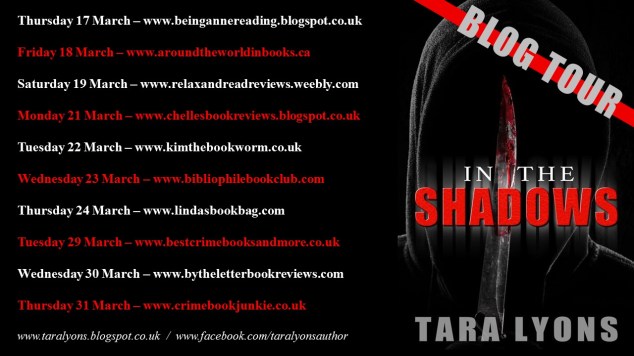
You can find out more about Tara and In the Shadows with these other bloggers:

IN THE SHADOWS_Blog tour March 2016

Beneath the Surface by Heidi Perks

cover

I’m delighted to be bringing a guest post by Heidi Perks whose debut novel Beneath the Surface is published tomorrow 24th March 2016 by Red Door Publishing. As well as from the publisher, Beneath the Surface is available in paperback and e-book on Amazon UK and in e-book on Amazon US.

Beneath the Surface

‘An intriguing novel… with a dark mystery at its heart’ C L Taylor, author of The Accident

I don’t know where you are…

I don’t know what I’ve done…

Teenager Abigail Ryder is devastated when she gets home from school to find her family gone. Nothing makes sense. Things are missing from the house and her stepsisters’ room is completely empty. But the police think she’s trouble, and when grandmother Eleanor tells her to forget them all and move on, there’s no choice other than face the future – alone.

Fourteen years on, Abi and Adam are a happy couple on the verge of parenthood. But when the past comes back to haunt Abi, the only way forward is to go back and uncover the truth – and reveal the dreadful secrets a mother has been hiding all these years.

Taking the Leap from Corporate to Writing

A Guest Post from Heidi Perks

I always knew that one day I would try writing a book but up until a few years ago I hadn’t done anything about it. I’ve always loved reading books and writing but had never felt the time was right to try.

I was working for large companies in marketing for nearly fifteen years, and had moved up to a good position as Marketing Director. I liked my job a lot even though it wasn’t my dream and the thought of giving it up to write wasn’t something I could seriously consider – that was too big a leap. So in a way I felt lucky when fate played its hand. I was on maternity leave with my second child and was offered redundancy. At first the thought was daunting, I had returned part time after my first child was born and assumed I would do the same again. But at the same time here was a great opportunity to do something different – something I really love.

I have now been writing seriously for four years and I don’t doubt that there’s nothing I would rather do. But that’s not to say it’s always easy. There are some things I really miss about working for a large company and mostly this is the people. Some days in between school runs I don’t see anyone else and as a people person it can be very lonely. When you’re used to people asking you questions, constantly running things by you, being in and out of meetings all day then spending the day with only your own imagination for company can be hard.

Also in the early days, in particular, I was hugely reliant on other people, and this requires patience. Agents and publishers warn they may take 6 weeks to get back to you and that can seem like the longest 6 weeks ever.

Then there’s the rejections, or only slightly better the feedback that says they like what you’ve done but then ask if you can completely re-write it. After holding my head in my hands for a few hours I’d have to pick myself back up and get back to it again, and unlike working for a big company there was no one to help me do that.

So yes it’s tough, but then when you get a break you realise that it’s all worth it, and for me it really is. The first time I wrote the words ‘The End’ and realised I had strung together 90,000 words into a complete novel, the first time an agent called me and said ‘we love what you’ve sent us,’ and the first time you hear a publisher say, ‘we want to publish you,’ were all momentous occasions. The moment I held a copy of my book in my hands, and when brilliant reviews came into my inbox were both moments of pure joy that I would never have experienced if I wasn’t doing something I desperately wanted to do.

When I started writing I fitted it around my two young children, and I know many have full time jobs too, which makes it incredibly difficult. But whatever you’re doing, if it is something you love it will be worth it. It might not be the journey you expect, in fact it probably won’t be, but that’s half the fun of it!

Thanks so much Heidi – I think an awful lot of aspiring writers, including me will take so much from what you’ve told us today. Very best of luck with Beneath the Surface.

Heidi

You can follow Heidi on Twitter and you’ll find her on Facebook and via her web site.

Author Interview – Barbara Copperthwaite

flowers for the dead kindle format 04.jpg

I’m so lucky to have met and chatted with lovely Barbara Copperthwaite at a blogger and author event organised by the wonderful Kim Nash and so I’m thrilled that Barbara has agreed to be interviewed for Linda’s Book Bag.

Barbara’s Books

Barbara writes gripping psychological thrillers. Her first, Invisible, was published in 2014 and is available in e-book and paperback on Amazon UK and Amazon US.

invisible cover large 02 new res 01

THERE’S ONE VICTIM OF CRIME NO ONE NOTICES…

Something is wrong. With her marriage, with her husband, with her. But as she pours her heart out to her diary, it’s clear she doesn’t know what.
Until one explosive night she finds a possible answer.
Suddenly hated and vilified by everyone, she clings to her relationship – even while wondering if she really knows her husband at all…
Invisible is a stunningly powerful, gripping and original psychological thriller of subtle insight that takes you on a twisted journey through one woman’s marriage.

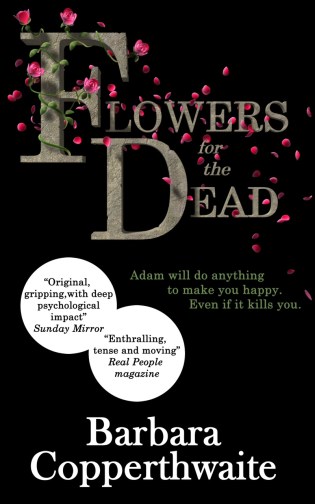
Barbara’s latest novel, Flowers for the Dead, is also available in e-book and paperback on Amazon UK and Amazon US.

flowers for the dead kindle format 04

ADAM WILL DO ANYTHING TO MAKE YOU HAPPY. EVEN IF IT KILLS YOU.

Adam Bourne is a serial killer who thinks he is a saviour. When he murders young women and cuts off their lips, he believes he has done it to make them happy.
How did he become warped from the sensitive four-year-old who adored his gran and the fairy tales she read to him? What turned him into a monster who stalks his victims? And what is he trying to say with the bouquets he sends?
When he meets Laura Weir, Adam weaves a fairy tale romance around them. A tale she has no idea she is part of. As he hatches his twisted plan for their fairy tale ending, can anyone stop him before he creates the ultimate sacrifice to love?

An Interview with Barbara Copperthwaite

NEVX7167

Hello Barbara. Thank you so much for agreeing to answer some questions on my blog about your writing.

Firstly, please could you tell readers a little about yourself?

Hello! I’m a journalist turned author of psychological thrillers. Using the knowledge I’ve gained over more than twenty years of interviewing perpetrators and victims of crime, I love to really get under the skin of my characters to create gritty, realistic stories. I don’t write whodunits, I write ‘whydunits’, as it’s the emotion of a situation that really grabs me.

When I’m not busy plotting murder (figuratively speaking, of course) I can generally be found walking my dog, Scamp, and taking photographs of wildlife in my local area around Birmingham.

On your new website you describe yourself as a crime writer. What drew you to this genre as opposed to another for your novels?

It’s just the way my brain works! I used to quite scare my partner, when we’d be walking down the street and I’d suddenly blurt out a great way of bumping someone off, or a place to hide a body. He’s used to it now though. Only the other day we went for a lovely walk on some marshes and were discussing how it was the ideal place to dump a body!

My mum has always loved crime, so I grew up watching Taggart, Morse, and the like. Going back even earlier, I was obsessed with reading Enid Blyton’s ‘Mystery’ series. I can remember the first time I solved one of the crimes before the big reveal, and feeling so proud of myself.

I’ve always been fascinated by why people do things, too. Again, for me a good crime book is as much about why as who. That’s the real mystery to solve. It’s what attracted me to journalism, as it gave me the chance to talk to people who have been in all kinds of incredible situations.

When did you first realise you were going to be a writer?

There wasn’t really a lightbulb moment for me, instead the feeling stole over me gradually. I became a journalist when I was 19, so writing was second nature to me, but I used to feel quite annoyed when people asked me, “When are you going to write a book?” As far as I was concerned, books were for me to read, not create. “I’m a journalist, I deal in facts,” I’d tell people. Honestly, I didn’t think that would ever change as, although I’ve always been a voracious reader, I never had any ideas for novels and had no drive to write one either.

But there was a tiny kernel of an idea from a brief period in my early twenties when I’d spent some time working in a men’s high security prison. I’d been fascinated by how normal all the inmates were – they were so easy to chat to. And over the years, through interviewing various victims of crimes as well as the occasional perpetrator, that was what kept coming up all the time: bad people seem nice and normal when you meet them, that’s how they get away with what they do for so long.

I started to wonder what it would be like to live with someone accused of something terrible. How much would it take for you to believe he’d done something wrong? Surely a hell of a lot, because no one can believe they would love someone who was capable of evil.

That’s how the idea grew for my first novel, Invisible. As a journalist, I desperately wanted to interview someone like the main character, but as time passed it became increasingly obvious it was probably never going to happen. So in that case, I’d have to make it up…and one day I sat down and started doing just that. Once I’d begun, I soon became obsessed. I’d write on the train to work, during my lunch break, and on the way home.

How did that moment feel when you decided to give up your previous employment and become a writer full time?

Terrifying! I was a successful journalist who had risen through the ranks, been in charge of a number of different national women’s weekly magazines, and was used to managing a large team of people. I was also used to a good, steady wage. And there I was, throwing it all away pretty much on a whim. I’d only written half of Invisible, but it was enough to know that it was what I wanted to concentrate on.

All of this happened immediately before my 40th birthday, and I think some friends did secretly wonder if I was having a midlife crisis – I know I did!

At first I cheated, and did a lot of journalism on a freelance basis, in order to bring in some extra cash while I wrote my first two books. But now I’ve given that up completely so that I can concentrate on being an author.

What advice would you give to those also thinking of writing full time now that you’ve experienced it?

Only do it if you’re truly passionate about not just writing a novel, but all the hard work that goes with it. Writing is only half the job. Whether you’re traditionally published or an indie author, you will have to spend a monumental amount of time promoting your books and making contacts in the industry. It’s a full time job, and if you’re not willing to put in incredibly long hours you will fail. It’s as simple as that. You’ve got to be driven, dedicated, and exceptionally hard working.

It can also be a lonely job sometimes, as so much time is spent working on your manuscript in isolation. There’s no office banter.

Is it worth all that worry, sweat, tears? Hell, yes!

To what extent have your previous experiences impacted on your fiction writing?

I’ve interviewed so many people who have been victims of crime, and all those stories have influenced me massively. I think it’s really important to have characters that are believable. It’s incredible what people can go through and survive, and I think that’s one of the reason why, I believe, my books are ultimately hopeful. They are full of grit, but also full of honesty and heart.

How far does your experience of being an editor help or hinder your writing process?

It’s definitely been both a help and a hindrance. At first it was frustrating for me because I was used to being able to produce a feature that was pretty much word perfect at the end of the first draft. I’d give it a read through then send it off to be printed, job done. Writing a book is nothing like that. I’ve had to get used to the fact that while writing the first draft I frequently feel out of control, and that the finished first draft is very rough, and has to go through a lot of rewrites and editing before it’s ready to be published. So rather a different experience to when I wrote articles…!

There are plenty of positives, though. Thanks to all those years of journalism, I know what makes a good story, how to hook readers, construct a tale, pace, characterisation, etc. Being a former editor helps me to step back and look at the book as a whole, to see the big picture. It’s been particularly useful when coming up with concepts for the cover. My partner is a very talented artist, who works with me to create something I think will sum up the story as a whole, without giving anything away.

You often review books too. How important is it for writers also to be readers do you think?

You can’t write if you don’t read. Simple as that. And don’t just read your own genre, read everything. I love reading, and that has inevitably influenced my love of writing.

You have a brilliant relationship with bloggers. What impact have they made on your life as a writer?

I only made contact with book bloggers back in August for the first time. Now, I don’t know why it took me so long! What a wonderful community! I’ve made some lovely friends along the way, and they’ve transformed so many aspects of my life as a writer. Yes, there’s the obvious stuff, such as they’ve read my books and reviewed them. But it’s so much more than that. You know earlier when I mentioned what a lonely job being an author can be? Well, thanks to the online community I have been lucky enough to become part of, I have found a network that is friendly, supportive, open with advice… It’s just so wonderful, I can’t actually gush about it enough.

In Flowers for the Dead, why did you decide to have a male protagonist?

I don’t think there was a decision, Adam came to me fully formed. Thinking about it now, I could have told the story much more from Laura’s point of view, but it has been done before. I could have told it more from the perspective of the detective, Mike Bishop, but that’s been done so many times, too. Telling it from the serial killer’s point of view…that’s almost unheard of.

I was fascinated with Adam, too. Was he born bad or made bad? What had happened to him? Could he have been different, if his life had taken just the slightest of turns? I suppose it’s the journalist in me, still trying to get the stories that have never been heard.

You don’t name the woman in Invisible? Why was that?

I was partly influenced by one of my favourite books, the classic Rebecca, by Daphne Du Maurier, as the second Mrs De Winter’s first name is never used. The device seemed so fitting for my novel. This is a woman who is invisible in every way. To friends. In her marriage. At work. Even when she is the most hated woman in Britain, she is still never seen for the person she really is – she is the one victim of crime no one notices.

Had I given her a name, it wouldn’t have made any difference to the story. But by not naming her, I feel it adds to the whole theme.

I know you like to photograph wildlife. Is this a lifelong hobby or does it act more as an antidote for the grittiness of your writing?

I started nature watching as a child. My sister used to laugh at me because I could look at an animal dropping and know what had done it! Sadly, as I hit my mid-teens, exams, boys, going out, all the usual stuff, took over and although I was still interested in wildlife, it wasn’t something I actively did any more.

Six years ago Paul and I got together and we loved to go for long walks in the countryside. It really helped me unwind after a stressful day in the office. Paul bought me a camera, and that really reignited my passion for nature. When I take a picture there is nothing but that moment, holding my breath, hoping I won’t scare the subject away. There is no past, no future, only the present. Back at home, I love to read up about what I’ve captured, so I learn as I go. It’s utterly absorbing in a totally different way from crime.

What can we expect next from you?

I’m in the process of writing my thirds stand alone psychological thriller, and it’s my most ambitious novel yet. A woman is forced to turn detective when the village she lives in conspires to keep secret what happened to her daughter. Nothing and no one is what they seem, everyone is hiding something, and once she has revealed it all, she will never be the same again…

That sounds brilliant – we’ll all be waiting for it to arrive with anticipation!

Thank you so much for your time in answering my questions Barbara. I found your answers utterly fascinating.

You can find out more about Barbara by visiting her website and following her on Twitter.

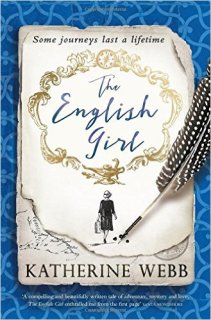
The English Girl by Katherine Webb

The English Girl

It’s my great pleasure to be part of the UK launch celebrations for Katherine Webb’s latest novel The English Girl which is published by Orion. The English Girl is out in hardback, audio and e-book on 24th March 2016 and is available on Amazon UK and directly from the publisher. Not only can you find out all about this latest release, but Katherine has written a guest post all about international publications which you can read below.

The English Girl

Joan Seabrook, a fledgling archaeologist, has fulfilled her lifelong dream to visit Arabia by travelling from England to the ancient city of Muscat with her fiancé, Rory. Desperate to escape the pain of a personal tragedy, she longs to explore the desert fort of Jabrin, and unearth the treasures it is said to conceal.

But Oman is a land lost in time – hard, secretive, and in the midst of a violent upheaval – and gaining permission to explore Jabrin could prove impossible. Joan’s disappointment is only alleviated by the thrill of meeting her childhood heroine, pioneering explorer Maude Vickery, and hearing first-hand the stories that captured her imagination and sparked her ambition as a child.

Joan’s encounter with the extraordinary and reclusive Maude will change everything. Both women have things that they want, and secrets they must keep. As their friendship grows, Joan is seduced by Maude’s stories, and the thrill of the adventure they hold, and only too late does she begin to question her actions – actions that will spark a wild, and potentially disastrous, chain of events.

Will the girl that left England for this beautiful but dangerous land ever find her way back?

The English Girl

International Publications

A Guest Post by Katherine Webb

I was so lucky with my first book, The Legacy – thanks to the build up of a wonderful momentum, and the heroic efforts of the Orion Rights team, it has now sold in twenty-seven countries around the world, most of which in translation. I get sent copies of most of these foreign editions, sooner or later, and I just love seeing my words in a language I can’t even speak, and thinking of readers in all those far off places, hopefully getting engrossed in one of my stories. China, Russia, Brazil, Turkey, Taiwan… Very surreal to see my words in an alphabet I don’t even recognise! It’s always interesting to see the different cover designs as well – and to try to draw conclusions as to what each different treatment says about the book market in that country, and where they see my novels fitting in, with regards to genre and tone.

The Legacy

Since those heady early days, my foreign markets have contracted to those in which the books have really sold well and got bedded in with readers. France, Turkey, Sweden; Germany, Norway and Hungary in particular; although, of course, foreign publishers can pick and choose which books they want to publish, and they don’t necessarily publish them in the same order that they come out in the UK, so new deals come in at odd times, without warning. It’s always a great feeling when they do.

I’ve been lucky enough to be invited to several countries to publicise a book’s release, and meet readers – Spain, Poland, Norway, Germany. Amongst other visits, I did a two week tour of Norway, starting in Tromsø, right up in the Arctic! I went up a few days before the tour started, and saw the Northern Lights – it was amazing. I was travelling with a group of other authors, flying between cities and doing a staged event each night – it was exhausting by the end, but a wonderful experience. My favourite tour of Germany came the year before last. I’d told the team over there that my mother grew up in Germany, in Bad Homburg, so they managed to arrange an event there, and some of my mum’s old school friends came along. That was a proud moment! A German actress called Anna Thalbach, who belongs to a famous acting dynasty in Germany, does the reading in German for me. She is fantastic – even when I can’t understand what she’s saying, she delivers such drama and atmosphere to the words, and I can see that the audience is rapt

You can follow Katherine on Twitter, find her on Facebook.

You’ll also find out much more about The English Girl and Katherine with these other bloggers:

KW blog tour

What Happens in the Alps – Release Blitz

TAWilliams-Alps-ReleaseBlitzBanner

Ever since I read What Happens in Cornwall by T A Williams (and you can read my review here) I’ve been delighted to support T A Williams’ lovely books. Today, 21st March 2016, is the launch day for What Happens in the Alps, Trevor’s latest chick lit book published by Harlequin and Carina UK.

TAWilliams-Alps-Cover

What Happens in the Alps

Up in the magical, snow kissed mountains…

Two years ago, Annie Brewer’s life was turned upside down when her adrenaline-junkie husband died in a tragic climbing accident. So she’s hoping that moving to the beautiful village of Santorso in the Italian Alps will finally put her life back on track!

…anything can happen!

She might be going into business with her oldest friend – notorious lady-charmer Matt Brown – but men are definitely out of the question for Annie! That is, until she bumps into tall, dark and delicious Alessandro Lago on the ski slopes…and spontaneously says ‘Yes’ to a date! It must be the crisp mountain air but suddenly, anything seems possible. The only trouble is, chivalrous Matt is looking more gorgeous than ever…

A sparkling romantic comedy guaranteed to beat the winter blues, What Happens in the Alps…is one story you don’t want miss in 2016!

You can find What Happens in the Alps on Goodreads and you can buy it from Amazon US,  Amazon UK, from Barnes and Noble and on iTunes

About T A Williams

TAWilliams

Firstly, my name isn’t T A. It’s Trevor. I write under the androgynous name T A Williams because 65% of books are read by women. In my first book, Dirty Minds one of the (female) characters suggests the imbalance is due to the fact that men spend too much time getting drunk and watching football. I couldn’t possibly comment. Ask my wife…

I’ve written all sorts: thrillers, historical novels, short stories and now I’m enjoying myself hugely writing humour and romance. Romantic comedies are what we all need from time to time. Life isn’t always very fair. It isn’t always a lot of fun, but when it is, we need to embrace it. If my books can put a smile on your face and maybe give your heartstrings a tug, then I know I’ve done my job.

I‘ve lived all over Europe, but now I live in a little village in sleepy Devon, tucked away in south west England. I love the place. That’s why you’ll find leafy lanes and thatched cottages in most of my books. Oh, yes, and a black Labrador.

I’ve been writing since I was 14 and that is half a century ago. However, underneath this bald, wrinkly exterior, there beats the heart of a youngster. My wife is convinced I will never grow up. I hope she’s right.

You can find out more about Trevor on his website, on Facebook, Goodreads and Amazon. You can also follow him on Twitter


Author Interview with Rosa Temple

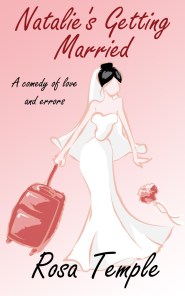
Natalies Getting Married Cover

I’m delighted to be featuring an interview with Rosa Temple today whose latest novel Natalie’s Getting Married is available to buy on Amazon US and Amazon UK. If you’re quick and head over to Rosa’s blog you have until 25th March 2016 to enter to win a copy of Natalie’s Getting Married.

An Interview With Rosa Temple

Rosa Temple author pic

Hello Rosa. Thank you so much for agreeing to answer some questions on my blog about your writing.

Firstly, please could you tell readers a little about yourself?

I’m a Londoner from a big, loud family. I could never get a word in, which is probably why I like to sit quietly and write. I’m married to a musician and I have two sons. I’m a ghost writer of romance novellas and the occasional magazine article (again in a ghost writing capacity, so I have no published articles to my name). I’m a lover of music who secretly puts on the player and does unchoreographed dance routines in front of the mirror when I’m finding it hard to write the next sentence. I have a very dry sense of humour which sometimes gets me in trouble.

When did you first realise you were going to be a writer?

It was probably right after I discovered that there is no such job as an official biscuit taster and failed in my attempts to have it recognised as a real career. But seriously … I mentioned my husband is a musician, well I’m also a singer-songwriter and all my songs are tiny stories. I began writing short stories that lasted for more than three verses and a chorus and, after taking a 10 week Creative Writing course to see if I was any good, I continued to write because of the encouraging feedback.

If you hadn’t become an author, what would you have done instead as a creative outlet as I know you are interested in music and it’s a big part of your life?

Yes, I love music. As a singer I’ve been in several bands before I started penning my own songs. Although the writing is taking up most of my time these days, I still perform, though it’s been a while since I wrote a song. Something I plan to remedy by starting a new album project very soon. I teach vocals, which is really satisfying and I also co-produce music for other singer-songwriters. Had the writing not taken hold, then I would have continued to immerse myself in music. But it’s good to know that I can still be involved in both.

How much did doing an MA (and congratulations on the distinction by the way) in Creative Writing affect your style?

Tremendously. I became a more positive and less nervous writer. On the course we were constantly writing under the guidance of some well known authors, poets and screenwriters which was an amazing experience and a real confidence booster. The most important thing I took from the course was developing my writer’s voice, discovering the themes I love to cover and gaining more experience in my preferred genre. All things that will improve your style, too. But I think I’m still learning.

What draws you to writing women’s fiction?

Naturally I feel close to the subjects usually found in this genre, be that from a romantic comedy or a more literary point of view. I feel I have something to say. The wonderful thing about women’s fiction is that as a genre it covers so much; the moods, themes, storylines, plots etc one can create are vast. If you have developed your own voice you can always find a fresh approach to writing about  things that are important to us as women.

What did you find most challenging about writing the comic elements of Natalie’s Getting Married?

I think trying to find the right balance between the comedic moments and the serious bits was hard. Because Natalie’s journey had its ups and downs and because she’d find herself in many serious situations, I wanted those to be felt by the reader. Having the reader laugh or cry along with Natalie, in the right places was my greatest challenge.

How did you create Natalie? Did she emerge naturally, did you have a name first, did you plan her back story and life or is there another means by which you create character?

What I had was a name and an idea of what kind of heroine I wanted to create, before I even had a story to put her in. I just started to write without a story outline and very little to go on apart from wanting my heroine to have a bumpy ride over several years before she eventually finds herself – and it had to be funny. Not an easy way to embark on a novel but it’s what happened. I started jotting down opening lines, whatever popped into my head. I’d never worked that way before but very soon I found a setting – university. This gave my heroine an age and a group of people for her to interact with. Looking at my original scribbles, a wedding never came into it once. It’s amazing where your mind will take you when you don’t give yourself too many guidelines.

If Natalie’s Getting Married became a film, which would you choose to play Natalie and why? 

Interestingly I did write a post on this on my blog which you can read here, but if you can’t nip over there then I’ve got Natalie down as a cross between Jess (Zooey Deschanel) from New Girl and Zelda (Cristin Milioti) from A to Z.

I know you’re happy to link with readers on social media (Twitter). How important do you think social media is to authors in today’s society?

I came to the Twitter and Facebook sign up forms kicking and screaming. Years ago I thought it was a really bad idea to try to communicate ‘virtually’ and it would only lead to trouble. Plus – I’m pretty hopeless at technology; sending an attachment with an email was like climbing Everest in high heels for me once upon a time. But now I see the error of my ways and I can’t believe how effective a way it is to reaching out to people and to potential readers. Everyone is on line so why would an author not use that to her advantage?

If you had 15 words to persuade a reader that Natalie’s Getting Married should be their next read, what would you say?

I’m totally excited about how it’s been received and don’t want you to miss out!

When ARE you going to run  the London Marathon?

Haha. You had to bring that up! I’d like to say soon but … um …  I can’t find my trainers, I’ve got an ankle injury, long journeys on foot make me dizzy, the doctor has advised against it – did I mention the dizzy spells? What was the question again?

Thank you so much for your time in answering my questions Rosa. I’ve really enjoyed having you on Linda’s Book Bag.

It was an absolute pleasure I loved the questions and I appreciate you having me here!.

Rosa’s Books

Sleeping

It’s Lori’s wedding night and husband, Sam, makes a startling revelation just hours after arriving at their dream honeymoon location. A devastated Lori returns to London believing revenge will help her recover from the shocking blow. But Lori does something she will live to regret.

Sam’s best friend, Matt, is there to offer Lori a shoulder to cry on because Lori’s best friend, Julia, disappeared just days before the wedding.

This flaky foursome are about to have their relationships stretched to the limits, when honesty is in short supply and bed hopping seems to be the order of the day.

Natalies Getting Married Cover

Career minded, Natalie Spencer, had never been in love. She could never understand what all the fuss was about. But when she met Jackson Humphries during Fresher’s Week at University, that all changed.

Utterly infatuated, Natalie quickly discovers the meaning of love and, before she knows it, she’s heading up the aisle – for the first time, that is.

This is a tale about four wedding dresses, a runaway groom and a girl who got so carried away, she couldn’t see true love staring her right in the face.

To find out more about Rosa and to catch up on all her musings please join her here on Rosa Temple Writes

You can find Rosa on Facebook, Goodreads, and Google+. You can also follow Rosa on Twitter.

Games People Play by Owen Mullen

Ganes People Play

I’m delighted to be bringing you a spotlight on Games People Play by Owen Mullen as there is a special price promotion running from today until 25th March 2016 when Games People Play is only 99p on Kindle with Amazon UK. Games People Play is also available in paperback.

As well as telling us how Games People Play came about, Owen has written a guest post all about learning from life and the writing process and you can read the opening of the novel too.

About Games People Play

On a warm summer’s evening thirteen month old Lily Hamilton is abducted from Ayr beach in Scotland, taken while her parents are yards away. Three days later, the distraught father turns up at Glasgow PI Charlie Cameron’s office and begs him to help. Mark Hamilton believes he knows who has stolen his daughter. And why.
Against his better judgement Charlie gets involved in a case he would be better off without. But when a child’s body is discovered on Fenwick Moor, then another in St Andrews, the awful truth dawns: there is a serial killer out there whose work has gone undetected for decades. Baby Lily may be the latest victim of a madman.
For Charlie it’s too late, he can’t let go. His demons won’t let him.

How Games People Play Was Born

For a long time I had a book in my head, just a vague idea. I even had a title. Games People Play. What I didn’t have was a story far less a beginning.

One late summer’s evening, around seven, we were walking on a beach near where we live in Greece. Christine, my wife, pointed to a couple in the distance, sitting on the sand. They had a child with them who couldn’t have been more than eighteen months old. They were laughing, having fun.

Christine said, ‘Nice to see, isn’t it.’

I agreed.

‘But what if somebody stole the baby? Wouldn’t that be awful?’

‘How could that happen?’

Christine thought for a minute. ‘I’ve got it, she said.

She did. I had the opening I’d been searching for and Games People Play was born.

Ganes People Play

The University of Life

A Guest Post by Owen Mullen

When I started writing I was just a crazy 58 year old kid…with a dream.

I had a track record at the old scribbling game. When I was ten I won a national primary schools short story competition. But since that early success… not a word.

We had just moved to Greece, looking forward to kicking back in the sun and reading all the books we’d been too busy working to get round to. Little did we know the world was about to implode. Something called subprime mortgages – until then I had never heard of it – triggered the worst financial crisis since the Great Depression of the 1930s and put us and millions of other people under pressure. What was to be done?

My wife, Christine, asked if I had any ideas.

‘Yes,’ I said, ‘I’ll use my skills.’

She laughed. ‘We’re in a foreign country, you don’t speak the language, what skills?’

‘My transferable skills.’

‘Did we bring them with us? I don’t remember packing them?’

‘Of course we did.’

‘So what are they? Give me an example.’

‘Answering a phone.’

‘Mmmm. Okay, answering the phone, fair enough. What else?’

I couldn’t think of anything else. There was nothing else.

Suddenly I remembered my secret talent. ‘I’ll write.’

‘Write… what?’

‘Stories. Books. Bestsellers.’

Christine has always been very supportive. She said, ‘Sounds good. You knock out a couple of bestsellers, and if the phone rings…’

I was ahead of her ‘…you answer it.’

And so it began.

I guess I believed a reasonably educated geezer – Msc Dip M MCIM – wouldn’t find it too difficult to string a few sentences into a few paragraphs into… tack that arrogance  on to my primary school triumph and you get the thinking.

Too late I realised that kind of learning, all very well in its place, isn’t what it’s about.

The lessons weren’t long in arriving. And I wasn’t ready for them.

Like wheelwright or shipwright, writing is a craft and needs to be worked at. Of course I was unaware of this when I opened up my PC and tapped the opening line of a new short story, a modest start to brush the cobwebs off and ease into my neglected gift. The King is Dead ran to 20,000 words and took me about three weeks. At the end I set it on the table, staring in awe at what I had achieved. Four decades had come and gone, was the magic still there? I turned the pages, fingers trembling, heart racing as a sobering truth was revealed. I didn’t. Years of indifference had claimed whatever ability I’d once had. What was in front of me was over written pretentious twaddle. ‘I’m a writer’ dross. Pure dead up itself, as they say in Glasgow.

I went through the manuscript again in case I had misjudged it. I had, it was even worse the second time. I had assumed too much and paid the price.

People fool themselves into believing the main obstacle between them and the book inside is finding the time. If only. Anybody who wants to create finds the time. End of. Finding the time is the minimum requirement.

I put aside the disappointment at how bad I was and became obsessed with getting better, those letters after my name hadn’t helped. Elmore Leonard’s 10 Rules of Writing and Stephen King, On Writing, showed me the way. Now when I read I studied how the tale was told, the characters, the dialogue: the language.

At one point I even bought three novels – won’t tell you which ones – by authors with reputations as literary figures. To ‘improve’ myself. A bust. Didn’t enjoy reading them; too many words, not enough story; too much description, no sense of humour: plain bloody boring. Not for me. So what was I to do ?

The answer was simple. Write a book I would want to read in a style that appealed to me. Over time [because it takes time] I developed an approach and a routine.

Everybody creates differently. Usually with me it goes like this: I get a core idea [or Christine does; no monopoly on ideas in our house] and tease it into a tale. Almost always I will know how it ends. That just leaves the bit in between. During this part of the process other plot lines and secondary stories are folded in. All kinds of interesting events and tensions jump out and are added to the mix. Then I begin.

Routine is essential: 4-6 hours 5 days a week. If you can turn out a thousand words a day, in 3 months you will have a book.

Reading: Look at what other authors are doing. There is no such thing as a bad example. Spotting what not to do is a quick road to becoming better. Other people have made mistakes so you don’t need to make the same ones.

Write what you know: How often do we hear that? Most of us don’t know what we know until we put it down on paper. Our life is a resource; a newspaper article, a joke, an experience, an incident, an attitude…it’s all there. Dig it out.

Storyline and plot line: Not the same thing. [didn’t understand that] For example, poor boy becomes rich man; the story. How, the journey of the character is the plot.

Rewriting: In the beginning I didn’t do much rewriting. I thought all my babies were beautiful. Now I examine each line to decide if it’s pulling its weight in taking the action forward. If it isn’t it’s gone.

Now and then I ask myself an important question. What story am I telling here? It is so easy to lose direction. In one book I cut an entire subplot of 40,000 words because it took the reader away from the main thread.

Last, Keep Going: Stay the distance or forget it.

Outside the sun is shining in a clear blue sky. The shrill sound of the phone ringing breaks the silence. Maybe I should…no, let Christine get it. Have to go easy on those transferable skills. Don’t want to wear them out.

Next up is getting published. When I discovered something I had long suspected.

God hates me.

Yeah, he does.

But that’s another story.

Owen

You can follow Owen on Twitter and you’ll find him on Facebook.

Now that Owen has whetted your appetite for Games People Play, read an extract from the beginning of the novel:

The footsteps came after him, racing as he raced; slapping the sand, crunching shingle, beating against rock. Grass beneath his bare feet meant he was almost home. Almost safe. Then the crunching became a heavy pad. Gaining. He ran faster.

 His chest burned, heavy legs refused to carry him; he couldn’t go on; he fell, panting and terrified.

The footsteps stopped.

For a long time he lay, too afraid to move, expecting a hand to touch his shoulder.

But no hand came.

He gathered his courage and looked behind him.

There was no one there.

 Ayr, 35 miles from Glasgow.

They walked along the beach and stopped not far from an old rowing boat with a whole in the bottom. Mark carried the folded push-chair and his daughter. The sun fell towards the horizon, it had been a great day, a scorcher, but the best of it was behind them. Noisy gulls scavenged, soaring and diving and calling to each other. Lily pressed her face against her father’s chest, too tired to be interested in the birds.

‘We ought to get back,’ Mark said, ‘Lily’s tired, she should be in bed.’

Jennifer didn’t reply. He knew what she was thinking. ‘Surely not?’

‘Last one? Five minutes?’

Mark glanced at his watch – ten past seven – and limited his concern to a sigh, the last thing he wanted was to spoil things with a quarrel; there had been enough of those. Red flags fluttered in the evening air, he saw them and said, ‘Be careful, Jen. The waves are getting bigger. Don’t go far.’

She dropped the bag with their towels and the baby’s things at his feet. ‘I will. In and out. Promise.’

The water was cold, colder than in the afternoon. When it was waist high she kicked her legs and headed out. Jennifer caught a glimpse of Mark and Lily standing on the sand: her whole universe, she loved them so much. That thought almost made her turn back, instead she took a deep breath and dived.

It happened so fast. One minute she was swimming, the next the current was dragging her to the bottom. Seawater flooded her mouth. She fought, thrashed to the surface and tried to shout; a hoarse whisper was all that came. Her head went under and stayed under. Her lungs were on fire. With no warning it released her and she saw blue sky. Jennifer gulped shallow ragged breaths, shocked and scared, and started towards her family. She would never leave them again. But the decision was no longer hers, the force drew her back into a world without light or oxygen. This time it didn’t let go. Her arm broke free in a desperate attempt to escape, tongues of spray pulled it down and Jennifer knew she was going to drown.

She’d dreamed of watching her daughter grow into a woman. That would never be. And Mark, poor Mark, how unfair to leave him. Her body rolled beneath the waves, she stopped struggling, closed her eyes and disappeared from sight.

Seconds passed before Mark realised something wasn’t right. ‘Where’s mummy? Where’s your mummy?’ The baby sucked her thumb. ‘Where is she, Lily?’

At first he couldn’t move. Cold fear consumed him. A hundred yards away a group of boys played football, apart from them the beach was deserted. He yelled. They didn’t hear him. He threw the push-chair to the sand, yanked it open and sat Lily in it. His hands were shaking, the damned straps wouldn’t fasten. He spoke to himself. ‘Please god, no. Please god, no’ and raced into the sea.

The water was freezing, what the hell had Jen been thinking? This was Scotland, for Christ’s sake. He swam to where he’d last seen her and went under. Mark was a good swimmer but it was dark. His frantic fingers searched until the pressure in his chest forced him to the surface. He took in as much air as he could and went back. Something bumped against him, he grabbed hold and dragged his wife up. Two boys ran into the water to help: the footballers. They hauled the body the last few yards, Mark fell to his knees on the sand beside his wife. Jennifer wasn’t breathing. People appeared on the beach, silent witnesses to the nightmare the day had become. Where had they been when he needed them? He shouted, half in anger, half in desperation. ‘Somebody call an ambulance!’

The crowd kept a respectful distance, they believed what he believed, that he’d lost her. Jennifer’s face was white, Mark covered her mouth with his and breathed into her. His hands pressed against her demanding she come back to him.

One of the boys took over with no better luck. Mark tried again, refusing to let her go. He pumped her heart, whimpering like a child, sobbing for himself as well as his wife. Jennifer’s eyes fluttered, she wretched and vomited water. Mark turned her on her side and rubbed her back, whispering reassurance, blinded by tears, aware his prayers had been answered. A siren sounded in the distance, it was going to be alright, his wife was safe, they would be together again.

The three of them.

He raised his head, ambulance men were racing towards him across the sand. Mark jumped to his feet, they must have drifted… except the boat was there. His voice rose from a cry to a scream. ‘Lily. Lily!’

He spoke to the group who had offered nothing. ‘I left a baby here, somebody must’ve seen her.’ They stared, no idea what he was talking about. A new terror seized him. He ran a few steps up and down the beach, lost and afraid. The bag lay where Jennifer dropped it. But no push-chair. No sign his daughter had ever been there.

Lily was gone.