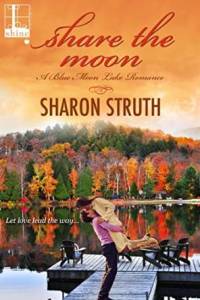
Share the Moon by Sharon Struth

 share_the_moon_banner

It is my very great pleasure to bring you Sharon Struth’s book ‘Share the Moon’. You can find out about the book, about Sharon, read two excerpts and enter to win a $10 Amazon voucher here:

“Heart-tugging small town romance with real emotion. Struth is an author to watch!” — Laura Drake, author of RITA-award winning The Sweet Spot

Sometimes trust is the toughest lesson to learn.

Sophie Shaw is days away from signing a contract that will fulfill her dream of owning a vineyard. For her, it’s a chance to restart her life and put past tragedies to rest. But Duncan Jamieson’s counter offer blows hers out to sea.

Duncan still finds Sophie as appealing as he had during boyhood vacations to the lake. Older and wiser now, he has his own reasons for wanting the land. His offer, however, hinges on a zoning change approval.

Bribery rumors threaten the deal and make Sophie wary of Duncan, yet she cannot deny his appeal. When her journalistic research uncovers a Jamieson family secret, trust becomes the hardest lesson for them both.

About the Author:

“Sharon Struth has woven a tale of suspicion, mystery and the complete emotional breakdown of two people searching for love and restoration of their past lives. The plot is refreshing and will definitely keep the reader turning page after page. SHARE THE MOON is a book that restores faith in human nature and the ability to again find love.” –Fresh Fiction

sharon

Sharon Struth is an award-winning author who believes it’s never too late for a second chance in love or life. When she’s not writing, she and her husband happily sip their way through the scenic towns of the Connecticut Wine Trail. Sharon writes from the small town of Bethel, Connecticut, the friendliest place she’s ever lived.
sharethemoon

I’m delighted to be able to share two excerpts from Sharon with you:

Excerpt Number 1:

“Now, gently swirl the wine.” A slight twist of Sophie’s wrist rotated the glass.

Duncan copied her moves, realizing she made the gesture fluid, easier than his attempts.

“This gives the molecules a little nudge to entertain us. I mean, who doesn’t like to be entertained.” She waved a playful brow. “Once you get them moving, stick your nose up close and take a whiff.”

Sophie brought her straight nose close to the rim. Her lids dropped, as if prepared to receive a scent from heaven. She inhaled. Passion-filled concentration dominated her expression, leaving him mesmerized, unable to stop watching even as he lifted his own glass. He copied her movements, contemplating the aroma in a way he’d never done before.

When he opened his eyes, she’d been watching. “Anything stand out?”

He took a second, shorter whiff. “Pepper, I think.”

Her mouth turned into a half-surprised, half-pleased smile. “Very good.”

A sensation fluttered in his gut, her approval an unexpected joy.

 ”I smelled some kind of berry too. Now take a decent taste. Let the liquid coat your entire mouth. It’ll feel different on your tongue versus the roof of your mouth or the inside of your cheeks. There are all kinds of hidden flavors. Some bold, others more subtle.”

She brought the glass to her lips then stopped, leaned across the counter, and placed her soft palm over the hand where he held the glass. A sweet floral scent drifted from her hair. She dropped her voice, now low and sexy. “A ready guy like you should take your time with this one.” She cocked a loaded brow. “Really work hard and you’ll detect the wine’s secrets.”

Heat crept up his neck again.

The microwave buzzer sounded but she kept her gaze on him as she tipped back her goblet. Her full lips brushed the rim with the delicate touch of a first kiss.

 Excerpt Number 2:

“I treat reporting the old-fashioned way. I only got your story in the first place because—”

He raised his palm. “My accusation wasn’t fair. Listen, I’m sorry to have outbid you on the land so close to the closing date. A pure business decision and not personal.”

“I never thought it was. Besides, the land isn’t yours yet.” Her brows arched.

“Point taken.”

“For the record, though, I write news. Not opinion pieces. I want to clear up any misconceptions since Mr. Steiner requested we put together a favorable piece.”

“I didn’t request special treatment.” He squirmed in his seat. “Write the story as you see fit.”

“Trust me. I will.”

Once again, she’d left him as winded as if he’d hit the bottom of a huge crest on a roller coaster. Her stare burned through him.

“May I switch gears?” Duncan ached to reclaim control.

“Sure.” She crossed her shapely legs.

“The other night, in the parking lot, you told me I’d never understand why you wanted the area to remain unchanged. It’s understandable you’d be unhappy about my bid. Is there something else I need to know?”

Her dark gaze averted to the tip of her jiggling foot and she blinked, making her long lashes flutter. He wanted to look, too, but didn’t want to appear as if he were checking her out again. His earlier trip past her pleasing calves and nicely rounded bottom had given him the urge to unpin her knotted hair and do something that would earn him a slap across the face. Instead, he watched her expression, now more sad than angry.

Her hand lifted to her slender neck, where her fingers slowly massaged beneath her chin. “No. Just the vineyards.” She met his gaze, but a story rested in the pain behind her empty stare.

Sophie switched topics, but the need to understand her overwhelmed him in the most unsettling way.

SHARE THE MOON, book one in the Blue Moon Lake Romances, is a finalist for a RONE Award and a Chatelaine Award for Romantic Fiction!

For more information, including where to find buy links to her novels and published essays, please visit her at the following places:

Amazon   /   Barnes & Noble   /   Kobo   /   GoogleBooks   /   iBooks​   / Amazon UK

Website

Musings from the Middle Ages

Facebook

Twitter

Enter to win a $10 Amazon voucher

http://www.rafflecopter.com/rafl/display/b0c1a5ad53/

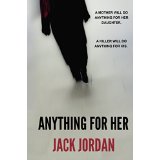
Anything For Her by Jack Jordan

Anything for Her

I was delighted to be offered a copy of ‘Anything For Her’ by the author, via Book Connectors on Facebook, in return for an honest review .

The Leighton family is in melt down. After ‘that night’ which is at the core of this book, Louise and her daughter Brooke have a secret they cannot share with anyone. Michael Leighton has problems of his own as his shady behaviour is rapidly catching up with him and when Louise discovers he’s been having an affair they think this is the end of their world. They’re wrong, there is much worse to come.

Firstly, let me say that this novel isn’t quite perfect – but it comes close. It is an absolutely brilliant first novel by a young writer who deserves to be a writing star.

From the attention grabbing opening ‘Louise has never wanted her husband to die. Until now.’ to the very end, this is a fast paced, twisting and exciting story. In fact I had something else I was supposed to be reviewing next, read the first page of ‘Anything For Her’ and had to continue because Jack Jordan’s writng was so good. Each short chapter adds to that feeling of speed and breathlessness with super hooks at the end of every one so that it is impossible not to want to read on.

The characters are well defined, humanly flawed and make the reader care about them so that the plot shocks and surprises throughout as they find themselves at the centre of a taut thriller. Descriptions make use of all the senses creating genuine scene painting. I could easily see this book as a film or television series.

The whole narrative is cleverly constructed so that what actually happened ‘that night’ between Louise and Brooke is gradually revealed as their own danger increases. Jack Jordan builds their fear so skilfully that I was desperate to know what happened next and truly shocked in places.

‘Anything For Her’ is a stunning debut novel – a fabulous book. I can’t recommend it highly enough and am desperate to read more from this writer.

You can find out more about Jack Jordan here:

Website: http://www.jackjordanofficial.co.uk

Twitter: @_JackJordan_

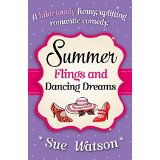
Summer Flings and Dancing Dreams by Sue Watson

Summer flings

My sincere thanks to Kim Nash at Bookouture Publishers for sending me a review copy of Sue Watson’s ‘Summer Flings and Dancing Dreams’ which was published in paperback on 3rd July 2015 and is also available as an e-book.

At 44, Laura’s life has passed her by so that she spends it watching ‘Strictly Come Dancing’ on television whilst consuming her own body weight in chocolates and cakes. When her daughter is jilted at the church and takes off around the world, Laura realises that it’s time she stopped living through Sophie and started her own life.

I have to be honest and say that had I not received a review copy of this I would not have read it as the title simply did not appeal to me and I thought it sounded lightweight and insubstantial. It just goes to show how wrong you can be.

‘Summer Flings and Dancing Dreams’ is a delight of a story that I think any woman (and plenty of men) would read and enjoy because there is an Everywoman quality to Laura. She has self doubts, she lives through her daughter about whom she is over protective and she feels constrained by needing her mother’s approval. A single mum who is reduced to working on a checkout in a job she hates, her life is simply on hold. I honestly thought Sue Watson had got inside the head of so many women perfectly to epitomise their thoughts through Laura.

It is Laura’s progression and development through the narrative that works so well. There are not cliched resolutions for her, but she has to learn how to take responsibility for her own happiness. Tony, another well defined character, helps her, but you’ll have to read the book to find out how.

In this romp of a plot I found a real poignancy and underlying sadness belied by the quirky and occasionally bizarre chapter titles. All of the story is extremely well written, but some passages are just a triumph. I literally laughed until I cried at the description of Laura in the Zumba class, but similarly I cried in sympathy with her later in the story. It takes a real skill to be able to evoke such extreme emotions in a reader.

The iterative theme of dancing is masterful. I’d defy anyone reading Sue Watson’s ‘Summer Flings and Dancing Dreams’ not to want to ‘dance like no-one is watching’ at the end of reading this book. I hate epithets like ‘uplifting’ and ‘hilarious’ as I rarely agree with them, but in this case any praise of that nature is totally deserved.

I loved it.

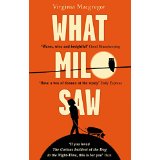
What Milo Saw by Virginia MacGregor

What Milo Saw

I am so grateful to Goodreads and @littlebookcafe for my copy of ‘What Milo Saw’. It is out in paperback on 13th August 2015, published by Sphere.

Nine year old Milo has retinitis pigmentosa so that he only has pin prick vision, but this doesn’t prevent him from seeing what most people miss. He also has a dad who has run off with his Tart and a new baby, a mum Sandy who is eating Hobnobs as if they are going out of fashion, a supposedly tea cup pig, Hamlet, and a great gran Lou who needs serious looking after. When Lou has to go in a home, Milo’s world shifts beyond his control. But Milo is not like other children and fights back.

‘What Milo Saw’ is a terrific book. Apart from one or two passages referring to sexual activity, initially I though it was a more of a young adult novel (and that’s not a criticism), but soon realised the simplicity of the language is artfully designed to convey life from Milo’s child-like perspective and to present surprisingly difficult themes in a completely accessible way. Despite loads of humour, ‘What Milo Saw’ is actually a terrifying portrait of how we sometimes treat our elderly and what may lie ahead for all of us. It also makes us question our responses to children, marriage, relationships and people who are different or from different countries. The nature of authority is brought into sharp focus from Milo’s point of view.

All the characters are completely believable, even the villainous Nurse Thornhill, so that they are more like people we know rather than characters in a novel. Milo is so well portrayed I wanted to hug him. I don’t much like children and often find them written badly or inconvincingly, but Milo is perfect. He is bright, sulky and devious but with a heart very firmly in the right place. He reminds me so much of a boy I used to teach who had tunnel vision. Given that I have eye problems myself, I think this might be why I found Virginia MacGregor’s writing so affecting and effective. I could empathise totally with Milo. I also have elderly relatives determined not to go into a care home so that reading ‘What Milo Saw’ felt utterly real and convincing.

There is a fast paced plot which is extremely well resolved. Without giving it away, it is as if Milo is let down by almost every adult he meets and this is what makes him such a glorious character – he doesn’t give in.

I am finding it hard to define exactly why, but I found Virginia MacGregor’s writing touching, emotional and wonderful. I laughed and cried along with Milo. I’d defy anyone reading ‘What Milo Saw’ not to love this little boy and his attempts to rescue Gran from her inadequate care home. It feels as if Milo is a little bit like Fredrik Backman’s Ove, but as he might have been as a boy. I loved them both.

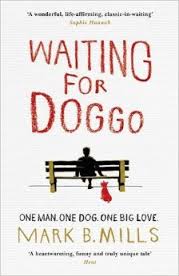
Waiting for Doggo by Mark B. Mills

waiting for doggo

My enormous thanks to Frances Gough at Headline and Bookbridgr for my review copy of ‘Waiting for Doggo’ by Mark B.Mills. It is published by Headline Review on 13th August 2015.

Thirty year old Daniel is surprised to find a ‘Dear John’ letter from his partner of four years, Clara, telling him ‘It’s over between us’. Even more worryingly, she has left behind possibly the ugliest dog in the world, Doggo. Out of work and lumbered with a Jennifer Aniston obsessed dog, something needs to change for Dan.

I absolutely loved ‘Waiting for Doggo’. It’s a quick read with a story that romps along, but that doesn’t mean it’s not really well written and stylish. There’s a perfect flow to the writing, with a great balance of description and direct speech that makes it a vibrant read. The situations are absolutely credible, recognisable and life like.

The humour is brilliant. Occasionally it is obvious, occasionally understated so that the reader is entirely caught up in it. This is what makes the contrasts in the scenarios even more effective and I found I had tears in my eyes towards the end, even though I’d laughed all the way through.

Characters are amazingly well depicted. Doggo, (and yes he does have a twitter account @WAITINGFORDOGGO), is masterful. He’s so lifelike that it seems impossible a non-speaking character can have such presence in a narrative.

What I found so wonderful about ‘Waiting for Doggo’ was that although it is relatively short, it packs a huge punch with themes of love and loyalty, how we treat our elderly, social conventions, the sense of identity and office politics. It really is a microcosm of life.

There is potential at the end of the story for a continuation of Dan and Doggo’s adventures and I just hope Mark B. Mills is already writing the next book because I feel bereft at having finished this one. It thoroughly deserves all the pre-publication praise it has received. I can’t recommend it highly enough.

Fall of Poppies Cover Reveal, Excerpt and Giveaway

Fall of Poppies

A fabulous new book has its cover revealed today

FallofPoppies_cover (1)

Fall of Poppies: Stories of Love and the Great War

by

Heather Webb, Hazel Gaynor, Beatriz Williams, Jennifer Robson, Jessica Brockmole, Kate Kerrigan, Evangeline Holland, Lauren Willig, Marci Jefferson

Top voices in historical fiction deliver an intensely moving collection of short stories about loss, longing, and hope in the aftermath of World War I —featuring bestselling authors such as Hazel Gaynor, Jennifer Robson, Beatriz Williams, and Lauren Willig and edited by Heather Webb.

A squadron commander searches for meaning in the tattered photo of a girl he’s never met…

A Belgian rebel hides from the world, only to find herself nursing the enemy…

A young airman marries a stranger to save her honor—and prays to survive long enough to love her…The peace treaty signed on November 11, 1918, may herald the end of the Great War but for its survivors, the smoke is only beginning to clear. Picking up the pieces of shattered lives will take courage, resilience, and trust.

Within crumbled city walls and scarred souls, war’s echoes linger. But when the fighting ceases, renewal begins…and hope takes root in a fall of poppies.

Win print copies of ‘After The War is Over‘, ‘A Memory of Violets‘ and ‘Land of Dreams‘ to celebrate ‘Fall of Poppies‘ here:

https://www.rafflecopter.com/rafl/display/97a55ed454/

Read an extract from the book

Excerpt from “Hour of the Bells

A short story included in Fall of Poppies

Beatrix whisked around the showroom, feather duster in hand. Not a speck of dirt could remain or Joseph would be disappointed. The hour struck noon. A chorus of clocks whirred, their birds popping out from hiding to announce midday. Maidens twirled in their frocks with braids down their backs, woodcutters clacked their axes against pine, and the odd sawmill wheel spun in tune to the melody of a nursery rhyme. Two dozen cuckoos warbled and dinged, each crafted with loving detail by the same pair of hands—those with thick fingers and a steady grip.

Beatrix paused in her cleaning. One clock chimed to its own rhythm, apart from the others.

She could turn them off—the tinkling melodies, the incessant clatter of pendulums, wheels, and cogs, with the levers located near the weights—just as their creator had done before bed each evening, but she could not bring herself to do the same. To silence their music was to silence him, her husband, Joseph. The Great War had already done that; ravaged his gentle nature, stolen his final breath, and silenced him forever.

In a rush, Beatrix scurried from one clock to the next, assessing which needed oiling. With the final stroke of twelve, she found the offending clock. Its walnut face, less ornate than the others, had been her favorite, always. A winter scene displayed a cluster of snow-topped evergreens; rabbits and fawns danced in the drifts when the music began, and a scarlet cardinal dipped its head and opened its beak to the beauty of the music. The animals’ simplicity appealed to her now more than ever. With care, she removed the weights and pendulum, and unscrewed the back of the clock. She was grateful she had watched her husband tend to them so often. She could still see Joseph, blue eyes peering over his spectacles, focused on a figurine as he painted detailing on the linden wood. His patient hands had caressed the figures lovingly, as he had caressed her.

The memory of him sliced her open. She laid her head on the table as black pain stole over her body, pooling in every hidden pocket and filling her up until she could scarcely breathe.

“Give it time,” her friend Adelaide had said, as she set a basket of jam and dried sausages on the table; treasures in these times of rations, yet meager condolence for what Beatrix had lost.

“Time?” Beatrix had laughed, a hollow sound, and moved to the window overlooking the grassy patch of yard. The Vosges mountains rose in the distance, lording over the line between France and Germany along the battle front. Time’s passage never escaped her—not for a moment. The clocks made sure of it. There weren’t enough minutes, enough hours, to erase her loss.

As quickly as the grief came, it fled. Though always powerful, its timing perplexed her. Pain stole through the night, or erupted at unlikely moments, until she feared its onslaught the way others feared death. Death felt easier, somehow.

Beatrix raised her head and pushed herself up from the table to finish her task. Joseph would not want her to mourn, after two long years. He would want to see her strength, her resilience, especially for their son. She pretended Adrien was away at school, though he had enlisted, too. His enlistment had been her fault. A vision of her son cutting barbed wire, sleeping in trenches, and pointing a gun at another man reignited the pain and it began to pool again. She suppressed the horrid thoughts quickly, and locked them away in a corner of her mind.

With a light touch she cleaned the clock’s bellows and dials, and anointed its oil bath with a few glistening drops. Once satisfied with her work, she hung the clock in its rightful place above the phonograph, where a disk waited patiently on the spool. She spun the disk once and watched the printed words on its center blur. Adrien had played Quand Madelon over and over, belting out the patriotic lyrics in time with the music. To him, it was a show of his support for his country. To Beatrix it had been a siren, a warning her only son would soon join the fight. His father’s death was the final push he had needed. The lure of patrimoine, of country, throbbed inside of him as it did in other men. They talked of war as women spoke of tea sets and linens, yearned for it as women yearned for children. Now, the war had seduced her Adrien. She stopped the spinning disk and plucked it from its wheel, the urge to destroy it pulsing in her hands.

She must try to be more optimistic. Surely God would not take all she had left.

Reprinted Courtesy of HarperCollins Publishers


Image Map

The Pact by Christian Liberty Marshall

pact 1

The Pact‘ by Christian Liberty Marshall is an exciting new series novel in eight episodes and is published twice a week on Mondays and Thursdays from 3rd August 2015, price £1.79 each. It would appeal to fans of Robert Ludlum’s ‘The Bourne Identity’, John Le Carre’s ‘The Spy Who Came In From The Cold’ and Daniel Silva’s ‘The Unlikely Spy’ and ‘Homeland’.

The series:

On a flight from New York to London, six ambitious twenty-somethings are each given an electronic tablet. Suddenly they are presented with all their personal statistics and a cool, female voice asks them to join The Nations’ Bureau of Security (NBS) to make the world a better place.
Eliska, Nick, Leah, Felicity, Paul and Jian are all connected in some way to The Syndicate, an international crime organization aimed at profiteering by keeping countries at war with one another. Their worlds collide when they are chosen and trained for one purpose: bringing The Syndicate down.
When a NBS agent is murdered shortly before their first assignment, the five remaining recruits quickly realize the agency they’re working for may not be as trustworthy as it seems. Can they stay alive long enough to uncover the truth? They make a pact: a pact to survive, no matter the cost, or the temptation to break it…

About Christian:

christian_0130

Christian Liberty Marshall is an American writer who is now based in Austria. He’s a musician with degrees from Vanderbilt University and University of Music and Performing Arts Graz. When he isn’t performing as a violist, he can be found teaching at the Popakademie Baden-Württemberg, writing educational material for children, or translating German literature.

I am delighted to have a guest post from Christian:

Dealing with ‘The Fly in the Ointment’

Before I began working on The Pact, I came up with a romantic daily schedule highlighting both my creativity and desire to maintain a healthy work/life balance. This short-lived dream had me waking up fully rested and enjoying a leisurely breakfast before turning on my laptop to “pen” the next several pages of the current episode. Hours would pass as witty dialogue and thrilling plot twists appeared on the screen word perfect.

Then I’d be interrupted (on schedule) by a friend asking me to grab lunch in the city, after which I’d run into another friend and—of course—have time for coffee. I would then be behind schedule, but that’d be OK, because the morning had been so productive. Racing home, I’d grab my swimsuit and head to the pool for my daily exercise. By the time I would arrive home in the late afternoon, I’d be ready to sit down for another hour and finish dictating whatever my muse had whispered to me while I’d been working on my Auerbach.

Though I’d love to tell you this dream came true twenty times a month, I can’t. And that’s because there is one uncontrollable factor in a writer’s work/life balance: the writing. Anne Lamott, author of Bird by Bird, refers to this as “the fly in the ointment,” and I couldn’t agree more. The best thing a writer can do is exercise the discipline needed to sit down, quiet his/her mind, and let the words come. And my hobbies, when not given the respect they deserve, tend to serve as a distraction and not as a reward, leaving me to stare in frustration at blank pages.

So how does one achieve the perfect work/life balance? I think it’s safe to say there’s no single right answer, but I can tell you what I find to be helpful for me.

My first step is to eliminate the feeling of unfinished work, because “unfinished work” has the power to gnaw at my mind 24/7, making virtually everything unenjoyable. And the easiest way to eliminate “unfinished work” is to give yourself short assignments, to avoid biting off more than you can chew. (Another piece of wisdom gleaned from Anne Lamott.) The easiest way for me to do this is with numbers. Sometimes it’s 350 words. Other times it’s three pages. And even sometimes it’s five minutes. Because setting a goal and reaching it is the easiest way to build confidence as a writer, clean your conscience, and—most importantly—remain sane.

Then, once I’ve done my work and have reached my goal, I treat my hobby as a reward. And I give it the respect it deserves by enjoying it fully. I don’t cut corners and say “just half an hour this time,” or “I spent an hour on this yesterday, I can’t afford losing so much time today,” or “No, it’s OK, I need to write. You guys go and have fun without me.” By saying such things, I often end up cranky, alone, and writing sentences with about as much life as a wilted salad.

Finally, when it’s time to return to the craft of writing, I give myself another short assignment, diving in with a fresh perspective from a rested mind.

While I can’t say this plan is foolproof, I can say it makes me a much happier and healthier writer, inside and out. And I think my characters and hobbies would agree.

‘The Pact’ is Christian’s first serial novel and he is available for interview by contacting Sophie Goodfellow on sophie@edpr.co.uk or Hayley Steed on hayley@edpr.co.uk. You can also request review copies and further information.

The Amazing Adventures of a Marginally Successful Musician by Bill Cinque

 Bill Cinque

When I was asked by a man who has toured the world playing over 4000 gigs and touring with Neil Diamond in 2015, if I wanted to read his book in return for an honest review I was sceptical. It would be a boring monologue of ‘I’m a famous musician and this is why I’m so great’. But Bill Cinque sent me a sample and I was hooked. Nothing could be further from the truth (although if I were his wife, I wouldn’t let him listen to music in the car!).

‘The Amazing Adventures of a Marginally Successful Musician’ shows that Bill Cinque is an entertainer in more ways than one. This is a really funny and interesting read. Indeed, Bill is often quite self deprecating which makes reading his book even more endearing. His story is based on his life as a musician because he ‘figured no one was interested in a book called ‘Why Jennifer Anniston Won’t Return My calls’ and he thought he should write what he knows.

It’s easy to dip in and out of this book as the chapters are succinct and full of what is, albeit often tongue in cheek in presentation, very good advice for aspiring musicians. Most chapters have a pithy final ‘BOTTOM LINE’ in which Bill might reinforce (or totally undermine) what he’s just said. I found myself laughing aloud frequently. A flavour of what you might expect is a comment he makes about Brian the banjo player; ‘Now we can’t afford to get rid of him. I’m taking my cue from Brian. I hope my belly dancing is as readily accepted as his banjo playing..’ There are absorbing autobiographical elements too that give a real insight into Bill’s personality. Reading ‘The Amazing Adventures of a Marginally Successful Musician’ has made me wish I had Bill Cinque as a friend.

Bill photo

Bill covers every element of what is needed to succeed in the music business from the different instruments to singers, flyers, producers, and ‘Ten Reasons Your Girlfriend Shouldn’t Come to the Gig’ and I think anyone who’s ever dreamed of being rich and famous could learn from Bill’s sagacity – as could thousands of teenagers practising and sending their parents mad in garages all over the world.

Whilst the majority of the book is genuinely funny and entertaining, a couple of chapters also have a more serious tone, particularly those dealing with alcohol or when Bill is describing his own emotions and feelings after gigs.

I’m not a lover of autobiographical writing, and I’m not especially interested in the music business, but I thoroughly enjoyed this book. I didn’t read it all in one go and think I enjoyed it more by reading a few chapters at a time.

If you want to know more about Bill, be warned, you might never be the same again if you visit his web site, but as he says at the end of ‘The Amazing Adventures of a Marginally Successful Musician’ , ‘Feel free to contact me…’

http://www.billcinque.com/about.html

You can download a free sample of the book here http://www.billcinque.com/book.html

The book can be bought here (and in other outlets)

http://bookstore.iuniverse.com/Products/SKU-000115858/THE-AMAZING-ADVENTURES-OF-A-MARGINALLY-SUCCESSFUL-MUSICIAN.aspx

Skin by Ilka Tampke

Skin

I am hugely indebted to http://www.goodreads.com for my copy of ‘Skin’ by Ilka Tampke. It is published by Hodder and Stoughton on August 6th 2015.

In AD 28 Ailia is left as a foundling on the doorstep of the Tribequeen’s kitchen. Taken in by Cookmother, Ailia can never truly be part of society because she does not know the skin to which she belongs. It is skin that holds this ancient world together. As she grows up, the Roman Empire threatens her people more and more until Ailia gradually learns her destiny.

I don’t particularly like books with an ancient history setting. Nor do I usually like books with a fantasy or mystical element. So why then, given that it has both elements, did I think Ilka Tampke’s novel ‘Skin’ was amazing?

The writing in ‘Skin’ is enthralling. It mesmerises the reader with a hypnotic rhythm to the narrative so that the songs, events and rituals become completely believable, adding layer upon layer to the textures of the story. Descriptions seemed to tingle on my skin as I read and I was drawn into the narrative in the same way Ailia is drawn into the worlds she encounters. I wanted to quote an example, but not a word is wasted and any quotation would spoil the plot and the enjoyment of other readers. It is as if the novel is a natural part of the traditions it describes.

I loved the tenets that began each chapter, hinting what might happen. The plot is also so skilfully constructed that, without giving anything away, ‘Skin’ did not end as I anticipated. I also found it both heartbreaking and uplifting.

The characters, particularly of Ailia, Cookmother and Fraid are perfectly drawn. This is a novel with strong, determined women at its centre regardless of their place in society. I think it is the quality of dialogue which helps to create the naturalness of the characters. Speech feels absolutely right for the setting and the era.

Themes in ‘Skin’ would have been relevant to the well researched time in which it is set, but still have total resonance today. Love, deception, hate, revenge, the need to belong, family and learning make ‘Skin’ such a captivating read.

I loved ‘Skin’ by Ilka Tamke. I think it would be perfect reading for anyone who has ever questioned their own position in the world, for all young women and for everyone who simply enjoys a brilliantly written story.

The Protector by S J Deas

Protector

I am immensely grateful to Frances Gough at Headline for a review copy of ‘The Protector’ by S J Deas in return for an honest opinion. It was published in hardback on 30th July 2015.

William Falkland is desperate to find his wife and children whom he has lost following the Civil War in 1640s England. Creator of the New Model Army, Oliver Cromwell, however, has other ideas for him and sets William the task of finding John Milton’s missing sister Anne. So begins an adventure of treachery, danger and frustrations.

I was captivated from the first sentence of this novel. It is completely accessible but at the same time totally authentic in its portrayal of England in 1646. The dialogue conveys the period so realistically but still feels entirely natural to the modern ear. What works so well is the attention to detail so that all the senses are treated to a wide range of descriptions, placing the reader at the scene in an immersive experience. It is so easy to visualise because of the skilful writing and I could easily see ‘The Protector’ as a film or television series.

The first person narrative makes the writing somehow intimate, as if you’re reading William Falkland’s private diary. This makes his character so interesting and lifelike. It is as if he’s a microcosm of the era, wrestling with his conscience, sometimes being brutal and occasionally tender. Whilst William is created by Stephen Deas, other characters are historical and the quality of research to create a seamless balance between fact and fiction is outstanding. It’s one of the elements that make this such a brilliant read. S J Deas illustrates a passion for, and perfect knowledge about, the era. I had no idea, before reading this, that Milton had a missing sister.

However, where ‘The Protector’ really triumphs, is in the storytelling itself. The plot is rapid and exhilarating to read with twists and subtle hints so that this is a hugely satisfying thriller as well as an historical novel.

Although this is the second novel, after ‘The Royalist’, to feature William Falkland, it is a perfect stand alone read. I haven’t read the first but I will do as soon as I can. I found ‘The Protector’ exciting, authentic and totally absorbing. A brilliant must read.