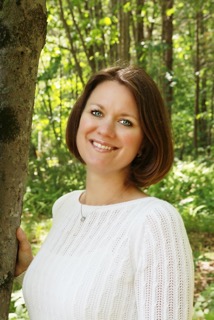
An Interview with Carol Wyer, author of Little Girl Lost

little-girl-lost-kindle

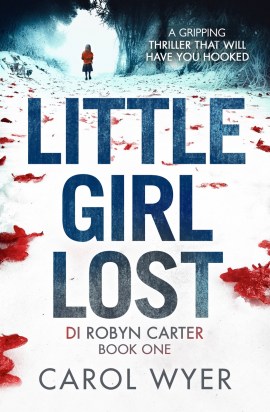
It gives me great pleasure to be helping to celebrate the launch of Little Girl Lost by Carol Wyer. Little Girl Lost is the first in the Detective Robyn Carter crime thriller series, published on 19th January by Bookouture, and is available for purchase on Amazon UK and Amazon US.

To celebrate publication of Little Girl Lost Carol has kindly agreed to an interview on Linda’s Book Bag.

Little Girl Lost
little-girl-lost-kindle

A perfect family hiding disturbing secrets. A killer who wants the truth to be told.

A teacher is found dead, close to the school where he works.

A millionaire is murdered at a local reservoir.

For Detective Robyn Carter, there’s no obvious link between the victims. Apart from one thing. The bodies both have the same grisly trophy beside them – a bloodstained toy rabbit.

As Robyn starts to delve into the lives of the two dead men, her investigations lead her to Abigail, perfect wife and mother to beautiful little Izzy. What was Abigail’s connection to the victims? And why is she receiving threatening messages from an anonymous number?

But as Robyn starts to inch closer to finding the killer, Izzy is abducted.

Unless Robyn gets to the twisted individual in time, a little girl will die …

Gripping, fast paced and nailbitingly tense, this serial killer thriller will chill you to the bone. Discover Carol Wyer’s new series – at a special launch price.

An Interview with Carol Wyer

Hi Carol. Thank you so much for agreeing to answer some questions on my blog about your writing and your latest novel Little Girl Lost in particular. Firstly, please could you tell me a little about yourself?

I hate talking about myself but here goes: I became a full-time writer in 2010 when I turned my attention from writing children’s educational books as a hobby, to the adult market.

My first two novels Mini Skirts and Laughter Lines and Surfing in Stilettos won several awards for humour and much attention from the media. Since then, I’ve appeared on numerous BBC radio stations, several international radio stations, NBC television and BBC Breakfast television, and Sky television, discussing age-related subjects such as ‘Irritable Male Syndrome’ and ‘Grumpy Old Menopause’. In 2015 I won the prestigious People’s Book Prize Award for Grumpy Old Menopause.
grumpy

I’ve written articles for, and featured in, several national women’s magazines, including Take A Break, Choice, Woman’s Weekly and Woman’s Own who also wrote about my journey to becoming a best-selling author.

Having written ten humorous books –three non-fiction and seven fiction, I changed direction this year, and am writing a series of psychological thrillers, and published by Bookouture, featuring DI Robyn Carter. The first, Little Girl Lost released in January 2017, has had some rave reviews and shows I have found my true niche.  (Pause for an evil laugh.)

(I’m finding that laugh slightly unnerving!)

And tell us a bit about Little Girl Lost (without any spoilers please!)

It’s a psychological thriller told from the points of view of three people: Robyn Carter, Abigail Thornton and a murderer. The opening is very gritty and made me wince writing it, but is essential to the plot which twists and turns. I’m going to use a recent review which describes it far better than I can, as I tend to give away too much. This is from Penny For My Thoughts Blog:

DI Robyn Carter is drawn into a search for a common denominator in a series of seemingly unrelated murders. Were the murders revenge for an act committed years ago and if so, who is the killer? When a husband goes missing and his wife discovers that he may not be the person she thought she married, she turns to a private detective rather than the police. Robyn returns to the police force after a leave of absence and discovers that her first assignment crosses paths with the missing husband and everyone involved has secrets and something to hide. Which secret leads to death and who has the most to lose if their true identity is discovered? Is someone setting up Abigail to be a victim or is she battling postnatal depression and seeing and hearing things that don’t exist?

(That sounds fantastic!)

When did you first realise you were going to be a writer?

Although I’d written educational books for children, I didn’t consider writing as a career until my son left home and I converted his bedroom to an office. That was in 2009.

If you hadn’t become an author, what would you have done instead as a creative outlet?

I’d have definitely been an actress or show presenter. I love the limelight!

How far do you think teaching English has impacted on you as a writer?

Teaching set texts to GCSE and A-Level students that required analysis certainly had an effect on my writing. I can’t put pen to paper without dissecting my plots and chapters and ensuring they do not fall short. This is particularly true of the series of thrillers. I am paranoid that I have made an error in my timeline, or introduced an inaccurate piece of information that someone will spot. I enjoy playing about with descriptive words or juxtaposing scenes to heighten suspense which is something I got from studying Literature and teaching it too. As for the grammar, well, I’d love to say being a teacher of English has ensured I make no errors but sadly, with failing eyesight, those pesky typos creep in.

(As an ex-English teacher myself, I know exactly what you mean.)

Little Girl Lost marks a departure from your other writing. How and why did you decide to try a different genre?

The real answer is lengthy but suffice to say, like many people who write humour or who do stand up, I have a dark side that first emerged when I wrote a series of short stories entitled Love Hurts. Some tales were amusing, all had a twist, and one was shocking. The reaction to that first story was surprising. People loved it and said I should write more ‘sinister stuff’. That gave me the confidence to explore that possibility. I wasn’t short of ideas. Thrillers have always been my go to choice of book to read. I have been playing about with surprises and twists in my novels for some time, along with darker moments that I sneak in, and Life Swap had the daddy of all twists. After I wrote that book, I decided I was ready to change direction and add as many twists and turns as possible into my books.
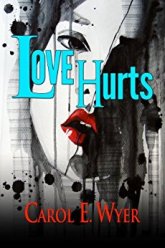
love-hurts

How do you go about researching detail and ensuring your books are realistic?

Months and months of research on the Internet and then, phoning people who are in the know to make sure facts are correct, or chatting to them on Facebook.

Which aspects of your writing do you find easiest and most difficult?

Thinking up the plot is the easiest part for me even though it takes months to get it right. Typing is the worst part. I can only type with two fingers, (I know…I know) and given I write out every book longhand first, it takes me forever to type it up.

What are your writing routines and where do you do most of your writing?

Once I start writing, I don’t stop. I suffer from insomnia, so I go and go and go until my batteries run out and I conk out for a short while, or until Mr Grumpy yells at me to stop.

You frequently refer to your husband as Mr Grumpy. How does he respond to that epithet?

He loves it. Ever since he discovered he has a fan club he has relished being Mr Grumpy and even produces videos on YouTube with me to do with travel. (The Grumpy Travel Show).

How did you create your new protagonist Robyn Carter?

I met the woman who inspired Robyn Carter while filming for a television show – Masterpiece with Alan Titchmarsh. We spent an entire day with fellow competitors in a stately home, and I found out a lot about this one in particular. She was such a strong character and looked astonishing. I discovered she was not only into fitness but had won many contests and modelled underwear even though she was my age. I got the idea then for Robyn’s attributes and some of her character, and began writing her backstory into a notebook, as I do with my main characters. Each one has a history and Robyn’s is a very interesting one. There are some clues in the first book, however her character will develop throughout the series. She may not have had much luck, yet she has backbone. She is also flawed, as she should be if she is to come across as human.

Once I began writing Little Girl Lost, I had yellow post-its all over my wall with essential details of the main characters. As for her name; it came to me one night, or I should say at three in the morning, as is so often the case when I am thinking up the plots. I have no idea why I chose it and to my knowledge, I have never met anyone called Robyn.

Little Girl Lost is the first in a new series and I know you’re already writing book three. How difficult has it been to retain ideas for future projects and not reveal everything in this first novel?

I haven’t had any problem with that as each synopsis is in front of me on my wall, when I write. I made sure they were all separate so that didn’t happen.

You’re not afraid to tackle issues like ageing in your writing. How important is it for writers to reflect the society in which they live do you think?

I have always believed that Literature reflects society’s thoughts, fears, and arguments, and as writer’s we need to keep abreast of those to retain integrity.

I know you’re keen for those of a certain age (like me) to age disgracefully – what plans do you have to do so?

I have been ageing disgracefully for the last decade: quad biking, flying helicopters, scuba diving wrecks, ziplining, and facing challenges like diving with sharks, and taking up stand up comedy. Unfortunately, I came a cropper last year and my spine which was in a bad way from my youth, gave up on me, so I am now limited to less wild antics. I haven’t had a chance to work out what I’ll get up to next, but it will involve some wacky project, that’s for sure.

You’ve recently created a Street Team. How important are bloggers to writers?

Totally essential! I would not have enjoyed any success had it not been for all the many bloggers and reviewers who have helped me since I began writing. I cannot stress how important they have been to me and how grateful I am.

When you’re not writing, what do you like to read?

Thrillers and since I speed read, I’ll read several a week when I get the chance.

Do you have other interests that give you ideas for writing?

Travelling and people-watching always give me ideas for books. At the moment, given my penchant for murdering folk, it’s probably a good idea if I don’t carry out too much real research.

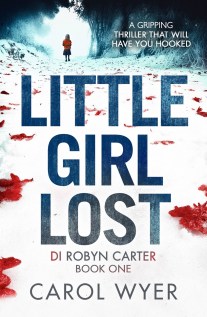
The cover of Little Girl Lost makes me think of Hansel And Gretal with the juxtaposition of innocence and evil. How did that image come about and what were you hoping to convey (without spoiling the plot please!)?

The lovely team at Bookouture produced the cover. It was designed by the same man who has worked on Wilbur Smith and Bernard Cornwell’s covers. Peter Augustus has done an incredible job and captured the atmosphere perfectly. In my mind, the whole idea of being lost can apply to more than the child who is taken and when you read it, you’ll understand what I mean.

If you could choose to be a character from Little Girl Lost, who would you be and why?

I ought to say Robyn, but I when I was writing the book, I became obsessed with Alice. I don’t want to be her but I loved writing from her point of view. Maybe part of me is Alice!

If Little Girl Lost became a film, who would you like to play Robyn Carter?

Jennifer Leann Carpenter who played Debra Morgan in the Dexter series.

If you had 15 words to persuade a reader that Little Girl Lost should be their next read, what would you say?

A recent tweet summed it up perfectly: It’s dark and messes with your head, you can’t be sure who’s telling the truth and who’s lying. Oh bother, that’s eighteen words.

I’ll let you off! Thank you so much, Carol, for your time in answering my questions.

About Carol Wyer
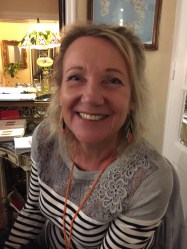
carol

Carol E. Wyer is an award-winning author whose humorous books take a light-hearted look at getting older and encourage others to age disgracefully. More recently she has chosen to write for the “dark side” and embarked on a series of thrillers, starting with the gripping Little Girl Lost.

Her book Grumpy Old Menopause won The People’s Book Prize Award for non-fiction 2015.

Carol has been interviewed on numerous radio shows discussing ‘Irritable Male Syndrome’ and ‘Ageing Disgracefully’ and on BBC Breakfast television. She has had articles published in national magazines ‘Woman’s Weekly’ featured in ‘Take A Break’, ‘Choice’, ‘Yours’ and ‘Woman’s Own’ magazines and writes regularly for The Huffington Post.

Carol is a signed author with Bookouture and Delancey Press.

You can follow Carol on Twitter, visit her website and find her on Facebook. All of her books are here.

There’s more with these other bloggers too:
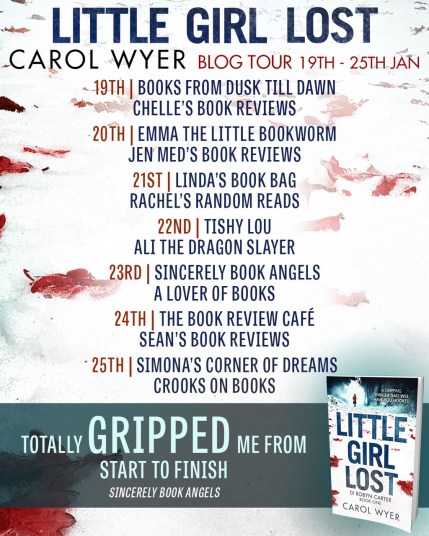
little-girl-lost-blog-tour-graphic

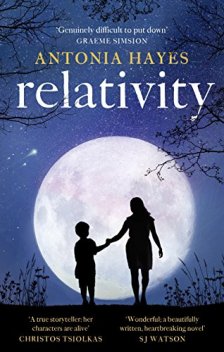
Relativity by Antonia Hayes

relativity

I’m thrilled to be part of the paperback launch celebrations for Relativity by Antonia Hayes which was released by Corsair, an imprint of Little Brown, on 19th January 2017. Relativity is available for purchase through the publisher links here.

Relativity

relativity

Ethan is an exceptionally gifted young boy, obsessed with physics and astronomy.

His single mother Claire is fiercely protective of her brilliant, vulnerable son. But she can’t shield him forever from learning the truth about what happened to him when he was a baby; why Mark had to leave them all those years ago.

Now age twelve, Ethan is increasingly curious about his past, especially his father’s absence in his life. When he intercepts a letter to Claire from Mark, he opens a lifetime of feelings that, like gravity, will pull the three together again.

Relativity is a tender and triumphant story about unbreakable bonds, irreversible acts, and testing the limits of love and forgiveness.

My Review of Relativity

Ethan lives with his Mum Claire in Sydney. But Ethan isn’t an ordinary little boy and his past is just one element that makes him who he is.

I thought Relativity was astonishing. How can it be a first novel? Relativity is heart rending and wonderful. It’s so beautifully written that I’m going to struggle to do it justice in a review. Reading Relativity felt like someone had my heart in their fist and the more I read, the more they squeezed, until I was almost overwhelmed by the intensity of feeling the story evoked.

I’m a complete ignoramus when it comes to anything scientific but I loved the way in which Antonia Hayes relates physics to human life and emotion. It was as if a whole new world had opened up to me in the same way the world is being studied by Ethan. I’d never appreciated the importance of physics for the individual, but everything about Relativity, from the chapter headings to the technical language felt aligned and perfect for the narrative. Just the smallest touches to the writing, such as Claire being called Mum in the chapters concerning Ethan, even though the narrative is still in the third person gave a simultaneous sophistication and somehow a rawness to the writing that I adored.

Essentially there only three main characters, Ethan, Claire and Mark with some minor additions like Alison. This reduced number means that we get to know them intimately so that they are living beings with a real history. I didn’t always like Claire, despite her fierce love for Ethan and I’m still undecided about Mark but I think it’s illustrative of how they have been created that I still find myself thinking about them after I’ve finished reading and I desperately want to know what happens to them all in the future. I felt I understood them completely, flaws and all.

There isn’t a particularly fast paced plot – very often Relativity is actually about the mundanity of everyday life but seen through the perspective of three exceptional people in Ethan, Claire and Mark . It also encapsulates themes and considerations that reverberate through relationships, families and society from bullying to extramarital affairs so that there is something to appeal to every reader.

Relativity is exceptional. It packs an emotional punch that hits you right in the solar plexus. I really recommend it.

About Antonia Hayes

hayes-antonia-credit-angelo-sgambati

Antonia Hayes, who grew up in Sydney and spent her twenties in Paris, lives in San Francisco with her husband and son. Relativity is her first novel.

You can follow Antonia Hayes on Twitter and visit her website.

There’s more with these other bloggers:

relativity_blogtour_twitpic_friday.jpg

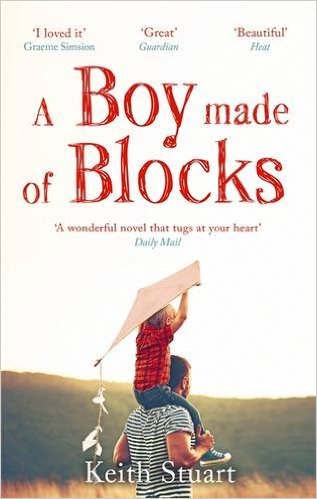
A Boy Made of Blocks by Keith Stuart

a-boy-made-of-blocks

It gives me great pleasure to be on the celebratory tour for a book, A Boy Made of Blocks by Keith Stuart, that I’ve adored reading. Published by Sphere, an imprint of Little Brown. A Boy Made of Blocks is available for purchase here.

A Boy Made of Blocks

a-boy-made-of-blocks

MEET THIRTY SOMETHING DAD, ALEX… He loves his wife Jody, but has forgotten how to show it. He loves his son Sam, but doesn’t understand him. Something has to change. And he needs to start with himself.

MEET EIGHT-YEAR-OLD SAM… To him the world is a puzzle he can’t solve on his own.

When Sam starts to play Minecraft, it opens up a place where Alex and Sam begin to rediscover both themselves and each other… When life starts to tear one family apart, can they put themselves back together, one piece at a time?

A Boy Made of Blocks is a beautiful, funny and heartwarming story of family and love inspired by the author’s own experiences with his autistic son.

My Review of A Boy Made of Blocks

Sam Rowe is autistic and his parents’ separation is not aiding his progress.

I found the self deprecating and honest first person narrative in A Boy Made of Blocks totally convincing so that it felt as if I knew Alex personally. The more I read, the more he had my empathy and sympathy even though I thought he’d been selfish and unhelpful towards Jody in the time before the novel actually begins. Here is a man with flaws and struggles so many of us can relate to.

I felt Keith Stuart balanced the challenges of dealing with Sam with the use of wry humour very effectively, giving a realistic and touching narrative in which I became so immersed I forgot I was reading about characters in a book and not real people. I’m not sure if that experience for me was because Keith Stuart has lived a similar life to Alex or because the writing was so skilful and effective but either way I absolutely loved this book.

Having no experience of dealing with children like Sam, I have no idea how realistic this portrayal is, but it felt thoroughly honest, convincing and authentic to me. It also taught me to be less judgmental of other people’s children when I’m out!

The allegory of the Minecraft game works incredibly well as a device to illustrate Sam’s life as it is invariably scary and also an adventure. I appreciated the multiple meanings of the title as Sam uses blocks to create his Minecraft world and suffers blocks in his actual life – from society, school, his father and his own perceptions of what he can achieve. However, I felt actually this was not a story so much about a boy made of blocks as a man, Alex, building a wall of blocks around himself. Both narrative elements are wonderful.

I thought the plotting was so stylish as the story is really about the quotidian events many families face, but I found it held my attention so thoroughly that I couldn’t bear to put the book down to do other things. I was completely engaged by the sub-plots involving Alex’s wife Jody, his sister Emma, his best friend Dan and Alex’s mother too. This isn’t just a novel about autism, it’s a novel about humanity, relationships and our insecurities and triumphs.

I honestly adored this book. I cried, as I often do with affecting reads, but A Boy Made of Blocks had an emotional intensity for me from despair to joy that I found extremely touching. I usually pass on copies of books to others to read. I’m keeping this one as it’s too special to part with.

About Keith Stuart

keith_stuart_2015_copyright_ashley_bird_horizontal-2

In 2012 one of Keith Stuart’s two sons was diagnosed on the autism spectrum. The ramifications felt huge. But then Keith and both boys started playing videogames together – especially Minecraft. Keith had always played games and, since 1995, has been writing about them, first for specialist magazines like Edge and PC Gamer then, for the last ten years, as games editor for the Guardian. The powerful creative sharing as a family and the blossoming of communication that followed informed his debut novel.

You can follow Keith on Twitter and there’s more with these other bloggers too:
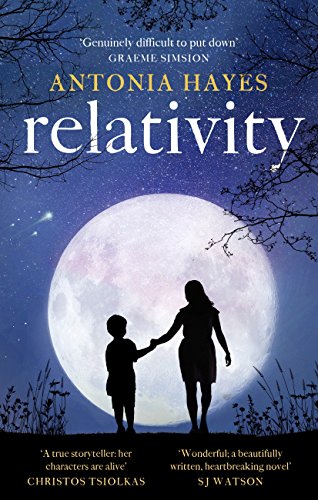
blog_tour5

When Your Best Isn’t Good Enough, a Guest Post by Robert Crouch, author of Fisher’s Fables

cover

I love featuring new to me authors on Linda’s Book Bag and when I ‘met’ Robert Crouch in the wonderful Book Connector’s Facebook group and found that it was blogging that led to his first published book, Fisher’s Fables, I had to invite him onto the blog to tell me more, especially as I’m a blogger with writing aspirations. Fisher’s Fables was published on 25th November 2016 and is available for purchase here.

Fisher’s Fables

cover

If insubordination were an Olympic sport, Kent Fisher would be world champion, according to his boss, who’s struggling with a section that’s the best at being the worst.

Yet there’s worse to come when Kent shows his dysfunctional team how to win in a no-win situation and get a second chance to make a first impression. No matter what the challenge, or how absurd the strategy, Kent and his colleagues can always find a way to frustrate their superiors.

Loosely based on the author’s experiences, Fisher’s Fables began life as a humorous blog, poking fun at dubious management, even more dubious acronyms, and the most dubious changes never needed.

Fictionalised to protect the guilty, Fisher’s Fables is packed with unforgettable characters and witty dialogue that’ll raise a chuckle or three from anyone who enjoys watching the mighty fall.

The blog and characters went on to inspire the first Kent Fisher murder mystery novel, No Accident, which starts where Fisher’s Fables ends.

What Do You Do When Your Best Isn’t Good Enough?

A Guest Post by Robert Crouch

image003

After years of edits, revisions and rejections by publishers and agents, I put my novel on the shelf and stopped writing. Maybe having an environmental health officer solve a murder in a traditional whodunit was too different. Maybe the characters didn’t leap off the page as one agent advised me.

Despondent and bruised by self-doubt, I figured a break from writing would do me good.

About two years later, I became aware of blogging. It looked like the perfect medium to write about my work as an environmental health officer, but I had to take care. As a law enforcement officer, I would be in hot water if I breached confidentiality. If I revealed the names of dirty restaurants or negligent employers, I could prejudice legal proceedings or find myself in court.

The only safe way to write about my work was to fictionalise it. And there, gathering dust on the shelf was my last novel with a cast of characters from an imaginary environmental health service.

In March 2007, Fisher’s Fables launched when Kent Fisher described my radio interview about the ban on smoking in public places. To broaden the blog’s appeal, I added a healthy dose of humour and irreverence to satirise issues as diverse as sexual health, public spending cuts and the banalities of management.

Over the years, as more people followed and enjoyed Fisher’s Fables, my confidence grew. The characters began to take on a life of their own. The blog morphed into a mini sitcom with complex storylines, plots and conflict, courtesy of a backstory between Kent and new recruit, Gemma Dean. Though fictitious, the episodes tackled current issues and the challenges at work.

Then I realised I’d found my voice as an author.

It was time to return to my whodunit. Twelve months later, after reading the first three chapters and a synopsis, Penmore Press offered to publish No Accident, the first Kent Fisher murder mystery.

no-accident

Without the blog, I would never have rewritten No Accident. Fisher’s Fables restored my confidence. It allowed me to improve as a writer and breathe life into my characters, turning the dull world of local government into something funny and entertaining in the vein of ‘Yes Minister.’

To show my journey from blogger to published novelist, I published Fisher’s Fables as a book in November 2016, adding two additional posts to end Fisher’s Fables at the point where No Accident starts for a seamless progression. Though perhaps unusual, it feels like a fitting record of a somewhat different approach to publishing a first novel.

I spent hours, sometimes days and weeks, crafting each blog with the care and attention I would give any kind of writing. Whether a journal, a guide to solve problems, or fiction, blogs need snappy titles and quality content to capture readers and hold them. If you can make them laugh, or cry, even better.

Established authors can blog to communicate with readers and encourage feedback. Most readers want to know more about authors, how they work and where they get their ideas from. Blogging is a great way to answer those questions and allow fans and followers to know a little more about their favourite authors.

I’ve covered ‘the writer’s life’ in my Robservations blog, but I want to expand into areas and interests enjoyed by my readers so they can become more involved.

Thank you, Linda, for a chance to guest on your site and share my story with your followers.

My absolute pleasure Rob. Great story and very motivating for aspiring writers like me!

About Robert Crouch

robert

Robert’s love of writing began when he won a national short story competition at the age of 12. Life, marriage and a career in environmental health pushed writing onto the backburner until Penmore Press offered to publish No Accident in 2015.

Robert Crouch pays homage to the traditional whodunit and murder mystery novels of authors like Agatha Christie while adding a fresh and irreverent twist.

He achieved this by creating Kent Fisher, an environmental health officer with more baggage than an airport carousel. Based on the author’s own experiences, Kent made his first appearance in the humorous and irreverent blog, Fisher’s Fables, which ran from 2007 to 2014 and was released as an eBook in November 2016.

In No Accident (available here), Kent investigates a fatal work accident at a theme park. But could it be a murder in disguise? That’s the question that propels his investigation through many twists and unexpected turns, putting him and the people he loves in great danger.

Robert now writes full time and lives in Eastbourne on the South Coast of England with his wife and their West Highland white terrier, Harvey, who stars in the novels as Kent’s sidekick, Columbo.

The second Kent Fisher mystery, No Bodies, will be available later in 2017.

You can find Robert on Facebook and visit his website. You can also follow him on Twitter. You can receive a free copy of Case Files by signing up to Robert’s newsletter here too.

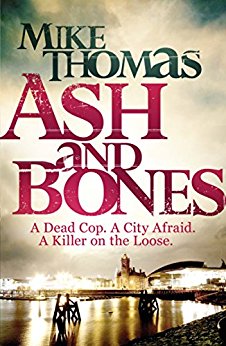
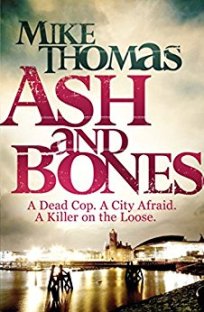
What is a Criminal? A Guest Post by Mike Thomas, author of Ash and Bones

ash-and-bones

I’m delighted to welcome Mike Thomas to Linda’s Book Bag today. Mike’s latest novel Ash and Bones, the first in the DC Will MacReady series, was published by Bonnier Zaffre on 25th August 2016. Ash and Bones is available for purchase here.

I was interested in how Mike perceived criminality, given that he has a background in the police, and luckily he agreed to tell me a few of his views in a thought provoking guest post that reminded me very much of the circumstances of many youngsters I’ve taught in the past.

Ash and Bones

ash-and-bones

At a squalid flat near the Cardiff docks, an early morning police raid goes catastrophically wrong when the police aren’t the only unexpected guests. A plain clothes officer is shot dead at point blank range, the original suspect is left in a coma. The killer, identity unknown, slips away.

Young and inexperienced, Will MacReady starts his first day on the CID. With the city in shock and the entire force reeling, he is desperate to help ­- but unearths truths that lead the team down an increasingly dark path…

What Makes a Criminal

A Guest Post by Mike Thomas

On one of my old patches there were two brothers, infamous siblings who were hooked on the gear, who spent their hours breaking into OAP housing complexes for copper piping, for the keys to the pensioners’ vehicles, for their treasured possessions, just to pay for their next bag of brown. And they did a lot of drugs, so they committed a lot of crime to fund their habits. Shoplifting, street robberies, a bit of dealing where they’d cut the amphet until it was nothing but chalk dust and baby powder. Whenever you arrested them, they’d fight. Every single time. Punch and spit on and headbutt you as you tried to cuff them, and they were tough guys, these brothers, twentysomething street brawlers with ruined knuckles and missing teeth. Every cop I knew hated them. Nobody stopped to wonder just why they were like they were. What had happened to them to shape their lives.

We’ll come back to them in a short while.

What makes a criminal? I used to ponder this a lot during my career – over twenty years – as a cop. I don’t know anybody who hasn’t – at least once in their life – done a bad thing. Some of them – friends, family members – have done Very Bad Things. When I was growing up, in a small Valleys town in Wales, there was little to do until you looked old enough to sneak into the pub and neck far too much watery lager. I took to graffiti. I was good at it. My little crew were good at it. So we tagged and conjured colourful murals and ran away before the Old Bill caught us. Did I know I was breaking the law? On some level, of course. But you’re talking about somebody whose closest cousin was a heroin-addicted prison veteran who died after jumping from a bridge while trying to escape pursuing cops. Spraying daft breakdancing figures at the back of Tesco paled in comparison.

And it didn’t stop me joining the police, where I spent two decades dealing with society’s disenfranchised. Wherever I worked – valleys, capital city – you would spend all your time with the same people. Locking them up. Sorting out their problems, from spousal fights to broken front doors to missing kids. Locking them up again. Sorting out yet more problems. And so it went, an endless conveyor belt of Other People’s Issues. It became exhausting. Frustrating. You were nothing but a glorified social worker, but one people would happily thump if you didn’t do what they demanded, or had the temerity to place handcuffs on them for setting fire to their neighbour’s car.

The frustration with policing, the awful things I’d witnessed, they fed into my first novel, Pocket Notebook, which charts the downfall of a PTSD-suffering firearms officer – the book is one long howl of rage. It was incredibly cathartic to write, and led to me leaving the police – which I was very happy to do. After twenty years of banging my head against a brick wall, fiction allowed me to address the concerns I had with the Job, the government, and the ineptitude of the senior ranks. I’ve calmed a lot since leaving, and the writing is less ragged and angry – more measured, I hope, yet still as authentic as a former police officer’s fiction can be.

Leaving also gave me the space to think further about those criminals I was dealing with all those years. Because it’s easy to see everything in just black and white or slide everyone into boxes marked good or evil. To just roll your eyes and mutter about scumbags and pond life and scrotes as you scream to the latest domestic involving That Couple Every Copper Knows. But that is to miss the reasons, the root causes. There’s the usual biggies: greed, money, sometimes profound mental illness. But I’ve dealt with so-called ‘career crims’ who used to cause untold misery, and it’s only upon speaking to them, or their families, and hearing their backstories do you understand – never accept, never condone, but understand – why they do the things they do. Why they behave in such a way. The fact is some of them never had a chance. They’ve been marginalised and brutalised since birth and wouldn’t know right from wrong if it thumped them in the nose (yes, that’s wrong).

So: back to those brothers. I’d been policing that area for five years, a teeth-grindingly busy patch where the calls never ended, where the locals detested you, where you’d go home after an afternoon turn and down two bottles of wine to take the edge off. And then I found out what happened to them. How their father repeatedly sexually abused them as babies, as toddlers, as they grew into their teens. They moved into adulthood already damaged beyond repair.

Both are dead now. One suicide, one overdose. Neither saw the age of forty.

The truth is you’re never too far from the edge. It would only take one or two life-changing events to nudge you towards doing something criminal. Losing your job, for example. No money coming in, your kids starving, so you shoplift food and are caught. Your wife leaves you for another man, and you can’t contain your rage, and you attack them both. I’ve seen people lose it for the most mundane of reasons. One wife stabbed her husband to death because he wouldn’t give her one of his cigarettes. In my new novel, Ash and Bones, we see decent people driven to commit terrible crimes for the most ridiculous of reasons.

As human beings – flawed, brilliant, baffling things that we are – we all have it in us.

About Mike Thomas

mike-thomas

Mike Thomas was born in Wales in 1971. For more than two decades he served in the police, working some of Cardiff ’s busiest neighbourhoods in uniform, public order units, drugs teams and CID. He left the force in 2015 to write full time.

His debut novel, Pocket Notebook, was published by William Heinemann (Penguin Random House) and longlisted for the Wales Book of the Year. The author was also named as one of Waterstones’ ‘New Voices’ for 2010. His second novel, Ugly Bus, is currently in development for a six part television series with the BBC.

His new novel (the first in the MacReady series), Ash and Bones, was released August 2016 by Bonnier Zaffre. Splinter, the second in the series, is ready for release in 2017.

He lives in the wilds of Portugal with his wife, two children and an unstable, futon-eating dog.

You can find out more about Mike by visiting his website, following him on Twitter and finding him on Facebook.

Getting Over the Middle Hurdle, a Guest Post by C J Carver, author of Tell Me A Lie

tell-me-a-lie

I’m delighted to be helping to celebrate Tell Me A Lie by C J Carver. Tell Me A Lie was published by Bonnier Zaffere on 12th January 2017 and is available for purchase in e-book and paperback here.

As an aspiring writer myself, I’m thrilled to be hosting a guest post today from C J Carver all about getting past that difficult middle phase of writing a novel.

Tell Me A Lie

tell-me-a-lie

How do you protect your family when you can’t remember who’s hunting them? A gripping international thriller, perfect for fans of Lee Child and Mason Cross

A family in England is massacred, the father left holding the shotgun.

PC Lucy Davies is convinced he’s innocent

A sleeper agent in Moscow requests an urgent meeting with Dan Forrester, referencing their shared past.

His amnesia means he has no idea who he can trust.

An aging oligarch in Siberia gathers his henchmen to discuss an English accountant.

It’s Dan’s wife

From acclaimed and award-winning author CJ Carver, this is the next gripping international thriller in her brilliant Dan Forrester series.

Getting over the Middle Hurdle.  Writers who give up most often do so in the middle of the book.  Tips on how to keep galloping to the end.

A Guest Post by C. J Carver

I have a moment writing each book that I hate.  Absolutely HATE.  It’s when I hit the 40,000 mark and I wonder if I’ve got enough story to keep going.

I’ve written nine full-length thrillers and it happens every time, so I don’t panic any more.  I just tell myself it’s part of the process and keep plugging away, grumbling that it’s like pulling teeth, groaning that writing is such hard work, it’s torture, mutter mumble.

Roughly 10,000 words on I’m on the downhill slope and then I panic that I have too much story!

This hiatus in the middle has to do with fear (at least for me, anyway).  Fear that the story is rubbish, that there’s nothing worth writing about, that what I’m saying will mean nothing to anyone else.  It’s a moment when I have to motivate myself to just KEEP GOING.

Don’t let insecurity beat you.  If you’re intimidated by great writing then don’t get caught up in going over pages again and again, seeking perfection.  Push on through.

It may seem impossible to finish because you’re sure you might find a better way of forging the plot, creating a difference character, twist or story.  A book can go on for ever but it could become stale and (certainly for thrillers) go out of date.

Set an artificial deadline.  I do this all the time.  I tell myself to finish the first draft by the start of my next holiday, or Easter, Christmas, my birthday.  It feels great to beat the deadline.

I find having a daily target useful at this point.  Some writers won’t stop until they’ve written 1,000 words for the day (or whatever the amount), others set themselves two-hourly targets. Put into place the best that works for you, and stick to it.  But don’t be over-ambitious or you’ll just beat yourself up.

Graham Greene apparently said 200 words a day was enough for anyone.  I find being able to keep up with one of my favourite authors very cheering!

Rest assured that at this point it doesn’t matter if the plot twist or new character is all wrong, things will become clear later.  They always do.

Don’t fall into the trap of re-writing as you go.  When I was starting out I spent hours re-reading and working on what I’d previously written but I now know there’s little point as I may cut whole chapters on the main edit.  Now I simply read through what I wrote the previous day but don’t get hung up on it.  It’s all about getting the first draft down.

Make time to write.  I know it sounds obvious, but there’s no point waiting for the Muse to strike.  The best time to write is when time is available.  I know a young mum who locked herself in the bathroom between nine and ten p.m.   She finished her novel this way.

Above all, keep writing in the knowledge you’re steadily moving forwards.  And before you know it, you’ll be writing THE END, hopefully with a big grin on your face.

About C J Carver

Version 6

C.J. Carver’s first novel Blood Junction won the CWA Debut Dagger and was selected by Publishers Weekly as one of the best mystery books of the year. Half-English, half New Zealand, C.J. has been a travel writer and long-distance rally driver, driving London to Saigon and London to Cape Town. Her novels have been published in the UK and the USA and translated into several languages.

You can follow C J carver on Twitter,  visit her website and find her on Facebook. There’s more with these other bloggers too:
tell-me-a-lie-blog-tour


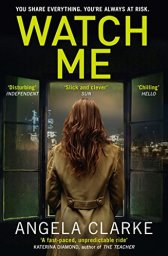
Growing Characters, A Guest Post by Angela Clarke, author of Watch Me

cover

I’m thrilled to be taking part in the launch celebrations for Watch Me by Angela Clarke. Watch Me was published by Avon Books on 12th January 2017 and is available for purchase in e-book and paperback here and through the publisher links here.

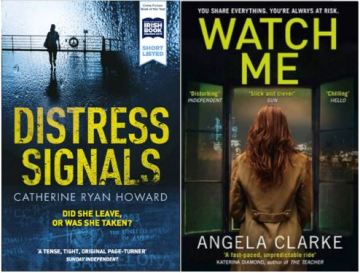
To celebrate Watch Me‘s launch, Angela has kindly provided a guest post all about developing characters across a series and she is running a very special giveaway (UK only I’m afraid) to win a copy of Watch Me and a specially selected guest book. Today it is a signed copy of Catherine Ryan Howard’s Distress Signals: A missing girl. A trail of secrets. A killer who’s found the perfect hunting ground.

There are details of how to enter at the bottom of this post.

Watch Me

cover

YOU HAVE SIX SECONDS TO READ THIS MESSAGE…

The body of a 15-year-old is found hours after she sends a desperate message to her friends. It looks like suicide, until a second girl disappears.

This time, the message is sent directly to the Metropolitan Police – and an officer’s younger sister is missing.

DS Nasreen Cudmore and journalist Freddie Venton will stop at nothing to find her. But whoever’s behind the notes is playing a deadly game of hide and seek – and the clock is ticking.

YOU HAVE 24 HOURS TO SAVE THE GIRL’S LIFE.
MAKE THEM COUNT.

How to Grow Characters Across a Series

A Guest Post by Angela Clarke

Here are some key questions writers can ask themselves to make sure they are developing and growing their characters across a series:

  1. Has your character changed? Basic story theory says that a character should be changed in some way at the end of a tale. They should be altered; physically, psychologically, or figuratively, from how they are at the beginning of the story. They will have been affected by the events that have taken place. For a series writer, this means you start a new book with a character that is distorted from how they were in previous books. We are all shaped by our own experiences, and it must be the same for your characters. They don’t exist in a vacuum where you press reset each time you start a new book in a series. It makes sense, for example, that Freddie Venton, the protagonist in the first Social Media Murder Series Follow Me is changed by her encounter with a serial killer. Thus in book two, Watch Me, she is not the brash, fearless wannabe-journalist we meet at the beginning of Follow Me. She is different. She reacts differently. She has different struggles. Different provocations. She has changed.
  2. Has your character grown up? Your character will have aged and learnt from their previous experience. Never mind anything else, characters who repeatedly make the same mistakes create formulaic and stale stories. This is your opportunity to shake things up. Perhaps your hero is at a fresh stage in their life, or they are now in a serious relationship, or have dependents? This will all affect how they act and react, as well as give you as a writer new areas for pressure and clashes. A former lone wolf who now has a loving partner, now also has new vulnerabilities. Have fun by playing with the rules of the game.
  3. Does your character have a core unresolved conflict that spans books? Claire McGowan’s Paula Maguire series is superb example of how to nail this. Her protagonist Paula’s mother vanished when she was thirteen years old, and has never been seen since. Not only does this key moment affect and shape Paula as an adult (she becomes a forensic psychologist specialising in missing people, and has trust issues in her personal life), it also feeds an ongoing story. What did happen to Paula’s mother? As the series evolves, pieces of the puzzle fall into place, drawing out the suspense in Paula’s own life, and transcending that of each novel’s core investigation.
  4. Can you change the key players? Has the grudgingly accepting boss of your detective been replaced by a new ambitious, PR-aware head of department? Changing one or two key players in your series will have an effect on your protagonist. For example, in Watch Me, book two in the Social Media Murder Series, DS Nasreen Cudmore has been moved to a new specialised e-crime unit. Not only does this mean she has to prove herself afresh, but it also means she has a whole new set of office politics to learn and navigate. Needless to say, it doesn’t go smoothly. New characters and new restrictions create new conflicts and tensions; vital components of story.
  5. What about other reoccurring characters? Ask the same questions above of your other characters: their lives will also be progressing, they will also be changing. As a series proceeds, you have a great opportunity to develop secondary characters into more vital roles. This means you have a new wealth of battles, frictions and motivations to mine.

UK Only Giveaway

prize

UK readers have six seconds to read this message and until UK midnight today 17th January 2017 to enter. To enter, click here.

About Angela Clarke

angela_clarke-credit-tim-wheeler

Angela Clarke is an author, columnist and playwright. Her debut crime novel Follow Me was the first in the Social Media Murders Series.

Her memoir Confessions of a Fashionista (Ebury) is an Amazon Fashion Chart bestseller. Her debut play The Legacy received rave reviews after it’s first run at The Hope Theatre in June 2015. Angela’s journalist contributions include: The Guardian, The Independent Magazine, The Daily Mail, and Cosmopolitan. Now magazine described her as a ‘glitzy outsider’. Angela read English and European Literature at Essex University, and Advances in Scriptwriting at RADA. In 2015 Angela was awarded the Young Stationers’ Prize for achievement and promise in writing and publishing.

She is almost always late or lost, or both.

You can follow Angela on Twitter, find her on Facebook and visit her website. There’s more with these other bloggers too:
blog-tour

Chasing Shadows by T.A. Williams

chasing-shadows

I have met the charming T.A. (Trevor) Williams several times and he’s lovely, so I’m thrilled to be starting the celebrations for his latest novel Chasing Shadows. Chasing Shadows is published by Canelo in e-book today, 16th January 2016, and is available for purchase here.

It was a real privilege to read Chasing Shadows for review as it is a slight departure from Trevor’s usual romances with an historical element too.

Chasing Shadows

chasing-shadows

Amy had it all – money, brains and beauty. And then the accident happened.

The Present Day: Left blind and without her family, Amy feels she needs to get away. On a trip along the Camino, she is accompanied by the mysterious and troubled Luke. Having been set up to help Amy by a mutual friend, Luke finds he is also running from his past…

1314: A Templar Knight, Luc, is also running. He meets the wife of a former comrade, now blinded in a terrifying attack: Aimee. Taking her under his wing, they must journey together through a dangerous world.

As they travel through the stunning scenery of Northern Spain, this couple, so very like Luke and Amy, emerge from the shadows of time carrying a treasure of inestimable value.

My Review of Chasing Shadows

After a terrible accident, Amy is making the most of her life, but it has surprises even she can’t imagine as echoes from the past link with the present.

I was slightly apprehensive about reading a change in style from T.A. Williams, especially as I’m not overly keen on timeslip stories, but was so relieved to find that his usual flowing narrative presentation still remains. I always find his writing effortless to read as there’s a confidence and elegance behind it that makes it so pleasurable and Chasing Shadows is no different.

As two of the protagonists are blind in this story, the quality of description from their travelling companions serves not only Amy and Aimee, but the reader too, so that I had a real understanding of the route taken because of the vivid writing. I thoroughly enjoyed the appeal to the senses, especially taste, which is so often missing from novels.

The structure of scenes set in both 1314 and 2016 is well constructed, with stories within stories and an exploration of history repeating itself. There was none of the awkwardness I sometimes feel when reading timeslip fiction. Not only did I enjoy a highly entertaining story but I really appreciated the historical research that led me to learning new things as I read. I found the Epilogue fascinating. I felt Chasing Shadows had been thoroughly researched and there was a personal connection from the author to the journey the characters take so it came as no surprise to find T.A. Williams had cycled the same route.

Initially I preferred the modern 2016 story of Luke and Amy and their developing relationship, but I was soon caught up in that of Luc and Aimee too, wanting to know the outcome of the mystery. Reading Chasing Shadows was so satisfying because I had a modern romantic read and an historical mystery that added extra layers of interest. I was impressed by the title Chasing Shadows as there are so many ‘shadows’ in this story. Luke and Amy are chasing a shadowy happiness with shadows of past trauma affecting their present lives. Luc and Aimee are being chased by shadows of enemies and memory and, without spoiling the plot, there is a huge ‘shadow’ to their burden. Luke and Amy are weaving the shadows of a narrative for their historical characters. All these layers added to the quality of the book for me and I thoroughly enjoyed Chasing Shadows.

About T.A. Williams

TAWilliams

My name is Trevor Williams. I write under the androgynous name T A Williams because 65% of books are read by women. In my first book, “Dirty Minds” one of the (female) characters suggests the imbalance is due to the fact that men spend too much time getting drunk and watching football. I couldn’t possibly comment. Ask my wife…

My background, before taking up writing full time, was in teaching and I was principal of a big English language school for many years. This involved me in travelling all over the world and my love of foreign parts is easy to find in my books. I speak a few languages and my Italian wife and I still speak Italian together.

I’ve written all sorts: thrillers, historical novels, short stories and now I’m enjoying myself hugely writing humour and romance. My most recent books are the What happens… series. What happens in Tuscany reached #1 in the Amazon.uk Romantic Comedy chart and What Happens on the Beach, the last in the series, came out in July. Chasing Shadows is still romance, but with the added spice of a liberal helping of medieval history, one of my pet hobbies. I do a lot of cycling and I rode all the way to Santiago de Compostela on a bike a few years back. This provided both the inspiration and the background research for Chasing Shadows.

I’m originally from Exeter, and I’ve lived all over Europe, but now I live in a little village in sleepy Devon, tucked away down here in south west England. I love the place.

You can find out more about Trevor on Facebook, Goodreads and Amazon. You can also follow him on Twitter and via his website.

There’s more with these other bloggers too:
chasing-shadows-blog-tour-2

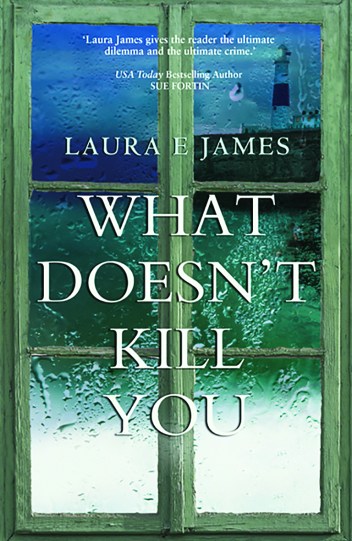
What Would You Do? A Guest Post by Laura E James, author of What Doesn’t Kill You

wdky-cover-with-sf-quote

I’m delighted to be helping to celebrate the paperback launch of What Doesn’t Kill you by Laura E James today. What Doesn’t Kill was published in paperback by Dark Choc Lit on 9th January 2017 and is available for purchase in ebook and paperback here or through the publisher links here.

Today Laura has kindly written a guest post asking us what we might do in certain situations. Her words are supported by photographs from Laura’s fellow writer and friend Kate Kelly.

What Doesn’t Kill You

wdky-cover-with-sf-quote

What doesn’t kill you makes you stronger – but how strong can one person be?

Griff Hendry knows what it is to be strong. After a turbulent past, he’s dedicated himself to saving lives, working as a coastguard along the breath-taking shores of Dorset. It’s Griff’s belief that everyone is worth saving – which is why he can’t forgive his father, Logan, for what he did.

Griff’s future is plunged into uncertainty when his wife, Evie, tells him she wants a separation. The revelation is a shock and leads Griff to question what Evie could possibly be hiding – and she isn’t the only one holding back. Griff’s troubled stepdaughter, Tess, also harbours a dark secret.

As the truth is uncovered, Griff is forced to accept that perhaps he’s never understood what real strength is.

What Would You Do?

A Guest Post by Laura E James

Thank you so much for inviting me to Linda’s Book Bag blog, the penultimate stop on the What Doesn’t Kill You paperback tour. The tour coach has clocked up the miles and has done me proud.

The first two weeks of 2017 has seen cold, but mainly dry weather here in the South West – vastly different to the weather at the start of What Doesn’t Kill You.

We meet a sodden Griff Hendry, a coastguard, standing at the end of Portland Bill, a peninsular in West Dorset, England. In addition to fighting his demons, he’s struggling with the high winds and pelting rain, reminiscent of the UK storms of January 2014.

portland-crane-kate-kelly-1

OLYMPUS DIGITAL CAMERA

The white horses of the English Channel were charging head first into the obelisk of Pulpit Rock, their remains spewing onto the cliff tops of Portland Bill, then receding, threatening to drag the winter tourists and spectators into the rough water below.

The wild spray reached as far as the toes of Griff Hendry’s boots as, under the gaze of the red and white striped lighthouse, he stood firm. His instinct was to keep vigil over the families and photo-opportunists gripped by the sight of the huge breakers – people like him, restless and eager to engage with the outside world following the festivities of New Year. It made no difference he was off-duty; his experience as a coastguard and his years of living in West Dorset meant he knew the risk; nature was sometimes a beast – raw, savage, and powerful. She was to be admired, but with reverence. Much like love.

Both could drown you without warning.

portland-kate-kelly

The storms are a metaphor for Griff’s life. Estranged from his wife, Evie, he stands alone, looking out to sea wondering where it all went wrong. He doesn’t understand how or why his marriage is on the rocks. His and Evie’s love for one another has never been in doubt, so why has she pushed him away? How is it he’s living in a rented flat and no longer in the family home? How can he fix things?

What would you do if you were Griff?

truth-or-dare

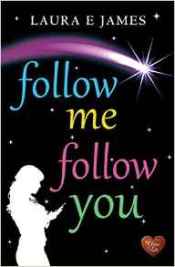
In my debut novel, Truth or Dare?, the hero, Declan, and heroine, Kate, are in their twenties and single when they first meet. In Follow Me Follow You, the second book in the Chesil Beach series, the hero, Chris, and heroine, Victoria, first met in their teenage years, although the reader meets them some time after this, with Chris and Victoria having been married to other people and with them having families of their own. The story looks at how a first love can impact a person’s life.

follow

When it came to writing What Doesn’t Kill You, the idea of starting the story at the point when a married couple are separated intrigued me. For two people so obviously in love with each other, what caused the split? And what would bring them together again? Could love be the victim or the perpetrator? Or both?

From riding high on wave after wave of ecstasy, his relationship with Evie had sunk without trace.

And Griff hadn’t seen it coming.

He needed Evie to talk, to tell him what the problem was so he could fix it, but communication was limited. Her usual reply was a shrug, or a silent diversion, and the more he pushed, the further she withdrew. The death blow came when Griff finally forced the issue with a question. A foolish, instantly-regretted question. ‘Is it because of someone else?’

Evie, her green eyes fading to a silky grey, turned away and breathed her word into life. ‘Yes.’

It was after that she asked Griff to leave.

What would you do for love?

I also wanted to examine the dynamics of the Sandwich Generation – people who care for an elderly relative, but are also raising children – and how this works, or doesn’t, within a blended family. Griff’s elderly and disabled father, Logan, is cared for by Evie. Evie has a fifteen-year-old daughter, Tess, from her first marriage, and Griff and Evie have a two-year-old son, Dylan, making Logan a step-grandad to Tess, but a blood relative to Dylan. With Evie’s time split between looking after Logan and running around after a toddler, where does Tess fit in? How does she feel about her mother’s carer duties? How far down the list does she perceive herself to be? And what if she didn’t get on with her step-father, Griff, known to her as Gruff? How would she deal with these situations?

Here’s Tess:
My wilful DMs take me past the garages with the asbestos roofs and I celebrate the fact Gruff hates them – both my boots and the buildings.

He rattles on about asbestos being a silent killer.

I think stepfathers are silent killers.

I fight hard to keep my individuality alive. If Gruff had his way, we’d all be in uniform, standing to attention every time he entered a room. Thinks everything should be done his way, as and when he says.

Belligerence boils in my gut. One day …

What would you do in Tess’s position?

Then there’s Logan, a housebound widower who relies on his daughter-in-law’s kind and caring nature to get him through each day, until he puts Evie in an impossible position. Should she brush it off and carry on as normal? Should she tell Griff? Should she walk away? What should she do?

What would you do?

The story poses many questions, but here’s my final one: What doesn’t kill you makes you stronger … but how strong can one person be?

#whatwouldyoudo?

About Laura E. James

laura-e-james

Possessing little in the way of domestic skills, and with an insatiable hunger to write, Laura E. James found a much better use than cooking, for the family kitchen. Tucked neatly in one corner is her very small, but very tidy desk from where she produces issue-driven romantic novels, short stories, and flash fiction.

Living in and enjoying the inspirational county of Dorset, Laura is a graduate of the Romantic Novelists’ Association’s New Writers’ Scheme, a member of her local writing group, Off The Cuff, a founder of Littoralis, and one eighth of The Romaniacs, the RNA Industry Awards 2015 Media Stars Winner.

Published by Choc Lit, Laura’s debut novel, Truth or Dare? was nominated for the Festival of Romance Best Romantic eBook. Her second novel, Follow Me Follow You was a LoveReading editorial selection. What Doesn’t Kill You, the third in the Chesil Beach Book Series, is the first title in Choc Lit’s new Dark imprint ‒ compelling, emotional, hard-hitting novels. Not your typical romance story.

You can visit Laura’s website, or visit The Romaniacs. You’ll also find Laura on Facebook and with like-minded writers who love the sea as inspiration here. You can also follow Laura on Twitter.

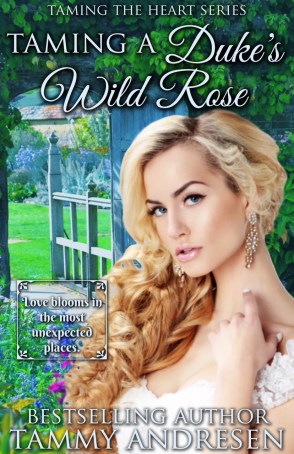
An Interview with Tammy Andresen, Author of Taming A Duke’s Wild Rose

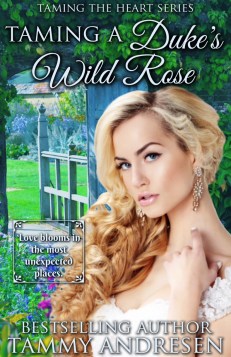
taming-a-dukes-wild-rose-cover

I’m always keen to broaden my reading horizons and so I’m very please to welcome Tammy Andresen to Linda’s Book Bag today to tell me a little about her Taming the Heart series of books as they belong to a genre I don’t often read. Taming A Duke’s Wild Rose from the series is available from your local Amazon site and you’ll find all Tammy’s books for purchase here.

Taming A Duke’s Wild Rose

taming-a-dukes-wild-rose-cover

Since the death of her mother, Lady Rose Wentworth has dreamed of a hero. A knight or soldier who sweeps her off her feet and heals the scars she hides within. These fantasies cloud her judgement when it comes to a man’s true nature and every suitor she pines for proves to be less than honorable. But Rose is convinced she has finally found a true hero in the soldier, Carl Lundberg.

Fearing for Rose’s future, her father arranges a match with the scarred duke. Powerful and rich beyond reason, Lord Wentworth is convinced this is the man who can provide a real future for his daughter. But Rose knows better, or so she thinks. Now she is caught between two men, one handsome and dashing, the other scarred but intriguing none-the-less. As each vies for her hand, Rose finds it more difficult to discern whose intentions are pure.

The more Rose is entangled in the web of love and marriage the more she questions which man has the true heart and who can unlock hers.

An Interview with Tammy Andreson

Hi Tammy. Thank you so much for agreeing to answer some questions on my blog about your writing. Firstly, please could you tell me a little about yourself?

I am a mom of three girls and a love of romance! After leaving my career as an English teacher, I decided to try my hand at writing. It has been amazing!

And tell me a little about Taming A Duke’s Wild Rose (without spoiling the plot!).

Rose is a sweet but naïve girl who wants a hero to save her from the pain of her past. But she has a knack for looking in all the wrong places. Her father, fearing for her future, arranges a marriage with the scarred duke.

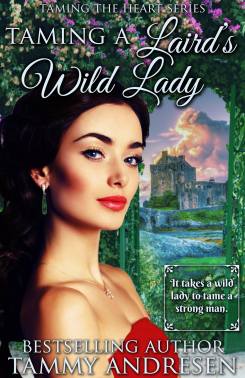
This book is the second book in the Taming the Heart series, though each is a standalone. The third book, Taming a Laird’s Wild Lady comes out on 17th January!

taming-a-lairds-wild-lady-cover

(Taming a Laird’s Wild Lady is available for pre-order here.)

There’s a lovely pun in the title Taming A Duke’s Wild Rose given that your protagonist is called Rose. How do you choose the titles of your books?

Being an English teacher, I couldn’t resist the pun!

I don’t often read romance so how would you persuade me to try your books?

I love all genres of books and movies and you will see influences of other genres in my work. My books tend to have more action than a great number of romances, suspense and a dash of mystery.

What draws you to historical romance as a genre?

It’s what I love to read most so it was a natural place to start writing.

How do you go about researching detail and ensuring your books are realistic?

It takes a lot of research. I pick a setting first and do some cursory reading and create a reference library for each book but then I have to go back and cross check little details. Just today, I was researching the history of a bride not seeing her groom on her wedding day. It is a tradition that dates back to arranged marriages. The bride’s father didn’t want to give the groom a reason to back out!!

How tricky is it to retain authenticity of setting whilst appealing to a modern reader?

I get better with each book I write. Setting and clothing are what appeal to a lot of readers, dialogue can be very tricky. It’s easy to slip into modern speech and each reader has a different level of expectation. While I make sure to use historically accurate vocabulary, it is a difficult balancing act.

I know you were brought up listening to storied told by you mother. How has that experience influenced your writing?

It just made me love stories. I try not to get too lost in dreaming them up, the dishes still need to get done!

When did you first realise you were going to be a writer?

A year ago… LOL. In all seriousness, I never thought it would actually happen. It was like winning the lottery or a trip to Africa. When I started the first book, I wondered if I would finish it. I feel truly fortunate to be a writer.

If you hadn’t become an author, what would you have done instead as a creative outlet?

Teaching. I loved creating curriculum. I miss it but I would miss writing more. If they add more hours into the day, I would love to do both.

Which aspects of your writing do you find easiest and most difficult?

Reviewers over and over talk about my character development. A classic English education, means I can’t just tell a love story. The characters must overcome their own flaws and grow into more self-realized people.

What are your writing routines and where do you do most of your writing?

On the couch. I write all day but in half hour spurts. Partly because I my brain needs a break. With even a short break my creativity perks back up. But also because life as a mom has a lot of interruptions!

When you’re not writing, what do you like to read?

Romance, romance, romance! It helps me to be a better writer and I love it!

If you could choose to be a character from one of your books, who would you be and why?

Hmmmm…. My newest character Isla, from Taming a Laird’s Wild Lady challenges the strictures of society with her competence and spirit. Love her!!!

If Taming A Duke’s Wild Rose became a film, who would you like to play Rose and why would you choose them?

Oh gosh. Amanda Seyfried has that vulnerable beauty that would work for Rose!

Thank you so much for your time in answering my questions.

So wonderful to chat with you!!!

About Tammy Andresen

tammy-headshot

Tammy Andresen lives with her husband and three children just outside of Boston, Massachussetts. Her childhood was spent on the Seacoast of Maine, where she spent countless days dreaming up stories in blueberry fields and among the scrub pines that line the coast. Her mother loved to spin a yarn and Tammy spent many hours listening to her mother retell the classics. It was inevitable that at the age of 18, she headed off to Simmons College where she studied English literature and education. She never left Massachusetts but some of her heart still resides in Maine and her family visits often.

You can visit Tammy’s website, or find her on Facebook, Amazon and Goodreads. You can follow Tammy on Twitter.