The Winter’s Child by Cassandra Parkin

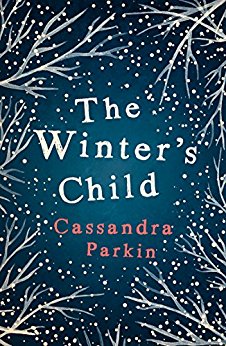
The Winter's Child cover

Having so loved Lily’s House by Cassandra Parkin, my review of which you can read here with an interview with Cassandra, and which was one of my favourite reads last year, I was thrilled to be asked to join in the launch celebrations for The Winter’s Child too. I also met Cassandra Parkin at a wonderful event you can read about here, Oceans of Words. Today, I’m re-interviewing her to find out more about her latest book The Winter’s Child and am delighted to share this latest Q+A as well as my review. As not all blog followers will know Cassandra I’m repeating a couple of questions!

The Winter’s Child was published by Legend Press on 15th October 2017 and is available for purchase here.

The Winter’s Child
 The Winter's Child cover

Five years ago, Susannah Harper’s son Joel went missing without trace. Bereft of her son and then of her husband, Susannah tries to accept that she may never know for certain what has happened to her lost loved ones. She has rebuilt her life around a simple selfless mission: to help others who, like her, must learn to live without hope.

But then, on the last night of Hull Fair, a fortune-teller makes an eerie prediction. She tells her that this Christmas Eve, Joel will finally come back to her.

As her carefully-constructed life begins to unravel, Susannah is drawn into a world of psychics and charlatans, half-truths and hauntings, friendships and betrayals, forcing her to confront the buried truths of her family’s past, where nothing and no one are quite as they seem.

A ghostly winter read with a modern gothic flavour. A tale of twisted love, family secrets and hauntings.

An Interview with Cassandra Parkin

Welcome to Linda’s Book Bag, Cassandra. Thank you so much for agreeing to answer some questions on my blog about your writing and The Winter’s Child in particular. I know you’ve been on the blog before but not all readers will know that so firstly, please could you tell me a little about yourself?

I’m a Yorkshire-based writer with Cornish roots and a passion for fairy-tales. I write contemporary fiction with a strong magical flavour. The Winter’s Child is my fourth novel, and it’s set in my home city of Hull, in our City of Culture year.

Why do you write?

It’s the thing that makes me happiest. Even on the days it’s like wading through treacle and I know that every word I write will end up being deleted later, I still love it. I’d still be writing even if I hadn’t found a publisher.

When did you realise you were going to be a writer?

I think most people who know me feel quite strongly that I took a stupidly long time to catch on! I spent literally years writing novels in secret, and short stories as Christmas presents, and volunteering for every single work-related writing project I could find. Everyone around me kept saying, “You’re supposed to be writing for a living. You are aware of this about yourself, right? Why are you still messing around pretending you want to be in marketing?” And to my shame, I completely ignored them for about fifteen years. (Sorry, everyone. I know I was annoying.)

I finally caught on when all my friends ganged up on me and made me enter a collection of unpublished short stories for Salt Publishing’s Scott Prize. I found out I’d won and my book was going to be published when I was unpacking yoghurts in the kitchen. I burst into tears, and called my mother and told her I was going to be a writer.

(I suspect you were a ‘writer’ long before that moment actually!)

Which aspects of your writing do you find easiest and most difficult?

I love all of it, so it’s difficult to say! I love writing beginnings, and endings. I love the moment when I start to find my way through the strange blank darkness of the middle section. I love editing – that feeling of taking the shambling mess of the first draft and starting to turn it into something worthwhile. I love talking to readers, and meeting other writers. I love it when my author copies arrive in the post and I open the wrapping and there’s that beautiful new-book smell and I can hold it in my hand and know it’s real. I love the friendliness and generosity of the writing and blogging community, and the support that everyone offers whenever someone needs it.

In fact, I think the only part I don’t like is pressing “send” when turning in a manuscript to my editor. It seems so final and terrifying. Sometimes I have to get someone else to do it for me while I hide under the duvet. Then I spend hours fantasising about how I might invent a way to climb inside my computer and somehow claw the email back again.

What are your writing routines and where do you do most of your writing?

I tend to write in the mornings, at my dining-table. Left to myself, I prefer to write in my pyjamas, but my kids’ friends call for them on the way to the bus-stop and I don’t think it’s fair to make them look at me in all my scruffy un-brushed un-showered glory just before a long day at school, so I only do the pyjama thing at weekends. I have a sort of little tray-table thingy that balances on the table so I can write standing up, and the cats come in and out and yell for cat-treats / for attention / to tell me it’s raining / because they want me to look at a dead bird. The window looks out onto the village main street, so I still feel connected to the outside world.

Without spoiling the plot, please could you tell us a bit about The Winter’s Child?

On the last night of Hull Fair, Susannah Harper visits a fortune-teller who gives her an unusually specific prediction: her son Joel, who has been missing without trace for five years, will come back to her by Christmas Eve. Haunted by this prediction, Susannah is gradually drawn back into a world she’d sworn to leave long ago – the world of psychics and mediums, who claim their supernatural powers will help her to bring her son home again.

I thought the way you portrayed what happens when teenage child goes missing was so absorbing and realistic. How did you go about researching detail and ensuring The Winter’s Child was realistic?

To start with, I read as many true-crime accounts of missing person investigations as I could get my hands on. (I think most writers probably have internet search histories that makes us look like serial killers.) I’m also lucky enough to have a close friend who’s a police officer, so she very kindly lent me her expertise whenever I needed it. It was the hardest part to get right, because of course every investigation is different, and technology and police work are changing all the time.

Of course, once you’ve done your research, you then have to bury it as well as possible, because fiction is never improved by the author standing in the corner yelling THINGS I KNOW ABOUT POLICE WORK LET ME TELL YOU ABOUT THEM. I hope I’ve got the balance right. And of course, any mistakes about the procedural aspects of the book are totally my own.

(You most certainly have got that balance spot on.)

Having read Lily’s House, I found The Winter’s Child was quite a bit darker. How do you think your writing has developed over time and to what extent did you set out to create a more disturbing read.

I absolutely love the tradition of the Christmas Eve ghost story. One of my favourite Christmas memories is being scared to death by a creepy film about a man who sold seven years of his life to the Devil, which my dad let my brother and I watch on Christmas Eve. I wanted The Winter’s Child to be worthy of that tradition. So it was important to me that it was a really dark and unsettling story.

As for the way my writing has developed over time…I’d love to say I’ve got more confident and skilled, but I think the main thing I notice is that I’ve discovered new and different things to worry about! For my first novel, I was thinking the whole time, Can I even do this? What if I get halfway through and dry up? What if I get to the end and hate it? What if I’m just fooling myself that this is ever going anywhere? What if it’s all a colossal waste of time? These days, I worry just as much, but about different things – Is this too similar? Too different? Am I challenging myself enough? Am I challenging myself too much? Is it okay for me to write about this subject? Oh my God how will I ever hit my deadline? Which I suppose is progress, in a way.

The Winter’s Child contains some very weighty themes including mental health issues, spiritualism and marriage. How far did you plan to write about them and how far did they arise naturally as the plot progressed?

That’s a great question! I knew from the start that the theme of spiritualism was going to be central, but I think all the others just naturally came out of the process of writing.

I was overwhelmed at times by the emotion of The Winter’s Child. How were you affected by writing about Susannah and Jackie’s situations?

It was very, very hard to write, because the idea of anything happening to my son – the idea that he could just vanish without trace, and I’d never know what had happened to him – was so close to the bone for me. I honestly felt as if I was tempting fate just by letting myself think about it. And I was really aware that there are many families who are still living through this experience. I wanted to do justice to the reality of their experiences, and not exploit them.

(You have done so magnificently.)

My view of John changed dramatically several times as I read. How do you create your characters when you’re writing?

This is going to sound so unbearably pretentious, but it’s true – at the start of a project, all I know about my characters is what they’re called, and a little bit about what’s going to happen to them. Everything else emerges as I write.

With the relationship between John and Susannah, I think my breakthrough moment was through one of those would-you-rather questions. If your spouse and child were drowning, who would you save first? I realised that this was the problem at the heart of John and Susannah’s relationship: Susannah would save Joel, but John would save Susannah.

There’s often an exploration or undercurrent of the supernatural in your writing. Why is this?

I think it’s because I’m fascinated by the possibilities. Like most people, I’ve had events in my life that I experienced at the time as supernatural. I’ve dreamed the future. I’ve encountered ghosts. I’ve known in advance when close family members were going to be in danger. I once saw a family of black panthers – a mother and her litter of cubs – in broad daylight, in a field next to the M5 motorway.

Of course, I do know that “I saw them” isn’t the same as “so that means they were definitely there”. But nonetheless…

I honestly don’t know what I find more exciting – the idea that there might actually be ghosts, telepathy, Alien Big Cats, predictive dreams and psychics who can make contact with the dead, or the idea that we can be fooled by our own minds into seeing these things when they aren’t there. If we can’t trust what we experience, how can we ever know what’s real? I love playing with that ambiguity in my writing.

I was enthralled when I came to hear you read and answer questions at the Oceans of Word event. How important are events where you work with other writers and get to meet readers for your work?

I absolutely love them and I feel so lucky whenever I have the chance to take part. Writing can be quite a lonely job, so it’s lovely to make contact with other writers and share stories and experiences. And talking to readers is just a huge joy. There’s nothing more special to me than finding that people have read what I’ve written and enjoyed it.

When you’re not writing, what do you like to read?

Whatever I can get my hands on! I love recommendations from bloggers, and I’ve discovered so many books I’ve loved and would never have found otherwise. I’m usually reading at least two books that are new to me (currently The White City by Karolina Ramkvist and A Boy Made Of Blocks by Keith Stewart) and then a couple that I’ve loved for years (at the moment that’s Persuasion by Jane Austen and The Summer Book by Tove Jansson).

If you could choose to be a character from The Winter’s Child, who would you be and why?

It’s quite a dark story, so I don’t know that I’d want to be any of them really! I’d be one of the minor characters – probably one of the customers in the book shop.

If The Winter’s Child  became a film, who would you like to play Susannah and why would you choose them?  

It would have to be Joely Richardson. I’ve loved her in everything I’ve seen her in.

If you had 15 words to persuade a reader that The Winter’s Child should be their next read, what would you say?

It’s a darkly gothic story, written to make a cold night feel a little colder.

Thank you so much for your time in answering my questions.

My Review of The Winter’s Child

Susannah’s grief when her teenage son, Joel, goes missing is all consuming.

Oh! The Winter’s Child really took me by surprise. I was expecting gorgeous writing with a magical element. I got it. I was expecting deep emotion. I got that too, but I wasn’t expecting the darker side of the narrative which took me by surprise and held me enthralled.

The Winter’s Child is a darkly disturbing tale of what happens when a child goes missing. It is an insightful and hugely affecting look inside the mind of a grief stricken mother whose life has been utterly devastated and who can no longer separate truth from fiction. It is also a psychological tale and a thriller so that it is multi-layered , intricate and a fabulous read.

The quality of the writing is such that I was brought up short on several occasions by the plot and found that sometimes I was as much deluded as Susannah is by the so-called psychics she visits in her desperate bid to find Joel. I couldn’t always separate fact and fiction. Indeed, Susannah is a triumphant creation. I felt every moment of her grief with her. She’s selfish, single minded and frequently quite unpleasant or unreasonable and yet she had every ounce of my sympathy and empathy. All the characters in The Winter’s Child are incredibly realistic.

I love the use of the senses in Cassandra Parkin’s writing to create setting and atmosphere but also to convey emotion. Her writing is textured and affecting so that reading The Winter’s Child was like being immersed in an experience I couldn’t control. The depth of research that has gone in to The Winter’s Child is also totally impressive. I felt as if Cassandra Parkin must have experienced the same events as Susannah to be able to translate them onto the page so magnificently.

I loved The Winter’s Child. I found it puzzling, complex and totally absorbing. It’s a wonderful read.

About Cassandra Parkin
cass

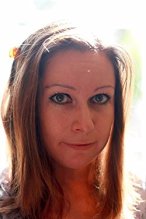
Cassandra Parkin grew up in Hull, and now lives in East Yorkshire. Her short story collection, New World Fairy Tales (Salt Publishing, 2011), won the 2011 Scott Prize for Short Stories. Her work has been published in numerous magazines and anthologies.
The Summer We All Ran Away (Legend Press, 2013) was Cassandra’s debut novel and nominated for the Amazon Rising Stars 2014. The Beach Hut (Legend Press, 2015) was her second novel, followed by Lily’s House.

You’ll find all Cassandra Parkin’s books here.

You can find out more by following Cassandra on Twitter and visiting her website.

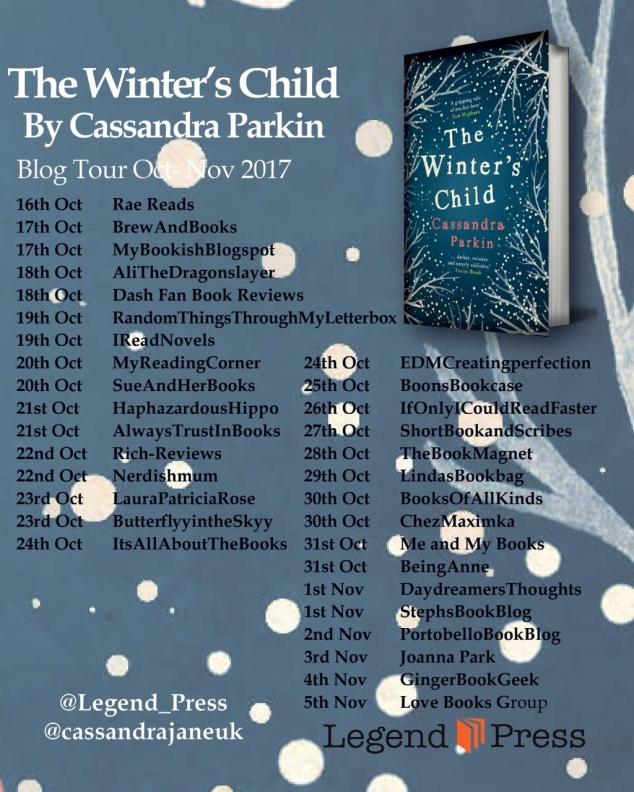
There’s more with these other bloggers too:
winters child poster


No police. No private eye. No murder. A Guest Post by Robert Crouch, Author of No Bodies

No Bodies - Robert Crouch - Book Cover

It’s a welcome return for No Bodies author Robert Crouch today. Robert previously wrote a smashing guest post for Linda’s Book Bag, all about how his own blog helped his writing, that you can read here. Today’s post is a fascinating insight into how Robert has created his Kent Fisher Mysteries.

No Bodies was published on 19th October 2017 and is available for purchase here.

No Bodies

No Bodies - Robert Crouch - Book Cover

No motive. No connection.

Why would environmental health officer, Kent Fisher, show any interest in finding Daphne Witherington, the missing wife of a longstanding family friend?

The police believe she ran off with Colin Miller, a rather dubious caterer, and Kent has problems of his own when a young girl who visits his animal sanctuary is rushed to hospital.

When enquiries into Colin Miller reveal a second missing wife, Kent picks up a trail that went cold over a year ago. But he’s struggling to find a connection between the women, even when he discovers a third missing wife.

Is there a killer on the loose in Downland?

With no motive, no connection and no bodies, Kent may never uncover the truth.

No police. No private eye. No murder.

A Guest Post by Robert Crouch

No police. No private eye. No murder.

It’s hardly the most obvious way to break into today’s busy crime fiction market, but then again a grey-haired spinster from St Mary Mead was hardly conventional, was she?

When you’re faced with shelf after shelf of police procedurals, serial killer thrillers and private eye novels, you know it’s going to be difficult to come up with something fresh and original.

Inspired by the likes of Miss Marple and Inspector Morse, the urge to write a crime series gripped me so tight, I spent most of my waking hours thinking about devilish plots and the elusive protagonist who would unravel them.

It didn’t take long to realise I knew next to nothing about how the police went about solving crimes. Having worked with the police in my job as an environmental health officer (EHO), I had a reasonable understanding of the conventions and rules that governed them, but little else.

“The police would never do that!” I would shout at the TV when procedures were broken or ignored in crime dramas.

Such transgressions might be good for the story, but credibility’s crucial. Without it, how can authors expect readers to trust them?

Authors like Peter James spend a lot of time with the police to understand how they work, to discover the atmosphere and nature of the people who protect us and solve crimes. Ex-police officers who write crime stories can bring the telling details and insights that I could never hope to produce.

No, if I was going to write crime, there could be no police.

Enter Sue Grafton. After following her feisty private eye, Kinsey Millhone, through much of the alphabet, starting with A is for Alibi, the answer seemed clear. Crime fiction and drama had produced many private detectives across the decades, from the iconic Sherlock Holmes to the curious Dirk Gently.

Surely there was room for another.

The thought prompted me to develop characters who were ex-army or ex-police, people who could handle themselves in a brawl or under pressure. But after writing a few drafts these gung-ho, macho heroes seemed empty and uninteresting. And authors more talented than me had already populated crime fiction with enough cynical, world weary detectives.

Sadly, I had to say no to private eyes, despite my fondness for Kinsey.

That left me with murders. I’d watched enough crime dramas to know it was almost impossible to have a murder that didn’t involve the police. The thought of having ponderous police officers arresting the wrong suspect, as often happened in Murder She Wrote, didn’t appeal. Police officers do a difficult and complex enough job without authors tarnishing their abilities.

That left the tried and trusted plots, like a wrongly imprisoned person, a suicide that was really murder, or a historical crime that had never been solved. While these offered opportunities, I wondered if these scenarios had become a little clichéd over the years.

With a weary sigh, I turned off the computer. My determination to bring something fresh and original to crime fiction left me with no police, no private eye and no murder.

Perhaps not the finest start to my crime writing career.

Then one evening, as I reflected on a gruelling and emotional day, investigating a workplace accident that resulted in the death of an employee, an idea crept out of my subconscious.

What if someone could disguise a murder as a fatal work accident?

The police would attend, as the national protocol demands, but if the inspector in charge dismisses corporate manslaughter, an EHO would then carry out the investigation.

Cue Kent Fisher and my first murder mystery, No Accident.

No Accident

After the first few pages, it had no police, no private detective and on the surface no murder. But would readers find the story and characters credible? Could an EHO, with no training or experience in investigating crime, solve a complex and baffling murder?

To start with I couldn’t find a way to solve the case. Maybe I’d created the perfect murder. Then a publisher took an interest in the idea. This gave me the spur to find a solution, which thankfully I did.

When No Accident was published, I held my breath, worried what readers would make of the story. Fortunately, readers liked the fresh and original approach. It provided a welcome change from the usual police procedural.

One reviewer said, ‘I was fascinated by the way Robert Crouch demonstrated how a seemingly ordinary member of the public could become what is best described as a Private Eye.’

It made my day.

It meant environmental health officer, Kent Fisher, could go out and solve more cases. He could also offer readers a glimpse into his world, both as an environmentalist and someone who works to protect and improve public health.

In No Bodies, the second novel, a devastating case of E coli O157 threatens to destroy Kent Fisher’s animal sanctuary, his reputation, and derail his struggle to find the missing wife of a longstanding family friend. The evidence suggests she ran off with a younger man, a rather dubious caterer, it seems.

 ‘Do I look like Hercule Poirot?’ Kent asks, initially refusing to take the case.

No, but he knows about catering, and it isn’t long before he senses foul play.

About Robert Crouch

robert

Inspired by Miss Marple, Inspector Morse and Columbo, Robert Crouch wanted to write entertaining crime fiction the whole family could enjoy.

At their heart is Kent Fisher, an environmental health officer with more baggage than an airport carousel. Passionate about the environment, justice and fair play, he’s soon embroiled in murder.

Drawing on his experiences as an environmental health officer, Robert has created a new kind of detective who brings a unique and fresh twist to the traditional murder mystery. With complex plots, topical issues and a liberal dash of irreverent humour, the Kent Fisher mysteries offer an alternative to the standard police procedural.

Robert now writes full time and lives on the South Coast of England with his wife and their West Highland White Terrier, Harvey, who appears in the novels as Kent’s sidekick, Columbo.

You can find Robert on Facebook and visit his website. You can also follow him on Twitter.

There’s more with these other bloggers too:

tour poster

People and Places: A Guest Post by Claire Baldry, Author of Different Genes

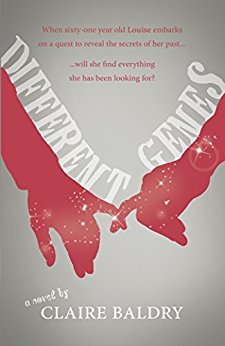
Different genes

It gives me enormous pleasure to welcome Claire Baldry, author of Different Genes to Linda’s Book Bag today, not only to support Claire’s writing and Different Genes in particular, but because Claire does such a lot for charity that I feel she deserves recognition herself.

In today’s guest post, written especially for Linda’s Book Bag, Claire reflects on the how her own life experiences have helped her to create the characters and setting for her debut novel.

Published by Matador, Different Genes is available for purchase here.

Different Genes

Graphic2

Sixty-one year old Louise finally learns she is adopted after the death of her mother. She embarks on a quest to reveal the secrets of her past, helped by new companion and lover, Simon, whom she meets after joining an Internet dating site.

The reader is reminded of the changing values of the post-war years, while Simon and Louise visit places from Louise’s past and meet people who knew her mother and grandmother. Together, they begin to unlock the forgotten secrets of Louise’s past – but in the face of so much change and uncertainty, can Louise let her relationship flourish?

The story is set mainly in the author’s home county of East Sussex, but finishes in Kent, when Louise and Simon finally visit her birth mother’s grave at a convent in Chatham. This journey of discovery is a charming and bittersweet mixture of romance, sadness and genuine suspense.

People and Places

A Guest Post by Claire Baldry

Although the people in Different Genes are entirely fictional, I have used much of my own life experience in the writing of this novel. Both the main characters, Simon and Louise, are in their early sixties and have been married before. They meet on the internet and, as well as embarking on a quest to find out about Louise’s past, their relationship needs to come to terms with their previous experiences in order to thrive.

I am in my early sixties and met my second husband on the internet about fifteen years ago. I well remember the way we each had to adjust our own slightly entrenched values and routines when we finally moved in together. I also think that I have included some of my own character in both Louise and Simon’s personality. I am an ex-teacher, like Louise, with a lot of experience of supporting pupils with challenging behaviour. Without wishing to give too much of the plot away, this is a skill which Louise uses when building a relationship with Simon’s younger son, Oliver. I am also a bit of a control freak, like Simon. In fact, now the book is written I see a lot of myself in him.

As regards the setting, I have only used places which are familiar to me, as I found this helped me to focus my writing. I was born in Bishop’s Stortford, and went to the Herts and Essex School which is mentioned in the novel. I moved to East Sussex in my late twenties, living in Hastings, Bexhill and Brighton and have worked in or visited all of the locations mentioned in the book. I have changed many names of roads or businesses, but most local readers say they recognise the venues.

The secrets of Louise’s past, which cannot be disclosed here, or I will reveal too much of the plot, are not part of my own experience, so required far more research. However, having worked in education for well over thirty years, I have watched the way childhood experiences impact on people’s emotions and behaviour, and this understanding was invaluable in writing the novel. If, having read the book, anyone wants to know more, please feel free to contact me via my website www.clairebaldry.co.uk.

About Claire Baldry

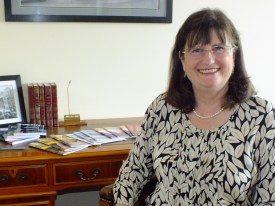
8th (37)

In her hometown of Bexhill on Sea Claire Baldry is known as the local poet. She writes and performs lighthearted ‘Pam Ayres’ style poetry and donates the fees to charity. Her poems sometimes appear in the local paper or on local radio, and she is frequently invited to clubs, such as the WI, to read her work and talk about her writing. Earlier this year Claire and her husband Chris won the Diabetes UK South East Inspire Award for innovative ways of fundraising.

In 2016 Claire fulfilled a lifetime writing ambition and finally completed a novel. She describes it as an ‘easy read’ tale about love in later life, combined with a gripping mystery. The title of the book is Different Genes.

You can follow Claire on Twitter @ClaiBal and visit her website. You’ll also find Claire on Facebook.

There’s more with these other bloggers too:

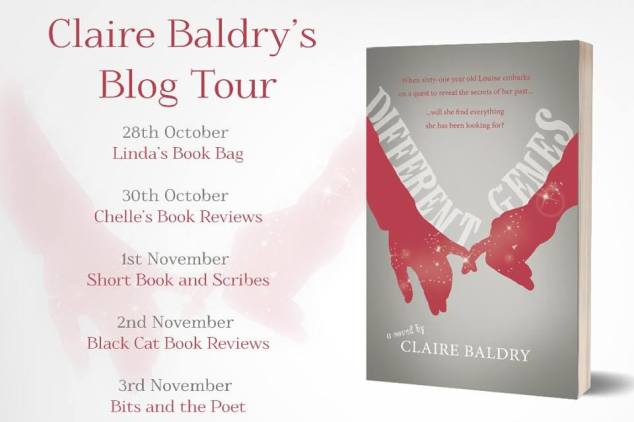
Tour poster

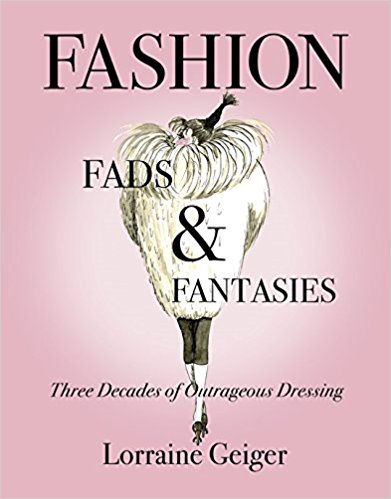
Fashion Fads and Fantasies: Three Decades of Outrageous Dressing by Lorraine Geiger

Fashion Fads

I get offered all kinds of books for review, and with literally hundreds on my TBR pile I’ve been turning down far more than I’ve been accepting of late, but when Fashion Fads and Fantasies: Three Decades of Outrageous Dressing by Lorraine Geiger popped up in return for an honest review I couldn’t resist.

Published by Albert, an imprint of Wisdom House Books on 14th August 2017, Fashion Fads and Fantasies: Three Decades of Outrageous Dressing is available for purchase from your local Amazon site.

Fashion Fads and Fantasies: Three Decades of Outrageous Dressing

Fashion Fads

A marvelous array of fashion sketches from the ’70s, ’80s, and ’90s. None is imaginings but each is a real person in their true mode of dress as observed on the streets by Lorraine Geiger’s keen eye, and recorded in detail with artful flair. The sketches are framed by essays about the decades they appeared in, and are accompanied by original captions describing the ensembles and the context of their appearance during this era of “fashion revolt.” A great resource for students of fashion, costume designers, and anyone with a love of outrageous fashion.

My Review of Fashion Fads and Fantasies: Three Decades of Outrageous Dressing

With scores of illustrations, Fashion Fads and Fantasies: Three Decades of Outrageous Dressing gives an insight into over thirty years of fashion.

Fashion Fads and Fantasies: Three Decades of Outrageous Dressing isn’t a book I’d normally pick up but I thoroughly enjoyed it.

I’m not heavily into fashion and I think those who are might appreciate the illustrations and their descriptions in Fashion Fads and Fantasies: Three Decades of Outrageous Dressing with a much more discerning eye than I have. However, I was fascinated by the paintings and sketches from Lorraine Geiger over the decades. I found her style quite naive in a way which felt far more accessible and less elitist than the high fashion artwork I’ve sometimes seen. It was interesting that as the decades progressed and society changed, there were more images of men included too.

Most interesting to me, however, was less the fashion than the social history of the twentieth century that has been explored. There’s so much here from the move away from real furs, for example, to the consideration of how women’s attitudes to their own sexuality have evolved too. Reading, or perhaps it’s better to say viewing, Fashion Fads and Fantasies: Three Decades of Outrageous Dressing took me back to my 13th birthday in the 1970s and the denim trouser suit I wore so proudly and the big coats of the 1980s placed me very firmly back at university with the nylon ‘fur’ coat I got from a charity shop and am sure an old lady had died in. I’d defy anyone who lived through those decades and turning the pages of Fashion Fads and Fantasies: Three Decades of Outrageous Dressing not to be reminded of their own lives in some way.

The text that accompanies the opening to each of the three decades, as well as the explanations of the images, gives a real insight into western life at the time alongside the influences of the east. As well as igniting memories for me, I found myself wondering what had happened to those depicted as these are all real people whom Lorraine Geiger had seen.

Fashion Fads and Fantasies: Three Decades of Outrageous Dressing is both interesting and entertaining.  Never mind readers,  I think it would be a smashing book to stimulate characters for authors and to help them create novels set in the more recent past. I enjoyed it.

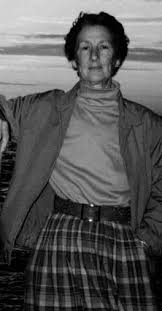
About Lorraine Geiger

Lorraine

Lorraine Geiger was a painter, fashion designer, and illustrator who was passionate about the visual arts. She painted in an array of mediums, and her work has been exhibited in New York City, the Hamptons, and Chapel Hill. Her earliest artistic memories were of drawing paper dolls and designing wardrobes for them. In her late teens she pursued that interest by attending the New York School of Fine Arts and Applied Design and Parson’s School of Design. In the late forties she married Albert Geiger, a custom milliner who was to become a leading designer of women’s clothes.

Lorraine worked with her husband on design and publicity. She was also involved with her husband’s freelance design projects which took them to Europe, especially Paris, Rome, and London. She loved Paris and returned as often as possible. During this period she was inspired to do quick sketches in her notebook of people on the streets who were outrageously dressed in one way or another. Over the years this led to her documenting those modes of dress in the US and abroad from the seventies until the present, by developing her rough sketches into finished illustrations.

Near the end of the eighties Lorraine and Bert retired from fashion and moved to East Hampton, NY, where Lorraine pursued her artistic endeavors, and painted at the Art Barge in Napeague. They customarily traveled to San Miguel de Allende, a well known artist colony for the winter, and Lorraine painted there at the Instituto Allende and at private studios.

In 1993 the Geigers moved to Chapel Hill. She studied figure drawing at UNC and also at the Art Center in Carrboro and continued to work on her illustrations up until her death.

She was also passionate and outspoken about social issues, and led a legal battle in New York City over the reversal of Andrew Carnegie’s wishes that Carnegie Hall remain a place for artists to live and work. She was a great inspiration to her children and grandchildren, and to all her family and friends. Her creativity, her strength, and her sense of humor strongly influenced their lives.

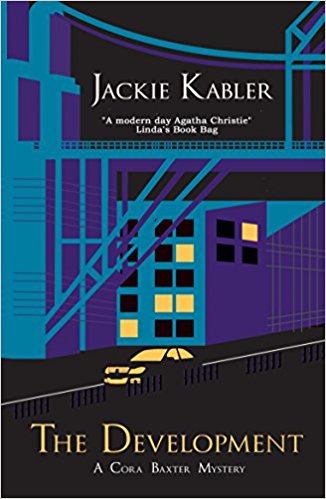
Cover Reveal: The Development by Jackie Kabler

the development

About a year ago I was lucky enough to read and review The Deadline by Jackie Kabler. I thoroughly enjoyed it and you can read my review here. Imagine my excitement then when I had a message from Jackie asking if I’d mind – mind I say – if I was quoted on the front cover of her latest book, The Development. Er, no, I didn’t mind. I was thrilled and delighted.

The Development is the third book in Jackie’s Cora Baxter Mysteries series and will be published by Accent Press in May 2018. The Development is available for pre-order here.

The Development

the development

The Development is the third instalment in the hugely popular Cora Baxter Mysteries by acclaimed broadcaster Jackie Kabler.

After a stressful week, TV reporter Cora Baxter is ready for a quiet weekend. What she isn’t counting on is witnessing the shocking death of a young woman on her way home.

Cora discovers that seventeen-year-old Leanne has been protesting against a new housing development, angering the powerful establishment. Leanne’s death is ruled a suicide but, when puzzling information comes to light, Cora decides to investigate further. She might not know what an unscrupulous businessman, a suspended police officer and hate-mail sending neighbours have to do with the case but she does know there is a news story there.

With her eccentric camera crew on hand to help, can Cora tie the strands of Leanne s case together or will other forces interfere?

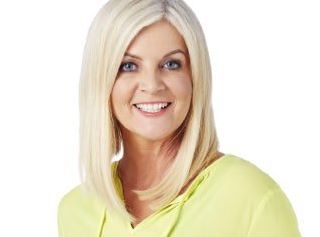
About Jackie Kabler

Jackie Kabler

Jackie Kabler is the author of the Cora Baxter Mysteries, a series of murder mysteries set in a television newsroom. Jackie worked as a newspaper reporter and then in television news for twenty years, including nearly a decade on GMTV. She later appeared on BBC and ITV news, presented a property show for Sky, hosted sports shows on Setanta Sports News and worked as a media trainer for the Armed Forces. She is now a presenter on shopping channel QVC. Jackie lives in Gloucestershire with her husband, who is a GP.

You can follow Jackie on Twitter, visit her website and find her on Facebook.

The Long Shadow of School Bullying: A Guest Post by Linda MacDonald, Author of Meeting Lydia

MeetingLydiaAUDIBLE2

It gives me very great pleasure to welcome another Linda to Linda’s Book Bag today. Linda MacDonald is the author of Meeting Lydia which is about to be released on Audible. Today Linda tells me about the inspiration behind her novel in a wonderfully personal guest post.

Meeting Lydia is available for e-book and paperback purchase and Audible pre-order here.

Meeting Lydia

MeetingLydiaAUDIBLE2

Marianne Hayward is having a midlife wobble. When she finds her charming husband has befriended the glamorous Charmaine, she is seized by jealousy. Her once-happy marriage begins to slide.

Insecurities resurface from when she was bullied at a boys’ prep school. Only one boy was never horrible to her, the clever and enigmatic Edward Harvey; her first crush.

Daughter Holly persuades her to join Friends Reunited where she searches for Edward convinced he may be the answer to all her problems. But she is unprepared for the power of email relationships.

Narrated by the talented voice actress Harriet Carmichael, Meeting Lydia is a book about childhood bullying, midlife crises, obsession and jealousy and will appeal to anyone interested in relationship dynamics.

The Long Shadow of School Bullying

How I came to write Meeting Lydia

A Guest Post by Linda MacDonald

When I was 5 years old and living in Cumbria, my parents sent me – as a day girl – to a boys’ prep school. They thought it would be less rough than the local primary. They were wrong. Girls were scattered thinly throughout the school and between the ages of 9 and 10, I was the only girl in the class. I was bullied. It was the usual stuff: name-calling, stealing equipment, being left out. No single incident was what you might call ‘serious’, but it happened hour upon hour, every day. And if someone makes fun of you often enough, you begin to believe it.

In the past bullying was accepted as a rite of passage, even ‘character building’. But does it really help children to cope better as adults? The Kidscape children’s charity thinks not. In a survey of 1000 adults, they found early bullying experiences often led to a lack of self esteem, depression, shyness, and less likelihood of success in education, the workplace or in social relationships. Most said they felt bitter and angry about their experiences.

These results are supported by a longitudinal study by a team from Kings’ College, London, who examined data on 7771 adults born in Britain during a particular week in 1958. At age 50, those who had been bullied showed greater incidence of depression, anxiety and suicidal thoughts and reported poorer physical health. The findings have provoked some researchers into saying that the effects of bullying are as serious as physical abuse or neglect. Those victimised were found to be less likely to have qualifications and/or to live with a spouse or partner and their cognitive IQ was also found to be lower than one would expect when taking their childhood IQ into account. Worryingly, it is speculated that school bullying could lead to premature ageing.

For me, I knew even the comparatively low level bullying I experienced had affected my confidence well into midlife and I can only guess that it may have played a role in some of my adult health issues. I always found it difficult to talk about and I pushed it to the back of my mind. But I had written stories since I was a child and through a hazy curtain, there was always a whispering that I should write a novel with a bullying theme. The problem was, I didn’t have a plot, and it wasn’t until 2001 – way into my midlife – that an idea struck.

Friends Reunited was hitting the headlines. It was the first of the major social networking sites and there were hundreds of exciting tales of people getting in touch with old classmates. In the class where I was the only girl, there was one boy who was never horrible to me. He was very clever and enigmatic and somehow different from the others. And he was the only boy I would write too – if I could find him.

It was some weeks before I saw his name on the site and I sent a tentative email. I was delighted when he wrote straight back and over the next three weeks we exchanged lots of emails – mostly about the past. He empathised with my situation, but also reminded me of the good times.

And in that short time-span of email exchanges, something strange happened. I realised the baggage I’d been carrying around for most of my life had gone. It was like a miracle – but I suppose revisiting the past had been like being in therapy.

As the weeks passed by and the emails continued, an idea began to form for the novel I had always wanted to write. I thought, if I spice up the reality, perhaps create an ‘only girl in a class who has a crush on the boy who was never horrible’ situation, then it would give potential for a much more interesting story if they met via the internet in later life.

So Meeting Lydia came into being and although the children in the story are very much inspired by my own experiences, the adults and their lives are fictional. I hope that the book may help others who have been bullied as children face up to what happened to them and perhaps find a way, as I did, to let go of the past.

The modern world brings new bullying threats in the form of cyberbullying. The founder of BeatBullying says that this threat could be even more damaging to future generations. In the past, children came home from school and shut the door. Now there is no escape. It is therefore ever more urgent that we try to find imaginative ways to address this problem and there are no easy answers. Ideally, bullying needs to be tackled at source, but that requires overturning thousands of years of evolution where humans have learned to establish a pecking order with the strong dominating the weak. Parents and schools must play their part, but their influence is limited and bullying is often hidden. Keeping anti-bullying in the news via celebrities and sporting role models may be a way forward. The message needs to be clear: ‘Bullying is So Not Cool’.

(What a fabulous post Linda. I’m so glad you have been able to move on and that there is a positive outcome in the form of Meeting Lydia for you.)

About Linda MacDonald

Colour crop

Linda MacDonald is the author of four independently published novels: Meeting Lydia and the stand-alone sequels, A Meeting of a Different Kind, The Alone Alternative and The Man in the Needlecord Jacket. They are all contemporary adult fiction, multi-themed, but with a focus on relationship issues.

After studying psychology at Goldsmiths’, Linda trained as a secondary science and biology teacher. She taught these subjects for several years before moving to a sixth-form college to teach psychology. In 2012, she gave up teaching to focus fully on writing.

Linda was born and brought up in Cockermouth, Cumbria and now lives in Beckenham, Kent.

You can find Linda on Facebook and follow her on Twitter @LindaMac1. You’ll find all Linda’s books here.

Why We Need Older Protagonists: A Guest Post by Eva Jordan, Author of All The Colours In Between

ATCIB cover

This evening I’m off to a very special event – the launch of All The Colours In Between by Eva Jordan. I’ve met Eva a few times and she’s absolutely lovely so I’m thrilled to be part of the launch celebrations for All The Colours In Between both virtually on Linda’s Book Bag and in person later.

Eva has appeared on the blog before (here) with a smashing post about female friendships and today I asked her to tell me her thoughts about older protagonists.

Published by Urbane on 19th October 2017, All The Colours In Between is available for purchase here and directly from the publisher.

All The Colours In Between

ATCIB cover

Lizzie is fast approaching 50. Her once angst ridden teenage daughters, now grown and in their twenties, have flown the nest, Cassie to London and Maisy to Australia. And, although Connor, Lizzie’s sulky, surly teenage son, is now on his own tormented passage to adulthood, his quest to get there, for the most part, is a far quieter journey than that of his sisters. The hard years, Lizzie believes, are behind her. Only, things are never quite as black and white as they seem… A visit to her daughter in London leaves Lizzie troubled. And that is just the start. Add to that an unexpected visitor, a disturbing phone call, a son acting suspiciously, a run in with her ex husband plus a new man in her life who quite simply takes her breath away; Lizzie quickly realises life is something that happens while plans are being made. Gritty but tender, thought provoking but light-hearted, dark but brilliantly funny, this is a story of contemporary family life in all its 21st century glory. A story of mothers and sons, of fathers and daughters, of brothers and sisters, and friends. A tale of love and loss, of friendships and betrayals, and coming of age. Nobody said it would be easy and as Lizzie knows only too well, life is never straightforward when you see all the colours in between.

Why We Need ‘Older’ Protagonists

A Guest Post by Eva Jordan

Firstly, I’d like to thank the lovely Linda for offering to take part in the blog tour for my second novel, All The Colours In Between. Referring to Lizzie, one of the main characters in my novel, Linda invited me to write a guest post questioning why we need ‘older’ protagonists.

I didn’t consciously make one of my main protagonists an ‘older’ woman, nor do I think I considered a particular market or age group when I wrote my second novel. Lizzie, like the novel, just evolved, and now, with the passing of time, is naturally older than when we were first introduced to her back in my debut novel, 183 Times A Year. Mid 40’s, Lizzie the librarian was then the exasperated mother of Cassie, Connor and stepdaughter Maisy.

unnamed

Fast-forward 5 years and All The Colours In Between sees Lizzie fast approaching 50. Her once angst ridden teenage daughters, now grown and in their twenties, have flown the nest, Cassie to London and Maisy to Australia. And, although Connor, Lizzie’s sulky, surly teenage son, is now on his own tormented passage to adulthood, his quest to get there, for the most part, is a far quieter journey than that of his sisters. The hard years, Lizzie believes, are behind her. Only, things are never quite as black and white as they seem…

Therefore, although it can be read as a standalone, All The Colours In Between is, for all intents and purposes, the sequel to my debut. So, in that sense, the characters are older (although not necessarily wiser) and life is moving on, as it does with all of us.

On a personal note, my preferred reading is quite broad. I love to read different genres and I like to be introduced to characters that include a diverse range of characteristics including class, race, gender and age. There is, however, a lot to be said for writing about ‘older’ characters, including a lot more scope for a back-story. As a writer you get to ask how your characters personalities were shaped? If they had easy or difficult childhoods? You also get to ask, as adults, do they consider themselves a success or a failure and what lessons have they learned from life? Then of course there is the aging process itself, which finds you asking your characters how they deal with the physical changes caused by ageing as demonstrated by Lizzie in the following extract.

“I finish applying my make-up and stare at the reflection in the mirror. I’m repulsed at the haggard face staring back at me. More powder is needed to seal the foundation covering the cracks of my aging face. Picking up an over-large brush I wave it like a wand across my cheeks and nose. Sadly though, this wand is not a magic wand and fails to miraculously transform me. No amount of foundation can hide the crevices becoming more obvious every day. The slightly delicate lines above my lips are the worst. Not immediately noticeable, at least not first thing in the morning, but slap on a bit of lipstick and within a few hours I am left with tiny rivers of blood leading from my mouth to the base of my nose. Threads of colour seeping and creeping along miniscule gaps where they remain stubbornly embedded, no matter how hard I rub them. Then there are the lines around my eyes, of course. Laughter lines, Simon calls them. Haven’t laughed much lately, though.”

I should add here, though, Lizzie is not the only protagonist, either in 183 Times A Year or All The Colours In Between. Her narration is contrasted with the voices of her younger children, namely 16 year old Cassie in 183 Times A Year, who is now 21 years old in All The Colours In Between, and Lizzie’s youngest child, Connor, who was 11 years old in my debut but is now 16 years old in the second novel. Connor has a much larger role in the second novel compared to the first, mainly because I have teenage children myself and they remind what a difficult transition period going from childhood to adulthood can be. But I also find young adults both hilariously funny and fascinating, apt to inspire me but also exasperate me, all within a Nano second of speaking, thus providing evidence of the disparities between young and old but also, at times, highlighting the perfect parallels between them.

However, Linda’s question did get me thinking about the idea of ‘older’ protagonists, especially female ones. A few immediately sprang to mind like Yvonne Carmichael, the forty something character in Louise Doughty’s Apple Tree Yard. Then of course there is Helen Fielding’s Bridget Jones who, although started out in her 30’s in the first novels, is now in her 50’s in the more recent books in the series. Nonetheless, when I investigated the subject matter a little more closely, I was pleasantly surprised to find quite an abundance of novels containing ‘older female’ protagonists. I therefore thought it a good idea to end this post with a short reading list of ten titles of books I have either read and enjoyed, or, I like the sound of and would like to read, all of which include ‘older female’ protagonists (not forgetting 183 Times A Year and All The Colours In Between, of course!).

Happy Reading!

Notes on a Scandal by Zoe Heller

The Long Weekend by Jane E James

The Break by Marion Keyes

The Silent Wife by A.S.A. Harrison

The Bulgari Connection by Fay Weldon

Half Broken Things by Morag Joss

A Tale for the Time Being by Ruth Ozeki,

The Blind Assassin by Margaret Attwood

The Woman Who Walked Into Doors by Roddy Doyle

The Night Guest by Fiona McFarlane

Great post and super reading suggestions Eva. Thanks so much. 

About Eva Jordan

DT6C0010

Eva Jordan, born in Kent but living most of her life in a small Cambridgeshire town, describes herself as a lover of words, books, travel and chocolate. She is also partial to the odd glass or two of wine. Providing her with some of the inspiration for her novels, Eva is both a mum and step mum to four grown-up children. Her career has been varied including working within the library service and at a women’s refuge. She writes a monthly column for a local magazine and currently works as a volunteer for a charity based organisation that teaches adults to read. However, storytelling through the art of writing is her passion. All The Colours In Between is Eva’s second novel.

You can find Eva on Facebook, follow her on Twitter and visit her website.

There’s more with these other bloggers too:

ATCIB twitter blog tour banner

Introducing Yes: A Guest Post by Anne Patterson, Author of Yes

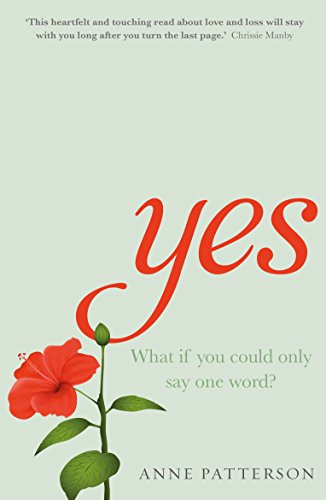
Yes

It’s almost a year (9th November) since my wonderful Dad died from the massive stroke he had in July and when I realised that Yes by Anne Patterson involved a protagonist who’d had a stroke I wanted to feature it on Linda’s Book Bag. I’m afraid I haven’t quite gathered the emotional strength to read Yes yet, but today Anne tells me a bit about it.

Published today, 26th October 2017 by Silver Tail Books, Yes is available for purchase here and on Amazon.

Yes

Yes

Maureen McCormack wakes up after a stroke, her memory fragmented. She can say only one word – Yes. Friends, family and lovers visit her in hospital, filling silences with secrets and learning to open up as Maureen learns to listen.

As the revelations mount, her view of life fundamentally shifts. Maureen and those around her attempt to come to terms with all that has been left unsaid and unexamined.

When her ability to speak gradually returns, she decides to keep it a secret, until she has made sense of her past and gathered the strength to shape her future.

Yes is a novel about how relationships grow, disintegrate and heal, showing what happens when people really listen to each other.

Introducing Yes

A Guest Post by Anne Patterson

I trained as a nurse and still work full time in the NHS and as you’ll see, my day job has had an influence on my noveI. I have always found hospitals fascinating; the rules, the language and the hierarchy. It’s also a great way of taking your characters out of their comfort zone and making them have conversations they wouldn’t normally have. The idea for Yes has been around for a while. In 1999 at age 38, I wanted to write about an overburdened woman aged 50 whose life is put on pause and she suddenly has time to think.  It’s taken me so long to get the book written that I have overtaken my character Maureen in age! I think in your 50’s you can easily sit back and have regrets or you can see it as a time to get started. I am talking about myself as well as Maureen.

Maureen is a full-time teacher, part-time farmer and would-be artist. She’s the narrator of Yes. When a stroke deprives her of nearly, but not quite all her speech, she starts to have regrets about how she has distanced herself from the people she loves. In her family and community, folk keep themselves to themselves, never talking about how they really feel. While she’s critical of that in others, after the stroke it dawns on her that she too has been part of the problem: isolating herself, emotionally, by being too busy to talk; shying away from uncomfortable conversations; worrying about being judged. While recovering from her stroke, Maureen has time to revisit, mentally, her secrets, her lovers, her crushes, her furious hatreds and the deep sadness she’s packed away and tried to forget. Her silence encourages her visitors to keep talking. Her hospital bedside is a venue for monologues and confessions, declarations of love and stories of betrayal.

Maureen isn’t based on anyone I know. Being able to say only one or a few set words following a stroke is quite common. My dad’s friend, John was a great talker – ‘great craic’ as they say where I come from. In his fifties, he had a stroke and for a while he could only say yes. His story made me think about the impact that losing your speech might have on relationships and how others react to you. Somehow he was able to stay part of the conversation using the word yes to show hearty agreement, extreme scepticism and stern negativity. His cronies all stuck by him. In time, his speech started to trickle, then to flow back. John was a confident outgoing guy; but for some, aphasia can be very isolating. Aphasiaalliance.org has some useful tips on ‘aphasia-friendly communication’.

Yes is set in 1998. There have been huge developments in stroke prevention, treatment and rehabilitation since then. Maureen was lucky because a stranger called an ambulance when she had the stroke. I can’t help thinking that if she’d been at home, she’d have said, ‘Don’t make a fuss, I’ll be okay after a nice cup of tea.’ Campaigns by the Stroke association have helped people know when to call 999 for crucial early treatment.

People have asked me about the book. Is it a romance? There is a bit of romance in it but I think the key relationship is the one between Maureen and her sister Shirley. Inseparable as little girls, their everyday lives are still intertwined, but Maureen realises that they have stepped back further and further from each other when they should have stood together.  Maureen is shocked at her sister’s frankness; once Shirley starts talking at the bedside, there’s no stopping her. This is a story as much about the importance of listening as the value of talking.

(And that’s a lesson we could all learn – before it’s too late Anne.)

About Anne Patterson

Anne patterson

Anne Patterson is from County Antrim. She lives in London and works for the NHS. Yes is her first novel.

You can follow Anne on Twitter @Patterson13Anne.

Special Christmas Giveaway from Lilly Bartlett, Author of Christmas at the Falling-Down Guest House

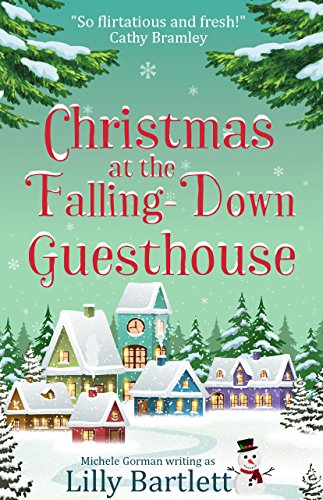
Christmas cover

I’m delighted to be part of the launch celebrations for Lilly Bartlett’s latest release Christmas at the Falling-Down Guesthouse not least because there’s a chance to win homemade cookies from the author Lilly, otherwise known as Michele Gorman, herself. I’ve loved the Lilly Bartlett books I’ve read and you’ll find my review of The Second Chance Cafe in Carlton Square here, and of The Big Dreams Beach Hotel here.

Previously Michele’s The Reluctant Elf, Christmas at the Falling-Down Guesthouse is published today, 25th October 2017 and is available for purchase here.

Christmas at the Falling-Down Guesthouse

GIF snowy cover

Put your feet up and tuck into the mince pies, because you won’t have to lift a finger to enjoy this Christmas!

Too bad the same can’t be said for single mother and extremely undomestic goddess, Lottie. When her beloved Aunt Kate ends up in hospital just before Christmas, Lottie and her seven-year-old daughter rush to rural Wales to take over her B&B. A picky hotel reviewer and his mad family are coming to stay, and without the rating only he can give them, Aunt Kate will lose her livelihood.

But Lottie can barely run her own life, let alone a hotel. How will she manage to turn the falling-down guesthouse into the luxurious wonderland the reviewer expects? And could the mysterious taxi driver, Danny, who agrees to help her, turn out to be the real gift this season?

As the snow sparkles on the trees and hot chocolate steams in your hand, snuggle into the delicious magic of Christmas at the Falling-Down Guesthouse.

My Review of Christmas at the Falling-Down Guest House

When Lottie’s Aunt Kate ends up in hospital, Lottie and her daughter Mabel have to help run her B and B over Christmas.

Yet again Lilly Bartlett has produced a warm-hearted story which is just right for the festive season. As a short novella I think Christmas at the Falling-Down Guesthouse would be perfect for snuggling up with on Christmas Eve or after Christmas lunch as it brings with it lovely themes of family and sticking together.

I really enjoyed the touches of humour and the speedy plot so that it felt satisfying to read an entire story in the space of an afternoon. I could picture the falling down guest house vividly and felt as if I was a guest too.

As always with Lilly Bartlett, the characters are warm, human and certainly not perfect so that they feel real and believable. I don’t usually like children in stories, but Mabel was a triumph with her aphorisms and balanced the foul Amanda and Oscar wonderfully.

Christmas at the Falling-Down Guesthouse is a lovely way to while away and hour or two as a Christmas treat.

About Lilly Bartlett

michele-photo

Lilly Bartlett is a pen name of Michele Gorman. Michele writes books with heart and humour, full of best friends, girl power and, of course, love and romance. Call them beach books or summer reads, chick lit or romcom… readers and reviewers call them “feel good”, “relatable” and “thought-provoking”.

She is both a Sunday Times and a USA Today bestselling author, raised in the US and living in London. She is very fond of naps, ice cream and Richard Curtis films but objects to spiders and the word “portion”.

You can find Michele on Instagram and on Facebook . You can follow her on Twitter and visit Michele’s blog and her website. There’s also a Lilly Bartlett Facebook page here.

Christmas Cookie Giveaway

Cookies

Win four dozen homemade Christmas cookies from Sunday Times bestselling author Michele Gorman, aka Lilly Bartlett!

Enter to win four dozen Christmas cookies baked by the author! Unlike poor Lottie in Christmas at the Falling-Down Guesthouse, she’s a keen cook who grew up baking every Christmas with her mum – dozens and dozens (and dozens!) of cookies to fuel the family through the season. This year, she’ll be baking for YOU!

The giveaway is global and the winner will be randomly selected on November 1st 2017. To enter, sign up here for Michele’s/Lilly’s newsletter (around three times per year, you can unsubscribe easily at any time and your details will never be shared).

Please note that this giveaway is independent of Linda’s Book Bag.

Fangs and Feasts in Transratania by Geronimo Stilton

Fangs and feasts

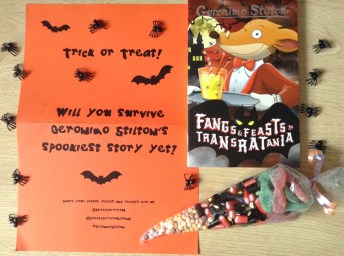
My enormous thanks to Jess at Sweet Cherry Publishing for a copy Fangs and Feasts in Transratania in return for an honest review (and for the spiders and sweets that accompanied it)!

IMG_0819 (1)

Published by Sweet Cherry in October 2017, Fangs and Feasts in Transratania is available for purchase here.

Fangs and Feasts in Transratania

Fangs and feasts

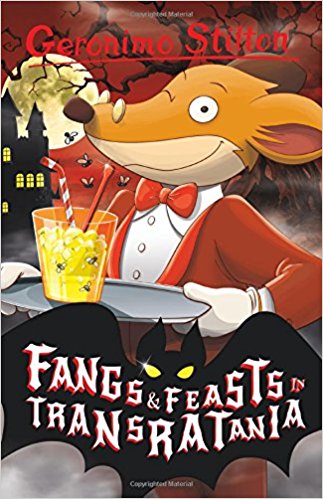
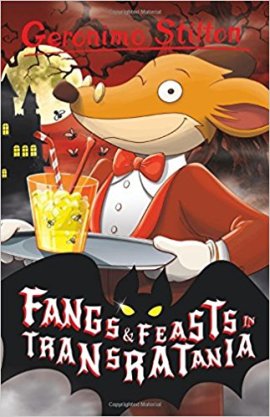
After a mysterious phone call from his cousin Trap, Geronimo sets off for Ratoff in spooky Transratania.

The garlic-fuelled town holds many mysteries, not least the residents of Ratoff Castle. Maybe it’s the way they sleep during the day, maybe it’s the blood-red drink they have with every meal, but there’s something not quite right about them …

Who are these mice?

And will Geronimo manage to survive the night?

For children aged 5-7 and also available as part of a 10 book box set.

My Review of Fangs and Feasts in Transratania

When a mysterious phone call in the middle of the night from cousin Trap sends Geronimo off to Transratania, his adventures are just beginning.

What a cracking book for children Fangs and Feasts in Transratania is. I’m going to get a small negative out of the way first before my review proper. I found the different fonts, designed to engage reluctant readers and break up what can be challenging amounts of text, quite tricky to read smoothly. However, I’m a 50 something woman and not a six or seven year old child.

Aside from that tiny quibble, I thought Fangs and Feasts in Transratania was an excellent story for children. There’s a really well maintained theme of blood and vampire allusions with smashing jokes through word play so that language becomes fun and entertaining. However, there’s nothing that could spark nightmares and unsettle children, just really good storytelling.

The plot is fast paced and engaging so that children would want to read just a little bit more. I think boys especially would enjoy Fangs and Feasts in Transratania and given that they can be hard to interest in reading, this is wonderful.

There’s a great sense of Geronimo as a character too through his first person account so that readers will want to find out what happens to him on other adventures. With another nine books in this particular publisher series available it would be enormous (or enor-mouse) fun to collect them all.

I thought the super illustrations added extra value too as they could be discussed with children, but also they help break up the text, making it more accessible to young independent readers.

Fangs and Feasts in Transratania is a super children’s book. I can understand why Geronimo Stilton is so popular as I thought his adventure was excellent and this particular book would make a perfect Hallowe’en gift.

About Geronimo Stilton

Geronimo

Born in New Mouse City, Mouse Island, Geronimo Stilton is Rattus Emeritus of Mousomorphic Literature and of Neo-Ratonic Comparative Philosophy. For the past twenty years, he has been running The Rodent’s Gazette, New Mouse City’s most widely read daily newspaper. Stilton was awarded the Ratitzer Prize for his scoops on The Curse of the Cheese Pyramid and The Search for Sunken Treasure. He has also received the Andersen 2000 Prize for Personality of the Year. One of his bestsellers won the 2002 eBook Award for world’s best ratlings’ electronic book. His works have been published all over the globe. In his spare time, Mr. Stilton collects antique cheese rinds and plays golf. But what he most enjoys is telling stories to his nephew Benjamin.

You can find out more about Geronimo, watch videos, play games and find lots of fun on his website.