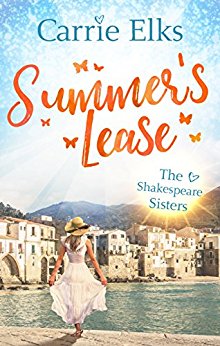
Summer’s Lease by Carrie Elks

Summer's Lease

I’m delighted to be part of the launch celebrations for Summer’s Lease by Carrie Elks and would like to thank Clara Diaz at Little Brown for inviting me to read this lovely book.

Published by Piatkus Books, an imprint of Little Brown, on 13th July 2017 Summer’s Lease is the first in the Shakespeare Sisters series from Carrie Elks and is available for purchase here.

Summer’s Lease

Summer's Lease

Cesca Shakespeare has hit rock bottom. Six years after the play she wrote bombed at the box office, she’s unable to hold down a job, keep an apartment, and worst of all her family have no idea how far she’s fallen. So when her fairy Godfather offers her the use of his friend’s Italian villa for the summer, she grudgingly agrees to try writing a new play. That’s before she finds out the house belongs to her arch-nemesis, Sam Carlton.

When Hollywood heart-throb Sam Carlton sees his name splashed across a gossip rag, all he wants to do is hide. That’s how he finds himself traveling to Italy, deciding to spend the summer in his family’s empty villa on Lake Como. Except when he arrives it isn’t as empty as he’d hoped.

Over the course of the hot Italian summer, Cesca and Sam have to come to terms with their pasts. What begins as a tentative friendship quickly grows into an intense attraction. But then Sam’s family arrive, threatening the delicate equilibrium.

Is Sam and Cesca’s relationship just a summer fling, or can they make it work out in the real world?

My Review of Summer’s Lease

Goodness I loved Summer’s Lease. It is the perfect escapist summer read. I can honestly say I didn’t want it to end and am so glad that there will be other books about the Shakespeare sisters.

I thought Summer’s Lease epitomised an intelligent example of women’s fiction. The Shakespearean quotations at the start of each chapter were perfect hooks and transported me back to so much pleasure from reading, studying and teaching Shakespeare in the past. Indeed, Summer’s Lease put me in mind of The Taming of the Shrew in many ways. However, a reader doesn’t need to know anything about Shakespeare to thoroughly enjoy the quotations and to have fun seeing how the chapters reflect the selections.

There’s a glorious sense of place so that I felt I was in Italy too with Cesca and Sam. The smatterings of food description and language really bring the text alive. I also loved the conceit of Cesca being a writer so that as a result of reading this story I felt I understood the challenges writers can face and the plot felt totally credible. There’s humour and lightness of touch too so that Summer’s Lease feels silky smooth to read.

The sensual parts were so well written. I was surprised by the level of detail and the effectiveness of the writing. It felt perfectly done and made such a refreshing change from the coy euphemisms of some romances or the deliberately explicit texts designed merely to shock. Summer’s Lease felt like grown up romance that all could relate to.

The characterisation is spot on. Of course Sam and Cesca are physically attractive but they have a depth, with issues from the past that affect their present so that I invested myself into the story wholeheartedly even though it is a lighter read. The dialogue between them adds humour and Carrie Elks is able to convey heightened sexual tension so brilliantly.

Summer’s Lease is witty, sexy, romantic and entertaining.  What more could a reader ask for? Pack it in your suitcase now!

About Carrie Elks

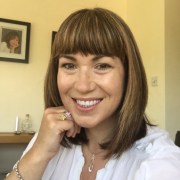
carrie-elks-headshot

Carrie Elks lives near London, England and writes contemporary romance with a dash of intrigue. She loves to travel and meet new people, and has lived in the USA and Switzerland as well as the UK. An avid social networker, she tries to limit her Facebook and Twitter time to stolen moments between writing chapters. When she isn’t reading or writing, she can usually be found baking, drinking wine or working out how to combine the two.

You can follow Carrie on Twitter @CarrieElks and visit her website. You’ll also find her on Facebook and Pinterest.

There’s more with these other bloggers too:

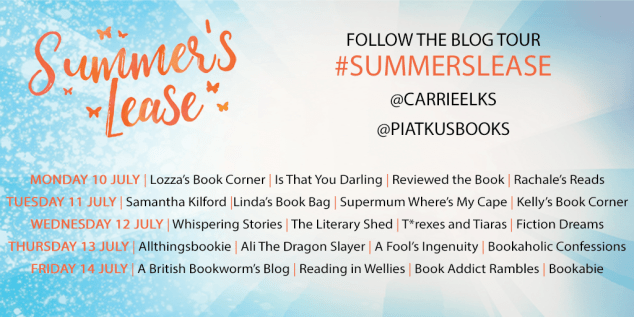
Summer's Lease blog tour poster

An Interview With Emylia Hall, Author of The Thousand Lights Hotel

thousand lights hotel

I can’t begin to say how excited I am to be interviewing Emylia Hall about her writing today. I love her books. You can read my review of The Thousand Lights Hotel here, of The Book of Summers here and of The Sea Between Us here.

The Thousand Lights Hotel was published in e-book on 1st July 2017 and is out in paperback on 13th July 2017. It is available for purchase through the links here.

The Thousand Lights Hotel

thousand lights hotel

When Kit loses her mother in tragic circumstances, she feels drawn to finally connect with the father she has never met. That search brings her to the Thousand Lights Hotel, the perfect holiday escape perched upon a cliff on the island of Elba. Within this idyllic setting a devastating truth is brought to light: shaking the foundations upon which the hotel is built, and shattering the lives of the people within it.

A heartbreaking story of loss, betrayal, and redemption, told with all the warmth and beauty of an Italian summer.

An Interview with Emylia Hall

Welcome to Linda’s Book Bag, Emylia. Thank you so much for agreeing to answer some questions on my blog about your writing and The Thousand Lights Hotel in particular. Firstly, please could you tell me a little about yourself?

I grew up in the wilds of Devon, and after spells in York, Lausanne, London, and the French Alps, I now live in Bristol with my family. My first novel, The Book of Summers, was published in 2012, and I’ve been writing full-time (well, alongside looking after my boy Calvin, who’s now three) ever since. The Thousand Lights Hotel is my fourth book. If I have a preoccupation as a writer it’s ‘place’ – the ideas for all my novels have come from thinking about setting, and I love working to capture the genius loci of somewhere. I’m a tutor with the Arvon Foundation, a mentor with the WoMentoring project, and have run creative writing workshops in Devon, Yorkshire, Zurich, Lausanne, and Kigali.

(Oh! If I ever get my writing act together I’ll have to attend one of those workshops!)

Why do you write?

In writing workshops I always, as a last exercise, ask people to think, and then write, about why they write. After teaching at Arvon a couple of years ago, I blogged about the experience, and did the same exercise myself. This is what I wrote then, and I stand by it…

I write because life’s too amazing to live just once. Because somehow we’ve been gifted hearts and minds that permit us to transcend the order of things, so why wouldn’t we want to see where that takes us (even if, sometimes, it turns out to be just three streets over, drinking coffee instead of tea)? I write because it’s time travel, it’s hurtling through place and space, it’s kissing the one who got away, or the one you never knew existed. It’s the button that came off your skirt one day when you were five years old, and knowing that that button mattered – maybe because your mother sewed it on and she’s not around any more, or maybe because she is here but you don’t see enough of her, or maybe, actually, everything’s pretty fine between you and your mother, but for some reason you still find yourself caring about that button… In a world where even the things we think we have a good grip on tend to have a habit of, sooner or later, slipping away, writing them down feels like the one practical, magical thing that we can do to hold on tight.’ 

(That’s beautifully put Emylia.)

When did you realise you were going to be a writer?

As a child, if you’d asked me what I wanted to be when I grew up, I would have said a writer. I read voraciously, and wrote stories and poetry all the time. Somewhere along the line I lost that single mindedness, and easy belief. While studying Literature at university I found I read less for pleasure, and my connection with what I was reading – and the feeling that maybe I was capable of doing it too – became far less involved. It was only when I was working all hours in a hectic advertising agency in London that I felt the strong desire to reconnect with what I really loved, and what, as a child, I’d been passionate about. That felt important to me, because the child-me felt like the purest version of my identity, in a way. I knew I wanted a different focus, and thought that writing might be it, but I was struggling to find the creative energy to do anything about it. It was only when my husband (then boyfriend) and I quit our jobs and spent two winters in the French Alps – working in a chalet, then as a snowboard guide and shop-girl respectively – that I felt free enough, and inspired enough, to start writing. I set my mind to it then. When we moved back to the UK in 2007 I was working on The Book of Summers, and writing that book was a big part of how I saw myself, and my hopes for what I wanted to be, and do next. Three years later – three years of that novel feeling like a kind of secret garden, mine to play in – it was ready to send out to agents.

Which aspects of your writing do you find easiest and most difficult?

I find first drafts difficult; their disorder and uncertainty unnerve me. I’m always relieved when I get to the end, as then I feel I have a base to build upon. I think I prefer rewriting to writing; it’s the officiousness in me. I like thinking ‘well, I have all that, now I just need to make it better’. What do I find easy? Maybe settling upon the heart of a story. I always know how I want the story to feel, even if it takes some time to work out how best to express that.

What are your writing routines and where do you do most of your writing?

Since my son’s been around I just have the afternoons to write. Four hours a day. When I’m feeling the pressure of a deadline, or am on a real roll, then I will work in the evenings, and every other early morning (when it’s my turn for a lie in, and my husband gets up with Calvin) too. When he was a baby I used to steal an extra hour or two of writing a day while he was sleeping – I’d stride around Bristol pushing his buggy, my whole morning designed around getting him to nod off in the vicinity of one of my favourite cafes, then I’d whip out my laptop and revel in an extra bit of writing time. When he starts school next year I’ll have more time than I know what to do with. No, I know exactly what I’ll do: write more.

Without spoiling the plot, please could you tell us a bit about The Thousand Lights Hotel?

The novel is set on the island of Elba, just off the coast of Tuscany. It follows a British travel writer, Kit, who goes to the island to connect with – or, perhaps more accurately, to scope out and challenge – the father she’s never met. I liked the idea of placing someone in a holiday environment, whose motivation is one that’s far from pleasure; she’s grieving, and carries an old, imprecise anger. The story is told from three perspectives – that of Kit, Valentino, and Oliviero. Valentino is the owner of the hotel, a man who’s devoted the last thirty years of his life to hospitality and serving others in his Elban idyll. Oliviero is the hotel’s chef, a wonder in the kitchen and something of a Lothario. As Kit settles into the Hotel Mille Luci, attempting to keep a cool head, and a distant manner, she finds herself drawn to these two men, and slowly succumbing to the hotel, and Elba’s charms. The story is about redemption, an opening of hearts, and making peace with the past.

Travel, water and the sea seem to be dominant features in your writing. Why is this?

You’re right, water figures prominently in all four of my novels. This wasn’t a deliberate thing, but it doesn’t surprise me. I’m perpetually drawn to water. To me it speaks of reflection and contemplation, and then motion, renewal; the seas and lakes in my stories are never still. My writing aside, I find my heart lifts whenever I’m near water, even just wandering alongside Bristol’s harbourside is a tonic, and in my day dreams I’m living by the sea. As to travel, I’m interested in how people behave when they alight in new places: the opportunity for reinvention. Travel evokes freedom, and when we travel we’re all looking for something (even if it’s something as uncomplicated as relaxation and a sun tan) that hope and desire, and sense of being an outsider connecting to a new clime, is of endless interest to me.

When I read your novels, I’m always struck by the fabulous appeal to all the senses. How conscious are you of including them in your writing or are they a natural part of your style?

It’s pretty natural – I guess that’s how I experience a place, with all the senses.  I recently went to LA and had a terrible cold the whole time I was there. I had no voice, so taste, no smell, and the way I responded to the city was just so diluted. I felt like I’d been wrapped in layers of wadding, and was barely there. I’m used to feeling enlivened by new surroundings, revelling in the feeling of possibility, and to go so far, and to somewhere I was so excited about, and have that experience dulled… I felt spectacularly cheated. I like reading prose that appeals to the senses and paints a vivid picture – and I think we all write what we like to read.

You always include very complex relationships in your novels. How far do you think this complexity is a natural part of family life?

I think complexity of relationships is absolutely a natural part of family life; we’re all interested in the muddled workings of other families, as it makes our own seem less crazy! Parents are vitally present in all four of my books, and certainly in three of them the relationships are, in some way, challenging; perhaps A Heart Bent Out of Shape is the exception. Thinking about it, I’m rather hard on parents – I’ve killed three mothers, and have a number of absent or unsatisfactory fathers – and this is probably an inversion of my own experience. I’ve always got on well with my mum and dad, they’ve never given me reason to doubt or reappraise them in their role as parents, so my explorations of more complicated relationships are maybe a kind of fantasy, or anti-wish-fulfilment. Also, all stories need conflict – even natured, temperate dynamics don’t make for such interesting fiction; conflict that arises from childhood or parental relationships feels so deep-rooted and inescapable, it’s fascinating to explore.

I’m aware of a pervading sense of loss behind your writing. Is this something you’ve experienced yourself and how far do you see writing as a cathartic experience?

I once read somewhere that you write what you’re most afraid of. Loss does run through all of my novels, but it’s not informed by any particular experience of my own. I like writing about change, and how we respond under the pressure of extreme situations – death sure fits that bill.  All stories need conflict, and inner conflict is, to me, the most interesting. For all the loss in my novels, they each contain a positive note, and are, essentially uplifting. I write from a place of optimism, and hope.

In The Thousand Lights Hotel you add layers of authenticity through using small smatterings of Italian. How difficult is it to get the balance right for readers when using a foreign language in your writing?

I think it’s a balancing act, and a little goes a long way. I consider what I respond to as a reader (that’s a decent MO for most aspects of writing, really) – a flavour to lend authenticity, but not so much that it becomes tiresome or potentially incomprehensible to readers. With my first novel I used quite a few Hungarian words and phrases, and when it came to recording the audiobook I had to furnish the actor with a pronunciation guide, which was fun to write.

(I bet!)

In The Thousand Lights Hotel I was struck by Valentino as almost Lear like because of the complexity of his relationships and his guilt. What would you say to that description of him?

I must admit, despite studying English at University, I’m not all that familiar with King Lear. An angry bearded king, with three daughters? Wait, let me look it up… Ah, okay! Well, now you mention it I can see the parallel, and I love that you make the association… The most important thing for me with Valentino was to write a man who was full of contradictions, burdened by his own past, but intent on making the present pleasurable for other people. Seeking to do right by Kit once he learns her identity, but also resistant to this, because opening himself to her means making a massive internal adjustment which, even thirty years on, he doesn’t feel he’s equal to. As he holds court in his hotel he presents as charming and affable, a man at ease in his own skin, but his interior life is a different matter.

When I’ve read your books I’ve been transported to Cornwall, Elba, Italy, Hungary and Devon. Where might I be travelling in your next novel?

Ah, so that means you’re yet to read A Heart Bent Out of Shape? You’re missing Switzerland from your travels! I’m currently working on a story set in LA, but it’s early days, so I almost don’t want to jinx it by saying anything more, but I’m enjoying writing my way to California…

(You’re right – A Heart Bent Out of Shape is the one I have yet to read.)

How did you go about researching detail and ensuring The Thousand Lights Hotel was realistic?

I’ve spent nearly four weeks on Elba over the years. When I first began working on the novel in early 2015 the island was already imprinted on my mind, and I loved the act of transporting myself back there (we’d visited in 2003 and 2012). My son, Calvin, was born while I was working on my third book, The Sea Between Us, and thanks to my husband and I sharing the care of him 50/50, I’d been back at my writing desk every afternoon since he was three months old. But as I was beginning work on the new novel – traveling to Elba on the page – I felt a stronger urge than ever to actually get up and go. Part of that was the desire to do something that felt like it was just for me. He was seventeen months old at that point, I’d recently stopped breastfeeding, and although I’d never had a night away from him, it felt like the right time. So I went to Elba for five nights. And they were… amazing. Being wholly on my own, responsible just for myself, losing myself in the landscape of my novel… My God, it was incredible. I’d done a lot of desk research to decide where I was going to base myself – and, by definition, set the book – and when I got to Marciana Marina on the north coast I wanted to cry; it was so perfect. I got off the bus and walked down to the seafront, talking to myself like a lunatic, unable to believe my luck that a place that looked lovely in pictures online was just so intoxicatingly gorgeous in real life. Looking back I really needed that trip – not just for the progress of the novel but for my own nourishment – and I think that heady ‘I love Elba’ feeling is evident in The Thousand Lights Hotel.

If you could choose to be a character from The Thousand Lights Hotel, who would you be and why?

I’d be Bernardo, the kitchen pot washer. He has the easiest, breeziest time of it, doesn’t he? No hard times in his past. And every morning when he gets to work Oliviero has a hot chocolate and a fresh cornetti waiting for him. Yep, I’d be Bernardo.

If The Thousand Lights Hotel became a film, who would you like to play Kit (or Rosa, or Valentino or…. any of the characters really!) and why would you choose them?

Oh this is easy! I love a bit of fantasy casting. Felicity Jones would be Kit. Stanley Tucci would be Valentino. Juliette Binoche would be Rosa. And Oliviero would be played by a hot newcomer.

When you’re not writing, what do you like to read?

I read fairly widely – mostly contemporary novels. I like to keep up with what’s current, what’s considered good, while also making my own discoveries. Some of the authors I admire most are Susan Fletcher, Tim Winton, and Anne Tyler, and I return to their novels again and again. In writing I look for a string sense of place, poetry and lyricism, and depth of feeling. I always want to feel an emotional connection to a story, and be lifted by the quality of writing.

Finally, Emylia, if you had 15 words to persuade a reader that The Thousand Lights Hotel should be their next read, what would you say?

To quote from The Enchanted April, if you ‘Appreciate Wistaria and Sunshine’ it’s for you.

Thank you so much for your time Emylia in answering my questions.

About Emylia Hall

emylia-hall-detail

Emylia Hall was born in 1978 and grew up in the Devon countryside. She is the author of The Book of Summers, which was a Richard & Judy Summer Book Club pick in 2012, A Heart Bent Out of Shape, The Sea Between Us and The Thousand Lights Hotel. She lives in Bristol with her husband, the writer Robin Etherington, and their young son.

You can follow Emylia on Twitter and visit her website. You’ll also find her on Facebook.

There’s more with these other bloggers too:

thousand lights hotel banner

Why I Wrote A Trilogy: A Guest Post by Peter Bartram, Author of the Morning, Noon & Night Trilogy

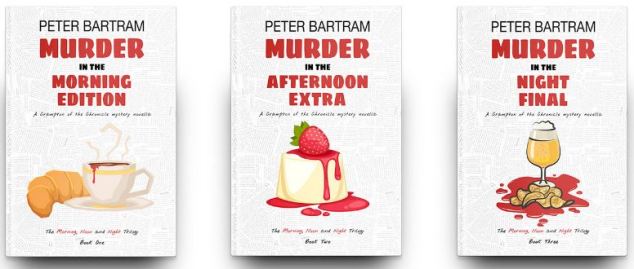
Peter bartrum books

As an aspiring writer who hasn’t yet managed to complete one novel (the 21 non-fiction books don’t count!), I’m fascinated by how Peter Bartram, author of the Morning, Noon and Night Trilogy has managed to produced three books in a row! Luckily, he’s agreed to tell me a bit about it.

Peter’s books are available here.

Murder in the Morning Edition

Murder in the morning edition

A comic crime caper. Book 1 of the Morning, Noon & Night trilogy

Book 1 of 3 in the Crampton of the Chronicle Morning, Noon & Night trilogy (3 Book Series)

Welcome to Brighton, England – where they do like to murder beside the seaside…

Don’t you just hate it when you get the afternoon off – and then find yourself chasing a train robber with his loot?

Join ace crime reporter Colin Crampton and his feisty Australian girlfriend Shirley Goldsmith as they embark on a new adventure.

It all starts when Colin spends a lazy afternoon by the beach with Shirley. But when a daring robbery takes place before their very eyes, Colin reckons he’s on the trail of a big story.

But nothing about the robbery is what it seems. And before long Colin and Shirley are drawn deeper into danger.

Colin encounters a motorcycle rocker with bad teeth, a dyslexic tattooist, and a seller of novelty toilet roll holders as he chases down his story.

If you enjoy books by authors like Janet Evanovich, M C Beaton and Simon Brett, you’ll soon be hooked by the mix of murder, mystery and mirth in this first book in the Colin Crampton Morning, Noon & Night trilogy. Come and join the fun…

Why I Wrote The Morning, Noon & Night Trilogy

A Guest Post by Peter Bartram

When I published a book of short stories last year – Murder from the Newsdesk, if you’re interested – I was struck by some of the reasons readers gave for enjoying them.

One reviewer said the book was perfect reading for the daily commute. Another enjoyed it on a plane journey. Yet a third said it was exactly the kind of book to pick up and put down when there were a few minutes for reading.

It got me thinking about the way people read books. We’re all different. Some of us like to sink into a deep armchair before a roaring fire for hours on end. But others grab a few pages when they can in a busy day.

I’ve seen people reading books pushing a supermarket trolley, standing in a queue, lying on a park bench. And, of course, these days they’re as likely to be reading a kindle, a laptop or an iPhone as a printed book.

So when it came to writing the next Crampton of the Chronicle comic crime mystery, I decided to do something different. Instead of writing one long (100,000 word) book, I’ve written three shorter novellas in a trilogy. I’m calling it the Morning, Noon & Night trilogy, which picks up on the titles of the three books.

It turns out the trilogy format perfectly fits the traditional murder mystery. They often fall naturally into three parts. In the first, the murder is committed and the sleuth is baffled. In the second, our hero picks up a key clue and follows it through many twists and turns towards the truth. In the third, the hero faces and overcomes a crisis to nail the killer.Murder in the morning edition

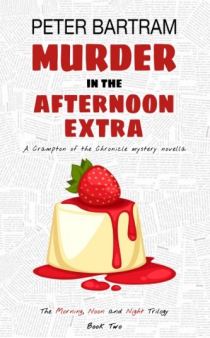
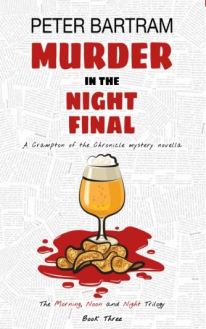
In my trilogy, those phases fit neatly into the three books in the series – Murder in the Morning Edition, Murder in the Afternoon Extra and Murder in the Night Final. But, as I found when I came to write the book as a trilogy rather than a single book, it’s important that each book should reach a natural ending point.

Muder in the afternoon extra

The key elements of that part of the story need to be rounded up so that the finish of the book feels naturally like an end – but with another beginning just around the corner.

murder in the night final

So three books, three murders, but one motive.

In the Morning, Noon & Night trilogy, Brighton crime reporter Colin Crampton and feisty Australian girlfriend Shirley Goldsmith spot a shifty character wearing a flash pair of gloves in a beachfront café on the hottest day of the year. Colin senses a story for his paper – but even he can’t imagine the trouble he’ll land himself in as he pursues the man with the gloves.

Before he solves the mystery he encounters a cast of crazy characters including a dyslexic tattooist, an exotic dancer who’s lost her pet python, and a clumsy assassin who kills the wrong people.

The trilogy is available on Amazon and Murder in the Morning Edition – the first book in the series – is free to download now here.

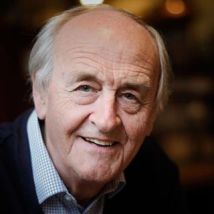
About Peter Bartram

peter bartrum

Peter Bartram brings years of experience as a journalist to his Crampton of the Chronicle crime series – which features crime reporter Colin Crampton in 1960s Brighton.

Peter has done most things in journalism from door-stepping for quotes to writing serious editorials. He’s pursued stories in locations as diverse as 700 feet down a coal mine and a courtier’s chambers at Buckingham Palace. Peter wrote 21 non-fiction books, including five ghost-written, before turning to crime – and penning the Crampton of the Chronicle series of humorous crime mysteries.

Peter is a member of the Society of Authors and the Crime Writers’ Association.

You can find Peter on Facebook, follow him on Twitter, visit Peter’s website here and find out more about the Colin Crampton books here.

Introducing Cosy Holders

cosy

Those who know Linda’s Book Bag know I used to be an English teacher, educational consultant and inspector. Therefore, you’ll also realise that anything that will contribute to getting children engaged in reading is going to capture my interest. Today I’m deviating from my usual blog posts to introduce a new product, Cosy Holders, designed to hold e-readers for children and that I think is a cracking idea.

Cosy Holders are available for purchase here.

Bailey and Frankie

Bailey_160x
The ‘Parents’ of the Cosy Holder family, suitable for most tablets, eReaders and some books. With a rear padded accessory pouch to hold your headphones, pens, pencils or other items you may want to keep safe with you. Supplied with adjustable carrying strap.
Made from soft and cosy fabrics and fillings it can also be used as a travel pillow for when the little ones need a quick nap!
Two colour options are available, ‘Bailey’ (purple) or ‘Frankie’ (green).

About Cosy Holders

frankie_160x

You can follow Cosy Holders on Twitter, find them on Facebook or visit their website for more details.

Bailey and Frankie are currently available at a special introductory price of £19.99 here.

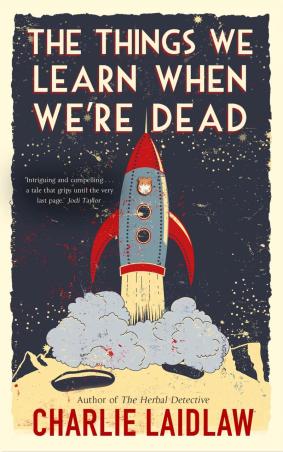
An Interview with Charlie Laidlaw, Author of The Things We Learn When We’re Dead

The things we learn COVER FINAL

I’m very pleased to welcome Charlie Laidlaw to Linda’s Book Bag today to tell me about his second novel The Things We Learn When We’re Dead which is a modern fairytale of love and loss.

Published by Accent Press, The Things We Learn When We’re Dead is available for purchase in e-book and paperback here.

The Things We Learn When We’re Dead

The things we learn COVER FINAL

On the way home from a dinner party she didn’t want to attend, Lorna Love steps into the path of an oncoming car. When she wakes up she is in what appears to be a hospital – but a hospital in which her nurse looks like a young Sean Connery, she is served wine for supper, and everyone avoids her questions.

It soon transpires that she is in Heaven, or on HVN. Because HVN is a lost, dysfunctional spaceship, and God the aging hippy captain. She seems to be there by accident. Or does God have a higher purpose after all?

At first Lorna can remember nothing. As her memories return – some good, some bad – she realises that she has decisions to make and that she needs to find a way home…

An Interview with Charlie Laidlaw

Welcome to Linda’s Book Bag, Charlie. Thank you so much for agreeing to answer some questions on my blog about your writing and The Things We Learn When We’re Dead in particular. Firstly, please could you tell me a little about yourself?

I’m the author of two novels, The Herbal Detective (Ringwood Publishing) and The Things We Learn When We’re Dead (Accent Press). A third novel, Darker Matters, is due to be published by Accent Press in January 2018.

I was born and brought up in the west of Scotland, which really wasn’t my fault, and am a graduate of the University of Edinburgh. I then worked briefly as a street actor, baby photographer, puppeteer and restaurant dogsbody before becoming a journalist. I started in Glasgow and ended up in London.

Surprisingly, I was approached by a government agency to work in intelligence, which just shows how shoddy government recruitment was back then. However, it turned out to be very boring and, craving excitement and adventure, I ended up as a PR consultant, which is the fate of all journalists who haven’t won a Pulitzer Prize, and which is what I’m still doing.

I am married with two grown-up children and live in East Lothian. And that’s about it.

(I think that sounds like a very eclectic CV!)

Why do you write?

Partly, it’s a compulsion; partly, it’s simple recognition that I’m pretty useless at everything else. I also believe that, whatever you’re good at, you should pursue it. It’s a kind of duty on all of us. Be the best at what you’re good at.

When did you realise you were going to be a writer?

I’ve always been a writer, if not a published author until recently. But I still don’t consider myself to be a proper author, because my main source of income still lies elsewhere.

(I think with three books under you’re belt you’re definitely a writer Charlie!)

Which aspects of your writing do you find easiest and most difficult?

Getting started! I’m a great procrastinator and will always find all sorts of excuses not to write. I suppose that writing is always time spent when you should be doing something else. However, once I do start writing, my brain usually slips into a creative gear, and the words tend to flow – sometimes in the right order.

Once you get started, what are your writing routines and where do you do most of your writing?

I write in a home-office. But that’s just to get words typed. The creative side of deciding what gets written can be thought through on a bus, or train, or car. I now only write when I have a clear idea of how that paragraph or chapter will fit into the overall narrative. I’ve very jealous of those writers who can produce a novel every few months. In a future life, I will come back as Barbara Cartland.

Without spoiling the plot, please could you tell us a bit about The Things We Learn When We’re Dead?

It’s a retelling of a universal and recurring story; how you can have second chances in life and, in doing so, look back at your life and find a new beginning. More prosaically, it’s the life story of a young woman who is complex and feisty, but who is also a little damaged. The book tells her story and how she glues back her constituent parts – and, I suppose, finally grows up.

The Things We Learn When We’re Dead takes its inspiration from The Wizard of Oz. Why this book in particular?

The Wizard of Oz is all about second chances and many, many authors have written the same kind of story, before and after. It is a story that resonates because we all do silly things, or lose our way. The premise within The Wizard of Oz is that a second chance can be just around the corner.

The idea for the book came to me on a train from Edinburgh to London, which is apt because Edinburgh is a civilised place and the only city in the world to have named its main railway station after a book. So powerful was the original idea that, when I got home, I write the first chapter and the last chapter. I therefore knew where the book started, and where it would end. The first chapter has changed a bit; the last chapter is almost the same.

However, having dreamed up an unfamiliar version of a familiar theme, I had a choice: either to recognise that it was loosely The Wizard of Oz, or ignore it. I decided to embrace it because, I figured, it’s a story that everyone likes!

You’re inverting the familiar in The Things We Learn When We’re Dead. What do you hope readers will get from this effect?

Everything in the known universe has been written about many times. Even Shakespeare used older sources such as Chaucer for inspiration, and even further back to Roman writers. So, as far as I’m concerned, nothing literary under the sun can be thought of as truly original. Love, sex, marriage, war, peace, betrayal…you name it, it’s all been done to death.

My approach is therefore to take a familiar theme, and give it originality. In my book, the reader will understand the overall familiarity and tradition of the narrative and why the central character, Lorna Love, will be given her second chance. It does therefore fulfil familiar expectations, using an oblique construct to provide a new perspective on a well-worn theme.

But it also makes the familiar unfamiliar, and therefore makes the readers’ journey worthwhile. That is the best that any author can hope for.

You also explore the concepts of utopia and dystopia in The Things We Learn When We’re Dead. Which is the most likely outcome for us in today’s society do you think?

You’re right, the book does pivot on a balance between utopia and dystopia. That balance was evident in the original Wizard of Oz – the Emerald City might have been paradise, but it was bounded about by evil witches and ruled by a false god.

I suppose it’s a question I address in the book, because it’s also a satire on religion. The book does ask whether the world would be a better place if we all stopped believing in God. It’s not a question I can answer but, in the current state of the world, it’s a question worth asking.

If you could choose to be a character from The Things We Learn When We’re Dead, who would you be and why?

None of them, because becoming one of them seems a bit creepy! I don’t know about other writers, but my characters become real people to me. They tell me what to write, and they tell me if a piece of dialogue isn’t what they would say. So, because they’re sort-of real, I wouldn’t want to take over their lives.

That said, I’d love to peek into what they’ve been up. As the book ends in 2007, I do sometimes wonder what’s happened to them and whether they’re all happy. I’d love to know what life has thrown at them and how they’ve responded.

(You’ll just have to write a sequel to find out!)

If The Things We Learn When We’re Dead became a film, who would you like to play Lorna and why would you choose them?

Part of Lorna’s attraction is that she’s a nobody trying hard to be a somebody. She wants to make something of her life, but isn’t entirely sure how to go about it. In that spirit, I’d like her to be played by an unknown but up-and-coming actress.

When you’re not writing, what do you like to read?

Mostly contemporary literary fiction. Joanne Harris is my favourite author, with the likes of Kate Atkinson not far behind. As a contemporary author, it’s only sensible to read other contemporary authors. I would encourage anybody thinking of writing a book to read anything and everything in their chosen genre. If you don’t read, you can’t write.

If you had 15 words to persuade a reader that The Things We Learn When We’re Dead should be their next read, what would you say?

Let Jodi Taylor, the best-selling author answer that from her review of it: “Intriguing and compelling…a tale that grips until the very last page.”

Thank you so much for your time in answering my questions Charlie.

About Charlie Laidlaw

CL bandw

Charlie Laidlaw was born in the west of Scotland and is a graduate of the University of Edinburgh. He has been a national newspaper journalist and worked in defence intelligence. He is married with two grown-up children.

You can follow Charlie on Twitter and visit his website.  You’ll also find him on Facebook.

Felicity at the Cross Hotel by Helena Fairfax

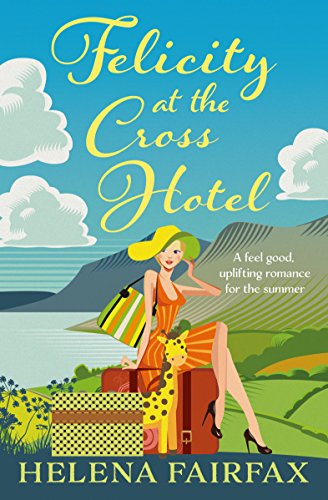
Felicity at the cross hotel

My enormous thanks to the author Helena Fairfax for a copy of Felicity at the Cross Hotel in return for an honest review. I have been privileged to host Helena on Linda’s Book Bag in the past and you can read her guest post all about fairy tales and trickery here.

Felicity at the Cross Hotel is published today 7th July 2017 and is available for purchase in e-book and paperback here.

Felicity at the Cross Hotel

Felicity at the cross hotel

A quaint hotel in the Lake District. The Cross Hotel is the perfect getaway. Or is it?

Felicity Everdene needs a break from the family business. Driving through the Lake District to the Cross Hotel, past the shining lake and the mountains, everything seems perfect. But Felicity soon discovers all is not well at the Cross Hotel …

Patrick Cross left the village of Emmside years ago never intending to return, but his father has left him the family’s hotel in his will, and now he’s forced to come back. With a missing barmaid, a grumpy chef, and the hotel losing money, the arrival of Felicity Everdene from the notorious Everdene family only adds to Patrick’s troubles.

With so much to overcome, can Felicity and Patrick bring happiness to the Cross Hotel … and find happiness for themselves?

My Review of Felicity at the Cross Hotel

Coming from the Everdene family international hotel chain, Fliss’s arrival at The Cross Hotel in the Lake District is viewed by many with suspicion.

What a lovely, lovely story Felicity at the Cross Hotel is. It’s so well written that it feels effortless to read, but that isn’t to say it feels frivolous and insubstantial. There are some weighty themes behind what it a gorgeous, gentle romance. Helena Fairfax explores parental relationships, grief, friendship, guilt, rivalry and our treatment of those who are different, as natural parts of her story so that there is much to ponder as well as to entertain. I thought her writing was very skilled.

The characterisation works brilliantly. I loved the concept of Felicity as one who lives up to her name by spreading happiness. The attraction between her and Patrick is naturally and convincingly displayed so that I was desperate for them to have a happy ever after ending – you’ll have to read Felicity at the Cross Hotel to find out if that happens! Unlike other similar romances, this doesn’t just focus on two people with a cardboard cut out supporting cast. All those in the story felt real and genuine to me; even Agnetha the car.

Similarly, I loved the depiction of the Lake District with its capricious weather, lowering lakes and changeable skies. I felt truly transported to the setting so that I could imagine staying at the Cross Hotel.

I thoroughly enjoyed Felicity at the Cross Hotel. It had exactly the right tone, depth and level of sophistication to transport me to another place with other people. I loved it. Felicity at the Cross Hotel is an ideal summer read that I recommend wholeheartedly.

About Helena Fairfax

helena-fairfax

Helena Fairfax writes engaging contemporary romances with sympathetic heroines and heroes she’s secretly in love with. Her first novel, The Silk Romance, was a contender for the UK’s Romantic Novelists’ Association New Writers’ Scheme Award and a runner-up in the Global Ebook Awards. The Scottish Diamond was a finalist in the I Heart Indie Awards. Helena Fairfax was shortlisted for the Exeter Novel Prize in 2014.

silk-romance

When not writing, Helena walks the Yorkshire moors near her home every day with her rescue dog, finding the romantic landscape the perfect place to dream up her heroes and her happy endings.

All of Helena’s lovely books can be found here.

You can find out more about Helena by visiting her website, finding her on Facebook, or following her on Twitter.

Unsolved and Unexplained: A Guest Post by Thorne Moore, author of Shadows

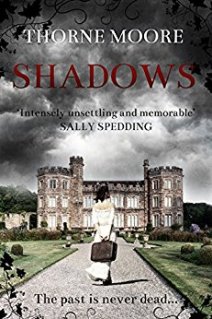
Shadows

I’m delighted to welcome Thorne Moore, author of Shadows, to Linda’s Book Bag today. I adore the atmospheric cover of Shadows and although I haven’t had time to read it yet, I was so pleased when Thorne agreed to come on the blog and tell me a bit about it.

Shadows was published on 14th June 2017 by Endeavour Press and is available for purchase in e-book here.

Shadows

Shadows

Kate Lawrence can sense the shadow of violent death, past and present.

In her struggle to cope with her unwelcome gift, she has frozen people out of her life. Her marriage is on the rocks, her career is in chaos and she urgently needs to get a grip.

So she decides to start again, by joining her effervescent cousin Sylvia and partner Michael in their mission to restore and revitalise Llys y Garn, an old mansion in the wilds of North Pembrokeshire.

It is certainly a new start, as she takes on Sylvia’s grandiose schemes, but it brings Kate to a place that is thick with the shadows of past deaths.

The house and grounds are full of mysteries that only she can sense, but she is determined to face them down – so determined that she fails to notice that ancient energies are not the only shadows threatening the seemingly idyllic world of Llys y Garn.

The happy equilibrium is disrupted by the arrival of Sylvia’s sadistic and manipulative son, Christian – but just how dangerous is he?

Then, once more, Kate senses that a violent death has occurred…

Set in the majestic and magical Welsh countryside, Shadows is a haunting exploration of the dark side of people and landscape.

Unsolved and Unexplained

A Guest Post by Thorne Moore

Kate Lawrence has a psychic gift – or a curse. She is tuned in to the imprint cast by violent death. So she is bound to face problems when she comes to stay with her cousin Sylvia, who has bought a Victorian mansion in Pembrokeshire. Llys y Garn is older than it looks. It has a lot of history, casting a lot of shadows. Who or what cast them? She can’t tell. Between the lines of recorded history are the vast echoing spaces of people and events that have slipped into oblivion. Sometimes they leave hints of mysteries that will never be explained.

Llysygarn

Llys y Garn, stands in a deep wooded valley in North Pembrokeshire. It’s a fictional house, but there are plenty like it in the area. The setting is important. Kate is hypersensitive to shadows of the past, but this is a place where you’d have to be totally insensitive to escape them. Many houses hide behind deceptively bland exteriors that belie their age. I know this. My house is a Victorian farm cottage, two up, two down, with a lean-to scullery, onto which a flat-roofed extension had been added back in the 1970s. Nothing to get excited about. It was only when I glanced through a book of old Pembrokeshire houses that I came across my house listed as a former Mediaeval manor, held by Jenkin ap Howell who was slain at Banbury in 1469. Well well. By 1811, it was described as “now but an ordinary farmhouse and bears no marks of its former consequence.”

I may be left without a mansion of consequence, but I am left with the conviction that things will have happened here over the centuries. Probably some bad things. Almost certainly some deaths. An account, hand-written in Welsh by a Victorian vicar, suggests that mediaeval bones had recently been dug up on this property and so it must once have been a churchyard or a site of battle. I’ve come across no other mention of these bones, but I do wonder what I might unearth if I ploughed a little deeper in the garden.

Old properties will have old secrets and naturally, Llys y Garn has them too. It has the façade of a Victorian Gothic mansion, but there’s a Mediaeval hall hidden behind, and a suggestion of a Bronze Age settlement in the grounds. Things have been happening there for generations. As one of the characters points out, “I bet every place as old as this has half a dozen grisly secrets buried away, but no one thinks of looking.” Unfortunately for Kate, at Llys y Garn people do think of looking.

I would not define myself as a crime writer, but I do write about crime and its impact on individuals, families, communities and even places. Not just the crimes that are formally investigated, with clues slipped nearly into place like a jigsaw puzzle, and put to bed with some act of “justice.” Perhaps the crimes that are never solved are more interesting. According to Home Office statistics, something like 20% of reported homicides lead to no identified suspects or any legal action, and that is with all the benefit of modern, scientific investigative tools. How many murders went unresolved in the past? And how many were not even recognised as murders? Over a couple of decades, Harold Shipman killed at least 200 people before anyone thought to question the deaths. We’ll never know what the real total was.

It is tempting, as an author, to delve into historical cold cases and come up with a convincing resolution. In a way, I have done that with my previous books, examining old (fictional) crimes and ultimately resolving them. In Shadows, I do things differently. Old murders are suspected – Kate can feel their imprint – and sometimes more than suspected, because tangible evidence comes to light. But it doesn’t mean they will ever be explained. And it means that some things happening now, under our noses, might never be explained either. Which is intriguing.

(Oo – it certainly is Thorne – can’t wait to read Shadows and find out more.)

About Thorne Moore

ThorneMoore

Thorne was born in Luton and graduated from Aberystwyth University (history) and from the Open University (Law). She set up a restaurant with her sister but now spends her time writing and making miniature furniture for collectors. She lives in Pembrokeshire, which forms a background for much of her writing, as does Luton. She writes psychological mysteries, or “domestic noir,” and her first novel, A Time For Silence, was published by Honno in 2012. Motherlove and The Unravelling followed, also published by Honno. She has also brought out a book of short stories, Moments of Consequence. She’s a member of the Crime Writers Association.

You can follow Thorne on Twitter @ThorneMoore and visit her website. You can also find Thorne on Facebook.

An Interview with Tiffany McDaniel, Author of The Summer That Melted Everything

Uk stme.jpg

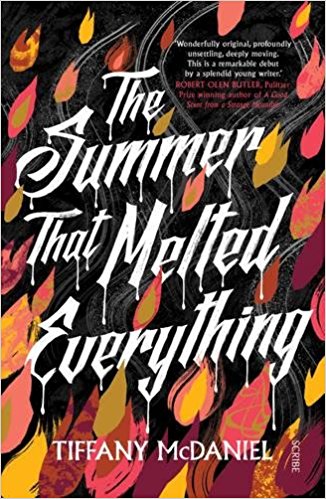
Having heard so many brilliant things about Tiffany McDaniel’s The Summer That Melted Everything, I’m delighted to welcome Tiffany in interview to Linda’s Book Bag to celebrate the paperback publication of the book.

Published by Scribe in the UK, The Summer That Melted Everything is available for purchase here.

The Summer That Melted Everything

new paperback of tstme

Fielding Bliss has never forgotten the summer of 1984: the year a heatwave scorched the small town of Breathed, Ohio. The year he became friends with the devil.

When local prosecutor Autopsy Bliss publishes an invitation to the devil to come to the country town of Breathed, Ohio, nobody quite expects that he will turn up. They especially don’t expect him to turn up as a tattered and bruised thirteen-year-old boy.

Fielding, the son of Autopsy, finds the boy outside the courthouse and brings him home, and he is welcomed into the Bliss family. The Blisses believe the boy, who calls himself Sal, is a runaway from a nearby farm town. Then, as a series of strange incidents implicate Sal ― and riled by the feverish heatwave baking the town from the inside out ― there are some around town who start to believe that maybe Sal is exactly who he claims to be.

But whether he’s a traumatised child or the devil incarnate, Sal is certainly one strange fruit: he talks in riddles, his uncanny knowledge and understanding reaches far outside the realm of a normal child ― and ultimately his eerily affecting stories of Heaven, Hell, and earth will mesmerise and enflame the entire town.

Devastatingly beautiful, The Summer That Melted Everything is a captivating story about community, redemption, and the dark places where evil really lies.

An Interview with Tiffany McDaniel

Welcome to Linda’s Book Bag, Tiffany. Thank you so much for agreeing to answer some questions on my blog about your writing and The Summer That Melted Everything in particular. Firstly, please could you tell me a little about yourself?

Thank you so much for having me on your blog, Linda.  So a little about me…I’m an Ohio poet and novelist.  I love gardening, baking, and creating art whether it’s drawing with charcoal or painting a canvas.  The Summer that Melted Everything is my first published novel.

Why do you write?

I’ve been writing since I was a kid.  Writing is really the first thing I remember doing without being told to do so.  I had an innate desire to write down what was in my head.  I think for most of us writers, we’re born to write.  We can only hope we’re fortunate enough to make a career out of it.

When did you realise you were going to be a writer?

Both of my parents had jobs, hard jobs that made them tired and not a lot of money.  I thought that’s what I would have to do in this world.  Have a job that I hated.  I didn’t get that distinction between a job and a career until I was in middle school.  Writing was so wonderful to me, I didn’t ever think of it as being work.

Without spoiling the plot, please could you tell us a bit about The Summer That Melted Everything?

The Summer that Melted Everything is about a man who one day puts an invitation in the newspaper, inviting the devil to town.  A boy, claiming to be the devil, answers the invitation, only this boy is not your stereotypical devil of red flesh and horns.  This so-called devil’s arrival coincides with the start of a heat-wave that threatens to destroy the town’s very sanity.  As the summer unfolds, the boy’s presence has tragic consequences on the town and everyone in it.  Who is the real devil?  That is a question The Summer that Melted Everything sets out to answer.

Which aspects of your writing do you find easiest and most difficult?

The easiest is the writing.  The hardest part is getting published.  While The Summer that Melted Everything is my first published novel, it’s actually my fifth or sixth novel written.  I wrote my first novel when I was eighteen, and wouldn’t get a publishing contract until I was twenty-nine for The Summer that Melted Everything.  It was a long eleven-year journey to publication, full of rejection and perseverance.  My writing is dark, and I was often told I was risky to publish, which is something I think female literary fiction writers often encounter in contrast to their male counterparts.  But if I had given up, I wouldn’t be where I am today with a book on the shelf.  So to all the writers out there on the journey to publication, I say, don’t let rejection destroy you.  Let rejection empower you.

What are your writing routines and where do you do most of your writing?

I never outline or plan the story beforehand.  If you plan a story too much, you can domesticate it in a way, and I like to preserve the story’s wild soul.  I also think a lot of creative energy is put into outlining, energy that is better spent in the actual writing of the story.  I like for the story to evolve with each new word and page that I write.  This is just what works best for me.  Each author has what works best for them, and that is the beauty of writing.

In The Summer That Melted Everything you explore the evil that is possible in ordinary people. How far do you think evil is part of the human condition?

With this novel, I really wanted to explore the good and evil within us all, but more than good and evil, I wanted to explore that grey area between the two.  The grey area that I think most of us live in.  We all have the potential to be good, and we all have the potential to be not so good.  We see this in the cast of characters within the novel.  It is how we choose to react to a situation, or to a person, that determines who we are.  In the end, I didn’t want a story that was out of reach.  I wanted a story that we could all identify with on some level, certainly on the level on which our human condition is crafted.

The Summer That Melted Everything has been described as allegorical. How far was this a conscious element and how far a natural part of your writing?

I’d say it’s just how I am as a writer.  I think every author is born with a particular tool set, and we use these tools to write the story to the best of our ability.  There are elements to my writing that will be present in all my books.  I’d say the allegorical and symbolic elements will always be one of the traits of my storytelling.

Heat is an integral part of your book. How did you ensure this iterative image melded seamlessly into your writing

I wanted the heat to feel like its own character.  And because weather isn’t a character that you often get to elaborate upon, I found writing about the heat to be one of the most interesting parts of writing this story.  The heat was a character that developed even more as the other characters developed around it.  The heat was always there, woven in ways that was a good exercise for the writing muscle.

You have had many accolades for The Summer That Melted Everything, including The Guardian’s 2016 ‘Not-the-Booker’ Prize. How does this make you feel?

It’s always wonderful when your work is recognized, and it certainly reassures the publisher and those who put stock in your writing, but it’s important to not let these things go to your head.  All you can hope to do as a writer is to write the characters’ truths to the best of your ability, and hope that the readers enjoy it.

If you could choose to be a character from The Summer That Melted Everything, who would you be and why?

Perhaps Sal.  Sal is the one who comes to answer the invitation inviting the devil.  Sal is a mystery, even to me.  Is he, or isn’t he, the devil?

If The Summer That Melted Everything became a film, who would you like to play Sal and Autopsy and why would you choose them?  

I do hope for the novel to one day be translated to the screen, and I have thought of who I would like to play the characters.  As far as who would play Sal, I think that would probably be a new-comer due to the character’s age of thirteen.  For Autopsy, it’d have to someone who is physically built like him.  Someone tall and thin, lanky in many ways.  I don’t think anyone can replace the images of these characters in my head, but one day I think I’ll see an actor and think that he could at least step into Autopsy’s shoes.

When you’re not writing, what do you like to read?

I like reading Ray Bradbury, Shirley Jackson, Donna Tartt, Toni Morrison, and the poet James Wright, who is from my land of Ohio.  I don’t have any one particular genre I read, or don’t read.  As long as it’s a good story, it’s worth turning the page for.

If you had 15 words to persuade a reader that The Summer That Melted Everything should be their next read, what would you say?

Fifteen words?  Let’s see…how about I say what Shelf Awareness said about the novel.  It’s exactly fifteen words:

The Summer that Melted Everything swells with the darkness that lurks in the human heart.”

And so, perhaps that will be enough to persuade a reader to take a chance on one summer that does indeed melt everything.

Thank you so much for your time, Tiffany, in answering my questions.

About Tiffany McDaniel

tiffany

Tiffany McDaniel is an Ohio native whose writing is inspired by the rolling hills and buckeye woods of the land she knows. Also a poet and artist, she is the winner of The Guardian’s 2016 “Not-the-Booker Prize” for her debut novel, The Summer that Melted Everything. The novel was also a Goodreads Choice Award double nominee in both fiction and debut categories, is a current nominee for the Lillian Smith Book Award, and a finalist for the Ohioana Literary Award and the Women’s Fiction Writers Association Star Award for Outstanding Debut.

You can find out more about Tiffany and The Summer That Melted Everything on her website.

Introducing Legend Press Classics in an interview with Tom Chalmers

Classics

I’m lucky to be a member of Legend 100 with Legend Press and so I get to find out all about, and read, a range of brilliant new books from this publisher. Today, however, I’m delighted to be going back in time with Legend and revisiting some fabulous classics that they have just released with stunning new covers.

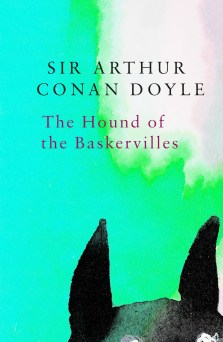
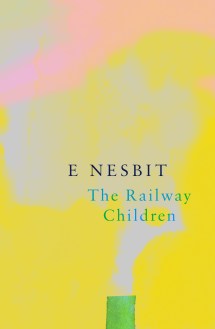
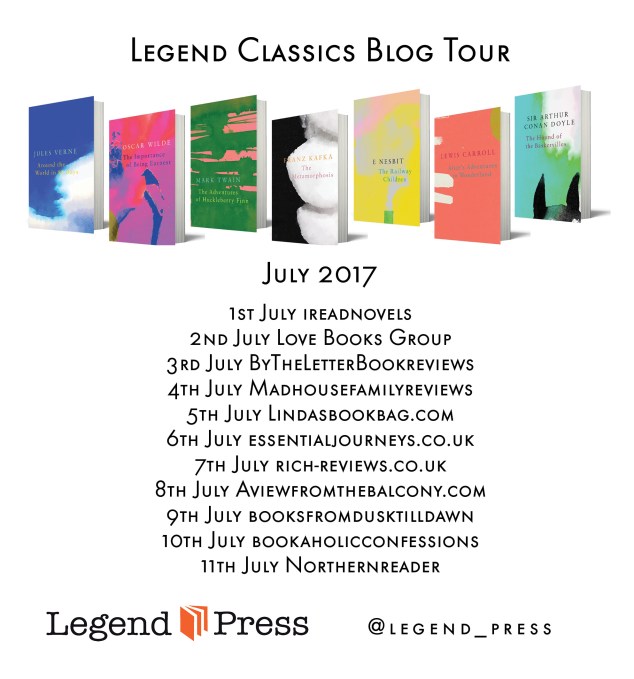
The first seven titles were launched on 1st June 2017, with further titles to be released in an expanded list in 2018 and 2019. The first collection comprises: Around the World in Eighty Days by Jules Verne, The Adventures of Huckleberry Finn by Mark Twain, The Importance of Being Earnest by Oscar Wilde, Alice’s Adventures in Wonderland by Lewis Carroll, The Metamorphosis by Franz Kafka, The Railway Children by E Nesbit and The Hound of the Baskervilles by Sir Arthur Conan Doyle.

You’ll find more details about these classics and buy links here.

Not only am I reviewing two of the seven in the series, Oscar Wilde’s The Importance of Being Ernest and Sir Arthur Conan Doyle’s The Hound of the Baskervilles, but I was lucky enough to be able to interview Legend Press’s MD Tom Chalmers all about the series.

The Hound of the Baskervilles

HOUNDS

Sir Charles Baskerville is found dead on the wild Dartmouth Moors with the footprints of a giant hound nearby and the murder is blamed on a family curse. It is left to Sherlock Holmes and Doctor Watson to solve the mystery of the legend of the supernatural and gruesome hound before Sir Charles’s heir comes to similarly painful end.

Widely considered the finest Sherlock Holmes novel, The Hound of the Baskervilles has become the defining book of the great detective and millions have read with enjoyment and horror the story of Holmes, Watson and the infamous hound.

The Importance of Being Ernest

EARNEST

The final comic or dramatic work from undisputed genius Oscar Wilde, The Importance of Being Earnest, A Trivial Comedy for Serious People is his most enduring popular play and a must-read for any Wilde fan.

A farcical comedy in which the protagonists maintain fictitious personæ to escape burdensome social obligations, the play is an unforgettable satire of Victorian ways.

Wilde’s notoriety caused the play, despite its early success, to be closed after 86 performances. This latest edition allows you to discover or enjoy once again the writing of one of history’s great comedy and drama writers.

METAMORPHOSIS

My Review of Legend Classics

I’m not going to say anything much about the stories themselves in The Hound of the Baskervilles and The Importance of Being Ernest because everyone knows them well, although I have to admit I hadn’t actually read the play script of The Importance of Being Ernest before and I found it just as funny on the page as I have on the screen.

What I do want to comment on is the lovely quality of these books. Both books have absolutely stunning colours that are vibrant and eye catching so that they would grace any bookshelf. The flyleaf of each has an evocative pen and ink drawing that relates to the story and there are potted and accessible biographies of the authors.

The books are printed on cream paper with print that I found perfect for someone like me with sight difficulties, making them comfortable to read. I really liked the way in which there is no blurb in the conventional sense – as I say, we all know the stories – but just a couple of brief quotations on the back covers that convey the essence of the stories.

I think these editions of well loved stories will make perfect gifts for those adults who already know them well and for a whole generation of new readers. I recommend getting them all!

RAILWAY

An Interview with MD Tom Chalmers

Thanks so much for agreeing to tell me more about this exciting series Tom. I normally associate Legend Press with a wide range of new authors. What made you decide to return to these famous classics?

We ran a promotion several years ago with Virgin Trains, giving away books across their stations, called ‘Lose Yourself in a Book’. Then last year we discussed how books have always been a great escape and came up with the idea of beautifully repackaging some of the modern classics and bringing them to readers for the first time or to enjoy them once again.

The series begins with seven quite eclectic books. Why this particular selection?

We researched the market to find books that haven’t recently been included in mainstream classic series or some that may have been overlooked – for instance there are hundreds of editions of The Portrait of Dorian Gray but far fewer of The Importance of Being Ernest. It was originally going to be adult fiction only but as we came across some classic children’s novels we couldn’t help but include them in as well to give the series as diverse range as possible.

You’re marketing the books as recapturing an exciting nostalgia. However, the cover images are very modern and almost impressionistic. How do you reconcile modernity and nostalgia?

Nostalgia may be remembering the past but it is a feeling in the present and we felt passionately that these books would be as enjoyable and rewarding to today’s reader as they would for a reader at any moment since they were originally published. We therefore wanted to give a modern feel to a classic book to emphasise its timeless nature as well as its appeal and relevance today.

How did you come to work with Anna Morrison on the cover designs?

Anna is a fantastic designer and she has designed the covers of a number of our recent novels and we have been delighted with what she has produced. We were therefore really pleased that she produced the covers for this series and believe she has done a fantastic job – in fact the stunning books currently have pride of place across our office bookshelves!

You’re having a big high street campaign. Where can readers buy these books?

They full series is currently being promoted by WHSmith at their travel branches – with travellers looking for a book to lose themselves in on their journey we thought it would be a perfect fit for the fantastic books. They are also available widely at other outlets and online.

What plans have you to extend the series in the future?

We are delighted with the initial reaction to Legend Classics and already plans are underway to extend the series next year, possibly to ten books. No doubt there will be a long debate over the selection but with so many fantastic modern classic novels, some of which haven’t been included in recent classic series, we are looking forward to bringing many more to today’s reader.

I wish you every success with these Legend Classics – I think they are collectables for the future.

About Legend Press

logo

Legend Press is an independent publishing company set-up in 2005 by then 25-year-old Tom Chalmers and has been shortlisted for numerous awards. Backed by an international sales, licensing and acquisitions network, it now publishes around 30 titles per year focused on literary, women’s, historical and crime fiction.

You an find out more on the Legend Press website, on Facebook and by following them on Twitter.

You can find out more about this exciting new series with these other bloggers too:
Classics Blog Tour Banner jpeg

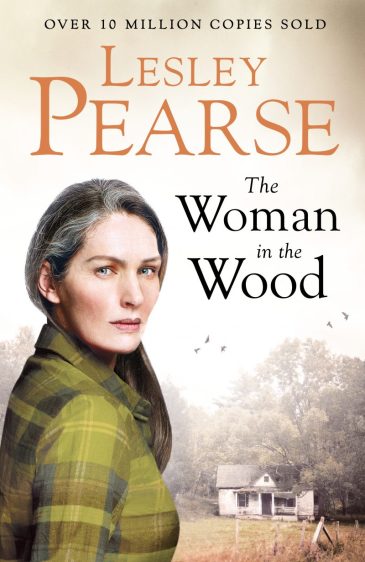
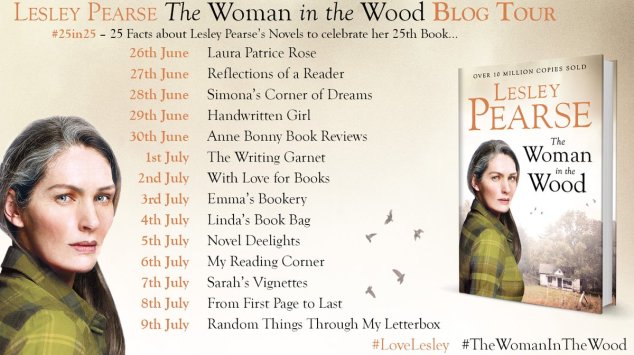
Celebrating #25in25 with Lesley Pearse, Author of The Woman in the Wood

The-Woman-in-the-Wood-002-800x1230

Having been a fan of Lesley Pearse’s writing since she began I’m delighted to be helping celebrate her 25th novel, The Woman in the Wood, with a fact from Lesley about another of her books, the twentieth, The Promise which was published in 2012.

The Woman in the Wood was published by Michael Joseph, an imprint of Penguin, on 29th June 2017 and is available for purchase here.

You’ll find all of Lesley’s books here.

The Woman in the Wood

The-Woman-in-the-Wood-002-800x1230

Fifteen-year-old twins Maisy and Duncan Mitcham have always had each other. Until the fateful day in the wood . . .

One night in 1960, the twins awake to find their father pulling their screaming mother from the house. She is to be committed to an asylum. It is, so their father insists, for her own good.

It’s not long before they, too, are removed from their London home and sent to Nightingales – a large house deep in the New Forest countryside – to be watched over by their cold-hearted grandmother, Mrs Mitcham. Though they feel abandoned and unloved, at least here they have something they never had before – freedom.

The twins are left to their own devices, to explore, find new friends and first romances. That is until the day that Duncan doesn’t come back for dinner. Nor does he return the next day. Or the one after that.

When the bodies of other young boys are discovered in the surrounding area the police appear to give up hope of finding Duncan alive. With Mrs Mitcham showing little interest in her grandson’s disappearance, it is up to Maisy to discover the truth. And she knows just where to start. The woman who lives alone in the wood about whom so many rumours abound. A woman named Grace Deville.

The Woman in the Wood is a powerful, passionate and sinister tale of a young woman’s courage, friendship and determination from one of the world’s favourite storytellers.

Fact 20 in the #25in25 celebrations with Lesley Pearse

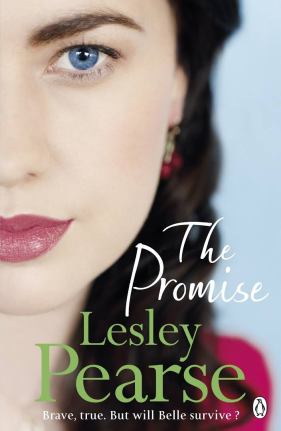
20 The Promise

Lesley tells us fact 20 about book 20, The Promise:

This is the sequel to Belle, and it finds our heroine a married, hat shop owner. WW1 breaks out and she volunteers to become an ambulance driver in France.

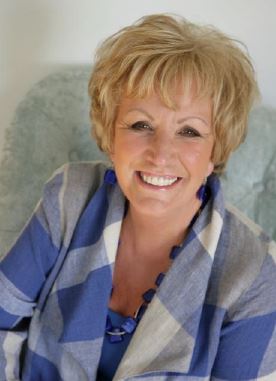
About Lesley Pearse

lesley

Lesley Pearse was told as a child that she had too much imagination for her own good. When she grew up she worked her way through many jobs – from corsetry sales in Cooks of St. Pauls (featured in Dead to Me), to bunny girl to nanny; from gift shop owner to dressmaker – finally finding her true vocation when she became a published author age 49. Since then Lesley has become an internationally bestselling author, with over 10 million copies of her books sold worldwide.

A true storyteller and a master of gripping storylines, there is no set formula for a Lesley Pearse novel although strong heroines and difficult circumstances are pervasive. Whether historical adventures such as Gypsy or Never Look Back or the passionately emotive Trust Me, Lesley is inspired by stories of courage and adversity and often gives voice to women lost in history. She is passionate about her research and her stories have taken her far and wide; from Alaska to the Crimea. Lesley now lives just outside Torquay in Devon where she loves to spend time walking on the beach with her grandchildren and dogs.

A fantastic speaker and committed and passionate fundraiser for the NSPCC, Lesley is a much sought after guest at literary lunches, library events and festivals up and down the country. Lesley was also selected as the first Ambassador for National Libraries Day in 2014.

You can follow Lesley on Twitter, and find her on Facebook.

There are more celebrations with these other bloggers too:
The Woman in the wood tour poster