The Abattoir of Dreams by Mark Tilbury

abbatoir-of-dreams

I’m delighted to be helping to celebrate the launch of The Abattoir of Dreams by Mark Tilbury.

The Abattoir of Dreams was published by Bloodhound on 28th February 2017 and is available for purchase here.

The Abattoir of Dreams

abbatoir-of-dreams

The past is never far away.

Michael Tate has not had an easy life. With his father in prison, and his mother dead, Michael was sent to Woodside Children’s Home.

Now an adult, Michael wakes up in hospital from a coma suffering from amnesia and paralysis. Confused and terrified, he is charged with the fatal stabbing of his girlfriend, Becky. He also learns he attempted to end his own life.

Detective Inspector John Carver is determined that Michael is sent to prison. With no way of defending himself, Michael is left in his hospital bed awaiting transfer to remand.

But then strange things begin to happen and his childhood comes back to haunt him.

Can Michael ever escape the past?

Will he ever discover the truth about Becky’s murder? And why is DI Carver so eager to make him suffer?

The Abattoir of Dreams is a bitter sweet story of murder, innocence and abuse.

My Review of The Abattoir of Dreams

When Michael Tate wakes in hospital without memory, he finds himself accused of his girlfriend Becky’s murder.

Let me just say, that had I not been asked to be part of the launch celebrations for The Abattoir of Dreams I would never have read it because it’s so far out of my comfort zone even the Hubble telescope wouldn’t be able to find it!

Abattoir of Dreams was so brilliantly written I could hardly bear to read it. Covering terrible themes of sexual, physical, emotional and verbal abuse The Abattoir of Dreams makes for very uncomfortable and sometimes disturbing reading. Having worked in education and inspected child protection, I know just how realistic the scenarios Mark Tilbury presents really are, despite their truly horrific nature. So, regardless of not wanting to read on, I found I couldn’t tear myself away as Mikey’s memories gradually began to reappear.

If you’re easily offended by bad language and disquieting themes then perhaps this isn’t the read for you, but The Abattoir of Dreams was written so effectively and realistically that I found these elements added to the atmosphere and never felt gratuitous. I believe not reading The Abattoir of Dreams would have left me a poorer individual. There’s quite considerable violence too that I found far more affecting than any film I might watch. At times my heart rate was elevated as I read, especially in the denouement which is, ironically, one of the less graphic parts of the story.

The characterisation is so effective. As the layers are peeled back and we find out what happened to put Mikey in hospital, we also understand his background as a child and how he has developed into the young man he is. There are villains aplenty who are startlingly depicted, but it is the victims, like Liam, who impact most on the reader. In fact, one of the characters that appealed to me most was the dog, Oxo.

However, despite the gritty, disturbing and frequently horrifying aspects of Abattoir of Dreams, it is not entirely bleak and unremitting. There is real love and friendship exemplified and the supernatural element gives us all hope too.

I can’t say I enjoyed reading The Abattoir of Dreams because it disturbed me, but it’s a book I won’t forget in a hurry as it engendered a range of emotions in me from rage to horror, sadness to hope and pity to murderous thoughts. I thought it was brilliant.

About Mark Tilbury

mark-tilbury

Mark lives in a small village in the lovely county of Cumbria, although his books are set in Oxfordshire where he was born and raised.

After serving in the Royal Navy and raising his two daughters after being widowed, Mark finally took the plunge and self-published two books on Amazon, The Revelation Room and The Eyes of the Accused.

When he’s not writing, Mark can be found trying and failing to master blues guitar, and taking walks around the beautiful county of Cumbria.

You can follow Mark on Twitter, visit his website and find him on Facebook.

There’s more with these other bloggers too:

tour-poster

The Stranger In My Home by Adele Parks

the-stranger-in-my-home

My enormous thanks to Georgina Moore for a copy of The Stranger In My Home by Adele Parks in return for an honest review.

Published by Headline Review The Stranger In My Home is available for purchase here.

The Stranger In My Home

the-stranger-in-my-home

Alison is lucky and she knows it. She has the life she always craved, including a happy home with Jeff and their brilliant, vivacious teenage daughter, Katherine – the absolute centre of Alison’s world.

Then a knock at the door ends life as they know it.

Fifteen years ago, someone else took Alison’s baby from the hospital. And now Alison is facing the unthinkable.

The daughter she brought home doesn’t belong to her.

When you have everything you dreamed of, there is everything to lose.

My Review of The Stranger In My Home

When Tom arrives on Jeff and Alison’s doorstep with the announcement that their daughter Katherine isn’t really their child, but his, the fallout reverberates far and wide.

Ooo. I so enjoyed The Stranger In My Home. Adele Parks has the ability to get right inside a character’s psyche and present them in fabulous detail. In this case it is Alison who is so distinct and well presented. I absolutely loathed her to begin with as she is such a controlling person, but as the narrative progressed and her frailties and background were uncovered she began to gain my sympathy and my empathy until I could fully understand her. By the end of The Stranger In My Home I was very firmly on her side. The first person aspect convinced me completely that I was almost inside Alison’s head listening to her thoughts rather than reading about her. The extra touch of the third person background added layers to Alison’s personality that helped to understand her further. I thought she was fantastically well portrayed.

All the other characters are also realistic creations so that this is a story about actual people to the reader and not fabrications in a book. I loved the title too. The Stranger In My Home could really be applied to anyone crossing the threshold into Alison and Jeff’s home as people are revealed to the reader. Even Alison is a stranger in her own home as dynamics shift and fluctuate.

I can’t say too much about the plot, as that would spoil the read, but I will say that my heart was thumping towards the end and not all of the plot was what I was expecting! The themes of identity and what actually constitutes parenthood are explored in a highly intelligent manner with writing that is such a joy to read. Adele Parks knows exactly how to tip a perspective with small phrase after more lengthy passages so that the reader experiences not only Alison’s emotions, but has shocks and discoveries of their own. I found myself exclaiming aloud at the perceptions of humanity at times.

If you want a narrative that is compelling, absorbing, intelligently written and entertaining on all levels, then look no further than Adele Parks’ The Stranger In My Home. It’s a corker!

About Adele Parks

adele-parks

Adele Parks worked in advertising until she published her first novel, Playing Away, in 2000, which was the debut bestseller of that year. All of Adele’s novels have been top ten bestsellers and her work has been translated into twenty-five different languages.

Adele has spent her adult life in Italy, Botswana and London until 2005 when she moved to Guildford, where she now lives with her husband and son.

Adele believes reading is a basic human right, so she works closely with the Reading Agency as an Ambassador of the Six Book Challenge, a programme designed to encourage adult literacy. In 2011 she was a judge for the Costa Book Awards.

You can follow Adele on Twitter, visit her website and find her on Facebook.

An Extract from In the Name of the Family Sarah Dunant

cover-2

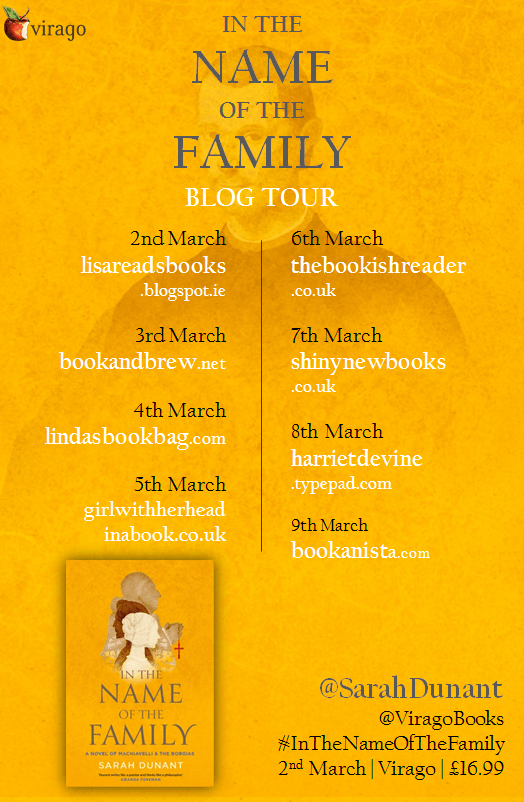
Having studied Machiavelli in my university days I so wish I’d had time to read In the Name of the Family by Sarah Dunant ready for these launch celebrations. However, as a treat for us all I do have an extract from In the Name of the Family to share with you today.

Published by Virago, In the Name of the Family is available for purchase here.

In the Name of the Family
cover-2

In the Name of the Family – as Blood and Beauty did before – holds up a mirror to a turbulent moment of history, sweeping aside the myths to bring alive the real Borgia family; complicated, brutal, passionate and glorious. Here is a thrilling exploration of the House of Borgia’s doomed years, in the company of a young diplomat named Niccolo Machiavelli.

It is 1502 and Rodrigo Borgia, a self-confessed womaniser and master of political corruption is now on the Papal throne as Alexander VI. His daughter Lucrezia, aged twenty-two, already thrice married and a pawn in her father’s plans, is discovering her own power. And then there is Cesare Borgia: brilliant, ruthless and increasingly unstable; it is his relationship with the diplomat Machiavelli which offers a master class on the dark arts of power and politics. What Machiavelli learns will go on to inform his great work of modern politics, The Prince.

But while the pope rails against old age and his son’s increasing maverick behavior it is Lucrezia who will become the Borgia survivor: taking on her enemies and creating her own place in history.

Conjuring up the past in all its complexity, horror and pleasures, In The Name of the Family confirms Sarah Dunant’s place as the leading novelist of the Renaissance and one of the most acclaimed historical fiction writers of our age.

An Extract from In The Name of the Family

PROLOGUE

Florence, January 1502

You couldn’t call him tall; he was barely an inch bigger than her, and wiry in stature. His soot-black hair was cut unfashionably close to his head and his face, broad at the eyes, tapered via a thin nose to a sharp clean-shaven chin. The word weasel had come to mind when they first met. But strangely it hadn’t put her off. Marietta Corsini had known already that her future husband was clever (he had a job in government, and everyone knew men like that needed a wheelbarrow to carry their thoughts), and within a few minutes he had made her laugh. He had also made her blush, for there had been something in his bright-eyed concentration, his almost animal quiver energy, that seemed to be half undressing her. By the time they had said their goodbyes she was smitten, and six months of marriage has done nothing to change that.

He leaves for work each day at dawn. In the beginning she had hoped that her nest-ripe body might tempt him to linger a while. Florence is rife with stories of married men who use early risings as excuses to visit their mistresses, and he had come with a reputation for enjoying life. But even if that were the case, there’s nothing she can do about it, not least because wherever he is going, this husband of hers has already ‘gone’ from her long before he gets out of the door.

In fact, Niccolò Machiavelli doesn’t leave the warmth of his marriage bed for any other woman (he can do that easily enough on his way home), but because the day’s dispatches arrive at the Palazzo della Signoria early and it is his greatest pleasure as well as his duty to be among the first to read them.

His journey takes him down Via Guicciardini on the south side of the city and across the river Arno via the Ponte Vecchio. A maverick winter snowfall has turned into a grimy frost and the ground cracks like small animal bones under his feet. On the bridge fresh carcasses are being unloaded into the butchers’ shops. Through the open shutters he catches glimpses of the river, its surface a silvery apricot under the rising sun. A feral dog streaks across his path, going for a gobbet of offal near the wheel of a cart. It earns him a kick in the ribs for his daring but his jaws remain firmly clenched over the prize. Scavenging opportunist, Niccolò thinks, not without a certain admiration. Stick a feathered hat on him and give him a sword and you’ve got half the country. How long ago was that business in the city of Fermo? Christmas, yes? He’d opened the dispatch himself: the Duke’s ‘loving’ nephew had invited his uncle to a seasonal dinner, then locked the doors and slaughtered him and his entire council, taking the title for himself. In the chancery, his staff was laying bets on how long till the next murderous dinner invitation, but Niccolò’s money is on the usurper. While the man may be a thug, he’s also a mercenary leader in Cesare Borgia’s army, which makes him a thug with powerful allies.

Across the bridge, he passes by the side of San Pier Scheraggio church, out into the open space of the Piazza della Signoria, dominated by the handsome crenellated palace of government. To the left of the main doors is a weathered bronze statue; the figure of Judith, calm, concentrated, a raised sword in her right hand poised to slice through the neck of Holofernes, who sits painfully twisted at her feet. Niccolò gives her a silent salute. He knows men in government who find it unnerving to be greeted daily by the sight of a woman administering justice to a man, but they are missing the point. Donatello’s statue, plundered from the Medici palace and placed here eight years before, stands as a deliberate reminder to the republic of Florence that she would never again allow the dictatorship of a single family.

Alas, the gap between the ideal and reality in politics is enough to give most men vertigo. If Judith were to lift up her eyes now, she would be looking at the place in the piazza where they had burned the Dominican friar Savonarola, whose fanatical devotion to God’s laws had made him another kind of tyrant. Every time Niccolò passes a tavern where some idiot cook has burned a carcass on a spit, the sick-sweet smell of caramelised fat and flesh has him back inside the crowd, straining to see the stake over the shoulders of bigger men. He had never witnessed a public burning before—Florence has little fondness for such barbarity—and Savonarola had been garroted before the faggots were lit to stop his cries. The crowd too had been eerily silent. He’d forced himself to stay to the bitter end, watching the soldiers gather up every scrap of bone and ash and throw it into the river so nothing was left as a relic.

He’d known then that Florence had a challenge ahead of her, re-establishing a working republic after so much madness. And if he is confident in public – for that is his job – in private he has grave doubts.

He slips into the palazzo through a side entrance, exchanging a joke with a sleepy guard, before climbing a spiral staircase that takes him through the great central hall, up a further flight into the council rooms and offices above. His desk is in a small antechamber set off from the main salon, with its gilded wooden ceiling and patterned fleur-de-lis walls. The temperature is almost as cold inside as out. When the elected members gather there will be braziers and fires lit, but as a hired hand he has his own clay bottle and must send out for regular refills to stop his feet from turning to ice. He will do it later: once the seals on the day’s dispatches are broken he won’t feel the cold.

It is Niccolò’s business, as head of the second chancery and secretary to the Council of Ten for Liberty and Peace, to keep abreast of every shift and change in the political landscape of the country. For as long as he can remember, such things have fascinated him. He was barely thirteen years old when his father had placed a newly printed copy of Livy’s History of Rome in front of him, and like every first great love affair, it has coloured the way he sees the world ever since.

‘This is the most treasured possession this house now holds, you hear me?’ Such dry humour his father practised. ‘In a fire you had better look to yourself, for this will be the man I save first.’

He wonders sometimes what the great Livy would make of this modern Italy. In his own mind he sees the peninsula as a great ragged boot hanging off the Alps, the leather mottled and discoloured by the vicissitudes of history. In the north, for the second time in a decade, a French army is in occupation, ruling Milan and overshadowing a dozen smaller states close by. On the Adriatic coast, Venice is puffed up with her own wealth and battles with the Turks, while the wild lands of the south are under the control of the Spanish, with a few old French strongholds inside.

But it is what is happening in the middle that would have surely fascinated Livy the most.

The speed and ferocity of the rise of the Borgia family have taken everyone by surprise. Of course Rome has had unscrupulous popes before, men who quietly favoured the fortunes of their ‘nephews’ or ‘nieces’. But this, this is different. Here is a Pope, Alexander VI, who openly acknowledges and uses his illegitimate children as weapons to create a new dynastic power block; his eldest son Cesare, once a cardinal, marches at the head of a mercenary army conquering a line of city-states historically owned by the Church, while his daughter, Lucrezia, is the family’s prize marriage pawn.

Two of the day’s dispatches bring further news of the Borgia project. Lucrezia is now halfway across Italy with an entourage the size of a small army, en route to her third husband, the Duke elect of Ferrara. Meanwhile, the Pope and his son, on a lap of honour to celebrate their latest conquests, the state of Piombino and the island of Elba, are making an early departure by boat back to Rome. How long till they arrive? If the wind obliges, the water will carry them faster than any road in winter, though it’s not a journey that he himself would choose to make. At least the rest of Tuscany will breathe easily for a while; a soldier at sea cannot be a duke leading an army on land.

He is filleting the dispatches ready for the council morning briefing when he hears the sounds of the great bells from the Cathedral of Santa Maria del Fiore marking the starting hour of the day. His thoughts move briefly to the cathedral workshop where the Florentine sculptor Michelangelo has spent the last nine months chiselling into a block of flawed marble, commissioned by the state to produce a great statue of David to be placed on the façade of the cathedral. No one has been allowed near the work, but the leaked gossip talks more of its emerging size than its beauty. It remains to be seen whether it will be powerful enough to shield the city from the Borgia Goliath.

As the last chimes die away, a series of contorted male shrieks rise up from somewhere nearby; a late coupling between the sheets or a few early knife thrusts into a belly? He smiles. Such are the sounds of his beloved city, the sounds indeed of the whole of Italy.

About Sarah Dunant

sarah-dunant

Sarah Dunant is the author of the international bestseller The Birth of Venus, which has received major worldwide acclaim and In the Company of the Courtesan. With the publication of Sacred Hearts, she rounds out a Renaissance trilogy bringing voice to the lives of three different women in three different historical contexts.

Sarah Dunant has two daughters, and lives in London and Florence.

You can follow Sarah on Twitter, visit her website and find her on Facebook.

There’s more with these other bloggers too:
itnotf-blog-tour-banner

The Song of the Stork by Stephan Collishaw

song-of-the-stork

Some books are special and, as The Song of the Stork by Stephan Collishaw is one such book, I’m thrilled to be sharing my review as part of its launch celebrations. The Song of the Stork was published on 1st March 2017 by Legend Press and is available for purchase here.

The Song of the Stork

song-of-the-stork

Fifteen-year-old Yael is on the run. The Jewish girl seeks shelter from the Germans on the farm of the village outcast. Aleksei is mute and solitary, but as the brutal winter advances, he reluctantly takes her in and a delicate relationship develops.

As her feelings towards Aleksei change, the war intrudes and Yael is forced to join a Jewish partisan group fighting in the woods.

Torn apart and fighting for her life, The Song of the Stork is Yael’s story of love, hope and survival. It is the story of one woman finding a voice as the voices around her are extinguished.

My Review of The Song of the Stork

On the run from the Germans, Jewish Yael can’t begin to know what else life can throw at her.

I’m not sure I know where to begin to review The Song of the Stork. It’s a relatively short book with quite a bit of white space to its pages and yet it took me a couple of days to read because I wanted to savour every word and nuance. Equally, the intensity of the story is so overwhelming I needed to come up for air as I found I was holding my breath as I read and wondered what reverberating emotion would hit me next. The Song of the Stork is an outstanding read.

What struck me most was the quality of the language. It is simple and often quite matter of fact in the telling of the story, but that is such a finely tuned counterpoint to the horrors that Yael has witnessed that it stunned me as I read. This pared down style weaves a magical spell on the reader.

The metaphor of the stork is incredibly well handled. It’s impossible to explain without spoiling the read, but the name, the symbolism, the practicalities of a stork’s song all serve to bind this almost claustrophobic read into a unity that is almost overwhelming. I loved the literature and poetry behind the narrative too. I couldn’t understand the Hebrew and Yiddish words, but that didn’t affect my enjoyment at all. Indeed, they added to the sense of bewilderment of a world in melt down and gave me the sense of otherness that Jewish Yael and mute Aleksei must have felt in this Second World War setting.

The characterisation is beautiful. The relationship between Aleksei and Yael is depicted with a delicay of touch so that there is a real sense of calm and beauty as well as intensity. It felt almost voyeuristic to read about them at times.

The Song of the Stork is a terrifying portrait of what humanity has been and what we might still become. It should be depressing and yet it is like a beacon of hope in a dysfunctional world. I think that, in a world of noise, The Song of the Stork is quiet perfection. I truly loved it.

About Stephan Collishaw

stephan-collishaw-cafe

Stephan Collishaw was brought up on a Nottingham council estate and failed all of his O’levels. His first novel The Last Girl (2003) was chosen by the Independent on Sunday as one of its Novels of the Year. In 2004 Stephan was selected as one of the British Council’s 20 best young British novelists. His brother is the renowned artist, Mat Collishaw. After a 10-year writing hiatus, The Song of the Stork is Stephan’s highly anticipated third novel. Stephan now works as a teacher in Nottingham, having also lived and worked abroad in Lithuania and Mallorca, where his son Lukas was born.

You can follow Stephan on Twitter. There’s more with these other bloggers too:

the-song-of-the-stork-blog-tour-banner

An Extract from Viper’s Blood by David Gilman

cover

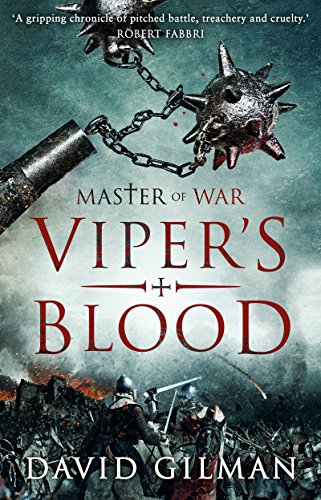
I’m thrilled to be hosting an exciting extract from Viper’s Blood by David Gilman today. Viper’s Blood is part of the Master of War series and is published by Head of Zeus. Viper’s Blood is available for purchase here.

Viper’s Blood

cover

Edward III has invaded France at the head of the greatest host England has ever assembled. But his attempt to win the French crown is futile. The Dauphin will no longer meet the English in the field and the great army is mired in costly sieges, scavenging supplies from a land ruined by decades of conflict.

Facing a stalemate – or worse – the English are forced to agree a treaty. But peace comes at a price. The French request that Blackstone escort their King’s daughter to Italy to see her married to one of the two brothers who rule Milan – the same brothers who killed Blackstone’s family to revenge the defeats he inflicted on them. Blackstone, the French are certain, will never leave Milan alive…

An Extract From Viper’s Blood

CHAPTER ONE

Thomas Blackstone spat blood.

The axe-wielding Frenchman’s blow missed his open helm but the fist clutching the axe slammed into his face. Blackstone’s height and strength carried him past the assault into the hacking mêlée as John Jacob, a pace behind, rammed his blade beneath the man’s armpit. The snarling roar of close-quarter battle mingled with the screams of mutilated men. Blood and entrails squelched underfoot as the city’s defenders fell beneath English violence. Step by step Blackstone and his men fought their way through the defensive ditches that had been dug around the city of Rheims. The walls were higher than heaven. Men died in their shadow, cast down into bloodstained mud. Some who fought cursed the cold and the rain, and some the King of England, who had brought his host often thousand men to this place of death. Sweat stung Blackstone’s eyes as he carved a path towards the Prince of Wales, the man he was sworn to protect and who was in the vanguard of the battle.Two of Blackstone’s captains, Gaillard and Meulon, huge bears of men who matched Blackstone’s size and strength, flanked the Englishman they had served these past fourteen years. Their spears thrust into the terrified French, some of whom were city militia who had never experienced the surging terror that now befell them.

Blackstone saw the Prince wheel, his shield slamming down a French knight. The man raised his visor and cried out, but his voice was swept away in the bellowing cacophony. His gesture was one of surrender. The Prince hesitated, but the weight of men around him forced him across the fallen man as Meulon leaned forward and pushed his spear into the man’s face. The Frenchman’s hands desperately snatched at the steel; his body bucked. Meulon wrenched the blade free; the man was already dead. Blackstone trod on his chest, unconcerned at the spume of blood that splattered his legs. He reached the Prince who, despite being flanked by his retinue, cleaved a path towards the city gates. For the past thirty-three days of the siege no one had expected such resistance from the walled city’s defenders; no one had believed that the winter rain could be so persistent; and only Blackstone believed that King Edward III in his pursuit of the French crown had made a foolish mistake in trying to take the city whose guardian, the nobleman Gaucher de Châtillon, had fortified the walls, blocked the drawbridges and dug defensive ditches. Ditches that Blackstone and his men had fought through for the past two days, and whose quagmire sucked men’s legs and sapped strength. Two days of half-starved fighting so that the English King could seize the city that traditionally crowned every King of France. New Year had passed but Edward wanted that crown.

‘My Prince!’ Blackstone yelled as the King’s son slipped. He leapt forward, slamming his shield into mail-clad foot soldiers, forcing himself between fighters who had poured from the city gates wild with fear and determination to stop the vile English horde from advancing and thinking that they might seize Edward’s son. The sight of the Prince falling to his knees gave them renewed courage but then they saw the shield bearing Blackstone’s blazon: the mailed fist clasping the sword blade. Its cruciform and declaration, Défiant à la mort, heralded death and made them falter. To stand against the renowned Englishman whose very name was enough to make men surrender before his violence was unleashed was an invitation few would accept. But the weight of those behind pushed them forward. Frenzy ruled the day; blood-lust defeated fear. They fell on Blackstone. His shield took the blows of mace and sword as he half bent his body, turning their blows away and thrusting with killing jabs of Wolf Sword’s hardened steel. As he spun around he caught sight of the Prince of Wales vomiting. He spewed across his own men and those who lay dead and dying at his feet. A banner dipped as willing hands reached for him. Rich food and plenty of it! Blackstone thought derisively. A king’s table groaning with succulent cuts and rich sauces. A sight he and his men would never see, let alone share. Most of the troops were starving. Man and horse had been deprived of supplies as the French burned food stores ahead of the English advance and the flooded rivers ran with waste, poisoned by slaughtered carcasses. Deny the English invaders supplies and they will be defeated had been the Dauphin’s command. A worthless son of a worthless French King in a worthless land in a worthless war. For Christ’s sake! What were they dying for in this country? In this ditch?

Blackstone backhanded Wolf Sword’s pommel into a Frenchman’s face contorted with hatred and purpose; then he rammed the rim of his shield beneath the chin of another. He shifted his weight, allowed a strike against him, saw the man stumble past, left him to die beneath John Jacob’s sword and then surrendered to the blood haze that filled his mind and softened the roar of the battle. He was cocooned in the place he knew well. Now the killing rage was with him again; his instinct to kill and maim enveloped him like a rising tide and swept him along, a warring demon blessed by the angels. Beneath the rolling clouds that brought the swirling curtains of rain, a darker storm swept across the battlements. English archers laid a deluge of arrows onto the city walls. Blackstone saw the bowmen in his mind’s eye, felt their effort in his heart. Nock, draw, loose! Sheaves of arrows carried by pages and anyone else ordered to feed the greatest weapon in the King’s army would be borne relentlessly to the thousands of archers. Will Longdon would be in the sawtooth line with his men, Jack Halfpenny, Robert Thurgood: men who had fought and suffered with Thomas Blackstone. All of them had swept across France during the years of war, back and forth to Italy where Blackstone and his men defended the road to Florence until finally returning to France a year before last. It was there an Italian assassin had ripped away Blackstone’s heart by slaying his wife and child.

About David Gilman

author

David Gilman enjoyed many careers, including firefighter, soldier and photographer before turning to writing full time. He is an award winning author and screenwriter.

You can follow David on Twitter, find him on Facebook and visit his website.

There’s more with these other bloggers:

vipers-blood

Cover Reveal: The Third Note by Virginia King

the-third-note-cover-final-art-01

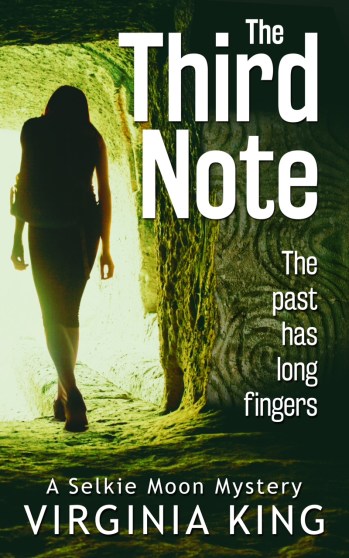
I’m very excited to be revealing the latest book from Virginia King in her Selkie Moon series, The Third Note, which follows The First Lie and The Second Path. Virginia has previously featured on Linda’s Book Bag with a wonderful guest post on Putting the Myth into Mystery which you can read here along with my review of The First Lie (although the competitions attached to that post are now closed).

laying-ghosts

I have also reviewed the short story prequel to the Selkie Moon series, Laying Ghosts, and you can read that review here. You can get a taste of the Selkie Moon mystery series with your free copy of Laying Ghosts – and be notified of the special launch price of The Third Note when it’s published at the end of March by clicking here.

The Third Note

the-third-note-cover-final-art-01

A mysterious parcel. An unsolved crime. A spell from beyond the grave.

After returning from her last strange quest, Selkie Moon is more than ready to settle down. So when she receives a parcel from her great grandmother 35 years after her death, opening it seems like such a bad idea. But curiosity wins and the objects it contains plunge her into long-buried family secrets. Suddenly an old mystery begins to echo with the present and Selkie is wrapped in a spell that won’t let go: frightening visions, deadly encounters and a pull from the past that she can’t ignore. Armed with only her wits and psychic twinges that are hardly reliable, Selkie is drawn into a web of cryptic clues that delve deep into the folklore of Ireland where superstition still weaves a powerful – and fatal – spell.

If you love mysteries with lightning pace, twists and turns you never see coming, quirky clues and a sprinkling of the supernatural, then you’ll love The Third Note.

Who is Selkie Moon?

Selkie Moon is a modern woman with a mythical name. One of her dead mother’s extraordinary ideas. The selkies are the seal people of Celtic folklore who peel of their skins and dance in the moonlight in human form. With a name like that, Selkie can’t help getting tangled in mysteries that spring from the haunting elements of mythology from around the world.

About Virginia King

Virginia King Author Portrait Small

When a voice wakes you up in the middle of the night and tells you to write a mystery series, what’s a writer to do? That’s how Virginia King came to create Selkie Moon, after a massage from a woman with gifted hands was followed by this nocturnal message. Virginia sat down at the keyboard and waited until Selkie Moon turned up. Soon she was hooked, exploring far-flung places full of secrets where Selkie delves into psychological clues tangled up in the local mythology.

Before Selkie Moon invaded her life, Virginia had been a teacher, an unemployed ex-teacher, the author of over 50 children’s books, an audio-book producer, a workshop presenter and a prize-winning publisher. These days she lives in the Blue Mountains west of Sydney with her husband, where she disappears each day into Selkie Moon’s latest mystery. Bliss.

You can find out more about Selkie Moon and Virginia via Virginia’s website, on Facebook and by following Virginia on Twitter. You’ll also find buy links for all Virginia’s books here.

Choices, A Guest Post by Roy L. Pickering, Author of Matters of Convenience

matters-of-convenience

It give me great pleasure to welcome Roy L. Pickering, author of Matters of Convenience, to Linda’s Book Bag today. We were discussing the concept of chance and choice and Roy has kindly agreed to write a guest post on that very topic as it is explored in Matters of Convenience.

Matters of Convenience is available for purchase in e-book and paperback here.

Matters of Convenience

matters-of-convenience

Marshall yearns for Audrey but she sees a future with James. When her personal and professional plans veer off course, their relationships are shuffled.

Can it work out with Marshall after he provides support at a critical juncture?

Or is it doomed to fail when paths cross with James, secrets are revealed, and commitments are put to the test?

Matters of Convenience examines the repercussions of unpredictable timing and rash solutions, asking if happiness results from choice, fate or serendipity.

Choices

A Guest Post by Roy L. Pickering

Pondering alternative translations of personal outcomes guided me in the writing of Matters of Convenience. My novel is a layering of love stories, each of them with an embedded flaw. Rather than creating characters who are meant to be together and concocting obstacles to keep them apart until the final chapter, I present intertwining forks in their roads. James and Audrey look perfect together “on paper”, but can perfection be indefinitely maintained? Marshall believes Audrey is the woman who is meant for him, but how far is he willing to go, how much bruising can a man’s ego take? Can a rebound love truly replace its predecessor? Is outwaiting someone’s inconvenient love of another worth the toll that it takes? Or does the steadfast patience required by the waiting game add sweetness to the eventual reward?

My goal was not to write the same story for every person, but rather, to tell one from which each reader will find different takeaways. My favorite works of literature are those that cause people to pick one side or another based on the humanity they brought with them into the experience. Question. Do you wince at the cruelty of Shel Silverstein’s The Giving Tree?  Or do you see the satisfaction of sacrifice, recognize the willing embrace of what seems like abuse from the outside because only interior needs matter? Your answer will be revealing, not that there is a right or wrong conclusion to reach. Happiness may be a drug but so too is misery, both of which can be equally addicting. Happiness seems the better way to go. But what if you believe the only way to the pinnacle of joy is through the eye of the storm of misery? Whether you take the easy road or the hard one, neither is paved with guarantees.

Even if you subscribe to fate/destiny/karma, you understand that there are choices to make on the way to where you’re meant to be. Among the incentives we base decisions on are selfishness, cowardice, familiarity, what is least challenging, or what is most useful to us. In storybook romances, love conquers all and that’s all there is to it. That’s why they were invented. They are immune to the harsh dictates of reality. I leave the writing of such fables to others. Yet I am very much a believer in the imperativeness of love, whether resulting naturally from selection or preordained. It’s why I read, why I write, why I live and how I live.

About Roy L. Pickering

roy

Roy Pickering was born on the idyllic island of St. Thomas and currently resides in New Jersey with his wife and daughter.

Roy is currently working on a series of children’s books being illustrated by his wife. Googling Roy’s name will bring up his web site which features a diverse sampling of his prose along with his blog, A Line A Day. His sports editorial writing can be found numerous places online as well.

You can follow Roy on Twitter. You’ll also find him on Facebook and can visit his website.