A Mini-Interview with Decima Blake, author of Hingston’s Box

hingstons-box

Having been an Engish teacher in a former life and an inspector very often responsible for inspecting child protection, I was fascinated to discover Decima Blake, debut author of Hingston’s Box, was positively influenced by her English Literature teachers at school. When I realised too that Decima is donating part of the royalties of Hingston’s Box to a charity supporting child victims of crime I had to invite her on to Linda’s Book Bag to find out more.

Hingston’s Box was published by Pegasus Publishers on 29th September 2016 and is available for purchase in paperback from Amazon and directly from the publisher.

Hingston’s Box

hingstonsbox-multi

Since investigating the disappearance of fifteen-year-old twin boys, Hingston – a young, talented Detective Sergeant, has been tormented by night terrors. On waking, he remembers a vast, golden meadow that glows with warmth and carries the sound of rapid footfalls and trouser legs pushing through grasses. A curly haired boy runs tirelessly through the meadow. The promise of adventure is lost when the sickening ache of death seeps into Hingston’s bones. Feeling suffocated and tortured, melodic chimes calm him and his panic subsides.

Signed off and leaving the office, a key inexplicably falls from Hingston’s investigation file. Intrigued, he takes it with him, escaping London for Dartmouth where his investigative race begins. Stalked by a challenging elderly woman and hindered by his boss, his determination to solve the case draws him into the supernatural world that connects a murderous past to the present.

A Mini-Interview with Decima Blake

Decima, what are your views on the importance of literature in children’s lives?

I very much like the quote by author George R.R. Martin: “A reader lives a thousand lives before he dies. The man who never reads lives only one.” I believe this sums up the importance of literature in children’s lives. The more literature children and teenagers can read, the more equipped they may be when tackling issues in their own lives as young adults. In the same respect, books can equally serve as an invaluable insight for adults into the lives of today’s young people and the unique challenges they face.

When I think back to the literature I studied at secondary school, I relive the swathe of disappointment that passed over me whenever the title was not to my liking. I remember the dog-eared books and play scripts; the immaculately inscribed annotations contained therein and in contrast, the sporadic distractions penned by others in the margins.

On reflection, I’m pleased I studied Shakespeare’s Julius Caesar instead of Romeo and Juliet. I’ve found its exposure of political shenanigans more educational than I had appreciated aged thirteen. And despite the quality of the copy (which mattered a lot at that age), all of the texts I studied over those seven years actually delivered something positive to me: they broadened and altered my perspectives on life.

I absolutely loved A Level English Literature. Whilst I studied texts that were not always my first choice, each of them introduced me to new issues, points of view and social dilemmas. Collectively, they taught me about people in depths I could not have learnt from history books, documentaries and films alone. Most importantly for my crime writing, I learnt how to analyse themes, plots and subplots, and how to investigate characters. I applied these techniques in reverse whilst writing Hingston’s Box.

What books did you enjoy as a teenager?

Some of the most memorable books I enjoyed were Captain Corelli’s Mandolin by Louis de Bernières, Catch 22 by Joseph Heller, The Turn of the Screw by Henry James and A Walk in the Woods by Bill Bryson.

How were you inspired by your teachers?

My teachers were motivational and passionate about English Literature. They set a high standard and taught us well by giving their time, providing written and verbal constructive criticism and encouraging the students to help each other. We had some fantastic in depth discussions and debates in the classroom, particularly about William Blake’s Songs of Innocence and Experience, and World War 1 poetry and literature. The most important skill I learnt was that of comparison and analysis, in particular of themes and characters. It was this that inspired me to weave different themes and ideas throughout Hingston’s Box that I hope can be debated and analysed by readers.

Why did you include a focus on child exploitation in your novel Hingston’s Box?

Working with eleven to sixteen-year-olds in a secondary school made me realise how vulnerable young people are and how quickly things can go wrong. We have seen through the media, particularly over the past four years, how many young people’s lives have been changed or lost due to crime, exploitation, drugs or abuse. I’m passionate about child victims of crime and therefore put them at the centre of my novel.

Hingston’s Box raises awareness of all children’s vulnerability to exploitation. I’ve aimed to illustrate by comparison of a Victorian crime with the present, how easily children are targeted by those who intend to cause them harm and that the motives for and the methods of exploitation don’t really change.

A percentage of royalties from the sale of Hingston’s Box will be donated to the charity Embrace Child Victims of Crime. For information about the important support they deliver, please click here.

About Decima Blake

decimablake

Decima Blake, has a long-standing interest in child protection having worked with teenagers, she is deeply passionate about child victims of crime. In writing Hingston’s Box, Decima drew on her love of classic English murder mysteries and ghost stories. Her interest in English Literature was ignited by two highly motivational teachers who made her A Level studies enjoyable, character forming and invaluable to her future endeavours.
Hingston’s Box raises awareness of the vulnerability of all children to exploitation. A percentage of royalties will be donated to the charity Embrace Child Victims of Crime.

You can follow Decima on Twitter.
Coming of Age, a Guest Post by Barbara Lorna Hudson, author of Timed Out

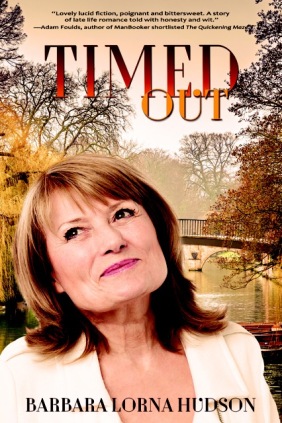
cover-to

As an aspiring writer of a particular age, I’m delighted to be featuring Barbara Lorna Hudson whose novel Timed Out was published by Driven Press on 16th April 2016. Barbara has written a lovely guest post for Linda’s Book Bag all about the fact that coming of age is not chronologically time bound so maybe there’s time for my own novel yet!

Timed Out is available for purchase in e-book and paperback by following the links here.

Timed Out

cover-to

Jane Lambert thinks she may have made a mistake putting her work ahead of love and family for so long. She’s left wondering what to do with her life now that she has retired.

Taking note of the sentiment from one of her retirement cards-Retirement is NOT the end. It’s a new beginning – she decides it’s about time she looked for love again, and places a lonely hearts advertisement. Jane embarks on her new life, suffering disappointments and learning hard truths about herself, while never losing her gift for self mockery or her eye for the absurd.

Timed Out is a contemporary “coming-of-age” novel about different kinds of love and the search for a meaningful life.

Coming of Age – At Any Age

A Guest Post by Barbara Lorna Hudson

“Perhaps that sums it up – this story to date, that is. The mistakes, the missed clues, the silly pride, and all the self-pity. And finding love in unexpected places.” (Timed Out)

Timed Out, published in my seventies, is a ‘coming of age’ story in two senses. My character Jane Lambert is sixty when the novel opens and over seventy when it ends. The title refers both to Jane’s use of a computer to seek a partner, and to her fear of running out of time to sort out her life.

In English, the expression ‘coming of age’ has taken over from ‘Bildungsroman’ to describe a novel recounting the spiritual or emotional development of its protagonist. Usually the character is a child or young person at the start and a young adult at the end (e.g. Great Expectations, The Adventures of Huckleberry Finn), and has learned and changed a lot along the way. Jane learns a great deal about herself and other people in the course of her journey through her retirement years. She discovers painful truths, but new pathways to happiness as well. Perhaps not all of us are able to do this after we reach sixty – or fifty – or forty, even – but I am sure that many can. ’Coming of age’ is not just for the young.

Not only did the fictional Jane Lambert experience a late-life coming of age. So too did her author. Like many another first novel, Timed Out had its origins in memoir or autobiography. No sooner had I unwrapped my presents and eaten and drunk my way through several retirement parties than I found myself wondering ‘Now, what is the point of me?’ I was single, lonely, and still healthy. Time to take stock and time to decide how best to use the years that remained. I wondered again about the Big Questions and about what I could do to make myself feel worthwhile again.

Jane and I both did Internet dating, with rather different results – and both got some happiness and some heartache from it.

Jane continued to be a wobbly agnostic, experiencing ‘religious moments’, re-examining the arguments against the existence of God. A number of older people have told me that these issues, ignored while they were focused on family and career, re-emerged when they ‘had time to think’ upon retiring. (This strand in Jane’s story is not something I myself lived through in my sixties, rather it reflects my experience as a much younger woman).

Timed Out recounts Jane’s struggles to find what she seeks and I will not reveal the outcome and what she learns. Suffice it to say that she is a different woman by the end of the novel.

As for me? I gradually reinvented myself as a writer of fiction. In the course of my re-education, I learned a lot more about myself both as a writer and as a person. And in the months since this novel was published, I have learned a lot more: that the best thing – the thing that makes me happiest – is finding that my Jane’s story has resonated with someone or given them pleasure. And I have learned some humility too – now, when I study the authors I most admire, I can better appreciate the effort and the genius needed for their kind of writing. I know now how hard it is. And how worthwhile.

That’s my own ‘coming of age.’ So far. Maybe there will be more.

(I’m sure there will Barbara. Thanks so much for such an inspiring piece.)

About Barbara Lorna Hudson

barbara

A farmer’s daughter from Cornwall, Barbara Lorna Hudson studied at Newnham College, Cambridge. She started out as a psychiatric social worker before becoming an Oxford tutor. She is an Emeritus Fellow of Green Templeton College, Oxford After many publications in social work, psychiatry, and psychology, she has re-invented herself as a fiction writer over the last few years. Barbara has published over twenty short stories and been listed in several short story competitions.

The first draft of Timed Out (written during a University of East Anglia Certificate Course) won first prize in the Writers’ Village Novel Competition and it was on the short list for the Exeter Novel Prize.

Barbara belongs to a writers’ group run by Blackwell’s Bookshop and The Oxford Editors, and she is also a regular performer at a story-telling club.

You can visit Barbara’s blog and follow her on Twitter.

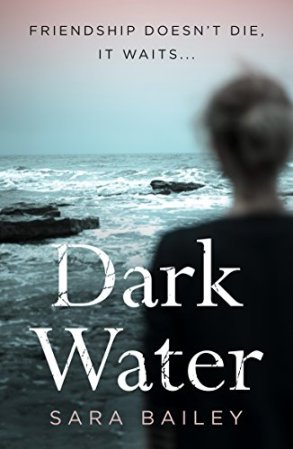
Publication Day Interview with Sara Bailey, author of Dark Water

dark-water

I love a psychological thriller and so I’m delighted to welcome Sara Bailey, author of Dark Water, to Linda’s Book Bag. Dark Water is published today 3rd October 2016 by Nightingale Editions, an imprint of Blackbird Books. Dark Water is available for purchase on Amazon and from Waterstones.

To celebrate Dark Water’s publication day, Sara kindly agreed to be interviewed.

Dark Water

dark-water

When Helena returns to her childhood home in Orkney to care for her father after a heart attack, she is forced to face memories that she has spent half a lifetime running from.

Still haunted by the disappearance of her best friend, the charismatic Anastasia – who vanished during a daredevil swimming incident – Helena must navigate her way though the prisms of memory and encounter not only her ghosts but also her first love, Dylan, the only one who can help her unravel the past and find her way back to the truth of what really happened that night.

Sara Bailey’s haunting and lyrical debut: a psychologically intense portrait of adolescent yearning and obsession, set in the beautiful Orkney Islands.

An Interview with Sara Bailey

Hi Sara. Thank you so much for agreeing to answer some questions on my blog about your writing and Dark Water in particular.

Firstly, please could you tell me a little about yourself?

An insomniac who is afraid of flying – apparently the two are connected, but don’t ask me how.

Dark Water is your debut novel. What made you choose to write a psychological narrative?

I don’t think I set out to write a psychological narrative. The book began as an exercise in remembering a past and distorting it. The first draft was all in third person and it wasn’t till I found Helena’s voice the psychological elements emerged.

To what extent do you think adults are shaped by their teenage years like Helena?

Hugely. I think we carry that teenage baggage around with us for the rest of our lives unless we find a way of resolving it. There’s so much angst going in in those years – it doesn’t just go away once you hit 20. I think we get better at disguising it, but events that happen in those years shape the adults we become.

Friendship in various forms underpins Dark Water. How important are friends in your own life and to what extent have they been included as characters in Dark Water?

Friends are very important. Although I’d have to say I’m not someone who talks to friends daily or even goes out with them a lot. My best friends are ones I sometimes don’t speak to for months or even years, but we pick up where we left off. As for using them as characters in Dark Water – no. There are elements of people I’ve known, I might take the eyes of one or the way another moves or speaks, but characters take on their own identity as you write, so often those early start off points get written out or lost as the work develops. I’ve skewed some of the nick names from ones I know for the Orcadians – nick names are very common up here and often have a story behind them, sometimes they’re even passed on from father to son.

How far have you always been fascinated by water and why did you choose Dark Water as your title (without giving away the plot if possible please)?

That’s interesting because the title of the book came right at the end. And actually I didn’t choose it. The book has had several titles and none of them really stuck. It wasn’t till talking about drowning and divers with my husband (he used to dive) that the title suggested itself and then it just wouldn’t go away. If the book is about anything it’s about that moment of not knowing which way is the right one – which truth is real?

Not sure if I am fascinated by water – it’s important to me to live near water though, so an island is pretty well my perfect location.

The Orkneys are the setting for Dark Water. Why did you choose that location in particular?

Orkney had a huge influence on me as a person. I came here when I was ten on a family holiday (we stayed in Rousay). It was clear my parents loved it. So when, a year later, Dad got a job up here, we moved. I was at boarding school for a while then moved to the local school. My teenage years were spent here and even when I left I knew I would come back one day. It gets into your bones and it’s home for me.

In Dark Water Helena goes back to her childhood home and I know you went beck there to write the novel. What advice would you give to readers thinking of completing a similar journey?

I don’t think I’d give advice on this. It was right for me at the time, couldn’t say for anyone else.

You have a Ph.D in Creative and Critical Writing. Was this a help or a hindrance in writing your debut novel? 

Difficult to answer. If you’d asked me just after I finished the Ph.D, I’d have said it was a hinderance and destroyed my confidence. However, in hindsight, I can see that it made me stronger and was a fantastic opportunity to explore my writing in ways I would never have done otherwise. I was lucky to get the input of some incredible people along the way. I think anyone wanting a Ph.D in any subject has to think carefully about what it is they are after. The floppy hat isn’t enough, because it gets really tough at times and you need to keep going.

Dark Water explores obsession. Do you have any obsessions in your own life?

Hahah – no I don’t think so, chocolate maybe.

(Not a bad obsession in my opinion Sara!)

When did you first realise you were going to be a writer?

When the first copies of the book arrived this week. Up until then all I knew was I wanted to be a writer, but I hadn’t actually really thought of myself as one. Then the book arrived this week and I realised that’s what I am now – a writer (does that make sense?)

(Complete sense. I think it’s that moment when the realisation hits home that others think you’re a writer too.)

If you hadn’t become an author, what would you have done instead as a creative outlet?

No idea – my family are all good artists but I can barely draw stick men, I can’t sew and my knitting is terrible. I like to bake, so maybe I’d have made a lot of cakes.

How do you go about researching detail and ensuring your books are realistic?

Different research methods, depending on what it is I’m looking into. I might google it or check with an expert, or go to the library. I purposely moved bits of Orkney around to fit with the story, so there are inaccuracies geographically – the graveyard is not as close to the Italian chapel as it appears in the book is one example. Also, some buildings have been renamed and shifted. I didn’t want to use the real names of hotels for instance. It is, after all, a work of fiction and I think that’s OK.

Which aspects of your writing do you find easiest and most difficult?

It’s all like pulling teeth. Although having said that, when the writing is going well, it’s wonderful and feels easy. The difficult bit is always sitting down and getting on with it.

(Haha – the typical writer procrastination!)

What are your writing routines and where do you do most of your writing?

I try to write in the mornings as I’m at my most awake then. Afternoons are hopeless, as soon as I sit down to write I’ll want a nap, so I try to avoid sitting at my desk in the afternoons and do other practical things then.

I write upstairs in our house, where we have amazing views from all the windows. I tend to write on my laptop, sitting on the sofa looking out of the window, which sounds very Barbara Cartland, but really isn’t! (Not a pink robe in sight, honest!). Editing and teaching work is all done at my desk which faces the wall so I’m not distracted.

view

View from house

(Those are very distracting views.)

When you’re not writing, what do you like to read?

I read a lot and all different things. At the moment I’ve just finished reading Moondance by Diane Chandler (from same publishers) and Susie Kelly’s Swallows and Robins (hilarious). If I wake in the night (which I do frequently) I’ll read something soothing like Georgette Heyer (my secret indulgence).

Do you have other interests that give you ideas for writing?

I don’t know about other interests giving me ideas, but I do walk and that gives me space and time to think.

Dark Water has a very atmospheric cover. How did that image come about and what were you hoping to convey (without spoiling the plot please!)?

I’m so glad you like the cover. We had a fantastic designer, who had a very detailed brief and who was sympathetic to the ideas in the book. We had a variety of ideas to choose from and all had different favourites but this was the one that we all immediately liked and when it was mocked up it became obvious that it was the one.

If you could choose to be a character from Dark Water, who would you be and why?

I couldn’t possibly say! LOL

If Dark Water became a film, who would you like to play Helena?  

Edie Campbell  has the right look. Otherwise someone like Gemma Arterton.

If you had 15 words to persuade a reader that Dark Water should be their next read, what would you say?

Tricky….  If you’re still haunted by the relationships you had as a teenager, you’re not alone.

Thank you so much, Sara, for your time in answering my questions.

About Sara Bailey

sara-bailey

Dr Sara Bailey is a writer, consultant and lecturer who has been working with authors and screenwriters for many years, in Richmond-upon-Thames, Winchester and Southampton. She has a PhD in Creative and Critical Writing from Bangor University. Her first book was published by Bloomsbury in 2013, Writing the Horror Movie, which she co-authored whilst hiding behind a cushion. Recently she has returned to her home of Orkney, the setting of her debut novel, Dark Water.

You can follow Sara on Twitter, find her on Facebook and visit her website.

You can find out more with these other bloggers too:

dark-water-tour-poster-1


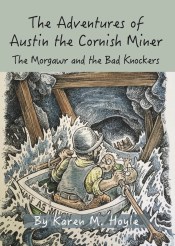
The Adventures of Austin the Cornish Miner: The Morgawr and the Bad Knockers by Karen M. Hoyle

the-morgawr-and-the-bad-knockers

I’m delighted to be part of the launch celebrations for Karen M. Hoyle’s latest children’s book The Adventures of Austin the Cornish Miner: The Morgawr and the Bad Knockers which is the second in the series. The Adventures of Austin the Cornish Miner: The Morgawr and the Bad Knockers will be published by Clink Street on 18th October 2016 and is available for pre-order here.

Today Karen M. Hoyle has written a brilliant guest piece about Cornwall, the setting for The Adventures of Austin the Cornish Miner: The Morgawr and the Bad Knockers.

The Adventures of Austin the Cornish Miner

Book Two: The Morgawr and the Bad Knockers

the-morgawr-and-the-bad-knockers

Spirited and adventurous children’s book series follows the adventures of a Cornish tin miner and his magical friends.

Two naughty Knockers -grubby trolls who wear miners boots and eat pasty crusts for those of you who don’t know- have been stealing from their community. With no-one else to turn to, it is up to Austin to help his friends out and bring the thieves to justice. However, things take a dangerous turn when the knockers take something explosive and Austin is forced to embark on a very different adventure which will take him underground through perilous tunnels and out into the wild sea.

With the help of new friends, in the shape of sea serpents and Bramble, a female knocker who used to be a wrestling champion, Austin finds himself in a race to save the lives of the magical underground world- but will he succeed? Enjoy the ride as the Cornish coast provides another dose of adventure and magic that children and adults alike with enjoy and remember for years to come.

The Magical attraction of Cornwall

A Guest Post by Karen M. Hoyle

We all know about Pixies and possibly about sea serpents. We all know Cornwall has beautiful blue waters and white sandy beaches with rugged dark coastline that can both be stunning and menacing. But what is magical? – the location?, the myths and stories? or the freedom to allow the imagination to run wild?

Tin mines have always had magical stories attached to them, and in Cornwall I grew up with all the stories passed down through my family and told at school. Nowadays the stories are less well known so eleven years ago I set out to create a series of children’s books that incorporated the old magical stories of mining and magical creatures but that added a modern twist of excitement and readability that young readers and parents would enjoy.

Cornwall is the perfect backdrop for magic of all forms for children to experience and enjoy. The Adventures of Austin the Cornish Miner series of books for for children is based in real Cornish locations. Children and parents can actually visit the Morgawr Mile on the Roseland Peninsula looking out to sea looking for sea serpents, or they can walk the cliffs from St Agnes down towards Cape Cornwall and take in all the caves and wheal houses of the books. I can easily imagine a mother and child looking down into the dark mine below Wheal Coates Tin Mine and the child can imagine Deffler and all his Knocker friends living down below, while mum is probably thinking more of Aiden Turner sweating at a rockface.

I have found that I have had a significant response from Cornish parents who had almost forgotten stories of Knockers, Pixies, Sea Serpents and myths from around Cornwall. I did a book a signing recently and the parents were saying that they were reading the books and enjoying them as much as the children and it made a change from unreal computer games about magical creatures when they could tell their children about the magic just outside their front doors or at the end of their gardens. Maybe one day an ‘Austin Trail’ may come from Visit Cornwall or the National Trust incorporating the book locations, myths and stories and be a real life Pokémon Go style adventure. #AustinTrailForCornwall – lets get the ball rolling.

Mining itself in Cornwall is part of Cornwall’s heritage and part of the curriculum of local learning for Primary Schools. I have deliberately brought in details about mining that are educational. What mines look and smell like, how miners accessed the mine tunnels, the distance the mines could go and the structure of tunnels underground. I have also brought in how the tunnels could go out to sea and how the mining industry was hard work and communities often had very little money. The tools that miners used are part of the detail as is the important fact that miners ate pasties and that led to a whole magical world underground with Knockers, Pixies and magical stones.

Cornwall is magical whatever way you choose to experience it, either as an adult or as a child. Worldwide tourists are flocking to Cornwall for Poldark, Doc Martin, Rosamund Pilcher and why not bring that experience for children in the magical world of The Adventures of Austin The Cornish Miner and all his magical friends and travels.

My Review of The Adventures of Austin the Cornish Miner: The Morgawr and the Bad Knockers

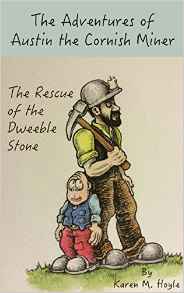
I will say first off that I think it would be best to read the first book in the series, The Adventures of Austin the Cornish Miner: The Rescue of the Dweeble Stone, in order to understand how Austin and the Knockers first met (though that would be no hardship).

This is a lovely story drawing on the folk history of Cornwall and there is a real sense of pride in the area that comes through very strongly.

I think younger children having the book read to them, and older ones reading it for themselves, would enjoy the exciting events and the idea of encountering characters like Deffler.

The bad Knockers, Marky and Greggor, serve to provide a good moral message and the way in which they are dealt with by the rest of the mine dwelling folk is a great example to youngsters of how they should treat others and expect to be treated in return.

The story is well illustrated so that readers of all ages have an enhanced experience. I loved the image of Marky and Greggor with their head torches of lit candles as they carry the dynamite keg.

I think Karen M.Hoyle has, if you’ll pardon the pun, hit a rich seam of themes and local folklore to explore and applaud her bringing the Cornish world to a younger audience.

About Karen M Hoyle

karenmhoyleauthor

Karen M Hoyle was born in Newquay, Cornwall and grew up with Cornish magical tales all around her. A writer through her career in public relations, Karen wrote her first book The Adventures of Austin the Cornish Miner The Rescue of The Dweeble Stone in 2004. The book stayed in a moving box for eleven years before resurfacing and finally being published in 2015.

dweeble

Karen has also written poetry, winning a poetry competition aged 13 which is now showcased at the British Museum. Karen now sees writing as a fundamental part of her future and mixes children’s writing with writing books and blogs related to her profession. Karen continues to live in Cornwall with her writing companion Bailey the Cocker Spaniel who likes to delete items from Karens laptop when bored.

You can find out more by following on Twitter and visiting the book’s website and Facebook page. There’s more too with these other bloggers:

karen-hoyle_banner

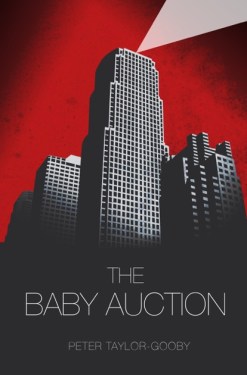
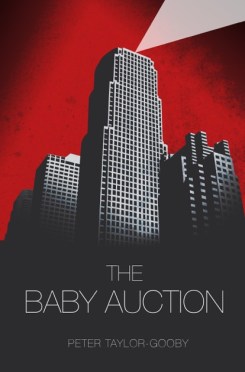
Why I Write Dystopian Fiction by Peter Taylor-Gooby, author of The Baby Auction

baby-auction-work-v2

I read and review most genres on Linda’s Book Bag, but I’m not so keen on dystopian fiction. When I found eminent social scientist Peter Taylor-Gooby had written a dystopian novel, The Baby Auction, after literally hundreds of papers and non-fiction books I just had to ask him why he has chosen this particular genre. Luckily he agreed to explain.

The Baby Auction was published by The Conrad Press in paperback and ebook on 15th July 2016 and is available for purchase from The Conrad Press (post free), Amazon, Google Books and all good booksellers.

The Baby Auction

baby-auction-work-v2

Auctioning babies makes sense, at least that’s what Market World thinks. After all the baby goes to someone who can give them a good start in life, and the parents get a return for their pain and trouble.

For Ed and Matt, the Baby Auction sums up everything that’s wrong with a society based on profit. Then one day Matt rescues a drowning child and they face the question: can love and compassion overcome the harsh laws of Market World?

Why I Write Dystopian Fiction

A Guest Post by Peter Taylor-Gooby

I write dystopian fiction, set in imaginary (and generally depressing worlds) for two reasons: first, I’m a social scientist in my day job, an expert on the welfare state, and what’s happening there is pretty depressing much of the time. Dystopias offer me the chance to experiment, to think ‘what if…?’ For example, what if we could clone people and we had a society without parenting? What if life-expectancy was reduced to 35 by pollution and general disaster? What if internet surveillance meant that big business knew more about our desires and fears than we did ourselves? and so on.

That’s all great fun and not all dystopias are necessarily bad, they’re just different. The second reason why I write about them, and far away the most important one, is that dystopian fiction allows me to address something that’s missing in my work, something that is (I believe) a real problem for social science.

I study society. Society is made up of people and people do what they do and live their lives through emotions as well as reason. Feelings, passions, dread, trust dominate our lives. Social science is pretty good at dealing with reason but not so good at understanding our feelings. Economists believed they understood how markets work – then there was a market panic, compounded by mistrust and we had the Great Recession of 2007-8, the biggest economic fact of our time.

Sociologists and political scientists were convinced that the right and rational answer to the EU referendum was to stay in the EU. They (we) failed to take seriously the fears about the impact of immigration and the distrust of Brussels law-making that drove Brexit, the biggest political fact of our time.

Social science will always get it wrong if it doesn’t find ways of dealing with the feelings, the passions and fears that dominate how people behave. That’s the big reason I write dystopian fiction, to face up to the challenge of creating real believable, characters and seeing how they might plausibly behave in a particular kind of imaginary world.

One of the things I find most pleasurable, engrossing and frustrating in writing is the way that characters, once created and established suddenly say and do things that I certainly don’t expect. One model of the novelist is of a creator, controlling the puppets she has willed into being. Balzac apparently had the plot structure of all 137 works in La Comédie Humaine mapped out in advance.

I can only comment ‘Wow!’ For me, it’s never like that. All my plans for the lives of these people I’ve thought about for hours and feel I know intimately, continually fall apart (a bit like bringing up children). They want to do something I didn’t expect, or a bit player becomes pivotal, or an interaction I expected to be resolved suddenly turns into conflict.  Everything has to be replanned – but that’s the point. The author does not control their characters. Writing is among other things about discovery, discovery about oneself and the limitations of one’s own ideas, and also about other people and what they do and might do.

That is the real reason for writing dystopia. In The Baby Auction the imaginary world is run on strict market lines: everyone is equal, no discrimination of grounds or sex, age, religion, ethnicity, only on what you can pay for; only fair bargains: no slavery, no exploitation, but no compassion, no charity; every bargain driven by self-interest and the principle of buyer beware: you always get what you pay for, but no trust, no empathy and ultimately no love.

The market is increasingly important in our world. I wanted to see what it meant to take current trends to extremes, what it might mean if two people fell in love in such a world. Pretty soon things moved on beyond what I’d planned and the novel is ultimately about trust and self-sacrifice and the shortcomings of fairness and about people and how surprising they are – and I really enjoyed writing it.

P.S. I don’t always write dystopian fiction. My next novel Ardent Justice, is a thriller set in the world of tax fraud and currency laundering, the dark underside of the City of London.

About Peter Taylor-Gooby

Peter.jpg

When he’s not writing Peter enjoys hill-walking, riding his bike, holidays and looking after his grand-daughter (not in that order). Peter became interested in social policy issues after working on adventure playgrounds, teaching, claiming benefits and working in a social security office in Newcastle. He has worked in the UK, most European countries, Canada, the US, China, Korea and Japan, Australia and South Africa.

You can follow Peter on Twitter.

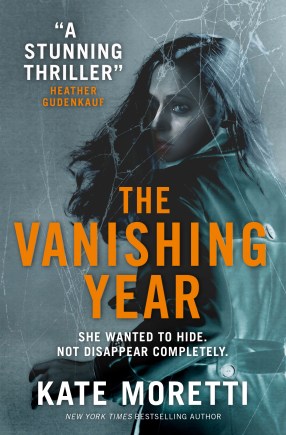
Why We Love Crime Novels, a Guest Post by Kate Moretti, author of The Vanishing Year

vanishing-year-fina_final

I’m really excited to be part of the launch celebrations for The Vanishing Year by Kate Moretti. The Vanishing Year was published on 27th September in e-book and paperback by Titan Books and is available for purchase on your local Amazon site, through Titan and all good booksellers.

To celebrate publication of The Vanishing Year, Kate Moretti has written a guest post all about why we love crime novels.

The Vanishing Year

vanishing-year-fina_final

Zoe Whittaker is living a charmed life: wife to a handsome Wall Street trader, with the perfect penthouse and summer home, she is the newest member of Manhattan’s social elite. What no one knows is that five years ago, Zoe’s life was in danger. Back then, Zoe wasn’t Zoe at all.

Now her secrets are coming back to haunt her.

As the past and present collide, Zoe must decide who she can trust before she – whoever she is – vanishes completely.

Why We Love Crime Novels

A Guest Post by Kate Moretti

I wrote much of my first novel in a Panera Bread (a US bakery chain), with reliable Wi-Fi, good coffee, and artisan sandwiches. In the mornings, the senior citizens would come in alone, carrying a thick hardcover, the cover flapping off, and take a small coffee to a booth where they’d hunker down for hours. I’d watch these people – mostly women, seventy-five, eighty – and they all had one thing in common. They adored Lee Childs. Every single book I saw was a Jack Reacher book.

I puzzled about this. All these grandmothers, you’d think they’d read love stories, or literary fiction, an examination of life, or even women’s fiction, stories they could relate to: husbands and kids and friendships. But no, it was the rogue military man making the world a better place one bad guy at a time.  Why?

I have a theory. First of all, crime novels move quick. Suspense, by very definition, gives you a shot of adrenaline.  You hold your breath. You gasp. I’ve already said “holy s*&t” to a completely empty room at a particular genius and well-hidden plot twist. But mostly, I think people read and love crime because by nature, these stories feel accessible to us.

We are inundated daily with news reports about real life horrible things that happen to good people. If you spend any length of time perusing the internet, children are kidnapped, people are murdered by the police, by their neighbor, by their spouses. Crime novels are a way to get inside that crime, to examine it from the inside out and understand all the nuances and details that made it come to life. In that way, we can sit back, relax and say, “okay, this can’t happen to us.” It’s almost a pressure relief valve.

I’ve often admired a good antagonist. I’ve admired their cunning, their intelligence, their undeniable understanding of the human condition. After all, if they didn’t understand what makes people tick, they surely wouldn’t be able to undermine them, to manipulate them. For me, I love the look into what makes us work from the point of view of a psychopath. A psychopath is looking, specifically, for weak spots. These weak spots hold fascinating stories.

I can’t tell if my love of a literary villain means I, myself, have some psychopathic tendencies. If so, then I expect I’m in the majority. After all, everyone loves Hannibal Lector.

Mostly, I think my love of crime comes from the rate at which I get absorbed into the story. Many crime stories, although not all, involve regular people doing regular things: their jobs, raising their families, visiting with neighbors and friends, when suddenly their world is upended by a crime. Their reactions, the resulting investigation, and what the plot does to relationships and friendships – the ripple wave of that crime – is to me the closest examination of society I can find. It’s better than any prolonged navel-gazer, which is why even some of the most impactful literary fiction novels revolve around a violent or criminal act.

Crime stories have endless potential. As long as we evolve and change, crime stories will change with us and I’ll have plenty of books waiting to be read on my bookshelf.

About Kate Moretti

kate

Kate Moretti is the New York Times and USA Today bestselling author of Thought I Knew You, Binds That Tie, and While You Were Gone. She worked in the pharmaceutical industry for ten years as a scientist, but now writes full time. She lives in eastern Pennsylvania with her husband and two children.

You can follow Kate on Twitter, find her on Facebook aand visit her website. There’s more about and from Kate with these other bloggers.

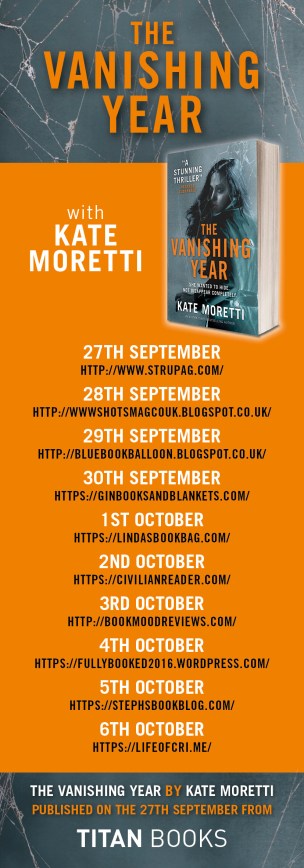
the-vanishing-year-blog-tour-banner