Interview with Sandra Nikolai, author of Icy Silence

Icy Silence_SNikolai

I love finding new to me authors and so it is with great pleasure that I’m interviewing Sandra Nikolai on Linda’s Book Bag today and finding out all about the latest book in her Megan Scott/Michael Elliott series, Icy Silence Icy Silence is available for purchase along with Sandra’s other books on Amazon UK and Amazon US.

An Interview with Sandra Nikolai

Hi Sandra. Thank you so much for agreeing to answer some questions on my blog about your book ‘Icy Silence’.

Hello, Linda. Thank you for inviting me to your blog today. I’m thrilled to be here.

Firstly, please could you tell readers a little about yourself?

I’m Canadian, born and educated in Montreal. I graduated from McGill University and followed a winding career path in sales, finance and high tech. With my husband’s encouragement, I took an early retirement and finally sat down to do what I’d wanted to do for so long—write mysteries.

When did you first realise you were going to be a writer?

As a child, I fell in love with the magical world of stories. My interest in books spanned various genres over time, though mysteries remained my favourite—triggered in part by the Nancy Drew Mystery series. I secretly aspired to be a writer ever since I can recall, but logic dictated that I had to pursue more practical means of earning wages to help pay the bills. With the arrival of the Internet and expansion of social media, I grabbed the opportunity to fulfil my dream. I began to write short stories and submitted them to publications. I was successful in getting a string of short stories published and earned several awards, which motivated me to write novels.

If you hadn’t become an author, what would you have done instead as a creative outlet?

I love the written word, so maybe I would have taught literature or worked as an editor.

How do you go about researching detail and ensuring your books are realistic?

I research the material for my settings to make sure they’re as realistic as possible, though in many instances, I’ll blend different settings and use fictitious names. Since I write mysteries, I ensure that ordinary characters experience extraordinary events in my stories. As in real life, nothing is more shocking than finding out that something horrendous has happened to someone you know or to a neighbour who lives on your street.

I know you also write short stories. How does that differ from writing novels and which do you prefer?

The plot in a novel offers more leeway when it comes to building a world where characters can develop and interact. Readers tell me they enjoy getting to know the characters and love to follow them through a series. I value my readership. Their feedback is priceless! Although it takes more time and research, I have to admit I prefer working on a novel.

Which aspects of your writing do you find easiest and most difficult?

I’ll start with the most difficult aspect first: the plot outline. I’ve tried writing without one, but I didn’t have much success. I need to visualize the storyline from start to finish, and I can accomplish that task best if I set up an outline first. It’s hard work but worth it in the end. The easiest aspect of writing is dropping my characters into threatening situations. It’s the most fun too! (Cue evil laugh here.)

What are your writing routines and where do you do most of your writing?

I write at my computer in a home office and usually work several hours each morning and afternoon. Bookshelves line two walls of the room and are filled with books from my favourite authors. A large window affords a view of a quiet street lined with maple trees, evergreens and colourful flowerbeds—except in the winter, of course, when a snowy landscape turns everything white. It’s quite pretty too!

(That sounds wonderful – I’m surprised you’re not too distracted to write!)

When you’re not writing, what do you like to read?

Mysteries, of course! To be honest, I’ll read any book that tells a good story.

To what extent do you think reading Nancy Drew mysteries as a child has influenced your genre as a writer now?

Immensely. Had my parents not gifted me with Nancy Drew mystery novels throughout my younger years, I probably wouldn’t have been as interested in the genre as I am now. These novels—though tattered and faded—still sit on the bookshelves in my office.

Do you have other interests that give you ideas for writing?

Watching the news will sometimes spark an idea for a “what if?” storyline. It’s amazing how much evil lurks in the real world. Sometimes I’ll use a familiar element to enhance the plot in my story, but I’ll put my own spin on it.

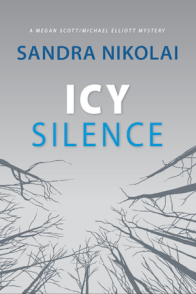
‘Icy Silence’ has a very striking cover. I think the branches look like skeletal hands reaching for help. How did that image come about and what were you hoping to convey (without spoiling the plot please!)?

Readers of Icy Silence have expressed different interpretations of the cover image. I suppose it depends on how and why certain scenes in the story touched them. I think the illustration represents a variety of perspectives drawn from the contents and encourages discussion—which is always good.

Why did you decide to make Megan a ghostwriter?

I wanted to give Megan a level playing field with Michael, who is an investigative reporter. As a ghostwriter, Megan writes material for clients from diverse professional backgrounds. She is considered a generalist whose knowledge in various fields can come in handy when helping Michael solve a crime.

Icy Silence is the third of your Megan Scott/Michael Elliott series. How much have these characters developed since you began writing about them?

Megan and Michael have a special relationship—one built on trust from their life-threatening experiences in False Impressions, the first book in the series.
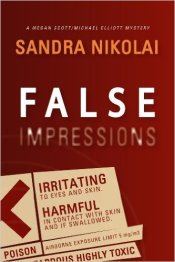
false

In his quest for justice, Michael takes risks and thinks nothing of dealing with shady informants to get to the truth. His determination to weed out criminals will only get stronger—as will the risks he takes. Although Megan prefers anonymity and works behind the scenes at her desk, she is showing an increased interest in Michael’s investigative work. She assists him more often in digging up information and following up on leads. It’s a given that their different personalities and viewpoints do create conflict, but they’ve often helped each other out of dangerous situations, thereby reinforcing their mutual trust. As far as romance goes…? Michael has hinted at a more ‘permanent’ relationship between them, but Megan isn’t ready to give up her independence just yet.

If you had 15 words to persuade a reader that ‘Icy Silence’ should be their next read, what would you say?

Icy Silence will forever change the way you look at boarding schools.

Thank you so much, Sandra, for your time in answering my questions and providing such interesting answers.

Linda, thank you for asking such thought-provoking questions.
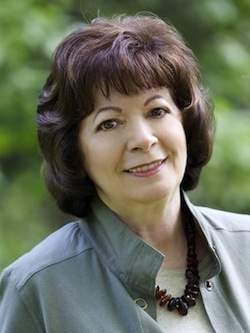
Sandra Nikolai author photo

You can find out more about Sandra and her books by visiting her website, finding her on Facebook or following her on Twitter.
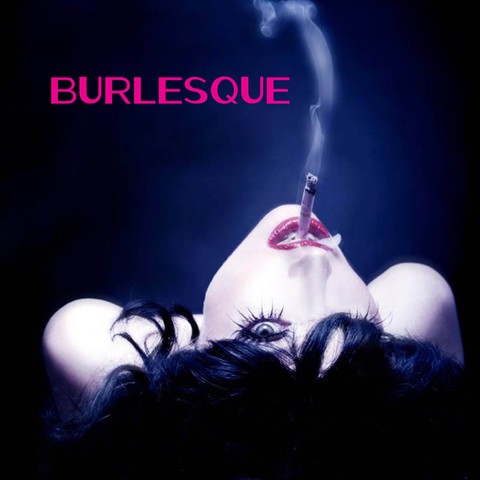
Burlesque by Christopher Logan

Burlesque

I was approached by the creator of Burlesque, Christopher Logan to see if I reviewed coffee table books and, not having done so on the blog I thought I’d give it a go. I wasn’t sure what to expect and what I found was quite different from anything that has appeared on Linda’s Book Bag before.

Burlesque follows d.r.a.g (Dressed as Girls), and is part of a project run by actor Christopher Logan to raise funds for independent film projects. The cover image is by Karl Giant. Burlesque will be released on 30th March 2016 and is available from the Book The Film website.

I was slightly disappointed to begin with that there wasn’t more text for me to read about the history of burlesque after the initial definition and introduction or more details about the individuals appearing in the photographs as I would have liked to know more about them.

That slight criticism aside, Burlesque is a stunning book. The photographs are gorgeous, high quality images that reward multiple views in order to appreciate the photographic skill. There is fabulous lighting to show off the performers at their very best such as that of Angie Pontani where the shadows give sculpture and form to her image. Colours are vibrant and the black and white images are atmospheric so that each plate is a work of art in its own right.

I hadn’t really considered the role of men in burlesque before so photos of people like Captain Kidd certainly made me challenge my own perceptions. So too did the expressions on the performers’ faces. Every emotion from sadness to joy and seduction to sweetness is to be found in the burlesque world. I appreciated the almost feminist pose of Missy Malone, for example, and the less than perfect but still beautiful figures of World Famous *BOB* and Selene Luna. Having said I would have liked more text to accompany the images, I still learnt an awful lot about burlesque. Looking at the photographs over several days and really studying them I began to see how the positioning of a hand, for example, was typical of some poses or conveyed a completely different meaning in others, and how a slight alteration in the lips could move an expression from innocence to seduction. Burlesque really isn’t a book to look through only once.

If you’re looking for something a bit different, are open minded and don’t mind some nudity, but want a book that is beautifully produced and supports an interesting project, look no further than Burlesque.

You may have seen Christopher in the recent X-Files episode ‘Founder’s Mutation’ and you can follow his Book The Film project on Twitter.

Summer at the Star and Sixpence by Holly Hepburn

Summer at the Star and Sixpence

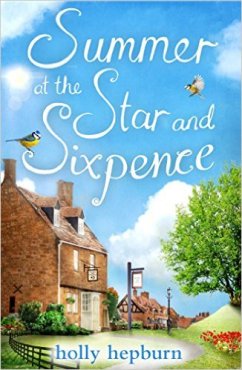
I was recently fortunate enough to meet Holly Hepburn at a Spring Blogger Event hosted by the Simon and Schuster Books and the City Team where it was lovely to hear Holly read from Summer at the Star and Sixpence and to get my copy signed by her.

Summer at the Star and Sixpence will be released by Simon and Schuster on 25th April 2016 and is available for pre-order on  Amazon UKAmazon US as well as Nook, Sainsbury’s and other online retailers.

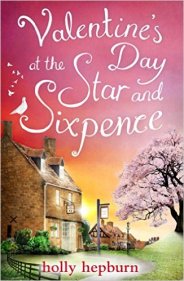
The story is part of a series of novellas featuring the Star and Sixpence pub and I previously read the short story Valentine’s Day at the Star and Sixpence, my review of which you can read here.

Valentine's Day at the Star and Sixpence

My review of Summer at the Star and Sixpence

With accommodation renovations underway at the Star and Sixpence, sisters Sam and Nessie are preparing to host a huge wedding for Jojo and Jamie. All appears to be going well, but Sam’s past is rapidly catching up with her.

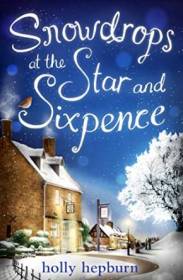
Snowdrops at the Star and Sixpence

I would say that it is best to have read Snowdrops at the Star and Sixpence and Valentine’s Day at the Star and Sixpence before reading Summer at the Star and Sixpence in order to have the full picture of all the back stories to the characters, but that it really doesn’t matter if you haven’t as Holly Hepburn skilfully provides just enough information to ensure the reader can enjoy the story as a stand alone.

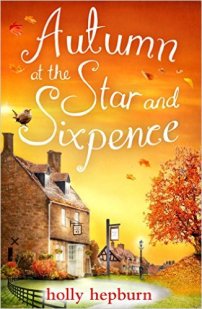
For such a short read there’s a fast paced and well developed plot that leaves the reader wanting more – setting up nicely the next in the series, Autumn at the Star and Sixpence, to be released in September. I would have liked just a little more at this point to resolve Sam’s story more fully as there is plenty of potential development in Nessie’s part of the narrative for the next book.

Autumn at the star and sixpence

I really like the way Holly Hepburn tantalises the reader. In Summer at the Star and Sixpence Sam’s secret is finally revealed and it wasn’t entirely what I was expecting. I can’t say more without giving away the plot.

This series is really easy to read. The narrative flows along effortlessly so that the reader becomes wrapped up in the story and longs for a happy ending for all the characters – from the tyrannical post-mistress Franny who frequently adds a comedic element, to heart-broken widower Owen. That’s not to say the reader always gets what they want though!

The Star and Sixpence series is a lovely escape from daily life. The stories are quick and light to read, but with enough depth and development to make the reader feel as if they’ve been part of real people’s lives for just a little while. I’m thoroughly enjoying them.

You can follow Holly Hepburn on Twitter and visit her web site. You’ll also find Holly on Facebook.

For more romantic reads follow Books and the City on Twitter or visit the website.

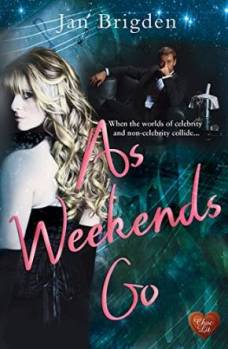
An Interview with Jan Brigden, Author of As Weekends Go

As weekends go

I ‘know’ author Jan Brigden from a variety of Facebook book groups and so it gives me enormous pleasure to be interviewing her for Linda’s Book Bag today. After winning the Choc Lit & Whole Story Audiobooks Search for a Star competition 2014/2015 with her debut novel As Weekends Go, Jan signed with Choc Lit and As Weekends Go was published by them on 4th December 2015. As Weekends Go is available on Amazon UK and Amazon US.

CHOC

About As Weekends Go

As weekends go

What if your entire life changed in the space of a weekend?

When Rebecca’s friend Abi convinces her to get away from it all at the fabulous Hawksley Manor hotel in York, it seems too good to be true. Pampering and relaxation is just what Rebecca needs to distract herself from the creeping suspicion that her husband, Greg, is hiding something from her.

She never imagined that by the end of the weekend she would have dined with celebrities or danced the night away in exclusive clubs. Nor could she have predicted she would meet famous footballer, Alex Heath, or that he would be the one to show her that she deserved so much more …

But no matter how amazing a weekend is, it’s always back to reality come Monday morning – isn’t it?

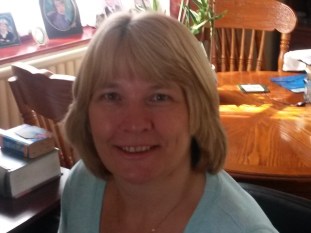
An Interview with Jan Brigden

20150927_114738 - Copy

Hello Jan. Thank you so much for agreeing to answer some questions on my blog about your writing.

Hi, Linda. I’m thrilled to feature – thank you for your support.

Firstly, please could you tell readers a little about yourself?

Well, I live in south-east London with my husband Dave who’s a painter and decorator and, alongside my writing and sporadic freelance proofreading jobs, I look after the admin side of his business. I write contemporary fiction, romance at heart with plenty of emotional fireworks, and my debut novel As Weekends Go was published by Choc Lit in December.

When did you first realise you were going to be a writer?

Probably at school, even if I did also want to be an actress and a policewoman… I always  loved reading and  creating little fictional scenarios either in my head or in story form for school friends and family and recognised this as being something I hoped to further explore.  I later enrolled on a creative writing course which eventually sparked the idea for my novel. I studied every ‘How to’ book I could get my hands on and attended as many writerly events as possible whilst also connecting with other readers and writers on social media to absorb as much knowledge and sound advice as possible.

How did it feel to win the Choc-Lit and Whole Story Audio Books Search for a Star competition?

Jaw-droppingly brilliant! My smile was watermelon-slice wide for days, Linda. A truly magical moment.

Congratulations on that wonderful achievement Jan.

How did you carry out the research for As Weekends Go – did you have a trip to a luxury hotel?

There is a gorgeous countrified hotel with glorious grounds and facilities fairly near to me upon which I loosely based Hawksley Manor in my novel. I’ve never  stayed there as a guest but had been to a couple of events there,  so made an appointment to see the manager who kindly showed me round and answered about a zillion questions for me.  I also had a good contact at a lovely hotel in Manchester who offered me masses of help and shared a few stories with me.

Which aspects of your writing do you find easiest and most difficult?

I’m a terrible ‘tweaker’ so I’d say the most difficult is my ‘editing as I go’ habit rather than bashing out the first draft and then revising afterwards (which, having learned the hard way, is what I am doing with Book 2).  As much as I love it, I don’t find any aspect of writing easy,  so I’d probably say research  is the most enjoyable.

What are your writing routines and where do you do most of your writing?

I’m home-based so able to chop and change the hours I write around my other commitments, so no typical writing days, really. In my dining room is mainly where I work, either at my little desk or at the table.

How did you create Rebecca’s character? Did you begin with a name, an image, a trait or something else and did you write a full profile before putting her in As Weekends Go or did she emerge naturally?

A bit of all sorts, really. I remember canvassing opinions from friends and family when I was toying with naming her.  I had three names in mind and eight out of ten people I asked said the name Rebecca Stafford appealed to them more than the other two names I’d put forward. I created a character profile for her and interviewed her which is what I do with all my main characters. It’s amazing what they tell me! I do also like to keep an open mind as I’m writing, though, so it’s not too regimented.

You’re one of The Romaniacs (www.theromaniacs.co.uk). Tell us more about that group.

Well, we all met via the Romantic Novelists’ Association’s excellent New Writers’ scheme. We were at varying stages with our writing and used to bounce ideas off each other and offer mutual encouragement and support, etc. The blog was a natural progression as we wanted to pool and share our various nuggets of knowledge and experience. Our name derived from a typo, so we stuck with it and now couldn’t imagine being called anything else.

When you’re not writing, what do you like to read?

Anything from Lisa Jewell to Bill Bryson to Stephen King.  I love dipping in and out of different genres.

If you hadn’t become an author, what would you have done instead as a creative outlet?

Probably something drama-based, albeit in the background rather than in the spotlight. (I’ve toyed with signing up to be an extra) or a publicist in some capacity, perhaps, as I enjoy helping people.

Do you have other interests that give you ideas for writing?

I do a lot of walking (and people-watching) which always provides plenty of great fodder or ‘what if’ moments for storylines.

Which of your characters would you most like to be and why?

Probably Rebecca, because she’s real and honest and despite her marriage woes and dramas, her confidence returns and blooms as her story progresses (and she also gets to meet lovely Alex!).

If As Weekends Go became a film, who would you choose to play Rebecca and Alex and why?  

Hmmm… this is tricky. Can I be REALLY greedy please, Linda? I’d say for Alex, possibly a short-haired Chris Hemsworth. Also, I know the age is all wrong, but I’m a HUGE Brad Pitt fan and quite often had his younger image in my head when writing Alex’s scenes. Same with Rupert Penry-Jones as Adam Carter in Spooks (I told you I was being greedy)  RPJ in Spooks was the perfect combo of kind/tough/manly/intelligent, not to mention great looking – in my eyes anyway. With Rebecca, I think either Lily James or Sienna Miller, perhaps?  Lily James has that vulnerability about her.

Will we see more of Greg, Alex and Rebecca or are you working on another set of characters for a new novel now?

We will definitely see more of all three. Plenty of newbies too.

You have your own blog and you’re on Facebook and Twitter. How important do you think social media is to authors in today’s society?

I think it’s incredibly important. The relationships I’ve formed with other authors, bloggers, readers, have been priceless. I’ve learned so much and the mutual encouragement and camaraderie  within the writerly community is fantastic. Social media is a great way to engage with people but it’s equally important to chat to and get to know those people and not just bombard them with book links or promotional stuff. It’s  also a terrific source of info for upcoming events/talks/sharing photos and book recommendations and just everyday news and views. It’s about  mutual effort  and never forgetting to respect boundaries and be grateful for all the help and support offered or received.

If you had 15 words to persuade a reader that As Weekends Go should be their next read, what would you say?

Oh my word … (excuse the pun!) Only 15? Er… right, here goes:  I’d say … “It’s eye-opening escapism, a fun-filled, temptation-beckoning trip, with life-changing emotionally explosive consequences for all parties.”

I think all those compound adjectives might be cheating but I’ll let you off!

Is there anything else you would have liked to be asked?

No, I think you’ve covered everything wonderfully.

Thank you so much for your time in answering my questions Jan. I’ve really enjoyed finding more about you.

And thank you, Linda, for featuring me on your fab blog.

Readers can find Jan on Facebook and follow her on Twitter.

Books and the City Spring Blogger Event

londoneyelogo2

Life took over recently and I wasn’t able to post this earlier, but on Wednesday 16th March 2016 I went to an exciting and enjoyable Books and the City (BATC) Spring Blogger Event thanks to the wonderful SJV (Sara-Jade) whom you can follow here (and you really should).

The evening started well when I met up with one of the loveliest bloggers around, Anne Williams (check out her blog here), at Kings Cross and we went off for a drink, a cake and a bookish gossip.

Once we’d put the book world to rights we headed off to BATC HQ where SJV welcomed us all in her inimitable style with nibbles and a tea, coffee or soft drink – I’ll have you know she’s rather partial to a cheese straw! It was wonderful to meet up with many of the bloggers I’m now privileged to call friends and to encounter others for the first time.

It wasn’t long before we were invited in to meet fabulous authors Penny Parkes, Paige Toon, Holly Hepburn and Juliet Ashton and it was at this point I realised I’d forgotten my camera!

We were treated to the authors reading from their latest books before a question and answer session led by Clare Hey (follow Clare here on Twitter). Just before the end of this part of the evening, Georgia Clark dashed in straight from the airport to be introduced to the gathering.

At this point, the popping of corks was heard so we grabbed our goody bags stuffed full with books and treats, got a glass of fizz, more nibbles and a BATC cupcake before personally meeting each of the lovely authors individually and getting our books signed. It’s a real thrill to meet and speak with authors and this evening certainly lived up to expectations. They were all lovely, reading so eloquently from their novels and spending time chatting to us all.

I had a mad dash to the train where I delved into my goody bag to find books, nail varnish, sweets, a notebook and pencil and other super treats. Thank you SJV!

You can find out more about Books and the City by clicking here and find all things Simon and Schuster on Facebook.

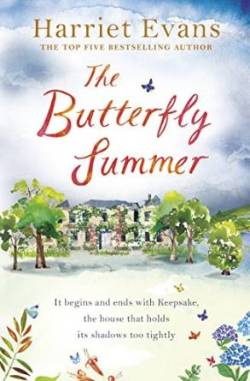
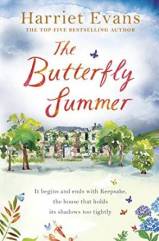
The Butterfly Summer by Harriet Evans

Butterfly Summer

My enormous thanks to Love Reading for an advanced reader copy of The Butterfly Summer by Harriet Evans in return for an honest review. The Butterfly Summer is published Headline Review on 19th May 2016 and is available from Love Reading, direct from the publisher, from Amazon UKWaterstones and all good bookshops.

The Butterfly Summer

What magic is this?

You follow the hidden creek towards a long-forgotten house.

They call it Keepsake, a place full of wonder … and danger. Locked inside the crumbling elegance of its walls lies the story of the Butterfly Summer, a story you’ve been waiting all your life to hear.

This house is Nina Parr’s birthright. It holds the truth about her family – and a chance to put everything right at last.

My Review of The Butterfly Summer

Butterfly Summer

When Nina Parr meets a curious old woman in the London Library, little does she realise how this meeting will reverberate through her future – and her past.

I loved The Butterfly Summer. It’s a curious book in that it seems quite straightforward initially and then it twists and turns back in time to ensnare the reader in the narrative history and the characters’ lives, almost against their will. There’s a dual story that is completely absorbing so that all the characters, even the more minor ones like Malc, are gradually uncovered and emerge rather like the butterflies from their chrysalises in an iterative image that weaves throughout. I had to concentrate to start with to keep up with all the characters and the timescales, but once I got into the rhythm of the narrative and its various layers I couldn’t tear myself away from The Butterfly Summer.

It might sound mad, but reading The Butterfly Summer made me think of a DNA strand because everything was so beautifully linked but at any point a lie, a coincidence, a choice could affect the future outcome in the same way a chromosome might affect a person.

Harriet Evans’s writing is just perfect. There’s such atmosphere that is so mesmerising. She has an eye for detail that brings alive every nuance of feeling and every image of setting in vivid relief. Her themes are universal and personal so that she lays bare sexuality, power, control, nature, happiness, selfishness, grief and, especially, family relationships, in a complex and intricately well plotted read.

All I can say is thank goodness for the epilogue, which, whilst I sobbed my way through it, made me thoroughly happy. You’ll have to read the book to find out why!

About Harriet Evans

Harriet Evans

Harriet Evans is the author of eight previous novels, Going Home, A Hopeless Romantic, The Love of Her Life, I Remember You, Love Always, Happily Ever After, Not Without You and A Place for Us.

You can find out more about Harriet Evans on her web site, follow her on Twitter and find her on Facebook.

There are more reviews from other Love Reading panel members here.

Author Interview with Guy Fraser-Sampson

DiPcover1

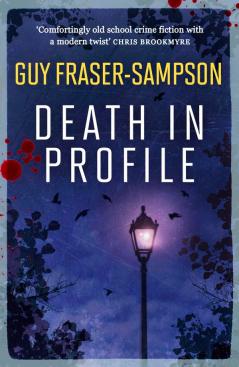
I’m an enormous fan of the independent publisher Urbane Publications so I’m delighted to be featuring another of their authors, Guy Fraser-Sampson, whose novel Death in Profile is published today 28th March 2016. Death in Profile is available to buy on Amazon UKAmazon US, from WaterstonesUrbane and all good book shops.

I asked Guy a few questions about his writing and career:

Hello Guy and thank you so much for agreeing to be interviewed on Linda’s Book Bag.

You have quite an eclectic background Guy; lawyer, speaker, writer, teacher – if you had to define Guy Fraser-Sampson in a couple of sentences, what would you say?

I suppose you could say I’m a Renaissance man, but that would be both glib and rather pretentious. Let’s just say that I have a very low boredom threshold which means that I’m constantly in search of a new challenge. In the process, I’ve found that there are quite few things I can do reasonably well. I’m sure other people would find the same thing if they tried, but they don’t. But it’s interesting that there is this urge to classify people, to put them in a box and stick a label on it. Interestingly, the same thing happens in finance and investment, which are two of my specialist areas.

Which of your roles have you found the most challenging and which the most rewarding and why is that?

I think being a writer in the most challenging as you need a lot of both self-discipline and self-reliance. Also, at the end of the day it’s not about what you can write but what you can get published (something many writers overlook!). I find being an educator the most rewarding. I teach mostly on the MBA programme, which is being taken by people who are looking to change their lives, often in quite significant ways, and it’s exciting to be able to help them do that.

Which is most interesting or challenging to research, your non-fiction titles or your fiction?

Non-fiction is the most challenging, although I apply the same standards to my fiction as well. For example, every period detail in my Mapp & Lucia books is correct, even down to people’s names.

You write non-fiction articles for a range of European magazines and clients. How do audiences differ in different countries?

They do differ across geography. The Dutch and the Australians, for example, have very different ways of providing pensions. The most difficult article I ever wrote, though, was for ‘Your Money’ and was explaining something very complex in simple terms which hopefully anyone can understand. I wrote a book called No Fear Finance which does the same thing.

No Fear

Your debut detective work of fiction Death in Profile is out on 28th March. How did you go about changing genre?

I have always wanted to write detective fiction, but I was very nervous about writing ‘just another detective book’, especially as in my view they have all become rather similar. I didn’t see any point in writing noir or in creating yet another damaged detective with a drink / drugs / gambling problem and a broken marriage.

I spent a long time doing market research among book bloggers, book shop managers and serious readers as to what they would like to see in a crime novel. There was a surprising level of consensus, and I have tried to stay true to it. Interesting, likeable characters who have to face up to and resolve real life issues. Good police procedural background. No gratuitous sex, violence or bad language. Above all, a book which treats its readers as mature, intelligent and well-read.

Death in Profile is the first in the Hampstead Murders series. Have you planned several books already or are they emerging organically?

One could get into a very arcane discussion about what is or is not a ‘series’. In my view it should be one long narrative spread across several books. Very few detective ‘series’ would qualify under this description, though Wallender might be an obvious one which does, mixing professional and personal issues. I can see the argument for writing stand-alone books featuring the same characters because then it doesn’t matter in which order people read them but again, I wanted to be different.

All my fiction evolves organically. I just create my characters and then let them take me where they will, and it’s important that you should trust that process. It’s only by being prepared to follow them into some dark places that your writing has integrity. All I know when I begin a detective novel is who the criminal is going to be. Everything else comes to me as I write, though obviously you carry a few ideas with you about method and motive.

Why did you decide to show the more personal side of the police in the Hampstead Murders series?

I think this goes back to wanting to be different. I wanted to create a cast with whom the reader can empathise, and care about what happens to them as they go through life. In order to do this, you have to set them against a personal background. The more of the books you read, the more deeply you will understand, and hopefully like, the characters.

You’re publishing Death in Profile with an independent publisher Urbane Publications. What has it been like working with a smaller, independent outfit?

I have published over a dozen books now with various publishers, including some very big ones like Wiley and Macmillan. I really enjoy working with small, independent publishers like Urbane. First, because you know that you really are important to them. Second, because they are much better at promotion than the big boys. Third, because the person you are dealing with is usually a decision-maker rather than having to refer everything to some committee (often in America).

Given your prolific writing experience, what three pieces of advice would you give to an aspiring writer?

  1. Have a very thick skin. Unless you are prepared to handle constant rejection (it helps if you’re a man, because you have probably learned all about this already!) and occasionally downright nasty criticism, then please don’t become a writer. I have known some fellow writers get deeply upset and even badly depressed about this.
  2. Be clear about why you are writing. Are you doing it for pleasure or money / recognition? If the latter, then be sensible. Work out what the big commercial publishers are looking for and then supply it, because they need to be able to tick their boxes: it’s the way they think. Get an agent, because, rather stupidly, they won’t even look at your work unless you do (if you think about it, of course, it should be the other way round). Say “gosh, what a good idea” to anything they suggest. Pretend to be blown away by other books they publish, no matter how bad you think they are. Let them re-write your book if they want to.
  3. Be persistent. Many good books get rejected, sometimes many times. Arthur Conan Doyle in his early days used to write what he called ‘homing manuscripts’ because they kept getting sent back. You must have the self-belief to keep trying. No Fear Finance was rejected by Wiley (even though I had previously written a best-seller for them) but accepted by Kogan Page. All my fiction was rejected by many publishers before being accepted. Harry Potter was rejected by several, including Macmillan. Mary Wesley and Barbara Pym were rejected not just for years but for decades Incidentally, if I could make just one change to the publishing industry it would be that every book should begin with a list of the publishers who had rejected it. After all, if they have confidence in their judgement, then why should they mind?

How do you carry out the research for your novels?

These days I use the internet a lot, though I write surrounded by books and am often jumping up to check some point or other.

Which aspects of your writing do you find easiest and most difficult?

Writing a book is the easiest part. Getting it published is the most difficult. For this reason, I try not to put any significant work into a book these days unless I know that a specific publisher has serious interest in it. Even then you can come unstuck. I had one publisher commission a three volume history of the Plantagenets, but go bust just as the first one was going into production. (I still have it, if anyone is interested!)

What are your writing routines and where do you do most of your writing?

I write in my study, which sounds rather grand but is just a spare bedroom with a desk and some books. I tend to work best early in the morning, or in the middle of the day. I’m lucky in that I never need to re-write anything. My first draft is also my final draft; I only correct for spelling, punctuation and repetition.

When you’re not writing, what do you like to read?

I grew up in a house without television, and do so again now, so I have always been a voracious reader. I reckon I’ve probably read about 10,000 books, and it’s also why I am a fanatic supporter of public libraries. Edgware library was my teen years!

I read a lot of non-fiction, particularly history. My fiction tastes are pretty catholic, my favourite novel being The Alexandria Quartet, which I have read about ten times. In contemporary crime fiction I go either for writers who are very different and quirky, such as Christopher Fowler, Chris Brookmyre or Malcolm Pryce, or just damn fine writers like Ruth Dugdall. I also read and collect a lot of Golden Age stuff, my overall favourite being Ngaio Marsh, about whom I am talking at CrimeFest this year.

(If readers would like to know more about CrimeFest, please click here.)

Do you have other interests that give you ideas for writing?

Yes, and I think if you don’t do this then your writing will probably suffer for it. For example, in Miss Christie Regrets, the second of the Hampstead Murders series which I am writing at the moment, there is already music (Schumann), Golden Age fiction (Ngaio Marsh and Agatha Christie), architecture (Gropius and Wells Coates), and, of course, lashings of Hampstead locations.

If you hadn’t become an author, what would you have done instead as a creative outlet?

I enjoy both listening to and making music. I actually flirted with the idea at one stage of becoming a professional singer. My talks are also creative. I don’t use notes, I just improvise – trying doing that for an hour …

Which of your characters would you most like to be and why?

One reviewer said rather perceptively that my favourite Mapp and Lucia character appeared to be Mr Wise, and on reflection that may be right. I like to think there’s a lot of me in Simon Collison from The Hampstead Murders, but then there’s also something of myself in Peter Collins. I certainly admire his eccentricity and rather lofty disdain for mundane everyday issues!

If one of your books  became a film, which would you choose and why?

I strongly believe that The Hampstead Murders will make a terrific TV series, with Collison’s Hampstead playing the part of Morse’s Oxford or Foyle’s Hastings. Apart from a very strong sense of place, it has some wonderful characters.

How important do you think social media is to authors in today’s society?

It’s obviously hugely important, though you need to think deeply about how you use it. There is a very fine line between making people aware of something once, and in a polite manner, and making a nuisance of yourself.

If you had 15 words to persuade a reader that a Guy Fraser-Sampson book should be their next read, what would you say?

My books are quirky, intelligent and entertaining, and are endorsed by fellow writers.

About Guy Fraser-Sampson

Guy

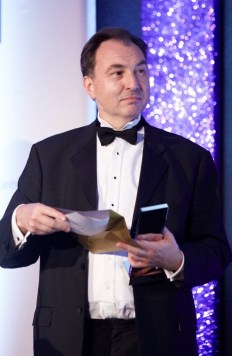
Guy Fraser-Sampson has been a corporate lawyer, an investment banker and a business school academic, in which capacities he has written various books on finance, investment and economics. However, he is best known as a writer of fiction, and his three Mapp & Lucia novels have all been optioned by BBC television. His new book “Death in Profile”, published by Urbane, is the first in a series called The Hampstead Murders and harks back, sometimes explicitly, to the Golden Age. He appears regularly on radio, television and at literary festivals. He is married with two grown-up sons and divides his time between London (NW3 naturally) and East Sussex.

You can follow Guy on Twitter and visit his web site.

Talking Lad-Lit with Steven Scaffardi

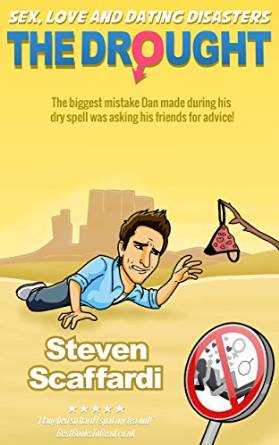
Drought

When I encountered Steven Scaffardi on Book Connectors and he asked if I’d be interested in his books I have to admit to being slightly cautious. What was this genre of Lad-Lit he writes? Well, the best way to find out is to ask and so I’m delighted that Steven has agreed to provide a definition in his guest post below.

The Drought

Steven Scaffardi’s The Drought is the laugh-out-loud tale of one man’s quest to overcome the throes of a sexual drought. After the stormy break-up with his girlfriend of three years, Dan Hilles is faced with the daunting task of throwing himself back into the life of a single man. With the help of his three best pals, Dan is desperate and determined to get his leg-over with hilarious consequences!

The Drought is available on Amazon.

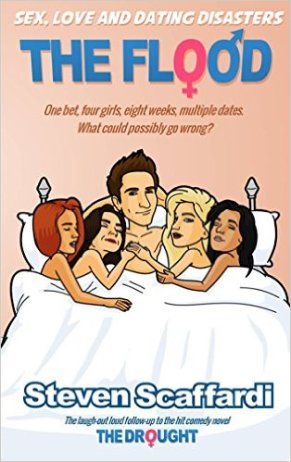
The Flood

Flood

The follow-up to The Drought, The Flood, is now available to pre-order for just 99p on Amazon. It will be released as an eBook on April 30 and the paperback will be available on May 19.

One bet, four girls, eight weeks, multiple dates. What could possibly go wrong?

Following his traumatic eight month dry spell, Dan Hilles is back in the driving seat and ready to put his dating disasters behind him.

But if only it were that simple.

After a drunken afternoon in the pub, fuelled by the confidence of alcohol, Dan makes a bet with his three best pals that will complicate his love-life more than ever when he brazenly declares that he could juggle multiple women all at the same time.

With just eight weeks to prove his point, Dan is about to find out how hard it is to date a flood of women without them all finding out about each other, especially when they come in the shape of an ex-girlfriend, a stalker, the office ice queen and the one that got away.

———-

What is Lad Lit…?

A Guest Post by Steven Scaffardi

Lad lit is a bit like the literary black sheep of the family. It’s made a few mistakes in the past and it is still paying for it now. It’s not like it hasn’t tried making amends, but it just seems that people don’t want to listen. If only they’d give it a second chance.

Even Wikipedia, that bastion of internet information, seems to be so upset that if you type ‘lad lit’ into their search box, it can’t even bring itself to refer to it by its rightful name in the first line of its description of the genre:

“Fratire” is a type of 21st-century fiction literature written for and marketed to young men in a politically incorrect and overtly masculine fashion.

Fratire? What the hell is fratire?! The sentence ‘a type of 21st-century fiction literature’ implies it’s not willing to attribute the fact that it is a real genre. It’s as good as calling it ‘a so-called fiction literature’ with as much contempt as you can muster. And what’s with the patronising inverted commas, used I’m sure in the same way like one of those annoying people who insist on holding their two fingers in the air and bending them down at the precise moment they utter a word that is unworthy of being part of the sentence leaving their mouth?

There is no doubt about it – Wikipedia does not like lad lit, and when the biggest encyclopedia in the world has an issue with you, what chance have you got?

Oh, you think I’m being over the top or too sensitive? Okay, let’s type ‘chick lit’ into the Wikipedia search box and see what it has to say about lad lit’s older, more respected sibling:

Chick lit or Chick literature is genre fiction which addresses issues of modern womanhood, often humorously and lightheartedly.

Hmmm, no inverted commas, the correct use of their name, no disdain pouring out from every syllable, just a pleasant and respectful description that makes you want to read a bit more, which is more than we can say about that awful little oik of brother of yours.

So what did lad lit actually do? Well, it uses the word ‘lad’ for a start; a word normally found loitering around in low-brow environments such as lads mags.

But what if lad lit was given a clean slate? What if the next time you saw those two little words you decided to give it a chance rather than dismiss it out of hand immediately? You’d be pleasantly surprised.

That’s why I started #LadLitSunday; a social media initiative to highlight the great work being written by lad lit authors. When you start to compile a list of authors leading the way in the genre, it’s hugely impressive.

Tony Parsons, Mike Gayle, Nick Spalding, Matt Dunn, Danny Wallace, Jon Rance.

Nick Hornby.

 Just last month the undisputed king of lad lit was rubbing shoulders with Hollywood’s elite as he was nominated for a Best Screenplay award for a second time, hot on the heels of his Bafta win just a week before.

It was another accolade for the man who brought to life the Arsenal 1989 title winning season in a more romantic way than Michael Thomas’ winning goal itself, not to mention the brilliant Rob Fleming in High Fidelity. Fleming epitomised everything you have been told to hate about lad lit characters. As Wordspy.com, lad lit is: A literary genre that features books written by men and focusing on young, male characters, particularly those who are selfish, insensitive, and afraid of commitment.

Well you know what? Fleming was selfish, insensitive, and afraid of commitment, but it was for all of those reasons that Hornby’s book became such a huge success; transformed into a big screen adaption and musical.

Lad lit might not always conform to the chick lit rule of HEA, but it pays it a huge compliment by being the prelude to the HEA. If book genres were a diet then lad lit would be the ‘before’ picture and chick lit would be the ‘after’ image.

In my Sex, Love and Dating Disasters series I love exploring the hilarious situations people can relate to before they find that perfect partner. Lad lit is that awkward first date you still tell your friends about 10 years later. It’s the boyfriend you will forever wonder what was I thinking when I got with him? It’s what puts the com in romcom!

 I recently interviewed Matt Dunn, best-selling author of The Ex-Boyfriends Handbook, and asked him to explain how male writers tackle a similar genre to our female counterparts differently. He said: “Personally, I think we just tell it how it is from our point of view. Or rather, how we see it. Which is kind of how it is, if you believe all that ‘perception is reality’ bollocks. Which I do, obviously.”

And that, in a nutshell, best sums up what lad lit is really about – a story told from a different perspective; not necessarily politically incorrect or overtly masculine fashion, and it certainly doesn’t always feature characters who are selfish, insensitive, and afraid of commitment.

So in the true fashion of those of you who love reading or are about to embark on a new book challenge, next time you happen to be sitting around one Sunday afternoon looking for that next book, promise me you’ll check out the hashtag #LadLitSunday and you might just find that alternative HEA you have been looking for.

Steve

You can follow Steven on Twitter and visit his blog.


Interview with Black to White author Sam Hayward

Black to white

Having had a difficult few months whilst my husband got clear of cancer at the end of 2015 and the beginning of 2016, it is a subject close to my heart. When I discovered that Sam Hayward had written a book, Black to White, in which Susie Chester has just lost her husband to cancer, I felt I had to ask Sam about it.

Black to White

Black to white

Sam Hayward’s debut novel Black to White is a fictional portrayal of loss, hope, love and renewal. It can be ordered from all good bookshops and from Sam’s website.

Through darkness comes light, through fear comes love and through pain comes triumph.

Grieving widow Susie Chester is trying to turn her life around with a little help from Peter, her gardener, who just might be her Guardian Angel – or a product of her imagination.

When fifty-five year old Susie Chester’s husband dies, her world falls apart, and although she lives in beautiful surroundings, she doesn’t know how she’ll cope alone. Then, after a chance meeting with Peter, her life slowly starts to change. He works for her as her gardener and, although she finds him mysterious, she feels inexplicably drawn to him. Has she met him somewhere before? Why does he feel so familiar?

Soon afterwards, white feathers begin to appear around the house. At first she finds them intriguing, but then they start to bring her comfort…

An Interview with Sam Hayward

Hello Sam. Thank you so much for agreeing to answer some questions on my blog about your debut novel Black to White.

Firstly, please could you tell readers a little about yourself?

I grew up in a town called Waterlooville on the outskirts of Portsmouth.  I was a very imaginative child, often making up stories about invisible animals that only I could see.  At primary school, my friends would frequently ask if they could see them too, so I said only if they were very nice to me.  Needless to say, I instantly became very popular.  My love of storytelling stayed with me and I knew that one day I would become a writer.  When I left school, I went to secretarial college.  It wasn’t what I wanted to do, but it was a career that most women followed in the ‘70s.  I returned to full-time education in the early ‘90s to study for a degree in journalism.  A few years before this, I had met my husband.  We knew instantly that we were meant for each other so decided to live together before getting married six years later.  We moved to Somerset in 2000 where we lived in an idyllic country cottage.  Then, after seventeen wonderful years together, at the age of 55, I was widowed.  It was the most devastating experience of my life.  In 2012 I enrolled on a postgraduate course in creative writing at Bath Spa University and finally fulfilled my aim of writing a novel.

Black to White is based on your own experiences after losing your husband to cancer. How difficult or cathartic was it to write?

It was extremely cathartic.  I knew that if I could express my feelings in words, it would help me.  I obviously struggled at the beginning because that was the most painful part of the story, but from there on it got easier.  I injected a lot of myself into the protagonist, Susie Chester, who I decided would be strong and positive.  I was determined that she would find happiness again.

You’ve written in the first person. Did doing so help your own grieving process or was that just an approach that felt natural to you?

I think writing in the first person was a more powerful way to convey Susie’s emotions.  It just felt right.  It also enables the reader to get closer to her.  Yes, it helped me enormously, but I wasn’t actually conscious of this until I finished the novel.

Having had my own husband diagnosed with cancer (and now thankfully free from it) when I was 54, Black to White is a book I haven’t been able to bring myself to read yet. What would you say to encourage me to do so?

The essence of the book is summed up in the sentence on the cover: ‘Through darkness comes light, through fear comes love and through pain comes triumph.’  It’s a story about overcoming adversity.  I think you would find it uplifting.  All of my friends who’ve read it said they enjoyed it.  Some of them have experienced loss but the majority haven’t.

There’s a level of spirituality in Black to White. How much has your own attitude to spirituality changed since writing the book?

After my husband died, I gave serious thought to the possibility of an afterlife.  I wanted to know where my husband was.  Sometimes I could sense him around me.  It was as if he still existed but I couldn’t see him.  I then started finding the feathers which I felt were a gift, either from him or my guardian angel.  I now believe that there is an ultimate force for good which we are all a part of.  I think about this a lot and feel certain that there is a sublimely beautiful and peaceful place that we go to when we die.  This was my view before writing my book and I can only say that since writing it, I am more convinced.

How did you feel when you sent Black to White off for editing given that it has such personal resonances?

I didn’t give it much thought at all.  It’s a work of fiction so how it’s interpreted is up to the reader.

What advice would you give to those suffering grief and considering writing about it?

Do it!  It really is the best form of healing.  I found writing and then reading about my feelings far more beneficial than just talking about them.

It’s no secret that white feathers are integral to the story and to your own life. Are you still finding them and how do they make you feel.

I’ve moved twice since I started finding the feathers so have only found a few in recent years.  One appeared on the kitchen floor of my previous house just after I’d moved in and then on a chest of drawers in my bedroom.  I moved to my current house last August and found one about two weeks ago.  It appeared on the sofa right next to where I was sitting.  They still surprise me and bring me joy.  I take them as a sign that I’m doing the right thing.

I’m sure you are Sam. Thank you so much for being on Linda’s Book Bag and sharing what is a very personal experience with me.

You can find Sam on Twitter and on her web site.

The Song Collector by Natasha Solomons

image003

I’m thrilled to be part of the paperback launch celebrations for Natasha Solomons’ The Song Collector which was published by Sceptre, an imprint of Hodder Books, on 24 March 2016, in paperback and ebook. It is also available in hardback. The Song Collector is available directly from the publisher, WaterstonesAmazon USAmazon UK and from all good bookshops.

I’ve only just had time to begin reading The Song Collector, but I already love it. I’m also honoured to have a guest post below from Natasha all about the cinematic means of setting scenes in which you can get a glimpse of the beauty of her writing.

About The Song Collector

Fox, as the celebrated composer Harry Fox-Talbot is known, wants to be left in peace. His beloved wife has died, he’s unable to write a note of music, and no, he does not want to take up some blasted hobby.

Then one day he discovers that his troublesome four-year-old grandson is a piano prodigy. The music returns and Fox is compelled to re-engage with life – and, ultimately, to confront an old family rift. Decades earlier, Fox and his brothers return to Hartgrove Hall after the war, determined to save their once grand home from ruin. But on the last night of 1946, the arrival of beautiful wartime singer Edie Rose tangles the threads of love and duty, which leads to a shattering betrayal.

With poignancy, lyricism and humour, Natasha Solomons tells a captivating tale of passion and music, of roots, ancient songs and nostalgia for the old ways, of the ties that bind us to family and home and the ones we are prepared to sever. Here is the story of a man who discovers joy and creative renewal in the aftermath of grief and learns that it is never too late to seek forgiveness.

image003

Praise for The Song Collector

‘A delightful, moving, utterly believable family saga.’ The Times

‘Takes you quietly by the hand and introduces you to such brilliantly portrayed characters, nuanced conversations and feelings, a true sense of place. Time and again I marvelled at the way Natasha Solomons unveils a quite complex plot with unerring confidence that makes it all click into place so logically.’ New Books & nudge

‘Packed with beautiful writing and marvellously conceived characters, The Song Collector moves effortlessly between the threadbare riches of England’s postwar country house society and the discordant ambitions of modern life, all bound together by a timeless love story that will break you and heal you.’

Beatriz Williams, New York Times bestselling author of A Hundred Summers

‘A tender, lyrical novel of family and fame.’ The Express

‘This novel is a profound story of love, loss and reconciliation. A captivating read that examines the power of music.’ Lady

Setting the Scene

A Guest post by Natasha Solomons

I don’t think I have a photographer’s eye – I have the dubious skill of missing out people’s heads whenever I take a snap – I think I’m probably more influenced by cinema. My first editor once commented on how I carefully light every scene. I do think in terms of scenes – I hear the characters speaking in my mind, and I see how they move – those tiny gestures that reveal emotion, the glance away, the irritable stirring of a teacup. Objects too can become infused with emotion. I’ve always loved the Philip Larkin poem ‘Home is so Sad’: ‘Home is so sad./ It stays as it was left,/Shaped to the comfort of the last to go/As if to win them back… You can see how it was: /Look at the pictures and the cutlery./ The music in the piano stool. That vase.’

I love the final line: ‘That vase’. It’s so simple, an unremarkable phrase and yet its specificity within the poem makes it oddly moving and also cinematic. I always picture ‘that vase’ left on the table in the empty house gathering dust – but as the camera in my mind lingers on it, I know that once ‘that vase’ meant something to someone. An entire narrative is implied in those two ordinary words. What was it? I imagine a different story each time I read the poem.

When I write a scene I know how much can be suggested by the inclusion of an object familiar to the reader. In ‘The Song Collector’ entire landscapes are suffused with significance for Fox: his creativity is bound up with his sense of home and the hills around Hartgrove. The description of landscape in the novel is never simple – it usually evokes Fox’s conflicting desire to write music and to care for the estate. It’s also a landscape that he lived in with Edie so that after her death the places themselves are imprinted with longing and loss: he sees his earlier shadow on the hills.

I’m fascinated by the connection between music and place. Will Hodgkinson writes that music has a regional accent and I love that idea. A folk song found in Dorset has a different feel to one sourced in Isla. Sibelius or Delius write music deliberately to evoke a specific place but in my novel the Wessex Ridgeway and the dark trees leach into Fox’s music unconsciously. Anteus like his strength comes from the earth of home. He struggles to write away from Hartgrove. He borrows the folk tunes he collects in a style similar to that of John Rutter or Vaughn Williams but the creative source of his internal music landscape is already a reflection of the Dorset landscape and hills that he’s loved through his life. This novel is about love: for a woman, for the songs of home and for the hills and copses of which they sing.

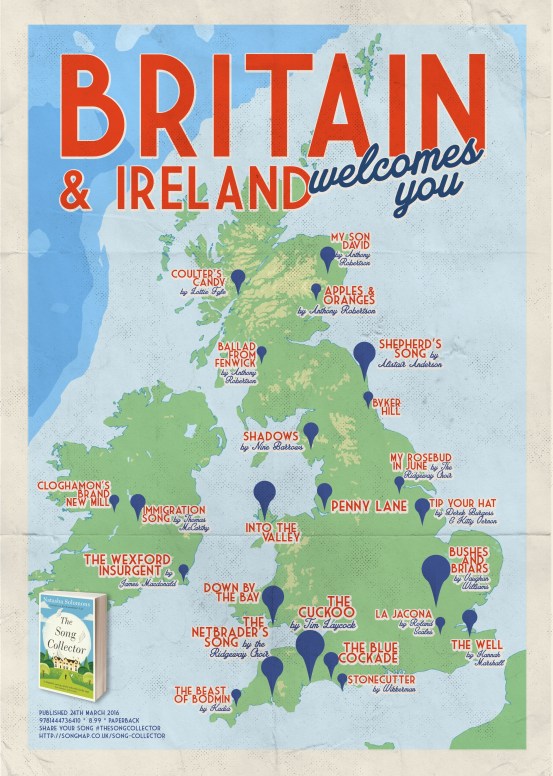
The Map of Songs from The Song Collector

Song Map

The history of Britain isn’t just written in books or notched upon the landscape in Holloways or long barrows, it’s also contained in song.

Since writing this novel, Natasha Solomons has been enchanted by the idea of song collecting. Inspired by the tradition, she has set out to create a portrait of contemporary Britain in song. Every hillside, village and city street has a song, some ancient and others new. Natasha is beginning a communal project to map as many songs as possible, put them up online freely available so that people can both listen to the music of their town, and if they like, learn their own local songs.

Natasha said:
‘It was a song about a blackbird that led me to write my new novel The Song Collector. I discovered that a song collector, alehouse keeper and mischief-maker lived in our cottage in the 1800s. The more I read about and listened to old songs from where I live in Dorset, I realised that I had to write a about a musician and song collector and his connection to the landscape – and woman — he loves.

As I wrote, I started to appreciate that songs are much like stories – one has to follow their rhythms and cadence. But, when I finished the book, I knew I wasn’t finished with song collecting. I’d been utterly caught. After all, there’s always one more song to find.
We now want to create a portrait of contemporary Britain in song. Every hillside, village and city street has a song, some ancient and others new. We want to start a communal project to map as many songs as possible, put them up online freely available so that people can both listen to the music of their town, and if they like, learn their own local songs. We’d love for you to get involved’

For more information on the Great British Song Map please contact Helene Frisby
helenefrisby@gmail.com

About Natasha Solomons

natcafe_400x400

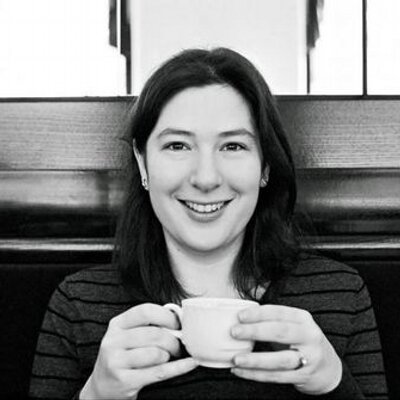
Natasha Solomons is the author of the internationally bestselling Mr Rosenblum’s List, The Novel in the Viola, which was chosen for the Richard & Judy Book Club, and The Gallery of Vanished Husbands. Natasha lives in Dorset with her son and her husband with whom she also writes screenplays. Her novels have been translated into 17 languages.

You can follow Natasha on Twitter and find out more about her on her web site and with these other bloggers:

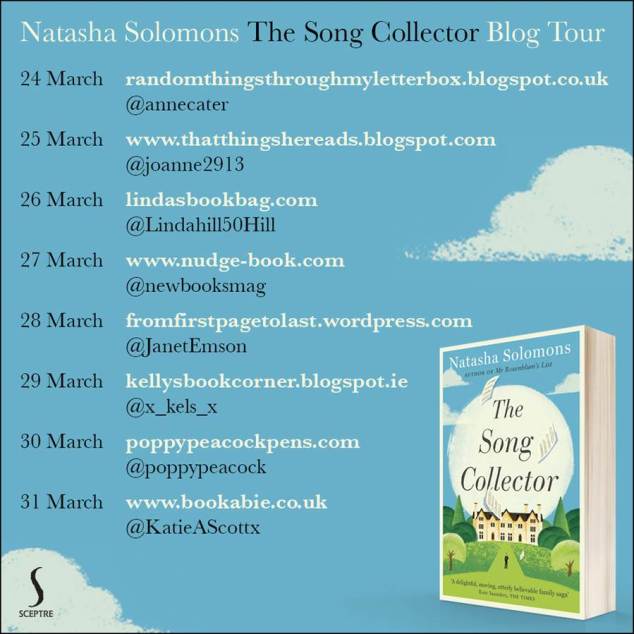
The Song Collector Blog Tour Poster