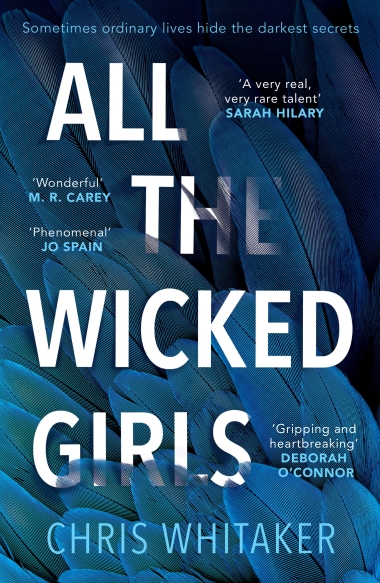
All The Wicked Girls by Chris Whitaker

all the wicked girls 2

I am indebted to Emily Burns for a copy of All The Wicked Girls by Chris Whitaker in return for an honest review. I thought Chris’s first novel Tall Oaks was fabulous and you can see my review of that book here.

All The Wicked Girls was published by Bonnier Zaffre and is available for purchase here.

All The Wicked Girls

all the wicked girls 2

Everyone loves Summer Ryan. A model student and musical prodigy, she’s a ray of light in the struggling small town of Grace, Alabama – especially compared to her troubled sister, Raine. Then Summer vanishes.

Raine throws herself into the investigation, aided by a most unlikely ally, but the closer she gets to the truth, the more dangerous her search becomes.

And perhaps there was always more to Summer than met the eye . . .

My Review of All The Wicked Girls

I previously read and loved Chris Whitaker’s Tall Oaks so I had extremely high hopes for All The Wicked Girls. I’d thought Tall Oaks was exceptional but All The Wicked Girls surpasses it and is sublime. What a writer Chris Whitaker is. He can show such depth through even the shortest of sentences so that I found myself on a complete roller coaster of emotion. I laughed. I wept. My heart broke for so many of those between its pages that I’m not sure I’ll ever be the same again. Several times I exclaimed aloud, most frequently for Raine, Noah and Purv, but also for Savannah, Black and Peach and indeed for just about every character between the pages of All The Wicked Girls.

In the same way the storm cloud gathers, the pages glower with suppressed violence, secrets and tension so that it is impossible to stop reading. When I slept I dreamt of the characters as they had pervaded my soul so deeply.

The religious fervour and belief, the deceptions and the love that Chris Whitaker reveals are almost too much to bear. I found his writing utterly heartbreaking, especially through Raine’s desperation to find Summer and the relationship between Purv and Noah because they are indeed they are so brave, so fierce and so beautiful. I wanted to take these three into my arms and hold them close until all their hurts had gone.

The plot is fabulous. Small town America lends itself to the claustrophobic feel so that the events fit the setting perfectly. At times I almost couldn’t bear what I was reading. I can’t explain more about the plot without spoiling the read but rest assured it is gripping, absorbing and brilliant.

I defy anyone to read Chris Whitaker and not feel they have been touched by genius to their very soul. All The Wicked Girls is utterly, utterly wonderful and I don’t have sufficient words to do it justice.

About Chris Whitaker

chris

Chris Whitaker was born in London and spent ten years working as a financial trader in the city. When not writing he enjoys football, boxing, and anything else that distracts him from his wife and two young sons. Tall Oaks was his first novel.

You can find Chris on Twitter.

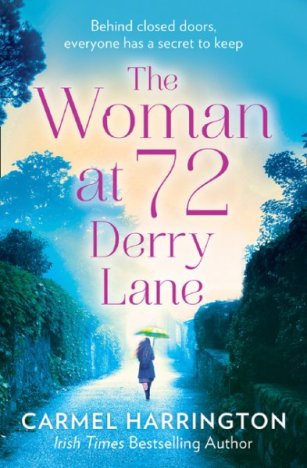
The Woman at 72 Derry Lane by Carmel Harrington

72 Derry Lane

My enormous thanks to Jaime Frost at Harper Collins for a copy of The Woman at 72 Derry Lane by Carmel Harrington in return for an honest review. I so loved Carmel Harrington’s The Things I should Have Told You and her guest post that you can read here, that I jumped at the chance to read The Woman at 72 Derry Lane despite another 900+ books in the queue!

Already available in e-book and audio, the paperback version of The Woman at 72 Derry Lane is published on 16th November 2017 by Harper Collins and is available for purchase through the links here.

The Woman at 72 Derry Lane

72 Derry Lane

On a leafy suburban street in Dublin, beautiful, poised Stella Greene lives with her successful husband, Matt. The perfect couple in every way, Stella appears to have it all. Next door, at number 72 however, lives Rea Brady. Gruff, bad-tempered and rarely seen besides the twitching of her net curtains, rumour has it she’s lost it all…including her marbles if you believe the neighbourhood gossip.

But appearances can be deceiving and when Stella and Rea’s worlds collide they realise they have much in common. Both are trapped in a prison of their own making.

Has help been next door without them realising it?

My Review of The Woman at 72 Derry Lane

Stella’s abusive husband Matt wants the impossible – a ‘perfect’ wife according to his definition of perfection – but life isn’t always perfect.

Well, well, well. Carmel Harrington has done it again. I adored every syllable of The Woman at 72 Derry Lane from the surprisingly violent opening to the final, utterly satisfying, word.

What makes Carmel Harrington’s writing so fabulous for me is her ability to involve the reader completely in the story. Before I was half way through I realised I had experienced so many emotions I was wrung out. I’d felt fear, humour, happiness, love and grief as acutely as if they were happening to me, let alone Stella, Skye and Rea.

There’s an irony in reading The Woman at 72 Derry Lane, because although it is ultimately a wonderful, life affirming read it actually made me dissatisfied with my life. I want to live in Derry Lane with Rea as my neighbour and I want Charlie as my hairdresser and Stella as my friend. The characters Carmel Harrington creates are so vivid, so real and so human that it’s impossible not to view them as real people. I felt as involved in their lives as if I were reading about my own experiences.

There are so many glorious layers to this story too, so that although love is very firmly at the heart of what Carmel Harrington writes, she isn’t afraid to tackle issues that might affect any one of us or someone we know. I thought Rea’s agoraphobia and Stella’s compliance in an abusive relationship were perfectly presented and so sensitively handled so that I understood them fully and empathised completely. I adored the way the threads of the story were woven together and as I don’t want to spoil the plot, I’ll just say the historical event was written fabulously with just the right level of detail.

Carmel Harrington is one of the best writers of emotionally involving narratives around and The Woman at 72 Derry Lane is her writing at her most outstanding. I absolutely adored this book.

About Carmel Harrington

carmel-harrington

Carmel Harrington is the bestselling author of The Life You Left and Beyond Grace’s Rainbow, voted Romantic eBook of the Year 2013.

Carmel lives with her husband Roger and children Amelia and Nate in a small coastal village in Wexford. She credits the idyllic setting as a constant source of inspiration to her. Carmel has the nickname, ‘Queen of Emotional Writing’.

Carmel writes emotional family dramas that share one common theme – strong characters who find themselves in extraordinary situations. She loves to dig deep and see how they cope, as they grapple with life-changing moments.

She is a regular on Irish TV and radio. Carmel is also a popular motivational keynote speaker, at events in Ireland, UK and US.

You can follow Carmel on TwitterFacebook and her website.

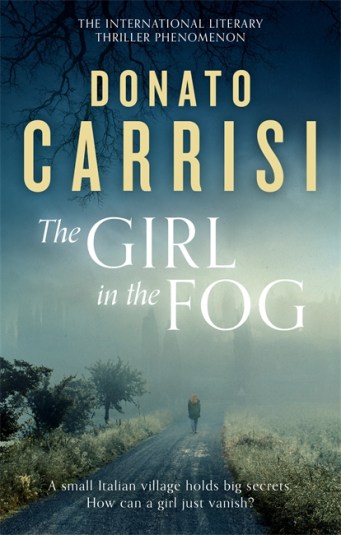
The Girl in the Fog by Donato Carrisi

girl in the fog

My grateful thanks to Hayley Camis at Little Brown for a copy of The Girl in the Fog by Donato Carrisi in return for an honest review.

The Girl in the Fog was published in the UK by Abacus, an imprint of Little Brown, on 2nd November 2017 and is available for purchase here.


The Girl in the Fog


girl in the fog

Sixty-two days after the disappearance . . .

A man is arrested in the small town of Avechot. His shirt is covered in blood. Could this have anything to do with a missing girl called Anna Lou?

What really happened to the girl?

Detective Vogel will do anything to solve the mystery surrounding Anna Lou’s disappearance. When a media storm hits the quiet town, Vogel is sure that the suspect will be flushed out. Yet the clues are confusing, perhaps false, and following them may be a far cry from discovering the truth at the heart of a dark town.

My Review of The Girl in the Fog

Detective Vogel is searching for missing Anna Lou Kastner and he’ll stop at nothing to solve the case.

The Girl in the Fog is a cracker of a book. Sublimely plotted it takes the reader on a roller coaster of a narrative. Of course I had it all worked out and of course I was completely wrong. Donato Carrisi leads the reader to erroneous conclusions with the same skill Vogel leads his investigations. The tension builds so that I kept telling myself I’d just read one more page until the whole book was devoured. I also need to say something about the quality of translation as not once did it feel as if I were reading a translated story. The prose flowed effortlessly, creating atmosphere and character exceedingly well and this is partly down to the skill of Howard Curtis too. I so appreciated the image of the fog, from the actual weather conditions when Anna Lou goes missing through the obfuscation of fact and lies to the foggy memory Vogel appears to have at the start of the book.

It’s always difficult to review this kind of thriller without giving away too much of the plot, so I’ll just say that I found it tightly written and very disconcerting, particularly the ending. It’s safe to say that we never really know our fellow human beings.

What is so engaging and clever about Donato Carrisi’s writing is his ability to create tension. My heart rate increased towards the end so that The Girl in the Fog truly is a thrilling read.

Although Anna Lou is the catalyst for events, she is barely present. Instead we get a fascinating insight into the minds of several men, but especially Vogel. He is devious, intelligent and manipulative and makes the reader question morality and whether the end ever justifies the means. For me, the requirement to think, to judge and, ultimately to be duped, makes The Girl in the Fog a story I thoroughly enjoyed.

The Girl in the Fog is a really good thriller and I recommend it most highly.

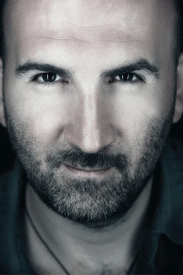
About Donato Carrisi

donato

Donato Carrisi was born in 1973 and studied law and criminology. He won four Italian literature prizes for his bestselling debut The Whisperer. Since 1999 he has been working as a TV screenwriter, and he lives in Rome.

You can follow Donato Carrisi on Twitter @DonatoCarrisi and visit his website.

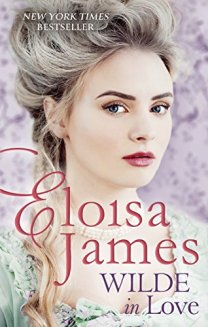
Wilde in Love by Eloisa James

Wilde in Love

I’m delighted to be part of the launch celebrations for Wilde in Love by Eloisa James and to share my review today. My grateful thanks to Clara Diaz for inviting me to take part and providing a copy of Wilde in Love for review.

Published on 31st October 2017 by Piatkus, an imprint of Little Brown, Wilde in Love is available for purchase here.

Wilde in Love

Wilde in Love

The first book in Eloisa James’s dazzling new series set in the Georgian period glows with her trademark wit and charm. Things are about to get Wilde . . .

Lord Alaric Wilde, son of the Duke of Lindow, is the most celebrated man in England, revered for his dangerous adventures and rakish good looks.

Arriving home from years abroad, he has no idea of his own celebrity until his boat is met by mobs of screaming ladies. Alaric escapes to his father’s castle, but just as he grasps that he’s not only famous but notorious, he encounters the very private, very witty, Miss Willa Ffynche.

Willa presents the façade of a serene young lady to the world. Her love of books and bawdy jokes is purely for the delight of her intimate friends. She wants nothing to do with a man whose private life is splashed over every newspaper.

Alaric has never met a woman he wanted for his own . . . until he meets Willa. He’s never lost a battle.

But a spirited woman like Willa isn’t going to make it easy . . .

My Review of Wilde in Love

When he arrives back in England to notoriety after years abroad, Lord Alaric Wilde might find the greatest challenges lie closer to home than he imagined.

Oh my goodness. I haven’t read a book in this genre for ages and Wilde in Love has made me realise just what I’ve been missing. I thoroughly enjoyed this romp through a Georgian house party with Willa and Alaric.

Eloisa James conjures her country house part setting perfectly with a fabulous blend of characters and social mores so that I honestly felt like a fly on the wall. The costumes, manners and behaviours have all been so brilliantly researched that the era comes to life with vivid clarity. Willa’s inversion of convention brings these aspects into even sharper focus and the time delineated house party adds zest and pace to the story.

I loved the wordplay and wit, especially between Will and Aleric, so that the dialogue reminded me of a combination of Jane Austen and Oscar Wilde and made me smile frequently. Occasional references to Shakespeare, John Donne and Rousseau all added depth and quality to the read too and I enjoyed spotting the allusions in what is a really well researched picture of the Georgian era. The settings all have just the right level of details to afford the reader a clear and vivid image in the mind’s eye.

Alongside a certain inevitability to the plot there are twists and turns with potential for future books and I’d certainly want to read them, not least because I found the underpinning and mounting sexual tension hugely entertaining and engaging.

Wilde in Love was enormous fun to read, sparkling and witty, and a must read for lovers of historical, humorous and romantic fiction. I thought it was brilliant.

About Eloisa James

eloisa james

Eloisa wrote her first novel after graduating from Harvard, but alas, it was rejected by every possible publisher. After she got a couple more degrees and a job as a Shakespeare professor, she tried again, with much greater success.

Over twenty best-sellers later, she teaches Shakespeare in the English Department at Fordham University in New York City. She’s also the mother of two children and, in a particularly delicious irony for a romance writer, is married to a genuine Italian knight.

You can follow Eloisa on Twitter @EloisaJames, visit her website and find her on Facebook.

There’s more with these other bloggers too:

A Letter to Myself by John Marrs, Author of The Good Samaritan

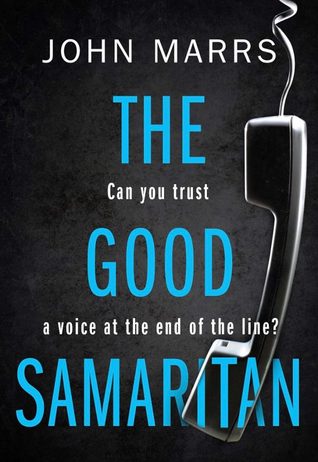
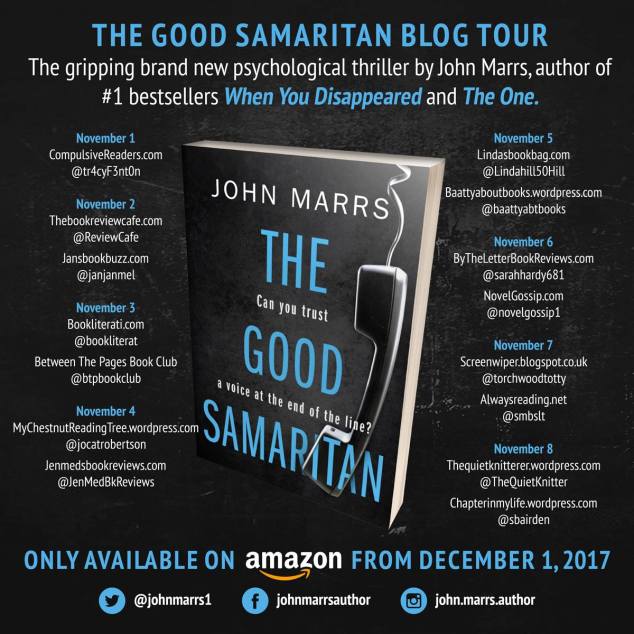
Cover

I’m thrilled to part of the launch celebrations for The Good Samaritan by John Marrs. I was lucky enough to read and review here another of John’s books, The One, which has become an enormous success and to interview John too here. When I was asked if I’d like to participate this time, I was desperate to know what John might tell himself with hindsight and luckily he agreed to write a letter to himself to tell me!

The Good Samaritan is available for purchase here.

The Good Samaritan

Cover

The people who call End of the Line need hope. They need reassurance that life is worth living. But some are unlucky enough to get through to Laura. Laura doesn’t want them to hope. She wants them to die.

Laura hasn’t had it easy: she’s survived sickness and a difficult marriage only to find herself heading for forty, unsettled and angry. She doesn’t love talking to people worse off than she is. She craves it.

But now someone’s on to her—Ryan, whose world falls apart when his pregnant wife ends her life, hand in hand with a stranger. Who was this man, and why did they choose to die together?

The sinister truth is within Ryan’s grasp, but he has no idea of the desperate lengths Laura will go to…

Because the best thing about being a Good Samaritan is that you can get away with murder.

A letter to myself, ten years ago.

A Guest Post by John Marrs

Dear John,

That makes it sound like I’m about to break up with you, doesn’t it? Well I’m not, so don’t worry. You and I are in this together, God willing, for the long haul.

You might be surprised to learn I’m actually writing this letter to you from ten years in the future. The year is 2017 and Donald Trump is president of America, Britain is leaving Europe, your musical heroes Prince, George Michael and Michael Jackson are all dead and the world’s most popular TV show is about dragons. No, really.

But I digress. John, you’ve been a journalist since you were 18 and you’re, what, 36 now? You’re living in London and you’ve made a career out of interviewing celebrities for the News Of The World (oh, that’s dead too.) That teenager who wore green dungarees and worked in Homebase during his school holidays is feeling more and more like a stranger to you now, isn’t he?

Well, you know how you’ve always had a hankering to write a book? Guess what? Ten years from now, it’s become a second job.

I know you don’t have any ideas in mind yet, only that the story might have something to do with traveling, like when you and your best friend Sean backpacked around America when you were 21. That’ll be book two.

At the moment, you lack the motivation to write. It’s been three years since your dad died and you’ve thrown yourself into your relationship and your work rather than dwell on how a terminal cancer ravaged his brain and turned that big, strong, warm giant into a shadow of his former self.

It seems hard to believe right now, but you’ll use his awful experience in your first book. It’ll be almost cathartic to give a character you love the same disease, but through the power of your pen, allow her to live the time your dad was robbed of. It’ll only be years later when you realise that writing is how you came to terms with his loss.

When you do finally get your arse into gear and write your book, it’ll be during the break-up of your marriage. Christ, I sound the harbinger of doom, don’t I? Well I’m sorry to be the barer of more bad tidings, but after being with your partner for eight years, you’ll have a civil partnership surrounded by all your friends and family only to split up 18 months later. It’ll break your heart and it’ll humiliate you. But writing will be the one good thing to come out of that whole sorry experience. It will help to divert your negative energies into something positive.

It’ll take you two years to finish that book, and then, proud as punch of it, you’ll send it out to 80 or so agents and they’ll be falling at your feet to take you on as the next big thing in literature. Well, that’s what’ll happen in your imagination. Because in reality, they won’t give a stuff. A handful of them will express a brief amount of interest in it, but it won’t amount to anything. You’ll have 110,000 words sitting in a file on your desktop with no-one to read it but you and your friends.

At this point John, and I can’t emphasise this enough, do not give up. Because someone will suggest self-publishing your book on Amazon, something you are unfamiliar with, but it’ll spark a kernel of interest inside you and will make you want to investigate the possibilities. You’ll wait a few more months first in the vain hope an agent might have been delayed in reading your book. But when it becomes obvious there’s nobody at the door, you’ll think sod it, and do it yourself.

Sales will trickle in at first, and then dry up. Don’t panic! Because they’ll start trickling in again and build up into a steady stream.

The journey will be a long one, and it’ll be an interesting one. And ultimately, it will alter many aspects of your life.

The book will prove to be a self-published success and generate enough of an audience for you to write a second book and then a third. And that’s when it’ll all start going crazy for you with two book deals and a TV option. I’m not going to ruin any more of the surprises to come, but let’s just say not having one of those 80 agents you wrote to won’t hamper you.

You’ll have some incredible times in the next decade John. You’ll hug your dog and cry your eyes out until the tears mat his fur; you’ll twice be made redundant, you’ll meet Mister Right, buy your dream home, you’ll marry again and be happier than you ever thought possible. You’ll read messages from strangers from around the world who want to reach out and you to tell you how much your books have touched them. You’ll wander into Waterstones and slyly rearrange their bookshelves, slipping yours to the front, and then wonder if it will ever sink in that you have written a book and that shops want to stock it.

And you’ll use all of these experiences, John, all of these emotions that have been good, bad, ugly and beautiful, in whatever you continue to write.

It’ll be the making of you, my friend, and I look forward to being with you for the ride.

With my very best wishes,

John, +10.

PS: Buy The Guardian on October 17, 2009. Trust me. It’ll change everything.

(Thank you so much John for a fabulous insight into your life.)

About John Marrs

John

John Marrs is a freelance journalist based in London, England, who has spent the last 20 years interviewing celebrities from the world of television, film and music for national newspapers and magazines. He has written for publications including The Guardian’s Guide and Guardian OnlineOK!MagazineTotal FilmEmpireQGTThe IndependentStarRevealCompanyDaily Star and News of the World’s Sunday Magazine.

His debut novel The Wronged Sons, was released in 2013 and in May 2015, he released his second book, Welcome To Wherever You Are.

You can follow John on Twitter and find him on Facebook. There’s more with these other bloggers too:

22047609_10155883372079052_813777306_o

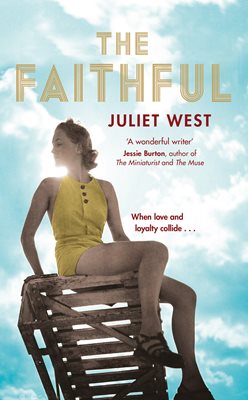
The Faithful by Juliet West

the faithful

My enormous thanks to Jess Duffy at Pan Macmillan for a copy of The Faithful by Juliet West in return for an honest review and my apologies that it has taken so long to read it!

The Faithful was published by Mantle, an imprint of Pan Macmillan on 15th June 2017 and is available for purchase through these links.

The Faithful

the faithful

July 1935. In the village of Aldwick on the Sussex coast, sixteen-year-old Hazel faces a long, dull summer with just her self-centred mother Francine for company. But then Francine decamps to London with her lover Charles, Oswald Mosley’s blackshirts arrive in Aldwick, and Hazel’s summer suddenly becomes more interesting. She finds herself befriended by two very different people: Lucia, an upper-class blackshirt, passionate about the cause; and Tom, a young working-class boy, increasingly scornful of Mosley’s rhetoric. In the end, though, it is Tom who wins Hazel’s heart – and Hazel who breaks his.

Autumn 1936. Now living in London, Hazel has grown up fast over the past year. But an encounter with Tom sends her into freefall. He must never know why she cut off all contact last summer, betraying the promises they’d made. Yet Hazel isn’t the only one with secrets. Nor is she the only one with a reason to keep the two of them apart . . .

From the beaches of Sussex to the battlefields of civil war Spain, The Faithful is a rich and gripping tale of love, deception and desire.

My Review of The Faithful

It’s the mid 1930s and the fascists and communists are on the rise so when Hazel and Tom’s lives collide there will be reverberations.

Oh my goodness. The Faithful is exactly my kind of read. Firstly, there’s an era I didn’t know too much about so that reading The Faithful enriched my understanding of British history just prior to the Second World War. The balance of brilliantly researched authentic detail and wonderful fiction is spot on. Every syllable adds depth and nuance to the narrative so that I felt the tensions and the passions just as much as the characters did.

I thought Juliet West’s writing was so skilful. I loved the prophetic imagery so that, at times, The Faithful feels almost Shakespearean in its quality and I kept thinking of Macbeth with the portents woven throughout. It’s difficult to say too much without spoiling the superb plot.

The narrative is taut and affecting. I slowed down my reading towards the end as I knew how I wanted the story to end but until the last few pages I didn’t know if Juliet West had the same ideas for Hazel as I did and you’ll have to read The Faithful for yourself to see what I mean! Revelations reverberate and shock throughout and the layers of deceit pervading everything from the most mundane through the political to characters’ self-deceptions are realistic and disturbing. I hated Bea’s actions, for example, but her desperate need to belong and to maintain her family makes them completely understandable.

Indeed, I am slightly in awe of the way in which Juliet West manipulated me as a reader when it came to character. Francine is quite vile, but she’s equally vulnerable and pitiful so that although I wanted to loathe her, she had my sympathy instead. Even the louche Charles had my grudging understanding. This is characterisation at its most sophisticated.

The Faithful is a book about love and deceit, about the personal and the political and about how we convince ourselves of truths that have no basis in reality. This makes The Faithful a book about humanity and I cannot recommend it highly enough.

About Juliet West

Juliet West

Juliet West worked as a journalist before taking an MA in Creative Writing at Chichester University, where she won the Kate Betts’ Memorial Prize. Before The Fall, her debut novel, was shortlisted for the Myriad Editions novel writing competition in 2012. Juliet also writes short stories and poetry, and won the H E Bates short story prize in 2009. She lives in West Sussex with her husband and three children.

You can follow Juliet on Twitter @JulietWest14 and visit her website.

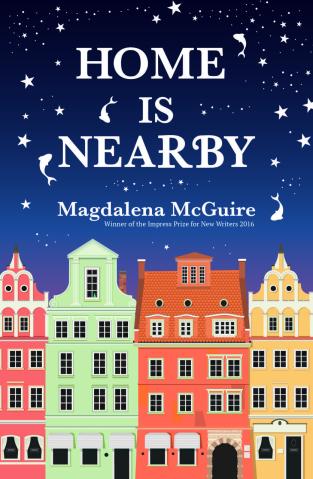
Home is Nearby by Magdalena McGuire

Print

A little while ago, as part of the launch celebrations for Home is Nearby I was lucky enough to host an interview with Magadalena McGuire that you can read here. Today I’m thrilled to be sharing my review of Home is Nearby.

Published by Impress Books on 1st November 2017, Home is Nearby is available for preorder in e-book and paperback through the publisher links here.

Home is Nearby

Print

1980: the beginning of the Polish Crisis. Brought up in a small village, country-girl Ania arrives in the university city of Wroclaw to pursue her career as a sculptor. Here she falls in love with Dominik, an enigmatic writer at the centre of a group of bohemians and avant-garde artists who throw wild parties. When martial law is declared, their lives change overnight: military tanks appear on the street, curfews are introduced and the artists are driven underground. Together, Ania and Dominik fight back, pushing against the boundaries imposed by the authoritarian communist government. But at what cost? ‘Home Is Nearby’ is a vivid and intimate exploration of the struggle to find your place in the world no matter where you are.

My Review of Home is Nearby

Country born Ania is off to start a new life as an art student, but events in Poland mean her life won’t be quite as she expects.

I have a confession. Initially I didn’t like Home is Nearby at all because I picked it up and started it three times, getting interrupted and not getting into the swing of reading it. However, I finally found a stretch of time where I could concentrate and as soon as that happened I was completely drawn in to the narrative and totally absorbed in every element of this beautifully layered and compelling tale.

Although I was aware at the time of the events happening in Poland around which the narrative is based, I had never really considered them from an individual perspective. Magdalena McGuire drills down through the layers of society so that the political, cultural and historical settings come alive from Ania’s viewpoint making everything personal, vivid and actually quite disturbing. Reading Home is Nearby narrowed that distance I think we have when we see things through the media and gave me an intense and immediate look into the lives of those affected. As a result I ended the book feeling moved and included.

Indeed, the characters were all so authentic and realistic so that I felt I knew them personally. I don’t want to spoil the plot but one small action from one of them (and you’ll have to read Home is Nearby for yourself to see if you know what I mean…) left me almost breathless with rage. I found myself talking to the characters, Ania and Dominik in particular, and giving them both advice and admonitions.

The quality of the writing is excellent. I have always considered art to be slightly pretentious and ’emperor’s new clothes’ but Magdalena McGuire’s writing helped me appreciate and understand what art’s various forms can add to our lives. I thought the exploration of the links between art and life was incredibly interesting.

However, it was the themes of loyalty, love, country, identity and, of course, what home is, that I found so affecting. The emotion I felt at the end of the book was physical so that the experience of reading Home is Nearby will stay with me for a considerable time.

Having begun not particularly engaged with Home is Nearby, I ended my read feeling as if I am a changed person as a result of Magdalena McGuire’s skilful, beautiful prose. What more can we ask of a book than that it changes our lives?

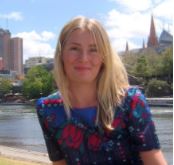
About Magdalena McGuire

magdalena mcguire

Magdalena McGuire was born in Poland, grew up in Darwin, and now lives in Melbourne. Her short stories have been published in the UK and Australia by The Big Issue and The Bristol Prize, and by Margaret River Press respectively. She has published widely on human rights topics, including women’s rights and the rights of people with disabilities. She is an avid reader and particularly enjoys reading books about girls who like reading books. Her first novel, Home Is Nearby, is set in Poland, Australia and the United Kingdom, in the eventful period of the 1980s. She is also working on a collection of short stories that focus on questions of place, identity and unbelonging, particularly in cross-cultural contexts, as well as another historical fiction novel.

You can follow Magdalena on Twitter @Magdalena_McG and visit her website.

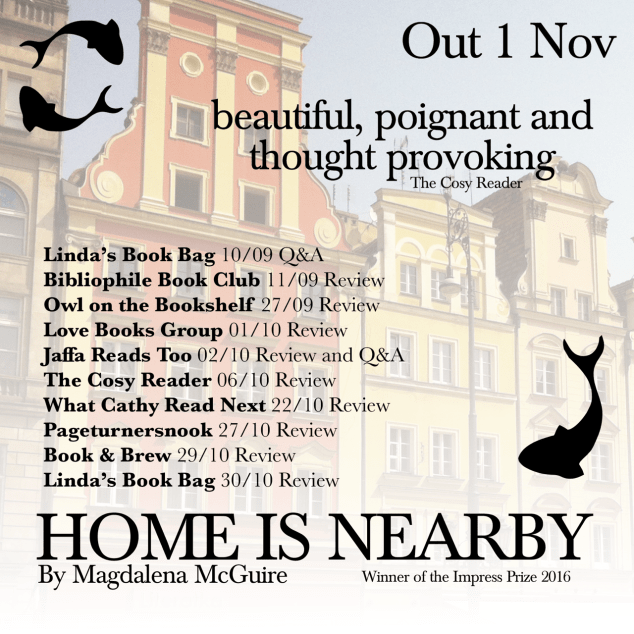
There’s more with these other bloggers too:

Home Is Nearby by Magdalena McGuire winner of the Impress Prize blog tou...

An Extract from Christmas at Woolworths by Elaine Everest

Christmas at Woolworths

I’m delighted to be sharing an extract from Christmas at Woolworths by Elaine Everest with you today. I’m just disappointed I didn’t have chance to read the book ready for today’s post. However, I do also have an extract from another of Elaine’s books, The Butlins Girls, that you might like to read here.

Christmas at Woolworths will be published by Pan on 2nd November 2017 and is available for pre-order here.

Christmas at Woolworths

Christmas at Woolworths

Even though there was a war on, the Woolworths girls brought Christmas cheer to their customers…

Best friends Sarah, Maisie and Freda are brought together by their jobs at Woolworths. With their loved ones away on the front line, their bonds of friendship strengthen each day. Betty Billington is the manager at Woolworths, and a rock for the girls, having given up on love . . . Until a mysterious stranger turns up one day – could he reignite a spark in Betty?

As the year draws to a close, and Christmas approaches, the girls must rely on each other to navigate the dark days that lie ahead . . .

With so much change, can their friendship survive the war?

An Extract From Christmas At Woolworths

Prologue

June 1942

Sitting astride the powerful motorbike, Freda Smith removed a large leather gauntlet from her hand in order to pull tight-fitting goggles from her eyes. She rubbed her eyes with the back of her hand and yawned. Although only the first day of June, the air was sultry and not a day for being covered from head to toe in a heavyweight motorcycle uniform. Freda felt sweaty and would have loved nothing more than to pull off her jacket and feel the wind on her skin as she sped through Kent towards her destination. It had been a long day and no doubt many hours lay ahead before she would see her bed. Gazing towards an angry orange glow that could be seen even in the afternoon sky, she knew her journey was almost at an end. She was close to Canterbury.

Freda had always thought the notion of travelling to Canterbury appealing and she’d planned to visit this famous city just as the pilgrims had done centuries before her. Never in a million years did she believe her trip would be to carry important orders to the Fire Service when Canterbury was under threat from the Luftwaffe. Ahead of her now was a city decimated by enemy action. As a volunteer dispatch rider for the Aux­iliary Fire Service Freda had longed for excitement, but she now realized that what lay ahead was death and destruction for this beautiful Kentish city and many of the people who lived there. After nearly three years would this terrible war never end?

Freda fervently wished she was back behind her coun­ter at Erith Woolworths, selling the popular Mighty Midget books and Lumar jigsaws that not only enter­tained the families but gave youngsters something to concentrate on during long nights when the country was under fire from the enemy. Life seemed so much easier then, even though she was often on fire-watch duties and had to sleep in her landlady’s Anderson shelter on many occasions. Knowing how lucky she was had made Freda yearn to do more to help this beastly war come to an end. She wondered what she’d discover when she reached the city walls. How would she find the fire sta­tion, where she was supposed to report once she reached Canterbury? Fear urged Freda to turn back and not get any closer to the burning city.

(And now I definitely have to bump Christmas at Woolworths up my TBR!)

About Elaine Everest

Elaine Everest updated author photo 2017.jpg

Elaine Everest, author of Bestselling novel The Woolworths Girls and The Butlins Girls was born and brought up in North West Kent, where many of her books are set. She has been a freelance writer for twenty years and has written widely for women’s magazines and national newspapers, with both short stories and features. Her non-fiction books for dog owners have been very popular and led to broadcasting on radio about our four legged friends. Elaine has been heard discussing many topics on radio from canine subjects to living with a husband under her feet when redundancy looms.

When she isn’t writing, Elaine runs The Write Place creative writing school at The Howard Venue in Hextable, Kent and has a long list of published students.

Elaine lives with her husband, Michael, and their Polish Lowland Sheepdog, Henry, in Swanley, Kent and is a member of the Romantic Novelists’ Association, Crime Writers Association, The Society of Women Writers & Journalists and The Society of Authors as well as Slimming World where she can been sitting in the naughty corner.

Elaine Everest lives in Kent and is the author of bestseller, The Woolworth GirlsShe has written widely for various women’s magazines and when she isn’t writing, she  in Dartford, Kent, and the blog for the Romantic Novelists’ Association.

You can follow Elaine on Twitter and find her on Facebook.

You’ll find all Elaine’s lovely books here.

There’s more with these other bloggers too:

Poster

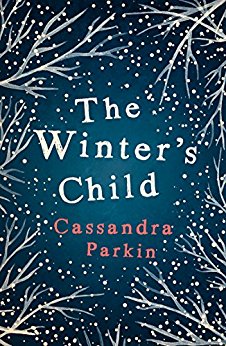
The Winter’s Child by Cassandra Parkin

The Winter's Child cover

Having so loved Lily’s House by Cassandra Parkin, my review of which you can read here with an interview with Cassandra, and which was one of my favourite reads last year, I was thrilled to be asked to join in the launch celebrations for The Winter’s Child too. I also met Cassandra Parkin at a wonderful event you can read about here, Oceans of Words. Today, I’m re-interviewing her to find out more about her latest book The Winter’s Child and am delighted to share this latest Q+A as well as my review. As not all blog followers will know Cassandra I’m repeating a couple of questions!

The Winter’s Child was published by Legend Press on 15th October 2017 and is available for purchase here.

The Winter’s Child
 The Winter's Child cover

Five years ago, Susannah Harper’s son Joel went missing without trace. Bereft of her son and then of her husband, Susannah tries to accept that she may never know for certain what has happened to her lost loved ones. She has rebuilt her life around a simple selfless mission: to help others who, like her, must learn to live without hope.

But then, on the last night of Hull Fair, a fortune-teller makes an eerie prediction. She tells her that this Christmas Eve, Joel will finally come back to her.

As her carefully-constructed life begins to unravel, Susannah is drawn into a world of psychics and charlatans, half-truths and hauntings, friendships and betrayals, forcing her to confront the buried truths of her family’s past, where nothing and no one are quite as they seem.

A ghostly winter read with a modern gothic flavour. A tale of twisted love, family secrets and hauntings.

An Interview with Cassandra Parkin

Welcome to Linda’s Book Bag, Cassandra. Thank you so much for agreeing to answer some questions on my blog about your writing and The Winter’s Child in particular. I know you’ve been on the blog before but not all readers will know that so firstly, please could you tell me a little about yourself?

I’m a Yorkshire-based writer with Cornish roots and a passion for fairy-tales. I write contemporary fiction with a strong magical flavour. The Winter’s Child is my fourth novel, and it’s set in my home city of Hull, in our City of Culture year.

Why do you write?

It’s the thing that makes me happiest. Even on the days it’s like wading through treacle and I know that every word I write will end up being deleted later, I still love it. I’d still be writing even if I hadn’t found a publisher.

When did you realise you were going to be a writer?

I think most people who know me feel quite strongly that I took a stupidly long time to catch on! I spent literally years writing novels in secret, and short stories as Christmas presents, and volunteering for every single work-related writing project I could find. Everyone around me kept saying, “You’re supposed to be writing for a living. You are aware of this about yourself, right? Why are you still messing around pretending you want to be in marketing?” And to my shame, I completely ignored them for about fifteen years. (Sorry, everyone. I know I was annoying.)

I finally caught on when all my friends ganged up on me and made me enter a collection of unpublished short stories for Salt Publishing’s Scott Prize. I found out I’d won and my book was going to be published when I was unpacking yoghurts in the kitchen. I burst into tears, and called my mother and told her I was going to be a writer.

(I suspect you were a ‘writer’ long before that moment actually!)

Which aspects of your writing do you find easiest and most difficult?

I love all of it, so it’s difficult to say! I love writing beginnings, and endings. I love the moment when I start to find my way through the strange blank darkness of the middle section. I love editing – that feeling of taking the shambling mess of the first draft and starting to turn it into something worthwhile. I love talking to readers, and meeting other writers. I love it when my author copies arrive in the post and I open the wrapping and there’s that beautiful new-book smell and I can hold it in my hand and know it’s real. I love the friendliness and generosity of the writing and blogging community, and the support that everyone offers whenever someone needs it.

In fact, I think the only part I don’t like is pressing “send” when turning in a manuscript to my editor. It seems so final and terrifying. Sometimes I have to get someone else to do it for me while I hide under the duvet. Then I spend hours fantasising about how I might invent a way to climb inside my computer and somehow claw the email back again.

What are your writing routines and where do you do most of your writing?

I tend to write in the mornings, at my dining-table. Left to myself, I prefer to write in my pyjamas, but my kids’ friends call for them on the way to the bus-stop and I don’t think it’s fair to make them look at me in all my scruffy un-brushed un-showered glory just before a long day at school, so I only do the pyjama thing at weekends. I have a sort of little tray-table thingy that balances on the table so I can write standing up, and the cats come in and out and yell for cat-treats / for attention / to tell me it’s raining / because they want me to look at a dead bird. The window looks out onto the village main street, so I still feel connected to the outside world.

Without spoiling the plot, please could you tell us a bit about The Winter’s Child?

On the last night of Hull Fair, Susannah Harper visits a fortune-teller who gives her an unusually specific prediction: her son Joel, who has been missing without trace for five years, will come back to her by Christmas Eve. Haunted by this prediction, Susannah is gradually drawn back into a world she’d sworn to leave long ago – the world of psychics and mediums, who claim their supernatural powers will help her to bring her son home again.

I thought the way you portrayed what happens when teenage child goes missing was so absorbing and realistic. How did you go about researching detail and ensuring The Winter’s Child was realistic?

To start with, I read as many true-crime accounts of missing person investigations as I could get my hands on. (I think most writers probably have internet search histories that makes us look like serial killers.) I’m also lucky enough to have a close friend who’s a police officer, so she very kindly lent me her expertise whenever I needed it. It was the hardest part to get right, because of course every investigation is different, and technology and police work are changing all the time.

Of course, once you’ve done your research, you then have to bury it as well as possible, because fiction is never improved by the author standing in the corner yelling THINGS I KNOW ABOUT POLICE WORK LET ME TELL YOU ABOUT THEM. I hope I’ve got the balance right. And of course, any mistakes about the procedural aspects of the book are totally my own.

(You most certainly have got that balance spot on.)

Having read Lily’s House, I found The Winter’s Child was quite a bit darker. How do you think your writing has developed over time and to what extent did you set out to create a more disturbing read.

I absolutely love the tradition of the Christmas Eve ghost story. One of my favourite Christmas memories is being scared to death by a creepy film about a man who sold seven years of his life to the Devil, which my dad let my brother and I watch on Christmas Eve. I wanted The Winter’s Child to be worthy of that tradition. So it was important to me that it was a really dark and unsettling story.

As for the way my writing has developed over time…I’d love to say I’ve got more confident and skilled, but I think the main thing I notice is that I’ve discovered new and different things to worry about! For my first novel, I was thinking the whole time, Can I even do this? What if I get halfway through and dry up? What if I get to the end and hate it? What if I’m just fooling myself that this is ever going anywhere? What if it’s all a colossal waste of time? These days, I worry just as much, but about different things – Is this too similar? Too different? Am I challenging myself enough? Am I challenging myself too much? Is it okay for me to write about this subject? Oh my God how will I ever hit my deadline? Which I suppose is progress, in a way.

The Winter’s Child contains some very weighty themes including mental health issues, spiritualism and marriage. How far did you plan to write about them and how far did they arise naturally as the plot progressed?

That’s a great question! I knew from the start that the theme of spiritualism was going to be central, but I think all the others just naturally came out of the process of writing.

I was overwhelmed at times by the emotion of The Winter’s Child. How were you affected by writing about Susannah and Jackie’s situations?

It was very, very hard to write, because the idea of anything happening to my son – the idea that he could just vanish without trace, and I’d never know what had happened to him – was so close to the bone for me. I honestly felt as if I was tempting fate just by letting myself think about it. And I was really aware that there are many families who are still living through this experience. I wanted to do justice to the reality of their experiences, and not exploit them.

(You have done so magnificently.)

My view of John changed dramatically several times as I read. How do you create your characters when you’re writing?

This is going to sound so unbearably pretentious, but it’s true – at the start of a project, all I know about my characters is what they’re called, and a little bit about what’s going to happen to them. Everything else emerges as I write.

With the relationship between John and Susannah, I think my breakthrough moment was through one of those would-you-rather questions. If your spouse and child were drowning, who would you save first? I realised that this was the problem at the heart of John and Susannah’s relationship: Susannah would save Joel, but John would save Susannah.

There’s often an exploration or undercurrent of the supernatural in your writing. Why is this?

I think it’s because I’m fascinated by the possibilities. Like most people, I’ve had events in my life that I experienced at the time as supernatural. I’ve dreamed the future. I’ve encountered ghosts. I’ve known in advance when close family members were going to be in danger. I once saw a family of black panthers – a mother and her litter of cubs – in broad daylight, in a field next to the M5 motorway.

Of course, I do know that “I saw them” isn’t the same as “so that means they were definitely there”. But nonetheless…

I honestly don’t know what I find more exciting – the idea that there might actually be ghosts, telepathy, Alien Big Cats, predictive dreams and psychics who can make contact with the dead, or the idea that we can be fooled by our own minds into seeing these things when they aren’t there. If we can’t trust what we experience, how can we ever know what’s real? I love playing with that ambiguity in my writing.

I was enthralled when I came to hear you read and answer questions at the Oceans of Word event. How important are events where you work with other writers and get to meet readers for your work?

I absolutely love them and I feel so lucky whenever I have the chance to take part. Writing can be quite a lonely job, so it’s lovely to make contact with other writers and share stories and experiences. And talking to readers is just a huge joy. There’s nothing more special to me than finding that people have read what I’ve written and enjoyed it.

When you’re not writing, what do you like to read?

Whatever I can get my hands on! I love recommendations from bloggers, and I’ve discovered so many books I’ve loved and would never have found otherwise. I’m usually reading at least two books that are new to me (currently The White City by Karolina Ramkvist and A Boy Made Of Blocks by Keith Stewart) and then a couple that I’ve loved for years (at the moment that’s Persuasion by Jane Austen and The Summer Book by Tove Jansson).

If you could choose to be a character from The Winter’s Child, who would you be and why?

It’s quite a dark story, so I don’t know that I’d want to be any of them really! I’d be one of the minor characters – probably one of the customers in the book shop.

If The Winter’s Child  became a film, who would you like to play Susannah and why would you choose them?  

It would have to be Joely Richardson. I’ve loved her in everything I’ve seen her in.

If you had 15 words to persuade a reader that The Winter’s Child should be their next read, what would you say?

It’s a darkly gothic story, written to make a cold night feel a little colder.

Thank you so much for your time in answering my questions.

My Review of The Winter’s Child

Susannah’s grief when her teenage son, Joel, goes missing is all consuming.

Oh! The Winter’s Child really took me by surprise. I was expecting gorgeous writing with a magical element. I got it. I was expecting deep emotion. I got that too, but I wasn’t expecting the darker side of the narrative which took me by surprise and held me enthralled.

The Winter’s Child is a darkly disturbing tale of what happens when a child goes missing. It is an insightful and hugely affecting look inside the mind of a grief stricken mother whose life has been utterly devastated and who can no longer separate truth from fiction. It is also a psychological tale and a thriller so that it is multi-layered , intricate and a fabulous read.

The quality of the writing is such that I was brought up short on several occasions by the plot and found that sometimes I was as much deluded as Susannah is by the so-called psychics she visits in her desperate bid to find Joel. I couldn’t always separate fact and fiction. Indeed, Susannah is a triumphant creation. I felt every moment of her grief with her. She’s selfish, single minded and frequently quite unpleasant or unreasonable and yet she had every ounce of my sympathy and empathy. All the characters in The Winter’s Child are incredibly realistic.

I love the use of the senses in Cassandra Parkin’s writing to create setting and atmosphere but also to convey emotion. Her writing is textured and affecting so that reading The Winter’s Child was like being immersed in an experience I couldn’t control. The depth of research that has gone in to The Winter’s Child is also totally impressive. I felt as if Cassandra Parkin must have experienced the same events as Susannah to be able to translate them onto the page so magnificently.

I loved The Winter’s Child. I found it puzzling, complex and totally absorbing. It’s a wonderful read.

About Cassandra Parkin
cass

Cassandra Parkin grew up in Hull, and now lives in East Yorkshire. Her short story collection, New World Fairy Tales (Salt Publishing, 2011), won the 2011 Scott Prize for Short Stories. Her work has been published in numerous magazines and anthologies.
The Summer We All Ran Away (Legend Press, 2013) was Cassandra’s debut novel and nominated for the Amazon Rising Stars 2014. The Beach Hut (Legend Press, 2015) was her second novel, followed by Lily’s House.

You’ll find all Cassandra Parkin’s books here.

You can find out more by following Cassandra on Twitter and visiting her website.

There’s more with these other bloggers too:
winters child poster


No police. No private eye. No murder. A Guest Post by Robert Crouch, Author of No Bodies

No Bodies - Robert Crouch - Book Cover

It’s a welcome return for No Bodies author Robert Crouch today. Robert previously wrote a smashing guest post for Linda’s Book Bag, all about how his own blog helped his writing, that you can read here. Today’s post is a fascinating insight into how Robert has created his Kent Fisher Mysteries.

No Bodies was published on 19th October 2017 and is available for purchase here.

No Bodies

No Bodies - Robert Crouch - Book Cover

No motive. No connection.

Why would environmental health officer, Kent Fisher, show any interest in finding Daphne Witherington, the missing wife of a longstanding family friend?

The police believe she ran off with Colin Miller, a rather dubious caterer, and Kent has problems of his own when a young girl who visits his animal sanctuary is rushed to hospital.

When enquiries into Colin Miller reveal a second missing wife, Kent picks up a trail that went cold over a year ago. But he’s struggling to find a connection between the women, even when he discovers a third missing wife.

Is there a killer on the loose in Downland?

With no motive, no connection and no bodies, Kent may never uncover the truth.

No police. No private eye. No murder.

A Guest Post by Robert Crouch

No police. No private eye. No murder.

It’s hardly the most obvious way to break into today’s busy crime fiction market, but then again a grey-haired spinster from St Mary Mead was hardly conventional, was she?

When you’re faced with shelf after shelf of police procedurals, serial killer thrillers and private eye novels, you know it’s going to be difficult to come up with something fresh and original.

Inspired by the likes of Miss Marple and Inspector Morse, the urge to write a crime series gripped me so tight, I spent most of my waking hours thinking about devilish plots and the elusive protagonist who would unravel them.

It didn’t take long to realise I knew next to nothing about how the police went about solving crimes. Having worked with the police in my job as an environmental health officer (EHO), I had a reasonable understanding of the conventions and rules that governed them, but little else.

“The police would never do that!” I would shout at the TV when procedures were broken or ignored in crime dramas.

Such transgressions might be good for the story, but credibility’s crucial. Without it, how can authors expect readers to trust them?

Authors like Peter James spend a lot of time with the police to understand how they work, to discover the atmosphere and nature of the people who protect us and solve crimes. Ex-police officers who write crime stories can bring the telling details and insights that I could never hope to produce.

No, if I was going to write crime, there could be no police.

Enter Sue Grafton. After following her feisty private eye, Kinsey Millhone, through much of the alphabet, starting with A is for Alibi, the answer seemed clear. Crime fiction and drama had produced many private detectives across the decades, from the iconic Sherlock Holmes to the curious Dirk Gently.

Surely there was room for another.

The thought prompted me to develop characters who were ex-army or ex-police, people who could handle themselves in a brawl or under pressure. But after writing a few drafts these gung-ho, macho heroes seemed empty and uninteresting. And authors more talented than me had already populated crime fiction with enough cynical, world weary detectives.

Sadly, I had to say no to private eyes, despite my fondness for Kinsey.

That left me with murders. I’d watched enough crime dramas to know it was almost impossible to have a murder that didn’t involve the police. The thought of having ponderous police officers arresting the wrong suspect, as often happened in Murder She Wrote, didn’t appeal. Police officers do a difficult and complex enough job without authors tarnishing their abilities.

That left the tried and trusted plots, like a wrongly imprisoned person, a suicide that was really murder, or a historical crime that had never been solved. While these offered opportunities, I wondered if these scenarios had become a little clichéd over the years.

With a weary sigh, I turned off the computer. My determination to bring something fresh and original to crime fiction left me with no police, no private eye and no murder.

Perhaps not the finest start to my crime writing career.

Then one evening, as I reflected on a gruelling and emotional day, investigating a workplace accident that resulted in the death of an employee, an idea crept out of my subconscious.

What if someone could disguise a murder as a fatal work accident?

The police would attend, as the national protocol demands, but if the inspector in charge dismisses corporate manslaughter, an EHO would then carry out the investigation.

Cue Kent Fisher and my first murder mystery, No Accident.

No Accident

After the first few pages, it had no police, no private detective and on the surface no murder. But would readers find the story and characters credible? Could an EHO, with no training or experience in investigating crime, solve a complex and baffling murder?

To start with I couldn’t find a way to solve the case. Maybe I’d created the perfect murder. Then a publisher took an interest in the idea. This gave me the spur to find a solution, which thankfully I did.

When No Accident was published, I held my breath, worried what readers would make of the story. Fortunately, readers liked the fresh and original approach. It provided a welcome change from the usual police procedural.

One reviewer said, ‘I was fascinated by the way Robert Crouch demonstrated how a seemingly ordinary member of the public could become what is best described as a Private Eye.’

It made my day.

It meant environmental health officer, Kent Fisher, could go out and solve more cases. He could also offer readers a glimpse into his world, both as an environmentalist and someone who works to protect and improve public health.

In No Bodies, the second novel, a devastating case of E coli O157 threatens to destroy Kent Fisher’s animal sanctuary, his reputation, and derail his struggle to find the missing wife of a longstanding family friend. The evidence suggests she ran off with a younger man, a rather dubious caterer, it seems.

 ‘Do I look like Hercule Poirot?’ Kent asks, initially refusing to take the case.

No, but he knows about catering, and it isn’t long before he senses foul play.

About Robert Crouch

robert

Inspired by Miss Marple, Inspector Morse and Columbo, Robert Crouch wanted to write entertaining crime fiction the whole family could enjoy.

At their heart is Kent Fisher, an environmental health officer with more baggage than an airport carousel. Passionate about the environment, justice and fair play, he’s soon embroiled in murder.

Drawing on his experiences as an environmental health officer, Robert has created a new kind of detective who brings a unique and fresh twist to the traditional murder mystery. With complex plots, topical issues and a liberal dash of irreverent humour, the Kent Fisher mysteries offer an alternative to the standard police procedural.

Robert now writes full time and lives on the South Coast of England with his wife and their West Highland White Terrier, Harvey, who appears in the novels as Kent’s sidekick, Columbo.

You can find Robert on Facebook and visit his website. You can also follow him on Twitter.

There’s more with these other bloggers too:

tour poster