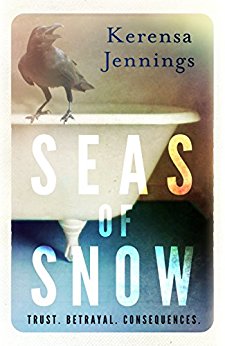
I recently received a copy of Seas of Snow by Kerensa Jennings from Debbie Forster of Novel Design in return for an honest review. Once I started to find out about the book and to see some of the 5* reviews rolling in I had to ask the author of Seas of Snow, Kerensa Jennings, if she would be interviewed for Linda’s Book Bag. Luckily she agreed.
Seas of Snow was published by Unbound on 16th March 2017 and is available for purchase here and I can’t wait to read it.
Seas of Snow
1950s England. Five-year-old Gracie Scott lives with her Mam and next door to her best friend Billy. An only child, she has never known her Da. When her Uncle Joe moves in, his physical abuse of Gracie’s mother starts almost immediately. But when his attentions wander to Gracie, an even more sinister pattern of behaviour begins.
As Gracie grows older, she finds solace and liberation in books, poetry and her enduring friendship with Billy. Together they escape into the poetic fairy-tale worlds of their imaginations.
But will fairy tales be enough to save Gracie from Uncle Joe’s psychopathic behaviour – and how far will it go?
An Interview with Kerensa Jennings
Welcome to Linda’s Book Bag Kerensa. Thank you so much for agreeing to answer some questions on my blog about your writing. Firstly, please could you tell me a little about yourself?
Thank you so much Linda for giving me the opportunity to feature in your Book Bag! I was wondering how to introduce myself and landed on starting with some of the things that make me me. I’m quite shy and introvert by nature, which surprises people when they get to know me because I have to present outward confidence at work. I’m at my happiest somewhere beautiful, quiet and serene. I love writing at my dining room table looking out over my garden; and much of Seas of Snow was written deep in the mountains of southern Spain on a series of holidays staying at a self-catering villa in the back of beyond. Just the rustling of leaves and the circling bird of prey as a backdrop…
I’m someone who has always been a storyteller. Ever since I could hold a pencil, I started scribbling stories and poems – something I still do every day. I used to pretend to be an author when I was little. And can hardly believe that I can now call myself one. As a child I devoured books; and these days reading is my constant source of pleasure and escape in life.
Earlier in my career, I worked in the media as a TV producer. So although most people would have no idea who I am, my words have been read out to millions and millions of people over the years in a variety of TV programmes. I was Programme Editor of Breakfast with Frost with Sir David Frost, for example, and made other big BBC One shows like New Year Live and Ellen MacArthur – Sailing into History. I was also the BBC’s Election Results Editor and ran BBC News Specials before becoming the BBC’s Head of Strategic Delivery.
Over the years, I developed a specialism for digital enterprise and these days run The Duke of York Inspiring Digital Enterprise Award. I’m also a professor and a qualified and practicing Executive Coach. So you could say I wear a few different hats. The one that makes me me though is my passion for writing. No matter where I am in the world, whatever I am doing, whoever I am with, whatever else is going on, I always find time to write.
(Crikey – I’m amazed you’ve ever found time to pen a novel!)
Without spoiling the plot, please could you tell us a bit about Seas of Snow?
If I was going to try to entice you to read the book, I’d start with a question, which indeed is the question at the heart of the book. “Is evil born or made?”, I would ask.
Seas of Snow is a story of broken trust and shattered dreams. Of consequences. Of a life lifted and liberated by poetry. Of a life haunted by darkness and lived in fear.
It is the tale of a young girl who escapes the torment of her life through playtime with her best friend Billy; and through reading and writing poetry, delighting in words for guidance and succour.
The book dances through time, backwards and forwards between the literary reveries and physical abuses of the young girl; and the old woman of today, frail and isolated in a nursing home. Billy Harper, Gracie’s childhood friend, is the only solid presence in her life, and seemingly the only constant. Diaries and poetry books bind the story and the characters.
Set both today and around the time of the second world war in North Tyneside, Seas of Snow is a bleak psychological thriller which traces the motives and actions of Gracie’s Uncle Joe. He appears unexpectedly in Gracie’s life when she’s just five years old. And changes everything.
Seas of Snow is a story of trust and betrayal, of the worst kind.
(Seas of Snow is on my TBR (to be read) pile and you’ve just persuaded me to bump it up the 850+ books in the queue)
I know you’re interested in nature versus nurture. Have you come to any conclusion as to which is most affecting in our characters?
In my view, both nature and nurture play their part in shaping our characters. Having said that, there are some people who are, quite simply, born psychopaths. These people are unable to feel remorse, or experience empathy. They find lying easy and can manipulate people and situations to their own advantage. However, not all psychopaths go on to commit monstrous acts. So environmental factors play a vital role.
Through my studies in psychology I became fascinated to learn about the neuroplasticity of the mind. Put simply, it means for those of us who are not psychopaths, we have the capacity to change the way we think. This can be very helpful if we are scared about something, or think we’re not very good at something.
Many of us grow up through childhood bearing various scars which lead us to think we’re rubbish at this, or terrible at that, because of things we were told or lead to believe. This way of thinking can be described as having ‘limiting beliefs’. The sad thing is, thinking you are rubbish at this, or terrible at that, can often hold you back from going on to do something you would both love and be great at.
But the brain is plastic – and adaptable. So although you can’t stop a ‘hardwired’ neural pathway from existing, because chances are you have been building that road since you were little – you can effectively put the ‘road closed!’ sign up and create a new road to start travelling down – a new neural pathway which will help you feel more positive about what you are able to do. It’s almost like magic but it really works. I have done a lot of this sort of ‘re-framing’ with clients over the years in my executive coaching and it’s remarkable how much it helps people gain confidence and try things they would never have imagined they could do.
So I believe nurture can very much assist nature… and the various influences in our lives can be both positive and negative. Not everyone who commits crimes is a terrible human being. One of the poems Gracie returns to time and time again throughout the book is a lovely prose poem which says: ‘Perhaps everything terrible is in its deepest being something helpless, that wants help from us…’. I think there is something very thought provoking in this; a concept I find fascinating – and ultimately why the novel centres on themes of good and evil.
Without being too specific, Seas of Snow was partly written as a form of catharsis for you following your coverage of some terrible national events. Has it achieved what you hoped?
I was originally inspired to write Seas of Snow because I had been profoundly affected emotionally after leading the BBC News coverage of the Soham case. I was working very closely with Cambridgeshire Police over several months, and got to see first-hand a lot of the evidence uncovered during the investigation. It was heart breaking learning about what had happened. About what that man did. And I began to wonder about the mind and motives of a psychopath – the school caretaker Ian Huntley who murdered those two beautiful little girls. I went on to study psychology and take my learning further after training and qualifying as an Executive Coach to see what I could discover to help myself and hopefully others.
You are completely right – I wrote the book as a means of catharsis after working so closely on something so incredibly upsetting. I have always used writing as a way to process my emotions. It’s how I make sense of the world. So it was natural for me to decide to use writing to try to gain some kind of closure and comfort.
In many ways it has achieved what I had hoped – through the book I explore themes I want to illuminate. Everything from the darkness of the human soul to different manifestations of maternal love to the capacity we have to lift ourselves sometimes against the odds. The book is also a love letter to literature in many ways – so through writing Seas of Snow, I also got to share some of my passions and inspirations, turning the process of writing about something so deeply unsettling into something which also had light and life.
Having said that, I still find myself very affected by what happened, and especially when I talk about it. I was at a Waterstones authors event a few weeks ago and telling a room full of readers and other authors about my inspirations for Seas of Snow. I couldn’t help myself choking up a little. I don’t think I will ever stop feeling emotional about it. And strange though it might seem to confess this – I still cry myself when I read certain passages of the book.
(I don’t think that’s strange at all. Literature really does have the power to move us.)
I know you’re interested in poetry and Seas of Snow has been described as poetic in style. How conscious were you of writing poetically and how far was it a natural style for you?
Poetry can be some of the best self-help you can possibly get. Diving into a poem can distract you, lift you, inspire you. But lots of people find poetry intimidating, or think it’s a bit pretentious. I’d say if you have ever been touched by the words of a song, be that a football anthem like You’ll Never Walk Alone (which funnily enough started life as a song from a musical); or a special song that reminds you of a person or a place – then that means whether you realise it or not, you are likely being affected by poetry. Words carry such power. They can make us laugh and cry.
What poets do is arrange those words in ways that have extra layers of meaning. Maybe they’re doing something clever with the way words sound; maybe they’re pulling images together in ways that spark the imagination. Maybe a bit of both – and more. Through Seas of Snow, I wanted to invite readers to come with me into a world where they could discover poetry in a completely unpretentious, natural way. Through the eyes of a child. And with that, as Gracie develops her passion and understanding of poetry, so do we.
I mentioned earlier that I write poems all the time – I also do poetry commissions for special occasions. I love both reading and writing poetry. For me, poetry is the greatest solace and escape – it offers me comfort and inspiration. I love reading it out loud, and I love listening to it read aloud.
I don’t consciously write prose in a poetic style, but I think in fiction writing I am naturally inclined to write in quite a lyric way. It’s how I see the world and in my writing it just sort of comes out that way.
Uncle Joe is a monstrous character. How did you create him?
It’s hard to describe my process. I had some very firm ideas about wanting Uncle Joe to be hiding in plain sight, as Ian Huntley had done. But I also wanted him to be irresistibly beautiful to look at, with attractive attributes such as a gorgeous voice; and a charm that people would find compelling. I wanted to create an unsettling counterpoint – a contradiction that would defy logic.
This stems from my fascination with fairy tales. Going back to my university days, I studied the psychoanalysis of fairy tales. I examined the archetypes in the Grimm’s stories for my thesis, which was titled ‘Persecution and Revenge of the Innocents’. In fairy tale land, there is a logic which works something like this – if a character is beautiful and light, then they are innocent and good. If a character is ugly and dark, then they are corrupt and evil. Even the Disneyfication of fairy tales notwithstanding, we are all familiar with the idea…
Real life can obviously be very different to this, but we all fall prey to certain assumptions and prejudices about people’s appearances. Unfortunately, it’s just a normal human trait for us to experience ‘unconscious bias’. When we see someone who is differently abled, for example – unable to walk or see – we make certain assumptions, even though we know nothing about that person. When someone has an unusual appearance, we make certain assumptions, again even though we know nothing about that person.
So in creating Joe, I wanted to bring to life an antagonist who people would fall in love with because of his outward appearance and charisma. Then make him evil to the core so our revulsion at him and what he is capable of makes us feel duped and horrified. I wanted that emotional disjuncture. That sense of not being able to trust our own eyes.
Ian Huntley was interviewed by the press and the media in the days after the girls went missing. He outwardly betrayed the appearance of someone who was a caring member of the community. All the while, as he lied and lied, he knew exactly what he had done. Hiding in plain sight.
How do you go about researching detail and ensuring your books are realistic?
Well, in common with many other people I suspect, I am a slave to Google! As I was setting the story in a different time and place, there was a lot of research to ensure I created an accurate sense of atmosphere, with historical details beautifully conveyed. I chose to set Seas of Snow in North Shields in Tyneside because my grandmother was a Geordie and grew up there. However, although I visited when I was younger, I needed to know what it would have been like back in the late 1940s and 1950s to give the right kind of look and feel to the narrative.
Researching accents was important – so the very small elements of dialect were checked meticulously.
Then I was blessed to have a wonderful copy-editor called Paul Fulton who went through the manuscript with a fine tooth comb and checked facts, timelines, historical nuances and continuity. I remember him noticing I called a piece of furniture a ‘console’ in one scene and a ‘sideboard’ in another. And I had accidentally originally had Joe drinking ale even though I was describing something more akin to Guinness. Various bits and pieces like that. So I had 42 queries from him to check, which I did and made amendments as required!
Which aspects of your writing do you find easiest and most difficult?
I absolutely love writing and I find the process of sitting down to write one of the most pleasurable things in my life. I just start typing and the words flow out. I wrote Seas of Snow in all my holidays between 2009 and 2013. I then polished my first submitted draft in 2014.
Last year I went through the rigour of the editing process and some aspects of that felt a bit like ‘homework’. I very much enjoyed the development edit however, even though I had been dreading it. I worked with Scott Pack who just asked very thoughtful, sensitive, intelligent questions. He made me think – and in no way did he try to make me change anything. It was all about extra things that could enhance things for the reader. He would always say it’s my book and it’s up to me. I loved that. Working with Unbound as my publishers has been such a joy because they are committed to allowing authors to retain the integrity of their own work. They wanted to support me bringing my vision, my creation to life. Scott’s questions were all about asking whether I was doing enough for my reader here or there. It was a wonderful experience.
I liked less the structural edit where the type setting process bunched up some of my fragmented sentences and paragraphs into bundles. My writing style tends to be sparse in fiction writing – and a bit like how the title of the book has a secret message – SOS; I was creating dissonance in the fragmenting quite deliberately to provoke unease in the reader which reflected the thematic development. The type setting process overruled what I had done. So I had to meticulously go through every line looking at the original manuscript on an iPad and the new version on Mac at the same time to compare and contrast which version I wanted to go with – my original fragmentary style or something which closed up some of the gaps. That was truly painful as I was then editing in gaps and line breaks depending on what was required. Believe me, this took what felt like an infinity to do. Exhausting!
There was then the formatting edit and two rounds of proof reading. My parents joke that Seas of Snow is my ‘baby’. Well it certainly had a very long gestation!
What are your writing routines and where do you do most of your writing?
I write anytime I can, and importantly, whenever I am in the mood. I don’t force myself to write if I am not in the right ‘head space’. So when I do write, it’s always the most luxurious pleasure. I often write in the notes section of my phone to and from work on my commute; I sometimes wake in the middle of the night with an idea I have to scribble down; and often after work at home instead of watching TV or reading a book I sit and find myself writing. I don’t have what I would describe as a writing routine, but I was very committed to writing Seas of Snow in all my holidays so devoted huge amounts of time and energy into doing it when I knew I had plenty of time to do so.
You come from a journalistic background. Has this helped or hindered you when writing your first work of fiction, Seas of Snow?
That’s a really good question. I went into journalism because I am a very curious person. I love discovering things about the world, and sharing what I have found out with others. Writing is hard wired into who I am. I love communicating stuff.
When you write for television, the trick is to imagine you are writing for a very smart nine year old. Someone who is bright, clever – with good vocabulary. But who would get a bit muddled and lost if you veered off into lots of subordinate clauses or made your sentences long-winded. So simple, clear, precise – but not patronising.
When I write poetry or prose or in the case of Seas of Snow, fiction, I just let my imagination take flight. With the novel, I carefully mapped out the structure and planned the ‘scaffolding’ for the book before I wrote a single word. The writing bit was just an extraordinary pleasure, as I would sit at my computer and the words would flow out of me and onto the ‘page’ on my screen. I would delight in finding out what happened next – and characters would arrive fully formed in my head with names and attributes.
In journalistic writing, you have to fit a word count, develop a style to suit the audience, and in my case write in ‘the voice’ of whoever my presenter was… The central purpose is to report what happened, convey facts, or provide impartial analysis of a situation. It’s all about being clear and succinct, to provide a service where you are giving information and fact.
I like the discipline of journalistic writing – deadlines, targets and through my BBC work, public service.
In my other writing, I impose my own structures and I get to unwind into who I am. It’s like the real me gets to peek out and start dancing in the light. I slowly unfurl into a different sort of presence, and a more poetic soul begins to emerge.
It’s helpful to have mastered a sense of discipline – that comes from deadlines and journalism. And I also have an ability to be able to write anywhere, in any environment. I can always write, no matter what mayhem might be going on. That’s come from journalism – the capacity to focus and concentrate. Many’s the time in my TV days when – because of developments on a breaking news item – I was writing the opening words of a programme while the title music was still playing. The adrenalin that fires in you is incredible. You have just seconds to complete something that has to sound good, make sense, and be visible to the presenter in time to be read.
So I think being a disciplined person has hugely helped me as I develop my fiction writing career. My publisher would often joke they wished other authors would get things back on time as I always did. But the writing is very different.
(As an ex English teacher I think we can apply that principle of structure to enable creativity to many walks of life, including education.)
Seas of Snow is set in the 1950s. How far do you think life has improved for those in similar situations to Gracie and her mother?
I think domestic abuse is as old as time, and sadly there is much that goes on behind closed doors. I hope that these days, people have more access to help, support and ways to escape their situations. There are some wonderful groups out there who do so much to provide a lifeline to those who suffer abuse.
We shouldn’t underestimate though how very hard it is for victims to reach out, even today. It’s very common for people to feel scared about what might happen if they speak out; they can be frightened and intimidated into saying nothing. It’s also very common for people to feel a sense of shame, as if somehow what’s happening is all their fault, or they should have been able to stop it. One of the reasons both Gracie and Billy in Seas of Snow spend a lot of time questioning why certain things happen, is to hopefully help readers see that they are not alone if they find themselves sometimes subjected to difficult situations that seem so terribly unfair. It’s so easy to secretly worry that somehow it might all be happening because of something you did.
That sense of shame can also be a product of the physical and emotional pain of what someone has done to you. You can feel dirty, soiled, revolted. When you feel like that, you are not necessarily minded to tell anyone else. So the cycle of abuse continues, and the numbers of scarred, damaged people grows and grows. Often with dreadful impacts and consequences later in life, as in Seas of Snow.
Although I set the story in the 1950s, I believe the core themes and developments of the book could just as easily happen today. I wish I could say otherwise, but there does not seem to be an end to the dreadful scandals that emerge, with young people being betrayed, abused, hurt or in other ways damaged by the people who are tasked to look after them.
What I hope the book does is help the reader see that a person who is a victim of violence, abuse or harm can be completely blameless.
Other threads of the book help the reader see the darkness of humanity, and what the worst of humanity can be capable of.
And the reader is also exposed to the consequences of inaction. This is in tribute to all the children who have been failed by the people who are trusted to care for them, but for whatever reason are paralysed, and unable to act.
You also work to help young people fulfil their potential. Could you explain a bit about that please?
I am passionate about trying to help people fulfil their potential and I try to do this in many ways – whether that’s through my work with clients as an Executive Coach; my former role as a TV producer when I worked with presenters to help them be the best they could be; or the various things I do to support diversity and inclusion.
In my day job, I run The Duke of York Inspiring Digital Enterprise Award, a new programme that has just launched this year which is a bit like the digital and enterprise equivalent of The Duke of Edinburgh Award. Anyone can have a go and it’s all about empowering people to develop digital skills that will help them flourish in today’s digital world.
We’ve created an innovative Badge Store which has online bite-size modules (‘badges’) you can do anywhere you can get online on any modern device or browser. The resources are completely free and you can learn about a range of topics from cloud computing and the Internet of Things to e-safety, cyber security, video editing, animation, research, enterprise, and how to do some basic coding. We’ve just launched the Bronze Award and have started to develop Silver with Gold coming after that. Bronze is beginner (rather than for a specific age), Silver is intermediate, and Gold is advanced. Why not have a go – just Google ”idea.org.uk” or click here. It’s ideal for family learning or for anyone who feels they may have missed out on chances fully to participate in the digital world. Our hope is that through doing this, we’ll be helping create life-changing opportunities for people and empowering them to get jobs they wouldn’t otherwise be able to do.
(This sounds such a rewarding scheme to take part in.)
So, when you’re not writing, what do you like to read?
How long have you got?! I love poetry, short stories, plays…. Novels of course; and also biographies and non-fiction books on philosophy, art, business, coaching – any number of topics. I always have at least two poetry books and at least two or three other books on the go at any one time.
You seem incredibly busy. Do you have other interests that give you ideas for writing?
I think for anyone who wants to know a bit more about this, I would love them to read my professorial lecture which I have published in full on GoodReads. This was titled ‘Orchids were the repository of her dreams’ and it is a critical analysis of the creative process. I go into lots of detail here about my own creative process and how I get ideas for writing. Here’s an extract to give you a flavour:
“Take something and make it yours. I am an inveterate magpie, collecting bits and pieces and thoughts and phrases and trinkets to store in my mind. Sometimes I wilfully and deliberately rummage around in great lierature, films and music, snatching cadences and rhythms and poetic treasures. Interesting nuggets, facts, curios, keepsakes and brain food. I was trained as a journalist and in my view, the core qualification you need is simply curiosity. But I didn’t get trained in curiosity. It’s just something that drives me and fires me every day of my life. From the minute I get up in the morning, to the moment I go to bed, the world is a kinaesthetic tsunami of the senses. I often scribble down things I have noticed or overheard. Public transport is brilliant for inspiration. You never know when something you hear, read or see might prompt something in you. The author of His Dark Materials Philip Pullman said ‘I have stolen ideas from every book I have ever read’.”
Seas of Snow has an almost nightmarish cover to me, with the raven suggesting death and the flame like letter S indicating hellishness. How did that image come about and what were you hoping to convey (without spoiling the plot please!)?
I knew I wanted the black, menacing bird somewhere. The prologue sets a wintry, bleak scene and obliquely introduces the presence of the raven. Gracie’s fear of birds is a theme that develops in the book – she gradually begins to associate Joe with the avian predator as they both hunger for her and bore into her with a fierce intensity.
And I suggested possibly a bath. In the story, it is Gracie’s uncle Joe who carries the momentum of the story. He intrudes on her while she takes a bath – a tableau that gradually unfolds through intermittent, evolving scenes as the book progresses. The scent of lemons in the air from the bubble bath reprises the first sensory impact Gracie had on Joe – as he locks the door and refuses to leave.
Unbound and I worked on a creative brief for the cover illustrator. It was so exciting the day I got emailed three potential routes for the cover art – all of which were extremely different! Each had a bird but they all had very different atmospheres.
I emailed around fifty friends, both men and women, asking which of the three designs they liked the best. Overwhelmingly, most of the women chose the one that is most similar to what we now have. Overwhelmingly, most of the men chose a very snowy, ghostly scene with a faded photograph of a woman from the 1950s. Almost everybody hated the third one, which had a dead sparrow lying on some postcards – apart from I think it was three people who said that one was their favourite!
In the end I went for the design I thought would carry the most impact on a bookshelf in a bookshop. I could imagine people reading the one we chose on the commute – and I could imagine the poster art. The original version of it had a green background rather than blue… I requested we make it more wintry and I really loved the blue they came up with. Also, in the original version the raven was much smaller. To get the proportions right (ravens are huge), I requested we upsize the bird.
One of the most wonderful, special things about working with Unbound is that they really involve you, the author, in every step of the process. It’s a massive amount of work, but I feel personally invested in every important decision that was made about the book. And that is an unbelievable privilege.
(Having found a raven in my bedroom at university I can vouch for the size!)
If you could choose to be a character from Seas of Snow, who would you be and why?
Gracie! Because she is a combination of all the wonderful people I know and there is something very pure and good and lovely about her. She’s also very smart, thoughtful, kind and curious. And she loves literature! I think secretly everyone wants a friend a bit like Gracie.
If Seas of Snow became a film, who would you like to play Uncle Joe and why would you choose them?
It would have to be someone incredibly handsome. Someone like Jamie Dornan or Tom Hardy would be brilliant.
And finally, Kerensa, If you had 15 words to persuade a reader that Seas of Snow should be their next read, what would you say?
Can Gracie escape? Will her mother protect her? Will the wing’s breath pass or linger?
About Kerensa Jennings
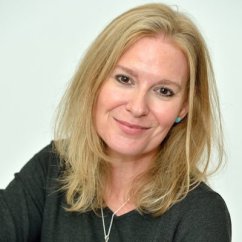
Kerensa Jennings is a storyteller, strategist, writer, producer and professor.
Kerensa’s TV work took her all over the world, covering everything from geo-politics to palaeontology, and her time as Programme Editor of Breakfast with Frost coincided with the life-changing events of 9/11.
The knowledge and experience she gained in psychology by qualifying and practising as an Executive Coach has only deepened her fascination with exploring the interplay between nature and nurture and with investigating whether evil is born or made – the question at the heart of Seas of Snow.
As a scholar at Oxford, her lifelong passion for poetry took flight. Kerensa lives in West London and over the last few years has developed a career in digital enterprise.
Seas of Snow is her first novel.
You can follow Karensa on Twitter, on her website and find her on Facebook.










 Linda's Book Bag