


I’m a huge fan of Alice Jolly’s wonderful and versatile writing and you’ll find my reviews of some of her books here.
When I discovered she has a new book out I simply had to invite Alice onto Linda’s Book Bag to discover more.
Let’s see what Alice told me:
Staying in with Alice Jolly
I’m thrilled to welcome you to Linda’s Book Bag Alice. I know I already know, but tell me, which book have you brought along and why have you chosen it?
I have brought along my new novel which is called The Matchbox Girl.
And it’s out today – happy publication day! What is The Matchbox Girl about?
It is an historical novel which is based on real life events. At the centre of my novel is the real Dr Asperger who worked in The Vienna Children’s Hospital starting in the 1930s. When Asperger’s work was rediscovered in the 1980s, he was hailed as ‘the father of neurodiversity’ but he was also rumoured to have collaborated with the Nazis. The story of Asperger and his colleagues is told through the eyes of a fictional 12-year-old girl called Adelheid Brunner who is obsessed by collecting matchboxes. She sometimes comments on the events unfolding around her with great accuracy but, like many in 1930s and 1940s Vienna, she also often fails to see what is really happening. Increasingly, she finds herself caught up in a deadly game whose rules she cannot understand.
That sounds an incredible tale Alice. I had wondered why you’d used The Matchbox Girl and why the book had that cover. Can you tell me a little more?
I know that Bloomsbury thought long and hard about the cover and I think that all their work has really paid off. For me, the cover really encapsulates the dual nature of the book. On the one hand, the book is about eugenics in the Second World War but because the book is being told by a bright and quirky young girl, it reads rather like a children’s adventure story. That is a deliberate choice.
And difficult to achieve I imagine. Why did you decide on that style?
I think we can write about dark issues but we don’t have to do it in a dark style. The figure of the child on the book is dashing through a confusing nighttime landscape of steps which lead nowhere. Up above are the planes which encapsulates the Second World War. The cover also hints at the design of 1930s matchboxes – and that references Adelheid’s dream of collecting 1000 matchboxes. I love that the cover is capturing so many aspects of what I have written.
How brilliant. So, what can we expect from an evening in with The Matchbox Girl?
At the heart of my book is a truly fascinating – but also very difficult – story. I get tired of Second World War books where there are goodies and baddies. The reality of what happens in war is so much more complicated.
I am trying to tell the story of a person (Asperger) who was not a hero. I wanted to unpick why people don’t resist. For me, this is very current. I don’t like books which deal in cheap judgements. I want the reader to ask themselves – if I was in this situation, would I have done any better?
Most definitely. I often wonder how I might behave in such circumstances. I’d like to believe I would always behave morally but…
I also want them to enjoy the character of Adelheid. She really wants to understand how the world works but, sadly, she is living in a world which just doesn’t make sense. Happily, she is surrounded by the staff of the Hospital who appreciate her and want to keep her safe.
I love the sound of The Matchbox Girl. Given the themes of the book, what else have you bought along?

I have bought along one of the secondary characters in my book. I would really love to show you a photograph of her but I have not been able to find one. That in itself is significant.
More evidence of history than herstory perhaps?
Sister Viktorine Zak was a nurse and in Austria they keep records relating to doctors but not to nurses. (It would be the same in many countries.) As I was researching my book, it became clear to me that some of the secondary characters in this story are at least as interesting as Asperger himself. Sister Viktorine was a woman of enormous compassion and skill. Asperger described her as ‘a genius.’ She was entirely central to the work which led to the first autism diagnoses but she has been forgotten. I am so happy that my book puts her back where she belongs – right at the centre of the pioneering work which was going on in Austria before the annexation.
And Sister Viktorine Zak is most welcome. I fear that in today’s world, the role of, and impact on women, in such situations is still far too under-represented so I’m delighted she’s here, especially as my niece wasn’t diagnosed as autistic until she was almost 40.
Thank you so much for staying in with me Alice, to chat about The Matchbox Girl. I think it sounds an amazing book and I cannot wait to read it. Let me give readers a few more details:
The Matchbox Girl
Adelheid Brunner does not speak. She writes and draws instead and her ambition is to own one thousand matchboxes. Her grandmother cannot make sense of this, but Adelheid will stop at nothing to achieve her dream. She makes herself invisible, hiding in cupboards with her pet rat, Franz Joseph, listening in on conversations she can’t fully comprehend.
Then she meets Dr Asperger, a man who lets children play all day and who recognises the importance of matchboxes. He invites Adelheid to come and live at the Vienna paediatric clinic, where she and other children like herself will live under observation.
But the date is 1938 and the place is Vienna – a city of political instability, a place of increasing fear and violence. When the Nazis march into the city, a new world is created and difficult choices must be made.
Why are the clinic’s children disappearing, and where do they go? Adelheid starts to suspect that some of Dr Asperger’s games are played for the highest stakes. In order to survive, she must play a game whose rules she cannot yet understand.
Triumphant and tragic, soulful and spirited, The Matchbox Girl is a burningly brilliant book – that brings the stories of a generation of lost children into the light.
The Matchbox Girl is published by Bloomsbury today, 6th November 2025, and is available for purchase through the links here.
About Alice Jolly
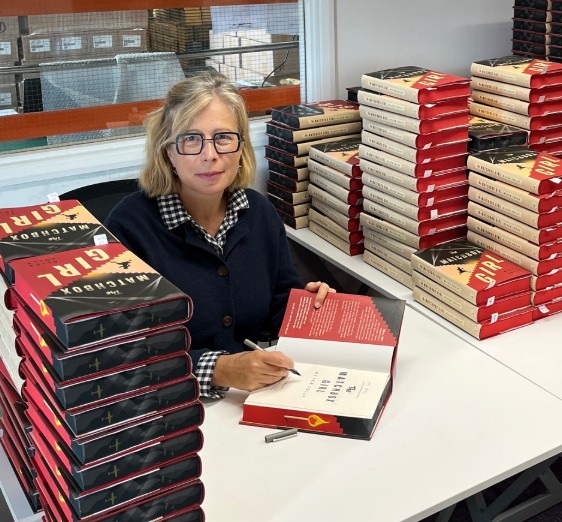
Alice Jolly is a novelist and playwright. Her writing has been awarded the PEN/Ackerley Prize, an O Henry Prize and the V. S. Pritchett Memorial Prize, and been longlisted for Ondaatje Prize and the Rathbones Folio Prize. She teaches on the Creative Writing Masters at Oxford University.
For further information, visit Alice’s website, or follow her on X @JollyAlice and Instagram.
 Linda's Book Bag
This is a book that definitely calls to me. I love Historical fiction, but also have 2 grandchildren on the Autism spectrum. Thanks for sharing this one, Linda.
LikeLiked by 1 person
Hi Linda, this sounds very interesting. I am neurodiverse as is my oldest son. I can’t find it on Amazon though.
LikeLiked by 1 person
This sounds like a thoughtful exploration of characters in history I’m sure many will be interested to read about.
LikeLiked by 1 person
I don’t know if you’ve read any of Alice’s books Claire, but I think you would truly appreciate them.
LikeLike
I think this might be a must read for you Robbie. It’s here in the UK https://www.amazon.co.uk/s?k=the+matchbox+girl&crid=18YCUYKH0PXJB&sprefix=The+matchbo%2Caps%2C118&ref=nb_sb_ss_mvt-t11-ranker_2_11 but I don’t know about South Africa.
LikeLike
And Alice’s writing is stunning Carla.
LikeLiked by 1 person
I haven’t read her before, I’m intrigued.
LikeLiked by 1 person
I think Mary Ann Sate, Imbecile (https://lindasbookbag.com/2018/06/11/mary-ann-sate-imbecile-by-alice-jolly/) might be right up your street!
LikeLiked by 1 person
Thanks, Linda 💓
LikeLike