
It gives me enormous pleasure today to welcome Ellen Alpsten to stay in with me to chat all about her latest book. I must thank Ellen for waiting so patiently for me to find time to have her over!
Let’s find out more:
Staying in with Ellen Alpsten
Welcome to Linda’s Book Bag Ellen.
Thanks so much for having me! It’s really the season for staying in, isn’t it? Light a candle and snuggle up with a cup of tea and a good book. There’s nothing nicer than that.
I could not agree more! Thank you for agreeing to stay in with me.
I thank you – once the task of writing and finishing a book (and hats off to ANYONE who does this, published or not!) is done and the book out there, there’s nothing nicer than to talk about it. I suppose that’s the strange JoJo existence of being a writer. For months, we are cooped up, writing away and pouring our souls onto the blank sheet of paper. Then, suddenly, we are out there, presenting our baby to the world.
I think some authors find these aspects tricky Ellen. What about you?
To me, this is a double pleasure, as I focus on history’s hidden heroines in my writing. Like in any art, a writer has to hone a voice and – with a bit of luck and a LOT of elbow grease – become an instantly recognisable brand. Once you find your narrative, stick to it. There’s the ‘Defamiliar’ historical fiction novel, which Grand Masters of our genre such as Bernard Cornwell and Robert Harris choose. These authors implant their character into a known scenario. Think Alfred the Great halting the advance of the Vikings or a transgender Cardinal being victorious at a Conclave.
Oo. Interesting. What else comes to mind?
Also, the world’s bestselling historical fiction novel ‘Gone with the wind’ by Margaret Mitchell falls in this category. Then, there’s the ‘Historical Romance’. I grew up devouring Jean Plaidy or Victoria Holt and was enthralled by her typical heroine: an English gouvernante, who arrives at a huge Manor house, tames the stroppy off-spring of a widowed and darkly handsome Lord, and wins the said Lord’s heart (while seeing off a well-born, and murderous competitor.) Finally, there is what I love most: the ‘Cultural Retrieval’. It allows for a new spin on a known subject. Think Hilary Mantel’s ‘Wolf Hall’ trilogy and Philippa Gregory’s ‘The Other Boleyn Girl’, which both made a well-known story – Anne Boleyn’s rise and fall – fresh and fascinating. My own ‘Tsarina’ series were the first ever novels about the wild women of the early Romanovsand the making of Russia: they set the stage for Catherine the Great, but their own trial and triumph was unknown. If they had a voice, I amped up the volume: speak up, sister – shout your story from each of my pages!
Sounds brilliant! So, tell me, which of your books have you brought along to share this evening and why have you chosen it?

My new novel, The Last Princess. It is the first in a planned trilogy, and has the subtitle ‘Daughter of the House of Dragons’. My gorgeous new girl is Gytha Godwinson, the last Anglo-Saxon Princess of England. In a time when women were perceived as cup-bearers, peace-weavers and memory-keepers, Gytha dares the unprecedented: she writes world-history. The Last Princess is stringent historical fiction that teems with trolls, fairies, giants, malevolent stars, nasty Norse sorceresses, handsome hunks and a beautiful princess that struggles to evade an evil spell – and it’s all true.
Wow! Tell me more…
The Last Princess is also spot-on: there is a HUGE William / Harold TV-Series coming up in 2025 and this year women marched alongside men at the Shetland Fire Festival for the first time ever, proudly celebrating their Norse and Anglo-Saxon heritage. For Gytha Godwinson to become the heroine of my new novel The Last Princess, it was a long and laborious way. She lived a 1000 years ago, which is a huge challenge. But the harder the conquest, the deeper the passion. To me, her story is so much more than a ‘feminist retelling’ of the tumultuous events of 1066. It leads us from the candle-lit great Anglo-Saxon Hall of Modranecht, to a muddy field near Hasting and on towards the vast, and perilous unknown. The planned trilogy spans a huge arch across Europe of the High Middle Ages. Between King and Conqueror, Gytha takes the ancient Anglo-Saxon kingdom forward into the future. Her bloodline exists until today. From the ashes of her father’s cursed kingdom, she makes a new Empire emerge. Which one, you ask? Here, Gytha remains tight-lipped, as her quest for love and kingship is all-consuming. But she’ll get there. You’ll see once you read book two of the trilogy, which publishes next autumn: The Sunrise Queen.
Until then, let’s not spoil a surprise.
No indeed. But I’m thrilled to have a copy of The Last Princess on my TBR as it sounds essential reading for me. What can we expect from an evening in with The Last Princess?
The last Princess is Gytha Godwinson, the daughter of England’s true House of Dragons and Harold II. After surviving the ‘slaughter-stained’ year of 1066, she flees the Normans, becomes a Viking slave, and is caught up in a lethal conflict of faith and superstition, until a passionate love story lets her create an empire of her own – no less. Her story is about us, albeit an utterly surprising, shocking, seductive and hitherto unknown us. The novel’s accuracy touches on Ramirez’s ‘Femina’, her epic sweep on Samantha Shannon’s ‘Priory’ work. Also, the book’s themes of loss, displacement, and betrayal are as ‘Zeitgeist’ as Gytha’s quest for trust, love and friendship. I try to write books that have a voice and that are relevant – my reader gives me their most valuable. And that’s not their money, but their time and attention: it’s almost as if an unspoken contract links us for that. I hope that The Last Princess offers what the finest historic fiction should: offering a new spin on a subject you think you know a lot about!
It certainly sounds as if it does!
What else have you brought along and why have you brought it?
I had some fine Anglo-Saxon mustard and honey cocktail sausages, but the dog ate them.
Oh no!
Instead, we must be content with turnip crisps, and sweet hot mead.
Not sure that sounds quite as appetising Ellen. What’s that sound I can hear?
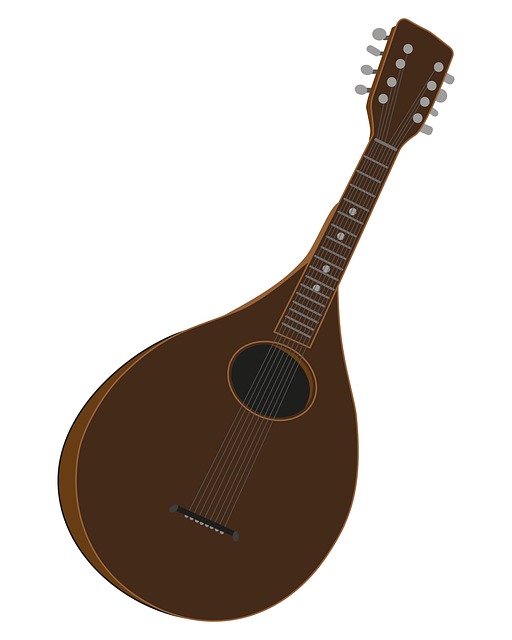
My friend plucks the stands of a lute and hums a song while sitting by the fire-place: he works the news of the day into his songs, which is so much more touching than any WhatsApp could be.
It is. But why is The Last Princess such an important story for you to tell?
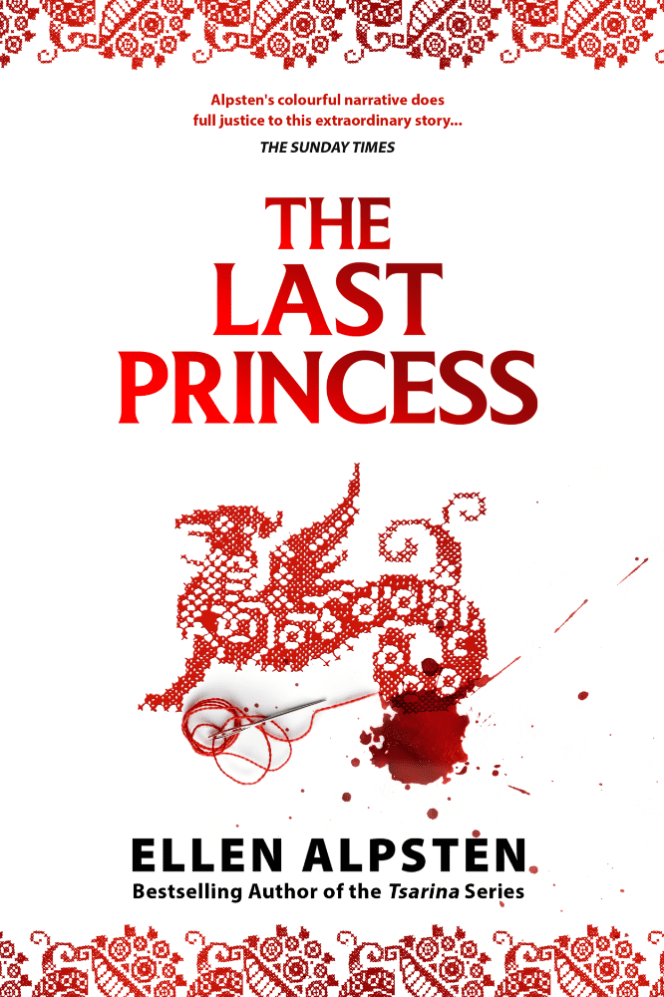
We can be so cosy, as The Last Princess is a family affair: How did I find her? She’s a family affair. Putin’s invasion put an erstwhile end to the ‘Tsarina’ series. But only another of history’s hidden heroines would do. It was then that my Swedish father-in-law pointed her out to me: She is my husband’s ancestress, but 33 times removed. She is also a family affair because Gytha tells the truth about what happened in 1066 – William the Conqueror was but a symptom of the cause, a searing sibling rivalry. She speaks with a strong and modern voice – as modern as the then bustling town of Lundenwic, a Roman settlement on the Thames. The former Londinium is about to eclipse nowadays Winchester as capital of the kingdom. Just describing Gytha’s journey there – she rattles along the old ‘Stone Street’ together with the women of her family – took me five days of research. Five days in a long year of research, before I picked up the pen and began to write her story, which bridges myth and modernity. But there is another aspect of a family affair: When it came to choosing a cover for The Last Princess, discussions were long and heated. Nobody wanted yet another Anglo-Saxon Amulet or a Viking-style longboat setting sail into the unknown. We hit a wall around Christmas-time one year ago. It was excruciating. Which image could sum up the appeal of this novel, which bridges myth and modernity?
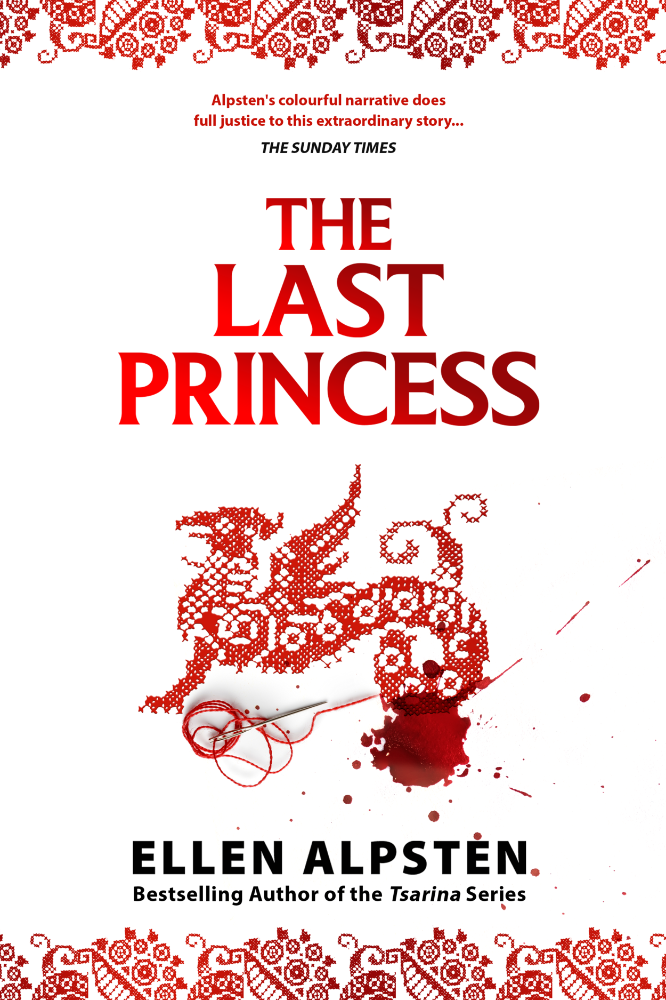
I went home for Christmas, which is forever changed since my mother died 5 years ago. I love that we can be together, but I also miss her so much, that I mostly sob into the gravy, when on my own in the kitchen. It was when I checked the table linen that, at the very bottom of the drawer, I came across a small table-cloth, which my great-grandmother had embroidered for her trousseau in 1914. The wedding was arranged in great haste: WWI was looming and the Kaiser barred his officers from marrying just one month later: he was in no mood of paying more widow’s pensions that he had to. I stared at it in disbelief: it was a Wyvern, the two-legged crimson and winged creature, which is Gytha Godwinson’s heraldic beast. Did my Ua Alice do protest embroidery when choosing this unusual ‘Wyvern’ motive and embroidering the beautiful, blood-red surrounding floral patterns? Perhaps. But for me, there could be no other choice. Her work is at the heart of the cover of my new novel even though, in the book, Gytha’s own embroidery skills are abysmal! Don’t you love how there is always a good story hidden in a good story? So I do think of her, too, when reading The Last Princess and writing the sequel.
What fascinating and wonderful connections Ellen. And I think you have an extract to share with us too?
I have Linda:
An Extract from The Last Princess
October 1066
The long-haired star does not come overnight. The tides of time make no haste, knowing of their power. It sneaks into our sky during the last days of summer, when our men line the South Coast, tirelessly on the lookout over the Channel. By the time the harvest beckons, and Father has no choice but to disband the army, it is still a speck in the sky. We think ourselves safe when we sample the first, fresh wines, pickle jars of plums and walnuts, and shelve apples for winter. Surely the light we see is the moon waxing or waning.
But once the star’s ungodly shine rims the horizon, my little sister Gunhild and I gather at our window in the women’s bower of Havering Palace.
‘What is this, Gytha?’
‘I do not know.’ I wish I had paid more attention to Grandmother’s lessons; lessons aimed at preparing me for either marriage or the monastery, whichever serves my family, and thus England, better.
When we go to bed, the star’s gleam pierces my eyelids and keeps me awake in the night hours. I try to settle, listening to Gunhild’s calm breathing. In vain. My thoughts race as my stomach knots. Despite the cool of the autumn night, I break out in a sweat. It is clear who has sent this star. The thought makes my heart skip a beat: how can we face her wrath? Not this, not now. The seidr Tora is taking revenge. She will show no mercy. A Norse sorceress never does.
The next night, as soon as our maids have retired, Gunhild and I drag our mattress – all heavy and stuffed with horsehair and straw – over to the window. We spread our blankets anew; their wool comes from our sheep that graze on meadows all over the country. But even their bearskin linings fail to warm us when the sight in the heavens chills us to the bone. A new fireball rules the sky, its size rivalling the sun. It makes the evening star pale and drags a devil’s tail of sparkling dust in its wake. Its fire sears the darkness and ploughs the night. In the meadows, the livestock stand awake, mooing and bleating in terror, joined by the geese’s honking. The villagers swarm from their houses. They push into the open palace gates, crying for help, and join the courtiers in the yard: staring, and sobbing. After what feels like too long a time, the chapel’s doors fly open; Stigand appears in his full regalia. The Archbishop of Canterbury preaches until his face pours with sweat. At his shouted sermon, his flock cup their faces, kneeling in the dirt, swaying, their bodies a wave of prayer. In a last, desperate stab, Stigand holds a small Cross carrying Christ towards the skies, his fat fingers moist, his hands trembling. He hopes to banish the apparition; but instead, its light first frames the Lord and then sets the Saviour himself aflame. I choke on my breath. Stigand halts, his chest heaving, his voice hoarse. He gives up.
We are dead on our feet, but unable to rest. When the door flies open, I cannot hide my relief, and turn: ‘Mother. Grandmother.’
‘Let’s stick together, girls.’ Grandmother’s voice, so used to giving orders, sounds brittle. The star’s threat burns her best-laid plans to ashes as Mother slips in behind. When she places her hand on her flat, bony chest, her bare fingers are pale and their every knuckle shows. She has given almost all her jewels to Wilton Abbey. ‘This is a curse. It is the hour of reckoning. Great change is about to happen in the Kingdom.’ It is startling to hear her speak after she has been silent for so long. For weeks, the only thing that has interested her have been Havering’s windows, where she stands, and stares.
I wrap my arm around her shoulders. Her body is bird-like, and I smell mead on her breath. I hold her close, never wanting to let go. I will keep her safe, no matter what.
‘What will happen to us, Mother?’ Gunhild’s blue eyes are wide. The walls of Havering Palace give no safety but offer us like choice morsels on a plate.
‘You are a child. No harm will come to you.’ Mother strokes back Gunhild’s thick blonde curls. Then she turns to me. ‘Come here, Gytha Haroldsdotter.’ She raises her veil, freeing its fabric from the neckline of her dress. Beneath, she finds a golden chain with a pendant. Once, her fabulous wealth was the base of Father’s power, giving him the fyrd, the simple soldiers ready to lay down their lives for him, and the geld, the rental income of her countless hides. If she should choose to travel from Loidis to Lundenwic or from Caernarfon to Canterbury, Mother sleeps every night under her own roof. Now this pendant is her last piece of jewellery: a Cross studded with a single ruby which is set on a backplate. The jewel has a stunning fire.
Grandmother tries to hold her back. ‘Have trust, Edith Swanneck. It is the Witan’s role to decide upon a King. The Royal Council chose Harold.’
‘Trust? Nothing has betrayed me more.’
Grandmother crosses her arms, her mouth a thin line. She is always hard to age, and the star’s white light makes her features look smooth as kidskin.
Mother fastens the clasp around my neck and our eyes meet. I am so similar to her: the fair skin, the faint freckles, the green eyes, the ginger curls. Our foreheads touch, as she says: ‘This is for you, Gytha. The ruby is the stone of courage and counsel. It will keep you safe.’
I shake my head. ‘But Father, Uncle Gyrth and Ulf will return soon. And Magnus and Edmond are here in Havering. The men of our family will keep us safe.’
‘The men of our family –’ The words hang in the air as Mother’s fingertips brush the pendant, taking leave of it. In the evening sky, the star glares with untold fury. ‘Without the men in our family none of this would have happened. Now, Tora is taking revenge. May my love protect you against everything, Gytha.’
My throat tightens. ‘Even her?’
Mother whispers: ‘Even her.’
My heart is a stone, weighing me down. If this is the end, then something else must begin. I melt into Mother’s embrace and as Gunhild joins us, we hold on to each other tightly. Only Grandmother chooses to stand by the window, looking out over the rolling hills: the star’s fire on their summits is the searing trail of Tora’s revenge. The future of our family, and England, will be decided on a field near Hastings.
I clutch the Cross. Already, the ruby’s glow is a secret source of strength.
Father must be back soon.
****
Brilliant. That’s a great piece. Thank you so much, Ellen, for staying in with me and captivating me about The Last Princess. It’s been lovely to have you here. Now, you pour some mead – I may as well give it a try – and I’ll tell readers a little more about The Last Princess:
The Last Princess
Young and beautiful Gytha Godwinson is the envy of England when her father Harold seizes the country’s crown in early 1066. However, treachery tears her house, her family and everything she holds dear apart. Soon triumph turns to terror as an evil star appears, heralding the end of an era and a new beginning for Britain. Her family and the realm seem cursed, but even as she suffers loss, betrayal and humiliation, Gytha is determined to regain what is rightfully hers. She survives the walk through the furnace that is the conquest and goes so much further.
In a stunning re-telling of 1066, international bestselling author Ellen Alpsten has created a captivating new heroine in Gytha Godwinson. Witness the demise of a cursed kingdom and the emergence of a new empire. The Last Princess bridges myth and modernity.
The Last Princess is available for purchase through these links.
About Ellen Alpsten
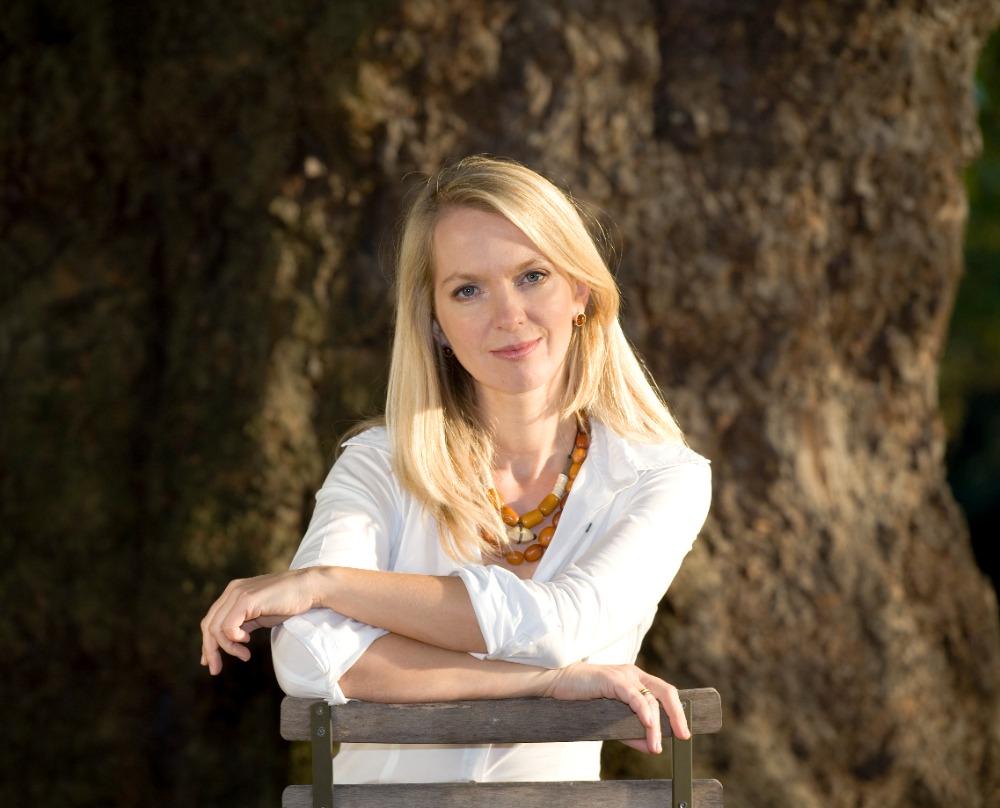
Ellen Alpsten was born and raised in the Kenyan highlands and holds a MSc from the IEP de Paris. She worked as a News-Anchor for Bloomberg TV before writing fulltime. Her debut novel ‘Tsarina’ and its sequel ‘The Tsarina’s Daughter’ (both Bloomsbury Publishing) is widely translated and were shortlisted for numerous awards.
For further information, visit Ellen’s website where you can sign up to her newsletter and find Ellen on Twitter/X @EAlpsten_Author and Instagram.














 Linda's Book Bag