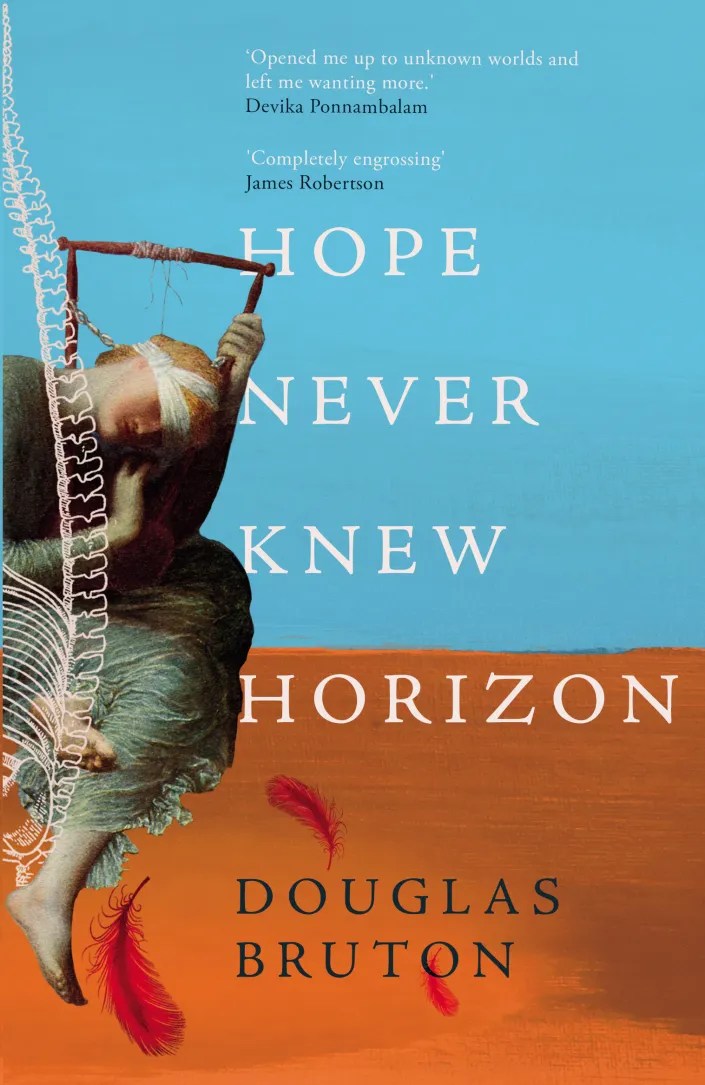
When Douglas Bruton got in touch with me recently about his latest book I knew it would be one that I’d love. Sadly, life simply didn’t afford me the time to read and review it. However, I so loved the concept that I simply had to invite Douglas onto Linda’s Book Bag to tell me more about it and I’m delighted he agreed to be here.
Let’s find out more:
Staying in with Douglas Bruton
Welcome to Linda’s Book Bag Douglas and thank you for agreeing to stay in with me.
Thank you for asking me to do this. I love meeting new people over tea and cake – I hope you are having cake. These things are always better with cake I find.
To be honest, I think everything is better with tea and cake so I know already we’re going to be great friends. Grab a slice and then tell me, which of your books have you brought along to share this evening and why have you chosen it?
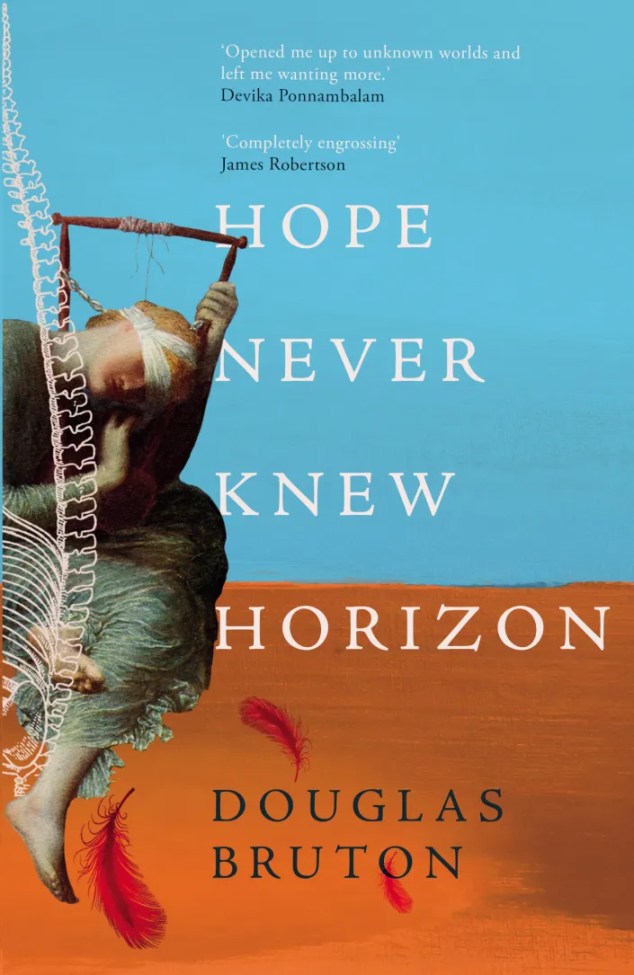
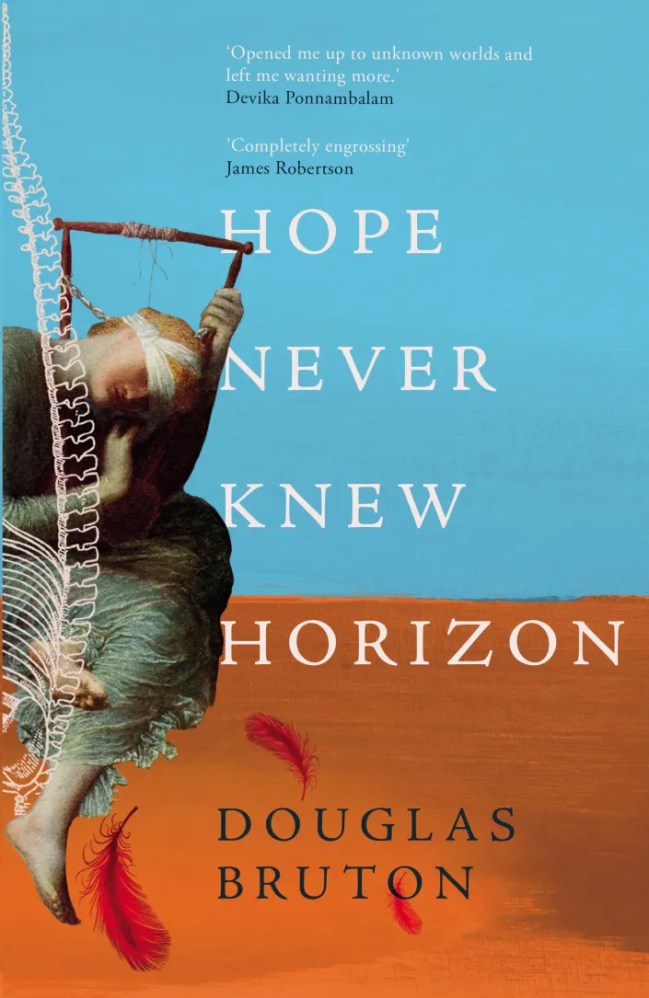
I’d like to share my most recent book with you. It’s called Hope Never Knew Horizon.
I love that title. How did the book come about?
The impulse that moved me to write this book came out of the deepest darkest moments of lockdown. I recall waking one morning with a thought in my head – an urgent and pressing thought: that I wanted to write something with ‘hope’ in it. I had no idea what that even meant but over the next few months the ‘universe’ just kept throwing stuff my way, stuff with ‘hope’ in it. And the stories and characters in my head began shouting louder and louder for my attention so that finally I had to sit down and write Hope Never Knew Horizon. The Glasgow Herald summed it up as ‘a book that glows with positivity’ and that’s really what I was going for. Not a book about the pandemic – it’s about as far away from that as you could get; but it’s a book that is, I think, filled up with hope.
Hope Never Knew Horizon sounds fantastic Douglas. We might be on a bit from the pandemic but the world really needs some hope at the moment. So, what can we expect Hope Never Knew Horizon?
Rope is always stronger when it is something braided rather than a single strand – indeed the braided rope is usually stronger than its constituent threads. I like that idea and so I have here braided three stories together.
That sounds very impressive. Tell me more.
The first thread is the story of the American poetess Emily Dickinson as seen through the Dickinson’s maid – and she is overly romantic and hopeful for Emily’s happiness. Emily secretly writes letters to a woman called Susan who will, later in the story, become her sister-in-law. The letters are tender and full of love and deep feeling. The maid, Margaret, thinks Emily might be in love. But there is a greater hope in Emily and only after her death is this hope realised. (Oh, and the maid has her own unexpected love story for love often comes when it is not looked for, when hope is all but gone.)
Fascinating. And the second?
The second thread involves the blue whale skeleton that hangs in the British Natural History Museum. The complete story of the whale unfolds through the voices of characters normally ignored by history books and their stories are full of hope and longing and whale-song. The whale skeleton was recently taken down, cleaned and renovated, then rehung in the splendid Hintz hall of the museum; it was also given a new name: ‘Hope’. I think this expressed the hope of everyone who worked on the project, a hope that the future will still have blue whales swimming in our oceans and don’t we all hope for that?
Oh we do indeed. You know, just hearing about Hope Never Knew Horizon is making me feel more positive. Tell me about the third strand.
The third thread is centred around a painting I fell in love with when I was twenty and it hangs on the wall at Tate Britain; it is a painting called ‘Hope’ by the Victorian artist G F Watts and I remember standing young and a little breathless looking up at it. I thought there must be a story in the woman who had modelled for the painting and a little research showed me there most certainly was – a wonderful story of hope and quiet ambition and love too.
Braiding these three threads together makes the hope I wanted to rediscover in the world all the stronger. I think it is there for the reader to discover also.
I have a feeling I’m going to have to find time to read Hope Never Knew Horizon Douglas as I am intrigued as to how those three strands come together in the book.
What else have you brought along and why have you brought it?
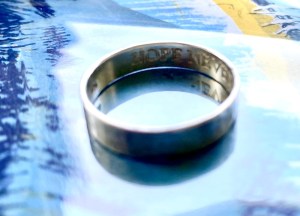
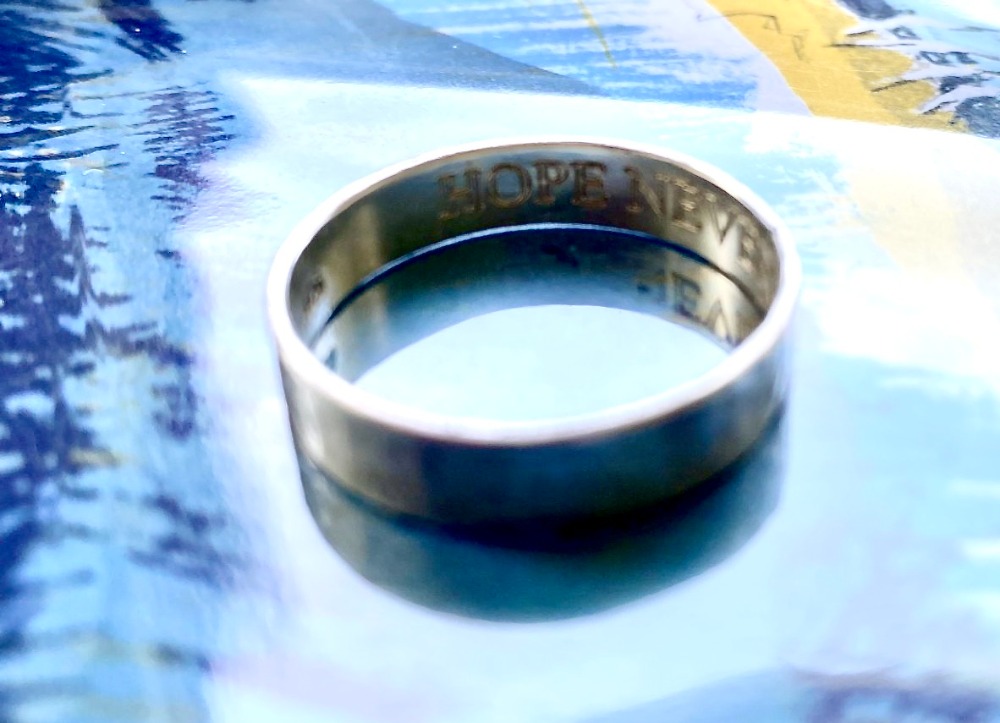
The first thing I have brought to our stay-in (apart from the tea and cake that is) is a ring. It is a fairly simple silver ring that I had made to celebrate the publication of Hope Never Knew Horizon. Inside the ring is a secret – I have had the title of the novel engraved on the inner ring. The words Hope Never Knew Horizon come from a poem by Emily Dickinson. Their relevance to the book is the idea that ‘hope’ is something we give birth to and maybe even say out loud or express in writing or art or film – but having expressed that hope it is then for the world to realise that hope and it is not always the case that it will do so within the lifetime of the person who has the hope but there is a sort of certainty that it will be realised at last. For example, Emily Dickinson harboured the hope of one day having a book of her poems published; this hope was fulfilled only in the year after her death. I wear my ‘Hope’ ring hoping that my book will be read and liked and that it will go on being read and liked even when I am not in the world – if that’s not too morbid a thought to have when we are drinking tea and eating cake. (btw my cake of choice would be something with almond paste in it – like Bakewell or frangipani.)
That’s not morbid at all. Hope Never Knew Horizon is out in the world. It will live on and so will you through it. I think that’s a lovely message of hope actually. (And I’m very fond of almond paste too!)
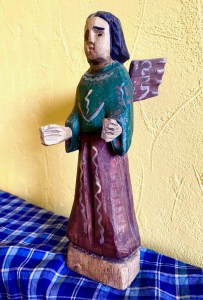
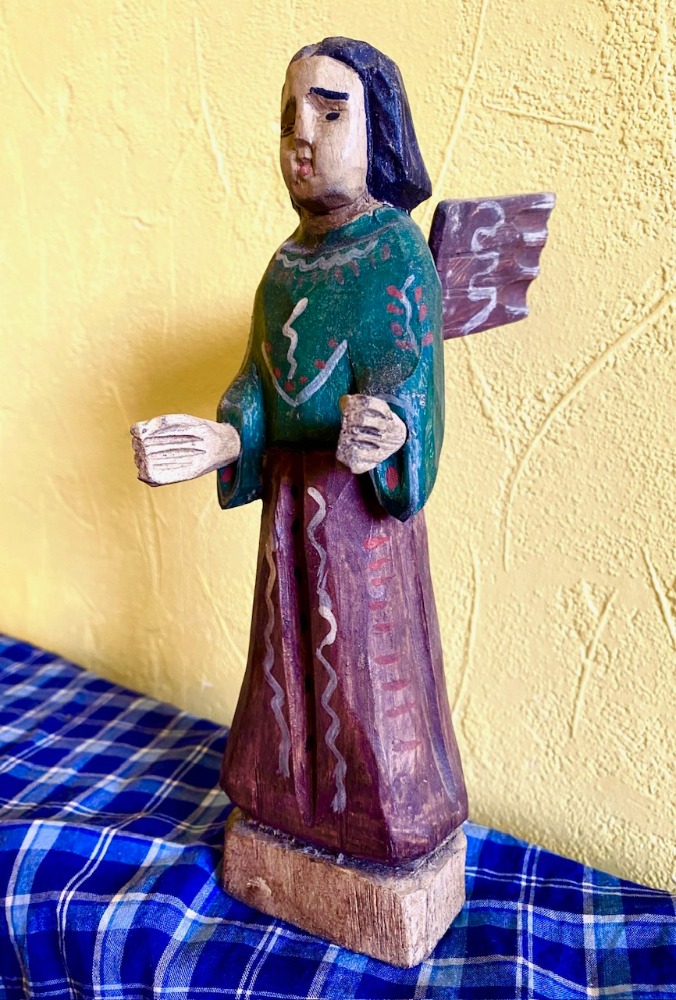
The second thing I have brought is a wooden angel that comes all the way from Chile. Isn’t she quite lovely?
She is certainly very different from conventional angel statues. I love that about her.
I have another book coming out in February 2025. It will be called Woman in Blue. It will be published by Fairlight books – my third book to be published by them; the other two are Blue Postcards and With or Without Angels. These first two books have angels in them; and the third, Woman in Blue does not… except that I was one day looking for a name for the central female character and it had to be a Dutch name and I stumbled upon the name ‘Lieke’. I fell in love with the name for its musicality and so used it. Only later in the writing did I discover that ‘Lieke’ is short for ‘Angelieke’, which means angel-like! And so angels creep into my work unawares and very welcome they are too.
That’s serendipity at its best!
Thank you so much for staying in with me to chat about Hope Never Knew Horizon Douglas. You’ve made me desperate to read the book and I think it sounds wonderful.
Thank you, Linda , for your warm hospitality. The cake and tea was fabulous.
My pleasure. Now, you pour us another cup and slice up that Bakewell and I’ll give readers a few more details:
Hope Never Knew Horizon
Wexford County, 1891. The unlikely discovery of a beached blue whale sets in motion a series of events leading to the present-day re-installation of a fundamental piece of London’s Natural History Museum.
Amherst, Massachusetts, circa. 1850. A letter is found revealing an intimate secret about the reclusive Miss Emily and her brother’s fiancé Susan Huntington.
London, circa. 1880. A young working-class woman named Ada Alice Pullen meets the esteemed painter Frederic Leighton, beginning a relationship that will transform her and the world of art forever. Three objects of hope, their stories retold as you’ve never heard them before: in the voices of the coxswain’s girlfriend, the maid, and the model.
Hope Never Knew Horizon was published by Taproot Press on 30th April 2024 and is available for purchase here.
About Douglas Bruton

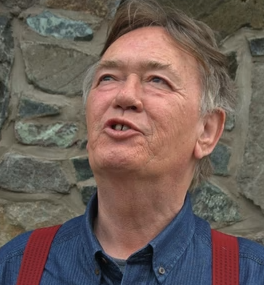
Douglas Bruton has had short stories placed in various publications including ‘Northwords Now’, ‘New Writing Scotland’, ‘Aesthetica’ and ‘The Irish Literary Review’. His short stories have also won many competitions including with ‘Fish’ and ‘The Neil Gunn Prize’. His children’s novel, The Chess Piece Magician was published by Floris Books (2009); his literary fiction debut, Mrs Winchester’s Gun Club, was published by Scotland Street Press (2019); and Blue Postcards, longlisted for the Walter Scott Prize for Historical Fiction 2022, was published by Fairlight Books (2021); With or Without Angels was also published by Fairlight Books (2023). A novella about the death of Dylan Thomas called Just Like Him To Die was published by Leamington Books (2022). In 2024 Taproot Press published Hope Never Knew Horizon.
For further information, find Douglas on Facebook or follow him on Twitter/X @DB14bbb.









 Linda's Book Bag