

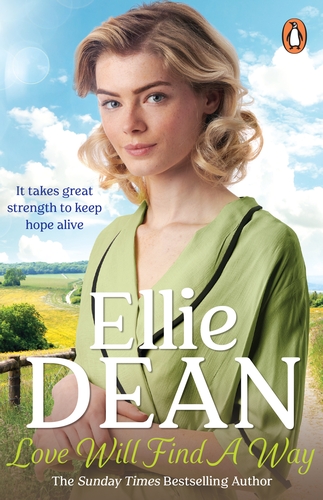
Thanks to lovely Hana Sparkes at Penguin, I’m lucky enough to have a copy of Love Will Find A Way by Ellie Dean on my TBR pile. I’ve recently begun to read more of this genre and have enjoyed the books so much that I thought it would be a good idea to share an extract from Love Will Find A Way so that other readers might also find a new-to-them genre. My thanks to Hana for providing an extract today.
Love Will Find A Way was published by Penguin on 28th March 2024 and is available for purchase through the links here.
Love Will Find A Way
Cliffehaven, December 1946
From a hill above the town of Cliffehaven, a young woman makes a heart-breaking choice that will change the course of her life forever.
Hours later, a baby is found in the Nativity crib of the local church.
Who could have left him there, and why?
The mystery preoccupies everyone in Cliffehaven – not least Peggy Reilly, who has enough to contend with at Beach View Boarding House without this extra secret to unravel.
What’s certain is that the whole community will pull together to keep the baby safe – and to support his mother when the truth of her identity is finally discovered…
An Extract from Love Will Find A Way
1
1946
It was a week before Christmas and from her vantage point on the hill above the town of Cliffehaven, the young woman watched preparations for the festive season, longing to be a part of them. She dared not leave her hiding place until she could be certain no one would see her. The time to go was fast approaching and, although she’d be returning home, she knew her world would never be the same again.
She refused to think about what the future might hold and forced herself to concentrate on the colourful scene being played out below. The shops had stayed open later than usual, and there was an excited bustle as people hunted for last-minute gifts, chatted on street corners, or bought bags of hot chestnuts from the man who’d set up his brazier outside the busy Crown pub. A school choir had assembled alongside the local brass band, and there was a sudden, expectant hush as their music teacher raised her baton.
Her gaze drifted to the children who stood in awe around the Christmas tree which had been erected outside the Town Hall some time ago. Its pretty lights twinkled in the early darkness of this winter’s day like a beacon – torturing her with the memories of other Christmases and the promise of warmth and light, and sorely needed company. Although tempted to throw caution to the wind and go down there, she remained where she was, hunkered low in the deep shadows of the trees, her new-born baby asleep in her arms.
He’d come earlier than she’d expected, which was a blessing, for it meant there would be fewer awkward questions to answer when she returned home – as she’d promised – in time for the celebrations. She tucked the blanket firmly about the baby and nestled him within the folds of her coat as the sound of the brass band and choir drifted up to her. Their music was yet another reminder of Christmases past when life had been uncomplicated, and her future a bright and unchartered map.
The school choir was singing, ‘Away in a Manger’, and she wondered how they would react if they knew that a baby had already been born that night without fanfare, a crib for a bed or a star to mark his arrival – for this little one had come into the world in a dilapidated caravan that stank of mould, sheep and mice droppings.
The cold had now become unbearable and, fearing the baby might come to harm, she took one last look at the brightly lit, bustling town and got to her numbed feet before heading further uphill towards the caravan which had been her home for almost three weeks. The bright moon lit her way as her boots trampled the frosted grass and the hem of her coat snagged on the brambles and gorse which grew in wild abandon beneath the ancient trees that sheltered her makeshift home. She paused to catch her breath and looked up at the sky which was liberally sprinkled with stars. Tonight would be colder than ever, she realised, and soon there would be snow, so it was fortunate she was leaving.
The caravan had once been her childhood playground during the school holidays, but it had long been forgotten and abandoned once the shepherd had lost his life in the war and the flock had been sold. It sagged on shredded tyres, settling deeper each day into the soft earth as the windows and outer shell became greener with mould and lichen, and its delicate fabric swelled and buckled with damp. She’d taken much longer than she’d expected to find it. But she’d eventually come across it, well hidden in a deep fold of the hills, and now, as she stepped into the darkness of the sheltering trees, the only sounds she could hear were the rustle of the wind in the leaves and the distant hoot of a barn owl.
She tugged at the warped door and stepped onto the rickety floor which creaked beneath her slight weight. Although it had lain empty during the long war years, the caravan’s interior still held the memory of lanolin and wool as well as the organic essence of soil and decomposition.
When she’d first set eyes on the wreck, she’d wondered if she was foolish to even contemplate setting up temporary home here, but accepting she had no other choice, she’d set to with a will to make it habitable. She’d dumped the stinking mattress and soiled bedding which had become a nest for vermin, tacked strips of old blanket over the windows to stop any light showing at night, and then scrubbed the interior from top to bottom.
She looked with some satisfaction at the results of her hard work, for it was almost homely with the blankets, eiderdown and sheet she’d brought with her draped on the planking bed and, once she’d lit the candles and kerosene heater, it felt quite snug; if one could ignore the blackness outside and the isolation which seemed to crowd in on her whenever she let herself think about it.
But she hadn’t bargained on how cold it would become as the wind whistled through every crack and crevice and managed to penetrate even the thickest blanket – or how hard it would be to keep her resolve as the night sounds kept her awake, and the thought of scuttling spiders and rodents put her on edge. But for all its inconveniences and isolation, it had been the perfect hiding place, and she’d been immensely relieved to find it was still here.
She placed the baby on the bed and covered him in the eiderdown before lighting the candles she’d stuck in jam jars, and the small kerosene heater. The heater smelt horrid and soaked the thin walls in condensation, but it was better than nothing. He would wake soon and would need feeding, so she carefully measured the powdered milk, added the last of the fresh water she’d sneaked down to collect from Chalky White’s well the night before last, and popped the feeding bottle into the saucepan of stale water to heat it up over the single gas ring.
As she waited for the water to simmer, she began to collect her few belongings and pack them into the holdall. There wasn’t much as she was wearing almost every stitch of clothing she’d brought to ward off the cold, and she’d be leaving the bedding, heater and single-ring camping stove behind. Yet, as she packed, her thoughts kept returning to all that had happened here. It felt dreamlike now – almost surreal – but at the time it had been the most terrifying ordeal she’d ever had to face.
The days of waiting for him to arrive had seemed endless, but when the pains had started last night, and the terror of having to go through the birth on her own had set in, she’d been on the very brink of seeking help. But before she could pluck up courage, the labour had advanced too rapidly so she’d had to persevere on her own, praying desperately that nothing would go wrong – that through her panic and selfish desire to keep him secret, her baby would not come to harm.
The very worst scenarios had flashed through her mind during that short, painfully hard labour. What if she died and no one found him? What if they both died? How would her loved ones deal with her mysterious disappearance? Who would ever think of looking for her here?
To her enormous relief, he’d arrived fairly quickly, and because she’d read every book she could find on the subject, she’d managed to deal with tying and cutting the cord, cleaning his airways and burying the afterbirth. But she hadn’t counted on feeling so weak afterwards – hadn’t realised how difficult it would be to keep them both clean and warm in the hours after his birth – or how utterly impossible it was to feel nothing for him. Which was why it was imperative she left tonight.
She finished packing and sank onto the hard planking she’d used as a bed, her gaze returning repeatedly to the baby beside her. He was beginning to stir, his tiny, mittened hands waving as his rosebud mouth began to pucker. His hair was surprisingly dark beneath the woollen cap, his skin pale and unmarked perfection under the layers of his knitted layette. She had no idea what colour his eyes were, for he’d yet to open them.
He was certainly sturdy enough to survive these brutal first hours, and that was probably because she’d been very careful to eat properly once she’d known she had no alternative but to see the pregnancy through. After all, she’d reasoned at the time, it wasn’t his fault she’d been so stupid – so cowardly – so utterly incapable of making the right decision about anything.
He began to mewl and fuss, and she reached for the feeding bottle to test the heat of the formula milk on the back of her hand before changing his nappy, and dressing him once again in the layers of clothes she’d secretly bought from an out of town market. And then, with great reluctance, she cradled him in her arms so he could feed.
Her breasts ached with the need to feed him herself and tears pricked as she looked down at him. She didn’t want to love him – couldn’t bear the thought of getting to know his scent, or the way he felt in her arms. And yet . . . He was so easy to love – so perfect . . . And at this moment she was all he had in the world – and she was about to abandon him.
She blinked back the tears and then closed her eyes as her breasts wept with the milk her baby would never taste. She was being selfish and cruel, but he would be better off without her. He would be loved and cherished by parents who wanted him, and have the chance of a good life. Whereas she would return to her old life unencumbered by scandal and shame – and hopefully wiser from the experience and more clear-eyed in her choices.
Biting back on a sob, she knew she was only fooling herself – and that these last few precious moments would live with her for ever; the guilt a well-deserved punishment for the unforgivable sin she was about to commit.
He weighed heavier in her arms and she realised he’d finished feeding and was once more asleep. She dried her tears, wrapped him snugly in the blankets and then curled around him beneath the eiderdown to wait until she was certain Cliffehaven was sleeping.
She must have dozed off, for when she opened her eyes again, it was almost three in the morning – and dangerously close to the time when the town would begin to stir. She would have to hurry.
As the baby seemed to be sleeping peacefully, she left him on the bed while she switched off the heater and blew out the stubs of candle. Fastening the army surplus coat over the two cardigans, jumper and heavy-duty dungarees, she wound the scarf round her neck, pulled the knitted cap further down over her ears and picked up the baby in one gloved hand, the holdall in the other.
Stepping down from the caravan, she nudged the door shut with her heel and set off into the still and silent night, the cold bright stars accompanying a moon ringed by an ethereal halo. With a trembling breath, she hitched the baby closer to her chest, tightened her grip on the holdall and, without looking back, began the long trek over the hills to the track which would eventually lead her down into the sleeping town.
By the time she finally reached the stile at the end of the track, her legs were trembling from the effort it had taken to walk so far, and she was desperate to rest. But as she looked down the steep road towards the High Street, she became aware of the sounds coming from behind the high walls of the dairy. Alan Jenkins would be loading his drays, and soon he and his men would be leading the shires out of the yard to begin their rounds. There was no time to rest.
Pausing to catch her breath, she eased the baby to the other arm and flexed her stiff fingers before once again lifting the holdall. Frost glittered on the pavement and silvered the weeds growing by the factory estate fence, and she had to negotiate the icy patches carefully as she went down the hill.
Reaching the deserted High Street, she saw the Christmas tree lights had been switched off, and only a dim glow came from a solitary streetlamp outside Plummer’s department store. All the shops were shuttered, the pavements deserted, and now the only lights she could see were a pale glimmer behind the curtains of Gloria’s bedroom above the Crown, and the blue lamp outside the police station.
The thought of someone seeing her made her even more nervous, and it seemed her anxiety had been transmitted to the baby, for he began to mither and squirm. Fearing he was about to start crying, she hurried over the hump-backed bridge and headed into the labyrinth of alleyways that led off the High Street. She knew exactly where she was going and could only pray that the door hadn’t been locked.
Her footsteps echoed as she entered the church grounds, but as she climbed the steps and reached for the heavy iron ring in the oak door she heard the stamp of horses’ hooves ring out from beyond the bridge, and knew she’d almost run out of time.
Holding her breath, she twisted the iron ring and the door creaked open so loudly she was sure someone must have heard it. She froze momentarily and then slipped into the darkness that smelt of incense, cold stone and old hymn books, and gratefully dropped the cumbersome holdall onto a nearby pew.
The church was vast. Built in Victorian days, it had withstood two world wars and then seen the congregation dwindle, but at Christmas it became the hub of Cliffehaven with its ancient crib, special carol concerts, services and lively re-enactments of the Christmas story.
She felt the baby stir and stretch in her arms as she tiptoed down the long aisle towards the altar which had been dressed quite gloriously with red-berried holly, mistletoe, ivy and thick white candles. If he woke now, his cries would echo to the rafters and be heard in the surrounding houses. She jiggled him in her arms, hoping to still his fretting.
It seemed to work, but her heart was thudding painfully against her ribs as she paused at the steps and deliberately turned her gaze from the gold cross that hung above the altar. She needed no reminders that what she was doing was against everything she’d ever believed in, but she had no choice – really she didn’t – and if God was as kindly as he was meant to be, then he’d surely understand and forgive her.
She turned from the altar towards the nativity tableau which, following a long-held tradition, was set up at the foot of the intricately carved pulpit. There was the stable, crudely made of wood off-cuts and straw thatch, but lovingly restored after many years of service, as were the painted wooden figures of Mary and Joseph, the three wise men and the shepherds with their miniature sheep. The crib at the centre was filled with straw in which lay a rather battered and ugly representation of the baby Jesus.
She bent down, and with a soft apology, lifted the effigy from the straw and placed it to one side before tenderly laying her own baby in its place. ‘Forgive me,’ she whispered as she placed the feeding bottle beside him, kissed his forehead and saw the sparkle of her tear on his downy cheek.
As if he understood that she was abandoning him, he opened his eyes, and meeting that accusing, clear blue gaze, she felt a pain so great it took her breath away.
‘I’m sorry,’ she sobbed. ‘So very sorry. Please, please forgive me.’ She backed away from those accusing eyes, and then was running down the aisle to snatch up her bag and make her escape.
The cold air and the reality of what she’d done hit her as the door-latch clicked shut behind her. Yet, on the point of rushing back to scoop him up and face the consequences, she heard the sound of approaching footsteps. Dashing from the doorway into the deeper shadows, she hid behind the town’s war memorial and watched as a familiar figure strode towards the church doorway. She stifled her sobs as she felt a deep thankfulness that her baby would now be safe.
Blinded by her tears, and consumed with guilt, she picked up her bag and slunk away into the darkness as the first soft flakes of snow began to fall.
****
I have a feeling I’m going to thoroughly enjoy Love Will Find A Way when it reaches the top of my TBR.
About Ellie Dean

Ellie Dean lives in a tiny hamlet set deep in the heart of the South Downs in Sussex, which has been her home for many years and where she raised her three children. She is the author of the The Cliffehaven Series.
For further information, visit Ellie’s website, or find her on Facebook.
 Linda's Book Bag
I share your appreciation for Ellie Dean’s books and I am happy to repost this.
LikeLiked by 1 person
Thanks Tony!
LikeLike
This sounds like a most intriguing book.
A baby found over the Christmas season.
LikeLike