

I feel rather terrible because I’ve been sitting on this review of Vaseem Khan’s Death of a Lesser God since last August and I completely forgot to share it on Linda’s Book Bag. With the paperback edition coming out in a couple of months, I thought it was high time I redeemed myself! I’m delighted to share my review today.
I’m a huge fan of Vaseem Khan, both as a writer and a man, and you’ll find my review of his book The Lost Man of Bombay here.
Book four in the Malabar House series, Death of a Lesser God will be released in paperback on 14th March 2024 by Hodder and is available for pre-order through the links here.
Death of a Lesser God
Can a white man receive justice in post-colonial India?
Bombay, 1950
James Whitby, sentenced to death for the murder of prominent lawyer and former Quit India activist Fareed Mazumdar, is less than two weeks from a date with the gallows. In a last-ditch attempt to save his son, Whitby’s father, arch-colonialist, Charles Whitby, forces a new investigation into the killing.
The investigation leads Inspector Persis Wadia of the Bombay Police to the old colonial capital of Calcutta, where, with the help of Scotland Yard criminalist Archie Blackfinch, she uncovers a possible link to a second case, the brutal murder of an African-American G.I. during the Calcutta Killings of 1946.
How are the cases connected? If Whitby didn’t murder Mazumdar, then who did? And why?
My Review of Death of a Lesser God
Persis is given 11 days to reinvestigate a crime.
It was so good to be back in the company of the feisty, intelligent and scrupulous Persis. She really is one of my favourite female characters in fiction. What is so wonderful in Death of a Lesser God is that it doesn’t matter if this is the first or fourth book in the Malabar House series you’ve read, because Persis’ personality is portrayed clearly by her actions and the responses others in the story have to her. However, that doesn’t mean that Persis loses the capacity to surprise or act with fallibility. It is her realistic, occasionally flawed and reckless persona, that makes her so captivating. I will confess that I read the ending with considerable anxiety regarding Persis, but you’ll need to read it for yourself to see why.
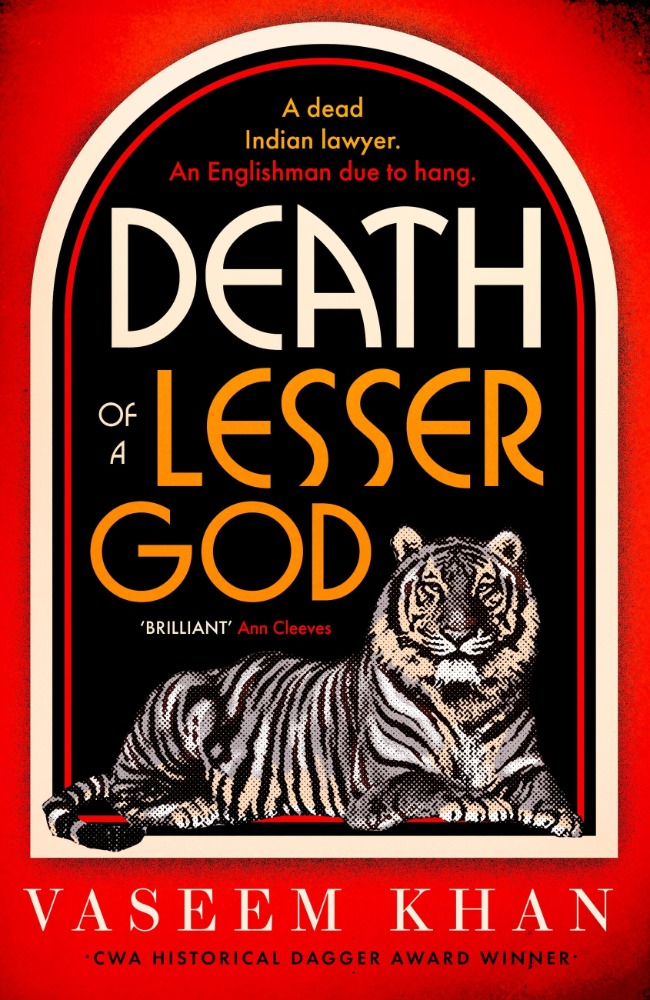
I have no idea whether I’m interpreting too much from it, and of course there are tiger references in the story, but I loved the animal on the cover because to me its stripes symbolised the wavering indistinct truths explored in the story. There might be a collective prejudice in people’s minds in the India of the setting, but equally Vaseem Khan explores the mercurial bending of truth, of perception and of race and culture with consummate skill so that he inverts many racial perceptions and prejudices and makes the reader truly contemplate the role of ethnicity, identity and race in society. I found that this theme added both exciting and emotional depth to the narrative and whilst Death of a Lesser God is historical crime fiction, the effect is to make it equally fresh and relevant to a modern reader.
And it’s a cracking story. What is so effective is that Vaseem Khan places the reader alongside Persis so that it is as if you’re investigating the case with her. His descriptions are so vivid that every sense feels catered for with the crowded, heated and oppressive setting of India adding to the atmosphere. The short chapters give pace and make it impossible not to read just one more until Death of a Lesser God has been consumed in greedy gulps. It’s filled with historical accuracy, but in a manner that never detracts from the pace and action as if the author is some kind of magician, weaving a spell around the reader and educating even as he entertains.
What really appealed to me is the fact that amongst the sweeping and major historical themes, at the heart of this mystery is humanity, and the everyday experiences of those living their lives, falling in love and simply trying to get by in a world that leaves them behind far too often, or makes them act in ways they themselves find surprising. It feels as if Death of a Lesser God has been created with compassion and understanding.
Steeped in history, peppered with dry humour and with a riveting, compelling plot, Death of a Lesser God is a story written by an author at the pinnacle of his craft. It’s a brilliant story.
About Vaseem Khan

Vaseem Khan is the author of two crime series set in India, the Baby Ganesh Agency series set in modern Mumbai, and the Malabar House historical crime novels set in 1950s Bombay. His first book, The Unexpected Inheritance of Inspector Chopra, was a Times bestseller, now translated into 15 languages. The second in the series won the Shamus Award in the US. In 2018, he was awarded the Eastern Eye Arts, Culture and Theatre Award for Literature. Vaseem was born in England, but spent a decade working in India.
Midnight at Malabar House, the first in his historical crime series, won the CWA Historical Dagger 2021, the pre-eminent prize for historical crime fiction in the world. His book The Dying Day about the theft of one of the world’s great treasures, a 600 year old copy of Dante’s The Divine Comedy, stored at Bombay’s Asiatic Society.
For further information, visit Vaseem’s website, follow him on Twitter/X @VaseemKhanUK, or find him on Facebook and Instagram.
 Linda's Book Bag
Fabulous review, Linda. You put so much into each review. This author has some great book titles!
LikeLike
Thanks so much for dropping by and commenting Sheila!
LikeLike
Hi Linda, thanks for this fascinating review. The book sounds compelling.
LikeLiked by 1 person
Thanks for dropping by Robbie. Vaseem’s books are amazing!
LikeLiked by 1 person