

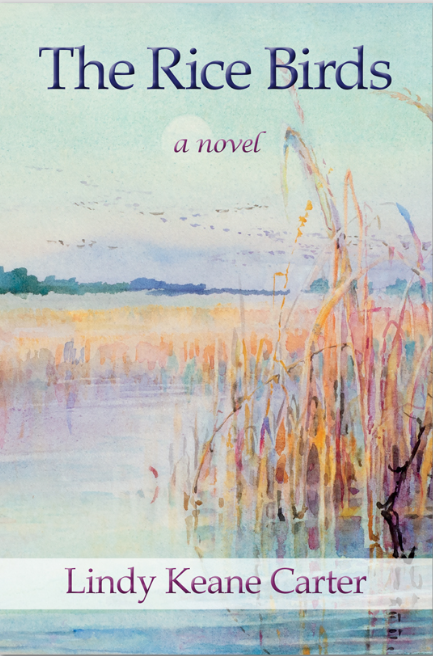
It’s my pleasure to welcome back Lindy Keane Carter to Linda’s Book Bag today to chat with me all about The Rice Birds. I had hoped to include Lindy somewhat earlier but life rather got the better of me!
Lindy has previously featured here on the blog and it’s a real pleasure to discover her latest novel. Let’s find out more:
Staying in with Lindy Keane Carter
Welcome back to the blog Lindy! So you’ve published another book since you were last here. Tell us about this new work.

Thank you for having me again. I’ve brought my new historical fiction novel, The Rice Birds, set in 1849 in Charleston, South Carolina in the southern United States. The title refers to the migratory bobolinks that arrived twice a year in South Carolina’s 18th and 19th century rice plantations. The flocks could devastate the crop if the planter hadn’t timed his planting and harvesting around the arrivals. The book is not about birds! The title is a metaphor for my Irish protagonist and her friend, an enslaved house servant, runaways from a huge plantation, so they’re hunted, hungry, and hated like the rice birds.
Sounds fascinating. Why did they run away?
One of them commits a crime on the plantation, so they must flee to Charleston, earn some money somehow out of sight, and get to New York.
I love the ethereal quality of the cover. Tell me about it.
It’s a golden rice field.
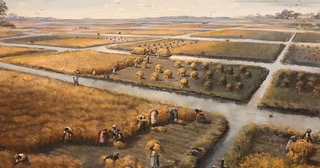
Here’s another photo that gives better idea of the grid system of waterways and dikes that flooded the fields with the tidal push of water from the creeks and rivers.
It looks very similar to the Fens where I live!
What else have you brought to share with us?

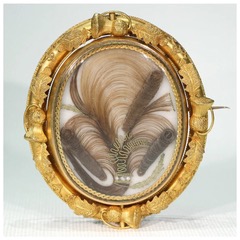
Some photos of hair art, a craze in the 1800’s. In my book, the two girls create hair art as a way to make money while in hiding. Creepy but impressive.
I’m not sure I’d be wearing those items Lindy!
Tell me a bit more about The Rice Birds.

You can expect to root for my poor Irish girl all the way. She arrives in America in 1849 expecting to work as an indentured servant in one of Charleston’s mansions (see the above photo of the city, which today looks much as it did then) but finds herself working in the house on a vast, remote rice plantation. There, she’s wooed by a carpenter (from County Mayo, of all places) but he betrays her, and she’s forced to flee. Just when she has the means to get on a boat to New York, an old enemy shows up in Charleston to carry out an illegal transatlantic slaving scheme and it will derail her plans.
I love the sound of this. Why did you make your protagonist Irish?
I wanted to bring an Irish voice to the historic narrative of Charleston. The Irish made so many contributions here, from 1640 on. Plus, I’m part Irish. Isn’t everyone in America?
I think so. When I was working in New York I think everyone I met claimed to be part Irish! Thanks so much for telling me all about The Rice Birds. It sounds a smashing read.
My pleasure. And by the way, you’ll learn a lot. This book is full of historical details that are based on my extensive research.
Brilliant! Thank you so much for sharing this with me.
The Rice Birds

In 1849, twin sisters fleeing Ireland’s famine arrive at New York’s seaport. Only one — Nora-is allowed to get on the boat to South Carolina to fulfil her work contract. On her master’s vast rice plantation, an enslaved worker — Pearl — befriends her. After one of them commits a crime, the girls flee to Charleston, a dangerous place for runaways. Nora frantically seeks to get back to her twin and Pearl tries to find her mother before heading north. Meanwhile, an old enemy’s illegal transatlantic scheme is about to derail the girls’ plans.
The Rice Birds, published by Evening Post Books, is available in paperback via the publisher here, or on your local Amazon site.
About Lindy Keane Carter

Lindy Keane Carter holds a journalism degree from the University of Georgia. After writing non-fiction for 40 years, she signed up for a fiction class and has won several awards for her short stories. The Rice Birds is her third novel. She’s the proud mother of three adults: two daughters and a son. She enjoys kayaking, swimming, and gardening in Charleston, South Carolina.
For further information, visit Lindy’s website or find her on Facebook.
 Linda's Book Bag
Rice Birds sounds like a fascinating insight into the Irish migrant experience Linda.
LikeLiked by 1 person
It does indeed Claire!
LikeLiked by 1 person