The Blood of Kings by Angela King

Blood of Kings correct final

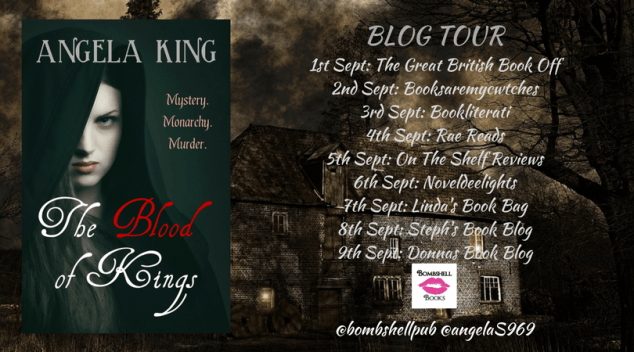
I love historical fiction so I’m delighted to be part of the launch celebrations for The Blood of Kings by Angela King.

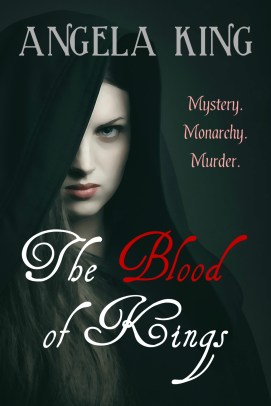
The Blood of Kings was published on 1st September by Bombshell Books, an imprint of Bloodhound, and is available for purchase here.

The Blood of Kings

Blood of Kings correct final

1559. A girl arrives in London to search for her brother.

Aalia, an awkward, arrogant teenager plans to bring William to his senses, until she discovers that both their lives are based on a lie. Aalia must unravel a web of secrets but has the weight of her past to contend with. Courageous and undisciplined, Aalia gradually comes to terms with the truth that William, her brother, has royal blood.

Deciding to undermine the men who want to use him as a pawn, Aalia must negotiate a world where secrecy arms the powerful. But unwilling to ask for anyone’s help she is forced into making a fateful decision. Who can she trust when everyone around her is plotting? Is the truth really something worth dying for?

This epic story of secrets and betrayal paints a vivid picture of Elizabethan England and asks questions that span beyond the test of time.

My Review of The Blood of Kings

With Queen Elizabeth on the throne, there are those who feel they have a greater claim.

The Blood of Kings surprised me. It took me quite a while to get into as there are several characters introduced in quick succession who are more fictionalised than I was expecting and I needed to get them clear in my mind.

I thought The Blood of Kings was well constructed. The plot hinges on events and conjecture from the times so that there is a real plausibility to it. As I read I kept thinking, ‘Oh. What if…’ so that the read was very entertaining. There’s so much action that this book would make a smashing film or television series as the narrative twists and turns in dramatic style. The themes of loyalty and betrayal, love and family are universal ones that are so well explored in The Blood of Kings too.

What I think Angel King is most skilled in is the attention to detail. She creates authentic setting to the extent that it is as if you’re there seeing and hearing exactly what the characters see and hear. I could picture so much of her settings extremely clearly and with the realistic dialogue that so well reflects what might have been spoken at the time I feel The Blood of Kings has considerable depth.

The characters are an eclectic mix of real people in history and fictional creations. Aalia’s life is fascinating and I found her feminist attitude very engaging. Reading The Blood of Kings made me glad I wasn’t alive in the Elizabethan era!

Interesting and fast paced, I think lovers of historical fiction will enjoy the new perspectives presented in The Blood of Kings.

About Angela King

angela-pic-1

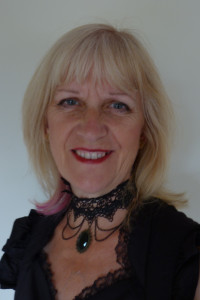
Angela King has always loved words and writing. She was born in Wimbledon and always dreamed of becoming a writer, but I came from a long line of practical dreamers who need first to earn a living so went to Medway College of Art in Rochester, to study design, later working as assistant designer to Bruno Stern.

After a series of personal disasters including a terrible car crash for her husband Michael and a fire that burned down their home, Angela and Michael moved to Cumbria where they began working from home. In 2008, two of Angela’s very close friends died, kicking her into action – if she didn’t write her novel soon it might never be written. She joined a couple of local creative writing groups and finally allowed her imagination to run free.

In 2016 Angela had short stories published in three different anthologies: Dark Minds (Bloodhound Books), Happily Never After (C & P Writers) and Dot, Dot, Dot, (Wiza Words).

You can follow Angela on Twitter @angelaS969, or visit her blog.

There’s more with these other bloggers too:

BLOG TOUR (6)

How Dan Knew Came To Be: A Guest Post by F J Curlew, Author of Dan Knew

Dan Knew

I’ve never been a dog owner, although I have been owned by many cats, so it is very exciting to welcome F J Curlew to Linda’s Book Bag today to tell me all about the Ukranian street dog Dan, the star of her latest book Dan Knew.

Dan Knew is available for purchase here.

Dan Knew

Dan Knew

A Ukrainian street dog is rescued from certain death by an expat family. As he travels to new countries with them a darkness grows and he finds himself narrating more than just his story. More than a dog story. Ultimately it’s a story of escape and survival but maybe not his.
The world through Wee Dan’s eyes in a voice that will stay with you long after you turn that last page.

How Dan Knew Came To Be

I had cried uncontrollably in the shop where I was casually buying a pair flowery wellies when I received the phone call. “It’s the vet here about Wee Dan. I’m sorry, it’s bad news.” I crumpled onto the floor in a heap of utter despair. The sobbing continued as I was walking along the street: sitting on the bus, going home, opening the door. I couldn’t stop and I didn’t want to. Drowning in sorrow was all I could do. People had avoided looking at me, probably thinking I was that crazy woman who talked to herself, had fits of hysteria, to be kept at a distance. Ignored.

I didn’t know if I could do this. I really didn’t. It felt like something was tearing at my heart, my chest hurt, my breathing was erratic: I felt sick, my head was swimming. Thoughts made no sense. Nothing made sense. My little dog had gone. No warning. No time to prepare myself. Just gone.

I’ve had dogs all of my life, lost several, been very sad, mourned and grieved over them, but nothing like this. I spent the day staring at mindless television…just getting through. Just.

I knew I had to write. It was the thing that kept me going these days. The thing I could count on to lift me out of whatever reality I was stuck in. It had got me through hard times before: given me hope, a reason. When I couldn’t teach any more, or work at all, due to the devastating side effects of a nasty little cancer, it had given me a purpose and more than that. A purpose that I loved! The ability to lift myself out of this world and into one of my imagination had been an absolute life-saver. I tried to work on my latest project. I was 60 000 words in. I could do it.

Well, actually, no I couldn’t.

It had to be his story. Our life together. That was all I could think about and it kept him with me somehow: kept him alive. I was writing it in his words, from his point of view and it was wonderful. Being inside his head. Every day.

As I wrote about him, relived it all, he was here with me for that little bit longer, by my side, tapping at my keyboard, nudging at my hand with his little wet nose. I was obsessed. I had to write, and write, and write. Now I had a positive reason for foraging through countless photographs, walking down streets in Ukraine, Lithuania, Estonia, Portugal, on Google Maps, remembering. Reliving. Writing.

We had been through such a lot together. Lived in all those countries, faced abuse, fear and sickness…together. The story poured out of me and I had the first draft of 70 000 words done in a month. That was unusual for me. I take my time, write slowly and carefully, perfecting and perfecting as I go. Not this time.

Of course, as I wrote, memories of some unpleasant times that I had long since buried also crept back in, and some of the writing was very difficult. I skirted a lot, avoided saying too much about me and my story, not really wanting to go back there, nor to crowd Dan’s story out with mine. Getting the balance right was a challenge. Sifting through a life, deciding which stories to tell, events to cover, feelings to express. There were many, many rewrites.

But I love that, the editing, making something that you have created the very best it can be gives me a thrill. And this was Wee Dan’s story so I had to do it justice. I can remember watching a documentary about Donna Tarrt and being amazed at how each of her novels had taken ten years to write. Now I understand. I could go on writing Dan Knew: perfecting it, living it for years. But that would be remarkably unhealthy. I know I have to move on, to live in the present.

Even now the synapses connect and more memories surface. I remember something and think maybe I should have added that?  But the deed is done and the book has been published. As long as I have shown enough, so that the reader can understand what was going on, whilst keeping it all in the voice of Dan, I am happy.

It is also amazing to be able to hold his book in my hands, to see it for sale, to know that his little voice is being heard by somebody else. His journey continues. That gives me a thing of concrete, of permanence. And I like that. I like that a lot.

About F J Curlew

Fiona

Fiona dropped out of school aged 15, because being the consummate rebel, she hated it! After becoming a single parent she decided to return to education, graduating in 1996 with an honours degree in primary education. Ah, the irony!

As soon as she graduated she packed everything she owned into her Renault 11, including her daughter, two dogs and a cat, and headed off to Estonia to become an international school teacher. After fifteen years of teaching, predominantly in Eastern Europe, she returned to the UK .

She now lives on the east coast of Scotland with two Scottish rescue dogs and a disgruntled Portuguese cat.

Fiona is also the author of To Retribution – A love story/political thriller set in times of turmoil, available here.

There’s more about Fiona on Facebook, on her website, Twitter and with these other bloggers:

Dan Knew Blog Tour

A Woman of A Certain Age: A Guest Post by Audrey Davis, Author of A Clean Sweep

A Clean Sweep

Recently, Audrey Davis asked me if I’d like to review her debut novel A Clean Sweep. The answer was a resounding yes (not least as I discovered I had already bought it when I came to investigate it), but as usual, my TBR is so huge I simply haven’t got to it yet.

As the main character in both A Clean Sweep and its prequel A Clean Break is fifty-something Emily and I happen to be a fifty-something woman, I asked Audrey if she’d like to tell me a bit more about how that feels as she is a woman past her half-century too. Today, Audrey reflects on what it means to be ‘a woman of a certain age’ in the 21st century.

A Clean Sweep and the short prequel A Clean Break are both available for purchase here.

A Clean Sweep

A Clean Sweep

A laugh-out-loud tale of love, lies and second chances.
Love comes around when you least expect it. Fifty-something widow Emily isn’t expecting romance. Nor is she expecting a hunky twenty-something chimney sweep on her doorstep.
Daughter Tabitha knows something isn’t quite right with her relationship, while her boss – Abba-loving Meryl – thinks she’s found the real deal. Are they both right, or pursuing Mr Wrong?
Emily’s sister, Celeste, has the perfect marriage … or does she? Can a fitness tracker lead her down the path to happiness or heartbreak?
Susan is single, overweight and resigned to a life of loneliness. There was the one who got away but you don’t get another try, do you?
Prepare for a rollercoaster ride of emotions in a book that will grab your heart, make you smile and wish you had a chimney to sweep.

A Woman of A Certain Age

A Guest Post by Audrey Davis

I drew on my own thoughts and experiences when fleshing out the character of Emily, as well as some of the other women in the book. I wanted to show that age should not be a barrier to how we behave, dress or who we fall in love with.

Was I happy to hit forty? Not really, but with two boys aged nine and ten at the time I was still mingling with younger mums in the school playground and feeling reasonably content with my reflection in the mirror. Ten years later, the boys had flown the nest and reading glasses had taken up residence in every room of the house. Like Emily, magnifying mirrors were avoided when possible – ‘Some things didn’t need to be brought into sharp focus. A gentle blurring of the edges was just fine.’

Now, at fifty-three, I can say I’m comfortable with my age even if my knees creak a bit and the pounds take longer to shift. My life is full, particularly now that I’m writing and can call myself a genuine published author. I have a great circle of friends – some older, some younger – and I will happily shop at Zara or Mango, even if their sizing is targeted at girls with no internal organs. I wear cut-off shorts in the summer, skinny jeans in the winter and work out at the gym three times a week.

There are times I think of my mother, who sadly died of breast cancer at the age of fifty-nine. The disease withered her slowly and painfully for many years, but I realise how different her life was. Thirty years ago, many women of her age dressed and behaved much older. Her outfits were always sensible and – dare I say it – old-fashioned. Her life was perhaps simpler but I am so glad to be in my fifties today, even if the world we live in seems full of hate, fear and hypocrisy.

Looking ahead, I will continue to write and participate in the wonderful community of fellow authors I’ve discovered through social media. Travel is always a particular joy, with trips to Africa and weekends away with friends to Spain and Belgium recent highlights. I don’t see my gorgeous boys as often as I’d like, but I can always hop on a plane (we live in Switzerland) and visit them in Edinburgh and Liverpool.

A couple of good friends are now in their sixties, but their energy and joie de vivre would put some younger folk to shame. Age is just a number. As long as we have good health and a positive attitude, we can do anything we want. Am I looking forward to sixty? No, but I’ll be ready to embrace and challenge whatever comes my way when the day arrives.

(Good for you Audrey – I’m with you all the way!)

About Audrey Davis

IMG_0891

Audrey Davis is a former journalist who can recall the days of typewriters and overflowing ashtrays. Born in Scotland, she has called Switzerland home for the past 15 years. Audrey still struggles with speaking French although she is well versed in dealing with plumbers and other workers. Her first novel began with a writing fiction course and took over a year to complete. She hopes the second one will be a little quicker.

You can follow Audrey on Twitter, visit her blog and find her on Facebook.

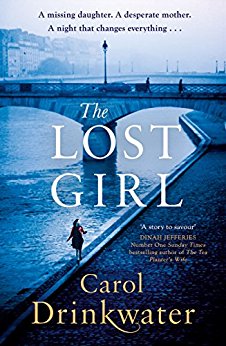
An Interview with Carol Drinkwater, Author of The Lost Girl

the lost girl

Oh my goodness am I excited today. I absolutely loved The Lost Girl by Carol Drinkwater when it was published and was lucky enough to review it and host an extract here. Carol’s writing always touches me and I have also reviewed another of her books on Linda’s Book BagThe Forgotten Summerhere. Imagine then, how exciting it is for me to be able to interview Carol all about her writing, especially as her latest book The Lost Girl has so many resonances in recent times.

The Lost Girl was published on 29th June 2017 by Michael Joseph, an imprint of Penguin, and is available for purchase via the links here.

The Lost Girl
the lost girl

Her daughter disappeared four years ago. . .

Since her daughter went missing four years earlier, celebrated photographer Kurtiz Ross has been a woman alone. Her only companion her camera. Since Lizzie disappeared, she has blamed and isolated herself, given up hope. Until, out of the blue, an unexpected sighting of Lizzie is made in Paris.

Could this lead to the reconciliation she has dreamed of?

Within hours of Kurtiz arriving in Paris, the City of Light is plunged into a night of hell when a series of terrorist attacks bring the city to a standstill. Amid the fear and chaos, a hand reaches out. A sympathetic stranger in a café offers to help Kurtiz find her daughter.

A stranger’s guiding light

Neither knows what this harrowing night will deliver, but the other woman’s kindness – and her stories of her own love and loss in post-war Provence – shine light into the shadows, restoring hope, bringing the unexpected. Out of darkness and despair, new life rises. New beginnings unfold.

Dare she believe in a miracle?

Set during a time of bloodshed and chaos in one of the most beautiful cities on earth and along the warm fragrant shores of the Mediterranean, Kurtiz discovers that miracles really can happen . . .

An Interview with Carol Drinkwater

Welcome to Linda’s Book Bag, Carol. Thank you so much for agreeing to answer some questions on my blog about your writing and The Lost Girl in particular. I’m really excited that you’re here! Firstly, please could you tell me a little about yourself?

I am of Irish blood on my mother’s side and a little bit on my father’s side too though I was born in London. I have an Irish passport and chose Ireland as my mother country early in adulthood. I was educated at an Irish convent in Kent, and hated almost every minute of it. It did offer me the opportunity to study languages which I love. Spanish, Italian and French, all of which have stood me in good stead as a traveller and a writer and, of course, as a French resident. The nuns also allowed me to indulge in my love of acting and drama. After I left the convent I worked backstage in the theatre in London before going to drama school in north London. There I studied acting and classical drama.

I live in France on an olive farm overlooking the Bay of Cannes. I ended up here because I fell in love with a Frenchman who asked me to marry him on our first date in Sydney, Australia. This love story is the basis of my Olive Farm series of six books.

I still keep a small bolthole near where my mother was born in Ireland. Keeping in touch with my roots is very important to me.

Why do you write?

I HAVE TO. I need to create or I drive myself insane. If I am not writing or acting or preparing a film it is as though I have a swarm of delinquent bees inside me, buzzing and stinging.

(What a fabulous analogy!)

When did you realise you were going to be a writer?

I have been writing since I was about eight. I KNEW I would act; I DREAMED of being a writer.

Which aspects of your writing do you find easiest and most difficult?

All of it is difficult. The fun bit is looking at the books line up on the shelves. I am writing my 24th now. Yay!

(Yay indeed. I can’t wait!)

What are your writing routines and where do you do most of your writing?

I begin early and write long hours, stopping for a couple of hours mid-afternoon to swim, walk, ponder, rest my mind. Then back to it for another couple of hours so that it is in my head ready to sleep on it.

Many of your reading fans also know you as an actress. What has being involved in drama added to your writing?

I think visually. I see every scene clearly. The way people look, move, dress. The details are essential. I look for the drama, the resistance in any moment, which creates drama in scenes. I aim to draw the inner lives of my characters as they seek to overcome obstacles. While writing I act out every scene, play every part aloud. The training I received at Drama Centre, London was perfect for writers.

(How fascinating – I’d never have thought of acting out what I write.)

You’re obviously very creative with both acting and writing as part of your skill set. Is there a creative talent you haven’t mastered but would like to?

I have no musical skills except that I love to dance and listen to music. My father was a musician and I am very sad that as a child I did not learn any musical instrument.  I am considering either brushing up on my Spanish and Italian, learning Arabic (difficult!!) or learning to play the guitar. But with everything I have going on in my life I probably won’t get round to any of it.

Without spoiling the plot, please could you tell us a bit about The Lost Girl?

The Lost Girl is the story of two very different women. They meet in a bistro in Paris on the night of the November 2015 terrorist attacks on the city. Over that weekend, their stories unfold.

The book is set in two time frames: November 2015 during the weekend of those terrorist attacks that rocked and shocked Paris, leaving more than a hundred dead and many more wounded. The second time frame is the glorious, headily-scented, post-war south of France, amongst the flower farms that fed the perfume industry in Grasse, the Perfume Capital of the World. The modern part of the story is darker, grittier, I think, than the earlier story. Both are told through the eyes and experiences of the two female protagonists women who meet in the bistro in Paris on 13th November 2015.

At its core, The Lost Girl is a love story with a twist, a miracle that, I hope, redeems the darker side of the story offering hope and new beginnings.

How did you manage the two time frames when you were writing The Lost Girl?

I wrote the two stories at the same time. There was no definite order to it. Sometimes I wrote Marguerite’s story for days, weeks, and then one day I would return to Kurtiz. When I was stuck I would write a scene from one or other of their live even if I knew I would not use it later.  It was important to keep telling myself their stories. The big challenge was putting it all together. This part took weeks.

The plot of The Lost Girl is based around the terrorist attacks in Paris. How did you come to the decision to write around such an emotive topic?

I watched the unfolding of the attacks on the news on that November Friday night. I was with my mother. We stood together with our arms round one another witnessing the horrors. I was weeping. When the TV reporters announced that 1,500 concert-goers were locked inside the Bataclan concert hall and had been taken hostage, Mummy said to me: “for everyone inside there fearing for their lives, there is a mother outside anxiously waiting for news”. It sowed the seed for my story.

One of the two women who is in the Parisian bistro is waiting to hear news of her daughter who went missing from her home in London when she was sixteen. She, Kurtiz, the girl’s mother, and her husband have reason to believe that their daughter, Lizzie, might be attending the concert at the Bataclan.

How did you go about researching detail and ensuring The Lost Girl was realistic whilst still making it a fiction?

I spent a month at the National Library in Paris in their media division. I watched, listened to footage, recordings from that weekend and afterwards. I researched very thoroughly. I owed it to the family members of those who lost their lives to make it accurate. Even if they never read the book.

(I think that level of care comes across very strongly to the reader Carol.)

How important is literature in exploring the difficult situations, emotional and political events of modern times do you think?

Essential. Think of Pablo Picasso’s stupendous work Guernica, a visually alarming, angry statement against the senseless lives lost during the bombing of Guernica in northern Spain in April 1937.  Many of the Greek tragedies were observations on the nation’s enthusiasm for war. Lysistrata by Aristophanes is a Greek comedy written and first performed in 411 BC. It recounts the story of one woman, Lysistrata, who persuades the women of Greece to withhold sexual favours from their husbands and lovers until they stop fighting and negotiate peace. It is an early, brilliant anti-war piece of theatre.

I believe literature, film, theatre, music and art can be the voices of sanity, of reason. They give us emotional air to breathe, you might say. While the media plasters on the doom and gloom, frequently inciting hatred, racism, mistrust, art can offer us hope, laughter, release, a way forward. Humans are complex, our emotions and experiences are prisms, spectrums of colours, of light and shade. Mostly, we struggle to overcome our darker instincts; we strive for goodness, not evil. Evil is the exception. Most of us desire peace, love, harmony. Even in our darkest hours we search for the  lighter moments. I have seen this over and over again in war zones, areas of conflict. The chink of light. This is what I hope The Lost Girl does. It is a story of generosity, regeneration, or that is certainly what I set out to achieve.

(Very powerfully said. And you certainly achieve what you set out to do in The Lost Girl.)

France has become a huge part of your life. How important is location to you as an author when you are writing?

I feel location, if one can say that. I breathe in the perfumes, the temperatures. Every blade of grass counts. I like to immerse myself in the places I am writing about and almost always go to the chosen locations to “live” the place before setting pen to paper.

That said, The Lost Girl seems to take you further away from your Olive Farm books. How has this change in your writing evolved?

I think it is important for me as a writer to evolve. I would not want to have played Helen Herriot for all my life (which is why I left the series). I need new challenges or I stultify.

So what can we expect next from Carol Drinkwater, the writer?

I never know what I will be writing until I have written it! I am at work on a book which, I THINK, is more of a chamber piece. At the moment it also covers two time frames (though this could change!). It is a relationship story, a love story, also set in France.

If you could choose to be a character from The Lost Girl, who would you be and why?

Marguerite, of course, because she’s an actress. Or on another day, it would be Kurtiz because she has fought to become an independent woman.

If The Lost Girl became a film, would you consider taking on one of the roles? 

YES!

When you’re not writing, what do you like to read?

I go through phases. At present, as it is summer and I am taking some time off, I am reading modern, mainly light fiction, mostly by female writers: Ferrante, re-reading Du Maurier, a few commercial novels on sale for my Kindle, writers I probably would never usually choose …

If you had 15 words to persuade a reader that The Lost Girl should be their next read, what would you say?

From reviews:  “beautifully written”, “page-turner”, “fabulously written”, “action-packed”, “emotive”, “captivating”, “hated finishing it”, “novel of hope”

Thank you so much for your time, Carol, in answering my questions.

Thank YOU very much.

About Carol Drinkwater
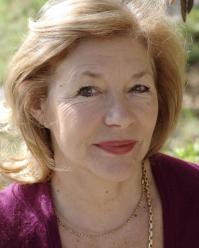
Carol Drinkwater c Michel Noll

Carol Drinkwater is a multi-award-winning actress who is best known for her portrayal of Helen Herriot in the BBC television series All Creatures Great and Small. She is also the author of over twenty books, both fiction and non-fiction. Her quartet of memoirs set on her olive farm in the south of France have sold over a million copies worldwide and her solo journey round the Mediterranean in search of the Olive tree’s mythical secrets inspired a five-part documentary film series, The Olive Route.

You can follow Carol on Twitter and visit her website.