The Summer of Serendipity by Ali McNamara

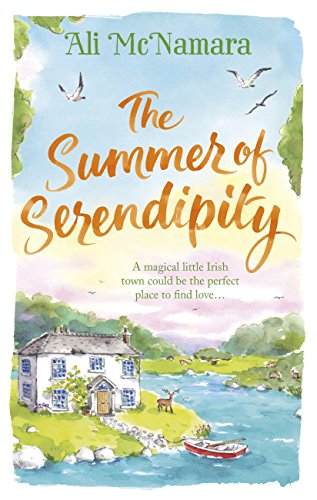
Summer of Seren cover

My grateful thanks to Clara Diaz at Little Brown for an advanced reader copy of The Summer of Serendipity by Ali McNamara in return for an honest review. I enjoyed reading The Summer of Serendipity so much that I’m thrilled to be part of the launch celebrations.

The Summer of Serendipity was published by Sphere, an imprint of Little Brown, on 13th July 2017 and is available for purchase in e-book and paperback here.

The Summer of Serendipity

Summer of Seren cover

One summer, property seeker, Serendipity Parker finds herself on the beautiful west coast of Ireland, hunting for a home for a wealthy Irish client. But when she finds the perfect house in the small town of Ballykiltara, there’s a problem; nobody seems to know who owns it.

‘The Welcome House’ is a local legend. Its front door is always open for those in need of shelter, and there’s always a plentiful supply of food in the cupboards for the hungry or poor.

While Ren desperately tries to find the owner to see if she can negotiate a sale, she begins to delve deeper into the history and legends that surround the old house and the town. But for a woman who has always been focussed on her work, she’s remarkably distracted by Finn, the attractive manager of the local hotel.

But will she ever discover the real truth behind the mysterious ‘Welcome House’? Or will the house cast its magical spell over Ren and help her to find true happiness?

My Review of The Summer of Serendipity

When Serendipity (Ren) Parker and her assistant Kiki head to the west coast of Ireland house hunting for a client, they find more than just the perfect house.

I loved The Summer of Serendipity. It is unashamedly women’s fiction with the kind of warmth and romance that makes it such a pleasure to read. I’m not usually one for any element of magical realism, but the mythology, superstition and omens of ravens and stags worked highly effectively and convincingly to enhance the story without dominating it, so that they were broad brush strokes that could be accessed on many levels from spirituality to coincidence to suit the reader’s taste.

I thought the sense of place was excellent. I’ve never been to Ireland, but Ballykiltara had all the elements I imagine, from Guinness serving pubs to misty lakes and changeable weather, making for an area I could picture vividly in my mind’s eye.

However, what made The Summer of Serendipity such a lovely read was the characterisation. From Ren to Finn and Fergal the dog I found each person distinct and realistic so that I could easily imagine chatting to them in the town of Ballykiltara. The gradually uncovered back stories to Ren and Finn gave them added depth and appeal too.

I thought the quality of Ali McNamara’s writing was so good. The prose flowed so that there was never any awkwardness, making for a highly pleasurable reading experience and the dialogue felt absolutely perfect. But aside from the quality of writing, a great sense of place and warm human characters, it was the attention to detail in the plot I most enjoyed. Ali McNamara knows her mythology and there is a smashing mystery to be uncovered here too surrounding Welcome House.

The Summer of Serendipity is a lovely summer read. My only regret is that I haven’t read Ali McNamara before. I shall be putting that right immediately.

About Ali McNamara

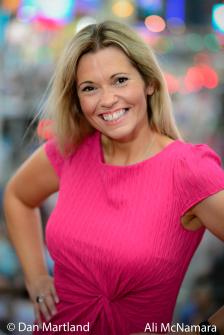
McNamaraAli+(c)+DanMartland

Ali McNamara attributes her over-active and very vivid imagination to one thing – being an only child. Time spent dreaming up adventures when she was young has left her with a head bursting with stories waiting to be told.

When stories she wrote for fun on Ronan Keating’s website became so popular they were sold as a fundraising project for his cancer awareness charity, Ali realised that not only was writing something she enjoyed doing, but something others enjoyed reading too.

You can visit Ali’s website, find her on Facebook and follow her on Twitter.

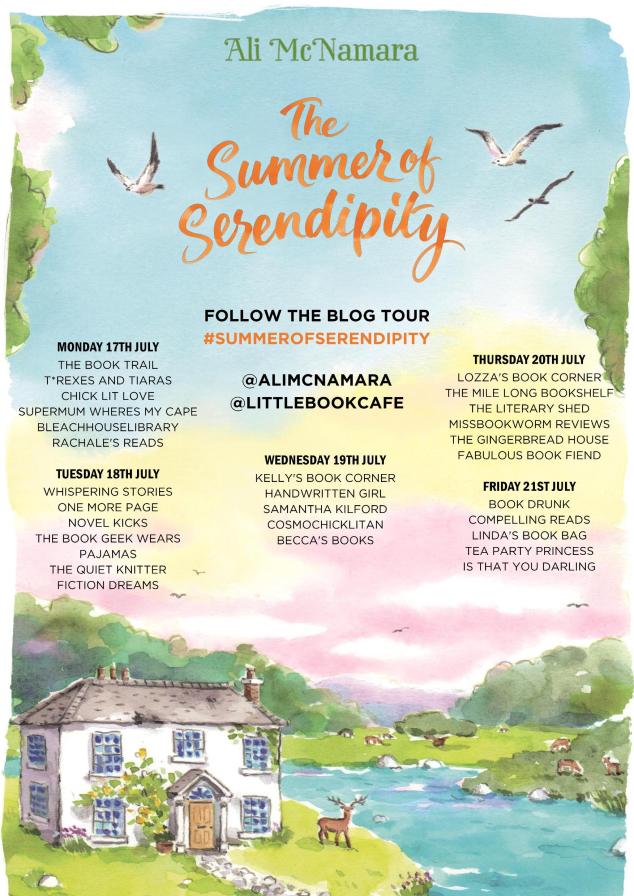
There’s more with these other bloggers too:

poster-page-001

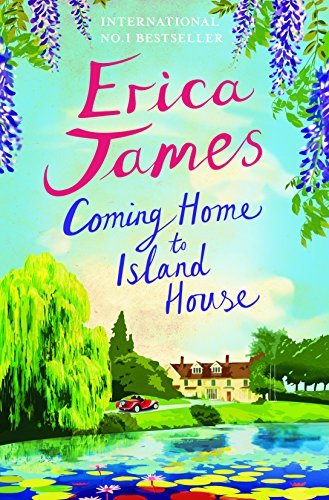
Cover Reveal: Coming Home to Island House by Erica James

Cover

You have no idea what a thrill it is today to be able to share with you the brand new book, Coming Home to Island House, from Erica James. I was so excited to meet Erica at the Deepings Literary Festival in my home town earlier this year and to have afternoon tea with her. She’s so lovely that it is a privilege to be bringing details of her latest novel and it’s one I simply can’t wait to read.

I have also previously reviewed another of Erica’s books, The Dandelion Years here.

Coming Home to Island House is to be published by Orion and is available for pre-order here.

Coming Home to Island House

Cover

The Devereux family has not been close for what feels like the longest time. Jack, who after the death of his first wife played the absent father to his children, has reached an age where he begins to reflect on the mistakes he’s made – and he’s made quite a few. When he suddenly passes away, his new wife Romily calls his children back to Island House, the idyllic place of their childhoods. According to his wishes, they must spend seven days together in the house or risk being written out of his will entirely.

Set in the lead up to and during the Second World War, this is a moving and ultimately life-affirming novel about the importance of family and finding your way back to each other.

About Erica James

erica james

With an insatiable appetite for other people’s business, Erica James will readily strike up conversation with strangers in the hope of unearthing a useful gem for her writing. She finds it the best way to write authentic characters for her novels, although her two grown-up sons claim they will never recover from a childhood spent in a perpetual state of embarrassment at their mother’s compulsion.

The author of many bestselling novels, including Gardens of Delight, which won the Romantic Novel of the Year Award, and her Sunday Times top ten bestsellers, Summer At The Lake and The Dandelion Years, Erica now divides her time between Suffolk and Lake Como in Italy, where she strikes up conversation with unsuspecting Italians.

You can find Erica on Facebook, follow her on Twitter and visit her website.

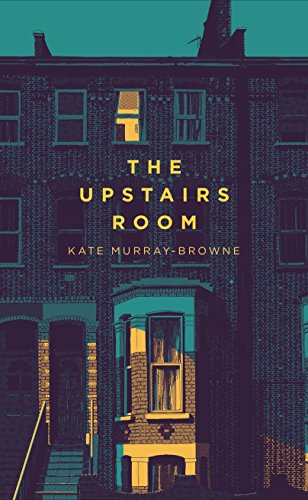
An Extract from The Upstairs Room by Kate Murray-Browne

The Upstairs room

I’m delighted to be part of the launch celebrations for The Upstairs Room, the debut novel by Kate Murray-Browne, even if I’m not sure I’m brave enough to read the book! I ahve a brilliant extract to share from The Upstairs Room today.

The Upstairs Room will be published by Picador, an imprint of Pan Macmillan, on 27th July 2017 and is available for purchase through the links here.

The Upstairs Room

The Upstairs room

Eleanor, Richard and their two young daughters recently stretched themselves to the limit to buy their dream home, a four-bedroom Victorian townhouse in East London. But the cracks are already starting to show. Eleanor is unnerved by the eerie atmosphere in the house and becomes convinced it is making her ill. Whilst Richard remains preoccupied with Zoe, their mercurial twenty-seven-year-old lodger, Eleanor becomes determined to unravel the mystery of the house’s previous owners – including Emily, whose name is written hundreds of times on the walls of the upstairs room.

An Extract from The Upstairs Room

They proceeded through the house. The basement, empty now, had been converted for a lodger – a bedroom, living room and a shower room under the stairs. It looked hasty and cheap, as though the shower might come away from the wall. ‘Can you imagine converting this into a kitchen/dining room?’ Michael asked. Richard could. ‘I don’t know if you guys like entertaining but imagine knocking all this through, dinner parties looking out onto the garden . . .’

They moved back upstairs. A greying bathtub. Heavy curtains. Everything – beds, armchairs, banisters – weighed down with blankets and quilts. Eleanor imagined touching them; they would be clammy. Four bedrooms. ‘So, the ven­dors are a family, a couple with a little girl, no onward chain. They want to move really quickly on this one, which I’m guessing is going to be good for you guys too. You’ve got kids, right? Two girls, lovely – a bedroom each for you and your little ladies and then you’ve got a spare room, or a study . . .’

They were on the top floor. Eleanor began to feel slightly peculiar here – it was almost airless, as if they were too far from the central nervous system of the house. There was only one room he hadn’t shown them. Michael stopped with his hand on the door and said, ‘OK, so you’re gonna need to use your imagination with this one.’ He stumbled; there seemed to be a little resistance from somewhere and then the door gave and swung open too fast.

Inside, the walls were covered in writing – a child’s writ­ing. The name ‘EMILY’ appeared again and again in capitals, sometimes very small, sometimes huge, covering almost all of the white. There were frantic scribbles – large clouds of line – and faces: dwindling to pointy chins with tiny dash-like mouths and enormous eyes.

Despite the blaze of black ink on the walls, the rest of the room was curiously still. The bedspread – a cheerless shade of pink – was smooth as glass. A collection of toys, which struck Eleanor as vaguely old-fashioned, was arranged in a neat pile on the pillows. There was no other furniture, only a leather suitcase in the corner of the room.

Richard laughed uneasily; Michael was embarrassed. ‘Yeah, so this isn’t quite . . .’ he attempted. ‘You know what some kids are like.’

‘This isn’t normal though,’ Eleanor said. ‘Why didn’t someone stop her?’

‘Well, the vendors are a bit . . .’ He stretched his mouth out into a triangle. ‘But all you need is a coat of paint and that room’s as good as new.’

(I’m not sure I believe him! – Linda)

About Kate Murray-Browne

kate murray browne

Kate Murray-Browne was born and lives in London. She worked in publishing for ten years, previously at Faber & Faber, before becoming a freelance editor. She is also a visual artist and has exhibited work in a number of different galleries. The Upstairs Room is her first novel.

You can find out more about Kate through her website.

There’s more with these other bloggers too:

Upstairs Room Blog Post 880x440

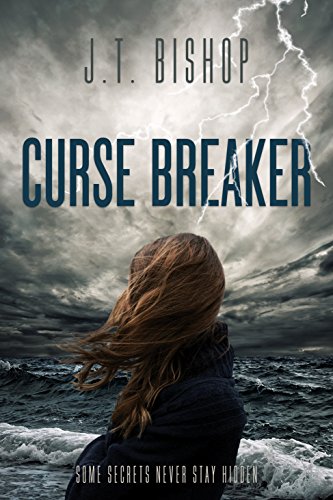
Extraordinary Abilities: A Guest Post by J. T. Bishop, Author of Curse Breaker

CurseBreaker4

One of the joys of blogging is finding new to me authors and I’m delighted to welcome J.T. Bishop, author of Curse Breaker to Linda’s Book Bag today. I’m always fascinated by how writers come to be writers and luckily, J.T. Bishop has agreed to tell me a little about the extraordinary abilities she believes we all have in a fascinating guest post.

Curse Breaker is the fourth in J.T. Bishop’s Red Line series and is available for purchase here.

Curse Breaker

CurseBreaker4

She’ll risk her life to break his curse, but revealing the truth could be far more dangerous.

In high school, a friend’s mother blames Grayson Steele for the tragic death of her daughter. Now, years later, Grayson is wealthy and successful, but on the brink of suicide. Because the women he loves are dying. And he can’t stop it.

Knowing about Grayson’s circumstances, Gillian Fletcher derives a plan. Catch the killer who’s making Grayson Steele’s life a living hell. But there’s only one way to do it. She has to be the bait.

As Grayson and Gillian’s plan takes shape, they must not only expose a killer, but also their feelings for each other. The further they go, the more secrets they will reveal. Secrets that will illuminate not just a murderer, but shocking truths that neither may be prepared to face.

Truths that will change their future forever.

Extraordinary Abilities

A Guest Post by J.T. Bishop

What’s it like to have extraordinary abilities? It’s a theme I follow in my books and I find fascinating to explore. I’m not necessarily talking about the superhero variety of mega abilities where you shoot webs from your hands or laser beams from your eyes, but more of the common extrasensory variety. Those things we sense or feel outside of the five senses. Those are of interest to me because I believe they exist and make for a good twist in a story. They allow me a little more license with my characters. Someone in a tight spot? You don’t need a weapon or a black belt. Just have them swing a door shut with their thoughts. Or communicate telepathically to keep up their cover story. Or have them direct an animal to jump on the bad guy to make their escape. The possibilities are endless.

I think one of the reasons I find this theme interesting is because I think we all have a sixth sense. Maybe not to the degree of moving objects with your mind, but more on the intuitive level. It’s not just about what we do, but what we feel, and believing in it. Once you do and you start to tune in, it’s amazing how reliable it is. The hard part for most, I think, is listening and trusting. This little voice is pretty quiet at best and you really have to lean in and pay attention to the whisper. It can be as soft as a feather against your skin. The tricky part is to act on the whisper, especially if the whisper takes you in a direction you did not expect.

I had whispers for years about my writing. And I didn’t listen. Yes. I dabbled here and there, wrote a few things, but nothing serious. After a while, the whisper got louder, which can happen if you ignore it. When I got the idea to write about a group of extraterrestrials that live on earth and whose origins are unknown among humans, the whisper became a shout. I started the story just for fun and couldn’t put down the pen. Two years later, I had a trilogy on my hands, with three more books in the works.

It’s amazing what a little whisper can do.

And so now I find myself writing about characters who have that whisper too. They must make the choice whether or not to follow their destiny and listen, despite the fear. So my question for you is, what is that whisper telling you? It told me to write. Is that an extraordinary ability? You could look at it that way. Some people are extraordinary cooks, teachers, singers, animal trainers, salespeople, and on and on. What is your extraordinary gift? Is that whisper guiding you, too?

Comment below and tell me what your extraordinary gift is and what your whisper is telling you. Is it time to listen?

(Oh, yes, do tell us what your gift is and whether you have a whisper telling you to do something creative.)

About J. T. Bishop

JTBishop

Born and raised in Dallas, Texas, J. T. Bishop began writing in 2012. Inspired by a video that theorized the meaning of the end of the Mayan calendar, J. T. began the Red-Line trilogy. The video surmised that the earth was the central hub of activity for extraterrestrials thousands of years ago. J.T. didn’t know whether that was true or not, but it did spawn an idea. What if those extraterrestrials were still here? Two years and a lot of work later, the first three Red-Line books were complete, but she’s not done. The Red-Line saga develops as she continues to write new books.

You can find out more about J.T. Bishop on Facebook, via her website and by following her on Twitter.

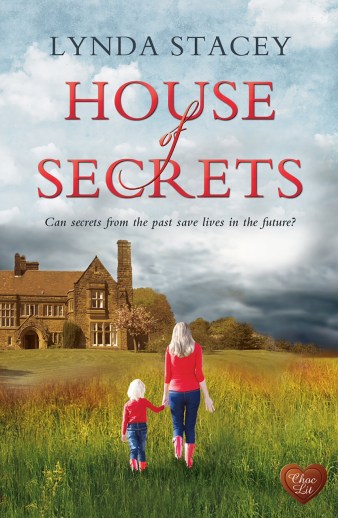
Madeleine: A Guest Post by Lynda Stacey, author of House of Secrets


9781781892916r

I have been desperate for House of Secrets by Lynda Stacey to reach the top of my TBR pile ever since I was involved in the e-book cover reveal a year ago. Sadly, life (and death) has intervened and it still hasn’t got to the top but House of Secrets is now available in paperback and I’m excited that Lynda is on the blog today to tell me more about her central character Madeleine. I’m also thrilled to have an extract from House of Secrets for you too.

House of Secrets is available for purchase through the publisher, Choc-Lit, links here.

House of Secrets
9781781892916r

A woman on the run, a broken man and a house with a shocking secret …
Madeleine Frost has to get away. Her partner Liam has become increasingly controlling to the point that Maddie fears for her safety, and that of her young daughter Poppy …

Desperation leads Maddie to the hotel owned by her estranged father – the extraordinarily beautiful Wrea Head Hall in Yorkshire. There, she meets Christopher ‘Bandit’ Lawless, an ex-marine and the gamekeeper of the hall, whose brusque manner conceals a painful past.

After discovering a diary belonging to a previous owner, Maddie and Bandit find themselves immersed in the history of the old house, uncovering its secrets, scandals, tragedies – and, all the while, becoming closer.

But Liam still won’t let go, he wants Maddie back, and when Liam wants something he gets it, no matter who he hurts …

Madeleine

A Guest Post by Lynda Stacey

On the 4th July my novel House of Secrets was turned into a paperback and I couldn’t have been prouder at the moment I got to take it back to where it all began, the beautiful Wrea Head Hall hotel in Scarborough.
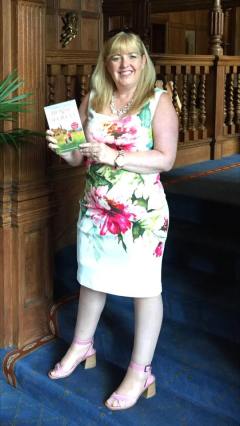
me on the staircase at Wrea Head hall

Lynda on the staircase at Wrea Head Hall

It was at this time, I got to look back at how I created Madeleine, the heroine of House of Secrets.

What happened to Madeleine before the story began?

Madeleine is a young, widowed mother. We meet Madeleine at a time in her life when she’s already overcome many obstacles, most of which she’d thought were her worst nightmare, that is until our story begins.

Madeleine fell in love at school with her childhood boyfriend, Michael. They married young, much to everyone’s disapproval and lived together in a second floor flat which they made into a home.

But, one morning Madeleine kissed Michael goodbye as he left for work. But it isn’t long before the police are at the door, Michael has been killed in a car accident and Madeleine is left widowed, while heavily pregnant. The shock sends Madeleine into early labour and Poppy is born so prematurely that Madeleine spends many a night sitting by her incubator, praying that she survives, whilst making promises to protect her and love her.

However, just a couple of years later, Madeleine meets Liam. He’s enigmatic, caring and falls into her life in a way that becomes all encompassing. But, Madeleine soon realises that she’s made a big mistake … and this is where our story begins …!

What makes a good heroine?

A good heroine is always someone the reader can relate to and identify with. I always give my heroines a history, a life and a family, after all, we all have parents, siblings and distant aunties, don’t we? So, the characters within a novel need to have that too.

I feel that by doing this, it gives them depth of character and a personality that can’t be ignored. They don’t necessarily have to be sexy, they don’t all have to be tall, blonde and straight out of a magazine. But, I do feel that they need to be a good person with dreams, hopes and wishes. They need to have a goal in life, something to achieve, something to aspire to and the novel needs to take them on a journey to achieve this.

But most importantly, the reader needs to feel that they are taking the journey with our heroine and that by the end of the novel, they’ve reached a good and satisfactory conclusion to the story.

Who would be the perfect Madeleine in a film?

michelle keegan

I think Michelle Keegan would be the perfect Maddie. She’s very down to earth, normal and would bring a realism to the character that readers would identify with. Yes … Michelle Keegan would be my Madeleine.

An Extract from House of Secrets

From Madeleine’s point of view …

Madeleine covered her eyes in an attempt to shield them from the early morning sun. It burst in through a tiny slit in the bedroom curtains and shone directly at her. She lay for a few moments, waiting for her eyes to become accustomed to the light before peering across to where Liam slept.

She took a deep breath and inched her body between the crisp white sheets towards the edge of the bed in an effort to widen the gap between herself and her naked lover. Then she lay as still as she could, not daring to move, as she watched him sleep. She used to love watching the steady rise and fall of his chest, his deep, slow, untroubled breaths and the way he slept on his back with his arms spread outward, as though surrendering in a childlike, unconscious state. But he’d changed. Now, she didn’t know whether to love him or to hate him, at any given moment.

Holding her breath, she noticed his eyes flicker and knew that as soon as he woke, she’d have to quickly judge whether he was in a good mood or bad. Whether he’d want to make love or argue and, right now, she was tired and didn’t feel in the mood to do either. Closing her eyes, Madeleine lay back against the pillows, only to feel Liam’s hand pushing the sheets down to uncover her.

‘You awake, Maddie darlin’?’ his soft Irish tone mumbled in her ear.

Liam’s hand started to move over her body in soft, gentle, caressing strokes. Madeleine felt herself relax. This was Liam in a good mood. For a moment she enjoyed the simple feeling of tenderness, along with the feel of his hand moving sensuously over her body. It was what she’d enjoyed so much at the beginning of their relationship and a small part of her wondered if he could change, if they could both change, and if once again she could have the loving and caring Liam, without the nasty side she’d experienced of late.

She inhaled deeply and then caught her breath as Liam’s hand travelled down to her thigh. There had been a time when she’d have felt waves of excitement, times when she’d wished for him to be closer and, more often than not, it had been her that had instigated their lovemaking. But that was before. Before she’d moved into his house with her daughter and before he’d taken control of everything she did. Madeleine thought back to when she had first met him, how generous, caring and loving he’d been, which made her wonder why he had changed, if the arguments were her fault and whether it was her that made him angry. Maybe he regretted allowing her to move in, or perhaps he simply didn’t like the fact that she was a mother, with a very young daughter.

About Lynda Stacey

Lynda-cut-240x300

Lynda, is a wife, step-mother and grandmother, she grew up in the mining village of Bentley, Doncaster, in South Yorkshire.

She is currently the Sales Director of a stationery, office supplies and office furniture company in Doncaster, where she has worked for the past 25 years. Prior to this she’d also been a nurse, a model, an emergency first response instructor and a PADI Scuba Diving Instructor … and yes, she was crazy enough to dive in the sea with sharks, without a cage. Following a car accident in 2008, Lynda was left with limited mobility in her right arm. Unable to dive or teach anymore, she turned to her love of writing, a hobby she’d followed avidly since being a teenager.

Her own life story, along with varied career choices helps Lynda to create stories of romantic suspense, with challenging and unpredictable plots, along with (as in all romances) very happy endings.

Lynda joined the Romantic Novelist Association in 2014 under the umbrella of the New Writers Scheme and in 2015, her debut novel House of Secrets won the Choc Lit & Whole Story Audiobooks Search for a Star competition.

She lives in a small rural hamlet near Doncaster, with her ‘hero at home husband’, Haydn, whom she’s been happily married to for over 20 years.

You can follow Lynda on Twitter and visit her website.

Self-Publishing to Traditional Publishing: A Guest Post by David Jester, Author of An Idiot in Marriage

An idiot in marriage

I’m so pleased to welcome David Jester, author of An Idiot in Marriage, to Linda’s Book Bag today. I do intend to finish writing my own novel one of these days so I’m always really interested in hearing how other writers have come to be published. David has a smashing post telling us how he went about getting his novels published.

An Idiot in Marriage is the follow up to David’s An Idiot in Love and was published by Skyhorse and is available for purchase in e-book and paperback here.

An Idiot in Marriage

An idiot in marriage

Kieran McCall’s youth was a series of misguided attempts at love—a succession of sexual failures that always ended in disaster but somehow led to something worthwhile. As an adult, his failures looked like they were behind him. He married the love of his life and they had a child together, but chaos was never far away.

An Idiot in Marriage follows Kieran McCall as he learns to live with the strains of married life and parenthood, from dealing with incompetent babysitters and dirty diapers to neighbors from hell, stray ducks, and a best friend who still thinks with his dick.

Kieran McCall grew up, but he never matured and he never changed. He’s still a little immature, he’s still a little naïve, and he’s still massively incompetent. Kieran may be older, but he’s definitely not wiser. And if he doesn’t shape up, he may risk losing it all.

From Self-Publishing to Traditional Publishing: My Journey

 A Guest Post by David Jester

I tried to make it as an author for nearly 10 years before it finally happened. And it didn’t happen in the traditional sense, I just got so tired of rejections, of dealing with agents and publishers, that I decided to do it myself. In 2012 I realized I had finally written a book that I deemed to be perfect. I had seen so many flaws in my books before then, but I was 100% happy with this new novel. That’s a rarity for any novelist, so I knew I was onto something good.

Three weeks later I had been told by several different agents that the book, An Idiot in Love, was too niche and wouldn’t sell more than a few hundred copies. I couldn’t believe that and I certainly couldn’t accept it. So, I decided to self-publish. I knew nothing about the process, but I figured it out quickly and I sold over 10,000 copies in the first month.

I resisted the overwhelming urge to email those agents with an “I told you so” and an obligatory “nuh huh nah nah nah” and I went on to write and publish more books. Within two years my books had been downloaded nearly half a million times and then I made the decision to get into traditional publishing.

 Why I Did It

The first thing people ask when I tell them this story is, “Why?”. The truth is, I panicked. I was working around the clock to write, publish and market my books and I was alone. I had the support of a loving partner (who also helped to create my covers) but for the most part, it was just me.

The life of an author is a lonely one as it is, but when you’re a successful self-published author it’s even worse. You have to do everything. You have to deal with all of the stress and the worry yourself. I knew that at any minute my books could stop selling and I would have nothing again. It was because of this that I started to freelance, which also worked very well for me. In a few months I was freelancing full-time and earning a very good wage, but I was juggling so many different things that I would go days without sleeping just to stay on track.

I chose to go to a traditional publisher because I knew they would take a large chunk of that burden off my shoulders. I wouldn’t have as much control, I would be risking those sales and that success, but in the long run, it felt like a good decision. And thankfully, it was.

 Why I Prefer Traditional Publishing

It takes a lot to unnerve me and to stress me out. But it still happens. Writers are generally a very temperamental bunch. We don’t like being critiqued. We don’t like bad reviews. After all, we work alone, we submit alone and we publish alone. We put our hearts, souls and time into a project that is 100% us, and when that gets picked apart, it’s understandably very hard to deal with.

One of the benefits of traditional publishing is that you have the support of editors, publicists, designers and a sales team behind you. They will arrange for critical reviews and they will support you whether they are good and bad. They will help with the editing and the construction of your novel; they will get your book into newspapers, onto shelves and on all major retailers.

As an author I earn less now than I did then, there’s no doubt about that. But I work less, I feel better about it, and all of that extra time allows me to get involved with other projects, to freelance more and to put my skills to good use elsewhere.

If I had to make the decision again, I would do exactly the same thing. And I’d recommend that any successful self-published author out there does the same thing.

(How interesting David. I wonder what self-published and conventionally published authors think?)

About David Jester

image3

David Jester is the pen name of a horror and comedy author living in the North-East of England. David has been working as a full-time writer since the age of 18, when he published his first short story. In his late 20s, towards the end of 2012, David self-published An Idiot in Love to great acclaim. Within 6 months this comedy novel had achieved Amazon bestseller status in the UK, US, Canada and Italy.

Throughout the next two years he published several other novels, novellas and short stories as David Jester. He also rewrote some of his older books and published these under a different pseudonym. In his spare time, David worked as a freelance writer, assisting with film scripts, comic books, novels, content writing, copywriting, and more.

In 2015, David began working with San-Francisco based agent Peter Beren, and together they sold all of his previously self-published books, as well as two un-released titles, to Skyhorse Publishing. In 2016, David began to spend less time on his freelance work and devoted more time to his role as an author.

You can follow David on Twitter @DavidJester, find him on Facebook or visit his blog.

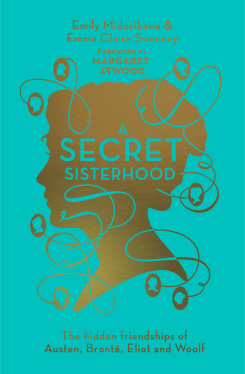
A Secret Sisterhood: The Hidden Friendships of Austen, Bronte, Eliot and Woolf by Emily Midorikawa and Emma Claire Sweeney

Secret Sisterhood revised cover

What better day to review a book that includes Jane Austen than on the anniversary of her death? I was so lucky to have a fascinating guest blog from Emily Midorikawa and Emma Claire Sweeney on the publication day of A Secret Sisterhood: The Hidden Friendships of Austen, Bronte, Eliot and Woolf that you can read here. Today I’m sharing my review.

A Secret Sisterhood: The Hidden Friendships of Austen, Bronte, Eliot and Woolf is published by Arum Press and is available for purchase here.

A Secret Sisterhood

Secret Sisterhood revised cover

The Hidden Friendships of Austen, Bronte, Eliot and Woolf

A Secret Sisterhood uncovers the hidden literary friendships of the world’s most respected female authors.

Drawing on letters and diaries, some of which have never been published before, this book will reveal Jane Austen’s bond with a family servant, the amateur playwright Anne Sharp; how Charlotte Brontë was inspired by the daring feminist Mary Taylor; the transatlantic relationship between George Eliot and the author of Uncle Tom’s Cabin, Harriet Beecher Stowe; and the underlying erotic charge that lit the friendship of Virginia Woolf and Katherine Mansfield – a pair too often dismissed as bitter foes.

In their first book together, Midorikawa and Sweeney resurrect these literary collaborations, which were sometimes illicit, scandalous and volatile; sometimes supportive, radical or inspiring; but always, until now, tantalisingly consigned to the shadows.

My Review of A Secret Sisterhood

I have to confess that it has taken me some time to read A Secret Sisterhood as there is so much information to absorb I needed time to reflect and consider what I’d read. The style of the book is very accessible and balances quotation and research with original writing perfectly. At times this is more like reading a narrative than an academic study and it just goes to show what wonderful writers both authors are. Their own friendship shines through the pages.

The quality of research that has gone in to A Secret Sisterhood is impeccable. Whilst several facts are already well documented, Midorikawa and Sweeney present them with a fresh eye. They also include new material and occasionally some conjecture so that the reader is left to form their own opinion too. I really enjoyed this aspect of the book and the details of quotidian life really bring the text alive. I also really appreciated the understanding of feminism that underpins much of the book and the debunking of so many stereotyped views of these women. They come to life between the pages of A Secret Sisterhood so that they are no longer the conventional creatures we have known for so long.

A Secret Sisterhood is a must read for any fan of Austen, Bronte, Eliot and Woolf, but equally for anyone interested in history, society and literature. The bibliography and footnotes make for fascinating reading and again, it took me ages to read the book because I found myself following up some of these independently. A passing reference to Roger Fry had me looking up his paintings, for example. I think A Secret Sisterhood is a book to be savoured and returned to frequently over the years.

About Emily Midorikawa and Emma Claire Sweeney

Writer friends Emily Midorikawa and Emma Claire Sweeney are the authors of A Secret Sisterhood: The Hidden friendships of Austen, Brontë, Eliot and Woolf. They also co-run SomethingRhymed.com, a website that celebrates female literary friendship. They have written for the likes of the Guardian, the Independent on Sunday and The Times. Emily is a winner of the Lucy Cavendish Fiction Prize, Emma is author of the award-winning novel Owl Song at Dawn, and they both teach at New York University London.

You can follow them on Twitter via @emilymidorikawa and @emmacsweeney, and Emma has an author page on Facebook as well as a website. Emily’s website is here and her Facebook page here.

The Fine Line Between Right and Wrong: A Guest Post by David Videcette, Author of The Detriment

the detriment

Earlier this month I reviewed The Detriment by David Videcette. You can see what I thought about this cracking thriller here. This got me thinking about where we draw the lines between what is morally right and wrong so I asked David if he’d write a guest post for me on that very topic and luckily he agreed. David has written a guest post every bit as interesting and thought provoking as his fiction.

The Detriment is the second book by David to feature Jake Flannagan after The Theseus Paradox and is available for purchase here.

The Detriment

Linda book bag The Detriment quote

“The truth costs nothing, but a lie can cost you everything…”

June 2007: a barbaric nail bomb is planted outside a London nightclub, a spy is found dead in his garden, and a blazing Jeep is driven into Glasgow airport. Three events bound by an earth-shattering connection that should have remained buried forever.

From the author of The Theseus Paradox, the smash-hit 7/7 thriller based on true events, comes the sequel about a real-life mystery that threatens to destroy a nation. Detective Inspector Jake Flannagan must uncover how a series of astonishing events are inextricably linked, before the past closes in on him.

We all have secrets we say we’ll never tell…

The Fine Line Between Right and Wrong

there are no heroes without villains

As a crime fighter turned crime writer, Linda asked me to write about right and wrong for her blog, which sounded nice and simple. Having spent a career in the police, you would think it would be a straightforward matter. Yet, the fine line between right and wrong is as indecipherably complex to me now as the day I started as a bobby on the beat twenty years ago.

As children, we are taught that we shouldn’t lie and shouldn’t be unkind, but the simple act of being told isn’t enough. We learn far more from our interactions with others. You don’t hit other kids, as they cry or hit back, creating a negative experience for us as individuals. You locate a lost ball and return it to someone, this results in a positive experience. We learn how to coexist. A form of social justice develops about what is acceptable and what isn’t. And this is where our early notions of right and wrong come from.

Animal instincts

In this respect, humans are like most other animals. Experiments with lots of different species have shown that all animals can differentiate between making good and bad choices.

Over time, an animal can learn that choosing A, gives them X amount of food, and choosing B, gives them no food at all. The reward is then their big driver in future decision making.

Animals can also learn that to do something wrong, results in a negative experience. For example, an electric fence encircling a field of cows says to the animals, “Don’t try to leave the field, as it’s going to hurt. Leaving the field is bad, it’s wrong.”

Choose your words carefully

Most of us can tell the difference between right and wrong, good and evil, or even between legal and illegal. But in doing so, we tend to rely on very simple, animalistic binary choices based on our learned experiences.

Even the language we use often only gives us binary choices. There is no third or even fourth option. We must choose one or the other. Right or wrong. For some people these simple choices are enough. They build their lives and environments based on one or the other. But there are certain people and situations where the simple rules of live or die; eat or starve; hunt or be hunted are much more complex and difficult to decipher.

A murderer is an evil wrongdoer

The police officer that catches him or her is good and righteous… easy.

But what happens when the murder is committed in revenge, or in a fit of rage? What happens when a drug dealer is tied to a chair, and watches a corrupt police officer torture his family, and rape his wife, in an effort to get the drug dealer to reveal where his drugs and money are hidden? What happens when that father and husband breaks free, hunts down the corrupt police officer, who he knows will never stand trial or face justice for what he did – and kills the police officer? Where are the boundaries of right and wrong, good and evil, legal and illegal now? Where are the simple binary choices that we learned as children? Where is the reward for doing the right thing?

firearm-409252_1920

How far would you go?

Imagine that you are a counter-terror officer. You’ve got a terrorist suspect in your custody. You are convinced he’s planted some bombs somewhere, convinced they are going to kill and maim hundreds of people, but he won’t tell you where they are hidden. Could you be tempted to intimidate or even hurt him, for the greater good, to save lives? Would you be happy to torture him, to get the answers you wanted?

The complexities of these decisions, of how to act, on what to do – have always fascinated me. They are issues which Detective Jake Flannagan, the lead character in my thrillers, has to face on a daily basis. They are what define us from the rest of the animal kingdom. No other animal would have these dilemmas; their decision making is completely binary. But as humans, we can be forced into a place where grey exists, where black and white is either side of us. Where lying becomes rewarding, where inflicting pain becomes acceptable, where the very basics of what we learned as children, is turned on its head.

Let’s go back to the scenario of you as the counter-terror officer, holding a terrorist prisoner whom you are convinced has planted bombs which will soon explode, killing and maiming innocent members of the public. How many of you thought that torture was acceptable here, for the greater good?

handcuffs-2102488_1280

Let’s imagine you start with a little bit of punching in the face while he is handcuffed to the chair, stamping on his head, then you progress to some cigarette burning, then even to pulling his fingernails out, then perhaps some waterboarding. Now he begins talking, singing like a canary. You feel good. You did the right thing, even though it was wrong?

But when you go to the places where he said he’s planted the bombs, they aren’t there.

He lied to you. Not because he wanted to, but because it’s the wrong man. You picked up an innocent person. He lied because he learned that saying nothing resulted in more pain. You taught him that lying was good and the right thing to do.

I often wonder if this is why human language evolved, so that we could communicate further than simple likes and dislikes, beyond rights and wrongs. I wonder whether we are short changing ourselves by trying to see the world in black and white, like animals do, instead of shades of grey.

This is where I think natural justice comes into play, where humans can justify their decision making over and above the simple binary choices of animals. The thing we hold deep inside ourselves – is the knowledge that we can say, ‘I am happy with myself’ or ‘I can sleep at night.’

It’s the human state of being able to recognise the grey in the world, which no other animal appears to have. It is language and explanation that allow us to do this.

But as you will discover in my books, these choices for a detective are never simple.

Wrong can sometimes be right – and right wrong.

About David Videcette

both books just one story I can't tell you the truth, but I can tell you a story...

David Videcette is the author of The Theseus Paradox and The Detriment – compelling detective thrillers based on true events.

With twenty years’ policing experience, including counter-terror operations and organised crime, David was a lead detective on the intelligence cell during the 7/7 London bombings investigation. As a Scotland Yard investigator, David has chased numerous dangerous criminals, searched hundreds of properties and interviewed thousands of witnesses. Now a security consultant for high-net-worth individuals, he’s also a regular commentator for the media on crime, policing and terrorism. David currently lives in London and is addicted to going to the cinema.

You can find out more about David on his website, by following him on Twitter and on Facebook or by checking out all his books on Amazon.

Blog Post 1000 Giveaway

1000

Who would have thought that when I began Linda’s Book Bag just over two years ago I would be posting my thousandth blog post today. I can’t believe it.

It has been such an honour to read fabulous books and meet wonderful authors, publishers and fellow bloggers both in real life and via the Internet. Blogging has brought me so much joy (and not a little stress at times when I STILL haven’t managed to get to a book I’ve promised to read and review) and introduced me to wonderful people I would never otherwise have met.

To celebrate this 1000th blog post I’m running a little thank you giveaway for all those who’ve supported my blog by visiting Linda’s Book Bag and sharing my posts, liking Linda’s Book Bag on Facebook, or following me on Twitter @Lindahill50Hill. Please take part and good luck!

Giveaway

£20

For your chance to win a £20 or $20 Amazon e-voucher click here. Open internationally, the giveaway closes UK midnight on Friday 21st July 2017.

Writing YA Fiction: A Guest Post by James Morris, Author of Feel Me Fall

Pageflex Persona [document: PRS0000032_00050]

I’m delighted to welcome James Morris, author of Feel Me Fall, to Linda’s Book Bag today. James has kindly agreed to tell me a little about the challenges of writing a novel for the so-called young adult market and, like me, he doesn’t always find categories of books helpful.

Feel Me Fall was published by Inkspot Imaginarium on 2nd May 2017 and is available for purchase here.

Feel Me Fall

Pageflex Persona [document: PRS0000032_00050]

Secrets and survival in the Amazon

Emily Duran is the sole survivor of a plane crash that left her and her teenage friends stranded and alone in the jungles of the Amazon. Lost and losing hope, they struggle against the elements, and each other. With their familiar pecking order no longer in place, a new order emerges, filled with power struggles, betrayals, secrets and lies. Emily must explain why she’s the last left alive.

But can she carry the burden of the past?

Discover the gripping new adventure novel that explores who we are when no one is watching, and how far we’ll go in order to survive.

Writing Young Adult Fiction – Or Am I?

A Guest Post by James Morris

Feel Me Fall tells the story of Emily Duran, the sole survivor of a plane crash that left her and her teenage friends stranded and alone in the jungles of the Amazon. Lost and losing hope, they struggle against the elements, and each other. With their familiar pecking order no longer in place, a new order emerges, filled with power struggles, betrayals, secrets and lies. Emily must explain why she’s the last left alive.

Feel Me Fall is classified as young adult, but as a reader wrote, “It reads like an adult psychological thriller,” and that’s exactly what I wanted to hear. For me, writing young adult is no different than other genres. While the characters might be younger, the drama and stakes still have to be high. The plot must still be engaging. The dialogue has got to sound real. A relative of mine once asked me: “How can you write YA if you’re not a teenager?” The undercurrent was: What do you know about being a teenager today? (Let’s just set aside that thing called imagination.) To me, teenagers are the same, in every era. True, the technology might be different, but the worries about fitting in, identity, sex, and wanting to be independent while still being dependent, are universal. People will be writing teen stories hundreds of years from now. That’s what I tap into. Even if I came of age in the 80s, my struggles and worries were probably very much the same as a teenager today.

I do avoid slang, because like technology, that will date itself. And I’m careful not to be patronizing. I try my best to make my characters—no matter the age—as real and complex as possible.

I find it interesting that when I was growing up, there wasn’t a “young adult” category. It was just stories with younger characters. A lot now is about marketing. I had a person in publishing tell me that “it’s all about where your book sits on the shelf,” meaning: What category can they clearly market it to? I think the marketing side of things has taken away some of the surprises of a book. If it’s easily categorized, a reader knows a lot about a story before they even read it.

I don’t even like to say my books are “young adult.” I like my earlier definition; they are stories that just happen to have a teenager at the center. If anything, the phrase “young adult” can seem patronizing—as if the story has to be watered down because the reader isn’t adult enough to handle it. Maybe that’s my own opinion. That’s the danger of YA—riding that line between what’s acceptable in an “adult” book, and one that a younger reader might read. But I like seeing a recent trend where everything is not just safe characters, but more complex, more morally ambiguous, maybe even slightly uncomfortable. I guess it all depends on whether you read for pleasure, or to be challenged. And there are times for both.

I’d like to think Feel Me Fall does both: provide a nice rollercoaster ride for those who want one, while asking questions of us that might be hard to answer.

About James Morris

James Morris

James Morris is a television writer who now works in digital media. He is the author of the young adult thriller What Lies Within, the dystopian love story Melophobia, the young adult suspense Feel Me Fall, and the upcoming young adult horror Screams You Hear. When not writing, you can find him scoping out the latest sushi spot, watching ‘House Hunters Renovation’, or trying new recipes in the kitchen. He lives with his wife and dog in Los Angeles.

You can find out more about James on his website, Goodreads and on Facebook and by following him on Twitter @JMorrisWriter. All of James’ books are available here.