Book Launch: Sealskin by Su Bristow

sealskin

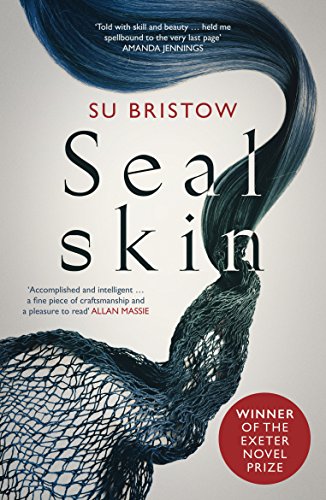
Last night I was so lucky to be able to attend the launch of one of the best books I’ve read this year, Sealskin by Su Bristow. If you haven’t yet discovered this wonderful book, you’ll find my review here.

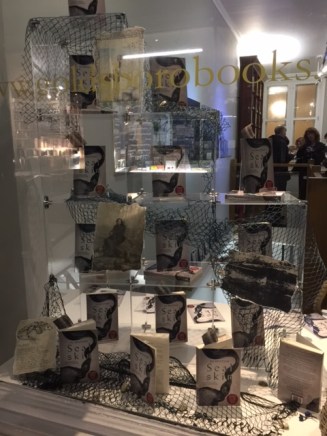
The event was hosted at Goldsboro Books where they had produced a magnificent display of Sealskin in their window.

IMG_0877

Sealskin publisher Karen Sullivan of Orenda Books introduced the evening, sharing some of the amazing reviews Sealskin has received.

Karen

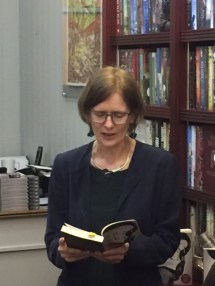
As well as the chance to catch up with several blogger friends, authors (including Amanda Jennings) and agents like Broo Doherty, the highlight of the evening was meeting Su Bristow and hearing her read from the wonderful Sealskin.

IMG_0885

When Su finished her reading there was pin drop silence as we were all so entranced, before we burst into applause.

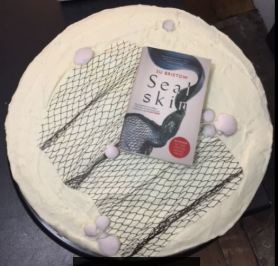
The evening continued with wine and a very lovely Sealskin cake. It was just a shame the trains constrained me as usual!

cake 1

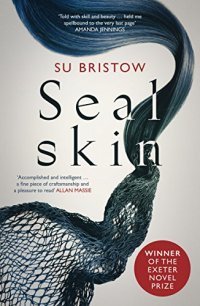
Sealskin

sealskin

What happens when magic collides with reality?

Donald is a young fisherman, eking out a lonely living on the west coast of Scotland. One night he witnesses something miraculous … and makes a terrible mistake. His action changes lives – not only his own, but those of his family and the entire tightly knit community in which they live. Can he ever atone for the wrong he has done, and can love grow when its foundation is violence?

Based on the legend of the selkies – seals who can transform into people – Sealskin is a magical story, evoking the harsh beauty of the landscape, the resilience of its people, both human and animal, and the triumph of hope over fear and prejudice. With exquisite grace, Exeter Novel Prize-winner Su Bristow transports us to a different world, subtly and beautifully exploring what it means to be an outsider, and our innate capacity for forgiveness and acceptance. Rich with myth and magic, Sealskin is, nonetheless, a very human story, as relevant to our world as to the timeless place in which it is set. And it is, quite simply, unforgettable.

Sealskin is published by Orenda and is available in ebook and paperback by following the publisher links here.

About Su Bristow

su-bristow

Su Bristow is a consultant medical herbalist by day. She’s the author of two books on herbal medicine: The Herbal Medicine Chest and The Herb Handbookand two on relationship skills: The Courage to Love and Falling in Love, Staying in Love, co-written with psychotherapist, Malcolm Stern. Her published fiction includes ‘Troll Steps’ (in the anthology, Barcelona to Bihar), and ‘Changes’ which came second in the 2010 CreativeWritingMatters flash fiction competition. Her novel, Sealskin, is set in the Hebrides, and it’s a reworking of the Scottish legend of the selkies, or seals who can turn into people. It won the Exeter Novel Prize 2013. Her writing has been described as ‘magical realism; Angela Carter meets Eowyn Ivey’.

You can follow Su on Twitter and find her on Facebook.

An Extract from The Mercury Travel Club By Helen Bridgett

travel-5_1

It gives me great pleasure to be part of the launch celebrations for The Mercury Travel Club by Helen Bridgett. The Mercury Travel Club is published by Red Door on 16th March 2017 and is available for pre-order here.

I have a smashing extract from The Mercury Travel Club for you to read below.

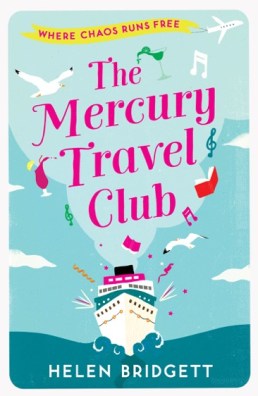
The Mercury Travel Club

travel-5_1

‘Hi, I’m Angela. My husband ran off with the caterer we hired for our daughter’s graduation party. Pleased to meet you.’

Meet Angie Shepherd who, after 24 years and 11 months of marriage, finds herself divorced and driven by friends and family to move on. From hangover to makeover, Angie steps firmly away from the sensible knitwear, and launches into every adventure on offer from baking classes and book groups, to speed dating, and even ‘The Granny-Okes’, a 1980s tribute act and YouTube sensation.

But Angie needs more than a bar of galaxy and a night in with Murder She Wrote… what she dreams of is entrepreneurial success. Channelling her inner Richard Branson, the light bulb moment happens: it’s time to take the plunge and invest her divorce settlement into The Mercury Travel Club, an exciting new business venture. But as the Travel Club gets going, things don’t go according to plan, and in this digital age a little chaos brings the fame she s been looking for.

Set in present-day Manchester, this classic mid-life journey features the 1980s soundtrack from Angie s youth, and sees her travel the world whilst coping with life after the Ex. Angie’s journey is the catalyst her friends need to examine their own lives; as they start to find their true callings, will Angie find hers? Witty, entertaining and laugh-out-loud funny, this feel-good debut novel shows it s never too late for a second chance.

An Extract from The Mercury Travel Club

A Fresh Start

A hearse drives out of the cul-de-sac as I drive in. I hope that’s not an omen.

Cross Road: genuinely the name of this street. I didn’t pick the place because of the address but I have to confess to enjoying the irony. I couldn’t bear to stay in our old house during the sale; it wasn’t just the thought of people traipsing round judging my taste and rifling through my memories (which would have been bad enough), but no, he brought her into our house.

‘Never in our bedroom,’ he yelled at me when I found out, as if bedding your mistress in the spare room somehow puts you on a higher moral plane.

The thing that annoyed me most was that she burned our only Jo Malone candle. It lived in the spare room, never ac- tually meant to be lit – just to sit there and tell anyone visiting we had impeccable taste. Every woman knows this; I’d never set fire to a £40 candle in anyone else’s house, but she did it in mine. She lit the match that started the row and eventually brought us here.

So here I am; I think they used to call these ‘starter homes’, small boxes for young couples. Given the obvious funeral taking place, maybe things have come full circle and they’re ‘finishing off homes’ now, last stop before the old fogey centre.

I can’t see a single person peeking through the blinds to have a nosey at the new neighbour. I might have caught someone’s eye, maybe made a new friend and have someone to talk to. Maybe I’d even get invited to an impromptu party – but nothing. Probably for the best, I’m not sure I’m ready to start explaining myself yet.

Hi, I’m Angela. My husband ran off with the caterer we hired for our daughter’s graduation party – pleased to meet you.

It’s New Year’s Eve and I start wondering why they chose today to hold a funeral; I guess because no one is working tomorrow. It’s always best to schedule your exit around the bank holidays.

They’re funny things, funerals; like all the big moments of life and death they take no time at all. A couple of words and that’s it, next please. I remember when Patty’s husband died, she looked at her watch as the congregation were leaving and said, ‘A few thousand pounds for twenty minutes? He wouldn’t have been happy with that.’

It made us smile because she was right, he wouldn’t have been.

Right then, Mrs (or I suppose its Ms now), stop this and perk up; this place is carefully designed to cause no offence: neutral magnolia walls, teal carpet and white gloss doors. The air has a whiff of industrial cleaning about it; the landlord probably bought the ‘new tenant’ package. Everything is packaged nowadays.

Wash that man right outta your life? Certainly madam – would you like the bronze, silver or gold package? The gold comes with free mistress removal.

I’ve bought a new bed and sofa, which were thankfully delivered on time, and I’ve unpacked what I need to: a ready meal, bottle of wine and a pint of milk. At the moment it still feels as if I’m staying in a holiday cottage for a few days. But this is it. This silent, easy to maintain house is all I have to show for twenty-four years and eleven months of marriage (yep, I didn’t even get a silver wedding anniversary bash). I mustn’t get morose. It’s over, but my life isn’t.

Despite hankering after a party invitation, I do want to be alone on my first night here. I thought it would be a good time to reflect and make plans for the future; sitting here now, I’m not sure what I’m going to do. It’s a funny night to spend on your own. Ordinarily I’d just watch television, but tonight it’s all people having a wonderful time. I must definitely avoid alcohol at all costs: do not open the wine, do not get drunk or maudlin. Have a bath, an early night and wake up gloriously refreshed for a dignified start to the next stage of my life.

The single years.

Oh Lord, what just happened? I wake up with that scary sensation; I have no idea where I am or what I’ve done to get here and I don’t recognise the room at first glance. Out of habit, I peer across the bed at the next pillow but there’s still no one there. At least I didn’t throw myself on any random passer-by or accost a new neighbour. Or if I did, the vision of me drowning in my own drool wasn’t particularly attractive and he didn’t stay. I also bypassed the bath last night and collapsed fully dressed with a full face of make-up; my pillow case looks as if Robert Smith has slept on it.

I remember switching on the TV and then convincing myself  I’d stick to one glass of wine if I opened the bottle. There are some lessons you don’t learn no matter how old you get.

Although every brain cell is begging me not to, I have to lift my concrete head up and take it downstairs to find the paracetamol. The kitchen is like a crime scene. I could imagine CSI dissecting the evidence.

Wine rack empty and lasagne not cooked, theyd note in their authoritative way.

Drinking on an empty stomach, nasty. How much wine?

Theyd shine one of their torches into the recycling corner (even when plastered I seem to be environmentally responsible).

Looks like two empties – a champagne and a cab sauv.’

(Did I really open the champagne too? And not just open but consume?)

Good taste, but a lot for one little lady.

Theyd nod in knowing agreement.

My phone is sitting on the worktop and with trepidation I check I didn’t make any drunken calls to my ex; I sigh with relief when I’m assured otherwise. It lights up with Patty’s daft photo and I realise I’ve had it on silent all night. I tell myself I wanted to avoid well-wishers, but the truth is I was more afraid that no one would ring. I hug my little phone as I see lots of missed calls around midnight and just as many text messages with kisses on the bottom; it’s like a virtual embrace and I’m so relieved that people care. Zoe tried to call so many times before and after midnight; she would have been working the room at the anointed hour.

I feel terrible for not being sober enough to pick up the phone to my one and only daughter. Discarded wife and neglectful mother; the accolades are piling up this year. Zoe will be my first call as soon as Patty gets off the line. In my hungover state, the saving grace is that Patty talks so much I don’t usually need to think or say anything.

‘What did you get up to last night?’ asks Patty. ‘An orgy with the new neighbours?’

I snort; it counts as an answer.

‘Guess where I ended up?’ she continues. ‘Onstage at the Rose & Crown. Guess what I sang? “Like a Virgin”. It was absolutely hilarious …’

This is what a conversation with Patty is like. I can drift off for hours and she doesn’t notice. It’s very soothing, almost like being in a coma yet knowing that there’s someone on the outside trying to make contact.

I’ve known Patty (she was actually christened Patience – it doesn’t fit at all) for over thirty years (ouch). She’s four years older than me and was my supervisor when I joined the airline (being a stewardess was a glamorous career back then, before budget flights). Patty has always been the biggest personality in the room. I’m sure if we were ever invited to the White House, all eyes would be on her. She’d also get the President singing; an ex-drama school student, she gets everyone singing and if The X Factor had been around when we were young, she’d have won. She frequently tells me that she still has time to be the next Susan Boyle.

She usually does Cyndi Lauper numbers, but I suppose ‘Time After Time’ isn’t really a New Year crowd-pleaser. Also the Rose & Crown doesn’t have a stage, so she was in all likelihood standing on a table. I don’t mention this.

‘So have you?’ she asks.

Blimey, a break in conversation, and I’m expected to reply.

‘Have I what?’ I say.

‘Made any resolutions? New Year, fresh start etc., there must be loads you want to do now you’ve lost all that baggage.’

Invent a way of drinking wine without having a hangover?

That’s the first thought to enter my head and I’d probably win the Nobel Prize for it. I drift mentally to the prize-giving where the room raises a glass of champagne to me; the imaginary smell of it makes me gag.

‘I’m not ready yet,’ I sigh. ‘I just want to unpack, recover and get my bearings first.’

‘I’m not going to let you stew,’ she replies. ‘No wasting your life away as divorce debris.’

‘Give me until the end of the month,’ I say. ‘You know what I’m like.’

‘You must be the only person who makes their New Year’s resolutions in February,’ says Patty. ‘OK, you’ve got till then or I’ll come round and sort you out myself.’

Heaven forbid.

With a final, ‘I’m always here for you’, she’s gone and the house is silent again.

Years ago I came to the conclusion that January 1st is the very worst day to start any resolutions as you’re always too tired or hungover. So I give myself a month of grace and start in February. It’s worked so far; just as everyone else is giving up, I’m just getting going. And you only have to stick to them for eleven months. Well, ten months, because let’s face it no one sticks to anything in December.

Now I have to redeem myself on behalf of all other errant mothers in the world and phone my daughter.

About Helen Bridgett

bridgett-bw

Helen has always loved books and always loved writing. One year she decided her New Year’s resolution would be “Write a novel to give as a Christmas present”. She spent the year writing and The Mercury Travel Club was born. Helen hails from the North East but now lives in Manchester with her Husband and their Chocolate Labrador Angus. When not writing, Helen can usually be found walking or drinking wine – not usually at the same time.

You can follow Helen on Twitter and visit her website

There’s more with these other bloggers too:

mtc-blog-tour-poster

An Interview with Susan Beale, Author of The Good Guy

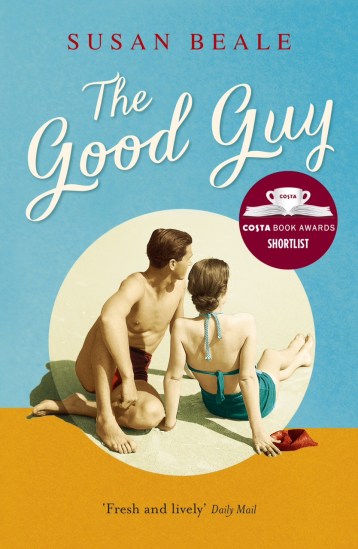
costa_good-guy_pb

I’m so pleased to be celebrating paperback publication day of The Good Guy by Susan Beale with an interview with the author. The Good Guy is published in paperback today, 9th March 2017, by John Murray and is available for purchase by following the publisher links here.

The Good Guy

costa_good-guy_pb

Ted, a car-tyre salesman in 1960s suburban New England, is a dreamer who craves admiration. His wife, Abigail, longs for a life of the mind. Single-girl Penny just wants to be loved. When a chance encounter brings Ted and Penny together, he becomes enamoured and begins inventing a whole new life with her at its centre. But when this fantasy collides with reality, the fallout threatens everything, and everyone, he holds dear.

The Good Guy is a deeply compelling debut about love, marriage and what happens when good intentions and self-deception are taken to extremes.

An Interview with Susan Beale

Welcome to Linda’s Book Bag Susan. Thank you so much for agreeing to answer some questions on my blog about your writing. Firstly, please could you tell me a little about yourself?

Thank you. I’m delighted to be here. I grew up in Falmouth, Massachusetts, which is the second largest town on Cape Cod. In 1990 I married my Danish husband and we’ve been expats ever since. We started in the UK, moved to France, and then Belgium, and then, in 2012, back to the UK. I worked as a journalist and editor until our second son (we have four) was fifteen months old. The work-life balance wouldn’t balance, so I took a break that ended up lasting fifteen years. Faced with the prospect of starting from scratch in an industry that had been thoroughly disrupted, I decided to go for the moon shot and try to become a novelist. I wrote the first draft of my novel The Good Guy while on the creative writing MA course at Bath Spa University.

Without spoiling the plot, please could you tell us a bit about The Good Guy?

It’s set in New England in the mid-sixties, just before the sexual revolution; conformity is reaching its high-water mark and white males without college degrees have never had it so good.

Ted McDougall is a university drop-out and an up-and-coming tyre salesman, living the American Dream in a tract housing development west of Boston, with his wife and childhood sweetheart, Abigail, and their baby daughter Mindy. Their troubles are relatively minor – Abigail misses her studies and struggles with the domestic arts; Ted interprets her sadness as dissatisfaction with him and his choice of career.

On the night he lands his biggest business deal to-date, Ted meets Penny and is enchanted, not only with her but also with what he sees as her glamorous, independent life. He repeatedly seeks her out, gradually conjuring a second life with her at its centre. He tells himself he can keep the two lives from colliding.

When did you first realise you were going to be a writer?

Probably when I was four or five, but it took me decades to admit, even to myself, that I wanted to write novels. I thought that novelists were born not made, and that I didn’t have the goods. I became a journalist because it’s considered a trade not an art – also because I’m very curious and I love asking people questions.

Which aspects of your writing do you find easiest and most difficult?

I hesitate to describe anything about the writing process as easy, but I’d say that dialogue, characterisation and description attract the bulk of my writing attention. My inter critic constantly badgers me with questions like: ‘Is that something that character would say or think?’, ‘What is their frame of reference?’, ‘What does he or she want?’; or ‘How would that place look, smell, sound?’ The inner critic isn’t as obsessed with things like pacing and suspense. I have to be more deliberate and conscious about those parts of storytelling.

(Interesting!)

What are your writing routines and where do you do most of your writing?

I would love to tell you about the wonderful routine that have I created and to which I cling. Regular practice is one of two essential ingredients to becoming a good writer – the other being reading – and I aim to get a few hours of writing in every day. Ideally, early in the morning, so that by lunchtime I can do other things without feeling guilty. Maybe when my kids leave the nest, I’ll be able to manage it.

But I can’t throw too much shade my kids’ way. I’m a terrible procrastinator. I could read political websites until my eyeballs melted and the past twelve months, with Brexit and Trump, I’ve indulged in unhealthy levels of it. Being a political junkie the worst kind of vice because you can pretend it’s a virtue: ‘It’s my civic responsibility to stay informed!’ when, really, you’re just wasting time, avoiding the hard work of fiction, which is mapping a place that doesn’t yet exist.

Where I write is equally haphazard – I surf between the dining room table, the living room sofa and my bed. Sometimes I go to a café or the library, usually when things aren’t moving and I need a change of scenery or, more likely, when I’ve lost control due to advanced-stage procrastination.

(I think you may have just described a typical author approach to procrastination Susan!)

You were brought up in America but are now living in the UK. How has that background helped or hindered your writing?

Being an expat for basically my whole adult life has without a doubt helped my writing. No matter how well you integrate, you remain a bit of an outsider. It can be isolating on a personal level, but it’s a boon to an aspiring writer.

Twenty of those years were spent the French-speaking world, which is a whole other layer of otherness. My French is pretty good (vastly better than my middle school French teacher could have imagined, especially given that I dropped her course before the end of a single term) but it will never be equal to my English. I make stupid mistakes – mixing up the gender of nouns, blurting out the wrong verb tense or word order in a sentence. I’m good enough that I can generally spot the error the moment it’s left my mouth. It’s a continuous lesson in humility. It’s made me more reflective. I consider what I want to say, and the different ways I could say it, but if I worried too much about making mistakes, I’d never say or do anything.

I would add that seeing America from outside has been invaluable. It’s not always pretty, not always comfortable to watch, but, for a writer, it’s a gift.

(You’re making me want to brush up my French.)

You’ve recently completed an MA in creative writing. How has that impacted on your style?

I can’t recall a tutor commenting on any students’ style during the course. It was one of those things, like voice, that was assumed to be unique to every writer and they gave us wide latitude. That said, I hope that some things rubbed off on me. It would be a shame if working with writers such as Samantha Harvey, Philip Hensher and Tessa Hadley hadn’t affected my writing style in some (beneficial) way, but I’m at a loss to say how.

The Good Guy is your debut. How does it feel to be published?

Awesome.

The Good Guy has self-deception as one of its themes. Why did you choose to explore that theme?

Without self-deception, there wouldn’t be much of a story to The Good Guy. The three main characters all engage in it and it’s a major source of tension.

I wanted to dig deep into the phenomenon because I think it’s a fascinating human trait. We read or hear about people getting cheated or swindled and think, ‘How is it they didn’t know?’ We’re sure that we would see through such a scam, but the science indicates we probably wouldn’t, particularly if it was perpetrated by someone we loved.

The behavioural economist Dan Ariely wrote a terrific book called The Honest Truth About Dishonesty: How we lie to everyone, especially ourselves. It’s about cheating in business, politics, school, and sports, but his conclusions are equally applicable to personal relationships.

All humans use motivated reasoning. We discredit information that doesn’t confirm to our world view and look for ways to dismiss it. It takes very little convincing for us to believe that the things we want to do are the things we ought to do. The more we have invested in a lie (emotionally or financially), the more likely we are to cling to it, even in the face of mounting evidence.

(Brilliantly put – couldn’t agree more!)

How did you go about researching detail to ensure The Good Guy was realistic?

My research began with my adoption papers, which were the inspiration for the story. Though literally written in my lifetime, they seemed to belong to a different world, one I was determined to understand. I read magazines from the time, and books such as The Feminine Mystique and Sex and the Single Girl; I looked at old photo albums, scoured the internet for pictures, old commercials, and the history of the places featured in the book, such the city of Lynn, Massachusetts, and Shoppers’ World, an open-air shopping centre, that was heralded as the Main Street of the future when it opened, but which was soon overshadowed by fully enclosed malls. My older cousin, who I adored, worked at the Jordan Marsh anchor store that was built to look like a flying saucer. I can’t remember going there myself, but I recall my grandmother talking about it in almost reverent tones. The television show Mad Men was a big help. It’s about a different socio-economic group, but the sets and costumes and the sense of the time are all beautifully portrayed.

The Good Guy has a very nostalgic cover. How did that image come about and what were you hoping to convey (without spoiling the plot please!)?

All credit goes to the folks in the art department at John Murray, who created two wonderful covers for The Good Guy. For me, the paperback cover conjures an image of an important scene in the novel, where Ted spends an idyllic weekend at Penny’s mother’s house on Cape Cod. Nostalgic is the right word for it, the picture, the font and the colours are all heavily evocative of the mid-1960s. The combination of teal and orange reminds me of Howard Johnsons’, a chain of restaurants and motor lodges that were at the height of their popularity at the time in which the book is set and are mentioned a couple times in the story.

If you could choose to be a character from The Good Guy, who would you be and why?

Penny’s roommate Peanut. She’s a relatively minor character but she knows the score. She is funny, loves life and people, but at the same time, she is under no illusions. She is neither overly romantic, like Penny, nor cynical, like their other roommate, Ellen. She has dreams and, unlike Abigail, is unwilling sacrifice them for convention. Although open to getting married, one day, she won’t consider it until she has done what she wants to do (which is travel the world as a stewardess). America is on the cusp of drastic change and Peanut is just the kind of gal to reap the benefits of it.

If The Good Guy became a film, who would you like to play Ted, Abigail and Penny and why would you choose them?

Ooh, good question! The actors would have to be young because the main characters are in their early twenties. I’d think maybe Hunter Parrish or Chace Crawford could work for Ted. Both are real charmers, with lovely blue eyes. For Penny, maybe Ashley Benson or Rooney Mara. They’re petite and can be made to appear fragile and wide-eyed; innocent, but not ditzy. Abigail would need to be played by someone who can show a torrent of emotion simmering beneath a placid surface. I could see Saoirse Ronan or Jennifer Lawrence.

When you’re not writing, what do you like to read?

The very first books I ever took out of the library were biographies. I still love them. Currently, I’m trying not to read Ron Chernow’s biography of Alexander Hamilton because I gave it to my husband for his birthday and I have a habit of reading the books I give to him as presents, but I’ve dipped into it a couple times and can hear it calling to me from the shelf. Helena Kelly’s Jane Austen Secret Radical reminded me that I’m overdue for a reread of Austen. I gravitate towards articles and books on behavioural economics and studies of human behaviour. I recommend Maria Konnikova’s The Confidence Game: Why we fall for it … every time. I listen to a podcast called Hidden Brain and read the Science of Us column in New York Magazine online. Not only are they interesting, they’re also useful for sketching characters and developing story ideas.

It’s probably no surprise that my interest in human behaviour is reflected in the fiction I read. I love Anne Patchett, Anne Tyler, Annie Proulx – hmmm a lot of Anns – also Karen Joy Fowler, Elizabeth Strout, Samantha Harvey and Tessa Hadley.

Do you have other interests that give you ideas for writing?

As Nora Ephron said, everything is copy.

I love talking to people, love hearing their stories, and learning what makes them tick.

Everyone has a story. It’s just a matter of listening and asking the right questions. I once sat next to a man at a wedding rehearsal dinner. For three-quarters of the meal, he barely spoke three words, and then I managed to find his interest (tractors, of all things), and the guy opened up like a flower. I can’t recall a word of what he told me about tractors, but I know I wasn’t a bit bored.

Story ideas are all around. The trick is to write them down before they slip out the back side of your brain. Too often, when something triggers a spark or an idea, I’ll tell myself that I’ll remember. I almost never do.

And finally, Susan, if you had 15 words to persuade a reader that The Good Guy should be their next read, what would you say?

To understand the forces of nostalgia that led to President Donald Trump, read this.

Thank you so much Susan for your time in answering my questions.

My pleasure. Thank you.

About Susan Beale

susan-beale-author-pic

Susan Beale was brought up on Cape Cod and now lives in the UK. She is a recent graduate of the Bath Spa MA in Creative Writing. The Good Guy is her first novel. It was shortlisted for the Costa First Novel Award 2016.

You can follow Susan on Twitter.

There’s more with these other bloggers too:

Not All Blood and Guts, A Guest Post by Julia Chapman, Author of Date With Death

date-with-death

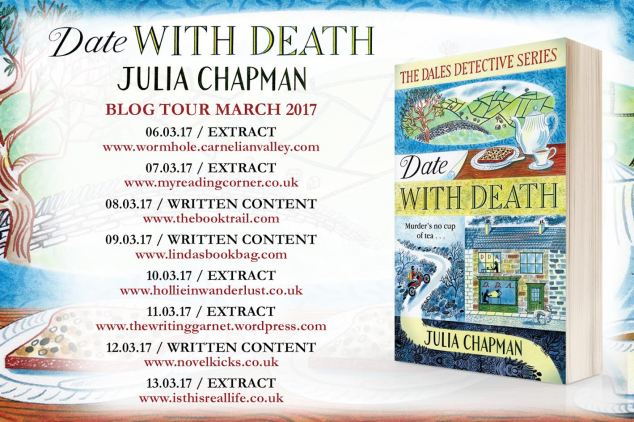
I’m really delighted to be helping to celebrate Date with Death by Julia Chapman. Date With Death is published by Pan MacMillan today, 9th March 2017, and is available for purchase by following the publisher links here.

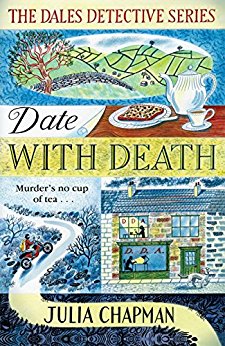
Date With Death

date-with-death

Samson O’Brien has been dismissed from the police force, and returns to his hometown of Bruncliffe in the Yorkshire Dales to set up the Dales Detective Agency while he fights to clear his name. However, the people of Bruncliffe aren’t that welcoming to a man they see as trouble.

Delilah Metcalfe, meanwhile, is struggling to keep her business, the Dales Dating Agency, afloat – as well as trying to control her wayward Weimaraner dog, Tolpuddle. Then when Samson gets his first case, investigating the supposed suicide of a local man, things take an unexpected turn, and soon he discovers a trail of deaths that lead back to the door of Delilah’s agency.

With suspicion hanging over someone they both care for, the two feuding neighbours soon realize that they need to work together to solve the mystery of the dating deaths. But working together is easier said than done . . .

Not All Blood and Guts; Not Always Cosy

A Guest Post by Julia Chapman

When I set out to write the Dales Detective Series, I was aware of the expectations of the genre. Cosy Crime. No blood. No guts. No gore. It’s a softer type of crime, at the opposite end of the spectrum from hardboiled thrillers. In this type of fiction, the characters take centre stage and the puzzle of identifying the perpetrator is more important than a forensically precise description of the bullet wound.

In the world of my Dales Detective, there is also humour, a light-hearted approach to life that persists even through the toughest of times. People tend to laugh rather than throw punches. Or, when punches are thrown (and there are a few in Date with Death), the result is funny rather than fatal.

There’s also a lot of tea. A LOT of tea. And cake.

Ultimately, it’s a world peopled predominately by good folk – Yorkshire folk who aren’t afraid to tell you when you’re out of line. Or to offer opinions on everything and anything, whether you want them or not!

Of course, there’s always the odd rogue. But we rest easy knowing that they will inevitably get caught. Even if the catching is unorthodox, involving amateur sleuths. Or tractors. Or a Weimaraner suffering with an anxiety disorder . . .

Fine. These are all hallmarks of the genre after all. But it doesn’t mean everything has to be cosy.

In the small market town of Bruncliffe, where my new series is set, there is dark as well as light. The backdrop of the Yorkshire Dales gives us that in spades! The weather and the landscape are capable of providing violence – the fells in winter as brutal a place as any desolate urban area, the winds that howl over them a destructive menace.

It’s a farming region, life lived in a cycle of seasons measured out by the breeding, raising and selling of livestock. But don’t presume that makes it a bucolic paradise. Ask any local here and they’ll tell you about the barbarity that visited this area during Foot and Mouth. The burning pyres. The empty fields. The acrimony that tore communities and families apart. There was blood and gore aplenty here then. And even today, the economic difficulties facing farming families don’t make for a cosy lifestyle.

So there is a healthy dose of reality in my take on Cosy Crime. There is plenty to disturb the reader; to snap them out of this comfortable world and into a slightly darker place. But I guess the key difference is that by the resolution, balance has been restored. Good invariably triumphs. And there is always a pot of tea and a thick slice of Yorkshire teacake close to hand. You can’t get much cosier than that.

About Julia Chapman

julia

Julia Chapman is the pseudonym of Julia Stagg, author of the Fogas Chronicles set in the French Pyrenees.

Born with a wanderlust that keeps her moving, Julia has followed her restless feet to Japan, Australia, the USA and France. She spent the majority of that time as a teacher of English as a Foreign Language but also dabbled in bookselling, pawnbroking, waitressing and was once ‘checkout-chick of the month’ at a supermarket in South Australia. She also ran an auberge in the French Pyrenees for six years with her husband.

Having spent many years wandering, she is now glad to call the Yorkshire Dales home, its distinctive landscape and way of life providing the setting for her latest series of novels, the Dales Detective.

You can follow Julia on Twitter, or find her on Facebook.

There’s more with these other bloggers too:

date-with-death-blog-tour

An Extract from What The Raven Brings by John Owen Theobald

cover

I’m so pleased to be helping to celebrate What The Raven Brings by John Owen Theobald. What The Raven Brings is the second in the Ravenmaster trilogy after These Dark Wings.

What The Raven Brings is published by Head of Zeus and is available for purchase here.

What The Raven Brings

cover

London, 1942: the Blitz is over but the war rages on. With the country still fighting for its existence, a young girl takes to the skies…

After her mother was killed in an air raid, Anna Cooper was sent to live with her uncle, the Ravenmaster at the Tower of London. Now, he too is dead. His dying wish was for Anna to be the next Ravenmaster, keeper of the birds who, according to legend, guard the fate of the kingdom. But the Tower authorities won’t stand for a female Ravenmaster, let alone one who is not yet sixteen years old.

Denied her destiny, Anna is desperate to escape the Tower and join the war effort. She bluffs her way into the glamorous – and dangerous – world of the Women’s Auxiliary Air Force.

But no matter how high she flies, Anna can’t escape her past… nor the secret that it conceals. A secret that could change the course of the war.

An Extract from What The Raven Brings

1

Saturday, 16 May 1942

My run of luck is over. During the Blitz, luck’s the only thing that keeps you alive. Every bomb that falls next door, every fire that whips up just as you reach the shelter, every scrap of food you find before someone else – that’s your luck, draining away. After a year, it’s flat gone. And you’re left trapped in the belly of a cement monster with the most annoying person in the world.

‘Squire. You asleep over there?’

I turn to face the grinning voice. ‘Working hard as you are, Lightwood.’

‘I’ll be the judge of that.’ From above comes the quartermaster’s voice. My head is down, focused on tying together the steel bars with wire. I don’t need to peek over my shoulder to know that Lightwood’s done the same.

‘Timothy Squire and Arthur Lightwood. I should not have to remind you that one word from me and neither of you will ever wear a uniform.’

‘Yes, sir.’

‘Yes, sir.’

I grit my teeth. Three months of demolition training to become a sapper – a Royal Engineer in His Majesty’s armed forces – and here I am reinforcing concrete down at the docks. Tie the steel bars together with a figure-eight knot, cut the wire free with pliers. Repeat until death.

Lightwood and I work together, apart. As far apart as you can be in a ten-foot cell. Even in the shadows cast by the walls, sweat drips into my eyes. We’re in a giant hollow concrete box, with twenty compartments, sunk into the earth. All that’s needed is a top, and we’re as good as in a coffin. If we were truly dead and buried, at least we wouldn’t notice these bloody midges.

It’s hard to imagine a smaller space to work with another human. I could well do with some light, or air. The river is so close, but the dry dock blocks it. Seagulls cry out, mocking us.

My luck has run to empty.

I keep working, not daring to check if the quartermaster is still atop the ladder, watching like a riled hawk. Crabby little apple, that one.

The armed forces have taken over the docks, and brought their discipline with them. I suppose I should be happy to be here. As long as I’m close to these sappers, I can find another chance to become one myself. Truth is, I’d rather be anywhere else.

Finally, I glance up and risk turning full around. Cranes on tracks swing and swoop high above, intent on their own work. The walkway that runs down the centre is clear. He is gone. Long gone, I’ll bet, smirking as he left.

Pressing a hand against the small of my back, I watch Lightwood working away, furious, tying the wire, yanking it firm. Did I look that stupid?

‘Lightwood.’

He stops, panting, and turns to me, face bright as a cherry. ‘He gone? Thank Christ.’

Letting the pliers fall to the concrete, he leans his back against the wall, closing his eyes. I watch him with a smile. Arthur Lightwood – sounds like he rides a white horse in some poem from school. Looks a bit like it, too. The horse, that is.

‘You know what I should be doing right now?’ I turn and spit in the opposite corner. ‘Learning about mines. But some fool – some blighter – added a Type 70 fuse instead of a 67.’

His eyes still closed, he looks almost relaxed. ‘I reckon another day in Aberdeen and you’d have been dead as a doornail. Can’t keep your sticky fingers out of TNT for five minutes at a time. One of ’em was bound to go off eventually. Fag?’

Lightwood’s eyes blink open, and he’s rummaging in his pockets.

‘Bleeding liar.’ I wave the offered cigarette away, casting a look up at the walkway. ‘Better get back to it. This bloody Phoenix isn’t going to build itself.’

Who knows, maybe it will. No one here’s got the first clue what a Phoenix is, and no one is allowed to ask.

The armed forces brought that with them, too – no questions, just make sure the concrete is reinforced.

Not even Lightwood knows, and he knows everything.  Doesn’t stop him from guessing, of course.

‘Think about it, Squire. There’s a ton of sappers down here. Obviously it’s vital to the war. So what could it be?’

I almost guess a battleship, but the thought of Lightwood’s horsey laugh makes me want to clobber him. And we really should get back to work.

‘Massive old block of concrete,’ he says after I fail to respond, then snorts when I don’t understand him. Man’s a bleeding talking horse. ‘You sink it, you’ve got a foundation underwater.’

‘A foundation for what?’

‘Harbours. Roads. Whatever you want.’

I shake my head. ‘You were wrong about the clockwork fuse.’

‘That was your fault, Squire.’

Lightwood is full of it. No one knows what anyone is building. At least three other Phoenix units are under construction here, and similar work’s going on at the other docks. And the clockwork fuse was partly my fault, that’s the worst bit. How could I get the fuses mixed up?

‘The Germans hold all the ports, right? If we’re going to land over there, we’ll need to bring our own—’

A voice booms from above. ‘Another peep out of either of you, and you’re both gone. Final warning.’

‘Yes, sir.’

‘Yes, sir.’

Don’t lose your wool, mate. Didn’t think it would be possible to miss the training, but two ticks and I’d go back and start it all over again. Who’d have thought I’d ever miss the endless buckles and buttons of the uniform. The marching drills were the worst, of course. The day my blistered feet finally burst, flooding my boots with blood, I thought I was done. But I learned a few tricks – get your boots one size too small, urinate on them, and never wear socks – worked a treat.

Lot of good marching tricks and rifle drills will do me stuck down here. At least when we spent hours in a bomb hole, we’d wonder what would happen if the bomb went off. Here we know nothing is going to happen. Ever.

Only two weeks away from completing sapper training; written tests, live demolitions, working with time-fused and magnetic response bombs – I’d finished it all. All I needed to do was blow the fake bridge. A single bloody bridge.

I was better than all those Kensington boys.

A whistle cracks the air. For what seems like the first time in hours, I look up. The sun has dropped behind the wall. Workers are hurrying across the wooden walkway.

Another hellish long day. Midges cloud around me.

‘Lightwood.’

He looks over, eyes wide. I already have my hand on the ladder.

‘Let’s close up shop, yeah?’

He nods, adds the final touches to some work, drops his pliers. We climb up to the light. I slide off my cap, take in as much sun as I can.

About John Owen Theobald

author

Born and raised in Eastern Canada, John moved to the UK to study the poetry of Keats, and in 2009 received a PhD from the University of St. Andrews. He lives in London, England.

You can follow John on Twitter, find him on Facebook and visit his website.

There’s more with these other bloggers too:

jot-raven

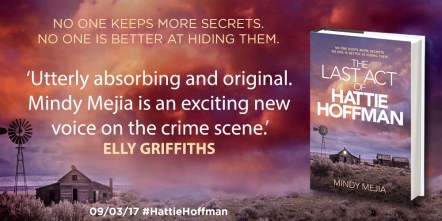
The Last Act of Hattie Hoffman by Mindy Mejia

hattie-hoffman

I’m incredibly grateful to Olivia Mead for my copy of The Last Act of Hattie Hoffman by Mindy Mejia and I’m delighted to be part of the launch celebrations for this exciting new writer.

The Last Act of Hattie Hoffman is published by Quercus on 9th March 2017 and is available for purchase here.

The Last Act of Hattie Hoffman

hattie-hoffman

Eighteen-year-old Hattie Hoffman is a talented actress, loved by everyone in her Minnesotan hometown. When she’s found stabbed to death on the opening night of her school play, the tragedy rips through the fabric of the community.

Sheriff Del Goodman, a close friend of Hattie’s dad, vows to find her killer, but the investigation yields more secrets than answers: it turns out Hattie played as many parts offstage as on. Told from three perspectives, Del’s, Hattie’s high school English teacher and Hattie herself, The Last Act of Hattie Hoffman tells the story of the Hattie behind the masks, and what happened in that final year of her life.
elly-griffiths-quote

My Review of The Last Act of Hattie Hoffman

When perfect high school student and budding actress Hattie Hoffman is found murdered, the community of Pine Valley will be left reeling.

I loved this book. Firstly, I’d like to praise the title The Last Act of Hattie Hoffman as it has multiple meanings, from Hattie’s roles in life to her actions and death but to say too much would spoil the plot.

The Last Act of Hattie Hoffman is the perfect blend of police procedural, crime and psychological thriller in a unique genre all of its own. Mindy Mejia has created a narrative that had me guessing from the first page to the last and I must have suspected just about every major character of having murdered Hattie at some point. There’s such a brilliant quality of writing here. I don’t think I’ve ever encountered a crime book style quite like it and I was completely absorbed every moment I was reading. I could feel the claustrophobic atmosphere of small town America almost oozing from the pages.

Sometimes I find multiple perspectives irritating or repetitive but Hattie, Sheriff Del and teacher Peter have such compelling and individual voices that I thoroughly enjoyed and believed the story told from their perspectives. I liked the way the events were anchored by the dates in each section too as we move towards Hattie’s last act.

However, the absolute triumph aside from a brilliant plot and wonderful settings, is the incredible characterisation; of Hattie particularly. With the conceit of drama, especially the curse of Shakespeare’s Macbeth, running through the story in an intelligent and captivating way, Hattie is the female equivalent of Everyman as she plays the different roles of daughter, student, friend, worker and girlfriend. So skilled is she in putting on an act that she is not entirely sure of her own true identity and as the events are revealed and we move towards her last act and action, it becomes clear that Hattie is as complex, human and flawed an individual as it is possible to meet. I thought she was an outstanding creation.

The Last Act of Hattie Hoffman is fresh in style, unique and utterly, captivatingly, entertaining. I can’t praise it highly enough. I’m desperate to read more from Mindy Mejia as soon as possible.

About Mindy Mejia

mindy-mejia

Mindy Mejia is a fiction writer, finance manager, weekend jogger, wife, and mother of two. She writes what she likes to read-contemporary, plot driven novels that deliver both entertainment and substance. She lives in the Twin Cities and is currently working on a project that might or might not be a trilogy.

You can follow Mindy on Twitter and visit her website. You’ll find her on Facebook too. There’s more with these other bloggers:

blog-tour-poster

Tin Man by Sarah Winman

tin-man

I adored A Year of Marvellous Ways by Sarah Winman, my review of which you can read here, so that when a surprise parcel dropped through my letterbox and revealed itself to be Tin Man, the next Sarah Winman novel, I actually gasped aloud with delight.

img_0687

My grateful thanks to Vicky Palmer and Katie Brown at Headline for my advanced reader copy of Tin Man in return for an honest review.

Tin Man will be published by Tinder Press on 27th July 2017 and is available for pre-order here.

Tin Man

tin-man

It begins with a painting won in a raffle: fifteen sunflowers, hung on the wall by a woman who believes that men and boys are capable of beautiful things.

And then there are two boys, Ellis and Michael, who are inseparable.

And the boys become men, and then Annie walks into their lives, and it changes nothing and everything.

My Review of Tin Man

Ellis lives a solitary life, but it is a life peppered with memories of the past.

I’ve been staring at a blank screen and wondering what I can say about Sarah Winman’s Tin Man that will be adequate enough to convey what a beautiful read it is.

Sarah Winman has a unique style. Direct speech is presented without punctuation so that the reader hears it naturally at the same time as the characters. The appeal to the senses is so strong that the writing is visual, auditory and both sensuous and sensual in a kaleidoscope of pattern and refraction. There’s a poetry to the language that left me heartbroken at times. The beauty of the language belies the prosaic brutality of some of the events, like Ellis’s ‘boxing’ moment so that they are all the more impactful.

The plot is quite simple and almost fragmented as the past slides in to colour the present, so that not a great deal of action takes place and yet there are whole lives laid bare and raw. I feel devastated that I’ve finished reading Tin Man. I don’t even want to pick up another book yet as I feel it will spoil this moment.

Tin Man is about hurt and longing, desire and loneliness, love and regret. There’s anger and fear too. Sarah Winman has the ability to write a sentence that attaches itself to your heart and that keeps reverberating with a wistful intensity of what might have been long after the read is finished. I cared deeply about every character, even those mentioned almost in passing. I found it hauntingly sad.

And Ellis, Dora, Annie, Mabel and Michael are not actually characters. They are real people. They are the embodiment of emotions that every one of us has experienced at some point in our lives so that to read Tin Man is not just to read about humanity, but it is also to experience it.

I don’t think Tin Man will necessarily appeal to all readers, but for those it touches as it has touched me, it will be a book they will not easily forget. I thought it was wonderful.

About Sarah Winman

sarah-winman-author-image-jpg-size-custom-crop-586x650

Sarah Winman grew up in Essex and now lives in London. She attended the Webber Douglas Academy of Dramatic Art and went on to act in theatre, film and television. She has written two novels, When God Was A Rabbit and A Year Of Marvellous Ways.

You can find Sarah on Facebook.

Channelling Holmes, A Guest Post by Ian Jarvis author of Cat Flap

cat-cover-406x640

With well over 800 books on the TBR, I haven’t had time to read Catflap by Ian Jarvis, but I was so intrigued by the concept of a modern take on Sherlock Holmes that I asked Ian to tell me a bit more about it. Catflap is published by M X Publishing and is available for purchase here.

Cat Flap

cat-cover-406x640

A contemporary Sherlock Holmes, the eccentric Bernie Quist is a consultant detective in the city of York. Christmas is days away and once again the reclusive sleuth will be quietly celebrating alone. His assistant Watson, a teenager from the Grimpen housing estate, has other ideas, mostly involving parties, girls and beer.

Yuletide plans are halted when three chemists die and the fiancé of one hires them to look into her apparent suicide. After discovering the chemist wasn’t engaged, they’re drawn into the mystery when their employer is killed.

Added to this, Watson has a puzzle of his own – Quist is clearly hiding something and he’s curious to know what.

The investigation leads to a shady cartel of northern businessmen, a forgotten Egyptian cult and an ancient evil lurking in the medieval alleyways of York. Quist’s secret is also revealed, and Watson doesn’t know what terrifies him the most.

Channelling Holmes

A Guest Post by Ian Jarvis

Hello Linda. I’m so pleased that you like the concept of Cat Flap – a humorous urban fantasy inspired by the Sherlock Holmes stories. You asked why Holmes and Watson are still relevant today and how a supernatural element might give the concept a freshness for a modern readership. Hopefully, the following might answer this and some of your other questions.

Sherlock Holmes appeared in 1887 in the book A Study in Scarlet and the world has been fascinated by Arthur Conan Doyle’s creation ever since. William Gillette was the first actor to play him, incredibly over 1300 times on stage, and he firmly cemented the image of deerstalker hat, magnifying glass, violin and calabash pipe. In the books, Holmes smoked a simple briar pipe, but the actor felt this obscured his mouth and adopted the elaborate curved pipe instead. Later actors maintained this image on film through the decades, including the superb Jeremy Brett, Peter Cushing and my personal favourite Basil Rathbone. It’s a tribute to the enduring fascination with Holmes that he’s been portrayed on screen over 250 times, with around 100 actors having now played him.

We also see Holmes in many other incarnations. Maverick cops dispense with police procedure and, quite often, the law itself, and instead use intelligence, deduction and observation to solve complex crimes. There are many fictional private detectives like this and other screen characters such as the Mentalist. Holmes has recently been updated, of course, in the amazing Sherlock series with Benedict Cumberbatch. This show constantly pulls in record viewing figures which proves that, well over a century later, everyone still has a huge love for Holmes.

With all this in mind, I decided to try a new take on the character with Bernie Quist – a different and original approach and hopefully both urban fantasy readers and Holmes fans will enjoy the idea. Quist, his assistant, and the other protagonists are likable and quirky, and the stories are humorous without being outright comedy. A contemporary Holmes, Quist is a consultant detective operating from Baker Avenue in the city of York. His eccentric personality and deductive methods resemble the celebrated sleuth and his assistant is named Watson, although this Watson is a black youth from a notorious housing estate and he’s definitely no doctor. The mismatched duo take on bizarre cases which invariably lead to the realms of the supernatural, a shadowy world Quist is all too familiar with. Reclusive and very much a loner, the consultant detective has a dark secret which eventually comes to light in the first novel Cat Flap.

It’s easy to see why the Hound of the Baskervilles is the most famous and best loved of the Conan Doyle stories. It’s a truly fantastic novel. Many readers love the supernatural, and here they get their favourite detective involved in a seemingly paranormal mystery of ancient legends, misty moorlands and a terrifying spectral beast. A similar atmosphere permeates the Quist novels, but where the Baskerville hound turns out to be a real dog, similar to the ones owned by drug dealers on estates, the eerie situations Quist faces are genuinely paranormal.

You asked how easy or difficult it was not to be derivative whilst still retaining an affection for Holmes? It was actually quite easy and I’ve included many tributes and nods to the Conan Doyle stories; hardcore fans should enjoy spotting these. Watson, for example, lives on the infamous Grimpen housing estate – named after the Grimpen Mire in Hound of the Baskervilles and described there as one of the most awful places in Britain. Because of the modern setting, my main task was to keep this a million miles away from the feel of the Sherlock television series. With the humour, the supernatural slant and various other factors, I’ve managed that.

Cat Flap begins days before Christmas and once again, Quist is quietly celebrating alone. His new assistant has other ideas, mostly involving parties, girls and beer, but Yuletide plans are halted when three York chemists die and the fiancé of one hires the pair to look into her apparent suicide. After discovering the chemist wasn’t engaged, they’re drawn into the mystery when their employer is killed. Added to this, Watson has a puzzle of his own – Quist is clearly hiding something and he’s curious to know what. The investigation leads to a shady cartel of northern businessmen, a forgotten Egyptian cult and an ancient evil lurking in the alleyways of York. Quist’s secret is also revealed, and Watson doesn’t  know what terrifies him the most.

Beginning as a murder investigation, Cat Flap soon develops into an urban fantasy, set against a backdrop of Manchester and York, a beautiful city of historic buildings and medieval fortifications that has seldom been used by mystery writers. The novel was published on the first of February by MX Publishing, the world’s largest publisher of Holmes stories, and it’s the start of a series. Assuming, of course, that Quist and Watson survive their first adventure, the second book, the Music of Sound, revolves around the British music industry, an enigmatic pop star and her management team of mercenary soldiers.

Thank you for reading. The game is afoot, or quite possibly thirteen inches, and you can find out more about me below.

About Ian Jarvis

ian-j

Ian was born in the north of England, where he worked for three hectic decades as an operational firefighter with West Yorkshire Fire and Rescue.

He’s spent the past twenty something years in a village near Selby, where he writes urban fantasy, humour and supernatural thrillers.

He travels regularly, usually though Asia and the Americas, and his interests include walking the North York Moors and Yorkshire Dales, natural history, with an emphasis on birds, real ale, and ridding the world of all known evils.

You can follow Ian on Twitter, visit his website and find him on Facebook.

Cover Reveal: Obsession by Amanda Robson

obsession

I love a good twisty thriller so I’m delighted to be helping reveal the cover to Obsession by Amanda Robson.

Obsession is to be published by Avon Books and is available for pre-order here.

Obsession

obsession

One evening, a wife asks her husband a question: who else would you go for, if you could?

It is a simple question – a little game – that will destroy her life.

Carly and Rob are a perfect couple. They share happy lives with their children and their close friends Craig and Jenny. They’re lucky. But beneath the surface, no relationship is simple: can another woman’s husband and another man’s wife ever just be good friends?

Little by little, Carly’s question sends her life spiralling out of control, as she begins to doubt everything she thought was true. Who can she trust? The man she has promised to stick by forever, or the best friend she has known for years? And is Carly being entirely honest with either of them?

Obsession is a dark, twisting thriller about how quickly our lives can fall apart when we act on our desires.

‘Thrilling, unputdownable, a fabulous rollercoaster of a read – I was obsessed by this book’ B A Paris, bestselling author of Behind Closed Doors.

‘Compelling and thoroughly addictive’ Katerina Diamond, No,1 bestselling author of The Teacher and The Secret.

About Amanda Robson

amanda-robson

After graduating, Amanda Robson worked in medical research at The London School of Hygiene and Tropical Medicine, and at the Poisons Unit at Guy’s Hospital where she became a co-author of a book on cyanide poisoning – and this book makes terrifying use of poison throughout…
Amanda attended the Faber novel writing course and writes full-time. Obsession is her debut novel.

You can follow Amanda on Twitter and find her on Facebook.

Oceans of Words

oceans-of-words

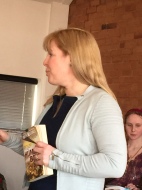
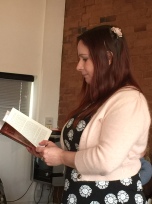
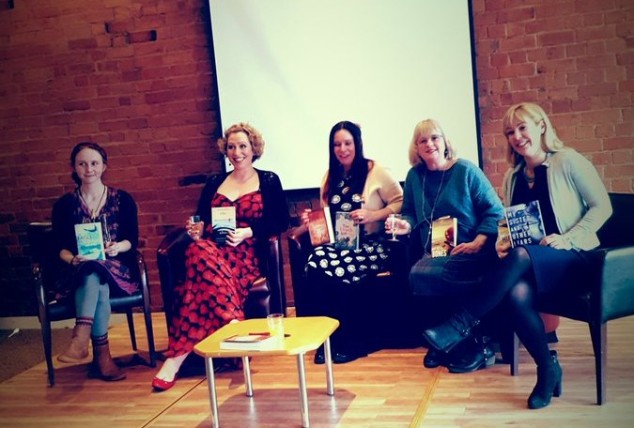
Yesterday I was lucky enough to head off to Waterstones in Nottingham for their wonderful Oceans of Words event where authors Ruth Dugdall, Louise Beech, Holly Bidgood, Tracey Scott-Townsend and Cassandra Parkin introduced themselves, telling us why they write and reading from their books.

group-1

With apologies for the quality of my phone’s photos, here’s a little bit about the event.

After we’d all grabbed a hot drink, a soft drink or a glass of wine we settled down to hear from our authors.

Ruth Dugdall

img_0865

First was Ruth Dugdall who explained all about how her background as a probation officer had led to her dark themes in her writing and how she’s interested not in the so-called evil of the crime, but in the mind of the criminal and how they have become who they are. Ruth read from Humber Boy. 

You can follow Ruth on Twitter and find all her books here.

humber-boy

Tracey Scott-Townsend

img_0868

Tracey Scott-Townsend then held us all in thrall as she described delivering a letter to her dead sister. Tracey is an artist as well as a writer and finds parts of her life and personality seep into her writing. Tracey is particularly interested in creating empathy through storytelling. Tracey read from Of His Bones.

You can follow Tracey on Twitter and find her books here.

of-his-bones

Cassandra Parkin

img_0870

It was then down to Cassandra Parkin to explain how she comes from a family of essentially bossy women and wants to explore their matriarchal and often almost supernatural influences. Cass read from the enchanting Lily’s House. You can read my review of Lily’s House here.

You can follow Cassandra on Twitter and find her books here.

lilys-house-cover

Louise Beech

img_0871

It’s always a pleasure to hear Louise Beech speak and each time there is something new to find out. Yesterday Louise told us how she writes to find her own story, as she has had an unsettled background like Connor in her latest book. Louise read from The Mountain In My Shoe.

You can follow Louise on Twitter and find her books here. You’ll also find my review of Louise’s How to be Brave here.

mountain-in-my-shoe

Holly Bidgood

img_0872

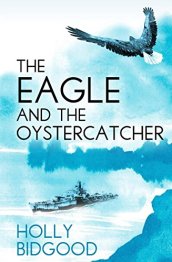
Last, but by no means least, was debut novelist Holly Bidgood. Holly is fascinated by landscape, and atmosphere and place are most important elements to her as a writer. That focus certainly came through when Holly read to us from The Eagle and the Oystercatcher.

You can follow Holly on Twitter and her book is available here.

eagle

Once the readings had taken place there was a lively question and answer session where we discovered that being a writer is certainly not a ‘get rich quick’ scheme, that all five ladies cannot help writing – it’s something they feel totally compelled to do and that the essential aspect for those wanting to write is to ask themselves, ‘How can I make a life that has writing in it?’

louise-and-linda-1

The afternoon concluded with the opportunity to speak with the authors and get books signed and I was disappointed I had to dash off quite so soon to get my train. I really enjoyed every moment and would like to thank all five authors and Waterstones in Nottingham for a fabulous free event. When shall we do it again?