

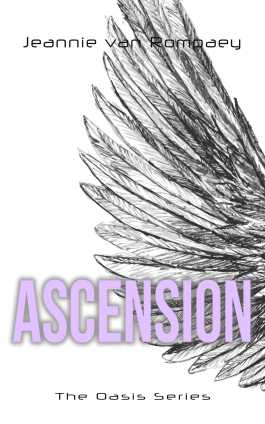
I’m pleased to be part of the launch celebrations for Ascension, by Jeannie van Rompaey. Ascension was published by Clink Street on 12th April 2016 and is the first in the Oasis Series. Ascension is available for purchase from Amazon UK and Amazon US. I have a fascinating guest blog from Jeannie about dystopian fiction below.
Ascension
Meet the MUTANT HUMANOIDS. They may look a little different from us, but inside they’re much the same as you and me. Left on a diseased Earth, they live in windowless compounds, safe from the contaminated wilderness outside. Safe, yes, but their lives are restricted. When the mutant humanoids discover that some complete human beings, COMPLETES, have also survived and are living greatly improved lives on satellites, they determine to rectify this imbalance and claim their share of Earth’s heritage. Three-headed RA rules the humanoids with ruthless precision, but others are involved in a power struggle to depose him. Who will succeed in being the next CEO of Planet Earth? Sixteen -year-old MERCURY plans to start a new life on Oasis. Will it prove the Utopia he expects it to be?
ASCENSION, the first novel in Jeannie van Rompaey’s Oasis Series, explores with humour and compassion the way humans respond to change. The future worlds of Earth and Oasis mirror our contemporary society. The division between the haves and have-nots widens and the lust for power leads to corruption. But there are idealists determined to build a fairer, more egalitarian society.
And now for something completely different…
A Guest Post from Jeannie van Rompaey
Writing Ascension was an exciting departure for me. I was creating an imaginary future world, entering the genre of science fiction and dystopian fiction for the first time. Before that my novels tended to be classed as general fiction, fixed securely in time and place and peopled by realistic characters. For this new venture I flexed my creative muscles to invent a world and characters that were a little different. I found the change invigorating. Refreshing.
Oddly enough I don’t read a lot of science fiction. The books in this genre that did inspire me were by literary authors who do not write exclusively in this field. Margaret Atwood’s The Handmaid’s Tale (1985) is a terrifying portrayal of a future world designed by men to keep women in their place while her trilogy, Oryx and Crake (2003) The Year of the Flood (2009) and MaddAdam (2013) is an indictment of scientific experiments gone wrong. The books are not all doom and gloom. Atwood shows the capacity of human beings to rise above what happens to them. As an optimist myself, this confidence in human nature is something I find important to express in my work. Kazuo Ishiguru’s Never Let Me Go describes a dystopian world in which cloning and genetic engineering have been taken to the extreme. Although a very different future is envisaged from that in Atwood’s novels, the resilience of the victims is once again highlighted. Ishiguru is such a consummate storyteller that I was gripped from beginning to end. Unlike many writers in the science fiction genre, the work of these two authors is not formatted, nor is it dependent on gratuitous action to stimulate readers. The characters and their response to the world they find themselves in are sufficient to hold our interest. These were the kind of books I wanted to write. I only wish my writing could be as good as theirs and my novels as popular.
One reason I’m interested in utopian/dystopian fiction is that it explores social and political structures. As I read or watch the news on TV, like most people, I often think about the kind of world we’re living in. The problems are easy enough to see, but not so easy to solve. The activist in me seeks change. Artists use their tools to explore possibilities for change. Ai Weiwei through sculpture, writers through words. Through writing dystopian fiction I can imagine what might happen if we don’t correct the mistakes being made in our society. By placing my imaginary world in the future I can look at our current world from a different perspective. And so can my readers.
As Keith M. Booker notes, “dystopian fiction is used to provide fresh perspectives on problematic and political practices that might otherwise be taken for granted or considered natural and inevitable.” For example, when my novel, Ascension, begins, it describes an Earth two hundred years into the future. Some of its inhabitants, mutant humanoids, have developed extra limbs or heads or only have one eye. They tend to move awkwardly and speak jerkily. They are shut up in windowless compounds and don’t venture outside for fear of further contamination from the plague that caused the mutations and the barren Earth. But what is this plague that has caused these disasters? Did it occur because we didn’t take enough care of our planet? Instead of writing a political non-fiction book, I weave these ideas into a story and let my readers make the connection themselves. The last thing I want to be is didactic and preachy. Oh, the power of fiction.
It’s not just a case of looking back and wondering what went wrong. In Ascension, apart from the mutant humanoids shut up in compounds on Earth there are completes, humans without mutations, who escaped from polluted Earth and live on Oasis, a manmade satellite in the sky. These privileged people set out to make a new world, a utopia. But human beings, even completes, are fallible and Oasis soon falls short of its ideals.
Once I’d created these two groups and began to think fictionally I saw that my novel must be about the bringing together of these two disparate groups. Prejudice, envy, anger and ambition will impede progress. Every story needs conflict. But I am determined to keep the ending of each novel upbeat. If I tell you that the third book in the series is called Renaissance it should give you a clue that this optimism for the future continues. I should just like to add there is quite a bit of humour in the books too.
It’s not only writers that sometimes feel the need to change direction and try a different genre, but readers too. If you decide you’re ready for a change, I hope you’ll try my books.
About Jeannie van Rompaey
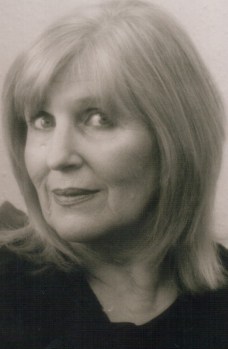
Award-winning author, Jeannie van Rompaey, MA in Modern Literature, has enjoyed a varied career as lecturer, theatre-director, actress and performance poet. As Jeannie Russell, she is a senior member of the Guild of Drama Adjudicators and adjudicates at drama festivals in Britain and Europe. Originally from London, she has lived in various countries including America and Spain. She now resides in Maspalomas, Gran Canaria, with her historian husband, Tony. She spends her time writing novels, short stories, plays and poems. When not writing she enjoys painting, and has had several art exhibitions on the island, and runs poetry and theatrical events at The British Club in Las Palmas. She has written eight novels including After (CreateSpace 2014) and Devil Face (Create Space 2013), as well as a number of short stories, two books of poetry –Straight Talk and On the Move- and a series of plays.
You can find more about Jeannie on her website and with these other bloggers:
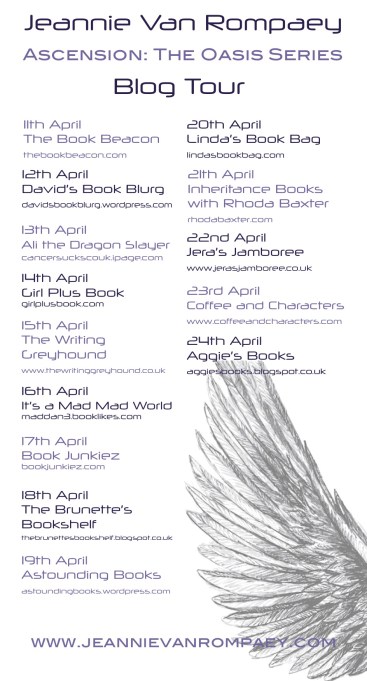
 Linda's Book Bag
Great post ladies. Lovely to read about the thought process behind your new series, Jeannie – I shall be adding Ascension to my must-read pile. 🙂
LikeLiked by 1 person
I thought this might be just your thing Shelley!
LikeLiked by 1 person
FOR GODSAKE SHELLEY……. stop getting to all the good books first! Everyone’s guna think I am copying you! But seriously…. this book looks wicked.
LikeLiked by 2 people
Haha – I did think of both of you when I posted this blog!
LikeLiked by 2 people
she gets to all the good ones before me! I have been following her around like a sheep this week as I read all my posts on a sunday!
LikeLiked by 2 people
That’s the thing with Shelley – she seems to be able to do 15 things at once!
LikeLiked by 2 people
Ha ha, I told you my secret – I wear my underpants over my trousers and try not to get my cape caught in the oven door! 😉
LikeLiked by 1 person